


Key Takeaways
Women love the wall, not the man behind it
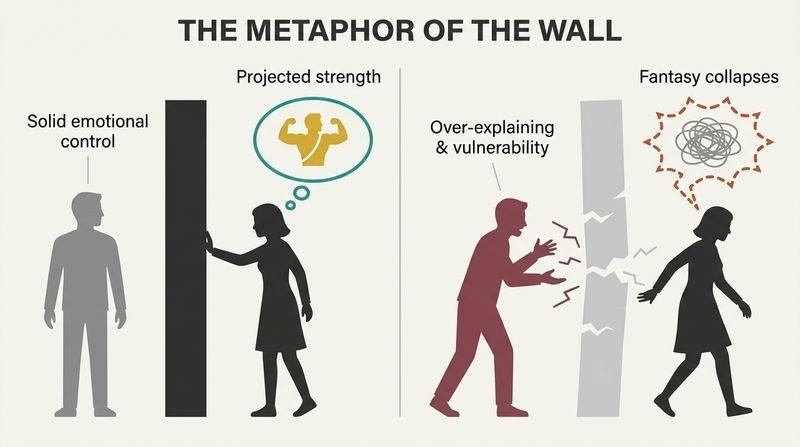
The book's spine is a metaphor the author calls "the wall," his term for masculine frame, defined as strict emotional control and restraint of outward expression. His claim: a woman is not attracted to a man's inner personality but to the disciplined, unreadable surface he presents. The wall is a blank screen onto which she projects a fantasy built by her own imagination and intuition.
By this logic, a man who over-explains himself, narrates his feelings, or seeks validation destroys the mystery and kills attraction. The author illustrates it with a parable: a woman touches a cold wall, talks to it, feels understood because it listens without over-reacting, then imagines an entire world of strength behind it. Reveal too much, he warns, and the fantasy collapses.
The observation that mystery and restraint can heighten desire is not new. It echoes esoteric attraction lore and even some research on uncertainty amplifying romantic interest (a 2011 study by Whitchurch found women were more attracted to men whose interest level was ambiguous). But the author overgeneralizes a tactic into a total theory of love. Attachment research (Bowlby, Hazan and Shaver) shows secure bonds are built on responsiveness and emotional attunement, not concealment. Gottman's decades of couples studies found that men who accept influence from partners have far more stable marriages. The "wall" may spark early intrigue, yet the evidence suggests it corrodes the intimacy that sustains long relationships.
Fatherless boys never inherited the tradition of emotional restraint
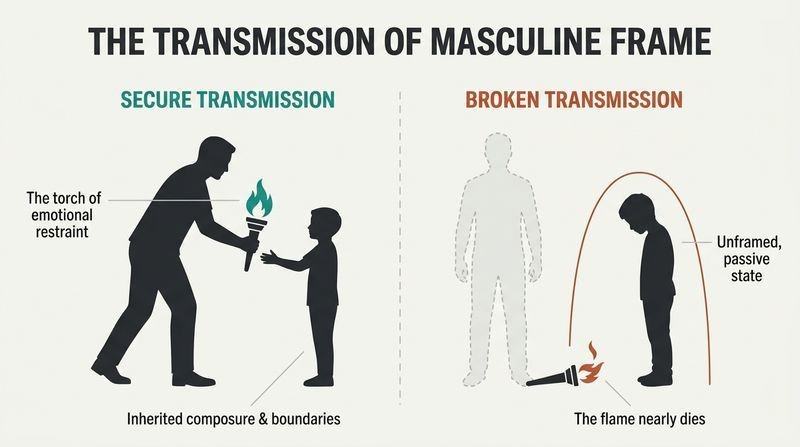
The author's central diagnosis is autobiographical and generational. He grew up with an addict father he saw three times, a property-smashing stepfather, and a coddling single mother. He argues masculine frame is not innate but transmitted, father to son, like a torch. Absent fathers mean the torch drops and the flame nearly dies.
He claims a mother raises a boy in a "feminine frame of authority," teaching self-doubt, guilt, and dependence on her validation. The result, he says, is a generation of "unframed" men: passive-aggressive, approval-seeking, and self-loathing about their own gender. His book positions itself as a substitute father, handing frame to "orphans" so they can pass it forward. The preface warns readers the process will feel like being stabbed and left in a desert.
The pain of father absence is real and well-documented. Children raised without engaged fathers show, on average, higher rates of certain adverse outcomes, and the longing the author describes is genuine and moving. Where the argument narrows into ideology is the leap from "fathers matter" to "mothers damage sons by nurturing them." Developmental psychology finds warmth and responsiveness from any caregiver predict better emotional regulation, not worse. The author reframes maternal affection as sabotage, which conveniently supports his thesis but contradicts the coddling-breeds-weakness folk theory that resilience research (Ann Masten's work on "ordinary magic") has repeatedly complicated. Secure attachment, not enforced distance, tends to produce confident adults.
Change your body first, and belief follows: external to internal
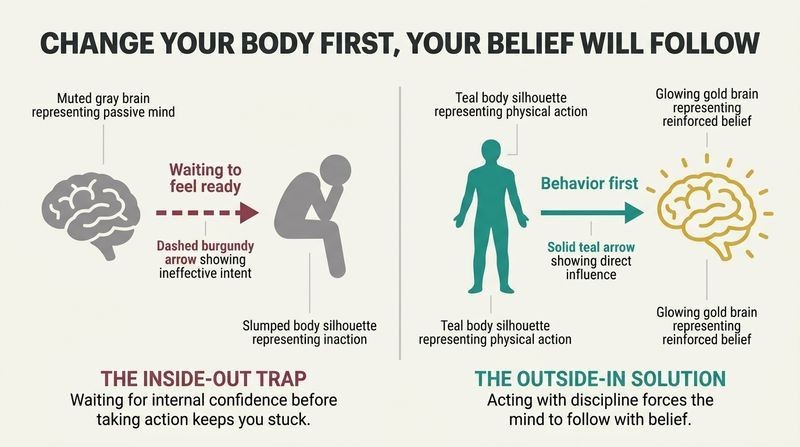
The most practically useful idea is what the author names the external-to-internal technique. Rather than waiting to feel self-love before acting, you act first and let the mind catch up. Exercise, eat well, stand up straight, quit the booze, and organize your space not because you already believe in yourself but to prove belief to a doubting mind.
He applies this everywhere: hold in a laugh to build emotional control, keep sober to signal that tomorrow matters, fix posture to manufacture confidence, do primal screams to loosen a fear-tightened voice. Self-control, in his framing, becomes self-respect, which becomes self-love. The logic is behavioral: repeated disciplined action rewires internal conviction, the way lifting weights is an "act" that produces real strength.
This is the book's soundest psychology, and it rests on solid ground. It mirrors cognitive-behavioral therapy's core insight that behavior change often precedes and drives mood change, and it echoes William James's claim that acting brave can make you brave. "Facial feedback" and embodied-cognition studies suggest posture and expression feed back into emotion, though some effects have failed replication. Where caution is warranted: the author extends this to suppressing all tears and laughter. James Gross's research on emotion regulation distinguishes reappraisal (healthy) from expressive suppression (linked to worse mood, memory, and relationship outcomes). Building discipline is wise. Chronically bottling every feeling is a documented health cost, not a strength.
Treat every provocation as a test of your composure
The author leans heavily on the manosphere concept of the "shit test," a challenge (often trivial) a woman poses to check whether a man's calm is real. Examples: she contradicts your restaurant choice, makes you wait, needles you in public, or changes her mind repeatedly. The test is not about the topic; it is about whether you crack.
Passing means neither exploding nor collapsing. He offers scripts: a calm "Excuse me?" that hands the discomfort back, or simply deciding and refusing to budge. He invokes Broken Windows theory: absorb one act of disrespect and more will follow, because decay invites decay. The antidote is immediacy. Address a slight the moment it happens, because stewing breeds the passive-aggression he considers the hallmark of weakness.
Stripped of gender ideology, there is a kernel here worth keeping: reacting to provocation with composure, and addressing problems promptly rather than nursing resentment, is genuinely healthier than passive-aggression. Assertiveness training in clinical psychology teaches exactly this middle path between aggression and submission. The Broken Windows analogy is evocative, though the criminological theory itself is contested. The trouble is the frame of adversarial suspicion. Interpreting a partner's every disagreement as a covert loyalty test is corrosive to trust and resembles the hypervigilance seen in anxious attachment. Reading ordinary friction as warfare tends to manufacture the conflict it claims to detect.
Ration your affection, because scarcity manufactures value
The author treats attention as currency governed by supply and demand. Give it freely and it depreciates; withhold it and it appreciates. So he counsels delayed text replies, measured "I love yous," rare gifts, and emotional and physical distance. His model image is Han Solo answering "I love you" with "I know."
He grounds this in dopamine: most reward-chemistry fires during anticipation, not consummation, so keeping the prize just out of reach keeps a partner chasing. He also invokes ancestral coding: men historically left to hunt for days, so women are supposedly wired to pine for an absent provider. "Happy wife, happy life" he dismisses as feeding an insatiable ego. His prescription is the carrot held perpetually before the horse.
The dopamine-anticipation point is legitimate. Schultz's primate studies showed dopamine neurons fire in expectation of reward, and intermittent reinforcement is powerfully habit-forming (it is why slot machines work). But weaponizing intermittent reinforcement against a partner is precisely the mechanism behind trauma bonding and anxious-preoccupied attachment, not healthy love. Relationship science consistently finds that responsiveness and reliable availability, not strategic withholding, predict satisfaction and longevity. The "ancestral hunter" story is speculative evolutionary psychology, hard to falsify and easy to abuse. Deliberately starving a partner of warmth to keep them anxious is a tactic that produces insecurity, and insecurity is not the same thing as devotion.
Anger is not strength; it is a tantrum dressed as power
Contrary to stereotype, the author classifies rage as weak and "feminine," a reaction rather than an action. The man who punches walls or screams is, in his reading, broadcasting fear of losing control, like a toddler denied candy in a grocery store. He recalls a childhood surrounded by men who ruled through terror and produced only resentment.
His alternative is a cold, rational detachment. He reframes abusers not as "evil" but as "selfish, callous, tyrannous," a move he says lets him hold a "god-level view" instead of a bitter one. Violence toward a partner he condemns outright as an admission that words have failed. His tools are calm speech and, if that fails, removing your presence entirely, the threat of absence rather than force.
This is one of the book's more defensible and even humane threads. The claim that explosive anger signals low emotional regulation rather than dominance aligns with affective neuroscience: reactive aggression is associated with poor prefrontal control over the amygdala. Reframing offenders as flawed rather than demonic is close to the cognitive reappraisal therapists use to defuse rumination and resentment. The distinction between responding and reacting is genuinely useful. The tension is internal to the book: it preaches suppressing tears as mandatory while treating anger control as enlightenment, when both are emotions. A consistent view would grant that all feelings, sadness included, benefit from regulation rather than denial.
Read deeply and write daily to build a rational mind
The author repeatedly urges men to read serious literature and keep a journal, framing this as masculine self-construction rather than academic chore. Reading, he says, is submitting humbly to another mind; writing is how you organize and interrogate your own. He recommends Orwell, Huxley, Steinbeck, and Dostoevsky, and quotes Orwell on who controls the past controlling the future.
The stated goal is rationality as a competitive necessity. In his worldview men must out-think their own impulses and understand both sexes the way a fisherman understands both his gear and his prey. He also prescribes hands-on problem solving, taking things apart and reassembling them, plus keeping an orderly space, all as ways to train the disciplined, cause-and-effect thinking he equates with leadership.
Detached from the gender framing, this is unimpeachable advice. Expressive writing has a robust evidence base: James Pennebaker's studies found that writing about difficult experiences improves mood, immune markers, and cognitive processing. Deep reading of literary fiction has been linked to gains in theory of mind and empathy (Kidd and Castano, 2013), which is quietly ironic given the book's insistence on emotional distance. Journaling to examine one's own reasoning is essentially metacognition, a pillar of both Stoic practice and modern therapy. The recommendation to prefer wrestling with great minds over passive consumption is timeless. It sits oddly beside the book's contempt for introspective vulnerability, since reading fiction cultivates exactly that.
Fatherless men freeze into one of three broken animals
Drawing loosely on Freud and Jung and his own siblings, the author sorts unframed men into three archetypes, each stuck in a survival response. The raging bull is jammed in fight mode: the brawler and womanizer who acts on impulse. The flighty bird is stuck in flight, which he controversially maps onto homosexuality as a redirection born of over-identifying with the mother. The paralyzed deer, the author's own type, is frozen: neurotic, fearful, observant, prone to voyeurism and to becoming a writer.
Each, he argues, is trapped in an "animal complex" that a father's frame would have cured, teaching rationality to the bull, responsibility to the bird, and assertive confidence to the deer. The cure is transcending the stress reflex through masculine frame.
The fight-flight-freeze trichotomy is a real stress-response model (the "freeze" response was added to Cannon's original fight-or-flight), and mapping personality styles onto chronic threat activation is a creative, if unfalsifiable, move. The serious problem is the claim that homosexuality is a psychological "redirection" caused by maternal over-identification. This revives discredited mid-century psychoanalytic theory. Contemporary research points to substantial biological contributions (prenatal hormones, genetics, the fraternal birth order effect), and no credible evidence supports "absent father" causation. The author frames "born this way" as an evasion of accountability, but the scientific consensus, and the failure of conversion therapy, cut the other way. Here the framework abandons evidence for ideology.
The author blames feminism and welfare for a crisis of weak men
The book widens from relationship advice into political polemic. The author argues that the welfare state "subsidized single motherhood," stripping fathers of the provider role and handing women, via a collectivist voting bloc, disproportionate power. Feminism, in his telling, is chaos institutionalized: it lowers birth rates, empowers women who then resent that power, and produces "dead bedrooms."
He reads postmodernism as a weapon that dissolves history and biology into mere "social constructs," citing Orwell on controlling the past. His remedy is explicitly restorative: each man reclaims authority in his relationship, his partner then "falls into her feminine," and society reverts to a male-led order he considers natural. He predicts censorship and persecution for the book and casts every reader as a messenger obligated to spread "frame."
This is where description of relationship dynamics hardens into a totalizing worldview, and its empirical claims are shaky. The correlation between women's rising education and lower birth rates is real, but attributing it to a "war on sexual selection" ignores economics, contraception, urbanization, and choice. The framing of gender as biology versus "social construct" is a false binary; serious scholarship treats sex differences as biological and social influences interacting. Presenting one contested arrangement as the singular "natural order" is the naturalistic fallacy: what evolved is not automatically what is good or obligatory. The movement-building call, casting critics as persecutors and readers as evangelists, is a rhetorical structure common to closed ideologies.
Create your own light: refuse despair and redeem yourself
The book closes on its most universal note. The author, who describes being cheated on, financially wrecked, and suicidally low, insists no one is uniquely broken. His refrain to every suffering man, whether abused, addicted, betrayed, or ashamed, is a blunt "get in line." You are not alone; you are a common iteration of countless forebears, and that commonness is a mercy.
He rejects victimhood and the "Peter Pan" retreat into video games, anime, and toys as a fearful hiding from adult reality. His prescription is redemption through service: do not take your life or drown in substances before giving something back, and the highest giving, in his view, is passing masculine frame to other lost men. Belief in a second chance is his final message.
Shorn of ideology, the closing is genuinely resonant. The insight that suffering is universal rather than uniquely yours is core to Stoicism and to therapeutic approaches that reduce shame through normalization; it echoes the "common humanity" pillar of Kristin Neff's self-compassion research. The push toward meaning through contribution recalls Viktor Frankl's finding that purpose sustains people through anguish. The warning against escapist infantilization has a point about avoidance, though it overstates the pathology of harmless hobbies. The most humane thread in the book is here: refuse surrender, accept the past as a starting line, and rebuild. That message survives independent of the gender theory wrapped around it.
Analysis
"The Wall Speaks" is a hybrid of confessional memoir, self-help manual, and anti-feminist manifesto, written by a pseudonymous author ("Jerr") from what he calls the father's side of a story most men only heard from their mothers. Structurally it is a single extended metaphor, the "wall" of masculine frame, hammered through roughly forty short chapters with heavy repetition and a recurring rhetorical device: an imagined objector who calls out "But JERR" and is corrected.
The book is difficult to summarize honestly because its genuine psychological insights are fused to sweeping gender essentialism and pseudoscience. Three threads have real merit: the behavioral principle that disciplined action can precede and produce internal confidence (consonant with CBT); the case against reactive anger and passive-aggression in favor of composure and prompt, direct address of conflict (consonant with assertiveness training); and the closing philosophy of refusing victimhood and finding redemption through service (consonant with Frankl and Stoicism). The pain of father absence that animates the whole project is authentic and affecting.
But the load-bearing theory, that women are chaos to be contained, that they love a concealing "wall" rather than a real person, that emotional suppression is strength, and that homosexuality and feminism are pathologies of fatherlessness, runs against the weight of evidence. Attachment theory, Gottman's marriage research, Gross's emotion-regulation studies, and the biology of sexual orientation all cut against the central claims. The book weaponizes real mechanisms (intermittent reinforcement, dopamine anticipation, embodied cognition) toward ends that relationship science associates with insecurity and trauma bonding rather than durable love.
Read critically, the text is a revealing cultural artifact of the manosphere: it shows how legitimate male grief over fatherlessness and lost purpose gets channeled into an adversarial, essentialist worldview. The useful 20 percent, discipline, composure, meaning through contribution, can be extracted; the rest warrants skepticism, particularly its empirical and ethical overreach about women, sexuality, and society.
Review Summary
The Wall Speaks receives mostly positive reviews, with readers praising its insights on masculinity and relationships. Many describe it as life-changing and a must-read for men. Critics argue it promotes toxic masculinity and oversimplifies gender dynamics. Supporters appreciate its blunt approach and emphasis on self-improvement, while detractors find it misogynistic and poorly written. The book's controversial nature sparks debate about modern masculinity, with some viewing it as a necessary counterpoint to feminism and others seeing it as regressive.
People Also Read








FAQ
1. What is "The Wall Speaks" by JERR about?
- Fatherless Men and Masculinity: The book is a manifesto for fatherless or unframed men, aiming to teach them how to reclaim masculine authority and dignity in a world dominated by feminine values.
- Masculine Frame Concept: Central to the book is the idea of "masculine frame"—emotional control, restraint, and leadership that men must embody for self-respect and successful relationships.
- Critique of Feminism: JERR argues that modern society, influenced by feminism and single motherhood, has led to the emasculation of men and the breakdown of traditional gender roles.
- Practical Guidance: The book offers step-by-step advice, exercises, and psychological insights for men to build their "wall"—a metaphor for the boundaries, self-control, and authority required for masculine success.
2. Why should I read "The Wall Speaks" by JERR?
- For Men Seeking Self-Improvement: The book is targeted at men who feel disrespected, emasculated, or lost in their relationships and want to regain self-belief and authority.
- Alternative Perspective: It provides the often-unheard "father’s side" of the story, challenging mainstream narratives about masculinity, relationships, and gender roles.
- Actionable Advice: Readers receive concrete methods for developing emotional control, setting boundaries, and leading in relationships.
- Cultural Critique: The book offers a provocative critique of feminism, postmodernism, and the welfare state, making it relevant for those interested in social dynamics and gender politics.
3. What are the key takeaways of "The Wall Speaks" by JERR?
- Masculine Frame is Essential: Men must develop emotional control and restraint to be respected and sexually desired by women.
- Women Love the Wall, Not the Man: Women are attracted to the mystery, strength, and authority projected by a man’s "wall," not his emotional vulnerability or self-expression.
- Reject Feminine Authority: Men must shatter the "feminine frame of authority" instilled by mothers, society, and feminism to reclaim their dignity.
- Practice, Not Theory: Building masculine frame requires daily practice, self-discipline, and exposure to discomfort, not just intellectual understanding.
4. What is the "masculine frame" in "The Wall Speaks" by JERR, and why is it important?
- Definition: Masculine frame is defined as emotional control, expression restraint, and the ability to lead oneself and others with certainty and authority.
- Foundation of Respect: Without masculine frame, men are disrespected by women and society, leading to humiliation and failed relationships.
- Sexual and Social Success: The frame is what attracts women and earns their respect and sexual submission; it is also the basis for male dignity and leadership.
- Tradition and Survival: The book argues that masculine frame is a tradition passed from fathers to sons, essential for the survival and health of civilization.
5. How does "The Wall Speaks" by JERR define the "wall," and what role does it play in relationships?
- Metaphor for Boundaries: The "wall" is a metaphor for the emotional and behavioral boundaries men must maintain—stoicism, mystery, and self-control.
- Source of Female Attraction: Women are drawn to the wall because it represents stability, strength, and the unknown, allowing them to project their fantasies and feel safe.
- Protection from Chaos: The wall shields both the man and his woman from emotional chaos, providing order and calm in the relationship.
- Act of Love: Building and maintaining the wall is described as an act of love for the woman, enabling her to relax into her feminine role.
6. What practical methods and exercises does "The Wall Speaks" by JERR recommend for building masculine frame?
- Emotional Control Training: Practice holding back laughter, tears, and excessive speech to develop emotional restraint.
- Speech and Posture: Slow down speech, use fewer words, and maintain proud posture to project confidence and authority.
- Self-Belief Habits: Engage in self-care, exercise, and disciplined routines to signal self-love and build internal strength.
- Immediate Response to Disrespect: Address disrespect or "shit tests" from women or others immediately and calmly, never with passive aggression or violence.
7. How does "The Wall Speaks" by JERR explain the dynamics between men and women, especially regarding attraction and respect?
- Women Test Men: Women constantly test ("shit test") men’s frame to assess their strength and leadership; passing these tests is crucial for respect and attraction.
- Dual Nature of Women: The book claims women are biologically chaotic, emotionally unstable, and crave both dominance and vulnerability in men, depending on their hormonal cycle.
- Women as Reflectors: A woman’s behavior is a reflection of her man’s frame; if he is masculine, she becomes feminine and submissive, and vice versa.
- Sexual Polarity: The strongest sexual and romantic relationships occur when the man leads and the woman follows, with clear roles and boundaries.
8. What is JERR’s critique of feminism and modern society in "The Wall Speaks"?
- Feminism as Chaos: JERR argues that feminism promotes chaos, undermines masculine authority, and leads to societal decay and sexual dysfunction.
- Welfare State and Single Motherhood: The rise of single mothers and the welfare state is blamed for the loss of masculine tradition and the creation of weak, unframed men.
- Postmodernism and Gender Fluidity: The book criticizes postmodernism for erasing biological realities and promoting confusion about gender roles.
- Call for Revolution: JERR calls for a peaceful "revolution" where men reclaim authority in relationships and society by embodying masculine frame.
9. How does "The Wall Speaks" by JERR address emotional vulnerability, self-expression, and the idea of "just be yourself"?
- Expression is Feminine: The book claims that emotional vulnerability and self-expression are feminine traits that undermine masculine authority and respect.
- "Just Be Yourself" is a Lie: JERR argues that this advice, often given by women, leads men to act more like women, which is punished with disrespect and lack of attraction.
- Suppression Over Expression: Men are encouraged to suppress emotions and expressions, using micro-expressions and measured affection to maintain mystery and authority.
- Validation Independence: True masculinity is defined by not needing validation from women or others, but by self-belief and internal discipline.
10. What are the "unframed archetypes" described in "The Wall Speaks" by JERR, and how do they relate to fatherlessness?
- Three Archetypes: The book identifies three unframed male archetypes resulting from fatherlessness: the "raging bull" (impulsive, angry), the "flighty bird" (feminized, often homosexual), and the "paralyzed deer" (neurotic, fearful, passive).
- Survival Stress Response: Each archetype is stuck in a different survival stress mode—fight, flight, or freeze—due to lack of masculine guidance.
- Father’s Frame as Cure: JERR asserts that only a strong masculine frame, ideally from a father or mentor, can help men transcend these animalistic, reactionary states.
- Societal Implications: The proliferation of these archetypes is linked to the decline of masculine authority and the rise of societal dysfunction.
11. What is "submission therapy" in "The Wall Speaks" by JERR, and how is it proposed to heal resentment in women?
- Therapy for Resentful Women: Submission therapy is a ritual where a woman physically kneels and verbally affirms her trust and respect for her man’s authority, guided by the man.
- Daily Practice: The therapy involves daily, brief sessions where the woman repeats affirmations that contrast resentment with submission and trust.
- Goal of Therapy: The purpose is to retrain a woman’s body and subconscious to associate submission with love and healing, and to overcome ingrained resentment toward masculine authority.
- Conditional Use: JERR suggests this method only for relationships on the brink of ending due to deep-seated resentment, and only with the woman’s willing participation.
12. What are the best quotes from "The Wall Speaks" by JERR and what do they mean?
- "A woman does not love a man, she loves his wall." – This encapsulates the book’s core idea that women are attracted to the mystery, strength, and emotional control men project, not their inner emotional selves.
- "Shatter the feminine frame of authority in your mind and be free." – JERR urges men to reject the internalized dominance of feminine values and reclaim masculine self-belief.
- "The wall is love." – Maintaining masculine frame is presented as the highest act of love a man can offer a woman, as it enables her to be feminine and secure.
- "Pick up, carry, and pass frame." – The book’s call to action: men must not only develop masculine frame for themselves but also teach and support other men in doing the same, for the good of society.
- "A man leads and a woman follows." – This quote summarizes the book’s stance on gender roles and the foundation of healthy, passionate relationships according to JERR.
Download PDF
Download EPUB
.epub digital book format is ideal for reading ebooks on phones, tablets, and e-readers.








































