
Key Takeaways
1. Paris: A Canvas for Self-Invention and Escape
“Feeling like aliens in the commercial world” of postwar America, they found comfort in “the idea of salvation by exile.”
Aesthetic refuge. Janet Flanner, disillusioned with her life in Indianapolis and New York, sought "pure aesthetic selfishness" in Paris, a city she believed offered unparalleled beauty and cultural richness. She yearned to escape the "flat and cornland" of her native country and the "heartache and death" associated with her father's suicide and a stifling marriage. Paris represented a chance to shed old identities and embrace a new, more authentic self.
Solano's influence. Flanner's lover, Solita Solano, a seasoned journalist and self-invented woman, was instrumental in convincing Flanner to leave America. Solano, who had already reinvented herself from Sarah Wilkinson to Solita Solano after escaping an abusive marriage in Manila, embodied the spirit of liberation that drew many to Paris. Together, they sought a life free from conventional responsibilities, aiming to establish themselves as writers.
Weidmann's parallel. Eugen Weidmann, a German serial killer, also found himself drawn to Paris, albeit for darker reasons. After a troubled youth and imprisonment in Germany and Canada, he saw Paris as a city where he could disappear and pursue his criminal ambitions. Both Flanner and Weidmann, though on vastly different paths, viewed Paris as a place of opportunity for reinvention, a city where one could be seen or disappear, and ultimately, possess.
2. Genêt's Genesis: From Aspiring Novelist to Iconic Correspondent
“I had the very good fortune of working for a lunatic,” she said. “He kept us completely on our toes, completely aware, completely awake… We chased words around the office together.”
Literary aspirations. Janet Flanner initially moved to Paris with the ambition of becoming a celebrated novelist, dreaming of being "Miss Henry James" or "Sterne or any of the Brontës." Despite her shaky finances, she prioritized her fiction, viewing freelance work as a temporary means to an end. Her debut novel, The Cubical City, received mixed reviews and modest sales, leading her to question her talent for fiction.
Ross's vision. Harold Ross, co-founder of The New Yorker, recognized Flanner's unique voice in her personal letters from Paris. He tasked Jane Grant with convincing Flanner to write a weekly "Letter from Paris" for the nascent magazine, offering forty dollars a piece. Ross sought a distinct personality and anecdotal content, aiming for a sophisticated yet accessible tone that would appeal to an "enlightened" metropolitan readership.
The birth of Genêt. Flanner reluctantly accepted the assignment, initially finding The New Yorker "frail" and "an oversized minnow learning how to swim." Ross gave her the pseudonym "Genêt," a name she embraced, allowing her to write with a "gentleman of the press in skirts" persona. Through Ross's demanding editorship and her own dedication, Flanner honed her style, becoming adept at:
- Using minimal language for maximum effect
- Finding and amplifying absurd details
- Capturing the "madcap spirit" and "fading vieux Paris"
- Connecting high culture with criminal lowlife
This role, initially a distraction, became her true calling, shaping her into one of America's key foreign correspondents.
3. The Shifting Lens: Journalism's Evolution Amidst European Turmoil
“I’m a pessimist who thinks the Nazi regime suits the Germans; my Communist friends, being optimists, are sure that every German is seething with revolt and starving; as I’ve twice been in Germany during reported ‘food shortages’ and ate what they ate—table d’hote with a Wiener Schnitzel big enough for three, plus three vegetables—I always sniff at reports now… Germans don’t know, want or appreciate liberty even when they occasionally see it.”
From culture to crisis. Flanner's early "Letters from Paris" focused on Parisian pleasures, fashion, and society gossip, reflecting her initial belief that culture existed beyond politics. However, as Europe's political landscape darkened, particularly with the rise of Nazism and the Stavisky Affair, her reporting began to shift. She increasingly covered political, military, and economic news, recognizing these as the subjects her American readers would most care about.
Ethical dilemmas. This shift presented ethical challenges for Flanner, who initially aimed for an "impersonal observer" stance, avoiding direct judgment or "editorializing." She struggled with the tension between factual reportage and the moral imperative to condemn atrocities, especially concerning Nazi Germany. Her colleagues, like Dorothy Parker, sometimes labeled her a "fascist" for her perceived soft touch in reporting on Hitler.
A unique approach. Despite her personal anxieties and the pressure to conform to ideological camps, Flanner developed a unique journalistic formula. She delivered hard news with the tone of light gossip, treating political and military developments as cultural events. Her biweekly schedule allowed for deeper reflection and refinement, enabling her to:
- Digest and distill complex truths
- Embrace multiple viewpoints
- Convey information entertainingly
- Use her "uncanny ability to find and amplify the most telling and absurd details"
This approach allowed her to stand apart from other correspondents and provide a nuanced, if sometimes ambivalent, perspective on a continent teetering on the brink.
4. Hitler's Enigma: Fascination and Fear in the Third Reich
“He has the most completely catalytic effect on the mind of mankind I ever heard of… He sums up the kind of godhead and mythology of silly bloody maleness and flatulent pride that suits [the Germans] to a T.”
A daring assignment. In 1934, Flanner, emboldened by her successful profile of Queen Mary, proposed a daring assignment: to profile Adolf Hitler for The New Yorker. This pushed the magazine into new, risky territory, as Ross typically avoided "serious articles about famous men," especially non-American political leaders. Flanner, despite her initial inexperience in political reportage, felt compelled to understand the "most vital story in Europe."
Nuremberg observations. Flanner attended the 1935 Nuremberg rallies as an "Honor Guest," witnessing firsthand the "spectacle" of Nazi power. She observed the "pulsing lines of service corps men goose-stepping," the "incandescent dome" of searchlights, and the "eerie pageantry of a torchlight procession." She was struck by the "sheer magnitude and precision and planning of the performance," which she recognized as a powerful form of opera, melodrama, and cinema designed to mask internal divisions and quiet individual doubts.
The "Führer" profile. Her three-part profile, "Führer-I," was one of the earliest in-depth studies of Hitler for American readers. Flanner aimed to present Hitler as a man with foibles, using anecdote and trivia to expose the terrifying realities of the Nazi party. She chronicled his:
- Physical weaknesses and "violent will"
- Mania for films and "fits of weeping"
- Hatred of dinner invitations and "laughable interpretations of art history"
- Embrace of Nietzsche's philosophy and love of police dogs
While she acknowledged his skills as a "mob orator" and his "furious energy," her harshest criticism was that he "has mystical tendencies, no common sense, and a Wagnerian taste for heroics and death." She exposed Nazi dogma, including its anti-Semitism, and warned that Hitler "still talks more than any other man in Europe," implying that he could not be laughed away.
5. Weidmann's Shadow: Crime as a Reflection of Societal Decay
“Only a typical postwar German like Weidmann, unfamiliar with the value of money as the rest of the freer world knows it, would have killed so many people for so little.”
A spree of violence. Eugen Weidmann, after his release from prison in Germany, embarked on a series of brutal murders in and around Paris in 1937. His victims included:
- Joseph Couffy, a chauffeur, killed for his car and a small sum of money.
- Jeanine Keller, a nurse, lured with a governess ad and murdered for a meager amount.
- Roger Leblond, a publicist, killed for a few thousand francs.
- Fritz Frommer, a former prison mate, murdered for 300 francs.
- Jean de Koven, an American tourist, kidnapped for a small ransom and then strangled.
Weidmann's methods were cold and premeditated, often involving a single shot to the back of the neck, a style noted by Commissioner Belin as similar to Gestapo executions.
The "Bluebeard" of Saint-Cloud. The discovery of multiple bodies and the pattern of killings led police to suspect a serial murderer, drawing comparisons to Henri "Bluebeard" Landru. Weidmann's capture was dramatic, involving a shootout with unarmed inspectors at his rented villa, La Voulzie. The villa itself became a macabre shrine, with victims' belongings neatly displayed, and later, a site for public tours.
Flanner's analysis. Flanner saw the Weidmann Affair as a "small and sinister European entanglement," using it to comment on national characteristics. She portrayed de Koven's "sociability with strangers" as a typically American "weakness," while Weidmann, the "ultimate Aryan," was an "exceptionally handsome male in the medieval manner" whose crimes reflected a German unfamiliarity with the value of money. His accomplices, Roger Million and Colette Tricot, were presented as typical Frenchmen, easily manipulated into passivity by their "demented German overlords."
6. France's Fractured Soul: The Stavisky Affair and Political Polarization
“The public is angry in the streets because it is overtaxed in the shop and ashamed in its heart.”
A scandal ignites. The Stavisky Affair, a fantastical financial scandal involving a swindler named Serge Alexandre Stavisky, erupted in late 1933. Stavisky's Ponzi scheme implicated a wide network of French officials, bankers, and aristocrats, leading to public outrage. His suspicious death in January 1934, officially ruled a suicide, fueled rumors of a government cover-up and a plot to defraud ordinary French citizens.
Street violence and political upheaval. The scandal triggered massive street protests in Paris, culminating in the violent riots of February 6, 1934. Thousands, primarily from hard-right nationalist leagues, clashed with police and counter-protestors, demanding the overthrow of the government. Flanner, though missing the most violent moments, observed the aftermath: "The square was empty of people and strewn with glass, bricks, trees, coat sleeves, embers, brass helmets, and one pair of ladies embroidered drawers." The riots led to the resignation of Prime Minister Édouard Daladier, marking a rare instance where street violence brought down a legally elected government.
Fragile democracy. The Stavisky Affair exposed the deep divisions and fragility of French democracy. Flanner initially tried to downplay the fascist threat in France, arguing it was "still only a term." However, the ongoing violence and the public's distrust of elected officials led her to conclude that France was "in a fine mess," with citizens increasingly calling for an authoritarian regime or full-scale communist revolution. The affair underscored the precariousness of civil society and the ease with which political tensions could escalate into chaos.
7. Spain's Agony: A Harbinger of Europe's Darkening Future
“Today it is Spain. Tomorrow it will be some other country.”
Ideological battleground. The Spanish Civil War, which erupted in 1936, quickly became a proxy war for the larger ideological struggle gripping Europe. Flanner, like many intellectuals, recognized it as a "litmus test for the health of European democracy." Franco's Nationalist forces, backed by Fascist Italy and Nazi Germany, fought against the democratically elected Republican government, supported by the Soviet Union.
The Perpignan exodus. By February 1939, with the fall of Barcelona, nearly half a million Spanish Republicans, including women, children, and soldiers, streamed across the border into France, creating a massive humanitarian crisis in Perpignan. Flanner and Solano witnessed this "exodus... without precedent," describing scenes of:
- Thousands behind barbed wire, "living largely as prisoners of war"
- Families forcibly separated
- Shortages of food, water, and shelter
- Refugees dying from exposure or lack of medical care
- French soldiers treating arrivals as a "uniformly dangerous horde"
A "cause" person. This firsthand experience of human suffering profoundly impacted Flanner, transforming her from an "impersonal observer" into a "cause" person. Her "Letter from Perpignan" was a searing account of the crisis, filled with "disgust" and "searing anger." Despite her past reluctance to take public political stances, she championed aid efforts and condemned the French government's inadequate response. The fall of Catalonia and the subsequent French recognition of Franco's regime served as a stark warning of the "greater suffering to follow" for Europe.
8. Spectacles of Power: Propaganda and the World's Fair
“International expositions illustrate a phase of history, express the soul of a generation, reveal its qualities or its weaknesses, and, for the informed observer, reveal the coming destiny of society and races.”
A stage for nations. The 1937 Paris International Exposition of Art and Technology in Modern Life was intended to promote international exchange and pull the world out of its economic slump. However, it became a grand stage for competing nationalistic displays and propaganda, particularly between the Soviet Union and Nazi Germany. Flanner noted that pavilion design had "leaped into importance as a special architectural class," reflecting political doctrines as much as industrial prowess.
German dominance. Despite French hopes, Germany's pavilion, designed by Albert Speer, dominated the fair. Speer, having secretly obtained Soviet blueprints, capped his building with a Nazi eagle and swastika, exceeding height limits and embodying an "intimidating display of power." The interior showcased German engineering and art, including Leni Riefenstahl's propaganda film Triumph of the Will, which won the Gold Medal at the Expo's film festival. This aesthetic triumph, partly funded by France, normalized Nazism in many French minds.
French disunity. The Expo also exposed France's internal divisions and inefficiencies. Wildcat strikes delayed construction, and many French pavilions remained unfinished. The "Peace Column," meant to be an enduring symbol of global cooperation, was dismantled shortly after the fair. Flanner observed that the botched opening "exposed the fragility of French parliamentarism," leading her to question whether France was any more unified than before the event. The fair ultimately served as a "symbol of our moving and tormented era," revealing the deep rivalries and creeping militarism beneath a veneer of international cooperation.
9. The Incomprehensible Monster: Weidmann's Trial and the Quest for Meaning
“I am the wound and the knife. The victim and the executioner.”
A public spectacle. Eugen Weidmann's trial in March 1939 became a national sensation, drawing massive crowds and intense media scrutiny. For the French, it was a chance to "avenge the evil of a German who'd committed his crimes on French territory." Weidmann, pale and thin, surprised the court by calmly admitting his guilt and asking to represent himself, though this was denied. His serene demeanor and "softness" made him even more horrifying to observers like Colette.
The defense of "the Cello." Vincent de Moro-Giafferi, France's most famous defense lawyer and a staunch antifascist, took on Weidmann's case. Moro, who loathed Weidmann, aimed not to prove innocence but to save him from the guillotine and use the trial to expose the "horridness of Nazi Germany." His cynical but brilliant strategy argued that Weidmann was mentally ill, a "perverted" product of a "monstrous" German "milieu" where "the blood in his veins and the climate of his days collaborated to produce the work that is Weidmann."
Incomprehensible evil. Despite the extensive testimony, expert diagnoses, and Moro's dramatic oratory, Flanner concluded that the trial failed to understand Weidmann's motives. His evil remained "forever incomprehensible," a "futile Faustian character" who inspired some of France's best crime writing but offered no real answers. The public's desire to understand the event became "a force exponentially greater than the event itself." Weidmann's execution, filmed and widely publicized, led to a change in French law, ending public executions due to the "scandalous" behavior of the morbid crowds.
10. The Phoney War: Europe's Descent into Inevitable Conflict
“This is a queer war so far—Thank God!”
A strange calm. As 1939 began, Flanner observed a paradoxical mood in Paris: a strange energy mixed with a "strange tedium" and "dread." Despite the looming threat of war, Parisians seemed "completely calm," having grown accustomed to air raid sirens and blackouts. Flanner noted the "dry theory" of the conflict, where leaders on both sides appeared reluctant to fully engage, creating a "Phoney War" of stagnant, confounding inaction.
Betrayal and disillusionment. The Hitler-Stalin nonaggression pact in August 1939 shocked and betrayed the French, who felt "cuckolded" by the "opportunist union of Europe's two ideological enemies." This, coupled with Germany's invasion of Poland and Britain and France's subsequent declarations of war, shattered any remaining illusions of peace. Flanner, witnessing the chaotic mobilization and the sandbagging of Paris's monuments, felt a profound sense of loss for the glittering city she once knew.
The personal and the global. Flanner's personal anxieties mirrored the broader European dread. She and Solano fled Paris for Orgeval, joining an exodus of citizens seeking refuge. They stocked supplies, covered windows, and listened to shortwave radio broadcasts, desperate for news. Flanner, despite her earlier reluctance, found herself immersed in the war's early days, observing the "strange war" where:
- Information came from American radio stations due to better equipment.
- French disappointment in America's neutrality was palpable.
- Soldiers marched off with a "sense of duty," not emotion.
- The conflict was "a fight for liberty," but its potential size threatened "civilization's ruin."
Her journey to America in October 1939 marked a temporary end to her role as Genêt, leaving her with a sense of uncertainty about her future and the fate of the "miserable beautiful world."
11. The War Correspondent: Witnessing History's Harsh Intelligence
“The news from the concentration camps seemed to me the most important news of all the years of the war… It must never be forgotten.”
Return to a changed Paris. After five years in New York, where she became a vocal advocate for American involvement in WWII and wrote extensively on occupied Paris and the French Resistance, Flanner returned to France in 1944 as an enlistee in the Women's Army Corps (WAC). She found Paris "shabby" and its inhabitants "rude and sad," a city "fallen to the bottom of a well." The Hotel Bonaparte was "utterly decrepit," and her French friends "completely deteriorated."
The wild purge. Post-liberation Paris was gripped by an "épuration sauvage" (wild purge), with summary executions of collaborators and public shaming of women accused of "horizontal collaboration." Flanner, though horrified, recognized this as a "necessarily violent period of rejuvenation" for France, requiring "harsh intelligence." She aimed to expose the truth about collaboration and the "great national deviation from morality" caused by Nazi doctrines.
Witnessing atrocities. Flanner's wartime reporting took her to the heart of the conflict's horrors. She visited:
- Cologne, bombed beyond recognition, where she witnessed the delirium of liberated Gestapo prisoners.
- Ravensbrück, a women's concentration camp, where she interviewed a survivor whose "torso now seemed to consist of only her broad shoulder bones."
- Buchenwald, days after its liberation, where she saw gallows, crematoria, and naked corpses near tidy flower gardens.
These experiences left her "shaken, ill," and screaming at night, but also instilled a renewed sense of purpose: to ensure these atrocities were "never forgotten."
Nuremberg and the "Beautiful Spoils." Flanner covered the Nuremberg trials, where Nazi leaders faced charges of "genocide." She found Goering's "bravura" performance "malicious and disturbing," and criticized American prosecutors for making "the world's most completely planned and horribly melodramatic war dull and incoherent." Simultaneously, she researched "The Beautiful Spoils," a series on Nazi art looting and Allied recovery efforts. Her work aimed to establish a public record of Nazi crimes and the heroic efforts to seek justice, cementing her legacy as a journalist who chronicled "this miserable beautiful world" with "harsh intelligence and beautiful spoils."
Review Summary
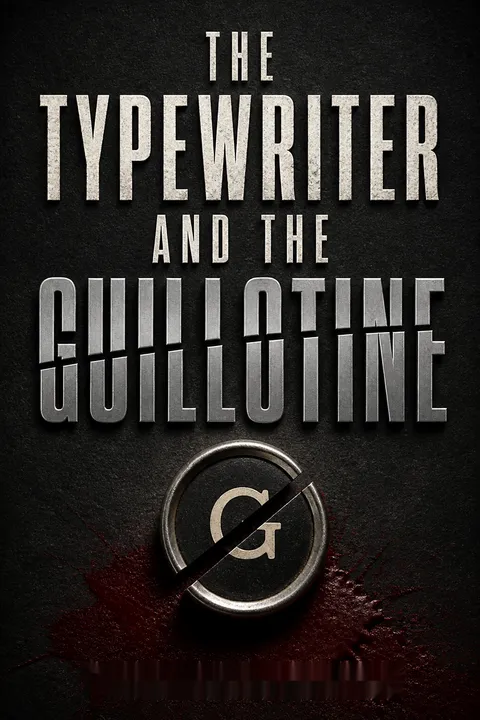
Reviews for The Typewriter and the Guillotine are generally positive, averaging 3.74/5. Readers appreciate the well-researched dual narrative set in pre-WWII Paris, frequently comparing it to Erik Larson's The Devil in the White City. Most find Janet Flanner's journalistic story compelling, particularly her coverage of Europe's political turmoil. The primary criticism is that the two storylines feel loosely connected, with many readers wishing for a more balanced focus between Flanner and serial killer Eugen Weidmann, or preferring them as separate books entirely.
People Also Read







Download PDF
Download EPUB
.epub digital book format is ideal for reading ebooks on phones, tablets, and e-readers.








































