
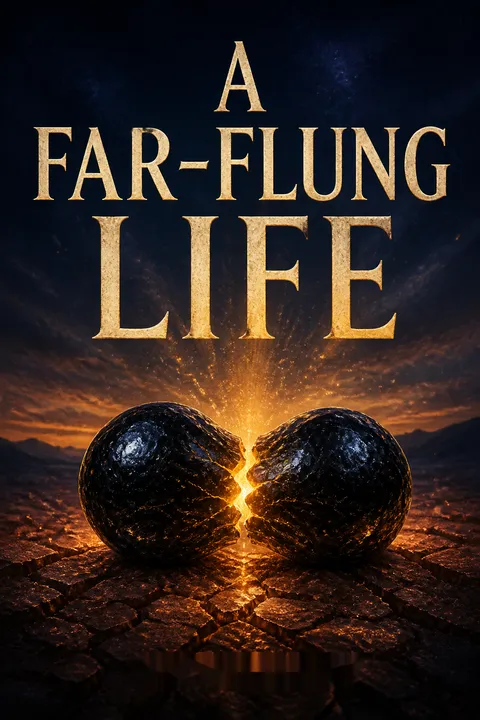


Plot Summary
The Kangaroo on the Road
Phil MacBride8 drives his sons Warren15 and Matt1 across their million-acre sheep station on January 10, 1958. A red kangaroo appears on the road, and Phil8 swerves — against his own cardinal rule. The truck catches soft gravel and flips. Phil8 drags Warren15 clear before dying.
Warren15 bleeds out. Matt,1 hurled through the windscreen, is found barely alive by the mailman, Sneaky Snook,9 whose three-legged dog licks the boy's face and detects a faint pulse. Rose,2 their sister, was supposed to be in that truck.
She had lied to Matt1 — claimed a girl he fancied would be at a meeting in town — so he'd take her place, freeing her to spend the day at Proserpine Mine with a visiting Englishman named Miles Beaumont.7 Her deception loaded the truck with all three MacBride men.
The Honorable Miles Beaumont
Months before the crash, Miles Beaumont7 — son of an English lord, heir to cattle empires spanning continents — arrived at Meredith Downs to learn sheep farming. He knew nothing about merinos. Rose2 taught him everything, from paddock names to castration cycles, and fell hard.
Miles7 played piano beautifully, hit sixes at cricket that earned him the nickname Omo, and treated Rose2 with a courtesy she'd never experienced. But his heart belonged to someone named Sandy, whose card sat hidden in his croquet set.
When Miles7 gently rejected Rose's2 advance during a croquet lesson — kissing her then pulling away — she was devastated. After the crash, he extended his stay to help the shattered family and became Matt's1 closest companion during recovery, before departing with his secrets intact.
Waking Into Wreckage
When Matt1 opens his eyes a week after the crash, he strikes Lorna3 across the face without recognizing her. Traumatic encephalopathy has sheared his brain back and forth inside his skull: he cannot form sentences, cannot control his moods, gropes a nurse without inhibition.
His memory is a patchwork — some facts return, others vanish between breaths. The neurologist warns Lorna3 that her son may never recover his old self, and forbids anyone from revealing his father's and brother's deaths until his mind can bear it.
Rose,2 visiting daily, watches her brother struggle with tasks a toddler could manage — tracing letters, fitting keys into locks — and carries the private knowledge that she put him in that truck. Each of his failures cuts her like shattered glass.
Rain on a Tin Roof
Rose2 brings Matt1 home for his first weekend visit. She drives him around the property to trigger memories, but a violent rainstorm traps them overnight in the Top Shed. Matt1 finds whisky hidden behind old almanacs.
Despite doctors' strict orders against alcohol, Rose2 lets him drink — guilt loosening her judgment — then drinks herself to keep the bottle from him. As night falls, Matt1 is disoriented, unable to distinguish Rose2 from a nurse or a stranger.
What happens in the flickering lamplight takes only seconds: driven by instinct freed from every safe enclosure, Matt1 doesn't know who he is touching. Rose2 freezes — unable to believe, then unable to stop what's happening. By morning, she rushes him back to hospital. He remembers nothing. His recovery is set back by months.
Rose Smith of Port Grace
Rose2 cannot stay near Matt.1 She forges her dead father's signature to get a refund on secretarial course fees, hitches a ride on Sneaky's9 mail truck, and reinvents herself as Rose Smith in Port Grace — the most remote town she can afford.
Ernestine Bobanac,12 a flamboyant meatworks manager who wears kitten heels to a slaughterhouse, hires her as a bookkeeper. Numbers soothe Rose2 — they always have right answers. Four months in, she faints at her desk. The doctor tells her she's five months pregnant.
Rose2 demands an abortion; he tells her it's a crime. When she collapses again, Ernestine12 slides off her own wedding ring and tells Rose2 to wear it for the appointment — armor against a judgmental doctor. Ernestine12 promises housing, employment, and safety. No husband required.
Proserpine's Darkest Fall
Dr. Finbar Rafferty,18 the Flying Doctor, delivers Rose's2 baby in Port Grace and recognizes her. Lorna3 brings Rose2 home with the unnamed infant just after Christmas. Rose2 will not name the father. She will not name the child.
She will not bond with him — holding the baby at arm's length while Lorna3 and Matt1 cradle and feed him. On January 10, 1959 — the crash anniversary — Rose2 whispers to the stars, walks the baby through the darkened homestead one last time, and drives to Proserpine Mine. She descends with him into the shaft.
Pete Peachey,5 the station's roo shooter, finds the car at dawn. He climbs down to discover Rose2 dead, her face shattered against granite. But the baby, thrown clear on a nest of leaves, is warm and breathing, with only a tiny cut near his eye.
Words in a Mattress
While redecorating Rose's2 bedroom for the baby, Matt1 lifts the mattress and a handle comes away, exposing a slit in the fabric. Inside: Rose's2 brass cigarette lighter and a folded page. He reads her ritual note — her childhood spell for making shameful truths disappear by writing them down and burning them.
But the words on this paper are recent, printed in capitals, line after line: Matt1 is the father. The smell of the mattress, the fragments of dreams about rain on tin, the inexplicable sensation of lamplight and shadows — everything clicks into place with the force of a physical blow.
He collapses on the shed floor, gasping, as his dog whines beside him. In a single moment, the secret Rose2 tried to burn has passed to its one other keeper.
One Breath at a Time
Matt1 spirals into despair. He drinks, picks fights, refuses to be near the baby. During a day of laying poison baits, he spills ten-eighty all over himself and makes no move to wash it off, murmuring that he'd be better off dead.
Pete Peachey5 strips the contaminated clothes from Matt's1 body and douses him with water, then sits with him by the campfire. Pete5 draws on his own unspeakable past — years as a Japanese prisoner of war, bayoneting men to survive another minute.
He tells Matt1 that living is his one chance of revenge on life, that he'll never know how the kid turns out if he quits now. Show Rose's2 boy the full moon, Pete5 says. Show him what she loved. Days later, on Wallaby Ridge, Matt1 burns Rose's note, whispering her childhood incantation into the wind.
The Boy Who Collects Clues
By 1969, Andrew Ross MacBride4 is a solitary, intensely curious child raised by Lorna3 and Matt1 on Meredith Downs. He collects rocks, writes letters to a pen pal named Harry Badger13 in a crocidolite mining town, and has learned from the household's atmospheric pressure exactly which questions change the air.
He knows not to ask Matt1 about the crash, and that mentioning his father makes Lorna's3 eyes glisten. A School of the Air project on pastoral family trees gives Andy4 official permission to dig.
He secretly raids Rose's Fruit Crate — the family memory box — handling her knitted sheep, her Bible, her shellac records. He maintains a private List of men who might be his father. He practices introducing himself to strangers at the Wanderrie Creek cemetery, whispering to gravestones the words he cannot speak to the living.
The Geologist in the Dam
Bonnie Edquist,6 head geologist for Hollamby Mining, arrives to survey Meredith Downs for minerals. Matt1 is hostile — miners across the state have been destroying pastoral land with impunity. The introduction is unforgettable: Andy4 catches Bonnie6 swimming naked in a station dam.
She is mortified; Matt1 is furious. But Bonnie6 befriends Andy4 through their shared passion for rocks, bringing him tektites and chrysocolla, treating his collection with the seriousness of a museum curator.
When she crashes her Land Rover and Matt1 rescues her — carrying her unconscious to his ute, getting vomited on for his trouble — something shifts. Bonnie6 discovers she is the only person who can keep Matt1 talking for hours, coaxing a hidden warmth from a man the district has written off as a recluse.
Across the Paddock
At the Bachelors' and Spinsters' Ball in a shearing shed on Bilby Rock Station, Matt1 watches Bonnie6 sway with Steve Glew — the tall, kind neighbor he himself suggested she invite. Something shifts in his chest: the same deep longing he felt watching his paralyzed friend Humpty Dumpton14 gaze at his wife.
Driven by beer and moonlight and years of raw frustration, Matt1 navigates through drunken bodies, past cinders and broken glass, to put a hand on Steve's shoulder, turn to Bonnie,6 and ask her to dance.
They talk until dawn by a creek. But driving home past the Top Shed the next morning, his body clenches. The shearing shed's silhouette smothers every feeling the night awoke. He showers in cold water and lets the memory of her touch drain into the earth.
The Letter in the Knitting Bag
Behind knitting patterns and a single yellow bootee, Andy4 finds an envelope with a gold crest. The letter inside, dated April 1958, is from Miles Beaumont,7 apologizing to Rose2 for hurting her and promising never to speak of what happened again. Below, in Rose's2 green ink, she has scrawled a phrase about touch and memory beside a tiny sketch of a rose.
Andy's4 heart hammers — this could be from his father. He slips it inside his shirt. Weeks later, he persuades Bonnie6 to help him investigate, swearing her to absolute secrecy from Matt1 and Lorna.3 He gives her the letter and his most prized dumbbell tektite as payment. Bonnie6 promises to follow the lead, already planning to track Miles7 through Sydney during an upcoming mining conference.
The Secret That Broke Pete
Andy,4 spying on Pete Peachey5 one night, sees the roo shooter emerge from a creek bath and dress in a crimson silk slip — a survival ritual born in a Japanese POW camp, where Pete5 played a woman's role in a prisoner production of Oscar Wilde.
Disgusted and confused, Andy4 removes Pete5 from his List of possible fathers. At a gymkhana campfire game, he whispers what he saw to a girl beside him. The gossip reaches his rough older cousin Johnno20 and Johnno's20 drunken mates, who ambush Pete5 at his camp — beating him, smearing lipstick on his face, shooting his beloved dog Strife when it attacks them.
Matt1 and Andy4 arrive with rifles and drive the mob off. Pete5 shoots Strife to end his suffering, then tells Matt1 he is leaving Meredith Downs forever.
The Ring He Couldn't Give
Weeks before Pete's5 departure, a cyclone had devastated Meredith Downs, and in the terrifying night Matt1 proposed to Bonnie.6 She accepted. But Pete's5 loss strips away Matt's1 last sense of safety, and Bonnie,6 returning from a Sydney conference, delivers more unsettling news: Miles Beaumont7 has a boyfriend — Sandy was always a man.
Miles7 is ruled out as Andy's4 father, but Bonnie6 promises to keep searching. Matt1 sees the future in a flash: this brilliant, relentless woman will never stop digging, and a life without secrets between them is impossible.
On the doorstep of her parents' Peppermint Grove home, the shagreen ring box burning in his pocket, he tells Bonnie6 he cannot marry her. He offers no explanation. She leaves Meredith Downs. Andy4 loses his closest friend.
Meredith Downs Reborn
Andy4 attends Scotch College, earns a degree at Muresk Agricultural College, and marries Jane. Four children fill the homestead with croquet matches and chocolate tributes to Old Wally the grandfather clock. Matt,1 watching this family bloom, finally receives his release: the boy he promised to protect no longer needs him.
In 1988, nearly fifty, Matt1 leaves Meredith Downs to build boats in Queensland, then crew yachts across the Caribbean, England, and Greece. Andy,4 meanwhile, pegs his own mineral claims and negotiates with Hollamby Mining — now run by Bonnie6 — to convert the station into a joint mining and nature reserve.
Jemima's rare eucalypts, protected from stock by breakaway fences all those years, earn official sanctuary as the only surviving stand of their species. The land begins its slow repair.
The Forgetment Is a Free Pass
Matt1 returns to Wanderrie Creek on January 10, 2000, for Lorna,3 dying of cancer at eighty-nine. At her bedside, she confesses a secret she has carried for decades: she always believed Miles Beaumont7 was Andy's4 father — a conclusion drawn from Rose's2 handwriting flourishes in the station diary.
Matt1 does not correct her. She dies asking whether she was a good mother. Afterward, Matt1 sits with Andy4 beside Old Wally and asks whether he would want to know his father's identity. Andy4 laughs — it has been years since he even thought about it.
What matters is not who his father was, but that he himself is a father now. The forgetment, Andy4 says, is a free pass. Something ancient dissolves within Matt.1 The secret he has carried for forty years can finally become what Andy4 coined as a child: a thing safely forgotten.
The Alpha Crucis Takes Flight
Andy4 secretly arranges for both Matt1 and Bonnie6 to meet at Wallaby Ridge. Neither expects the other. The shock gives way to trembling words — Bonnie6 recalls the exact date they parted: January 30, 1970, a Friday. She tells Matt1 that over thirty years and one failed marriage, no one could ever quite claim the territory he had staked in her heart.
Matt1 confesses the same. She asks if it is too late. He answers by kissing her beneath Jemima's trees — the place that held all his grief now holding something else entirely.
Then, fulfilling the promise MacBrides have made for generations, they helicopter Monty's pearling lugger off Meredith Downs — the boat towed inland by camels a century ago, finally heading for the ocean. Andy4 salutes from below. Matt1 takes Bonnie's6 hand as the homestead shrinks to a smudge on that timeless red landscape.
Analysis
Stedman1 demonstrates that secrets function like load-bearing walls: remove them and the house collapses; leave them and they warp everything built around them. Matt's1 central dilemma — knowing a truth that would annihilate his nephew's4 life if revealed — creates a moral imprisonment more suffocating than any physical space, even one as vast as a million-acre station.
The novel's most radical proposition is that ignorance can be a form of grace. Andy's4 coined word 'forgetment' evolves from childish whimsy into genuine philosophy: some truths serve no living person. When Andy4 declares his unknown father a free pass, he is not avoiding reality — he is asserting that identity is constructed forward, not excavated backward. This directly challenges the contemporary therapeutic insistence that all buried knowledge must be unearthed for healing to occur.
Stedman uses the Australian outback as more than setting — it functions as an epistemological argument. In a landscape where forty acres support a single sheep and the nearest neighbor is a day's drive, knowledge itself becomes scarce, rationed, subject to drought. The station diaries — meticulous records of stock movements and rainfall — exist alongside vast unrecorded emotional territories. What gets written down survives; what does not, vanishes. This parallel between land management and emotional management permeates every relationship in the novel.
The book also anatomizes how shame operates as contagion across generations and genders. Rose's2 expulsion, her pregnancy, Pete Peachey's5 POW ritual, Miles Beaumont's7 sexuality — each represents a private reality that the social machinery of mid-century Australia converts into public punishment. That the same community which rallies magnificently after a cyclone can destroy a man for wearing silk exposes the central contradiction of pastoral solidarity: it protects insiders by annihilating difference.
Ultimately, A Far-Flung Life argues that love is an act of faith performed without complete information — and that this incompleteness may be not love's weakness but its salvation.
Review Summary
A Far-Flung Life is M.L. Stedman's long-awaited second novel, receiving an overall rating of 4.21/5. Most readers praise its emotionally devastating yet beautiful portrayal of the MacBride family navigating tragedy, secrets, and resilience on a Western Australian sheep station. The vivid outback setting is frequently described as a character in itself. However, several readers flagged significant trigger warnings, particularly around incest, leading some to DNF. Those who persevered largely found it rewarding, drawing comparisons to Stedman's beloved debut.
People Also Read




Characters
Matt MacBride
Brain-damaged survivor, secret keeperThe youngest MacBride son, Matt is a bright boy with dreams of sailing and cartography who never intended to inherit Meredith Downs. A devastating brain injury strips him of memory, identity, and emotional control, forcing a long, humiliating rehabilitation. What makes Matt psychologically compelling is his orientation toward duty despite profound internal damage—he is fundamentally a man who stays when every instinct screams to flee. His relationship with silence is central: he learns to inhabit the spaces between words, between knowing and speaking. Matt carries a deep capacity for love that he systematically denies himself, creating an exile within his own life. His bond with the land—particularly Wallaby Ridge—functions as both prison and sanctuary, the one witness that never judges.
Rose MacBride
Fiery sister, shame's prisonerRose is the middle MacBride child, born between two brothers in a world that rewards sons. Tenacious, imaginative, and fiercely independent, she develops from childhood a talent for bending truth—inventing a ritual of writing confessions and burning them to make shame disappear. Rose's psychology is shaped by paradox: she craves autonomy in a society that defines her through men, yet her attempts at self-determination entangle her further. Her relationship with blame is pathological—she internalizes everything while outwardly deflecting it. Rose is driven by romantic hunger for a life beyond the station—London, travel, sophistication—but her boldest moves carry devastating collateral damage. She loves her family deeply but struggles to inhabit that love without destroying its foundations.
Lorna MacBride
Indomitable matriarch of Meredith DownsLorna is the MacBride matriarch—an Adelaide stockbroker's daughter who married Phil8 at the Shell Ball and made the arid station bloom through sheer competence and humor. She shoots snakes, bakes Victoria sponges, and fixes generators. After catastrophic loss strips away her family, Lorna's response is not collapse but governance: she manages grief the way she manages drought—practically, rationally, one task at a time. Her psychology revolves around control and propriety, which paradoxically makes her both a superb crisis manager and a mother who holds her daughter to impossible standards. Lorna carries the era's conviction that shame is contagious, blighting the whole flock. Her deepest wound is the suspicion she failed Rose2, and her deepest consolation arrives in the form of a grandson4.
Andy MacBride
Rose's son, seeker of originsAndy is Rose's2 son, raised by his grandmother3 and uncle1 on Meredith Downs without knowledge of his parents' true story. He is curious to the point of compulsion, collecting rocks and clues with equal fervor, and coins the word 'forgetment' for things forgotten—a concept that becomes his philosophy. Psychologically, Andy represents the resilience of innocence: he grows up surrounded by secrets he cannot detect, protected by a conspiracy of love. His isolation breeds both resourcefulness and vulnerability—he practices conversations with gravestones because the living will not answer him. Andy's search for his father is less about identity than completing a picture. His ultimate wisdom is recognizing that some pictures are better left unfinished—that belonging can exist without origins.
Pete Peachey
Roo shooter, guardian angelPete is Meredith Downs' roo shooter—a lanky, silent ex-POW who arrives after the war and becomes the family's most unexpected protector. A crack shot who won the King's Medal, Pete carries wounds from Japanese captivity that manifest in a private ritual incomprehensible to those around him. His psychology is built on the paradox of violence and tenderness: he kills for a living but teaches Rose2 about the moon; he can butcher a kangaroo and bake ginger cake that rivals Lorna's3. Pete's relationship with secrecy is not shame but survival—he has constructed an interior fortress from which he surveys the world with extraordinary compassion. He functions as the novel's moral center, counseling those in crisis from the authority of one who has endured the unendurable.
Bonnie Edquist
Geologist, Matt's great loveBonnie is Hollamby Mining's head geologist—niece of the millionaire owner, though she earns her position through genuine expertise. Athletic, direct, and emotionally courageous, she arrives at Meredith Downs as an adversary to the pastoral world and gradually becomes its most passionate advocate. Her psychology is defined by intellectual fearlessness applied to emotional territory: she approaches love with the same methodical determination she brings to reading rock formations. A previous broken engagement has taught her to recognize deception, making her both more vulnerable and more demanding of honesty. Bonnie's tragedy is that her greatest strength—her inability to leave mysteries unsolved—is precisely what threatens the man she loves1. She represents modernity's challenge to inherited silence.
Miles Beaumont
Charming English trainee, red herringThe Honorable Miles Beaumont is an English aristocrat sent to Meredith Downs to learn sheep farming. A brilliant cricketer and pianist, he treats everyone with impeccable courtesy while concealing his own truth. Miles functions as a catalyst—his presence destabilizes Rose2 and later becomes the central red herring in Andy's4 search for his father. His defining quality is graceful evasion, masking private pain beneath immaculate manners.
Phil MacBride
Patriarch who sets the rulesPhil is the MacBride patriarch—a war veteran, shrewd pastoralist, and man of absolute certainties. He loves his wife3 deeply but views his children through the lens of utility: Warren15 will inherit, Rose2 must be married off, Matt1 is an afterthought. Phil's influence persists long after his death through the station diaries, the traditions he maintained, and the unbending standards his family measures itself against for decades.
Sneaky Snook
Mailman, district lifelineThe mail contractor for Meredith Downs, Sneaky is a rotund, warmhearted man with one built-up shoe and an optimism that defies his waistline. He discovers the crash scene and saves Matt's1 life. His mail truck serves as the district's connective tissue, carrying people, parcels, and confidences across hundreds of miles. He maintains strict discretion about the communications entrusted to him, treating gossip as a betrayal of the Crown.
Myrtle Eedle
Funeral-haunting postmistress sleuthThe postmaster's wife and Wanderrie Creek's self-appointed chronicler of death, Myrtle attends every funeral within hundreds of miles, maintaining meticulous notebooks she calls the Drawers of Death. Behind her eccentric obsession lies a woman haunted by giving up a baby for adoption at seventeen. She senses something amiss about Rose MacBride's2 death and quietly investigates for years, driven by empathy for abandoned mothers and displaced rage at the men who escape accountability.
Sergeant Rundle
By-the-book new policemanA Melbourne-trained statistician transferred to Wanderrie Creek, Rundle sees anomalies in crime data where others see normalcy. He reopens buried cases from his lenient predecessor19, including Rose's2 death file. His psychology is defined by an almost religious devotion to procedural justice that blinds him to the human cost of enforcement, though he is capable of keeping his word when a promise is extracted under pressure.
Ernestine Bobanac
Meatworks boss who shelters RoseThe flamboyant general manager of Port Grace meatworks who hires and protects Rose2 during her pregnancy. She wears kitten heels, sparkly brooches, and Nefertiti eyeliner to a slaughterhouse, and treats female independence as a birthright.
Harry Badger
Andy's pen pal from mining townAndy's4 Italian-Australian pen pal from Mount Halcyon, whose father's death from asbestos-related disease provides a stark counterpoint to Andy's4 own losses and foreshadows the mining dangers that threaten Meredith Downs.
Humpty Dumpton
Matt's paralyzed best friendMatt's1 best friend from Scotch College, paralyzed in a diving accident at fifteen. Humpty once mapped his life to ninety-four years; a cricket injury rewrote it entirely. His refusal to be defined by tragedy—marrying Coral, planning to adopt, insisting life is worth biting one day at a time—serves as Matt's1 most important mirror, demonstrating that imprisonment and freedom can coexist within the same body.
Warren MacBride
Cocksure eldest brotherPhil's8 eldest son, destined to inherit Meredith Downs. Cocksure and controlling, Warren polices Rose's2 behavior and bullies Matt1. His death in the crash opens the path none of the survivors wanted.
Neil Tinnett
Stock agent who holds the fortThe Dalgety's stock and station agent who arranged Miles's7 placement and helped Lorna3 manage the station after the crash. A practical, dependable man who keeps the MacBride operation financially afloat through its darkest years.
Maudie Knapp
Lorna's stalwart neighbor friendLorna's3 closest friend from Deep Springs Station, the first neighbor to arrive after the crash with shortbread, stew, and unflinching support through every MacBride catastrophe.
Dr. Finbar Rafferty
Flying Doctor, family physicianThe Irish Flying Doctor who treats the crash victims and later delivers Rose's2 baby in Port Grace, recognizing her. His discretion and compassion help protect the family from further exposure.
Sergeant Wisheart
Merciful old lawmanThe Wanderrie Creek policeman who records Rose's2 death as accidental, choosing mercy over procedure. His lenient approach creates the buried files his successor11 later reopens.
Johnno MacBride
Cruel older cousinAndy's4 older second cousin who bullies him about being illegitimate and later leads the drunken mob that attacks Pete Peachey5, representing the viciousness lurking beneath pastoral solidarity.
Plot Devices
Old Wally
Grandfather clock as family witnessThe ornate longcase clock shipped from London, Old Wally is addressed by name, toasted at holidays, and fed chocolate by Andy's4 children. More than furniture, it functions as the novel's timekeeper and silent witness—present at every family gathering, every crisis, every whispered confession. When Lorna3 overwounds it after Phil's8 death, time itself seems to go wild. Her restoration of its midnight chimes mirrors her own recovery of purpose. For Andy4, the clock marks the passage of generations; for Matt1, each chime measures the distance between who he was and what he has become. Old Wally embodies the novel's central question: whether time heals, imprisons, or simply persists indifferently while humans struggle beneath its weight.
Rose's Yawa Ritual
Burning shame into smokeAs a child, Rose2 invents a ceremony: write a shameful act on paper, light it with a brass lighter, whisper the word 'away' spelled backwards three times, and watch the words dissolve into nothing. She initiates Matt1 into the ritual on a lemon gum branch, and it becomes her lifelong escape from accountability. The ritual embodies Rose's2 psychology—her belief that truth is negotiable, that confession to fire equals absolution. It recurs at every crisis of her life, and its ultimate failure becomes the story's most devastating irony. When Matt1 later uses the same incantation to burn Rose's2 final confession, the ritual passes between siblings and across decades, testing whether magic that failed its inventor might still protect those who survive her.
The Alpha Crucis
Landlocked boat as deferred dreamA fully rigged pearling lugger, won in a bet, towed by camels to the middle of a million arid acres. Uncle Monty never sailed it; gassed at the Somme, he could only sit in its hull and imagine the sea. His ashes rest in the bow alongside a compass and a beer. For generations, MacBrides maintain the boat—varnishing timber, replacing frayed lines—as an act of faith that one day it will reach the ocean. Matt1 continues the ritual, finding peace in the repetitive work. The vessel represents every deferred dream in the novel: Matt's1 abandoned plans to circumnavigate, Rose's2 fantasies of London, Lorna's3 wish for a complete family. Its eventual departure from Meredith Downs becomes the story's final image of liberation and promise fulfilled.
Proserpine Mine
Playground turned underworld portalAn abandoned tantalite mine ringed by sagging barbed wire and a faded warning sign, named for the Roman goddess condemned to spend half her life underground. Three generations of MacBride children ignore the prohibition to play cowboys and treasure hunts in its dark passages. The mine holds both innocence and catastrophe in equal measure—Rose2 explores it with Miles7, discussing mythology and hiding Warren's15 toy car there; she later chooses it for her final act. Pete Peachey5 climbs down its shaft to retrieve what he can. The mine embodies how the same space can harbor play and devastation, how forbidden places attract both the curious and the desperate, and how a single location can accumulate layers of meaning that eventually become unbearable.
The Family Fruit Crates
Memory archives hiding evidencePine fruit crates lined with calico by Lorna3 to hold each family member's most treasured objects—wedding invitations, baby teeth, school certificates, cricket medals. They function as curated autobiographies, each crate telling the story its owner chose to preserve. Rose's2 crate holds her knitted sheep pajama holder, her Bible, her shellac records—and, unknowingly, the evidence that launches Andy's4 investigation: Miles's7 apology letter hidden behind knitting patterns. For Andy4, forbidden to touch the crates, they represent the sealed castle in Sleeping Beauty—a kingdom of maternal knowledge he raids in secret, finding fragments that illuminate and mislead in equal measure. The crates embody how families choose what to remember and what to bury.
Download PDF
Download EPUB
.epub digital book format is ideal for reading ebooks on phones, tablets, and e-readers.








































