

Key Takeaways
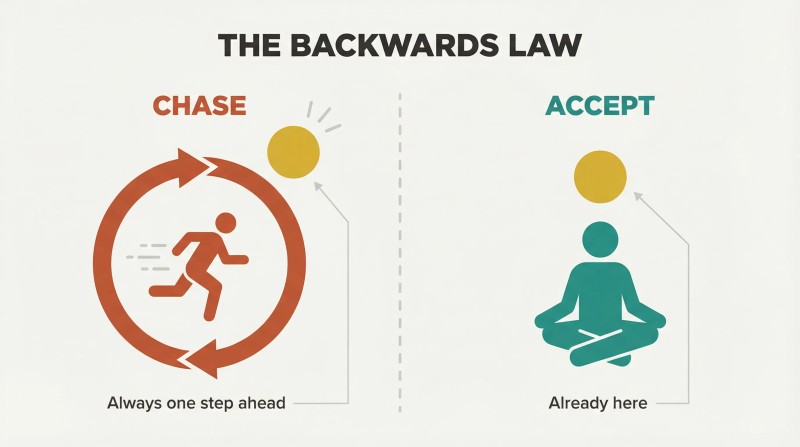
Desperately chasing happiness is exactly what makes you unhappy
The Backwards Law explains everything. Philosopher Alan Watts observed that the harder you chase feeling good, the more you reinforce that you don't feel good. Repeating "I'm beautiful" in the mirror only highlights that you don't believe it. Manson opens with Charles Bukowski — a drunk, gambling poet rejected for decades whose tombstone reads "Don't try." His success came not from grinding determination but from honestly accepting who he was and writing about it.
This spawns the Feedback Loop from Hell: feeling anxious about being anxious, guilty about feeling guilty. Social media amplifies it — hundreds of images of perfect lives make your normal Tuesday feel pathological. The antidote isn't more positivity; it's accepting that negative feelings are part of being human and refusing to layer judgment on top of them.
The art isn't zero fucks — it's fewer, better-chosen fucks
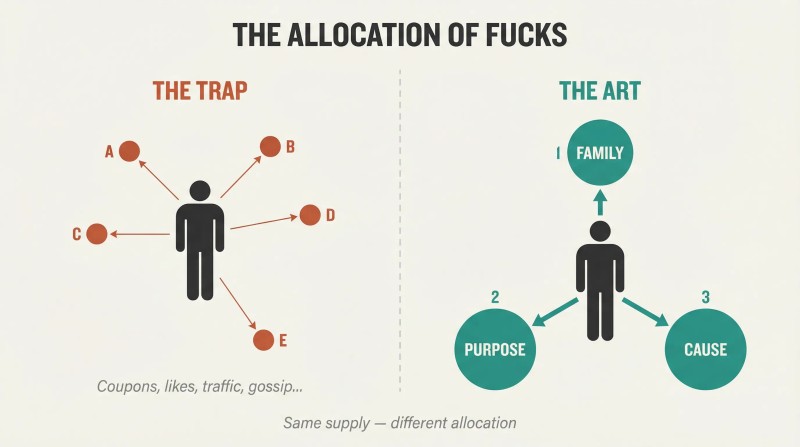
Not giving a fuck isn't indifference. Manson distinguishes three subtleties: first, it means being comfortable with being different, not emotionally numb. Second, it requires caring about something more important than the adversity you'll face — Manson threatened to sue someone who screwed his mother because family mattered more than avoiding conflict. Third, it's a skill that matures with age: teenagers give fucks about everything; older adults learn to reserve their dwindling supply for family, purpose, and a few worthy causes.
The coupon lady illustrates the trap. When people have nothing meaningful to care about, trivial things consume them — an expired thirty-cent coupon becomes a full-scale meltdown. The real problem is never the coupon; it's that nothing bigger is demanding their attention.
Ask what pain you want to sustain, not what reward you want
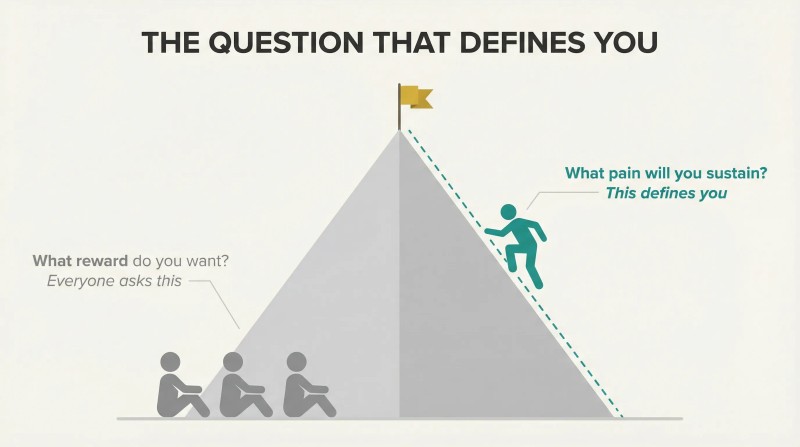
Everybody wants the highlight reel. Everyone wants the corner office, the beach body, the amazing relationship. That's the easy question. The harder, more revealing one is: what struggle are you willing to endure? Manson fantasized for years about being a rock star — the screaming crowds, the pouring-your-heart-out glory — but he never fell in love with the process: daily practice, hauling gear with no car, playing for empty rooms. He loved imagining the summit but hated the climb.
Your willingness to struggle determines your reality. People who build chiseled physiques enjoy the gym's pain. Successful entrepreneurs appreciate the risk and the insane hours. The path to fulfillment runs through chosen difficulty, not around it. Joy is in the climbing itself.
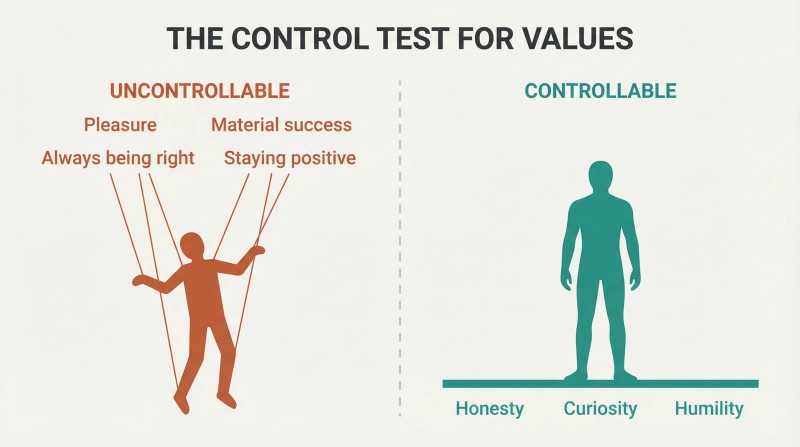
Good values are controllable; bad ones leave you at the world's mercy
Four values reliably ruin lives:
1. Pleasure — research shows hedonic chasers become more anxious and depressed
2. Material success — beyond basic needs, more money barely moves the happiness needle
3. Always being right — prevents learning from mistakes
4. Constant positivity — suppresses the negative emotions that signal real problems
Good values share three traits: they're reality-based, socially constructive, and immediately controllable — things like honesty, curiosity, and humility. Dave Mustaine founded Megadeth after getting kicked out of Metallica, sold over 25 million albums, yet wept in a 2003 interview because Metallica sold 180 million. His metric — "be bigger than Metallica" — guaranteed misery. Pete Best, fired from the Beatles, eventually measured his life by his loving family and marriage — and said he was happier than he would have been as a Beatle.
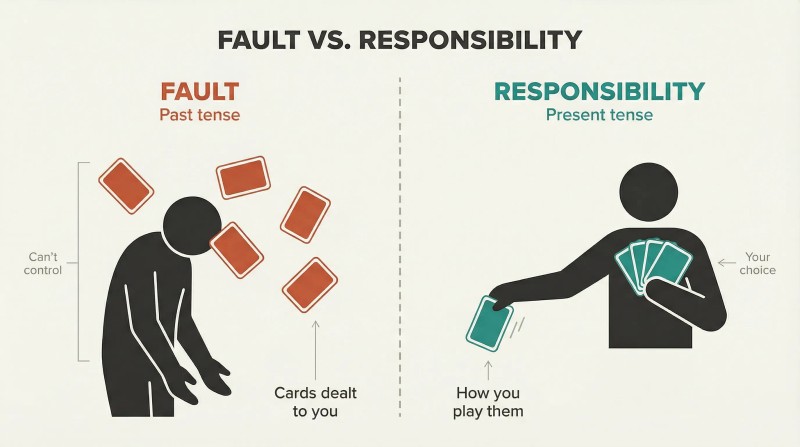
You're always responsible for your life, even when it's not your fault
William James tested this idea with his own life. Broke, chronically ill, and suicidal at nearly thirty, the future father of American psychology made a wager: he would spend one year believing he was 100% responsible for everything in his life. If nothing improved, he'd end it. That experiment became what he later called his "rebirth" — he went on to teach at Harvard, publish landmark work, and raise five children.
Responsibility and fault are not the same thing. If a baby appears on your doorstep, it's not your fault — but it's your responsibility. Manson compares life to poker: we all get dealt different cards, but the winners are determined by the choices they make with those cards. Malala Yousafzai didn't choose to be shot in the face by the Taliban at fourteen, but she chose to keep speaking — and won the Nobel Peace Prize.
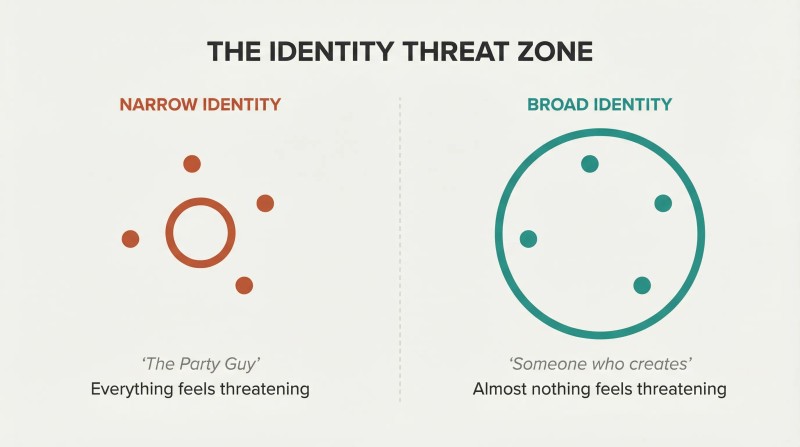
You avoid what threatens your identity — even when it would save you
Manson's Law of Avoidance works in both directions. Making a million dollars can threaten your self-image as much as losing everything. An artist who endlessly tweaks his portfolio but never launches is protecting his identity as "An Artist Nobody's Heard Of" — which feels safer than risking becoming "An Artist Nobody Likes." A perpetual party guy who complains about loneliness but never settles down can't imagine himself without the Party Guy identity.
The fix is counterintuitive: stop finding yourself. Buddhism suggests releasing rigid self-concept. Define yourself in broad, mundane terms — student, partner, creator — rather than grandiose or narrow ones. The narrower your identity, the more everything feels like an existential threat. Giving up that sense of specialness hurts like withdrawal, but the freedom on the other side is worth it.
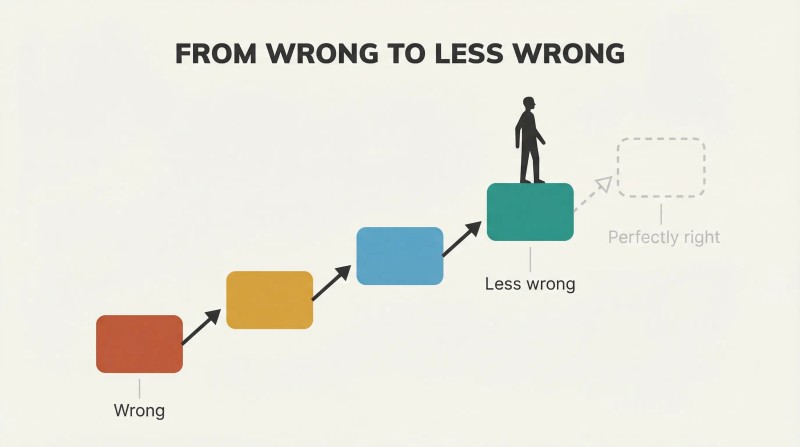
Aim to be slightly less wrong tomorrow, not perfectly right today
Five hundred years ago, doctors cured illness by slicing arms open. We laugh at them now — and people five hundred years from now will laugh at us. Growth isn't going from wrong to right; it's an iterative process of going from wrong to slightly less wrong. Your values are hypotheses, your actions are experiments, and the resulting emotions are data. Being wrong isn't the obstacle; believing you're right is.
False certainty breeds the worst behavior. Psychologist Roy Baumeister found that people who do terrible things typically have high self-regard — their unwavering certainty in their own righteousness justifies cruelty. Even personally, checking a partner's texts or demanding agreement stems from a desperate need for certainty that only deepens insecurity. Embracing uncertainty — about your beliefs, your identity, your future — is what creates space to grow.
When you're paralyzed, do anything — motivation follows action
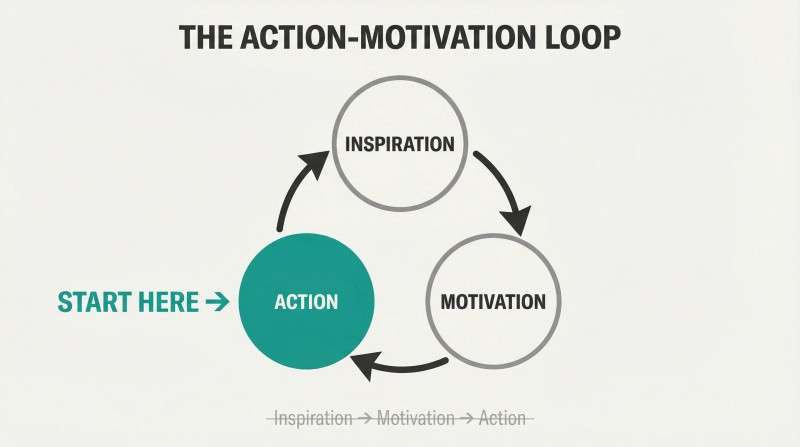
Most people wait for inspiration to strike. They assume the chain is: Inspiration → Motivation → Action. But Manson discovered through years of struggling as a self-employed writer that the chain is actually a loop — and you can start anywhere. His high school math teacher, Mr. Packwood, put it simply: if you're stuck on a problem, just start working on it. The answers will follow.
The "Do Something" Principle turns paralysis into momentum. A novelist who'd written over seventy books credited his output to one rule: "Two hundred crappy words per day, that's it." The crappy words sparked real writing. Whether it's dropping out of med school or asking someone on a date, these are VCR questions — they look impossibly complex from the inside but have obvious answers from the outside. The pain of acting is real, but the action itself generates the motivation people wait around hoping to feel.
Saying no is how you define what you actually stand for
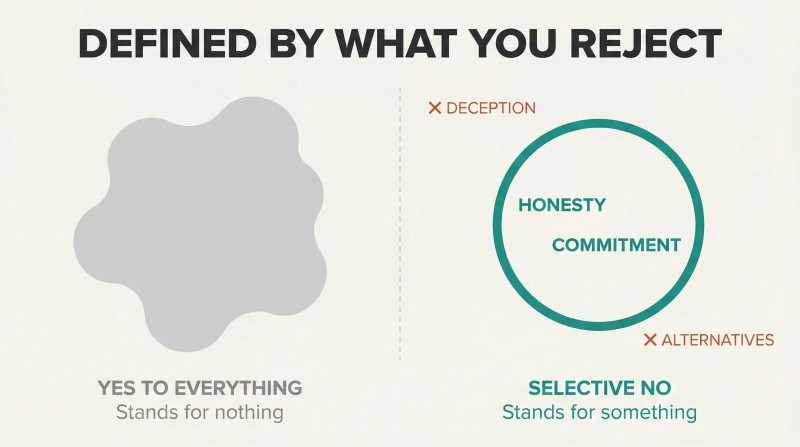
If you accept everything equally, you stand for nothing. Positive-thinking culture trains people to say yes to everything, but without rejection there are no values — and without values there is no meaning. To value honesty, you must reject deception. To value your marriage, you must reject alternatives. Avoiding rejection — both giving and receiving it — creates a rudderless, pleasure-chasing existence that Manson calls a deep form of entitlement.
In relationships, this plays out as boundaries. Healthy relationships require both partners to own their own problems rather than demanding the other fix them. When someone says "You can't go out without me — you know how jealous I get," they're outsourcing responsibility for their emotions. Trust is built through honest conflict, not people-pleasing. Without the ability to say and hear "no," relationships quietly rot into manipulation.
Depth through commitment beats the breadth of fifty-five countries
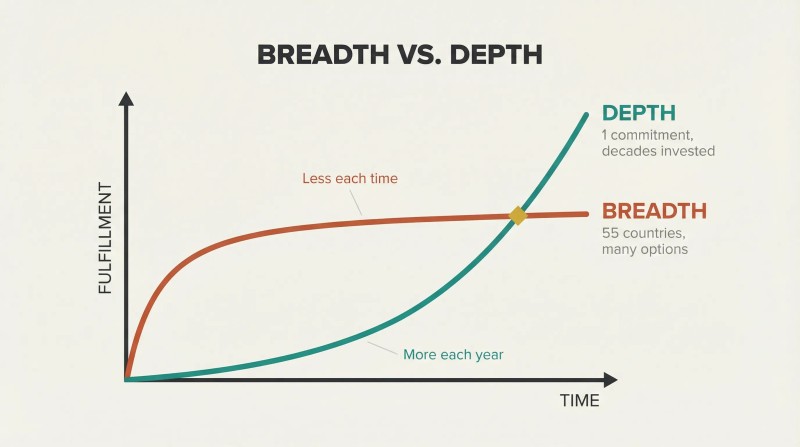
Manson traveled to fifty-five countries and felt emptier each time. The first country transforms your worldview; the fifty-first barely registers. Psychologists call this the paradox of choice — more options breed more doubt and less satisfaction. The same diminishing returns apply to sexual partners, hobbies, jobs, and possessions. The hundredth party is just a normal weekend; the thousandth feels boring.
The real rewards require decades of investment. There are experiences you can only have by staying with the same person for years, working the same craft for a lifetime, or rooting yourself in one community. Manson eventually settled in New York with a wife and an electric bill — and found it more fulfilling than any globe-trotting adventure. Commitment gives you freedom by eliminating the constant anxiety of whether you're missing something better.
Rehearse your death regularly — it's the only reliable bullshit detector
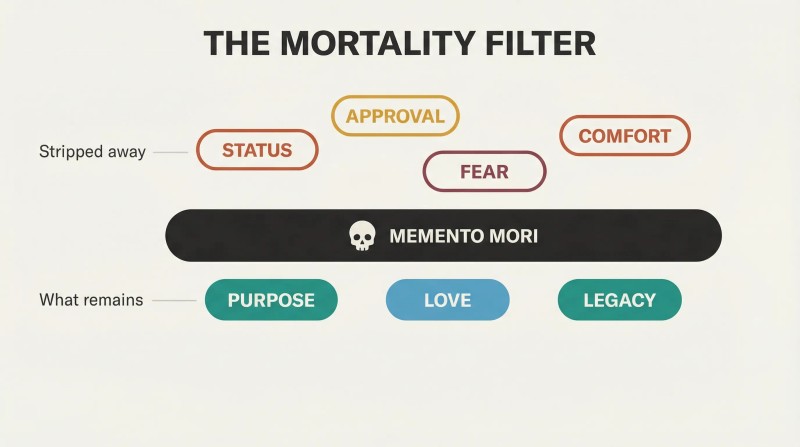
A friend's drowning at nineteen rewired Manson's entire life. Josh died in a Texas lake after jumping off a cliff at a party. The grief cracked open a realization: if death erases everything, then fear, embarrassment, and shame are trivial. Manson quit drugs, enrolled in college, started exercising, and transformed. Ernest Becker's Pulitzer-winning The Denial of Death argues that all human motivation traces back to "death terror" — and that our values are really immortality projects designed to outlive our physical selves.
The Stoics, Buddhists, and Becker all converge here. Confronting mortality obliterates superficial concerns about status, approval, and comfort. It forces the only question that actually matters: what will remain when you don't? Without regularly asking that question, trivial values inevitably fill the vacuum.
Analysis
Manson's book is a Trojan horse: Stoic philosophy, existentialist thought, and Buddhist psychology packaged inside profanity-laced millennial-speak. The intellectual lineage is unmistakable — Alan Watts's backwards law, Camus's absurdism, Becker's terror management theory, and the shadow of Frankl's meaning-through-suffering thesis all appear, rebranded for readers who would never open The Denial of Death.
What elevates this above typical contrarian self-help is its values-first framework. Where most books in the genre tinker with surface behaviors — habits, routines, morning rituals — Manson works at the foundation: the metrics by which people judge their lives. The Mustaine-versus-Best comparison is the book's masterstroke. Two musicians with virtually identical origin stories (ejected from legendary bands on the threshold of fame) arrive at opposite emotional destinations purely because of different success metrics. It's a concrete, memorable proof of an abstract philosophical claim.
The book's structure mirrors its thesis, progressing from what to stop caring about (chapters 1 – 4) to what to start caring about (chapters 5 – 9), culminating in death as the ultimate value-clarifier. This arc lends more narrative cohesion than the modular, listicle-style format typical of the genre.
The work has genuine blind spots. Manson's 'take responsibility for everything' principle borders on unfalsifiable — applied universally, it risks shading into victim-blaming, the very thing he claims to oppose. His treatment of the self-esteem movement oversimplifies decades of research that Baumeister himself later nuanced. The relentless irreverence occasionally substitutes for analytical depth, particularly in middle chapters where stories accumulate but the framework plateaus.
Yet the core architecture is sound: suffering is unavoidable; its quality depends on chosen values; and selecting those values consciously is the only meaningful freedom. The book functions as a gateway to serious existentialist philosophy for a generation raised on Instagram and participation trophies. Manson reaches readers who would never encounter Camus or Becker directly, delivering the essential insight — that a good life is not a painless one but a purposefully painful one — in language they'll actually absorb. The repackaging matters.
Review Summary
The Subtle Art of Not Giving a F*ck received mixed reviews. Many readers found it refreshing and insightful, appreciating its honest approach to self-help and its focus on prioritizing what truly matters. Some praised its humor and relatable anecdotes. However, others criticized it for being clichéd, repetitive, and overly reliant on profanity. Some reviewers felt the author's tone was smug and patronizing. While some found the book life-changing, others saw it as repackaged common sense or watered-down Eastern philosophy.
People Also Read




Glossary
The Backwards Law
Chasing positivity creates negativityBorrowed from philosopher Alan Watts: the more you pursue feeling better all the time, the less satisfied you become, because pursuing something reinforces the fact that you lack it. Conversely, accepting negative experiences produces a kind of positive experience. This is the book's foundational premise—that traditional self-help's relentless positivity backfires by emphasizing what people feel they're missing.
Feedback Loop from Hell
Negative emotions about negative emotionsManson's term for the psychological spiral where negative feelings trigger additional negative feelings about having those feelings—anxiety about being anxious, guilt about feeling guilty, anger about getting angry. Modern consumer culture and social media amplify the loop by making negative emotions seem abnormal, which adds a layer of shame. The loop is broken by accepting the initial negative feeling without judgment.
The Self-Awareness Onion
Three layers of self-understandingManson's framework for progressive self-awareness. Layer 1: recognizing your emotions ('I feel angry'). Layer 2: understanding why you feel them ('I feel angry because I failed at something'). Layer 3: examining the personal values and metrics that determine what you consider success or failure ('I consider this a failure because I value being liked by everyone'). Most people and most self-help operate only at layers 1 and 2, leaving the root-cause values unexamined.
Manson's Law of Avoidance
Identity threats trigger avoidance behaviorThe more something threatens to change how you view yourself—your sense of success, your self-image, your place in the world—the more you will avoid doing it. This applies equally to positive and negative changes: making a million dollars can feel as threatening as losing everything, because both force a redefinition of identity. The law explains why people fear success as much as failure.
The "Do Something" Principle
Action generates its own motivationManson's principle that motivation is not just a prerequisite for action but also a product of it. The conventional assumption is that inspiration leads to motivation, which leads to action. In reality, the chain is a loop, and you can enter at any point. Taking even the smallest action—writing two hundred bad words, designing one header—creates emotional momentum that fuels further effort. Named after his high school math teacher's advice to just start working when stuck.
Immortality Projects
Values that outlive physical deathErnest Becker's term from The Denial of Death for the ways humans attempt to ensure their conceptual self survives beyond their physical death—through art, legacy, family, religion, or cultural institutions. Becker argues all of civilization is essentially a collection of immortality projects, and that wars erupt when one group's projects threaten another's. Manson equates immortality projects with personal values, arguing that death awareness helps us choose them more wisely.
Practical Enlightenment
Comfort with inevitable sufferingManson's term for becoming comfortable with the idea that some suffering is always inevitable—that life inherently includes failures, loss, regret, and death. Distinguished from 'airy-fairy, eternal bliss' enlightenment, it's a grounded acceptance that makes a person psychologically resilient. Once you stop expecting life to be painless, you stop interpreting normal difficulties as evidence that something is wrong with you.
VCR Questions
Deceptively simple problems feel impossibleManson's term for problems that seem impossibly complex to the person experiencing them but have obvious answers to outside observers. Named after how his parents found new technology incomprehensible while he, as a child, just pressed buttons until he figured it out. Examples include 'How do I ask her out?' or 'How do I quit this job?'—the action is straightforward, but the emotional pain makes it feel opaque.
Victimhood Chic
Performative victimhood for social currencyManson's term for the cultural trend across all demographics of publicly claiming victim status over minor infractions to gain attention, sympathy, and moral authority—particularly on social media. Amplified by what media commentator Ryan Holiday calls 'outrage porn,' it creates a cycle where mild offenses generate outsized reactions, which generate counter-outrage, distracting from genuine injustice and making it harder to identify real victims.
FAQ
What's "The Subtle Art of Not Giving a F*ck" about?
- Core Concept: The book by Mark Manson is about focusing on what truly matters in life by choosing what to care about and what to let go.
- Counterintuitive Approach: It challenges the conventional self-help advice of always being positive and instead suggests embracing life's struggles and limitations.
- Philosophical Foundation: Manson draws on philosophical ideas, including the "backwards law," which suggests that the pursuit of positive experiences is itself a negative experience.
- Practical Advice: The book offers practical advice on how to prioritize values and make meaningful choices that lead to a fulfilling life.
Why should I read "The Subtle Art of Not Giving a F*ck"?
- Realistic Perspective: It provides a refreshing take on self-help by focusing on accepting life's challenges rather than avoiding them.
- Relatable Examples: Manson uses personal anecdotes and relatable stories to illustrate his points, making the concepts easy to understand.
- Actionable Insights: The book offers practical steps to help readers identify and focus on what truly matters to them.
- Philosophical Depth: It combines humor with deep philosophical insights, making it both entertaining and thought-provoking.
What are the key takeaways of "The Subtle Art of Not Giving a F*ck"?
- Choose Your Values: Focus on values that are reality-based, socially constructive, and within your control.
- Embrace Suffering: Understand that suffering is a part of life and can lead to personal growth and resilience.
- Accept Responsibility: Take responsibility for your life and choices, regardless of who is at fault.
- Limit Your F*cks: Prioritize what you care about and let go of the rest to lead a more meaningful life.
How does Mark Manson define "not giving a f*ck"?
- Selective Caring: It's not about being indifferent but about being comfortable with being different and choosing what to care about.
- Focus on Values: It involves focusing on values that matter and rejecting those that don't align with your true self.
- Embrace Adversity: Accepting adversity and failure as part of life and using them as opportunities for growth.
- Set Boundaries: Establishing clear boundaries in relationships and life to maintain personal integrity and happiness.
What is the "Feedback Loop from Hell" in "The Subtle Art of Not Giving a F*ck"?
- Cycle of Negativity: It's a cycle where negative feelings lead to more negative feelings, creating a loop of self-loathing and anxiety.
- Self-Perpetuating: The loop is self-perpetuating because worrying about negative emotions only amplifies them.
- Break the Cycle: Manson suggests breaking the cycle by accepting negative emotions and not giving a f*ck about them.
- Focus on Solutions: Instead of fixating on the negative, focus on solving problems and taking action.
What does Mark Manson mean by "You Are Not Special"?
- Challenge to Entitlement: Manson argues against the cultural narrative that everyone is exceptional, which can lead to entitlement.
- Embrace Mediocrity: Accepting that being average is normal and that not everyone can be extraordinary.
- Focus on Improvement: True greatness comes from recognizing one's mediocrity and striving for improvement.
- Avoiding Narcissism: By not believing in one's inherent specialness, individuals can avoid narcissistic tendencies and focus on meaningful growth.
How does "The Subtle Art of Not Giving a F*ck" address the concept of failure?
- Failure as Growth: Manson views failure as a necessary part of personal growth and success.
- Learn from Mistakes: Emphasizes learning from failures and using them as stepping stones to improvement.
- Redefine Success: Success is not the absence of failure but the willingness to fail and learn from it.
- Embrace Discomfort: Encourages embracing discomfort and uncertainty as part of the journey to success.
What is the "Do Something" principle in "The Subtle Art of Not Giving a F*ck"?
- Action Over Inaction: The principle suggests taking action, even if small, to create motivation and inspiration.
- Break Procrastination: By doing something, you break the cycle of procrastination and create momentum.
- Motivation Follows Action: Contrary to popular belief, action can lead to motivation, not the other way around.
- Start Small: Begin with small, manageable tasks to build confidence and progress.
How does Mark Manson suggest building trust in relationships?
- Honesty and Boundaries: Trust is built through honesty and setting clear boundaries in relationships.
- Conflict is Necessary: Healthy conflict is necessary for trust, as it shows who is there for you unconditionally.
- Responsibility for Emotions: Each person should take responsibility for their own emotions and not blame their partner.
- Track Record of Behavior: Trust is rebuilt through a consistent track record of improved behavior over time.
What are some of the best quotes from "The Subtle Art of Not Giving a F*ck" and what do they mean?
- "Don't try." - Emphasizes the importance of accepting oneself and not striving for unrealistic ideals.
- "The desire for more positive experience is itself a negative experience." - Highlights the paradox of constantly seeking happiness.
- "You are going to die, and that’s because you were fortunate enough to have lived." - Encourages embracing mortality to find meaning in life.
- "We are defined by what we choose to reject." - Stresses the importance of setting boundaries and prioritizing values.
How does "The Subtle Art of Not Giving a F*ck" address the concept of mortality?
- Embrace Mortality: Manson suggests that accepting the inevitability of death can lead to a more meaningful life.
- Legacy and Values: Encourages focusing on values and legacy rather than superficial achievements.
- Death as a Compass: Use the awareness of death to guide decisions and prioritize what truly matters.
- Live Fully: By accepting death, individuals can live more fully and authentically.
What is the "backwards law" in "The Subtle Art of Not Giving a F*ck"?
- Paradox of Pursuit: The backwards law states that the pursuit of positive experiences is itself a negative experience.
- Acceptance of Negativity: Accepting negative experiences can lead to positive outcomes and personal growth.
- Letting Go of Control: Emphasizes letting go of the need to control everything and accepting life's uncertainties.
- Focus on Process: Encourages focusing on the process rather than the outcome to find fulfillment.
About the Author
Other books by Mark Manson


Download PDF
Download EPUB
.epub digital book format is ideal for reading ebooks on phones, tablets, and e-readers.








































