


Plot Summary
The Fifth Child Buried
Sixteen-year-old Yin Wei1 climbs the Ancestors' hill with her mother to bury Larkspur, the fifth sibling lost to the famine. She kisses the bamboo casket and prays her sister will be reborn in a better time, one without hunger.
On New Year's, Wei1 takes her seven-year-old brother Bao11 to Guishan, expecting another disappointment. Instead, Prince Isan9 arrives. His Guo seal glows, and fruit erupts from cobblestones and eaves: peaches, pears, mulberries. Wei1 weeps at the sweetness. Then Isan9 announces his brother, Prince Terren,2 the heir with the feared Dao blade seal, seeks concubines.
Despite whispers that Terren2 flays servants and slaughters dogs, Wei1 imagines full bellies, soft beds, and Bao11 attending school. She decides to offer herself at the selection, trading her body for her family's survival.
The opening establishes the brutal economy of survival that defines Wei's world: children die, bodies are buried, and hope is a luxury. The juxtaposition of Larkspur's tiny grave with Isan's magical abundance crystallizes the central injustice of the Azalea Dynasty. Wei's prayer for rebirth in a better time foreshadows her eventual role in creating precisely that future. Her decision to become a concubine is not romantic ambition but cold calculation: her body is the only currency she possesses. This transactional understanding of power, learned in the rice paddies, will prove both her greatest weapon and her deepest wound in the palace.
Knives Rain at Selection
After a month of training in the Hall of Earthly Sanctity, hundreds of candidates gather in the blade-lined Hall of Divine Harmony. Prince Terren2 arrives drunk, stumbling, his Aricine Ward coiling around him in glowing characters.
He dismisses candidate after candidate, letting Empress Sun6 make the actual selections based on family connections. An assassin named Sima Zhen draws a knife and lunges. The Ward stops her blade midair. Terren,2 suddenly lucid, promises mercy: reach the doors and her family lives.
She crawls, blades raining down behind her, a sword piercing her back. She dies an arm's length from the gate. Still reeking of wine and blood, Terren2 turns to Wei,1 the daughter of a rice farmer, and names her Empress-in-Waiting. The room erupts in shock as guards drag her away through cold rain.
The selection scene is a masterclass in establishing Terren's monstrousness while simultaneously revealing his political impotence. He is heir yet cannot even choose his own concubines, controlled by the empress. His cruelty is performative, almost theatrical. The Aricine Ward's dramatic display of invulnerability introduces the central problem: how to kill a man who cannot die. Wei's selection is not fortune but a sentence: she has no powerful family to protect her, making her the perfect target for a prince who needs someone he can torture without consequence.
Seven Bowls of Rice
Hesin5 escorts Wei1 to the Tower of Mental Tranquility. Terren2 sits reading scrolls, ignoring her. When she requests help sending food to her famine-stricken village, he dismisses her plea and commands her to eat. He watches intently as Wei1 finishes one bowl, then uses a floating sword to fill another, then another. By the fourth bowl Wei1 is sick, rushing to vomit.
She returns and keeps eating. Seven bowls, three trips to the basin. When the rice is gone, Terren2 orders her to his bed. She finds him already asleep, turned away. In the morning, he cuts a gash beneath her ribs, smears blood on the sheets, and warns her: tell anyone what happened, try to escape, and she dies. Wei1 realizes he will never plant her, but he will keep hurting her.
This first night establishes the ritualized nature of Terren's cruelty. The force-feeding is a grotesque parody of the abundance Wei sought, perverting her hunger into punishment. Terren's refusal to consummate the marriage reveals a secret vulnerability beneath the monstrous exterior. The morning blood ritual completes the trap: Wei must maintain the fiction of their union or face execution, making her the perfect prisoner. The scene also introduces Hesin's complicity: he knows what happens in that tower and does nothing, bound by an oath to serve whoever holds Heaven's Mandate.
Blood on the Bamboo
The concubines grow suspicious. Terren2 summons only Wei,1 yet months pass without her belly swelling. Empress Sun6 orders an imperial examination. Wei1 remembers Lady Chara's lessons using bamboo poles for technique demonstrations.
That night, with Terren2 too drunk to perform, Wei1 runs to a bamboo grove at the palace's edge. She saws a stick to size with a rock, lies on the cold earth, and pushes it inside herself. It will not go in at first. She pushes harder, biting her lip against the searing pain, tears streaming.
She keeps going until her insides burn and her hands are sticky with blood. The next day, doctors strap her to a table in front of hundreds of spectators, probe her, and declare her dutiful. Wei1 survives. But she cannot forget the feeling of cold instruments on her body.
This is the book's most brutally intimate violation. Wei must inflict pain on herself to survive a system that values her only as a vessel for imperial seed. The parallel between the bamboo and the doctors' instruments is deliberate: both are violations sanctioned by the House. The scene crystallizes the novel's central argument: that the childmaking act is not magic but violence, and that women's bodies are territory to be conquered, examined, and discarded. Wei's survival here plants the seed of her eventual refusal to play by the House's rules.
Jia's Severed Tongue
Terren2 summons Wei1 to punish Sun Jia,13 the empress's6 niece, for spreading the rumors that led to the examination. In the Cypress Pavilion, guards force Jia13 to her knees before Wei.1 Her threats turn to desperate begging, reminding Wei1 that a woman without a tongue is no more than an animal.
Wei1 hesitates, hearing her mother's voice urging her to keep her head down, then Ciyi's8 voice warning that mercy costs lives. She remembers the bamboo grove, the cold instruments, the humiliation. She raises the knife.
Guards hold Jia's13 mouth open, muffling her screams. The blood is dark and warm. Afterward, a shameful thrill courses through Wei.1 The other concubines stop humiliating her. She has learned the palace's true currency: not rice, not beauty, but cruelty.
This turning point marks Wei's moral contamination by the palace. The act is both survival and corruption: necessary for her continued existence, yet it transforms her into the very thing she despises. The thrill she feels afterward is the seduction of power, the same force that corrupted the Azalea princes. Wei's internal conflict, her mother's voice against Ciyi's, represents the novel's central moral tension: can one wield power without becoming wicked? The answer, for now, is no. Wei has crossed a threshold from which there is no return.
Jinzha's Borrowed Future
Hesin5 begins meeting Wei1 at dawn in the Palisade Garden, telling her the dynasty's secret history. He served the Yonghuan Emperor, called Jinzha, a joyous boy who never wanted the throne but was forced onto it after his father and brother died.
Jinzha filled the palace with music, parties, and sycophants while the nation crumbled. When his sons rebelled, Hesin5 begged him to act, but Jinzha laughed and claimed he had borrowed from the future, that the dynasty could not fall while he lived.
He was wrong. His son Muzha killed all his brothers, forced Jinzha to choose his own death, and became emperor. Afterward, the famine began. Hesin5 tells Wei1 that Muzha, desperate and dying, finally agreed to produce heirs: Maro3 and Terren,2 two years apart.
Hesin's stories transform the novel from a personal survival narrative into a generational tragedy. Jinzha's borrowed future, whatever cosmic bargain he struck, has been repaid in famine and suffering. The structural pattern becomes clear: each generation of Guan men is shaped by violence, each passes that violence to the next. Hesin himself is a tragic figure, bound by a loyalty oath to serve rulers he despises, unable to intervene even as children suffer. The stories also give Wei what she needs: material for a heart-spirit poem, the truths and emotions that will become her weapon.
Maro's Hidden Pages
At the Mid-Autumn Parade in the capital, Wei1 connects with Song Silian,4 Prince Maro's3 wife. Later, in the West Palace, Silian4 opens her husband's private study and retrieves a mahogany chest. Inside are Maro's3 childhood journals, pages he removed because they concerned his brother.
Wei1 reads voraciously. She discovers that Maro3 adored Terren2 fiercely, carrying him on his back up the Century Peach tree, sneaking him mung bean cakes, sparring with him endlessly. Terren2 wrote his first Blessing at age seven to heal a wounded carp.
But the adults around them were determined to make the brothers enemies. Master Ganji15 beat Maro3 for saying he wanted to be a peasant instead of heir. The empress6 falsely accused Maro3 of stealing Terren's2 spell. The journals reveal that everything Wei1 thought she knew about Terren2 was wrong.
The journals are the novel's great act of re-framing. The monster Wei has been enduring is revealed as a creation: a gentle, brilliant child systematically broken by a system that required brothers to be enemies. Maro's love for Terren is the lost possibility haunting the narrative, the alternate future that palace politics destroyed. The journals also establish the novel's method: truth is layered, hidden in private writings, denied by public record. Wei's literacy grants her access to a counter-narrative that the official histories suppress, making her uniquely capable of writing Terren's true poem.
Snow on the Terrace
Wei's1 wedding to Terren2 takes place on a snow-dusted morning before thousands of bannered guests. During the tea ceremony, Empress Sun6 shatters Wei's1 cup and presents a terrified maid named Maya who claims to have seen Wei1 visiting the West Palace in bedrobes at night.
The implication: Wei's1 sanctity has been compromised with Prince Maro.3 If proven, both Wei1 and Terren2 would be deposed. Wei1 gambles, confessing the visit was real but claiming she went to learn nighttime techniques from Silian4 to please Terren.2
Silian4 corroborates the lie. The empress,6 outmaneuvered, must resume the ceremony. That night, a drunken Terren2 stabs Wei1 in the chest. She survives by staying awake until dawn, when he mends the wound. She cannot flee, cannot die. She can only endure.
The wedding encapsulates the novel's political chess game. Empress Sun's trap is elegant, targeting both Wei and Terren simultaneously. Wei's improvisation demonstrates her growth as a political actor: she now understands that lies, told with conviction, are the palace's true currency. Silian's corroboration cements their alliance but also reveals how women must work together, in the shadows, against a system that pits them against each other. The wedding-night stabbing is Terren's most nakedly self-destructive act, a crime so reckless it nearly undoes his own position. Only Wei's endurance saves them both.
The Loyal Hand Falls
Hesin5 discovers Wei1 is literate and writing a heart-spirit poem. She burns the evidence, then races to Terren.2 She plants a verse from Maro's3 journals in her storerooms and claims Hesin5 has been colluding with the West Palace.
When Hesin5 presents the planted evidence, Terren2 recognizes his brother's poetry and turns on his advisor. A knife severs Hesin's5 hand, the one scarred with the loyalty character. Guards drag him away. The next morning, Wei1 returns to the Cypress Pavilion and finds her servants slaughtered.
Teela's head on the ground, organs strung in the cypress branches. Aron's body draped over an azalea bush. Wren,7 pinned by seven swords, her hand still twitching. Terren2 explains he cleaned the pavilion of spies as a reward. Wei1 pulls a sword free and ends Wren's7 suffering herself.
This is the novel's darkest turning point, where Wei's political victory comes at an unbearable cost. She has successfully eliminated Hesin, her primary obstacle, but Terren's reward transforms her triumph into guilt. The massacre of the servants, particularly Wren, whom Wei had taught to read, loved, and protected, makes Wei complicit in their deaths. Her choice to frame Hesin, made in desperation, has real and horrific consequences. The image of Wren's twitching hand will haunt Wei through every subsequent decision, including her final choice at the coronation.
The Violet Heron Tower
Rather than return to Lu'an, Wei1 diverts her traveling party to Angkin City in the northern district of Tieza. At the Violet Heron Tower, a luxurious pleasure house, the owner Aunt Ahma reveals the truth under threat of Wei's1 blade.
Terren's2 mother, Lady Autumn,10 brought him here at age nine and forced him to perform the childmaking duties with pleasure girls. When he cried or resisted, they beat him. When he failed, they punished him with fire tongs. This continued for seven years, every day during the war, weeks at a time afterward.
Lady Autumn10 called it duty, the price of making a seal-bearing grandson. In the fireplace of his old chamber, Wei1 finds Niu Niu, his petrified snail shell, thrown into the flames the day he liberated Tieza. He had finally given up on his childhood.
The Violet Heron Tower revelation re-contextualizes everything. Terren's cruelty is not innate but learned, a child's response to systematic abuse. His refusal to bed Wei, his drunkenness, his violence: all are symptoms of trauma, not inherent evil. The novel asks an uncomfortable question: how much suffering excuses inflicting suffering? Wei's anger at Aunt Ahma and Lady Autumn is righteous, yet she cannot escape the knowledge that she has been planning to kill the victim they created. Niu Niu in the fireplace is the novel's most devastating image: a child burning his own toys, killing the boy he was, because that boy could not survive what was being done to him.
The Meadow's Ghost Boy
Outside Angkin City, a glowing ghost sparrow leads Wei1 to a meadow where the ghost of nine-year-old Terren2 kneels among wildflowers. He is forging a sword with his newly awakened Dao seal, his movements uncertain. Wei1 places the broken pieces of Niu Niu's shell on the ground.
The ghost boy's face lights up as a shimmering snail appears. He notices Wei1 watching him. She tells him to pretend she is not there. Surrounded by battlefield ghosts, the boy reads over her shoulder as she works on the heart-spirit poem.
Then, with his sword, he carves a few characters in the earth and shyly presents them to her. It is a verse, beautiful and heartfelt, far better than anything she could have written. Wei1 copies it down, and the poem begins to glow with true magic.
The ghost meadow scene is the novel's most transcendent moment, where the boundary between love and hate, victim and killer, dissolves entirely. The ghost boy is Terren before the damage, still capable of wonder and generosity. His gift of a verse to the woman who will kill him is an act of profound trust. The scene argues that writing, particularly poetry, is a collaborative act: Wei's poem is not solely hers but woven from Hesin's stories, Maro's journals, Lady Autumn's cruelty, and now the ghost child's own words. No single truth is sufficient; only the assemblage of many truths can capture a person.
Fourteen Rounds of Agony
Wei1 returns to the palace and is immediately arrested. In the Hall of Divine Harmony, before a crowd of officials, a magistrate presents her with three Blessings to copy, only one safe. She must choose by instinct, as an illiterate would.
She picks torture spells repeatedly, her body seizing with agony, blood leaking from her nose and mouth. Fourteen rounds, each worse than the last. She faints, wakes, writes again. Terren2 watches from the shadows, his hands fidgeting. When the magistrate orders another round, Terren2 stops the trial.
He declares his father as good as dead, himself effectively emperor, and threatens anyone who objects with the ten thousand swords on the ceiling. He forces Maro3 to his knees. He lifts Empress Sun's6 chin with a blade. The trial ends. Wei1 is carried away, barely alive.
Terren's intervention is simultaneously his most heroic and most politically catastrophic act. By declaring himself emperor before his coronation, he commits treason against the dying Muzha and alienates every faction in the court. The act is irrational, emotional, deeply self-destructive, and it is for Wei. The scene complicates every assumption: Terren is capable of protection, even of sacrifice. Yet his protection is inseparable from his violence, the same swords that save Wei also threaten everyone else. The trial also exposes the fundamental absurdity of the literacy test: Wei suffers precisely because she is literate, and her suffering proves her innocence.
The Sword Cage Confession
Weeks later, Wei1 finds Terren2 has built a dome-shaped cage of swords in the Palisade Garden. Inside, she tells him his mother failed him, that he deserved to be safe. He threatens to kill her, throws a knife that misses. Then he collapses, sobbing.
He confesses what happened in the peach garden after Maro's3 failed assassination attempt: his mother10 found him hiding, injured, under an azalea bush. She pressed her shoe into the arrow wound in his leg, handed him a knife and a fish, and commanded him to make a cut.
One cut, she promised, and he would be safe. The fish was suffering. He cut. But the knife also caught her throat. He killed her. For years, everyone believed he did it out of cruelty. Even he believed it. Wei1 holds him through the night as he cries.
The confession re-frames the novel's central murder. Lady Autumn's death was not patricide but a desperate, accidental act of self-defense by a child who had been systematically brutalized. Terren has internalized the narrative of his own monstrosity, believing himself evil because everyone told him he was. Wei's response, holding him rather than condemning him, is the first unconditional compassion he has ever received. Yet the scene is morally complex: Wei is also the woman who has been tortured by him, whose friends he slaughtered. Her compassion does not erase his crimes, nor does his trauma excuse them.
A Father's Last Medicine
Wei1 visits Silian4 at the summer solstice celebration in the West Palace. She gives Maro3 a section of the completed heart-spirit poem, glowing with magic, proving it will work against Terren2 at the coronation. Maro3 confirms its potency, then excuses himself to attend filial duties: visiting his dying father to spoon medicine into his mouth. That night, the sky tears open.
The Crown dragon roars in agony. The emperor is dead. The timing is too precise to be coincidence. Wei1 realizes Maro3 has poisoned his father, using the same medicine he had been bringing for months, to accelerate his own path to the throne. The first son, the honorable prince, has become what he always claimed to despise: a kinslayer who will do anything to win.
Maro's implied patricide completes his corruption arc. The boy who once declared he would rather fail with honesty than succeed without honor has become a murderer. The novel refuses to let any character remain morally pure. Maro's descent mirrors Wei's: both began with noble intentions, both have been shaped by the palace into people capable of terrible things. His act also clarifies the stakes: if Maro wins, the dynasty continues its cycle of violence. The question Wei must now answer is whether Terren's death would break that cycle or simply replace one monster with another.
Two Brothers, One Arena
At the coronation, Terren2 fights the dragon alone, his Aricine Ward down for the first time since boyhood. The battle is spectacular: swords against claws, blades parrying teeth. Terren2 subdues the dragon but collapses, exhausted.
Before he can claim the Crown, Maro3 uses his Lu seal magic to pass through the literomantic barrier and enters the arena. He wraps both hands around his brother's throat and lifts him off the ground. Terren,2 too spent to summon his swords, goes limp. The crowd screams.
Wei,1 having already decided to spare Terren2 and become empress, watches in horror. With Maro3 dead on his feet from the fight, Wei1 realizes she must cast her poem immediately, not as a killing spell but as a healing one. She begins furiously writing on the rug.
The brothers' confrontation is the novel's tragic culmination. Maro's choice to kill Terren rather than let him become emperor is his final act of love for Tensha, sacrificing the brother he loved for the nation he was raised to serve. Terren's helplessness is a devastating inversion: the Winter Dragon, the One Who Cannot Die, is reduced to a limp body in his brother's grip. Wei's decision to heal rather than kill is her moral triumph, choosing a difficult future over an easy death. Yet the choice is immediately complicated by what follows.
A Fish Among Trees
The heart-spirit poem, recast as healing magic, floods the arena with light. Grass unfurls from shattered cobblestones, fruit trees burst into blossom, and a golden fish made of light swims among their trunks. Terren's2 eyes open. His wounds close. He rises and faces Maro.3 The brothers fight with their sigil magic: Maro's3 roads and rivers against Terren's2 infinite blades.
Canyons split the earth, waterfalls roar. But the dragon, wounded and furious, rears up behind Maro.3 Terren2 sees it. He does not warn his brother. The jaws snap shut, and Maro3 is gone, pieces of him raining down on the arena. Terren2 flicks a bit of entrail from his cheek and says, without emotion, farewell to his brother. Then he turns and finishes taming the Crown.
The healing spell's manifestation as a fish swimming among trees is the novel's central metaphor made literal: a small life finding joy and freedom in an impossible environment. The poem that was meant to kill becomes the vehicle for resurrection, subverting every expectation. Terren's choice not to warn Maro is his final, quiet act of fratricide: passive where Maro's was active, but no less deliberate. The dragon consuming the first prince completes the dynastic tragedy: the Crown itself, the symbol of imperial power, devours the heir who sought it most desperately.
Blood and Salt Kiss
Wei1 descends to the arena. Terren,2 recognizing that she wrote the spell that saved him, lets her through the barrier. He is overjoyed, weeping, disbelieving. He drops his dagger, vulnerable for the first time. She steps close, takes his face in her hands, and kisses him.
He closes his eyes, peaceful at last. She drives the dagger into his heart. He dies in her arms, lighter than she expected. The crowd does not understand what they have witnessed.
Wei1 stands alone in the flooded, wrecked arena, her husband's blood warm on her gown, having given up the title of empress for something she could not have named when she first came to the palace: the conviction that some monsters must be put down, even when you love them, even when you understand exactly how they were made.
The kiss-betrayal is the novel's most complex moral act. Wei kills Terren not out of hatred but out of a love that recognizes he cannot be saved, that his trauma has made him too dangerous to let live. It is simultaneously murder and mercy: she gives him a gentle death, the quiet ending he asked for, before he can become the tyrant emperor who rains blades on the nation. The act costs Wei everything: her power, her position, her chance to guide the dynasty from within. She chooses to become nothing rather than become complicit in what Terren would do with an amplified Dao seal.
Twenty Thousand Blades for Peace
Isan9 becomes emperor, his Guo seal now amplified by the Crown. He visits Wei1 in her mountain prison cell, riding the dragon now coated in fruit and blossoms. Wei1 presents her conditions for revealing the location of Terren's2 twenty thousand hidden Dao Blessings, the ones he stockpiled to protect the nation after his death.
First: famine relief before debt repayment. Second: full absolution for all her crimes, plus a stipend for her village and free schooling for Bao.11 Third: a quiet, private burial for Terren.2
Fourth, the most radical: the Inner Court women may stay in the palace, learn to read, and practice literomancy if they wish. Isan9 balks at the last condition but agrees. Wei1 returns to the palace not as a condemned traitor but as the Rice Wife, empress to a new emperor, architect of a different future.
Wei's negotiation transforms her from protagonist into world-builder. Having torn down the old order by killing Terren, she now lays the foundation for a new one. The fourth condition is revolutionary: by granting women literacy and the right to practice literomancy, she creates a mechanism for other women to write their own spells, send their own Blessings home, and make their own marks on history. The Rice Wife is not merely a title but a role: the empress who remembers what hunger feels like, who answers letters from villages not on any map, who understands that dynasties are fiction and that the only true measure of a nation is whether its children are fed.
Epilogue
Wei1 and Isan9 bury Terren2 on a mountain peak at dawn, with Kiran and Hesin5 attending. As they light incense, Wei1 sees the ghost boy from the meadow. He clasps his hands and bows to her in gratitude. She returns the bow. Then a second ghost appears: Maro,3 slightly older, his sigil glowing gently.
The brothers see each other. Maro3 gasps and pulls Terren2 into a crushing embrace, his cheek buried in his brother's hair. Behind them, a peach garden materializes: a bridge over a carp pond, the Century Peach tree beside a golden pagoda, a white tiger waiting with Niu Niu and Little Sparrow.
Terren's2 smile is beaming. Maro3 puts an arm around his shoulder and leads him toward the garden. They do not look back. The Ancestors take the body; vines curl over the bamboo casket as white lilies bloom.
The epilogue grants the brothers what the living world denied them: reunion without politics, love without ambition. The peach garden is the novel's lost paradise, the space where two children were once happy before the dynasty demanded they become enemies. The white tiger, Niu Niu, and Little Sparrow are Terren's childhood toys, restored to him in death, suggesting that what is broken in life may be healed in the afterlife. Wei's final vision is not of triumph but of peace: the two brothers walking away together, finally free. The blooming lilies on the casket echo the novel's opening, where vines and flowers consumed Larkspur's tiny coffin, closing the circle of burial and rebirth.
Analysis
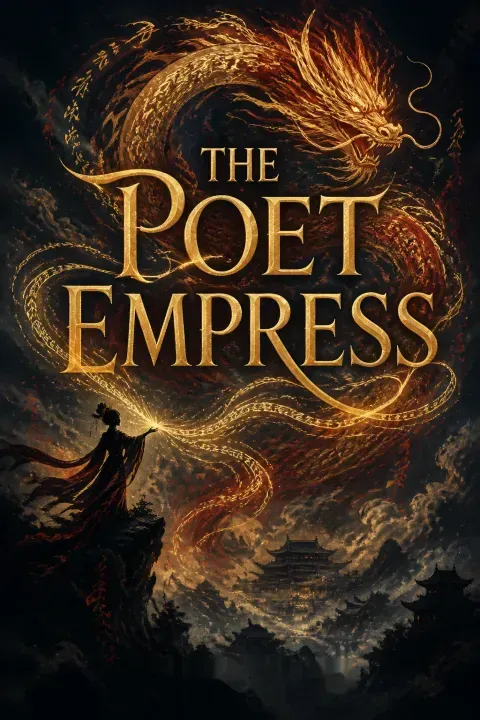
[The Poet Empress] is fundamentally an interrogation of power: who holds it, what it costs, and whether it can ever be wielded without corruption. The novel structures itself around a series of nested revelations, each layer of backstory complicating the moral calculus of the present. Terren2 is introduced as a monster, then revealed as a victim, then revealed as both simultaneously. Maro3 is introduced as the honorable alternative, then revealed as equally capable of murder. The empress6 is a villain until we understand what the palace did to her. Every character exists in a system that demands cruelty, and the novel refuses to exonerate anyone while also refusing to condemn anyone absolutely.
The heart-spirit poem is the perfect metaphor for the novel's method: the only way to truly know someone, and therefore the only way to judge whether they deserve to die, is to love them first. Love and hate are not opposites but adjacent territories, and the novel maps their shared border with devastating precision. Wei's1 journey from victim to killer to liberator traces the full arc of this understanding. She learns that killing Terren2 is necessary not because he is irredeemably evil but because the system that created him will never let him heal, and the power he would wield as emperor would multiply his damage across an entire nation.
The novel is also a feminist text in the truest sense: it argues that patriarchy damages everyone, not only women. The imperial obsession with seal-bearing sons destroys mothers, brothers, wives, and the sons themselves. Lady Autumn's10 ambition is the logical endpoint of a system that gives women value only through their male children. Terren's2 trauma is male-specific: forced to perform sexually from childhood, denied vulnerability, taught that violence is the only acceptable expression of pain.
Wei's1 final negotiation with Isan,9 demanding literacy for women, is not merely a happy ending but a structural solution. The novel's argument is that when women can write, when they can compose their own spells and tell their own stories, they can reshape the systems that have trapped them. The Rice Wife is not a fairy tale princess but a political actor who understands that stories, poems, and the magic they contain are the most powerful weapons of all. The dynasty may fall, new rulers may come, but the seed Wei1 plants, of women learning to make their own marks on the world, is the only change that can outlast any empire.
Review Summary
The Poet Empress receives overwhelmingly positive reviews, with most readers praising its complex, morally gray characters, dark themes, and unique poetry-based magic system (literomancy). Reviewers consistently emphasize it is not a romantasy despite misleading marketing. The emotionally devastating story follows Wei, a poor village girl navigating brutal court politics as a concubine. Standout praise focuses on the layered villain, Prince Terren, and Wei's compelling arc. Minor criticisms include occasional shallow worldbuilding, pacing issues, and emotional distance from characters.
People Also Read




Characters
Yin Wei
Rice farmer turned empressThe narrator and protagonist. At sixteen, Wei has already buried five siblings to famine. She is pragmatic and fierce, motivated by love for her family and a desperate desire to save her brother Bao11 from hunger. She enters the palace as a concubine candidate knowing she is worthless in its economy of bloodlines and clan connections, but she learns quickly. Her defining trait is endurance: she absorbs torture, humiliation, and loss, converting suffering into resolve. Over the course of the novel, she teaches herself to read, learns literomancy, and writes a spell that changes the nation. Her moral journey is the novel's central arc: she begins wanting only to feed her family, learns to wield power and cruelty, and ultimately chooses to sacrifice her own position for a greater good.
Guan Terren
Tortured prince, Dao bearerSecond son of the Azalea House, bearer of the Dao (blade) seal. Known throughout Tensha as the Winter Dragon, The One Who Cannot Die. He is feared for his cruelty: flaying servants, slaughtering animals, torturing concubines. He is also a brilliant poet and literomancer. Beneath the monstrous exterior lies a history of profound childhood trauma: his mother10 forced him into the childmaking duties from age nine, his brother3 abandoned him, and his father valued only his magic. His cruelty is a defense mechanism, his invincibility a desperate attempt to ensure nobody can hurt him again. He cannot be intimate with women, he drinks to excess, and he trusts no one. Yet he is also capable of wonder, love, and vulnerability when someone finally offers him unconditional compassion.
Guan Maro
First son, economic seal bearerThe eldest prince, bearer of the Lu (road/passage) seal. Raised to be emperor from birth, Maro is dutiful, hardworking, and desperate to prove himself worthy. He built the Salt Road as a child, nearly killing himself from Heavenly Fatigue in the process. He loved his younger brother Terren2 fiercely and was his only protector. But palace politics, his mother's ambition, and his tutors' warnings poisoned that love. He is driven by a need for his father's approval and a deep shame at never being enough. His moral code is genuine but fragile: he believes in honor and integrity, yet the succession war forces him into increasingly ruthless decisions, culminating in actions that betray everything he once stood for.
Song Silian
Maro's wife, Wei's allyWife of Prince Maro3, from the Song Clan of the Northeast. Her hair is frost-white, a clan trait. She is beautiful, poised, and seemingly fearless. She teaches Wei1 the concubine's weapon: using intimacy and trust to manipulate men. She provides Wei1 with Maro's3 journals and becomes her ally against Terren2. But Silian is also playing her own game. She wants her husband on the throne and is willing to sacrifice Wei1 to achieve it. Her kiss with Wei1 on the wedding night is both genuine connection and political maneuver. She represents the novel's thesis that in the palace, no alliance is pure, no love without calculation.
Yong Hesin
Three-generation eunuch advisorAn elderly eunuch who has served three emperors: Jinzha, Muzha, and now Terren2. He bears a loyalty scar on his palm, sworn to serve the nation rather than any individual prince. He is the novel's repository of history, telling Wei1 the stories that become the material for her heart-spirit poem. He knows Terren2 is a monster but serves him anyway, bound by oath and a belief that the Dao seal is necessary for Tensha's survival. He is weary, compassionate toward Wei1 even as he enables her torture, and ultimately betrayed by her when she frames him for treason. He is a man who has spent his life serving causes he despises, unable to intervene as the dynasty consumes everyone he cares about.
Empress Sun Ai
Matriarch of the Sun ClanThe Yongkai Emperor's wife, mother of the infant Prince Ruyi, and matriarch of the most powerful Great Clan. She survived the deadly competition of Muzha's Inner Court and is now determined to secure the throne for her son. She is cunning, patient, and venomous. Her enmity toward Wei1 is both political (Wei1 occupies the position meant for her niece Jia13) and personal (Wei1 represents everything she despises: low birth, undeserved favor). She was Lady Autumn's10 closest friend and has never forgiven Terren2 for killing her. Like everyone in the palace, she is both villain and victim, shaped by the same system that forces women to trade their bodies for power.
Lin Wren
Wei's loyal head attendantWei's1 head attendant in the Cypress Pavilion, recognizable by her crane-colored shawl and freckled smile. She sold into the palace at age four and once had the privilege of riding the Crown dragon. She discovers Wei's1 literacy early and becomes her confidante, the only person who knows the full scope of Wei's1 plan to kill Terren2. She helps Wei1 hide the injured scribe Pima, learns to read alongside the other servants, and represents the community Wei1 builds within the palace. Her murder during Terren's2 massacre of the Cypress Pavilion is the novel's most devastating loss, the death that solidifies Wei's1 resolve to see her plan through regardless of the cost.
Li Ciyi
Ambitious eunuch scribeA eunuch who initially rejects Wei1 at the Guishan selection, calling her ugly and village-smelling. After Wei1 becomes Empress-in-Waiting, he offers his services as advisor and scribe, driven by naked ambition: he wants to rise with her. He teaches Wei1 to read in secret, a treasonous act. He is pragmatic, ruthless, and frequently argues that Wei1 should be crueler to her enemies. Yet he is also genuinely helpful, providing the knowledge Wei1 needs to survive. His loyalty is transactional and entirely self-interested, but in a palace where no one can be trusted, his predictable ambition makes him reliable in his own way.
Guan Isan
Third prince, Guo fruit bearerThe third son of the Azalea House, bearer of the Guo (fruit) seal. His magic can grow orchards and produce food, making him beloved by the common people but dismissed by the court as militarily useless. He visited Guishan on New Year's, indirectly setting Wei's1 entire journey in motion. He is softer than his brothers, more benevolent, but not without political calculation. When he becomes emperor after both his older brothers die, he must navigate the crisis Wei1 has created, ultimately agreeing to her revolutionary conditions for the future of the dynasty.
Lady Autumn
Terren's abusive motherTerren's2 mother, originally a pleasure girl from the Violet Heron Tower in Tieza. She escaped the tower, entered Muzha's Inner Court, and bore a seal-bearing son. She was beautiful, charismatic, and beloved by the other concubines, especially Sun Ai6. She was also monstrously cruel to her child, forcing him into the childmaking duties from age nine to produce a seal-bearing grandson. Her ambition was born of her own trauma: having suffered so much in the palace, she believed winning was the only way to make that suffering meaningful. Terren2 killed her accidentally during a forced exercise in cruelty.
Yin Bao
Wei's younger brotherWei's1 seven-year-old brother, the only surviving sibling besides Wei1. He is bright, affectionate, and loves sweet things. Wei's1 entire motivation for entering the palace is to secure his future: food so he can grow strong, schooling so he can become anything he wishes. On New Year's, one of Isan's9 Blessings chooses Bao, a spark entering his heart, and their father declares Bao will grow up to be a great man. He represents the future Wei1 is fighting for.
Du Hu
Mute elderly maidAn elderly maid in the Cypress Pavilion whose tongue was cut out by Terren2. She communicates by writing characters in the earth. She is the only servant besides Ciyi8 who survives Terren's2 massacre, perhaps because she could never have been Hesin's5 spy: she cannot speak. She learns to write her name from Wei1, her eyes welling with tears at the simple dignity of self-representation. Her advice, written in the dirt the night before the coronation, guides Wei's1 final decision: remember who you are doing this for.
Sun Jia
Empress's niece, rival concubineNiece of Empress Sun6 and member of the powerful Sun Clan. She expected to be chosen as Empress-in-Waiting and despises Wei1 for taking her place. She is arrogant, cruel, and unsubtle, spreading rumors and openly mocking Wei's1 village origins. She convinces Jin Veris14 to poison Wei's1 wine. Her punishment, having her tongue cut out by Wei1, is both brutal and symbolic: the woman who used words as weapons is rendered mute, becoming the animal she once called Wei1.
Jin Veris
Concubine, poisoner turned allyA concubine from the wealthy Jin Clan, known for their plum wine. She initially allies with Sun Jia13 and gives Wei1 poisoned wine. When the plot fails, she switches allegiance, warning Wei1 about the examination and providing evidence against Jia13. Her pragmatism reflects the survival calculus all the concubines must make: alliances shift as quickly as power does. She is neither good nor evil, merely desperate to succeed in a system that offers women only one path to influence.
Master Ganji
Maro's ruthless tutorPrince Maro's3 childhood tutor, a harsh disciplinarian who believed Maro's3 only purpose was to become emperor. He beat the young prince for saying he wanted to be a peasant, drilled into him that his veins were Tensha's rivers and his flesh its mountains. He orchestrated the assassination attempt on Terren2 in the peach garden and later blamed Maro3 when it failed. He represents the system that manufactured the brothers' enmity: the adults who taught children that love was weakness and power was all that mattered.
Plot Devices
Heart-Spirit Poem
Killing spell disguised as love poetryA rare and complex literomantic spell developed in the early Ash Dynasty. It takes the form of a love poem so heartfelt it can only be written for someone the composer knows deeply. The Ancestors judge whether the target deserves to die based on the emotional truth of the poem. It is the only killing spell that can bypass physical barriers, finding its way directly to the target's heart from any distance. Historically, only a handful have been successfully written because the paradox at its core is nearly impossible: to write a true love poem for someone you wish dead. The spell can also be used to heal rather than kill if the poet's intention shifts from condemnation to life-affirmation.
The Aricine Ward
Makes the wearer unable to dieThe most powerful protective spell in Tenshan history, previously cast only by the legendary Metal Scorpion to kill the First Emperor. It manifests as a band of glowing white characters swirling around the wearer's body, appearing as a white tiger when activated. It renders its subject immune to all forms of death except old age. Terren2 spent seven years writing his ward, originally intending it for his brother Maro3 to prevent his death from Heavenly Fatigue. He cast it on himself instead after the succession war turned them into enemies. The ward must be voluntarily lowered during the Taming of the Dragon coronation ritual, as dragons accept no external literomancy, making the coronation the only opportunity to kill the wearer.
Imperial House Seals
Hereditary elemental magic marksEvery son born to an emperor bears a glowing seal on his cheek: an outer ring of the Azalea House flower enclosing a Chinese character representing his magical affinity. Maro3 bears Lu (roads/passage), Terren2 bears Dao (blades), Isan9 bears Guo (fruit), Kiran bears Feng (wind), and the infant Ruyi's seal is still unformed. The seals grant the princes intuitive mastery of spells related to their domain. Upon becoming emperor and taming the Crown dragon, a prince's seal magic is amplified a thousandfold. The seals manifest around age nine or ten when a prince first accesses his power. Only male children can inherit seals, making the production of male heirs the primary purpose of the imperial Inner Court.
Literomancy
Magic cast through written poetryThe magic system of Tensha, in which poetry written with truth and emotion can produce supernatural effects. The Ancestors judge the sincerity of the words and grant magic accordingly. Spells can heal wounds, grow crops, forge weapons, or kill. They are written on paper, traced in earth, or carved into objects. Most Blessings have limited uses before their words lose meaning and their magic fades. Women are forbidden from learning to read or write, as literacy is seen as a threat to the social order. The system creates a natural aristocracy of literomancers, who control access to magic and therefore to power. Wei's1 secret literacy and her eventual mastery of literomancy represent a fundamental challenge to this patriarchal order.
The Crown Dragon
Amplifies the emperor's seal powerA massive red dragon that lives in the sky above the Azalea House, visible from miles away. It serves whoever holds the title of emperor, amplifying that ruler's seal magic a thousandfold. When an emperor dies, the dragon becomes untamed, ripping a hole in the sky. The new heir must enter an arena alone or with allies, lower all protective literomancy (including the Aricine Ward), and subdue the dragon through combat and the channeling of seal magic. The dragon transforms physically to reflect the new emperor's affinity: under Terren2 it would become steel-gray with knife-scales, under Isan9 it bears fruit and blossoms. The Taming of the Dragon is extremely dangerous; throughout history, one in four princes died attempting it.
Download PDF
Download EPUB
.epub digital book format is ideal for reading ebooks on phones, tablets, and e-readers.








































