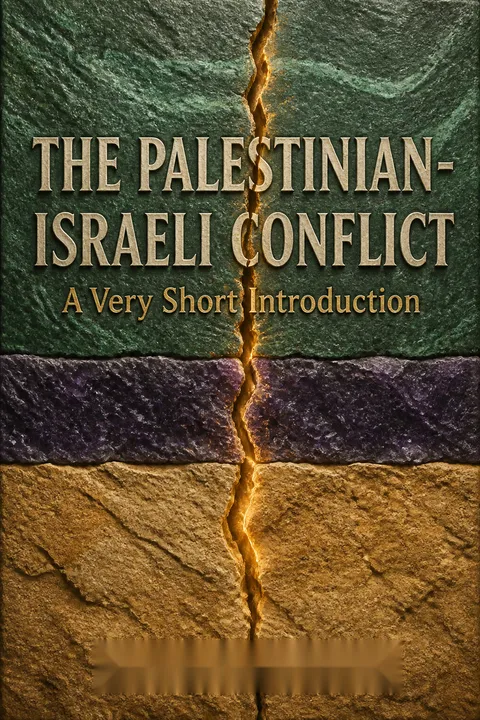

Key Takeaways
1. Zionism's Genesis: A Modern Territorial Contest on Inhabited Land
Had Palestine in fact been empty, there would be no conflict as we know it.
A modern movement. The Palestinian-Israeli conflict is not ancient or religious in origin, but a modern territorial contest sparked by the 1897 Basel Congress, where Theodor Herzl's World Zionist Organization declared its aim to create a Jewish national home in Palestine. This vision, born from 19th-century European nationalism and antisemitism, largely overlooked the existing Arab population, encapsulated by the problematic slogan "A land without a people for a people without a land." Early Zionist leaders like Ahad Ha'am, however, prophetically warned of the indigenous inhabitants' resistance.
Settlement over diplomacy. While Herzl pursued international diplomatic support, "labour Zionists" of the Second Aliyah (1904–14) focused on practical settlement, aiming to build a self-sufficient Jewish society through "conquest of labour" and "conquest of land." The Jewish National Fund (JNF), established in 1901, acquired Arab landholdings, strategically focusing on agriculturally rich coastal plains and inland valleys rather than religiously significant mountainous areas like Judea and Samaria. This economic pragmatism profoundly redefined Zionism's geographical focus.
Ottoman context. Palestine, then part of the Ottoman Empire, was undergoing significant changes due to Tanzimat reforms and integration into the world economy. The 1858 land law allowed Arab notables to acquire vast tracts in the plains and valleys, which they later sold to Zionist agencies. This period saw a western migration of the Palestinian population, and while a distinct Palestinian national identity had not yet fully formed, the growing Zionist presence began to shape a specific Palestinian consciousness in opposition to this perceived threat.
2. Britain's Conflicting Promises Ignited the Conflict
Of the three sets of commitments Britain made over this much-promised land, the Balfour Declaration would be the most enduring.
Wartime pledges. During World War I, Britain made a confusing array of conflicting promises regarding Palestine's future, driven by strategic interests to protect its trade routes and the Suez Canal. These included:
- The Husayn-McMahon correspondence (1915-16), promising an independent Arab kingdom to Sharif Husayn.
- The Sykes-Picot Agreement (1916), secretly dividing Arab territories between Britain and France, placing Palestine under international administration.
- The Balfour Declaration (1917), favoring "the establishment in Palestine of a national home for the Jewish people."
Balfour's impact. The Balfour Declaration, issued by Foreign Secretary Arthur James Balfour to Lord Walter Rothschild, became the most significant. It aligned British interests with Zionism, rooted in racialized beliefs that exaggerated Jewish power and dismissed the rights of Palestine's Arab inhabitants. Balfour famously justified it by stating Zionism was of "far profounder import than the desires and prejudices of the 700,000 Arabs."
Mandate for conflict. Britain's post-war acquisition of the League of Nations Mandate for Palestine officially incorporated the Balfour Declaration, giving the small Jewish minority a uniquely privileged position. This international sanction turned a wartime promise into a binding contract, obligating Britain to facilitate a Jewish national home while simultaneously preparing the territory for self-determination. This inherent contradiction set the stage for inevitable conflict, as Palestinian Arabs immediately recognized the threat to their national identity.
3. The Mandate Era: British Failure to Reconcile Two Nationalisms
The failure to create a legislative council in Palestine represents a key turning point in the country’s history.
Colonial administration. Britain governed Palestine as a "Crown colony" for its first two decades, with power centralized in the High Commissioner and Colonial Office. Despite Palestine being an "A" mandate, theoretically destined for self-determination, Britain deliberately avoided establishing a legislative assembly. This was primarily due to Palestinian Arab demands for control over Jewish immigration and land purchases, which Britain, committed to the Balfour Declaration, refused to concede.
Yishuv's parallel state. In contrast, the mandate explicitly empowered the Jewish Agency to develop governmental institutions for the Yishuv (Jewish community). This allowed the Yishuv to build a distinct, self-sufficient society with its own:
- Taxation system
- Healthcare and education
- Revived Hebrew language
- Paramilitary force (Haganah)
This parallel structure, alongside strategic land purchases and significant immigration (especially the Fifth Aliyah, 1933-36, which doubled the Jewish population), laid the foundations for a future state.
Palestinian fragmentation. The Palestinian Arab leadership, dominated by traditional notable families like the Husaynis and Nashashibis, suffered from paralyzing divisions. Britain exploited these rivalries through "divide and rule" tactics, appointing figures like Hajj Amin al-Husayni as Grand Mufti, whose authority grew through institutions like the Supreme Muslim Council. However, this leadership struggled to unite against Zionism and British policies, leading to growing resentment and radicalization among the populace, culminating in the 1929 Western Wall riots and the 1936 General Strike.
4. Partition Plans: A Recurring, Yet Rejected, Solution
Manifestly the problem cannot be solved by giving either the Arabs or the Jews all they want.
Peel's radical proposal. The 1937 Peel Commission, sent to investigate the causes of unrest, concluded that Arab and Jewish nationalisms were irreconcilable. It recommended partitioning Palestine into separate Arab and Jewish states, with a controversial "exchange of population" (transferring over 200,000 Arabs) to create a "clean and final" division. The proposed Jewish state was shaped by modern Zionist settlement patterns in the fertile plains and valleys, not ancient Biblical sites.
Zionist pragmatism, Arab rejection. The Zionist leadership, led by Chaim Weizmann and David Ben Gurion, strategically accepted the principle of partition, seeing it as a step towards statehood, even if the specific territorial allotment was rejected. However, Palestinian Arabs fiercely rejected the Peel plan, viewing it as an unjust division of their patrimony. This rejection fueled the brutal 1937-39 Arab Revolt, which Britain crushed, severely damaging Palestinian political and social structures.
UN's second attempt. Following World War II and the Holocaust, Britain, exhausted and under immense international pressure (especially from the US), handed the Palestine problem to the UN. The 1947 UN Partition Plan (Resolution 181) proposed dividing Palestine into two states, awarding 55% of the land to the Jewish state (despite Jews owning less than 10% of the land and comprising 33% of the population). This plan, influenced by the need to absorb Holocaust survivors and Zionist land purchases, was accepted by Zionists but rejected by Palestinian Arabs, who viewed it as profoundly inequitable.
5. 1948: Israel's Independence and Palestine's Catastrophe
Israel’s victory was hailed by the Jews as the War of Independence (in Hebrew, milhemet ha’atzmaut), a revolutionary overthrow of the British imperial yoke and a hard-fought victory over the new state’s Arab enemies.
War and birth. The UN partition vote in November 1947 ignited a civil war in Palestine, followed by a regional war after Britain's withdrawal on May 15, 1948, and Israel's declaration of independence. The nascent state of Israel, with its well-coordinated forces, decisively defeated the disunited Arab armies. This victory, achieved at a cost of 6,000 lives (1% of the Yishuv's population), secured Israel's existence within expanded borders, encompassing 78% of mandate Palestine, including West Jerusalem.
The Nakba. For Palestinians, the war was an "unimaginable catastrophe" (al-nakba). Approximately 750,000 Palestinians were expelled or fled their homes, becoming refugees dispersed across neighboring Arab countries, the West Bank, and Gaza. Israel refused their right of return, arguing Arab states initiated hostilities. The UN established UNRWA to provide temporary assistance, but the refugee problem became a central, unresolved issue, shaping Palestinian national identity around the demand for return.
New regional order. The 1949 armistice agreements solidified Israel's new borders (the Green Line) and saw Jordan annex the West Bank (including East Jerusalem) and Egypt administer the Gaza Strip. The Arab defeat discredited existing regimes, leading to coups like Gamal Abd al-Nasser's in Egypt. Israel, meanwhile, focused on state-building, absorbing a massive influx of immigrants (doubling its Jewish population within three years), and developing a strong military doctrine of "Ben Gurionism" – disproportionate retaliation against Arab aggression.
6. Post-1967 Occupation: A New Era of Expansion and Resistance
Most problematically, the sudden conquest of territory steeped in Biblical history sparked within Israel expansionist aims that would make the conflict much more difficult to resolve.
Six-Day War's impact. Israel's swift victory in the 1967 Six-Day War against Egypt, Syria, and Jordan quadrupled its territory, occupying the Sinai Peninsula, Gaza Strip, West Bank (including East Jerusalem), and Golan Heights. This conquest presented a dual outcome: new territorial assets for potential peace negotiations, but also a surge of messianic nationalism within Israel, viewing the captured lands, particularly Judea and Samaria, as a "miraculous liberation" of Eretz Israel.
Resolution 242 and its ambiguity. The UN Security Council Resolution 242, passed in November 1967, became the cornerstone of future peace efforts, advocating a "land-for-peace" formula. However, its deliberate ambiguity—specifically the omission of "the" territories—allowed for divergent interpretations: Arab states demanded withdrawal from all occupied lands, while Israel argued it could retain some. This diplomatic deadlock, coupled with the Arab League's "three noes" (no recognition, no negotiation, no peace), stalled progress for years.
Settlement expansion. The post-1967 period saw the rapid growth of Israeli settlements in the occupied territories, driven by both security concerns ("hawks") and religious-nationalist ideology (Gush Emunim). These settlements, often strategically located to thwart future territorial compromise, were heavily protected by military occupation, imposing severe restrictions on Palestinian life. Jerusalem was unilaterally annexed by Israel, its municipal boundaries expanded, and a ring of Jewish suburbs built, further complicating its future status.
7. The Land-for-Peace Formula: A Diplomatic Stalemate
Progress on the land-for-peace formula would have to wait for radical changes to the geopolitical situation.
War of attrition. Following 1967, Egypt launched a "war of attrition" (1969-70) to break the diplomatic impasse, leading to increased superpower involvement: the Soviet Union resupplied Egypt, while the United States solidified its support for Israel. This low-intensity conflict failed to achieve a breakthrough, but set the stage for future shifts.
Yom Kippur War's catalyst. Anwar Sadat, Nasser's successor, launched a surprise attack in October 1973, aiming to create an international crisis that would force US diplomatic engagement. Despite mixed military results, the war succeeded in making the Arab-Israeli conflict a top US priority. Henry Kissinger's "shuttle diplomacy" led to initial disengagement agreements, but a comprehensive peace remained elusive.
Separate peace. Sadat's frustration with slow progress led to his historic visit to Israel in 1977 and the 1978 Camp David Accords, mediated by President Jimmy Carter. This resulted in a separate Israeli-Egyptian peace treaty in 1979, returning the Sinai to Egypt. However, it failed to address the Palestinian issue, as newly elected Israeli Prime Minister Menachem Begin refused to commit to Palestinian self-determination in the West Bank and Gaza, accelerating settlement construction instead.
8. Oslo Accords: Hope for Peace Undermined by Distrust and Settlements
The Oslo process said nothing about these issues.
Secret diplomacy. The 1987 Palestinian Intifada, coupled with the geopolitical shifts of the post-Cold War era and the 1991 Gulf War, pushed both Israel and the PLO towards direct talks. Secret negotiations in Oslo, Norway, culminated in the 1993 Declaration of Principles (DOP), known as the Oslo Accords. This landmark agreement involved mutual recognition between the PLO and Israel, with the PLO renouncing violence and Israel recognizing the PLO as the representative of the Palestinian people.
Phased autonomy, deferred issues. Oslo envisioned a five-year transitional period for Palestinian self-rule under a new Palestinian Authority (PA), with phased Israeli military redeployments. Crucially, the most contentious "final status issues"—borders, refugees, settlements, and Jerusalem—were deliberately deferred for later negotiations. The success of Oslo hinged on building trust and momentum through prompt and good-faith implementation of interim agreements.
Erosion of trust. However, the Oslo process ultimately failed to deliver lasting peace, largely due to:
- Continued settlement expansion: The number of Israeli settlers in the occupied territories dramatically increased, fragmenting Palestinian society with bypass roads and land confiscations.
- Economic hardship: Israeli restrictions and divisions (Areas A, B, C) worsened Palestinian unemployment and poverty.
- Palestinian Authority's shortcomings: Arafat's centralized, often authoritarian rule and perceived cronyism alienated local leaders and fueled disillusionment.
- Hamas's sabotage: Rejecting Oslo, Hamas launched suicide bombings against Israeli civilians, undermining Israeli trust and strengthening hardliners.
This created a cycle of violence and distrust that derailed the peace process.
9. The Intifadas: Popular Uprisings Reshape the Conflict
The intifada also fundamentally transformed political equations on the ground.
First Intifada (1987-1993). The 1987 "shaking off" (intifada) was a spontaneous, grass-roots uprising against Israeli occupation, mobilizing all strata of Palestinian society. It forced both the PLO leadership in exile and the Israeli government to respond. The PLO, empowered by the uprising, shifted its strategy to a two-state solution, recognizing Israel and Resolution 242 in 1988. For Israel, the intifada exposed the moral and practical unsustainability of the occupation, leading to increased pressure for disengagement.
Hamas's emergence. The Intifada also saw the rise of Hamas, an offshoot of the Muslim Brotherhood, which gained popularity by providing social services and vehemently opposing the PLO's compromises. Hamas's charter called for the destruction of Israel and the establishment of an Islamic state over all of mandate Palestine, posing a significant challenge to Fatah's authority and the peace process.
Second Intifada (Al-Aqsa Intifada, 2000-2005). Triggered by Ariel Sharon's provocative visit to the Temple Mount/al-Haram al-Sharif, the second intifada erupted from widespread Palestinian disillusionment with the failed Oslo process and Arafat's rule. This more violent uprising, marked by Palestinian security forces using automatic weapons and Hamas's suicide bombings, led to immense human suffering. It strengthened hardliners in Israel (Sharon's election) and further fragmented Palestinian power, with Hamas gaining influence amidst Fatah's disarray.
10. The Two-State Solution: A Clear Blueprint, Fading Prospects
All this means that the parameters of a two-state solution are well known and well rehearsed.
A consensus blueprint. Despite repeated failures, a broad international and regional consensus has emerged around the parameters of a two-state solution, elaborated in initiatives like the Taba accords (2001), the Arab Peace Initiative (2002), the Quartet Road Map (2003), and the Geneva Initiative (2003). President Obama's 2009 Cairo speech and the 2012 UN General Assembly resolution further affirmed this vision.
Key parameters. The core elements of this widely accepted solution include:
- Borders: Two states based on the 1949 armistice lines (Green Line), with minor, reciprocal territorial exchanges to ensure contiguity and viability.
- Jerusalem: Shared capital for both Israel and Palestine, with sovereignty over respective neighborhoods and guaranteed access to holy sites.
- Refugees: A mutually acceptable resolution involving financial compensation and a "return" to the new state of Palestine, without threatening Israel's Jewish character.
- Security: Limitations on Palestinian military forces to ensure Israel's security.
Fading prospects. Despite this clear blueprint, the prospects for a two-state solution are diminishing. This is primarily due to:
- Palestinian disunity: The deep political schism between Fatah (West Bank) and Hamas (Gaza) paralyzes a unified national strategy.
- Israeli settlement expansion: The rapidly growing settler population (over 500,000) and associated infrastructure in the West Bank make a contiguous and viable Palestinian state increasingly difficult to achieve.
- Lack of political will: Hardliners on both sides resist compromise, and leaders struggle to implement solutions against powerful domestic constituencies.
11. The Perilous Choice: Binationalism or Apartheid Without Two States
If, and as long as between the Jordan and the sea, there is only one political entity, named Israel, it will end up being either non-Jewish or nondemocratic … If the Palestinians vote in elections, it is a binational state, and if they don’t, it is an apartheid state.
Eroding viability. The continued expansion of Israeli settlements, particularly in East Jerusalem and the West Bank, is rapidly making a two-state solution physically impossible. The deepening settlement infrastructure, including housing and access roads, fragments Palestinian territory and isolates East Jerusalem, effectively bisecting the West Bank. This creates a de facto "one-state framework" that challenges Israel's long-term identity.
The demographic dilemma. With the Palestinian Arab population growing faster than the Jewish Israeli population, the demographic reality between the Mediterranean Sea and the Jordan River presents Israel with a stark choice if a two-state solution fails. Former Israeli Prime Ministers Ehud Olmert and Ehud Barak have both warned of this impending dilemma.
Two undesirable outcomes. In the absence of two viable states, Israel faces two options, neither of which aligns with its founding principles:
- Binational state: A shared homeland with equal rights for both national communities would mean Israel losing its dream of being a Jewish-majority state.
- Apartheid-like state: Maintaining a Jewish majority through the subjugation and disenfranchisement of Palestinians would cost Israel its democracy and international legitimacy.
The current diplomatic impasse, coupled with the relentless facts on the ground, pushes the region towards these perilous alternatives, highlighting the urgent need for a political breakthrough to secure a just and lasting peace.
Review Summary
The Palestinian-Israeli Conflict receives largely positive reviews (4.04/5) for its balanced, factual approach to a complex topic. Readers appreciate Bunton's even-handed presentation of both perspectives without oversimplification, making it an excellent introduction for newcomers. The book covers 1897-2007, emphasizing territorial disputes over religious tensions. Reviewers praise its conciseness and objectivity, though some note dry writing and dated content (published 2013). A few criticize subtle biases in language choices. Most recommend it as a solid foundation for deeper study, valuing its "just the facts" approach to such a politically charged subject.
People Also Read

Very Short Introductions Series Series













Download PDF
Download EPUB
.epub digital book format is ideal for reading ebooks on phones, tablets, and e-readers.








































