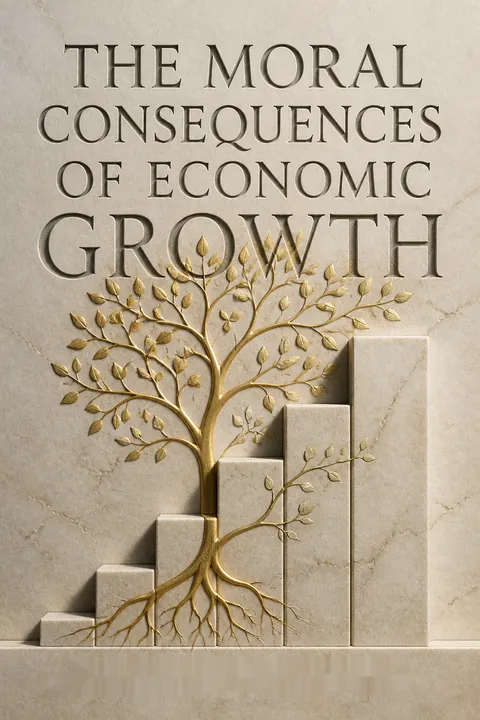

Key Takeaways
1. Economic Growth is a Moral Imperative, Not Just Material Gain
The value of a rising standard of living lies not just in the concrete improvements it brings to how individuals live but in how it shapes the social, political, and ultimately the moral character of a people.
Beyond material benefits. Economic growth, defined as a rising standard of living for the majority, is often mistakenly viewed as solely a material concern, potentially at odds with moral values. However, this perspective is dangerously incomplete. The author argues that growth is intrinsically linked to a society's moral character.
Fostering positive values. A growing economy, where most citizens experience improving living standards, tends to cultivate a range of desirable societal traits. These include:
- Greater opportunity
- Tolerance of diversity
- Social mobility
- Commitment to fairness
- Dedication to democracy
Stagnation's moral cost. Conversely, when living standards stagnate or decline, societies often regress on these moral dimensions. This isn't just about material comfort; it's about the fundamental qualities that define a just and progressive society. Therefore, decisions about economic policy have profound moral consequences, extending far beyond mere financial metrics.
2. Enlightenment Thinkers Forged the Link Between Progress and Prosperity
The specific idea that rising living standards cause public attitudes and political institutions to evolve in ways that improve the moral character of the society, together with some concrete explanation of how this process comes about, was primarily a product of the remarkable efflorescence of new thinking in the eighteenth century that those who observed it soon came to call the Enlightenment.
A new theory of progress. Enlightenment figures like Adam Smith and Anne Robert Jacques Turgot developed a dynamic theory of societal evolution. They posited that societies progress through distinct economic stages—from hunting to shepherding, then farming, and finally "commerce"—driven by expanding populations and advancing knowledge.
Economic change, moral evolution. Each economic stage, they argued, necessitated different political and legal institutions. For instance:
- Hunter-gatherers needed few laws.
- Shepherding introduced property rights for animals and pastures.
- Farming required more complex legal structures for land and produce.
- Commerce demanded sophisticated systems for trade, contracts, and money.
This progression from simpler to more complex economic activity inherently led to advancements in governance and social relations, which they viewed as moral progress.
Religious underpinnings. This secular idea of progress had deep roots in earlier Protestant thought, particularly among Puritans. Millennialist interpretations of history, emphasizing inevitable worldly improvement through natural forces, laid a foundation. The Protestant ethic, valuing hard work, diligence, and thrift as moral imperatives, inadvertently spurred economic activity, creating a virtuous cycle where moral means led to moral ends via economic prosperity.
3. Rising Incomes Positively Reshape Individual and Societal Attitudes
The principal driving force underlying the positive influence that economic growth has over people’s attitudes, and through the political process therefore over the character of their society, is the interaction between how each of these two respective points of comparison affects people’s perceptions.
Relative well-being. People assess their economic standing not just absolutely, but relative to their past experience and to those around them. Economic growth, by consistently improving most people's lives compared to their own past, reduces the intense desire to "get ahead of others." This shift in focus fosters broader societal benefits.
Reduced fear of loss. In a growing economy, the prospect of downward mobility is less threatening. Losing ground relative to others might mean not gaining as much, rather than experiencing an absolute decline. This makes individuals more willing to accept:
- Enhanced social and economic mobility
- Anti-discrimination laws
- Programs for low-income families
This willingness stems from a confidence that even if one's relative position shifts, their absolute standard of living will still improve.
Generosity and public good. When incomes are rising, people feel more secure and are more inclined to support public goods and assist the less fortunate. This translates into greater public support for:
- Better schools and healthcare
- Parks and cultural institutions
- Welfare programs and charities
This generosity is not just about having more resources, but about a psychological shift where the satisfaction of personal progress makes individuals more open and empathetic towards the collective good.
4. Economic Stagnation Historically Breeds Intolerance and Social Rigidity
The resulting frustration generates intolerance, ungenerosity, and resistance to greater openness to individual opportunity.
Frustration and resentment. When economic growth falters, and people no longer feel they are getting ahead, the focus shifts to relative standing. The inability to improve one's position compared to others intensifies frustration, leading to a more defensive and inward-looking societal mood. This often manifests as:
- Increased antipathy towards immigrants
- Resurgence of racial and ethnic prejudice
- Resistance to social mobility and equal opportunity
Historical American examples. The late 19th century and the 1920s in the U.S. vividly illustrate this pattern.
- Late 19th Century (1880-1895): Stagnant incomes, falling farm prices, and the 1893 depression fueled Populism. This movement, while advocating some reforms, also embraced nativism, anti-Semitism, and anti-urban sentiment, seeking to preserve a simpler, agrarian America.
- 1920s (Post-WWI): Despite some industrial growth, average Americans saw little real income progress. This era witnessed the "Red Scare," the rise of the second Ku Klux Klan (anti-Catholic, anti-Semitic, anti-immigrant), and restrictive immigration laws, reflecting a retreat from openness.
Erosion of democratic values. In such periods, the willingness to support policies that broaden opportunity or assist the disadvantaged diminishes. Public discourse often becomes more cynical, and extremist groups gain traction by offering simplistic explanations and scapegoats for economic woes. This rigidity can undermine the very fabric of a democratic society.
5. The Great Depression Stands as a Unique Exception to the Rule
But in this instance the response to economic adversity was mostly different.
Unprecedented crisis. The Great Depression of the 1930s, the most severe economic collapse in American history, presented an extreme test of the link between economic conditions and societal character. Despite widespread hardship and the rise of demagoguery, the U.S. largely strengthened its commitment to openness, tolerance, and democracy.
Roosevelt's leadership. President Franklin D. Roosevelt's New Deal, characterized by pragmatic experimentation and a commitment to "social justice," played a crucial role. Roosevelt:
- Accepted national responsibility for economic welfare.
- Implemented massive relief and jobs programs (CCC, WPA).
- Created permanent social safety nets (Social Security, FDIC).
- Articulated a vision of economic democracy, linking relief to preserving liberty.
Widespread impact and solidarity. The sheer scale of the depression, affecting nearly all segments of society, fostered a sense of shared struggle. This collective experience, coupled with the existential threat to the republic from both internal extremists and external totalitarian regimes, may have overridden the usual tendencies of stagnation to breed intolerance. People pulled together when their very lives and the nation's democratic structure were in imminent danger.
A boundary condition. The 1930s demonstrate that while economic stagnation typically erodes social cohesion, extreme crises can sometimes elicit a different, more unifying response. This exception highlights that the relationship between economic conditions and societal character is powerful, but not absolute, and can be influenced by leadership and the perceived magnitude of the threat.
6. Post-War Prosperity Fueled America's Embrace of Openness and Rights
The most dramatic dimension of the new agenda taken up during the first quarter-century or so following World War II was the effort to extend American democracy, both political and economic, to nonwhites.
A new era of growth. Following World War II, the U.S. experienced a quarter-century of robust and broadly distributed economic growth. This prosperity, coupled with a sense of national purpose, created a fertile ground for significant social and political advancements.
Civil Rights and expanded opportunities. The period saw a dramatic push for racial equality, culminating in landmark legislation and judicial decisions:
- Truman's desegregation of the armed services (1948).
- Brown v. Board of Education (1954) ending school segregation.
- Civil Rights Act of 1964 and Voting Rights Act of 1965, dismantling legal discrimination in public life, education, and employment.
- Expansion of women's rights and opportunities in the workforce.
Generosity and internationalism. The era also saw a renewed commitment to social welfare and global engagement:
- Expansion of Social Security and creation of Medicare/Medicaid.
- Johnson's "War on Poverty" initiatives.
- New Immigration Act of 1965, abolishing national origin quotas.
- Active U.S. leadership in international institutions (UN, World Bank, IMF) and alliances (NATO).
This period demonstrated how sustained economic progress can empower a society to address historical injustices and embrace a more inclusive vision.
7. European Democracies Echo the Link Between Growth and Social Progress
But on the whole, the British experience, like that of the United States, indicates that a society is more likely to achieve moral progress when its citizens’ standard of living is rising, and to move in the opposite direction when living standards stagnate.
Consistent patterns in Britain. Britain's path to modern democracy and social reform largely mirrors the U.S. experience. Periods of sustained economic growth often coincided with advancements in democratic rights and social openness.
- Mid-19th Century (1840s-1870s): Growth after Corn Laws repeal (1846) and industrial expansion led to the Second Reform Act (1867), opening civil service, military, and universities to merit.
- Post-WWII (1940s-1970s): Robust growth supported the Beveridge Report reforms, establishing national health and social insurance, and later the Race Relations Acts of the 1960s.
French and German parallels. France and Germany also show this correlation, despite their unique historical traumas.
- France (Early Third Republic & Post-WWII): Periods of strong growth (1870s, 1950s-1970s) saw democratic consolidation, expansion of civil liberties, and social reforms (e.g., universal public education, women's suffrage, European integration).
- Germany (Post-Unification 1870s & Post-WWII): Economic booms led to liberal reforms, civil liberties, and democratic institution-building.
Stagnation's European shadow. Conversely, economic stagnation in Europe often coincided with social and political regression.
- Britain (Late 19th C, early 20th C): Stagnation fueled anti-Semitism (Marconi scandal) and repression (suffragettes).
- France (Interwar Period, 1970s-present): Economic woes contributed to the rise of Action Française, fascism, the Vichy regime, and later, the anti-immigrant National Front.
- Germany (Late 19th C, Weimar Republic): Stagnation and hyperinflation paved the way for protectionism, anti-socialist laws, and ultimately, Nazism. Post-unification stagnation in East Germany fueled anti-immigrant violence.
8. Economic Development in the Global South Fosters Basic Freedoms
The positive relationship between higher per capita incomes and these fundamental ingredients of an open and democratic society is more than just a reflection of the handful of Western democracies with high standing both economically and politically.
Growth's foundational impact. In the developing world, economic growth first and foremost improves basic human well-being: longer life expectancy, lower infant mortality, reduced malnutrition, and increased literacy. Beyond these, it also correlates with the expansion of political rights and civil liberties.
Modernization's double edge. Economic development, often synonymous with modernization and industrialization, can initially create social conflicts by disrupting traditional structures and increasing awareness of inequalities. However, growth also provides the resources and impetus to resolve these conflicts through compromise, fostering:
- Interpersonal trust, crucial for stable institutions.
- The emergence of a diverse middle class, supportive of democratic values.
- The capacity to invest in education and health, further empowering citizens.
Evidence from Freedom House. Cross-country data consistently show a positive relationship between a nation's per capita income and its citizens' political rights and civil liberties. Furthermore, countries experiencing faster income growth over time tend to see greater advancements in these freedoms.
- Examples: South Korea, Taiwan, and Chile transitioned to democracy during periods of rapid economic success.
- Exceptions: China and Singapore show rapid growth with limited freedoms, suggesting that while growth creates pressure for change, it doesn't guarantee immediate political liberalization.
9. Growth and Democracy Can Create Virtuous or Vicious Circles
A country can therefore get stuck, either in a favorable situation in which a high income level promotes a democratic society and vice versa, or in far less fortunate circumstances, a “vicious circle” combining economic stagnation, repressive government, and limited civil or political freedoms.
Reinforcing feedback loops. The relationship between economic well-being and societal character is often bidirectional, creating self-reinforcing cycles.
- Virtuous Circle: Economic growth fosters openness and democracy, which in turn can enhance economic growth by promoting education, efficient resource allocation, and stability.
- Vicious Circle: Economic stagnation leads to repression and limited freedoms, which then impede economic growth, perpetuating poverty and instability.
Democracy's economic advantages. While not always perfectly efficient, democracies offer key benefits for long-term growth:
- Human Capital: They tend to foster more extensive and meritocratic education systems, crucial for a skilled workforce.
- Crisis Management: A free press and active opposition act as an "early warning system" against disastrous policies (e.g., preventing famines in India vs. China).
- Stability: Over longer periods, democracies are more resilient to political instability, which deters investment.
Dictatorship's pitfalls. Autocratic regimes, despite sometimes achieving high saving rates (e.g., China), often suffer from:
- Corruption: Resources diverted to self-aggrandizement or favored elites.
- Inefficient Resource Use: Policies driven by political control rather than economic logic.
- Lack of Accountability: Disastrous policies can persist without public challenge.
The "chaos of democracy" can be a strength, providing safety valves and adaptability that rigid dictatorships lack.
10. Economic Growth is Key to Reducing Poverty, Despite Inequality Debates
But if “misery” in the economic context corresponds to what most people understand as poverty, the weight of experience since World War II has mostly demonstrated the opposite.
Poverty vs. inequality. While inequality (the gap between rich and poor) is a significant concern, especially in developing nations, economic growth's impact on poverty (absolute deprivation) is more consistently positive. The traditional "Kuznets curve" suggests inequality first widens then narrows with development, but the evidence for the initial widening is mixed.
Growth lifts all boats (mostly). Studies show that as average incomes rise in developing countries, the incomes of the poor generally rise in tandem.
- Global trend: The number of people living on less than $1 or $2 a day has dramatically decreased worldwide over the past three decades, despite population growth.
- Regional disparities: This decline is largely driven by rapid growth in populous countries like China and India, while poverty has worsened in stagnant regions like sub-Saharan Africa.
Tangible improvements. Reduced poverty translates into fundamental improvements in human well-being:
- Increased life expectancy and reduced child mortality.
- Better access to sanitation and immunization.
- Higher school enrollment rates, breaking cycles of intergenerational poverty.
Economic growth, by providing the means to escape absolute deprivation, addresses the most acute moral challenge in the developing world.
11. Sustainable Development Requires Policy to Balance Growth and Environment
Humanity has the ability to make development sustainable—to ensure that it meets the needs of the present without compromising the ability of future generations to meet their own needs.
Growth's environmental paradox. Economic growth initially exacerbates environmental problems like pollution and resource depletion. However, as incomes rise further, societies can afford and demand cleaner technologies and stronger environmental policies, leading to an "environmental Kuznets curve" where degradation eventually declines.
Policy is paramount. This reversal is not automatic; it's largely driven by deliberate public policy addressing market failures (externalities).
- Pollution: Regulations (e.g., Clean Air/Water Acts, catalytic converters) force adoption of cleaner, often more expensive, technologies.
- Resource Scarcity: Market prices signal scarcity, encouraging conservation and innovation, but policy can accelerate this.
- Global Challenges: Issues like climate change and species extinction require international cooperation (e.g., Kyoto Protocol, Montreal Protocol) due to their global externality.
The challenge of sustainability. Achieving "sustainable development"—meeting present needs without compromising future generations—requires balancing continued economic growth with environmental protection. This involves:
- Population Control: Especially in developing countries, slowing population growth is crucial to ease pressure on resources.
- Lifestyle Changes: Affluent nations must adopt more ecologically conscious lifestyles.
- Investment in Green Technology: Research and development for cleaner energy and production methods.
Ultimately, sustainable development is about intergenerational fairness, ensuring future generations inherit a world with ample resources, a healthy environment, and robust social and political institutions.
Review Summary
Reviews of The Moral Consequences of Economic Growth are generally positive, averaging 3.74/5. Many readers praise Friedman's central thesis—that economic growth fosters tolerance, democracy, and social openness, while stagnation breeds authoritarianism—as remarkably prescient given post-2008 political developments. Readers appreciate his historical analysis of the US, UK, France, and Germany, and his intellectual honesty in acknowledging exceptions. Common criticisms include the book's excessive length, a weaker second half focused on policy prescriptions, and insufficient causal evidence linking growth to moral outcomes.
People Also Read









About the Author
Other books by Benjamin M. Friedman

Download PDF
Download EPUB
.epub digital book format is ideal for reading ebooks on phones, tablets, and e-readers.








































