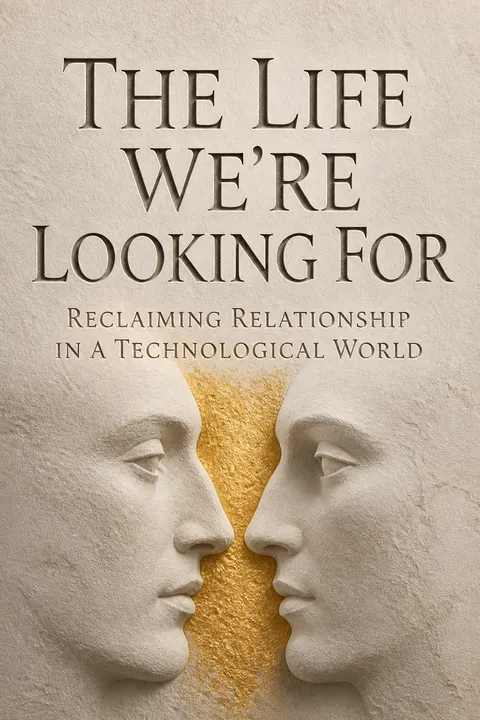

Key Takeaways
1. Recognition is the primary human quest, yet personalization has replaced personal connection
The personalized world of the screen somehow held a power over his attention that the child before him did not—even as she cried, "No! No! No!"
The quest for recognition. From the moment of birth, human infants seek out faces to establish mutual recognition, a process essential for developing a sense of self. When this recognition is denied, as demonstrated in Edward Tronick's "still face" experiments, children quickly experience emotional dysregulation and distress. We are wired to look for a face that looks back at us with undivided attention, confirming that we are known and loved.
Personalization versus personal. Our modern digital landscape offers highly personalized experiences—algorithms that curate feeds, target ads, and even mimic human handwriting. However, personalization is fundamentally impersonal because it is driven by machines or systems that treat us as data points rather than unique souls. A personalized letter from a machine is a convincing forgery of care, designed to exploit our preferences rather than engage our personhood.
The cost of convenience. This simulated recognition is alluring because it places our desires at the center of the universe without the vulnerability and unpredictability of real human relationships. We trade the difficult, rewarding work of loving real people for the frictionless comfort of screens, resulting in an epidemic of profound loneliness.
- Infants spend their first hours in "quiet alert" searching for a face.
- Personalization is transactional and designed to exploit our attention.
- True personal connection requires mutual vulnerability and cannot be automated.
2. We are heart-soul-mind-strength complexes designed for love, not isolated individuals
Every human person is a heart-soul-mind-strength complex designed for love.
The Shema's ancient wisdom. Drawing from the ancient Jewish Shema and its expansion by Jesus, human personhood is best understood as an integrated, multi-dimensional reality. We are not merely disembodied brains or physical machines; we are a unified complex of desire, interior depth, intellect, and physical capability. To be fully human is to engage all of these dimensions simultaneously in the pursuit of loving God and our neighbors.
Contemplation over exploitation. To treat others as persons requires contemplation—beholding their intrinsic dignity as "image bearers" without regard for their immediate usefulness to us. In contrast, our fast-paced, transactional economy encourages exploitation, reducing human encounters to mere convenience and efficiency. When we pause to contemplate the faces around us, we restore the sacred boundary between "someone" and "something."
The path to wholeness. When we isolate these dimensions—such as focusing solely on mental stimulation while neglecting physical movement—we become lopsided and susceptible to deep relational and existential loneliness. True growth requires us to step out of our isolated, individualistic bubbles and enter into relationships of mutual dependence.
- Heart: Driven and drawn by desire and emotion.
- Soul: A unique, interior depth of self.
- Mind: Capable of reflection, memory, and understanding.
- Strength: Physical "muchness" and active engagement with the world.
3. The "superpower zone" trades our active human capacities for effortless, diminishing power
You cannot take advantage of a superpower and fully remain a person, in the sense of a heart-soul-mind-strength complex designed for love.
The illusion of superpowers. Technology promises us "superpowers"—the ability to exercise immense power with zero physical or mental effort, such as flying across continents or instantly accessing global information. While these capabilities are exhilarating, they require us to put essential parts of our humanity on hold, rendering our bodies passive and our minds distracted. We trade our active, embodied "muchness" for the passive comfort of the superpower zone.
Flow versus superpower zone. True human satisfaction comes from "flow," a state of deep engagement and effort where our skills are tested to their limits, leaving us with a sense of gratitude and peace. The superpower zone, by contrast, relies on dopamine-hijacking mechanisms that offer fleeting pleasure but leave us feeling hollow, addicted, and relationally bankrupt. When we exit the superpower zone, we are often met with irritability and a lingering sense of emptiness.
The physical toll. By avoiding physical and mental exertion, we adapt to a sedentary, screen-dominated lifestyle that atrophies our natural capacities. We become highly adapted to narrow, machinelike tasks but lose our overall adaptability and resilience as physical and relational beings.
- Superpowers offer effortless power but diminish our active agency.
- Flow requires vulnerability and effort, leading to genuine fulfillment.
- Dopamine pathways are hijacked by technology, preventing us from learning real reward.
4. Modern technology is driven by the ancient, power-seeking dream of magic and alchemy
At the heart of magic is the belief that, given the right code words—'abracadabra' being the schoolchild's imitation of the magician's incantation—a human being can gain unquestioned control of the forces at the heart of the cosmos.
The alchemical roots. Our obsession with technology is deeply connected to the medieval practice of alchemy and its quest for the philosopher's stone. The alchemists dreamed of unlocking hidden, esoteric forces to command nature, escape the limitations of the physical body, and achieve godlike status. This same dream animates modern Silicon Valley, where tech elites seek to transcend human biology and achieve digital immortality.
Magic as domination. Magic is fundamentally about standing over the world rather than standing under it in humble contemplation. When we treat our devices as magical objects that perform tasks without our effort, we adopt this ancient desire for absolute, impersonal control over our environment. This quest for magic inevitably leads us to treat other human beings as instruments of our will rather than as persons.
The sorcerer's trap. Like the sorcerer's apprentice who summoned a magical broom to escape labor, we find that the impersonal forces we unleash are incredibly difficult to control and ultimately master us. The spirits we summon through our screens cannot be easily banished, and they leave us drowning in a flood of distraction and alienation.
- Alchemy sought to transmute base metals to gold and achieve physical immortality.
- Magic seeks power without relationship, treating the world as an exploitable servant.
- True science approaches nature with humble delight rather than a desire for domination.
5. Mammon rules our world by promising abundance without dependence
What Mammon wants, above all, is to separate power from relationship, abundance from dependence, and being from personhood.
The power of money. Money is the ultimate engine of impersonal power, allowing us to secure goods and services without the messy entanglements of relationship or mutual obligation. While this transactional efficiency has generated immense material wealth, it has stripped our daily lives of the personal connections that sustain us. We can make a dozen purchases a day and never learn the name of a single person who served us.
The rival god. Jesus identified Mammon not merely as neutral currency, but as a spiritual force and a direct rival to God. Mammon's primary objective is to turn a world made for and stewarded by persons into a world made of and reduced to exploitable things. It promises us that we can have everything we want without ever having to depend on anyone else.
Aligning technology with profit. Under Mammon's influence, technology is developed primarily to generate economic profit rather than to support ordinary, healthy human existence. When we serve Mammon, we allow our tools to isolate us, trading the rich, demanding life of personal relationship for the weightless convenience of transaction.
- Money promises abundance without the vulnerability of dependence.
- Mammon seeks to put all persons into the service of things.
- Personal technology can buck this trend by facilitating real-world neighborly care.
6. Artificial intelligence will succeed technically but fail to change the human condition, leaving us with "boring robots"
Every attempt to implement machine learning will come at the cost of removing features of personhood from the world.
The "boring robots" scenario. Despite sensational predictions of a technological singularity where machines surpass human intelligence, the future of AI is far more likely to be mundane. AI will continue to succeed in automating routine, narrow tasks, but it will ultimately fail to replicate the embodied, emotional, and common-sense intelligence of a human being. Our advanced machines will simply recede into the background as one more set of boring devices.
The cost of automation. To make environments suitable for autonomous machines, we are forced to make our world more machinelike and inhospitable to humans. We see this in the creation of sterile interstate highways and the reduction of complex human emotions to binary "likes" on social media platforms. We adapt ourselves to the limitations of our machines, flattening our own personhood to generate clean data.
Toil behind the magic. Behind every seemingly magical technology lies a hidden army of human laborers treated like robots. From content moderators exposed to psychological trauma to gig-economy drivers monitored by algorithms, Mammon uses human beings as cheap, flexible components to keep the magical machine running.
- True intelligence is embodied and inseparable from emotion and social connection.
- We are already "cyborgs," voluntarily embedding ourselves in digital systems.
- Content moderators and gig-economy drivers endure grueling toil to maintain the illusion of technological magic.
7. We must transition from passive "devices" to active, skill-demanding "instruments"
Instruments expand the capacity of human beings without shrinking other parts of us at the same time.
Devices versus instruments. Albert Borgmann distinguished between "devices," which displace human skill and replace personal engagement with passive consumption, and "tools." When we upgrade tools to high-tech "instruments," we use advanced technology to re-place ourselves as active, creative agents in the physical world. Unlike devices, instruments require our full heart, soul, mind, and strength to operate, leaving us deeply engaged with reality.
The four promises of technology. Every technological advance comes with a double-edged sword of four distinct promises and threats. While devices emphasize the relief of labor, they silently rob us of our capacities and enforce new, coerced behaviors. Instruments, however, expand our capabilities without demanding that we sacrifice our active, embodied skills.
Reclaiming the mind's bicycle. Steve Jobs famously called the computer a "bicycle for our minds," a metaphor for a tool that amplifies human power without replacing human effort. We must demand that our digital tools function as instruments of wonder and creativity rather than as devices of distraction and passivity.
- Promise 1: "Now you'll be able to..." (expanded capacity).
- Promise 2: "You'll no longer have to..." (reduced toil).
- Threat 3: "You'll no longer be able to..." (atrophied skill).
- Threat 4: "Now you'll have to..." (enforced behavior).
8. The household, not just the nuclear family, is the essential social architecture for personhood
A household is a community of persons who may well take shelter under one roof but also and more fundamentally take shelter under one another’s care and concern.
The definition of a household. A household is a localized community of mutual provision and dependence that extends far beyond the modern, isolated nuclear family. It is a place where assets and liabilities are shared, and where individuals are deeply seen, known, and held accountable. In a household, we are forced out of our individualistic isolation and into the messy, life-giving reality of shared daily rhythms.
The canopy of trust. Households provide a "canopy of trust," a safe environment where we can let down our guard, take creative risks, and experience the healing cycle of conflict and forgiveness. Without this physical and relational shelter, we are left to navigate a highly competitive, transactional world entirely on our own. The household is the primary school where we learn how to trust and be trustworthy.
Redesigning our spaces. Reclaiming personhood requires us to intentionally shift our social and physical architecture away from isolation and toward shared life. We must resist the temptation to build larger, more private homes filled with individual screens, and instead create spaces that invite hospitality, collaboration, and intergenerational connection.
- Households are sized perfectly for the mutual recognition we crave.
- The nuclear family is often too small and fragile to sustain personhood alone.
- Modern "stroads" and suburban zoning laws actively discourage household-scale community.
9. True flourishing is found in blessing the "unuseful" rather than living a charmed, transactional life
If those who cannot earn money, and perhaps are not even able to spend it, are of the greatest value, then we, too, can be free from serving it.
Charmed versus blessed. To live a "charmed" life is to exist in a temporary bubble of privilege, beauty, and ease, protected from the harsh realities of suffering. "Blessing," however, is found at the limits of our humanity—in the midst of grief, illness, and death, where love is made tangible and real. When our charms inevitably fail, we are invited to discover the deeper, unshakable reality of being blessed.
The community of the unuseful. Mammon values people solely for their economic utility and productivity. By building our households around the "unuseful"—the disabled, the elderly, the very young, and the marginalized—we break free from Mammon's grip and learn to love unconditionally. These vulnerable individuals are not burdens to be managed; they are our teachers, showing us how to be persons without having to prove our usefulness.
The chain of love. Our existence is sustained by an unbroken chain of personal care stretching back through generations. By choosing to love the vulnerable, we join this sacred chain, passing on the blessing of recognition and care to a world desperate for real relationship.
- Leprosy colonies and communities of the disabled teach us the true meaning of Christ's body.
- The runaway slave Onesimus was transformed from "useful" property to a beloved brother.
- Only by embracing the vulnerable do we discover the life we are truly looking for.
Review Summary
People Also Read





About the Author
Download PDF
Download EPUB
.epub digital book format is ideal for reading ebooks on phones, tablets, and e-readers.








































