


Plot Summary
Prologue
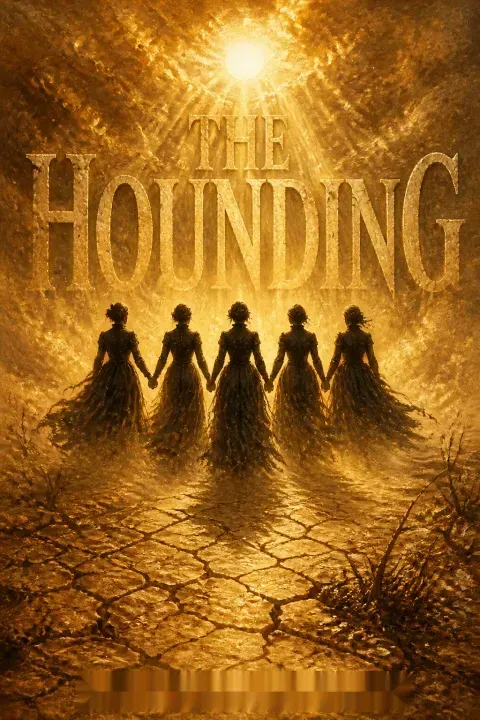
A mob of villagers marches up the river path toward five black-clad girls. They carry stones and wear gaudy ribbons. A dead man lies at the sisters' feet, a bite mark blooming blood across his fist. The villagers chant the names: Anne,1 Elizabeth,7 Hester,8 Grace,9 Mary.10 They tell themselves they have nothing to fear from wicked girls with hidden tails and pointed teeth.
The drought has cracked the earth, shriveled the river to a bed of husks and bones. But today the shared enemy unites them, shoulder to shoulder, righteous and vengeful. The sisters stand silent, watching them come. Some say Anne1 was the first to change, barking in the barren lane. Then it spread like contagion through the rest.
This opening flash-forward functions as both prophecy and verdict. By showing the climax first, the novel forces us to read everything that follows as inevitable, a slow tightening toward this riverbank reckoning. The mob's psychology is laid bare: economic grievance (failed crops, shallow wells) has fused with supernatural terror, and the sisters serve as convenient vessel for both. The chanting of their names is an exorcism disguised as a reminder of their humanity. Purvis also seeds the central ambiguity here: did the sisters actually transform, or did the village project its fears onto five grieving, unconventional girls? The answer remains suspended, unresolved, throughout the novel.
Anne Wades Ashore
Pete Darling2 lives with a private conviction that he is chosen. An angel once stepped onto his punt, luminous and fleeting. But the five Mansfield sisters offer him no such reverence. They step aboard in their mourning black, silent as winter trees.
He asks friendly questions about their dead grandmother. They ignore him. Enraged at being unseen on his own ferry, Pete2 stops punting mid-river. The boat drifts. Anne, the eldest,1 slides into the shoulder-deep water and wades to the far bank through weeds and current.
She has shamed him completely. Back at the Swan, Pete2 nurses his grudge. Soon after, when villagers haul a giant sturgeon from the shrinking river and the sisters try to push it back, Pete2 stamps his boot on the creature's head. His hatred has found its shape.
Pete's psychology is a study in the violence that erupts when male entitlement meets female indifference. His self-image as a man blessed by heaven depends entirely on external validation. Anne's refusal to perform gratitude or deference strips him of that mirror, and his response is not mere anger but a kind of existential panic. The wading scene is brilliantly doubled: Anne literally steps into the river, the domain Pete considers his kingdom, and proves she does not need him. The sturgeon episode extends this dynamic into communal territory: the girls' compassion for a dying creature is read as defiance of village authority. Pete's boot on the fish's head is a rehearsal for everything that follows.
A Farmhand Bewitched
Thomas Mildmay3 arrives in Little Nettlebed for the haymaking season. At the alehouse, Pete2 warns him: the Mansfield sisters are prideful, wild, not like other folk. Thomas3 shrugs and crosses the river. At the farm, he meets all five at dinner. Elizabeth,7 pretty and soft. Hester,8 boyish and freckled.
Grace,9 anxious and watchful. Mary,10 gap-toothed and staring. And Anne, the eldest:1 plain-faced, ancient-seeming, whose eyes met his from an upper window before she appeared. When their gazes lock across the table, Thomas3's body stops working. His insides leap like a salmon.
He tells himself she is the ugliest of the five, but she is the one he cannot stop watching. Later, Hester8 tricks him into descending a well to rescue a kitten that was never trapped. Hauling himself up the slick rope, Thomas3 begins to understand the ferryman2's warning about these strange sisters.
Thomas's instantaneous enchantment operates on the logic of fairy tale rather than realistic romance. He sees Anne and is claimed, the way a mortal might stumble into a fairy ring and lose all desire to leave. His conviction that she is ugly, followed by his gradual recognition of her beauty, mirrors the village's own perceptual shift: what seems ordinary or even off-putting about the sisters becomes, under the pressure of obsession, something otherworldly. The well prank establishes an important dynamic: the sisters are not passive victims but active agents who test, trick, and sometimes humiliate the men who enter their orbit. Thomas passes the test by accepting humiliation without resentment, which separates him decisively from Pete.
Five Girls, Five Dogs
At dusk, Pete2 watches five black-clad figures pick their way along the far riverbank. The Mansfield sisters, unmistakable. Then something shifts. He sees their bodies drop to all fours, mouths extending into snarling jaws, fur sprouting from pale skin. They bark, a deep hacking sound that carries across the darkening water.
When Temperance4 finds him on the bank, his face is bloodless. He swears he saw five girls turn into five dogs before his eyes. She makes him promise not to spread the story, but Pete2 cannot contain it. At his betrothed Agnes12's house, he describes the transformation in lurid detail.
Agnes12 gasps, thrilled and horrified, and promises to tell her father. The story slips its leash. Within days, villagers add embellishments: the girls always had sharp teeth, their eyes always glowed amber in certain light. Pete2's private vision becomes public truth.
The novel refuses to resolve whether Pete's vision is supernatural reality, alcoholic hallucination, or deliberate fabrication. This epistemological slipperiness is the book's central formal gambit. By narrating the transformation from Pete's point of view with full sensory detail, Purvis implicates the reader in the very act of believing. The story's spread follows the classic mechanics of rumor: each retelling adds specificity, each listener becomes a co-author. Temperance's attempt to contain the story and Agnes's eagerness to amplify it map neatly onto two gendered responses to toxic information. But the crucial detail is Pete's need for the story to be true: his entire identity as a chosen witness depends on it.
The Devil in the Orchard
Robin Wildgoose6 hears the story from the baker's wife and feels cold. He remembers the night of the badger baiting: the barking he heard after he left Anne1 and Elizabeth7 on the dark road, and Pete Darling2 stalking from the same direction moments later.
He wants to disbelieve. But his mother's hens are found slaughtered, their feathered bodies scattered on the grass. She blames dogs. Richard,11 Robin6's younger brother, parrots schoolmaster Tubb's theories about possession. Then the vicar13 visits Mansfield's farm.
In the orchard, a trick of late-afternoon light falls across Anne1's face, and the vicar13 sees something monstrous. He stumbles away convinced the devil is at work. His authority sanctifies the rumor. The village no longer whispers. It declares.
Robin occupies the novel's moral center: he has direct evidence of Pete's suspicious behavior on the night of the barking, yet his gentleness and self-doubt prevent him from acting on it. His paralysis is the paralysis of the good person in a system trending toward violence. The vicar's confirmation is the tipping point, and Purvis handles it with devastating irony: the 'proof' is literally a trick of light, but it arrives wrapped in ecclesiastical authority, so it becomes unassailable. The slaughtered hens function as a tutorial in confirmation bias: any dead animal becomes evidence for the rumor's truth, because the rumor has already supplied the verdict. Facts are now arranged to support the story, not test it.
The Howling Examination
Mansfield5 summons a young Oxford doctor, John Friend,14 hoping to prove his granddaughters are ordinary. Thomas3 waits in the yard, his stomach churning. Through the walls, he hears it begin: a sound like a pack of hounds, rising from five throats. The sisters are howling, not crying, not speaking, answering each other in turn.
Inside, the doctor14 takes their pulses and asks them questions they do not answer in words. When Thomas3 is called to carry the girls to their rooms, he finds them collapsed in a heap on the floor, pale and exhausted but also, somehow, satisfied.
Mary10 gives him a disgusted look, as though he interrupted a game. The doctor14 diagnoses a nervous disorder, erratic animal spirits, hysteria. He prescribes rest and confinement. Mansfield5 locks his granddaughters in their bedrooms. The rumor should be dead. Instead, the howling confirms everything the villagers already believe.
The howling scene is the novel's most unsettling sequence because it refuses to resolve into either diagnosis or supernatural event. The girls could be performing, seizing on the doctor's expectations and giving him exactly the spectacle he came to witness. Or they could be genuinely convulsed by something beyond medical understanding. Purvis's genius is that both readings are equally supported and equally horrifying. The doctor's diagnosis of hysteria, with its language of 'erratic animal spirits,' is simply the educated man's version of the villagers' demon theory: both seek to pathologize female behavior that resists easy categorization. The confinement that follows is ostensibly medical but functionally carceral, and it accelerates the tragedy.
Secret Hands in the Hayfield
Connie and Amie,15 the maids, pack their belongings and flee to London. They will not risk contagion, nor the village's growing hostility. Thomas3 alone remains, sleeping in the stable, bringing food to the barricaded doors. He becomes the sisters' sole link to the outside world.
In stolen moments, Anne1's resistance to him softens. Her hot hands, her guarded smiles, her habit of eating cherries with savage abandon: each detail fuels his devotion. One evening during haymaking, Robin Wildgoose6 glimpses them at the field's edge: Thomas3's fingers tracing the back of Anne1's hand, her face turned up to his.
The sight shocks Robin6 like staring at the sun. If the village knew that the eldest dog-sister1 had seduced the farmhand,3 the fury would be incinerating. He keeps the secret, but dread pools in his chest. The drought deepens. The river shrinks to a trickle. The village bakes, and tempers thin.
The love story that develops inside the siege is the novel's counterweight to its horror. Thomas and Anne's relationship is rendered with an almost painful tenderness, all the more affecting because it unfolds in stolen glances and brief touches while the walls close in. Their love is both a refuge and an accelerant: it gives Thomas a reason to stay when he might have fled, and it provides the emotional logic for his eventual sacrifice. Robin's accidental witness is a masterful piece of dramatic irony: he sees something beautiful and immediately understands it as dangerous, because he knows how the village will weaponize it. The departure of the maids marks the point where the household ceases to function as a household and becomes a fortress under siege.
The Slaughtered Animals
Young Richard Wildgoose11 comes to the alehouse with a story for Pete Darling.2 He crept out at night and saw five large dogs running near the hayfields. On his way home, he noticed the Mansfield farm's gate standing open and candles burning in the upstairs rooms where the girls are supposedly confined.
Pete2 seizes the report like a gift. The next day, Samuel Tubb arrives with worse news: scores of dead animals, rabbits and pigeons and even a young fallow deer, torn and scattered along the hedgerows. Every dog in the village is locked up that afternoon, but the howling continues.
The logic tightens like a noose: the girls transform at night, slip through their windows, and kill. Temperance4 tries to argue for reason. No one listens. The village has found its witches, and a summer without rain demands a sacrifice.
Richard's report is the novel's most chilling illustration of how decent people become instruments of persecution. He is not malicious; he is a boy flattered by adult attention, telling a story he half-believes. But his testimony becomes the crucial link in the chain of 'evidence.' Purvis understands that witch-hunts are not driven by evil masterminds but by ordinary people making small, self-serving choices: Richard wants to impress Pete, Pete wants to be right, Tubb wants to be the bearer of important news. The mass animal deaths are left genuinely unexplained, which makes them more terrifying than any revelation could. They could be the work of actual dogs, or something stranger; what matters is how quickly the village assimilates them into its preexisting narrative.
Barking at the Wedding
Pete2 wakes on his wedding morning dreaming of rain. He drinks to steady himself for the ceremony, then pauses on the riverbank hoping for a sign. The angel appears to him again, a shimmer of white light, confirming his righteousness. He walks to the church assured of God's favor.
But during the vows, a sound cuts through the stone walls: barking, wild and mocking. The congregation freezes. Pete2 breaks from Agnes12's side and charges outside. Through the dry riverbed he pursues the sound, Robin6 and Richard11 swept along in the crowd.
They find the five sisters beneath a willow, Thomas3 beside them. Pete2 thrusts out his wounded hand: a row of bleeding punctures. Anne Mansfield1 bit him, he declares. He rolls up his sleeves. The girls have ruined his wedding, and now they will pay.
The wedding-day climax is engineered with the precision of a classical tragedy. Pete's second angelic visitation, occurring on the morning of his marriage, convinces him he is acting as God's instrument. The barking that interrupts the ceremony is never sourced: it could be the sisters, a stray dog, a prank, or collective auditory hallucination. What matters is that Pete interprets it as a personal attack and responds with violence. The wound on his hand functions as stigmata in reverse: a self-inflicted or accidental injury that he immediately imbues with cosmic significance. Purvis uses the dry riverbed as a stage for the final confrontation, a landscape stripped of its living water, mirroring the moral desiccation of the community.
Robin's Three Stabs
Pete2 lunges at Thomas,3 his broad hands closing around the farmhand's throat. The girls scream. Hester8 pulls a small knife she uses for cutting apples. Richard11 twists it from her grip, then freezes. Robin6 sees his brother11's terrified face, sees Thomas3's lips turning blue.
Something in him breaks. He snatches the knife from Richard11 and plunges it into Pete2's back, once, twice, three times, the blade sliding through cloth and flesh like soft dough. Pete2 releases Thomas,3 staggers around, and fixes Robin6 with a bewildered stare.
He asks about the angel. Then he falls. Robin6 drops the knife and begins to sob. Before the approaching mob can reach them, Thomas3 steps forward and raises his voice. He killed Pete Darling,2 he announces, because he loves Anne Mansfield1 and would not let the ferryman2 destroy her.
Robin's act of violence is the novel's central moral paradox: the gentlest character commits the most brutal act, and it is presented as both inevitable and righteous. His three stabs are not a descent into savagery but an eruption of protective instinct that shatters his carefully constructed passivity. Purvis frames it as a kind of birth: the person Robin truly is emerges from the shell of the person he has been pretending to be. Thomas's immediate decision to claim responsibility is the book's most moving gesture of love, but it also completes the sacrificial logic that has been building all summer. A scapegoat is required, and Thomas offers himself. His confession is a lie that tells a deeper truth: he would have killed Pete if he could have, and he would die for Anne without hesitation.
A Razor Shell Gift
Temperance4 has spent her life avoiding the ale that killed her father, pulling on hide gloves before touching any tankard. But the morning of Pete2's death, something cracks. Alone in the empty Swan, she pours herself a pint, then another.
The drink fills her with warmth and courage she has never known. She staggers across the dried riverbed to the Bullocks' house, where Thomas3 is bound with wedding ribbons in a dark parlour. Bribing the guard with promises of free ale, she sits across from the young man. He confesses the truth: Robin6 killed Pete.2
He took the blame to protect the gentle boy6 and the sisters he loves. Temperance,4 fumbling in her apron pocket, pulls out a razor-sharp shell she picked from the riverbed that morning. She lets it clatter to the floor, then stumbles back into the blinding sun.
Temperance's drunk scene is the novel's most subversive liberation narrative. Her lifelong abstinence has been a form of self-punishment for her father's sin, a refusal to inhabit her own body and its desires. Her surrender to drink is not a fall but an awakening: it unlocks the courage to act on the moral convictions she has always held but never voiced. The shell gift is a perfect symbol: a remnant of the living river, sharp enough to cut through bonds, offered by a woman who has finally stopped trying to be the village's conscience and has become its saboteur instead. Temperance and Thomas's brief communion in the dark parlour is one of the book's few moments of genuine solidarity between people who see the truth.
Joseph Sees at Last
Joseph Mansfield5 goes to bed heartsick, his granddaughters lying to him, a mob gathering in the village. In the night he wakes to a miracle: his sight has returned, sharp and luminous in the blue moonlight. He wanders the silent house and finds the bedrooms empty, the beds undisturbed.
At the window, he looks down into the silver orchard and sees them. Five dogs, panting and tall, circling beneath the apple trees. A golden-haired boy3 crouches among them. Then they run, leaping the stone wall, disappearing into the wooded darkness.
Joseph5 shouts for them to come back, but they do not hear, or they no longer know human words. He sobs, then discovers a strange gladness: they are not damaged girls but fierce, powerful creatures, and they are free. A cloud passes across the moon. He smells rain.
This final vision is the novel's most daringly unresolved passage. Is Joseph actually seeing his granddaughters transformed, or is his miraculously restored sight providing a consoling metaphor for their escape? Purvis refuses to decide, and the refusal is the point. What matters is Joseph's acceptance: he would rather they were dogs than damaged girls, rather they were free than confined by his protection. The golden-haired boy (Thomas, escaped with Temperance's shell) confirms that the sacrifice was not futile. The long-awaited rain that finally arrives is both literal relief from drought and symbolic cleansing: the season of strangeness is over, but at immense cost. The mob will arrive in the morning to find an empty house. The girls have become what the village feared, and in doing so, they have won their freedom.
Analysis
The Hounding operates as a slow-motion witch trial, set in the liminal period when supernatural explanations for female behavior were beginning to give way to medical ones, but the underlying impulse to control and pathologize women remained unchanged. Purvis constructs her tragedy with the inexorable logic of a folktale: a drought, a dead grandmother, five unconventional sisters, and one resentful man2 whose fragile ego becomes the match that lights the pyre. The novel's great formal achievement is its epistemological restraint. We never learn definitively whether the Mansfield sisters actually transform into dogs. The question is unanswerable by design, because the novel's subject is not the supernatural but the social: how communities manufacture monsters, how stories become evidence, and how the vulnerable are sacrificed to restore a sense of order. The multiple POV structure distributes responsibility across the entire village. Pete2 is the obvious villain, but the tragedy requires the vicar13's theological authority, Agnes12's appetite for gossip, Richard11's hunger for adult approval, Robin6's paralyzing gentleness, and dozens of smaller complicities. Even sympathetic characters like Temperance4 and Joseph5 are implicated in their failure to act sooner or more decisively. The drought functions as both literal setting and moral metaphor: a community starved of compassion will eventually consume itself. When rain finally arrives, it is not redemption but aftermath. The girls have fled, transformed into whatever they needed to become to survive. The novel ends not with justice but with absence: an empty house, a coming storm, and the terrible freedom of being hunted into becoming something else.
Review Summary
The Hounding by Xenobe Purvis receives mixed reviews averaging 3.69/5 stars. Set in 18th-century England, it follows five sisters rumored to transform into dogs, told through villagers' perspectives but never the sisters' own. Readers praise the atmospheric writing, feminist themes, and exploration of misogyny and scapegoating. Comparisons to The Virgin Suicides and We Have Always Lived in the Castle are frequent. Critics note the blunt metaphor, predictable plot, and lack of nuance. Many appreciate the debut's lyrical prose and commentary on female persecution, though some find it slow-paced with heavy-handed dialogue and an unsatisfying ending.
People Also Read








Characters
Anne Mansfield
Fierce eldest sister, reluctant matriarchThe eldest of the five Mansfield sisters, bearing the weight of her grandmother's death and her grandfather5's blindness. Her face is thin, pale, ancient-seeming, not conventionally pretty but radiating a magnetic intensity that ensnares Thomas3 on sight. She manages the household accounts, tends her grandfather5's failing eyes, and mediates her sisters' conflicts with a composure that villagers mistake for arrogance. Her pride is not vanity but armor: she refuses to perform deference for men who demand it. Beneath the cold surface is a capacity for savage, sacrificial love. She will not bow, will not apologize, will not run until running is the only way to save her family.
Pete Darling
Self-righteous ferryman, architect of ruinThe ferryman of Little Nettlebed, an alcoholic who believes an angel once visited his punt, confirming his election by God. His self-image as a chosen, powerful man depends entirely on external validation, and the Mansfield sisters' indifference unhinges him. His hatred of women who defy him curdles into obsession. Whether his vision of the girls transforming into dogs is hallucination, drunken delusion, or genuine supernatural witness is left ambiguous. What is certain is that his story, once loosed, becomes the engine of tragedy. He is both villain and symptom: a product of a world that teaches men their honor depends on female submission.
Thomas Mildmay
Devoted farmhand, Anne's protectorA young farmhand who arrives in Little Nettlebed practical, unromantic, and indifferent to girls. Then he meets Anne Mansfield1. His transformation is instantaneous and total: he cannot stop thinking about her face, her voice, the way she eats cherries with savage abandon. He becomes her willing servant, then her lover, then the man who will sacrifice his freedom to protect her and her family. His devotion is presented not as folly but as the most honest expression of his character. He is guileless, brave, and ultimately the fulcrum on which the entire tragedy pivots.
Temperance Shirly
Alehouse keeper's wife, secret rebelThe publican's wife, who wears leather gloves to handle tankards because she cannot bear the touch of the drink that killed her father. She is the sharpest observer of village life, a collector of secrets, and one of the few people who sees the Mansfield sisters as victims rather than monsters. Her moral awakening comes late and through paradox: getting drunk for the first time in her life liberates her to act on her long-suppressed conscience. She is warm, funny, deeply lonely, and unexpectedly brave when it matters most.
Joseph Mansfield
Nearly blind patriarch, helpless guardianThe sisters' grandfather, whose eyesight has deteriorated to shapes and shadows while his other senses have sharpened. He raised his granddaughters after their parents died, and his love for them is total. But love cannot see the threats gathering, cannot stop the rumors spreading, cannot keep the girls from transforming into something beyond his understanding. His arc is one of tragic acceptance: the dawning recognition that his protection has become a prison, and that his granddaughters' freedom requires him to let them go.
Robin Wildgoose
Gentle farmhand, unwilling killerA young farmhand who loves animals, despises the baiting and brawling that other men enjoy, and has spent his life learning to disguise his gentleness as manliness. He serves as the novel's moral barometer: he knows more than he says, feels more than he shows, and his essential goodness is what ultimately makes him capable of the story's most violent act. His relationship with his younger brother Richard11 forms the emotional spine of his arc, as he watches the boy being seduced by Pete2's toxic model of masculinity.
Elizabeth Mansfield
Pretty second sister, reluctant dreamerThe second Mansfield sister, fifteen, whose beauty is both gift and burden. She dreams of London, of fine dresses and wider horizons, but her vanity masks real loyalty and depth. She is the first to cry, the first to forgive, and the one who will tell her grandfather5 the truth when her sisters will not. Her sobbing in the cherry orchard signals that something terrible has already happened to the family, something the novel only gradually reveals.
Hester Mansfield
Wild tomboy sister, family's furyThe third sister, thirteen, boyish and freckled, who climbs trees, plays with knives, and receives the onset of menstruation as a personal betrayal. She is the family's id expressed aloud: her rage at the world's limitations on girls is everyone's rage, and she refuses to disguise it. Brave to the point of recklessness, she is the sister most likely to fight back, and the one whose knife will become the instrument of both salvation and death.
Grace Mansfield
Anxious fourth sister, family's conscienceThe fourth sister, eleven, watchful and nail-bitten, prematurely aged by worry. Of all the sisters, she understands most acutely the danger they are in. She is the family's early-warning system, but her anxiety is so constant that the others have learned to dismiss it. Her confession to Thomas3 about the doctor14's visit marks a crucial breach in the family's fortress of silence.
Mary Mansfield
Baby sister, truth-teller in gamesThe youngest sister, six years old, gap-toothed and imaginative. She processes trauma through play: she is a cat, Thomas3 is a moon person, and the family's secrets slip out through her games in ways the adults miss. Her relationship with Thomas3, built on shared fictions, provides some of the novel's few moments of uncomplicated warmth.
Richard Wildgoose
Easily influenced younger brotherRobin6's twelve-year-old brother, teetering on the brink of adolescence. He adores Robin6 but is drawn to the performative masculinity that Pete Darling2 offers. His report of seeing five dogs, extracted by Pete2's flattery and free ale, becomes crucial evidence against the Mansfield sisters. His arc is one of seduction and potential redemption: a boy learning what kind of man he will become.
Agnes Bullock
Pete's vain betrothedNearly thirty, spoiled and silly, obsessed with porcelain and beauty. She accepts Pete2's proposal because she fears spinsterhood, not because she understands him. Her eagerness to spread Pete2's story about the Mansfield girls accelerates the tragedy.
The Vicar
Wounded clergyman, rumor's authorityReverend Kennett, who wears a velvet patch over the hole in his skull from a shooting accident. His own physical brokenness mirrors his theological rigidity. His 'confirmation' of the rumor transforms village gossip into religious truth.
Dr. John Friend
Young Oxford doctor, rational investigatorA physician from Oxford who examines the Mansfield sisters hoping to document a curious case. His diagnosis of hysteria caused by erratic animal spirits is both progressive (rejecting demonic theories) and patronizing (pathologizing the sisters' behavior). His prescription of rest and confinement becomes the medical justification for their imprisonment.
Connie and Amie
The Mansfield maids who fleeSisters themselves, golden-haired, who work in the Mansfield household. Connie is sharp, practical, and fearful. Amie is gentle, pockmarked from childhood illness, and genuinely loves the girls. Their departure for London marks the point where the household's defenses collapse.
Plot Devices
The Drought
Shrinking river, shriveling mercyAn unseasonable, unrelenting heat wave that dries up the Thames over the course of the summer. The river shrinks from a flowing barrier to a muddy trickle to a bed of cracked stone and stranded fish. This environmental catastrophe serves multiple functions: it eliminates Pete2's livelihood and intensifies his desperation, it creates a literal pathway for the villagers to cross and confront the sisters, and it functions as an objective correlative for the community's moral desiccation. The drought also generates apocalyptic anxiety: failed crops, empty wells, and dead animals all feed the village's hunger for a scapegoat. When rain finally comes at the novel's end, it signals both natural renewal and the irreversible change that has already occurred.
The Angel Vision
Pete's proof of divine favorPete Darling2's repeated claim that an angel once boarded his ferry and later reappeared to bless his wedding day. No one else witnesses these visitations; they exist solely in Pete2's account. The angel functions as the psychological foundation of Pete2's monstrous self-righteousness: if heaven has chosen him, then anyone who opposes him is opposing God. The vision's ambiguity (divine message or alcoholic hallucination) mirrors the book's larger epistemological uncertainty. Pete2 dies asking about the angel, receiving no answer.
The Sturgeon
Royal fish, moral test, omenA giant sturgeon, ten to eleven feet long, beached in the shrinking river early in the summer. The villagers haul it out and butcher it for a feast. The Mansfield sisters try to push it back to the water and fail. Pete2 stamps on its head with his boot. The sturgeon is a royal fish, belonging by law to the Crown, and its death is both a literal feast and a symbolic violation: the village consumes something sacred. The incident establishes the central moral divide: the sisters align with the living creature, the village with its exploitation. Its entrails are later dumped outside Mansfield's gate as an insult.
Hester's Knife
Apple knife becomes murder weaponA small knife that Hester8 carries for cutting apples. During the climactic riverside confrontation, Richard11 takes it from her, then Robin6 seizes it from Richard11 and stabs Pete2 three times. The knife's journey from domestic tool to murder weapon traces the path of the novel's violence: ordinary objects become lethal when placed in desperate hands. Its smallness matters: this is not a soldier's weapon but a girl's tool, and its use by the gentlest character6 in the book makes the killing both more intimate and more tragic.
The Razor Shell
River remnant becomes escape toolA sharp clam shell that Temperance4 picks up while crossing the dried riverbed on the morning after Pete2's death. She later drops it on the floor of the parlour where Thomas3 is bound with wedding ribbons, giving him a means to cut his bonds and escape. The shell is a fragment of the living river, the world that existed before the drought, and its gift from Temperance4 to Thomas3 completes her arc from passive observer to active ally. It represents the solidarity that exists between the marginalized: a woman who knows what it is to be trapped helps a man who sacrificed himself for love.
Download PDF
Download EPUB
.epub digital book format is ideal for reading ebooks on phones, tablets, and e-readers.








































