
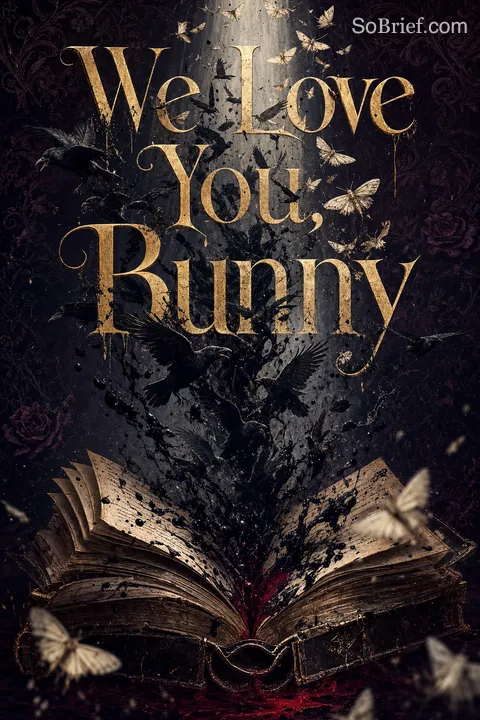


Plot Summary
Prologue
Two years after graduation, the four women who once shared an MFA cohort lure Samantha Mackey7 back to their old New England college town, where her debut novel about them is on tour. They spike her bookstore wine, bind her to a chair in Kyra's2 attic, and gather in rabbit masks beneath a Hunter's moon on Halloween.
An axe waits in the corner, flecked with old blood. They swear they will not kill her, probably. They only want to correct the story she got so wrong, taking turns speaking one by one under the workshop gag rule, forcing the once dominant Sam7 to finally sit still and listen to the tale of how they made something beautiful.
The frame weaponizes the seminar table itself: the gag rule, the taking of turns, the demand to be heard become instruments of captivity. Awad stages revenge as a reversal of narrative power, the silenced subjects seizing the pen from the author who reduced them to caricatures. The rabbit masks and rainbow dresses signal ritual rather than mere menace, and the promise not to kill is undercut by the bloody axe, establishing an unreliable, seductive collective voice. Beneath the menace runs wounded artistic vanity: they insist their creation predates and surpasses Sam, framing the whole novel as a defense of authorship, love, and the terror of being misread.
Four Become One Body
At Warren's Narrative Arts welcome party, Coraline1 arrives alone, clutching the razor she hides in her dress pocket, dreading the smug poets and vampiric faculty. She drifts toward Kyra2 in a grass-patterned dress, then Vik3 devouring pastries in filthy plaid, then silver-haired Elsinore4 beside their shared idol, the hybrid-fiction author Ursula Radcliffe.6
The four incoming Fiction students finish each other's sentences, wear matching white gloves, and sense an uncanny synchronicity. A white rabbit darts past unremarked.
By dawn Coraline1 and Kyra2 wake tangled together, dresses swapped, boundaries already dissolving into what they will call the hive mind. They came to Warren chasing Ursula's6 erotic novels, but they have found something stranger: each other, and the terrifying comfort of no longer being alone.
Awad renders belonging as contagion. These are wounded perfectionists, each fleeing a mocking mother or a scornful sibling, and their instant merger reads less like friendship than folie a quatre, a shared psychosis that soothes individual shame. The matching gloves and echoed whispers dramatize identity dissolution as both rescue and threat: to be known completely is to lose the self. The stray rabbit, ignored, plants the engine of everything to come. The satire of MFA pretension (conceptual eyeglasses, French theory) sharpens the loneliness underneath, showing how institutions of art manufacture the very desperation for approval they claim to refine.
The Man From Their Nightmares
On the first day in the black-box theater they call the Cave, the four expect Ursula6 and instead get Allan,8 a tattooed Scottish horror novelist substituting while Ursula6 takes a research fellowship. He makes Coraline1 read her precious two-page story aloud, then dismantles it line by red-inked line while she presses her razor until her finger bleeds through her pocket.
Devastated, she sobs in the rose garden that she wants to kill him. Kyra,2 half joking, offers to do it with her; Vik3 and Elsinore4 gather round, echoing the wish until it hums through all four like a shared pulse. A common enemy welds the group tighter, and the phrase that will drive the entire novel, kill Allan, is born somewhere between venting and vow.
Awad locates horror in the ordinary cruelty of critique. Allan's red pen becomes literal violation, and the girls' disproportionate rage exposes the fragile, grandiose self at the heart of the aspiring artist, for whom feedback registers as annihilation. The scene satirizes workshop culture as a theater of exposure and shame, but it also seeds tragedy: a careless collective fantasy, spoken aloud in a hive-minded state, acquires a life its speakers never intended. The wish to kill is really a wish to be seen as worthy, redirected outward, and its casual utterance will later cost innocent men their heads.
The Bunny's Eyes Turn Blue
Raw from Allan's8 evisceration, the girls meet a white rabbit in the rose garden that hops willingly into their arms. As Coraline's1 cut finger drips onto its fur and their collective tears fall, its dark eyes brighten to the pale blue of her sky dress. All four embrace the creature at once; the change feels like proof they are magic.
The rabbit bolts, but something irreversible has begun. When they beg Ursula6 at her home to become their teacher, she refuses, instead delivering a cryptic sermon: form your own creative crucible, make the word flesh, trust that the collective can rewrite the laws of the world. They leave her witchy living room taking the riddle as a dare, as permission, as prophecy.
Inspiration arrives here as accident, blood, and grief rather than discipline, dramatizing the Romantic myth that creation is possession rather than labor. The changing eyes literalize the artist's fantasy of altering reality by sheer feeling. Ursula functions as oracle and enabler, her deliberately unfalsifiable mysticism (make the word flesh) granting the girls license while absolving her of responsibility. Awad skewers the guru-mentor who mistakes evasion for wisdom. The scene also establishes the novel's central conflation: for these women, writing and world-breaking are indistinguishable, and metaphor is never merely metaphor.
Something Explodes in the Attic
Following the rabbit to Kyra's2 attic, the four light candles and incense, project a flickering film, cue their playlists, and encircle the trembling creature. Their minds lock into one throbbing frequency, each silently conjuring the lovers and beasts she craves in the pink fog of the hive mind. The pressure swells past bearing until the rabbit simply detonates, spraying blood and entrails across the girls and the walls.
Horrified and thrilled, they realize their combined will can unmake a living thing. Elsinore,4 cradling a severed ear, declares there are no accidents, only a process they must learn to master. The attic becomes laboratory and temple at once, and the boundary between writing fiction and remaking flesh collapses entirely.
The explosion is orgasm and abortion fused, the group's repressed erotic and creative energy discharged catastrophically. Awad renders collaborative creation as literally combustible, a warning about the loss of individual conscience inside collective ecstasy. Elsinore's refusal to see accident, only meaning, marks the dangerous artist's compulsion to aestheticize destruction. The candles, incense, and film transform craft into cult, exposing how easily communal art-making curdles into ritual sacrifice. The severed ear, kept as a relic, foreshadows a worldview in which gore is simply the raw material of beauty, and in which the demand to master the process justifies any carnage.
A Man Made From Fur
Days later they discover the true fruit of their ritual: a tall, beautiful man standing barefoot in the garden, wearing Elsinore's4 torn nightdress and Coraline's1 pearls, clutching Coraline's1 razor and muttering that he must kill Allan. They name him Aerius,5 after the allergy-medicine box in his pocket. He is fully human, five-fingered, anatomically complete, unlike anything they will ever manage again.
When he proves wild, screaming, and unnervingly aware of their secret shames, they resolve to revise him: sliding their favorite novels and proems under the door, playing him melodramas and playlists, eventually tying him to a chair, straining to civilize their creation into loving them the way they need to be loved.
Aerius is Pygmalion inverted and multiplied: a beloved forced into being, then imprisoned for failing to adore his makers. Awad turns revision, the writer's sacred labor, into coercion and captivity, exposing the tyranny latent in the maker-made relationship. The girls' insistence on shaping him mirrors every author's fantasy of control over a character who insists on his own life. His knowledge of their shadow selves makes him unbearable, because a creation that truly sees its creators becomes a mirror rather than a possession. The chair and ropes render metaphor flesh again, indicting the violence of authorship dressed as love.
The Creation Jumps
For weeks the four keep Aerius5 bound, feeding him candy and grasses, begging him to say he loves them, thrilling only when he screams. He shreds their pages, refuses their food, and comes alive solely at their suffering. On Halloween, flustered by a name he spits at her, Vik3 ties his ropes too loosely. Aerius5 frees himself with the razor, seizes Kyra's2 axe, shatters the triangle window, and leaps into the night.
On the attic wall he leaves two words scrawled in his own blood: kill Allan. The girls are gutted, unmoored, uncertain whether they have loosed a murderer on the town or merely lost the one real, breathing thing their combined genius ever produced. Their magic, and their world, drains instantly of color.
The escape enacts the oldest anxiety of creation: the made thing that flees the maker, Frankenstein's creature slipping the leash. Awad frames abandonment as artistic bereavement, the girls grieving less a person than a proof of their own significance. Vik's loosened rope, born of pique, shows how catastrophe hides inside petty emotion. The bloody directive left behind is the return of the repressed, their casual vengeance-fantasy now autonomous and lethal. The draining of the world's color when he leaves reveals their terrifying dependency: without their creation to worship, reality reverts to unbearable ordinariness, and love reveals itself as possession all along.
Every Allan Must Die
Aerius's5 own written account takes over the telling. Loose in the Halloween dark with his toy pony14 and the axe, driven by the compulsion planted in him, he mistakes a trick-or-treating child, then a frat boy named Tyler11 wearing an eye patch, for the Allan8 he must destroy, and beheads Tyler11 at a party.
Later he decapitates two joking strangers at a truck stop who both claim to be Allan.8 Each severed head rolls away and vanishes, the bodies disappear, and police find no evidence, dismissing the killings as a prank. Aerius5 feels no relief from the darkness gripping his heart, only mounting horror at his own wiring and a dawning certainty that he belongs nowhere in this human world.
The killings satirize vengeance stripped of reason: Aerius murders men named Allan without knowing why, executing an authorial intent he never authored. Awad exposes the absurdity and horror of programmed desire, a creature enacting his makers' grudge as instinct. The vanishing bodies keep the world uncertain whether any violence is real, sustaining the novel's slippage between the literal and the imagined. His growing self-alienation, the sense of wrong wiring, transforms slasher tropes into a meditation on determinism and the longing to be more than the sum of another's intentions. The comedy of mistaken Allans darkens into genuine pathos.
Falling for a Poet
Between killings, Aerius5 meets Jonah,9 the gentle, dandelion-haired poet who once glimpsed him with the girls. Jonah9 demands nothing and enchants him instantly. Dragged to a nearly empty poetry reading and pressured to perform, Aerius5 gathers every chapbook and loose page and sets them ablaze, delighting the other poets13 but appalling Jonah,9 who prizes creation over destruction.
Afterward, on a graveyard hillside beneath the moon, the two make love, and Aerius5 feels for the first time something like home. But Jonah9 confesses feelings for a fellow student named Sam7 and, at a crucial moment, chooses poetry and a dinner over him. The rejection cracks Aerius's5 heart and teaches him that love has already made him a liar.
Awad grants her monster the novel's tenderest interiority, and his queer love for Jonah becomes the emotional core against which all the makers' possessiveness is measured. Jonah wants nothing from Aerius, which is precisely why Aerius can love him: desire without ownership. The burning bar stages the book's central argument, destruction versus creation, and Jonah's recoil marks the ethical line Aerius keeps crossing. His choice of poetry over the beloved rhymes with every artist in the book who chooses the page over the person, and Aerius's discovery that love makes him lie deepens his tragic humanity.
Kept as a Muse
The four rival Poets13 kidnap the heartbroken Aerius5 to their den, feeding him Pinkberry and dandelions while mining his sleeping utterances for their manuscripts. When their idol, the visiting immortal Leonard Coel,10 arrives, Aerius5 joins them at a bistro dinner. Fleeing his old makers, he ends up in a snowy park where the drunken Leonard10 howls a tribute poem into a freshly dug hole, repeatedly proclaiming himself Allan G.8
The trigger fires and Aerius5 beheads him, then finds a rabbit wearing Leonard's10 cap where the body had lain. The terrible arithmetic finally surfaces: his killings do not end men, they turn them into the very bunnies he once was, releasing them into the lost green world he cannot reach.
The Poets literalize the artist as vampire, extracting Aerius's dreams as raw material while starving the source. Awad's satire of the muse turns the romantic ideal inside out: to be a muse is to be consumed. Leonard's death delivers the novel's key revelation, that violence is transformation, decapitation a doorway back to the animal past. This reframes every murder as inadvertent mercy and deepens Aerius's anguish: he grants others the return he desperately craves and cannot achieve for himself. The rabbit in the cap collapses horror into pathos, and the killing compulsion becomes a warped expression of homesickness.
The Witch in the Shed
Led by the rabbit that was Leonard,10 Aerius5 arrives at Ursula's6 garden shed, where the aging writer, whom he comes to call Mother,6 sits within a ring of candles. Starved for a comeback after years of creative drought, professional neglect, and institutional threats of early retirement, she claims him as her private Source and installs him in the shed to bleed his experiences onto the page for her upcoming showcase.
She confiscates his toy pony,14 dresses him in a kilt and pirate shirt, and promises to send him back to the lost world of wind and grass if he writes the book she demands. Secretly he transcribes dead Leonard's10 poems for her while hiding his own true story, addressed to an imagined reader, in the reversed back pages.
Ursula embodies the solitary-genius myth in opposition to the girls' collective, and Awad exposes both as forms of predation. Her patronage is possession dressed as salvation; the ghostwriter Aerius is erased even as he produces. Mother is a devastating portrait of the once-celebrated woman writer, terrified of obsolescence, mistaking a captive muse for renewal. The two books Aerius keeps, the false one for Mother and the secret true one for the reader, dramatize the split between commissioned art and confessional necessity. His hidden narrative, the one we are reading, becomes his single act of authentic authorship inside a life of imposed bleeding.
Killing Their Darlings
The four resume their telling. After Aerius5 vanished, they kept conjuring, but every new man emerged paw-handed, dickless, hollow-eyed, and blandly worshipful, nothing like their first miracle.
They stash the promising ones in Elsinore's4 basement and have Kyra2 behead the rest with the axe in the attic, literalizing the writer's maxim to kill your darlings. Taking four of these Darlings to a bistro, they watch one named Fyorg scream at the window and later shriek that Aerius5 is the axe-wielder who kills.
His outburst proves their creations retain fractured memories of one another. It also reignites the group's desperate, grieving hunt for their lost first love,5 the only conjuring that ever felt real, alive, and beautifully, dangerously human.
The manufactured lovers, interchangeable and compliant, expose the emptiness of desire that demands total control: perfect obedience produces perfect hollowness. Awad makes literal the deadening of art reduced to formula, the writer churning out flawless, soulless drafts. Killing your darlings, the workshop cliche, becomes serial slaughter, indicting an aesthetic that prizes ruthlessness. The Darlings' residual memory hints that even discarded creations carry inconvenient interiority. Underlying the black comedy is genuine mourning: nothing they make can replace the singular, resistant Aerius, because what made him precious was precisely his refusal to be theirs, the reality they cannot manufacture on demand.
Ursula Denies Everything
Following a Darling's lead to Ursula's6 shed on a snowy night, the bloodied girls confess their entire story: the color-changing rabbit, the attic explosions, Aerius,5 the axe murders.
Ursula6 listens, then coolly recasts their reality as a common creative crisis, dismissing their account as a wacky whore-story and their memories as confused metaphor. She insists true creation must visit an artist unbidden and alone, hinting she has been visited herself.
Sent home doubting their sanity, the four return in spring to find Ursula6 teaching distractedly, humming, skipping with a hop in her step, her hair growing steadily more golden. Slowly, sickeningly, they piece it together: their idol has stolen Aerius5 and is grooming him for a triumphant public unveiling.
Awad delivers a precise anatomy of gaslighting as institutional power. Ursula reframes the students' lived experience as delusion, then aestheticizes the theft by preaching that real inspiration arrives solo, a doctrine that conveniently discredits collaborative claims. The scene stages the perennial exploitation of young artists by established ones, labor absorbed and rebranded as the mentor's own genius. Her rejuvenation, the golden hair and hopping gait, is vampiric renewal at the girls' expense. The horror is quiet and social: not the axe but the confident older woman who makes you doubt your own memory, converting your creation into her comeback while smiling over tea.
Chaos at the Showcase
At Ursula's6 Riot of Spring showcase, Aerius5 kneels masked on a garden stage while she reads Leonard's10 stolen poems aloud as her own. The Poets13 erupt, screaming plagiarism; the four Keepers rise shouting that she robbed them too; an axe-violence protest mob presses at the doors. Desperate to reclaim his self-writing book, Aerius5 endures as Ursula6 raises an enormous axe to behead him for her live demonstration, missing only when he leaps.
His conjured brothers shriek, and rabbits pour through every door, casting a strange glamour over the crowd. In the darkness Aerius5 snatches back his book and flees into the labyrinth of Narrative Arts, pursued at once by his makers, the Poets,13 the mob, and the woman who calls herself his mother.6
The showcase is public exorcism and farce, every faction converging to claim ownership of one body. Awad stages the ultimate authorship dispute: who made Aerius, who owns the words, who profits. Ursula's willingness to behead her Source on stage exposes the artist who will sacrifice the living for the spectacle of genius. The plagiarism accusations ricochet because everyone in this ecosystem steals, mentors from students, students from each other, the dead from the living. The rabbit flood, uncanny and redemptive, tips the scene from institutional satire into fable, suggesting the natural world reasserting itself against the human machinery of appropriation.
The Long Way Back
Fleeing through the Hall of Infinite Reflection, Aerius5 watches his Keepers batter his mirrored images in a frenzy of possessive love, shattering the glass while he slips free. Wounded, he reunites with Jonah9 and finally grasps the lesson Allan8 once offered: a book, not an axe, is the truest way back, because a book is made for someone else.
He gives his blood-stained flower-covered book and the rabbit that was Leonard10 to Jonah,9 then walks off with Tyler,11 the frat boy he once beheaded and has now befriended. As the two hop together beneath a low, warming moon, their shadows lengthen into ears, their pelts soften, their hands fur over, and the wind's long-forgotten song swells in their growing ears, carrying them home.
Aerius's arc resolves the novel's governing opposition: transformation through generosity rather than violence, the gift rather than the theft. Allan's aphorism, that a book belongs to a stranger, reframes art as an act of release instead of possession, the exact inverse of everything his makers and Mother practice. Giving Jonah the book is Aerius's first free authorship and first free love. The gentle return to bunnyhood, achieved by surrendering the axe and letting go, offers the book's quiet ethical center: we are remade not by clutching what we create but by handing it outward and trusting the wind.
Epilogue
Back in the attic, the four finish their tale and beg the weeping captive to help publish their book. They untie her; she embraces them, then suddenly holds both the axe and the book. Speaking in a trance, she reveals she is a bunny-proxy the real Samantha7 conjured and sent in her place, too frightened to face her old enemies, and that the tale itself is teaching her the Way out of being Sam.7
She smashes the triangle window and leaps. Below, on the grass, sits a smiling rabbit perched atop the book. Then the true Samantha7 slips from the trees where she has waited all night, gathers the rabbit and the stolen book into her arms, and runs like the wind.
The frame devours itself. The listener was never simply the captive author but a made thing, and the tale performs the very magic it describes, transforming its audience as it is told. Awad closes on the recursive proposition that stories remake their readers, that Aerius's book is a genuine Way back precisely because it changed the one who received it. The real Samantha, revealed to have engineered a proxy and learned transformation from the narrative, becomes both thief and creator, escaping her enemies by absorbing their art. Revenge, authorship, and metamorphosis fuse: the last image is flight, freedom seized through the stolen, living book.
Analysis
We Love You, Bunny is Awad's ferocious meditation on creation as consumption. Every relationship in the novel is a maker clutching a made thing: the four girls and Aerius,5 the Poets13 and their muse, Ursula6 and her stolen Source, and, most damningly, Sam7 who wrote her classmates into a book. The recurring literalizations, killing your darlings becomes serial beheading, making the word flesh becomes actual conjuring, revision becomes captivity, expose the violence latent in the writer's cherished metaphors. Awad satirizes MFA culture with surgical glee: the preening cohort, the guru-mentor who mistakes evasion for wisdom, the critique that registers as annihilation, the institutional appetite that absorbs young artists' labor and rebrands it as established genius. But the satire houses genuine tragedy. Aerius,5 the created being who longs to belong to himself, gives the book its aching heart, and his queer, unpossessive love for Jonah9 stands as the moral counterweight to every character who chooses the page over the person, ownership over release. The central opposition, collective versus solitary creation, refuses easy resolution: the girls' hive mind drowns individual conscience, yet Ursula's6 insistence on the lone visited genius is merely predation in another costume. The novel's answer, voiced through Allan,8 is that a book is a way back precisely because it is made for a stranger, an act of giving rather than grasping. Aerius's5 final surrender of the axe for the gift, and his gentle return to the animal world, argues that we are remade not by holding what we create but by letting it go. The vertiginous frame then enacts this thesis on the reader-listener herself, so that story becomes both the wound and the escape, transformation achieved through the very telling.
Review Summary
We Love You, Bunny receives mixed reviews, with some praising its dark humor, surrealism, and expanded character perspectives. Others find it overlong and less ambiguous than its predecessor. The novel explores themes of art, creation, and toxic relationships in a dark academia setting. Many reviewers note it's best appreciated by fans of the original "Bunny." The book's unique narrative style and multiple POVs garner both praise and criticism. Overall, it's seen as a polarizing but intriguing addition to Awad's work.
People Also Read
Characters
Coraline
Razor-hiding Virginia belleThe first to narrate, Coraline arrives from Virginia in immaculate sky-patterned dresses, a bob dyed frigid blonde, and a razor perpetually gripped in her pocket. Sam's7 novel reduced her to a baked good called Cupcake. Raised by a glamorous, mocking mother who prizes throwing up and marrying well over art, Coraline writes to prove herself and self-harms to feel real. She is at once the group's most fragile member, dissolving into tears at criticism, and its most ruthless, coldly ordering deletions when creations turn inconvenient. Her aching need to be adored, tangled with fear of being suffocated, drives her possessive love for both Kyra2 and, above all, Aerius5. Beneath the primness runs a bottomless, wounded hunger for a mother's unconditional approval she never received.
Kyra
Attic witch and executionerA quarter-Japanese witch from New Hampshire whom Sam7 nicknamed Creepy Doll, Kyra owns the haunted attic where the group performs its rituals. She burns sage, collects typewriters and crystals, and claims to have sex with ghosts and entities. Craving connection, she is the group's most tender and most unheard member, her words routinely ignored even when she speaks first. She becomes the reluctant executioner, wielding the axe on the failed Darlings while insisting on ethics and the greater good. Kyra oscillates between fierce love for Coraline1 and a growing horror at what they do, forever wanting to spare, to release, to stop, yet never quite able to break from the hive that swallows her voice.
Viktoria (Vik)
Shock-artist ex-ballerinaRechristened Vignette by Sam7, Vik is the daughter of a virtual-reality mogul and a diet-prosecco Pilates guru, a former ballerina who burned her toe shoes and became a self-declared shock artist. Unwashed, manspreading, tattooed with a horned rabbit, she preaches hybridity and violence as the essence of true art and cares nothing for meaning, only for what turns her on. She digs the first rabbit hole with her bare hands and lusts openly for the conjured men. Provocation is her armor and her creed; she pokes every bear, orgasms at destruction, and hides genuine vulnerability behind bravado. Her looseness with a rope becomes a hinge on which the whole tragedy swings.
Elsinore (Else)
Self-proclaimed psychic leaderSilver-haired, willowy, and coldly serene, Elsinore, whom Sam7 called the Duchess, styles herself the group's oracle and true author. She wears a diamond dagger at her throat and believes she can kill roses, choke grandmothers, and detonate rabbits with the sheer force of her mind. Scarred by a surgeon sister named Jane who dismisses her as psychotic, and by a family that treated her as a mere moon to Jane's sun, Elsinore hungers for recognition of her supposed powers. She is the coiner of the creative-crucible doctrine, the strategist who directs the revision project from a distance, and the most grandiose of the four, mistaking her own ego for the voice of God and creation itself.
Aerius
The conjured bunny-manConjured from a rabbit in a group ritual, Aerius emerges tall, beautiful, and fully human, named for the allergy-medicine box in his pocket. Gentle, articulate, and heartbreakingly earnest, he narrates his own secret book addressed to an imagined reader-friend. Programmed with the compulsion to kill Allan, he beheads the wrong men without understanding why, tormented by a wiring he did not choose. He aches for the lost world of grass, wind, and cowslip, the animal self he half-remembers, and falls hopelessly in love with the poet Jonah9. Passed between makers, poets13, and a devouring mentor6, Aerius embodies the created thing longing to belong to itself, torn between the violence others planted in him and the tenderness that is authentically his.
Ursula Radcliffe
Idol turned rival mentorThe famous author of erotic hybrid novels who first inspired all four girls, Ursula is their absent idol, a caftan-wearing witch-mentor who takes a fellowship rather than teach them. Aerius5 comes to call her Mother. Aging, professionally sidelined, and terrified of obsolescence after a long creative drought, she is desperate for a comeback that will silence her doubters at Warren and in New York. Cool, cryptic, and manipulative, she gaslights her students, insists genius arrives to the solitary artist alone, and prefers to collaborate directly with her Source5 rather than share. Beneath the mystical serenity lies ravenous appetite and a bottomless fear of barrenness, driving her to possess and exploit whatever living inspiration falls into her lap.
Samantha Mackey
Kidnapped debut novelistThe former fifth member of the cohort and author of a thinly veiled debut novel about the four, Sam (or Samantha Heather Mackey) is the bound listener the whole book addresses. In her classmates' telling she was a hair-curtained, wolf-shirted loner, a teacher's pet who adored Allan8 and betrayed the group in print. An outsider from a working-class background, ambiguously queer, hungry for belonging yet incapable of it, she becomes the friend of the poet Jonah9. Now a touring, midlist author trailed by no one, she returns to the town she most fears. What exactly sits gagged in that chair, and what she has learned about transformation, forms the novel's final, vertiginous question.
Allan
Dreaded workshop criticA semi-famous Scottish horror novelist who writes of women murdered by philosophical psychopaths, Allan substitutes for Ursula6 as the fall workshop leader. Tattooed, cryptic, and maddeningly calm, he eviscerates the girls' work with red-pen precision, igniting their murderous grievance. Whether smug or merely honest, he becomes the target of the kill-Allan compulsion. Later he proves unexpectedly perceptive, offering Aerius5 the crucial insight that a book, not an axe, is the truest way back.
Jonah
Gentle dandelion-haired poetA soft-spoken, sloth-shirted poet who wanders campus smiling at the sky, Jonah is the one person who wants nothing from Aerius5 and therefore wins his heart. Sincere, sober through poetry, and generous with cigarettes, he loves the craft above all, even choosing a reading over Aerius5 at a crucial moment. His friendship with Sam7 and his openness to whatever Aerius5 is make him the novel's rare figure of unpossessive affection and unforced kindness.
Leonard Coel
Visiting immortal poetA drunken, scally-capped literary legend the Poets13 worship, Leonard arrives to give a reading and dine with his acolytes. Weathered and world-weary, he speaks of the animal past and the primal self, longing himself for the lost place. His howled tribute poem and his repeated cry of being Allan G8 trigger a fatal encounter with Aerius5 that reveals the deepest truth of the axe's magic.
Tyler Fields
Beheaded frat boyAn eye-patched, raven-wearing frat boy Aerius5 meets and jumps with at a Halloween party before beheading him in a case of mistaken Allan8-hood. Posters later declare him missing. Aerius's5 warmth toward him, and their eventual reunion, complicate the killer-victim relationship.
David Sylph
Ursula's lizardy husbandUrsula's6 husband, a poet who teaches the poetry workshop and ogles the students. Faintly repellent, he drinks Chartreuse, reads pornographies, and has not been visited by inspiration since the eighties. He accepts Ursula's6 lies about Aerius5 without question.
The Poets
Pretentious rival cohortA cauldron of trench-coated poetry students, led by a slick-haired figure with a pearl-earringed redhead, a blond henchman, and a weeping-tattooed member. Contemptuous of the Fictions, they later kidnap Aerius5 as their muse, mining his sleeping words for their manuscripts. Jonah9 is the gentle outsider among them. Preening, cruel, and hungry for their immortal's10 approval, they satirize literary self-importance.
Pony
Aerius's toy confidantA pink toy horse originally given to Aerius5 by Coraline1, Pinkie Pie, whom he calls Pony. His only steadfast companion through his ordeals, Pony speaks to Aerius5 in a voice Aerius5 slowly realizes is his own imagining, a poignant emblem of his loneliness and his need for a friend.
Plot Devices
The attic conjuring ritual
Collective creation engineThe heart of the girls' magic: candles, incense, projected films, playlists, and a tight circle of four minds locking into a single throbbing frequency they call the hive mind. Surrounding a live rabbit, their fused desire either detonates the creature in gore or transforms it into a man. The ritual literalizes collaborative authorship and the erotics of creation, blurring writing with world-remaking. Its first success produces Aerius5; its repetition yields defective Darlings. The hive mind also functions narratively, letting four women speak as one voice and dissolving the boundary between individual and collective self. It embodies the novel's central danger: the loss of conscience and singular judgment inside communal ecstasy.
The axe
Instrument of transformationKyra's2 father's wood-chopping axe, kept on a hook in the attic, becomes the tool for beheading failed creations and, in Aerius's5 hands, for killing the wrong Allans8. Crucially, decapitation does not simply end a man; it transforms him into a rabbit, releasing him into the animal world. The axe thus fuses destruction and rebirth, embodying the book's argument about violence as a brutal, unreliable form of transformation. It recurs at every climax: the escape, the murders, the showcase where Ursula6 raises a giant version over Aerius's5 neck. It is finally rejected in favor of a gentler way, marking the moral turn from possession toward release.
Aerius's flower book
The true way backThe pink flower-covered notebook Ursula6 gives Aerius5 to bleed his experiences into for her showcase. He fills its front with dead Leonard's10 mended poems to satisfy her, while secretly writing his own life story, addressed to an imagined reader, upside down in the back. The book we read is largely this hidden text. Allan8 reveals its deepest power: a book is itself a transformative magic, a truer way back than any axe, because it is made not for the author but for a stranger. When Aerius5 finally gives it away rather than clutching it, the gift completes his arc, and in the frame it works its transformation on the very listener receiving the tale.
The kill-Allan directive
Implanted compulsionBorn from Coraline's1 humiliated wish in the rose garden and reinforced by the group's echoing rage, the phrase kill Allan is planted into Aerius5 during his conjuring and revision. It functions as an autonomous compulsion, an authorial intention that outlives its authors and drives the created being to behead any man named Allan8 he encounters, without reason or relief. It literalizes how grievance and vengeance, casually spoken inside a fused collective, acquire monstrous independent life. Aerius's5 inability to understand or resist the directive dramatizes determinism and the longing to be more than another's instrument, and his eventual refusal to swing marks his claim to a self of his own.
The nested revenge frame
Story as captivity and cureThe entire novel is told to a gagged, chair-bound Sam7 on Halloween, the four narrating in turns under a workshop gag rule while Aerius's5 own written account forms the inner books. This recursive structure weaponizes storytelling: the listener is forced to receive the tale as both punishment and, ultimately, transformation. The frame lets Awad interrogate authorship, unreliable narration, and the ethics of writing real people into fiction, since Sam7 did exactly that to the four. By the end the frame folds inward, the tale performing on its audience the very metamorphosis it describes, so that narrative itself becomes the way back and the means of escape.
Download PDF
Download EPUB
.epub digital book format is ideal for reading ebooks on phones, tablets, and e-readers.








































