

Key Takeaways
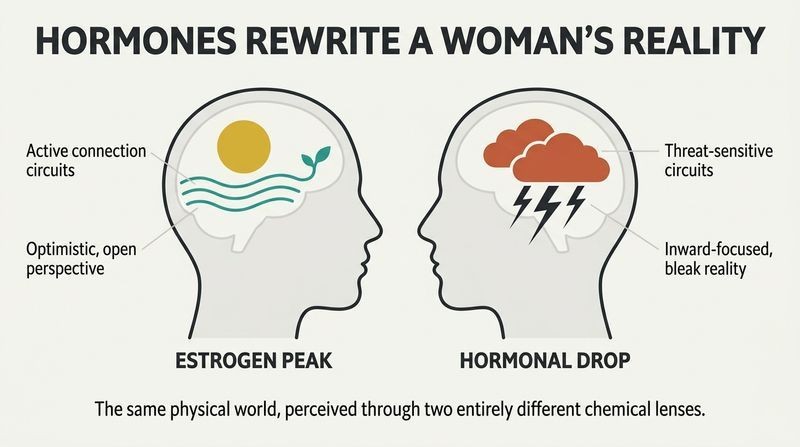
Hormones don't just shift moods, they rewrite a woman's reality
The book's central thesis is that female neurochemistry actively constructs a woman's perception of what matters, day to day and decade to decade. Brizendine, a UCSF neuropsychiatrist, argues that hormones like estrogen, progesterone, oxytocin, and testosterone act as fertilizer for different neural circuits at each life stage.
She illustrates with extreme premenstrual patients whose thoughts turned genuinely bleak for a few days each month, then vanished when hormones shifted. Some brain regions change up to 25% in a single monthly cycle. A man's brain, she argues, is like a mountain worn slowly over eons, while a woman's is like the weather itself, constantly changing. The practical upshot: recognizing a hormone-driven brain state lets you choose not to act on it.
This framing is empowering and risky at once. Empowering because it destigmatizes: mood swings become biology, not character flaws. Risky because critics like Cordelia Fine (Delusions of Gender) argue such neuro-essentialism can recycle stereotypes under scientific cover. The honest reading sits between: hormones measurably modulate neural circuits, but environment and cognition feed back powerfully. Brizendine herself insists biology is not destiny, that the brain is a learning machine. What is genuinely useful is the reframe that a feeling is not always a fact. Naming a state as hormone-influenced creates a pause between impulse and action, a technique cognitive therapy independently validates.
There is no unisex brain; girls arrive already wired for connection
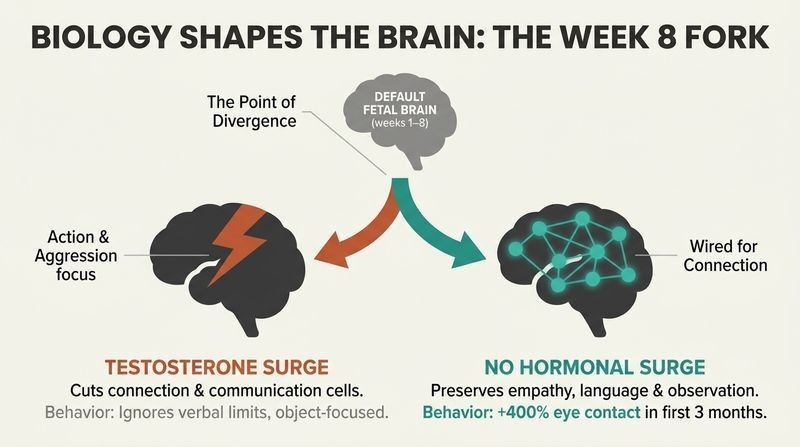
Every fetal brain looks female until around eight weeks, when a testosterone surge in males kills cells in communication centers and grows cells in sex and aggression areas. Absent that surge, female circuits for language, emotion-reading, and observation keep developing.
The consequences appear immediately. Baby girls' skill at mutual eye contact and facial gazing jumps over 400% in the first three months, while boys' does not increase at all. In a Stanford study, one-year-old girls checked their mothers' faces for approval far more than boys, who ignored maternal shouts of no and touched the forbidden toy anyway. A girl given a toy fire truck may swaddle it and coo. Brizendine cites this to argue innate wiring, not just socialization, drives divergent behavior.
The strong claim, that biology drives these differences, is the book's most contested. Studies of congenital adrenal hyperplasia (girls exposed to fetal testosterone who show more rough play) genuinely support a hormonal contribution. But the 400% gaze figure and similar stats have drawn scrutiny for small samples and replication gaps. A fairer synthesis: newborns show modest average sex differences that culture then amplifies through the exact feedback loop Brizendine describes, parents mirroring faces at responsive daughters. The nature-versus-nurture binary she rightly rejects is the real lesson. Development is both, inextricably, and averages across groups say nothing about any individual child.
Girl talk is a dopamine-oxytocin high rivaling a drug hit
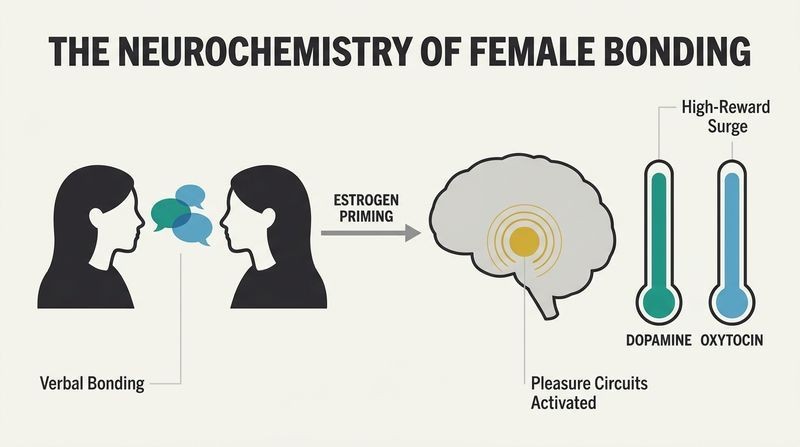
At puberty, estrogen floods the female brain and cranks up production of dopamine (motivation and pleasure) and oxytocin (the bonding neurohormone triggered by intimacy). Connecting through conversation, sharing secrets, and gossiping activate pleasure circuits so strongly that Brizendine compares the rush to what cocaine or heroin users chase.
This explains the teenage girl glued to her phone or texting under the dinner table. On average girls speak two to three times more words per day than boys and reach vocabulary milestones earlier. Female rhesus monkeys use all 17 of their species' vocal tones daily; males use three to six and may go silent for weeks. Verbal bonding, she argues, is the biologically rewarded tool girls use to build the tight social networks that once meant survival.
The neuroscience of social reward is solid: oxytocin and dopamine genuinely reinforce affiliative behavior, and Kerstin Uvnas-Moberg's oxytocin research supports it. But the widely repeated claim that women speak far more words daily than men was later contradicted by Mehl et al. in Science (2007), who found both sexes average roughly 16,000 words per day. The deeper point survives the disputed statistics: connection itself is neurochemically rewarding for the developing female brain. This reframes teenage phone obsession not as vanity or weakness but as a drive as biologically grounded as hunger, which is a more compassionate and more accurate lens for parents.
Women's stress response is tend-and-befriend, not just fight-or-flight
The classic 1932 fight-or-flight model was built largely on males. UCLA psychologist Shelley Taylor proposed that females evolved an additional response: tend-and-befriend, meaning nurturing offspring and forming protective social alliances under threat.
Why? A smaller female could rarely win a physical fight, and fleeing meant abandoning vulnerable children. Banding with other females offered protection instead. Brizendine notes anthropologist Joan Silk's 16-year baboon study found the most socially connected mothers had the most surviving infants. In the female brain, aggression circuits link more to verbal and emotional areas, while the male amygdala (the brain's fear and aggression core) is larger and wired more directly to physical action. This is why relationship conflict spikes a woman's stress hormones, and why social rejection registers as a survival-level threat.
Tend-and-befriend is one of the book's most durable ideas, well cited across psychology. It reframes behaviors dismissed as neediness as evolved survival strategy. Oxytocin plausibly underlies the befriending drive, released by social contact and buffering the stress axis. One caution: evolutionary just-so stories are hard to falsify, and the model risks overstating a clean sex binary when both men and women tend and befriend depending on context. Still, the clinical value is real. Understanding that a woman's brain treats social disconnection as danger explains why isolation is so corrosive and why social support measurably improves health outcomes, a finding echoed across epidemiology.
Falling in love is a temporary brain state chemically identical to addiction
Romantic infatuation is not an emotion but a motivation system, sharing circuits with obsession, mania, hunger, and drug craving. Dopamine, oxytocin, estrogen, and testosterone flood the brain while the amygdala (fear alert) and anterior cingulate cortex (critical judgment) get dialed down, which is why lovers are blind to flaws.
Brizendine notes this passionate phase lasts roughly six to eight months. Separation triggers genuine neurochemical withdrawal, not mere sentiment. She warns that oxytocin, released by a 20-second hug, literally boosts trust: in a Swiss experiment, people given oxytocin nasal spray handed over twice as much money to a stranger. Her blunt advice: do not let someone hug you unless you plan to trust him, because cuddling shuts down the skeptical mind.
The addiction parallel is backed by Helen Fisher and Lucy Brown's fMRI work showing romantic love lights up the same dopamine-rich reward regions as cocaine. This demystifies heartbreak: withdrawal symptoms are physiological, which validates the pain and predicts its arc. The oxytocin-trust link is real but often oversold in popular media; effects are modest and context-dependent, and later replications have been mixed. The actionable wisdom holds regardless. Knowing infatuation is a time-limited neurochemical state, not a permanent verdict on compatibility, can prevent both premature commitment during the high and premature abandonment when the calmer attachment phase, driven by oxytocin and vasopressin, sets in.
Female orgasm requires the fear center to switch off first
Female arousal begins, paradoxically, with a brain turn-off. The amygdala must deactivate before impulses can reach the pleasure centers and trigger climax. Any last-minute worry about work, kids, or schedules can halt the process, which is partly why women take on average three to ten times longer than men to reach orgasm.
Brizendine's patient Marcie could not climax with a new partner until a muscle-relaxant Valium quieted her amygdala. Research found women needed warm feet and comfort before wanting sex. The practical translation: for women, foreplay is arguably everything in the preceding 24 hours, while for men it is the preceding three minutes. Anger at a partner and sexual desire cannot coexist in the female brain, so reconnection must precede arousal.
The neuroscience here draws on Gert Holstege's brain-imaging of orgasm, which did show deactivation of anxiety-related regions. The insight has real clinical utility: it locates many female arousal difficulties in safety and stress rather than mechanics, which reframes them away from pharmaceutical quick fixes. Indeed, the decade-long hunt for a female Viagra largely failed precisely because female desire is not primarily a blood-flow problem. One nuance worth adding: individual variation is enormous, and framing a 24-hour foreplay window as universal can itself create performance pressure. The core principle, that psychological safety gates physical response, is the takeaway couples can actually use.
Motherhood physically rebuilds the brain, and it is largely irreversible
Pregnancy marinates the brain in fetal and placental neurohormones. Progesterone spikes 10 to 100 times normal, sedating like Valium. Remarkably, fMRI scans show a pregnant woman's brain actually shrinks between six months and birth, likely from circuit restructuring, returning to size around six months postpartum.
At birth, an oxytocin cascade forges thousands of new connections, imprinting the baby's smell, cry, and touch (mothers identify their infant's smell with about 90% accuracy). In one study, mother rats chose the oxytocin rush of nursing pups over cocaine every time. New mothers lose roughly 700 hours of sleep in the first year. Brizendine also notes fathers change too: their testosterone drops by a third after birth, priming them to bond.
The claim that maternal brain changes are permanent has gained striking support since publication. Hoekzema et al. (2016) found pregnancy produces long-lasting gray-matter reductions in social-cognition regions, changes so consistent an algorithm could identify who had been pregnant. This reframes mommy brain fog not as decline but as specialization, pruning for maternal sensitivity. The father data is equally important, undercutting the idea that nurturing is exclusively female wiring. What deserves emphasis is Michael Meaney's epigenetic research the book cites: nurturing style transmits across generations through gene expression, not just imitation, meaning a grandmother's warmth can literally reshape a grandchild's stress biology.
Women feel your emotions in their own bodies through mirroring
The female brain excels at reading faces, tone, and unspoken cues, a talent Brizendine grounds in mirroring: automatically matching another person's breathing, posture, and facial expression, then running those signals through one's own emotional circuits to feel what they feel.
Men detect subtle sadness in a face about 40% of the time; women about 90%. In a University College London study, when women learned their partners were receiving a strong shock, the same pain regions lit up in their own brains, an effect researchers could not elicit in men. Girls under 24 hours old respond more to another baby's cry. Brizendine argues this evolved to read nonverbal infants and anticipate danger, though it comes at a cost: women lose sleep after scary films and absorb others' distress.
Mirror-neuron science was fashionable when the book appeared and has since been tempered; direct evidence for a distinct human mirror-neuron system, and for sex differences in it, remains debated. But the behavioral finding that women on average score higher on emotion-recognition tasks is robust across cultures (Simon Baron-Cohen's empathizing research aligns here). The framing of empathy as embodied simulation, feeling pain in your own pain circuits, is powerful and increasingly supported by affective neuroscience. The underappreciated corner is the cost side: heightened emotional absorption correlates with higher rates of anxiety and depression, suggesting the same sensitivity that builds connection can also overwhelm.
Women register emotional memories in vivid, lasting cinematic detail
When couples fight or fall in love, she remembers the full-length movie and he remembers the trailer. Brizendine attributes this to hardware. Women use both brain hemispheres to process emotional experience; men use mainly one. In a Stanford study, nine brain regions lit up in women viewing emotional images versus two in men.
The female amygdala activates more readily to emotional nuance, and because women have a relatively larger hippocampus (the hub for memory formation), more details get tagged and stored. The result is a three-dimensional sensory snapshot: what he said, what they ate, whether it rained. This is not that men love less; their circuits simply encode fewer emotional details unless the amygdala fires hard, as with a direct threat.
Larry Cahill's neuroimaging work does show sex differences in how the amygdala engages during emotional memory, with lateralization patterns differing between men and women. The everyday relevance is enormous for relationships: many recurring conflicts stem from asymmetric memory, one partner litigating a detailed past the other genuinely cannot retrieve. Reframing this as encoding difference rather than indifference can defuse blame. A useful caveat: memory vividness is not the same as accuracy, and emotionally charged memories are actually more prone to confident distortion, as Elizabeth Loftus's research shows. So the richly remembered fight may feel definitive yet still be partly reconstructed.
At menopause the fuel for tending others runs dry, and priorities reset
Menopause is not decline but a hormonal regime change. As estrogen falls, so does oxytocin, and the circuits that for decades drove a woman to nurture, keep peace, and read others' emotions lose their fuel. The result Brizendine calls a take-no-prisoners clarity: less interest in others' needs, less tolerance for one-sided caretaking.
This reframes a familiar pattern. More than 65% of divorces after age 50 are initiated by women, which Brizendine attributes partly to this neurological shift rather than to men leaving for younger women. Her patient Sylvia, after decades of accommodating a demanding husband, suddenly wanted her own life. The circuits are not gone; a menopausal woman who adopts a baby or takes estrogen can see nurturing impulses come flooding back.
This is the book's most liberating reframe for older women: the postmenopausal shift toward self-direction is not bitterness or crisis but biology lifting a lifelong chemical imperative. Margaret Mead's phrase postmenopausal zest captures it. The grandmother hypothesis (Kristen Hawkes) adds evolutionary weight, explaining why humans uniquely live decades past fertility: elder women boosted grandchildren's survival, so longevity was selected for. One should hold the hormonal determinism loosely; midlife divorce also reflects financial independence, empty nests, and accumulated grievance. But the reframe rescues a life stage long pathologized, recasting it as a return to the steadier, lower-hormone clarity a woman last knew in childhood.
Women aren't worse at math; estrogen redirects interest toward people
Brizendine directly rebuts the implication of Lawrence Summers' 2005 remarks that women lack aptitude for top science. She argues that at the start of the teen years, boys' and girls' mathematical and scientific capacity is identical. The divergence comes later and is about interest, not ability.
As estrogen intensifies the female drive for communication and connection, many talented girls gravitate toward people-oriented work over solitary pursuits. Her patient Gina, a gifted engineer, wanted to leave the field for more human contact. This is a value decision shaped by hormonal effects on the brain, not a deficit. The female brain, she insists, carries distinct strengths: verbal agility, deep friendship, near-telepathic emotion-reading, and conflict defusing, talents many men simply lack.
This is a shrewd rhetorical move: accepting that fewer women reach elite STEM ranks while relocating the cause from aptitude to interest and values. Recent data complicate a purely hormonal story. The gender-equality paradox (Stoet and Geary) shows women pursue STEM less in more egalitarian countries, suggesting freedom of choice, not just estrogen, drives divergence. Meanwhile the math-ability gap has narrowed toward zero in many measures. Attributing career sorting mainly to hormones risks underweighting culture, discrimination, and role models, the very factors Cori Bargmann's anecdote about smart friends leaving science hints at. The valuable half is the insistence that difference in outcome is not deficit in capacity.
Analysis
The Female Brain is a work of popular neuroscience by UCSF neuropsychiatrist Louann Brizendine, structured as a life-stage journey from fetal development through menopause, with clinical vignettes anchoring each chapter. Its ambition is to translate a decade of brain-imaging, endocrinology, and primatology research into an owner's manual for women. Its narrative engine is the recurring MRI thought-experiment, inviting readers to watch hormones sculpt behavior in real time.
The book's great strength is synthesis and reframing. By locating mood swings, teen phone obsession, infatuation, maternal transformation, and midlife divorce in neurochemistry, Brizendine offers compassion where culture offered blame. The tend-and-befriend model, the addiction-like anatomy of love, and the epigenetic transmission of nurturing (Meaney's work) are genuinely illuminating and have aged well. Hoekzema's 2016 discovery of lasting pregnancy-induced brain changes vindicated her boldest claim.
The book's vulnerability is precision. Several headline statistics, the word-count gap, the daily-thoughts-of-sex figures, the 400% gaze increase, rest on thin or later-contradicted sourcing, and a first edition erratum forced corrections. Critics like Cordelia Fine and Rebecca Jordan-Young charged that Brizendine sometimes presents contested findings as settled and that averaging across sexes obscures enormous individual overlap. The neuro-essentialist frame, however well-intentioned, can be conscripted to justify the very stereotypes she says she opposes.
The honest verdict: read it for the reframes, not the decimals. Its enduring contribution is a mental habit, treating a feeling as a hormone-influenced brain state rather than an unquestionable fact, which creates space between impulse and action. That habit is therapeutically sound regardless of whether every cited number survives replication. The book works best as a compassionate lens and a conversation-starter about biology's role in behavior, and worst as a literal predictor of any individual woman, whose brain, as Brizendine herself insists, is a learning machine that biology influences but never locks.
Review Summary
The Female Brain receives mixed reviews, with some praising its insights into female neurobiology and others criticizing it for reinforcing stereotypes and lacking scientific rigor. Supporters find it enlightening about hormonal influences on behavior, while critics argue it oversimplifies gender differences and relies too heavily on anecdotes. Many readers appreciate the accessible writing style but question the validity of some claims. The book's controversial nature sparks debate about biological determinism versus social construction of gender roles.
People Also Read







FAQ
What's The Female Brain about?
- Exploration of Differences: The Female Brain by Louann Brizendine explores the neurological and hormonal differences between male and female brains, focusing on how these differences influence behavior, emotions, and relationships.
- Hormonal Impact: The book emphasizes the role of hormones like estrogen and progesterone in shaping a woman's brain and behavior, particularly during key life stages such as puberty, pregnancy, and menopause.
- Real-Life Applications: Brizendine combines scientific research with clinical observations to provide insights into how understanding these differences can improve relationships and mental health for women.
Why should I read The Female Brain?
- Understanding Female Experience: The book offers valuable insights into the female experience, helping readers understand their own behaviors and those of the women in their lives.
- Scientific Backing: Brizendine presents a wealth of scientific research, making complex neurological concepts accessible to the general reader, enhancing the credibility of her claims.
- Practical Advice: It provides practical advice for women navigating hormonal changes and emotional challenges, making it a useful resource for personal development and mental health.
What are the key takeaways of The Female Brain?
- Hormonal Influence: Hormones significantly influence a woman's brain structure and function, affecting everything from mood to decision-making.
- Emotional Sensitivity: Women are generally more emotionally sensitive than men, which is rooted in their brain structure, allowing them to read emotional cues better.
- Life Phases: Different life phases bring distinct neurological changes that shape a woman's identity and experiences, each marked by unique hormonal influences.
What are the best quotes from The Female Brain and what do they mean?
- "The female brain is so deeply affected by hormones that their influence can be said to create a woman’s reality.": This underscores the profound impact hormones have on a woman's perception and emotional state.
- "Girls arrive already wired as girls, and boys arrive already wired as boys.": This emphasizes the innate differences in brain development between genders, suggesting many behavioral traits are biologically predetermined.
- "The mommy brain is a finely tuned instrument.": Highlights the significant changes in a woman's brain during motherhood, enhancing nurturing instincts and emotional connections.
How does The Female Brain explain the differences in male and female brains?
- Structural Differences: Male brains are larger, but female brains have more densely packed neurons, affecting cognitive functions and processing styles.
- Hormonal Effects: Testosterone and estrogen influence brain development and behavior, with males having a larger amygdala linked to aggression, while females have a more developed prefrontal cortex for emotional regulation.
- Cognitive Processing: Women tend to use both hemispheres for emotional processing, contributing to their superior ability to read emotional cues and engage in empathetic communication.
What role do hormones play in the female brain according to The Female Brain?
- Hormonal Fluctuations: Hormones like estrogen and progesterone fluctuate throughout a woman's life, impacting mood, cognition, and behavior.
- Impact on Emotions: Hormones can heighten emotional sensitivity and influence responses to stress and relationships, leading to conditions like PMS and postpartum depression.
- Long-Term Effects: Cumulative hormonal changes shape a woman's identity and emotional health over time, influencing relationships and self-perception.
How does The Female Brain address motherhood and its effects on the brain?
- Mommy Brain Changes: The "mommy brain" undergoes significant changes to prioritize nurturing and attachment, driven by hormonal surges during pregnancy and after childbirth.
- Neurochemical Responses: Oxytocin and dopamine play crucial roles in bonding with the child, enhancing feelings of love and attachment.
- Long-Term Impact: These changes can have lasting effects on a woman's identity and emotional well-being, emphasizing the importance of support systems for new mothers.
How does The Female Brain explain the impact of hormones on mood?
- Mood Fluctuations: Changes in estrogen and progesterone levels can lead to mood swings, irritability, and depression, particularly during the menstrual cycle and menopause.
- Neurotransmitter Connection: Estrogen influences neurotransmitters like serotonin and dopamine, crucial for mood regulation, with drops leading to decreased levels of these chemicals.
- Clinical Examples: Brizendine shares case studies illustrating the real-life implications of hormonal imbalances on mental health.
What does The Female Brain say about the relationship between motherhood and brain changes?
- Maternal Brain Adaptations: Pregnancy and motherhood induce significant changes in the female brain, enhancing maternal instincts and emotional bonding with infants.
- Long-Term Effects: Experiences of motherhood can lead to lasting changes in brain structure and function, affecting responses to stress and emotional challenges.
- Impact on Identity: The transition to motherhood can shift a woman's identity and priorities, reflecting the complex interplay between maternal roles and personal aspirations.
How does The Female Brain address sexual desire and hormones?
- Testosterone's Role: Testosterone is crucial for sexual desire in women, with levels significantly dropping during menopause, leading to reduced libido.
- Hormonal Treatments: Various treatments, including testosterone therapy, are discussed for women experiencing low sexual desire.
- Cultural Perceptions: Societal attitudes towards female sexuality can influence experiences and expressions of desire, with biological understanding helping to challenge stereotypes.
What insights does The Female Brain provide about aging and the female brain?
- Cognitive Changes with Age: Aging affects brain function, particularly after menopause, when estrogen levels decline, potentially leading to memory issues.
- Protective Effects of Estrogen: Estrogen has protective effects on brain health, with its absence increasing the risk of neurodegenerative diseases.
- Empowerment in Aging: Brizendine encourages women to embrace aging, highlighting renewed purpose and vitality post-menopause.
What practical advice does The Female Brain offer for women experiencing hormonal changes?
- Seek Medical Guidance: Women are advised to consult healthcare professionals about hormonal changes and potential treatments.
- Lifestyle Modifications: Regular exercise, a balanced diet, and stress management techniques are suggested to support hormonal health.
- Embrace Self-Awareness: Understanding their bodies and hormonal cycles can empower women to make choices that enhance their well-being.
Download PDF
Download EPUB
.epub digital book format is ideal for reading ebooks on phones, tablets, and e-readers.








































