


Key Takeaways
Relationships are value exchanges — desire is just the price tag
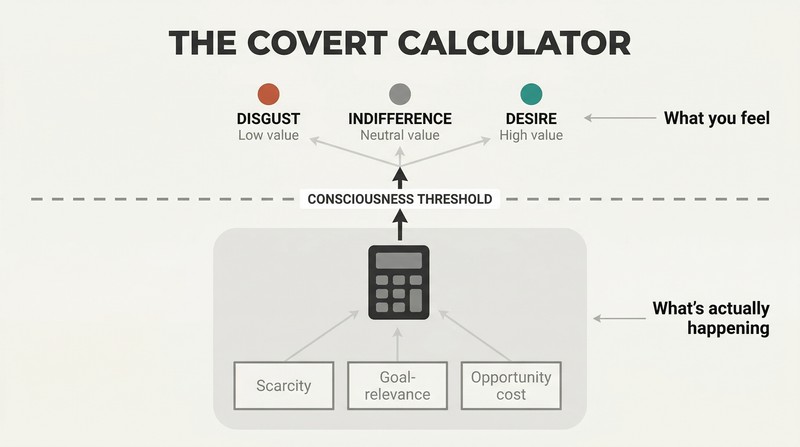
The economic model of relationships. Taraban's central thesis is that people don't form relationships out of goodness or love — they form them because they want things from each other. A relationship exists wherever unequal goods of comparable value are exchanged. Your brain runs a "covert calculator" — an unconscious process evaluating millions of data points like scarcity, goal-relevance, and opportunity cost — then converting the output into emotion. In sexual relationships, that emotion is desire.
High perceived value produces attraction; low value produces disgust; net neutral yields indifference. This explains why attraction feels mysterious: the valuation process is buried so deep in the unconscious that you experience only the emotional output, never the calculation. You don't think "this person helps me achieve important goals" — you feel "I want this person."
Build a ship, learn to sail, plot a course — then take passengers
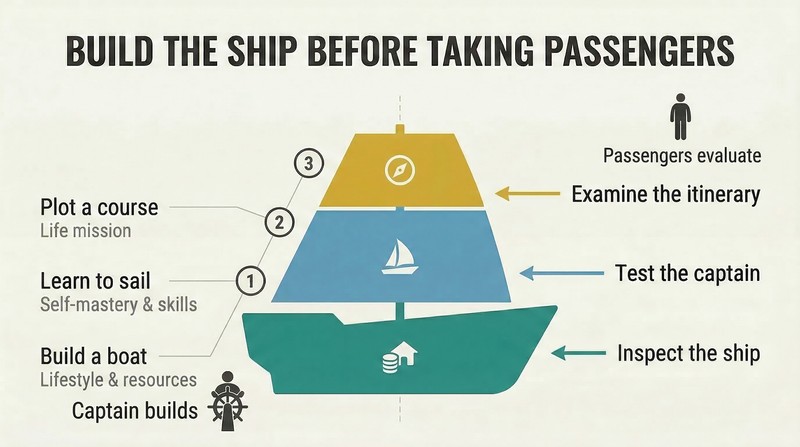
The captain/passenger metaphor is Taraban's framework for the sexual marketplace. Captains (who own ships) attract passengers (who seek passage). Becoming a captain — roughly a ten-year process — requires three challenges:
1. Build a boat — create an emotionally compelling lifestyle backed by resources and knowledge
2. Learn to sail — develop self-mastery, plus seduction (inciting sexual interest) and frame management (maintaining the relationship's negotiated structure)
3. Plot a course — identify your overarching life mission
Passengers exercise three prerogatives: inspecting the ship (evaluating lifestyle), testing the captain (stress-testing character under pressure), and examining the itinerary (discerning the captain's real direction). Critically, most filtering happens before a captain even notices the passenger. Assets earned through this process, once built, cannot easily be taken away.
Stop offering what you want — offer what the other sex values
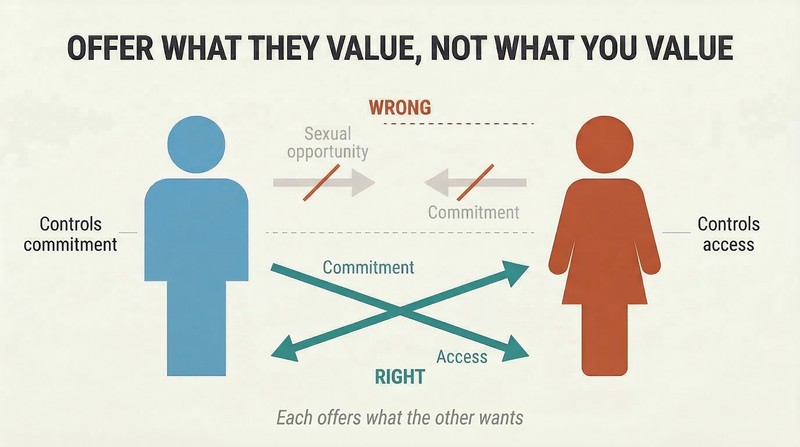
Naive negotiators offer the wrong currency. Men mistakenly offer women sexual opportunity (which women already have in abundance), and women mistakenly offer men commitment (which men already have in abundance). The key insight: women control access to sex, and men control access to commitment. Each guards the commodity the other most desires. Successful negotiators learn to provide what the other party actually wants.
This exchange shapes incentives everywhere. The marginal utility of additional wealth is higher for men because money buys reproductive optionality — which partly explains the earnings gap beyond discrimination. Meanwhile, women's sexual opportunity functions almost like currency: it can acquire attention, protection, devotion, and lifestyle. Understanding what each sex actually values transforms the entire negotiation from guesswork into strategy.
Wanting someone more never makes them want you back
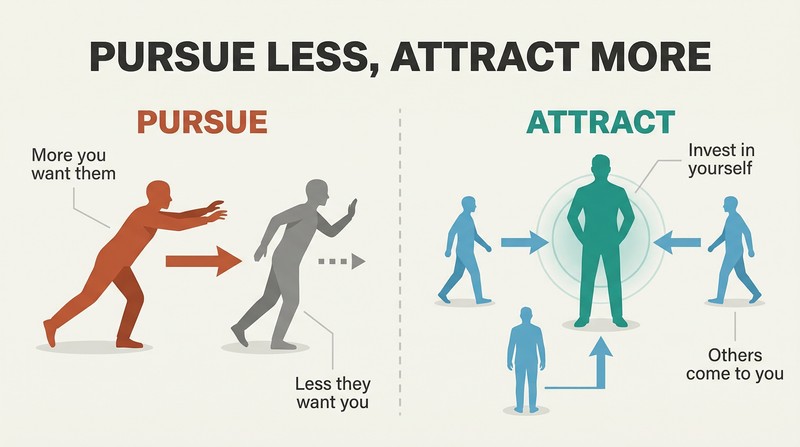
The first law of attraction is that people want what they want, not what wants them. Demonstrating intense interest doesn't increase your partner's attraction — it often suppresses it. Desire operates like a shared resource within a relationship: when one partner does all the desiring, the other's desire becomes unnecessary and atrophies. Western romantic culture compounds this problem by teaching people that persistence and grand gestures will eventually be rewarded.
Become attractive rather than pursuing attractiveness. Instead of wanting someone into wanting you, invest in becoming the person your desired partner would naturally approach. This means appealing deeply to a smaller, more aligned group rather than broadly to everyone. A captain who advertises a specific, compelling destination attracts passengers who genuinely want to go there.
Someone always likes the other more — pick the role that fits
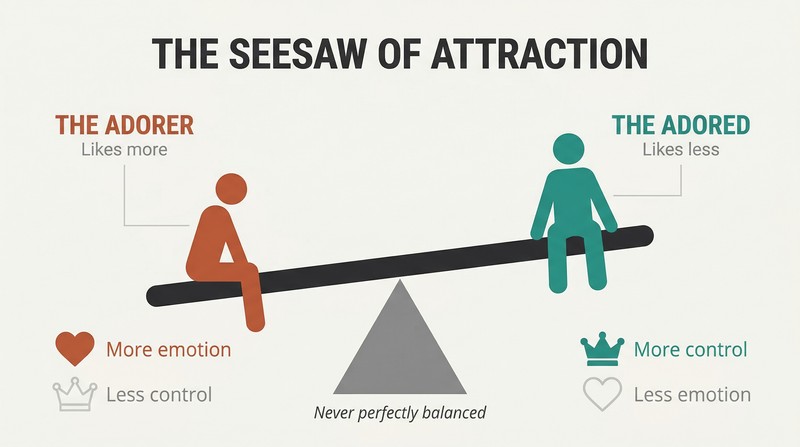
The second law of attraction holds that two people can never be equally attracted to each other. This creates two positions: the adorer (who likes the other more, feels intense highs and lows, but wields less power) and the adored (who likes the other less, commands more control, but experiences muted emotion). Neither role is inherently superior — each carries distinct trade-offs.
Men are generally better suited as the adored because women's hypergamy — their preference for men they can look up to — is undermined when a man pedestalizes her. If he's looking up at her, she's forced to look down. Two people who prefer the same role create constant friction. Complementarity between these positions is what makes long-term relationships sustainable — trying to secure the benefits of both while avoiding the costs of either is a fool's errand.
Power in relationships is psychological, not financial or physical
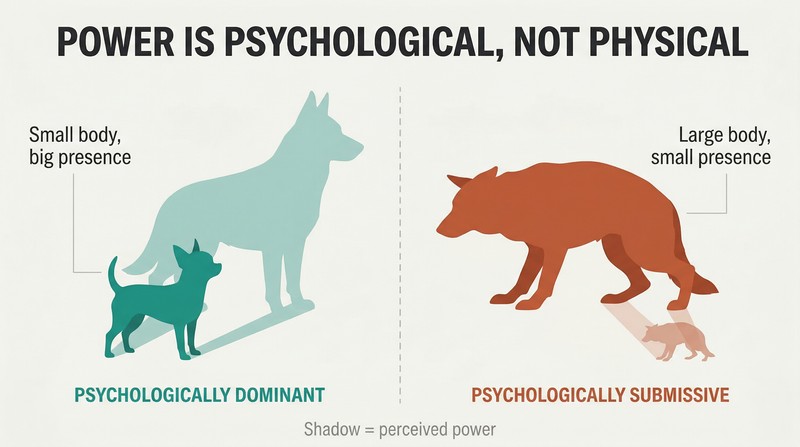
Taraban defines power as the ability to get other people to act in your service — and insists it's immaterial. A German shepherd cowering before a Chihuahua illustrates the point: the intimidated dog isn't the smaller one, it's the one that becomes afraid. Wealth, status, and strength are merely power proxies — they only work by evoking psychological states like desire, fear, or awe.
Ten principles signal who holds power: the person who moves less, is less committed, has more options, is more willing to sacrifice, more willing to transgress, more emotionally resilient, less visible, more flexible, more knowledgeable about the other, and communicates more effectively. The single most important defense is emotional resilience — because every manipulation strategy works by evoking a feeling you can't tolerate. Tolerate it, and you become unmanipulable.
Date inside your actual life, not a manufactured fantasy
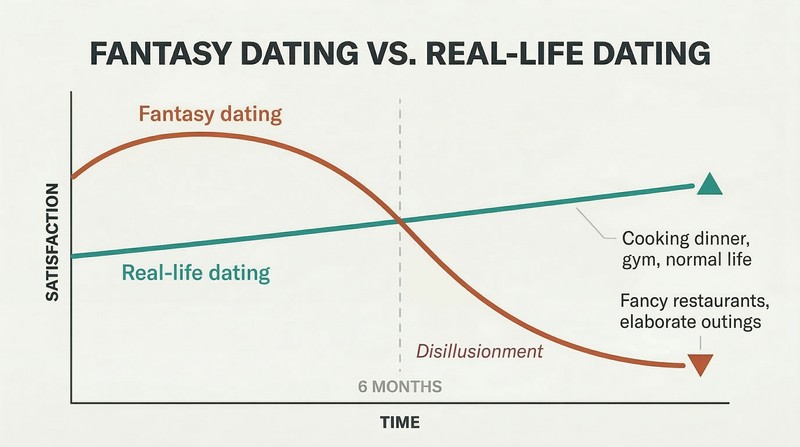
The Crisis of Disillusionment strikes roughly six months into a relationship, when attraction-fueled fantasies collide with reality. Since no one can live up to an idealized projection, desire reliably drops. Most dating activities — fancy restaurants, elaborate outings — make this worse by cultivating unsustainable expectations that collapse once commitment is secured.
Invite prospects into your preexisting lifestyle instead. If your normal evening involves cooking dinner and hitting the gym, date there. This aligns courtship with reality, dramatically reducing the fantasy-reality gap. Captains seeking long-term passengers should err on the side of being too boring rather than too bold. The same principle extends to honesty: reveal potential dealbreakers early. Marketing yourself accurately attracts a smaller but far better-matched audience — and the relationship you build won't require a constant performance to maintain.
Select your partner like a lifetime appointment — hire slow, fire fast
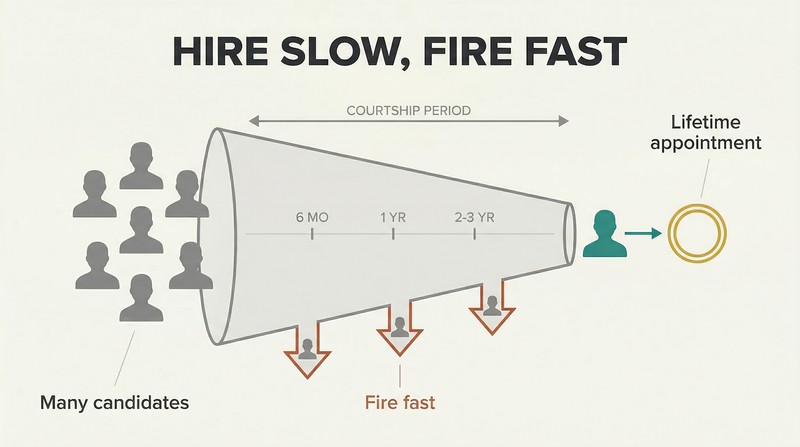
Taraban argues that 90% of relationship success is selection. The work a relationship requires is inversely proportional to the goodness of fit between partners. Forcing compatibility is a Procrustean solution — like the mythical innkeeper who stretched or amputated guests to fit his bed. Since "spouse" is a lifetime appointment, the selection process should reflect that gravity.
"Hire slow" means allowing two to three years of courtship minimum — enough to survive disillusionment and see your partner clearly. "Fire fast" means ending things at the first sign of genuine incompatibility, since it only gets harder and more expensive to leave. Remember that "and" is expensive: wanting a rich and handsome and funny and chivalrous partner exponentially shrinks the qualified pool with each added criterion. Clarify what actually matters — and drop the rest.
Love is non-transactable — it has nothing to do with relationships
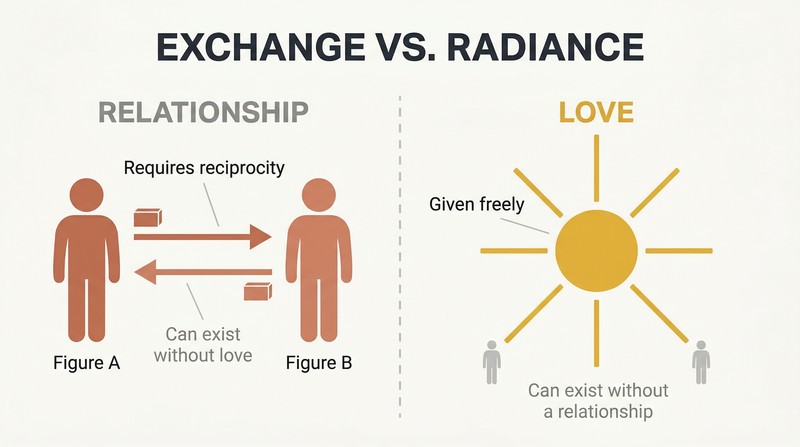
Non-transactable goods — love, loyalty, friendship — cannot be bought, earned, or exchanged. They're given freely at the giver's pleasure, no reciprocity expected. Since relationships require exchange, these goods technically exist outside relationships: you can love someone you have no relationship with, and maintain a relationship devoid of love. Romantic love, Taraban argues, is actually transfigured religion — originating with the 12th-century Cathars, whose heretical beliefs were hidden inside chivalric poetry. Its hallmarks — unobtainability, tragedy, obstruction — were features, not bugs.
True love is radically different: the bittersweet triumph of sacrificing yourself for the other's good. Like the Sun, it shines regardless of who benefits. This makes love extraordinarily powerful — yet deeply unattractive in the sexual marketplace, where self-sacrifice reads as weakness rather than virtue.
Technology didn't ruin dating — it made sex cheap and commitment optional
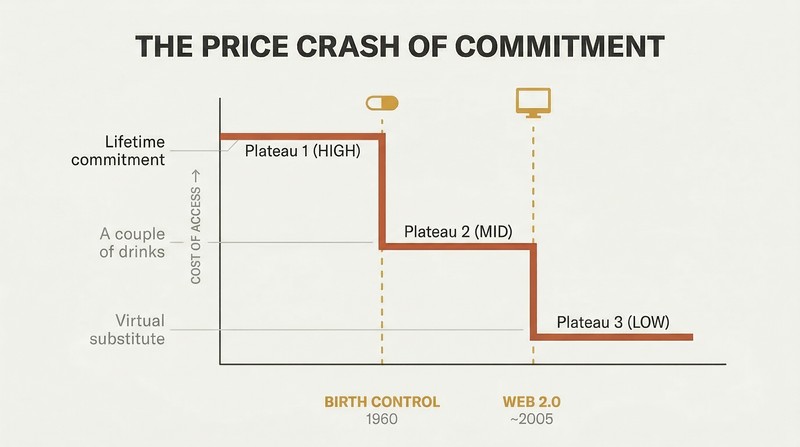
Marriage rates have halved since 1970; one in three American men under 30 report no sex in the past year — a figure that tripled in a single decade. Taraban traces this to two technologies. Birth control (approved 1960) separated sex from reproduction, reversing the historic order where commitment preceded sex and crashing the "price" of sexual access from a lifetime of provision to a couple of drinks at a bar.
Web 2.0 completed the disruption. Pornography gives men free, safe simulated sexual opportunity — removing their incentive to enter the marketplace. Social media and platforms like OnlyFans give women attention, validation, and monetized resources without physical contact — removing theirs. Both sexes are increasingly replacing actual relationships with virtual substitutes, each occupying online roles that mirror their real-world marketplace positions.
Analysis
Taraban's economic model of relationships is an ambitious synthesis of evolutionary psychology (Buss, Trivers), behavioral economics, and game theory — wrapped in a provocative framework designed to strip romantic mystification from sexual dynamics. The captain/passenger metaphor is his most original contribution, elegantly capturing asymmetric investment and authority while remaining theoretically gender-neutral even as biology and culture gender these roles in practice.
The book's greatest strength is internal consistency. From the covert calculator to the balance of attraction to three maintenance crises, each concept builds logically on the prior framework, giving readers coherent language for dynamics they've always felt but couldn't articulate — why attraction fades after six months, why kindness can backfire, why the less interested partner holds the cards.
However, by treating relationships as purely economic, Taraban underweights neurobiological bonding mechanisms — oxytocin, attachment systems — that don't always follow cost-benefit logic. Secure attachment research consistently shows that emotional bonds, while not transactional in his sense, are embedded within ongoing relationships in ways that resist the clean separation his model demands. His claim that love 'has nothing to do with relationships' is philosophically provocative but functionally misleading for most readers.
His Cathar origin story for romantic love, drawn from Denis de Rougemont's contested scholarship, makes for compelling narrative but remains historically debatable. The gendered strategy chapters will inevitably draw accusations of naturalistic fallacy — describing what IS as implying what OUGHT. Taraban pre-empts this explicitly but the boundary blurs in practice.
Still, the book fills a genuine void. Most relationship advice oscillates between saccharine platitudes and cynical pickup artistry. Taraban occupies the uncomfortable middle: acknowledge the marketplace, play it intelligently, but remain open to transcendence. The tension between his economic model and his chapter on love reveals a thinker wrestling honestly with the central paradox of human connection — that we are both self-interested animals and beings capable of genuine self-sacrifice.
Review Summary
The Value of Others receives mixed reviews, with many praising its insightful analysis of modern relationships through an economic lens. Readers appreciate the author's candid approach and practical advice. However, some criticize the book for promoting a transactional view of relationships and lacking empirical evidence. Critics also note potential gender biases and oversimplification of complex issues. Despite controversy, many readers find the book thought-provoking and valuable for understanding current dating dynamics, though some disagree with its future predictions.
People Also Read










Glossary
Covert calculator
Unconscious value computation systemTaraban's term for the brain's hardwired, unconscious process that continuously evaluates perceived objects against personally relevant goals. It weighs countless factors — scarcity, goal-relevance, likelihood of success, opportunity cost — and converts the output into an emotion (desire, disgust, or indifference) that motivates action without the individual ever being aware of the underlying calculation.
Value coefficient
Output of unconscious valuationThe numerical output of the covert calculator for any specific good at a specific moment. It represents how valuable an individual perceives that good to be. In sexual relationships, the value coefficient is transmuted into desire (high value), disgust (low value), or indifference (neutral value). This coefficient is constantly recalculated as new information enters consciousness.
nSMV (normalized sexual marketplace value)
Cultural attractiveness standard scoreThe degree to which a specific individual matches their culture's gendered archetype of attractiveness. For women, nSMV is primarily based on physical beauty, youth, and fertility cues. For men, it's primarily based on wealth, status, and lifestyle. nSMV peaks at different ages for each sex — roughly 18–23 for women and 35–50 for men — and serves as the initial filter in sexual marketplace interactions.
pSMV (perceived sexual marketplace value)
Individual's perceived attractivenessThe value assigned to a specific person in the mind of a specific observer. Unlike nSMV (the cultural standard), pSMV accounts for personal 'types,' idiosyncratic preferences, and contextual factors. It is the metric most directly responsible for whether an interaction occurs, since attraction is based on perception rather than any objective measure. A person's pSMV can differ dramatically from observer to observer.
tSMV (transacted sexual marketplace value)
Actual revealed marketplace valueThe closest approximation of a person's 'true' value in the sexual marketplace, determined at the point of transaction. For men, tSMV equals the median nSMV of women from whom he has secured sex. For women, tSMV equals the median nSMV of men from whom she has secured commitment. Each sex is measured against the transaction that is harder for them to achieve.
Game of Please/No
Fundamental negotiation dynamicTaraban's model for the archetypal game underlying all human relationships. One player (the 'wanter') can only say 'please'; the other (the 'giver') starts from 'no' and can say 'yes' or 'no.' The wanter must transform the no into a yes using behavioral strategies — twelve 'core strategies' including intimidation, seduction, pity, charm, and quitting — most of which operate by manipulating a specific human emotion.
Balance of attraction
Who-likes-whom-more dynamicThe principle that two people in a relationship can never be equally attracted to each other. This creates two complementary positions: the adorer (who likes the other more, experiences more emotion, and holds less power) and the adored (who likes the other less, experiences dampened emotion, and holds more power). These positions are gender-neutral and role-independent but shift over time. The discrepancy between positions is called the attraction gap.
Non-transactable goods (NTGs)
Freely given, unearnable giftsGoods like love, loyalty, and friendship that cannot be bought, earned, or exchanged. They are always given at the spontaneous pleasure of the giver with no expectation of reciprocity. Because relationships require the exchange of value, NTGs technically fall outside relationships — they can exist without a relationship, and relationships can exist without them. When NTGs co-occur with relationships, it is a fortunate coincidence, not a requirement.
Crisis of Disillusionment
Fantasy collapse in relationshipsThe first major maintenance crisis, typically occurring around six months into a relationship. When attraction-driven projected fantasies collide with accumulating evidence of who the partner actually is, the idealized image shatters. This produces a significant drop in desire and can feel like 'falling out of love.' It is exacerbated by dating activities that cultivate unsustainable fantasies and by hiding potential dealbreakers.
Goal conflation
Wanting too much from one personThe condition where a single relationship is used to pursue multiple goals simultaneously — sex, security, friendship, emotional support, lifestyle, parenting, and more. Goal conflation makes relationships exponentially more complicated because completely satisfying options become both rare and expensive. It is the primary reason no single person can give you everything you want, and why relationship longevity depends on navigating evolving trade-offs.
Fundamental romantic misunderstanding
Confusing context for the personThe third law of attraction: all forms of attraction are functionally indistinguishable. People cannot reliably distinguish whether they are attracted to a person or to the circumstances surrounding that person — rejection, distance, jealousy, uncertainty, competition. Both feel identical. This explains why people become obsessed with exes who move on, then lose interest after reuniting: the attraction was to the conditions, not the individual.
Frame management
Maintaining relationship structureThe skill of preserving the negotiated arrangement of a relationship against pressures to alter it. Just as a ship's frame is its structural hull, a relationship's frame is its agreed-upon terms and dynamic. Captains who are too rigid risk passengers abandoning ship; those too flexible compromise structural integrity. The ideal integration mirrors good shipbuilding wood: firm with a little give. Frame management is essential for long-term relationship maintenance.
FAQ
What's The Value of Others about?
- Economic Model of Relationships: The book explores how relationships function as economic transactions, particularly in the sexual marketplace, where value is exchanged between individuals.
- Value and Negotiation: It emphasizes that relationships are formed based on the exchange of unequal goods of comparable value, with negotiation being a key component.
- Roles and Dynamics: The book also discusses the roles of the "adorer" and the "adored," and how these roles impact relationship dynamics.
Why should I read The Value of Others?
- Insightful Framework: It offers a new perspective on understanding relationships, aiming to clear up confusion and frustration in dating and mating.
- Practical Applications: Readers can apply concepts of value and negotiation to improve their relationship outcomes.
- Cultural Commentary: The book provides a candid analysis of societal norms, encouraging readers to confront uncomfortable truths about attraction and value.
What are the key takeaways of The Value of Others?
- Value Transactions: Relationships are about the transaction of value, and understanding this can lead to better relationship choices.
- Importance of Selection: Choosing the right partner is crucial, as it can significantly reduce the effort needed to maintain a relationship.
- Power and Negotiation: Understanding power dynamics and negotiation is essential, as the more powerful player typically secures favorable terms.
What is the economic model of relationships as defined in The Value of Others?
- Transactional Nature: Relationships are seen as transactions where individuals exchange unequal goods of comparable value.
- Perception of Value: The perception of value is central to relationship dynamics, influencing who gets what in the sexual marketplace.
- Behavioral Economics: The model integrates principles from behavioral economics to explain mating and dating decisions.
How does Orion Taraban define sexual marketplace value (SMV)?
- Normalized SMV (nSMV): This quantifies how closely an individual aligns with cultural archetypes of attractiveness.
- Perceived SMV (pSMV): It is the value perceived by others, which can differ from nSMV based on individual preferences.
- Transacted SMV (tSMV): This is the median nSMV of partners with whom an individual has successfully engaged, reflecting their marketplace value.
What are the three stages of relationships discussed in The Value of Others?
- Attraction Stage: Involves recognizing and responding to each other's value, often influenced by physical appearance and social cues.
- Negotiation Stage: Individuals negotiate the terms of their relationship, balancing needs and desires.
- Maintenance Stage: Focuses on sustaining the relationship over time, requiring ongoing negotiation and adaptation.
How does The Value of Others address the concept of power in relationships?
- Power as Psychological: Power is defined as the ability to get others to act in service of one's goals, emphasizing its psychological nature.
- Principles of Power: The book outlines ten principles to help identify who holds more power in interactions.
- Inequality is Inevitable: Inequality in power dynamics is a fundamental aspect of relationships, affecting interactions and negotiations.
What are the laws of attraction mentioned in The Value of Others?
- First Law: People want what they want, not what wants them, meaning attraction is driven by desire.
- Second Law: It's not possible for two people to be equally attracted to each other, leading to a balance of attraction.
- Third Law: Attraction is influenced by individual preferences, which can deviate from cultural standards.
What are the three crises of relationships outlined in The Value of Others?
- Crisis of Disillusionment: Occurs when initial fantasies about a partner are shattered by reality.
- Attempted Mutiny: Arises when one partner seeks to change the relationship terms after significant investment.
- Doldrums: Represents a period of stagnation, requiring effort to rekindle passion and intimacy.
How can I improve my chances of a successful relationship according to The Value of Others?
- Focus on Selection: Emphasizes the importance of selecting the right partner to ensure compatibility.
- Understand Yourself: Accurate self-knowledge is crucial for making informed relationship decisions.
- Be Open to Change: Flexibility and adaptability are key to maintaining satisfying interactions.
What strategies does The Value of Others suggest for women in the sexual marketplace?
- Hunting Strategy: Women should strategically target high-value men by leveraging social networks.
- Gatekeeping Sexual Opportunity: Offering sexual opportunities can create exclusivity and desirability.
- Providing Value: Enhancing attractiveness by offering support and assistance that aligns with a partner's goals.
What strategies does The Value of Others suggest for men in the sexual marketplace?
- Focus on Self-Improvement: Men should invest in developing skills and resources to increase their value.
- Avoid Premature Commitment: Waiting to commit allows men to secure more favorable relationship terms.
- Cultivate Optionality: Dating multiple women provides valuable insights and enhances attractiveness.
Download PDF
Download EPUB
.epub digital book format is ideal for reading ebooks on phones, tablets, and e-readers.








































