


Key Takeaways
Men don't lack depression, they hide it behind a wall of doing
The hidden epidemic. Terrence Real, a family therapist, argues that depression in men is systematically overlooked because the disorder itself looks unmanly. Culture reserves the label of depression for visible collapse: the man too paralyzed to leave bed. But most depressed men never look sad. They look busy, angry, drunk, or successful. Real distinguishes two forms:
1. Overt depression, the recognized, acute pain writ large
2. Covert depression, chronic and hidden even from the sufferer himself
The cover-up. Between 60 and 80 percent of depressed people never get help, and men are four times likelier than women to kill themselves. Their pain gets rerouted into physical illness, addiction, violence, workaholism, and failed intimacy, problems we rarely trace back to their depressive root.
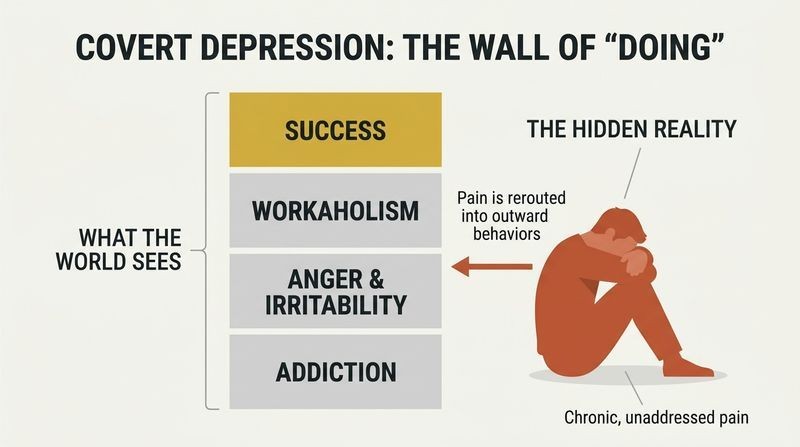
Real's reframing anticipates a now-growing clinical movement toward recognizing "male-typical" depression symptoms like irritability and risk-taking, later formalized in tools such as the Gotland Male Depression Scale. What's compelling is his refusal to treat the underdiagnosis as accidental. The same masculine code that produces the depression also camouflages it, a self-sealing trap. A useful caution: by expanding depression to encompass workaholism, rage, and affairs, Real risks making the category so broad it loses diagnostic sharpness. Yet the clinical payoff is real, redirecting attention from surface "troubles" to underlying pain that talk-and-pill approaches often miss entirely.
Covert depression is a disorder of self-esteem, not sadness
The Narcissus misreading. Real reinterprets the Narcissus myth: the youth wasn't drowning in self-love but starving from its absence, paralyzed by dependence on his reflection. Covertly depressed men are the same. Lacking internal worth, they chase external props: money, muscle, conquests, applause. Thomas, a chief financial officer who logged 80-hour weeks and lost his daughters' affection, had built a life around performance while a neglected boy who once guarded his passed-out alcoholic mother waited inside.
Healthy self-esteem is internal. Real defines it as the capacity to hold yourself in warm regard despite your flaws, neither above nor below others. Its opposite, performance-based esteem, requires beating someone to feel worthy. The prop never refills the well, so the chase never ends.
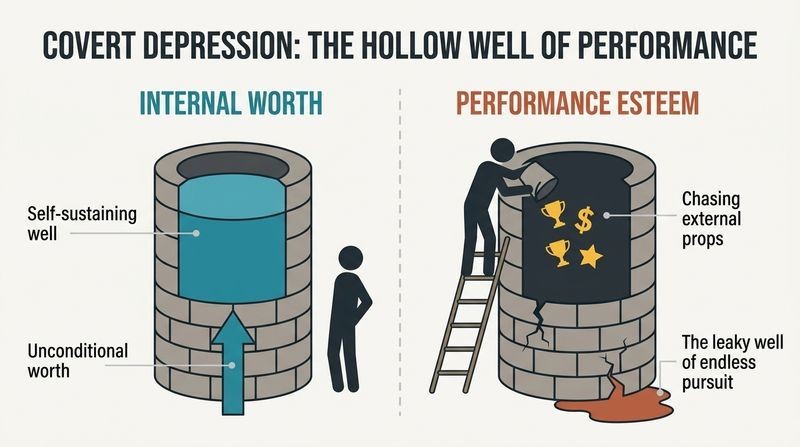
This distinction between intrinsic and contingent self-worth maps precisely onto decades of self-determination theory research (Deci and Ryan), which shows that self-esteem staked on achievement produces anxiety, fragility, and burnout. Jennifer Crocker's work on "contingencies of self-worth" found students who based esteem on external validation showed more stress and depression. Real arrives at the same conclusion through the clinic rather than the lab. The Narcissus reinterpretation is genuinely fresh: most people invoke narcissism as excess self-regard, but the clinical reality is often a hollow core desperately seeking mirrors. The therapeutic implication is sobering, no amount of winning cures a worth deficit.
The only cure for covert depression is letting it become overt
You must feel it to heal it. Real's counterintuitive principle: a man cannot leap from his defenses straight to wholeness. He must first stop running, let the addictive prop fail, and allow the buried pain to surface. The fix never works precisely because it prevents this. Damien, a controlling architect and mild sex addict, only recovered after his compulsive behavior stopped, plunging him into a near-hospitalizing depression that finally exposed childhood sexual abuse beneath it.
Three layers, peeled in order. Recovery resembles peeling an onion:
1. Stop the addictive defense (achieve "sobriety")
2. Repair the damaged relationship to the self
3. Release the original childhood trauma
Crisis, Real argues, is an ally. He deliberately resists smoothing it over too fast.
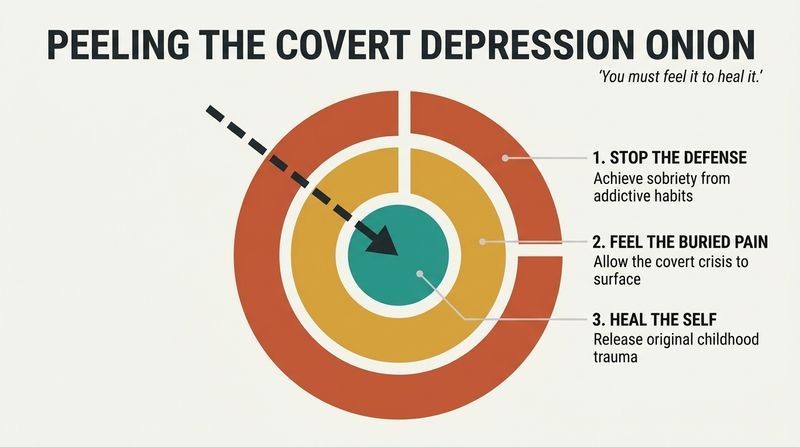
This mirrors a paradox at the heart of several therapeutic traditions: Acceptance and Commitment Therapy's insistence that experiential avoidance amplifies suffering, and exposure therapy's finding that avoided emotions must be approached, not suppressed. Real's sequencing is clinically shrewd, addressing addiction before underlying pain reflects the addiction field's hard-won lesson that you cannot psychoanalyze an actively drinking man sober. One tension worth noting: deliberately keeping a suicidal or destabilized patient in crisis carries real risk, and Real leans heavily on medication and hospitalization as safety platforms. The insight is powerful but demands the scaffolding of genuine support, not a solo descent.
Boys are pushed out of connection the way girls are silenced
The reciprocal wound. Feminists documented how girls lose their assertive "voice." Real maps the mirror-image injury in boys: they are systematically pushed away from emotional expressiveness and the skills of deep connection. Both sexes are asked to "halve themselves." Studies show newborn boys are actually slightly more emotionally expressive and harder to soothe than girls, yet they are spoken to less, comforted less, nurtured less.
Masculinity as subtraction. When asked to define femininity, girls used positive words (compassionate, connected). Boys defined masculinity through negatives: not weak, not dependent, not like a woman. Real's striking conclusion: masculine identity is not developed but achieved through loss, a successive amputation of the tender, relational self. If socialization takes aim at girls' voices, it takes aim at boys' hearts.
Real's framing predates and complements later bestsellers like William Pollack's Real Boys and Niobe Way's Deep Secrets, whose interviews found adolescent boys articulate about intimate friendships until around age fifteen, when they abruptly disavow closeness to appear manly, and grow lonelier. The "masculinity as double-negative" finding is quietly devastating and empirically echoed in gender-role research. A fair challenge: Real sometimes underplays temperamental and biological variation, treating socialization as nearly the whole story. Still, his core claim, that we conflate maturity with disconnection and teach boys that needing others is shameful, reframes male stoicism not as strength but as engineered deprivation.
Neglect harms boys as much as abuse does
Two kinds of trauma. Real distinguishes active trauma (a boundary violation, being hit, screamed at, molested) from passive trauma (a boundary failure of absence, the withholding of nurture, attention, and guidance). A father who screams at his bleeding son commits active trauma; a father who makes the bleeding boy wait while he finishes a call commits passive trauma. Real considers not touching a child for decades or withholding love until he's grown a genuine form of emotional violence.
The quiet damage is pervasive. Passive trauma is estimated to occur at least twice as often as active abuse; Richard Gelles estimated one in eleven children suffers extreme neglect. Because it's an absence rather than an event, it's easy to dismiss, yet it lays depression's foundation just as surely.
Real's active-passive distinction aligns with attachment research and the landmark ACE (Adverse Childhood Experiences) study, which found emotional neglect predicts adult depression and addiction as robustly as overt abuse. Developmentally, Rene Spitz's mid-century findings on "failure to thrive" in adequately fed but emotionally starved orphans made the same point in extreme form. What Real adds is the recognition that neglect is nearly invisible precisely because nothing happened, there's no bruise, no incident, no story. This creates a diagnostic blind spot: patients often say their childhood was "fine" because they're scanning for events rather than absences. The therapeutic skill is helping people grieve what they never received.
Depressed men host two inner children: a wounded boy and a harsh boy
Trauma splits the self in two. When a child is traumatized, he internalizes not just the pain but the interaction itself, both the victim and the perpetrator. Real calls this identification with the aggressor. The result is two immature parts:
1. The vulnerable boy, carrying shame, sadness, and unmet need
2. The harsh boy, carrying the abuser's contempt and shamelessness
Depression is their cruel dialogue. Overt depression is the endless internal loop of the harsh boy flaying the wounded one. Real calls depression an auto-aggressive disease, the self attacking the self. Billy, a college freshman, personified his harsh voice as a chest-beating gorilla torturing a tied-up little boy. Recovery means building a "functional adult" who protects the vulnerable child and demotes the harsh one, empathic reversal reversed.
This dual-self model resonates strikingly with Internal Family Systems therapy (Richard Schwartz), developed around the same era, which likewise externalizes wounded "exiles" and harsh "managers" and installs a compassionate "Self" to lead them. Real's version is distinctive in genderizing the split: the wounded boy is culturally coded feminine, the harsh boy masculine, so healing requires a man to embrace the very "feminine" vulnerability he was trained to despise. The concept of carried shame, absorbing a parent's disowned self-hatred, offers a mechanism for how abuse transmits across generations. A skeptic might find the personification techniques theatrical, but their clinical logic (making abstract self-attack concrete and confrontable) is sound.
Healing your depression breaks the chain before it reaches your kids
Every man is a bridge. Unresolved depression passes from father to son like a toxic inheritance, through the look in the eyes, the tone of voice, the quality of touch. Real's own father passed him the depression his father passed to him. But recovery works as a circuit breaker: a man who transforms his internal violence spares his children and, symbolically, heals the generations behind him.
The relational hero's motive. Many men won't endure therapy's pain for their own sake, but will do it for their kids. Real calls them relational heroes. Jonathan carried a crayon note from his daughter to interrupt his rage; Damian stared at his children's photos before he could lash out. Real reframes recovery as a hero's quest whose reward belongs to the community, not the hero.
The intergenerational transmission of trauma is now well documented, from studies of Holocaust survivors' descendants to emerging epigenetics research suggesting stress can alter gene expression across generations. Real's clinical intuition, that depression travels through micro-interactions rather than genes alone, is supported by attachment transmission studies showing parents' unresolved trauma predicts disorganized attachment in their children. His motivational insight is pragmatically brilliant: leveraging protective love for children bypasses the male resistance to self-focused help. One might note this can also burden recovery with guilt. But framing therapy as fathering, as service rather than self-indulgence, cleverly recruits masculine values into the healing rather than fighting them.
Addiction is any prop that yanks you from shame to grandiosity
A broad, useful definition. Real expands addiction beyond substances to any substance, person, or activity used to regulate self-esteem, including socially rewarded ones like work, exercise, and achievement. The mechanism is always the same: intoxication shifts a man from feeling "less than" (shame) to feeling "better than" (grandiosity), never to healthy middle-ground worth. He identifies two flavors:
1. Merger (dissolving into an abundant other, as in love addiction, alcohol, bingeing)
2. Elevation (inflating the self toward godlike power, as in rage, gambling, conquest)
Why the fix fails. Like saltwater to thirst, defenses breed more of what they relieve. Alcohol eases depression and causes it. The relief shrinks while the dose grows, the shame cycle, dragging the man further from the connection he actually needs.
Real's inclusion of work and exercise as potential addictions is provocative and clinically valuable, since these are culturally applauded, their destructive function hides in plain sight. This anticipates "process addiction" frameworks now widely accepted for gambling and internet use. His neurochemical aside, that rage releases both adrenaline and endorphins, giving a genuine physiological high, helps explain why abusive men describe rage as almost pleasurable, a point corroborated by research on the arousal-reward loop in intermittent explosive behavior. The shame-to-grandiosity swing echoes Kohut's self-psychology. The limitation: defining addiction this broadly risks pathologizing ordinary ambition, so the diagnostic test Real offers (persistence despite known harm) does essential gatekeeping work.
Competition-based worth forces men to inflict pain to feel valuable
Winning requires wounding. Real argues that performance-based esteem, achieving specialness through dominance, structurally demands disconnection from others' humanity. You cannot beat someone without diminishing them. In the film Searching for Bobby Fischer, chess prodigy Josh deliberately loses a tournament, then later begs a rival to accept a draw, because his gift keeps forcing him to decimate other children. Athletes like Michael Oriard describe savoring physical domination as a "salve" for adolescent wounds.
Conditional grandiosity. Real coins this for the male bargain: boys receive privilege and status only if they abandon vulnerability and connection to compete. Sports, which supposedly "build" boys, more often teach that one is either hammer or nail. 78 percent of pro football players retire permanently disabled. The lesson learned: turn your back on your needs and become special.
Real's claim that competition intrinsically erodes empathy is bracing but deserves nuance. Research on cooperative competition and "flow" (Csikszentmihalyi) suggests rivalry can coexist with mutual respect and even deepen bonds, think of climbing partners or debate opponents. Real acknowledges this, distinguishing healthy competition (enhancing an already-secure self) from the abusive kind (medicating a hollow one), a parallel to his recreational-versus-addictive drinking distinction. The Josh Waitzkin example is well chosen because it dramatizes the cost precisely at the moment of victory. The deeper insight worth extracting: cultures that stake male worth on relative ranking manufacture chronic status anxiety, since there is always someone younger and faster "crowding the wings."
Stop protecting a depressed man's dysfunction or watch the marriage rot
The core collusion. Real describes the unconscious deal industrialization cemented: men abdicate emotional needs to compete at work, women abdicate achievement to caretake, becoming "the cheerleaders of industrial society." Wives of depressed men double down on this, cajoling, nagging, but rarely confronting, which lets dysfunction flourish. Julian Hafner's research found that when phobic women recovered, their husbands often developed depression, addiction, or violence, evidence that one partner can stabilize another's disorder by shrinking herself.
The brutal choice Real offers wives. Confront the depression directly and risk a roughly fifty-fifty chance he leaves, or protect him and face a ninety percent chance the relationship slowly corrodes. Joe Hannigan, hours from suicide, was outflanked by his six-year-old's phone call, then rebuilt his marriage by learning to wash dishes and listen, discipline before feelings.
Real's systemic view, treating the couple rather than the individual as the unit of dysfunction, reflects his family-therapy lineage and remains ahead of much individual-focused depression treatment. The Hafner finding on symptom "handoff" between spouses is a genuinely unsettling data point supporting the idea that relationships homeostatically resist one partner's growth. His "fake it until you make it" prescription, change behavior first and let feelings follow, aligns with behavioral activation, one of the most empirically supported depression treatments. The gendered framing (silent wives, avoidant husbands) reads as dated in its universality, and Real knows it. But the underlying mechanism, that protective accommodation enables decline, applies to any caretaking dynamic regardless of gender.
Maturity means asking what you can offer, not what you can get
The shift into fathering. Real's endpoint for recovery isn't just symptom relief but a change in the question a man lives by, from "What will I get?" to "What can I offer?" He calls this fathering, which needn't involve biological children. Drawing on the Grail legend, where the healed knight finally asks "Who serves the Grail?" rather than whom it serves, Real argues that a grown man with nothing to devote himself to is sick at heart. Discipline shares a root with disciple: to place oneself in service.
Ecological wisdom. Real extends the dominance-versus-caretaking dynamic outward. Al Gore's description of civilization's addictive consumption of the earth mirrors covert depression exactly: distraction from lost connection. The paradigm of conquest, in the psyche or the biosphere, must yield to stewardship.
This closing move, scaling a clinical model up to ecology and meaning, risks overreach, and some readers will find the Grail-and-Gore expansion more sermon than science. Yet the core psychological claim is well grounded. Erik Erikson's concept of generativity (investment in guiding the next generation) as the central task of mature adulthood, and George Vaillant's Harvard longitudinal findings that generativity predicts late-life flourishing, both support Real's thesis that self-transcendence, not self-actualization, marks genuine maturity. Viktor Frankl made the parallel argument that meaning comes from what life asks of us. Real's contribution is connecting this to male depression specifically: the isolated, achievement-chasing man is starved not of success but of something worth serving.
Analysis
Terrence Real's 1997 book is a hybrid: part clinical treatise, part cultural criticism, part memoir. Its structure moves from diagnosis (hidden depression, covert versus overt) through causation (masculine socialization as trauma) to treatment (the three-layer descent) and outward to relationships and society. The memoir thread, Real's brutal father, his own near-fatal descent, and their fragile reconciliation, functions as both evidence and emotional engine, making abstract theory viscerally credible.
What makes the book durable is its central inversion: the same masculine code that generates male suffering also renders it invisible, to clinicians, families, and men themselves. This self-sealing quality explains statistics Real deploys effectively, the four-to-one male suicide ratio against the two-to-one female depression-diagnosis ratio, which resolve once you count addiction, violence, and workaholism as depressive equivalents. His reframing of depression as auto-aggressive disease, and of covert depression as a defense against overt depression, gives practitioners a genuinely useful map.
The book's intellectual weakness is scope creep. By expanding "depression" and "addiction" to encompass nearly all male dysfunction, Real trades diagnostic precision for explanatory reach. The nature side of nature-nurture gets shortchanged; temperament and heritability appear mainly as "vulnerability" awaiting environmental activation. And the gender binary, though Real repeatedly calls it socially constructed, still organizes the argument in ways that feel dated against contemporary understandings of gender fluidity.
Yet the therapeutic core has aged remarkably well. Real anticipates Internal Family Systems, behavioral activation, trauma-informed care, and the ACE research paradigm. His insistence that men are not less relational but trained out of relationship, and that recovery means dragging them back into connection "kicking and screaming," reframes male emotional absence as injury rather than nature. The book's enduring gift is compassion without excuse: it holds wounded men accountable as "wounded wounders" while refusing to reduce them to villains. That double vision, seeing both the perpetrating adult and the abandoned boy, remains its most humane and clinically fertile achievement.
Review Summary
"I Don't Want to Talk About It" explores male depression, distinguishing between overt and covert forms. Real argues that societal expectations and childhood trauma contribute to men's struggles with emotional expression and connection. The book combines clinical insights, personal experiences, and client stories to illustrate how depression manifests in men and impacts relationships. While some readers found it enlightening and transformative, others critiqued its dated perspective and lack of intersectionality. Despite its age, many readers still consider it a valuable resource for understanding male mental health and breaking generational cycles of trauma.
Glossary
Covert depression
Hidden depression masked by defensesA chronic, disguised form of depression concealed not only from others but from the sufferer himself. Rather than feeling despair, the man wards it off through addictive defenses like workaholism, substance abuse, rage, or sexual conquest. Real considers it prevalent in men and rooted in a disorder of self-esteem, distinct from the visible collapse of overt depression.
Overt depression
Visible, acute, recognized depressionThe classic, clinically recognized depression involving conscious despair, hopelessness, numbness, sleep and appetite disturbance, and sometimes suicidality. Real describes it as violence endured, the self openly attacking the self. It often emerges when covert depression's defenses finally fail, making it, paradoxically, the necessary gateway to recovery.
Carried shame / carried feelings
Absorbed emotion from an abuserEmotions, especially shame, that a child unconsciously absorbs from a parent who behaves shamelessly during abuse or neglect. Because the injuring parent fails to feel appropriate shame, the child takes it in, along with the parent's disowned rage and pain. Real, drawing on Pia Mellody, sees this transmitted shame as the psychological seed of later depression.
Empathic reversal
Losing self-empathy, adopting abuser's viewThe process by which a traumatized child loses empathy for his own suffering while internalizing the aggressor's contemptuous perspective. He feels sorry for his failing parents but nothing for himself. Real identifies this as the link converting childhood trauma into adult depression; reversing it, restoring self-compassion, is central to recovery.
Active vs. passive trauma
Abuse versus neglectReal's distinction between two boundary failures. Active trauma is a violation: hitting, screaming, molesting, a toxic presence. Passive trauma is an absence: withheld nurture, attention, touch, or guidance. He argues passive trauma (neglect) is more common than active abuse and equally damaging, though far easier to overlook because nothing observable happened.
Conditional grandiosity
Male privilege traded for connectionReal's term for the core male bargain: boys are granted privilege, status, and a sense of being "better than" only on condition that they renounce vulnerability and relational connection to compete. Those who refuse or fail are marginalized. It produces chronic status anxiety, since the granted superiority can always be revoked.
Performance-based esteem
Self-worth earned through winningA fragile sense of worth derived from achievement, dominance, and comparison rather than intrinsic value. Unlike healthy self-esteem (an internal, non-fluctuating sense of being worthwhile), performance-based esteem requires beating others and collapses when performance falters. Real sees it as the fuel for both addiction and covert depression.
Relational heroism
Disciplined choice toward connectionA recovery moment when a man, against every ingrained impulse pulling him toward his dysfunctional pattern, chooses through sheer discipline a more vulnerable, cherishing, or mature response instead. Like the trauma that created depression, recovery is built from countless small repeated victories rather than one dramatic breakthrough.
The core collusion
Unconscious breadwinner-caretaker gender dealThe largely unconscious deal Real says industrialization cemented between men and women: men abdicate deep emotional needs to compete as breadwinners, while women abdicate achievement needs to caretake, including managing their husbands' egos. This arrangement, he argues, sets up both male covert depression and the marital dynamics that sustain it.
Merger vs. elevation
Two forms of intoxicationReal's two routes by which addictive defenses shift a man from shame to grandiosity. Merger dissolves the self into an abundant other (alcohol, love addiction, bingeing), producing feelings of boundless fusion. Elevation inflates the self toward godlike power (rage, gambling, conquest, violence). Both are grandiose escapes from underlying depression.
FAQ
What's I Don't Want to Talk About It about?
- Focus on Male Depression: The book explores the hidden epidemic of male depression, highlighting both overt and covert forms. It examines how societal expectations of masculinity contribute to men's reluctance to acknowledge their emotional struggles.
- Generational Legacy: Terrence Real discusses how male depression is often passed down from father to son, creating a cycle of emotional pain and disconnection. Understanding this legacy is crucial to breaking the cycle.
- Healing Relationships: The author provides insights into how men can heal their relationships with themselves and others by confronting their vulnerabilities. Emotional honesty and connection are advocated as pathways to recovery.
Why should I read I Don't Want to Talk About It?
- Unique Perspective: The book offers a rare focus on male depression, a topic often overlooked in mental health discussions. It provides valuable insights for both men and women about the emotional struggles men face.
- Practical Advice: Real combines personal anecdotes with clinical insights, offering practical advice for men seeking to understand and address their depression. His approach encourages self-reflection and open dialogue.
- Cultural Critique: The book critiques societal norms surrounding masculinity, making it relevant for anyone interested in gender studies or mental health. It challenges readers to rethink traditional views on masculinity and emotional expression.
What are the key takeaways of I Don't Want to Talk About It?
- Understanding Covert Depression: Real defines covert depression as a hidden form of emotional pain that manifests through behaviors like anger, addiction, and disconnection. Recognizing this form of depression is crucial for healing.
- Importance of Vulnerability: The book emphasizes that vulnerability is not a weakness but a necessary component of healthy relationships. Men are encouraged to embrace their emotional needs rather than suppress them.
- Breaking the Cycle: Real highlights the need to break the generational cycle of male depression by fostering open communication and emotional connection within families. This can lead to healthier relationships and improved mental health.
What are the best quotes from I Don't Want to Talk About It and what do they mean?
- “The son wishes to remember what the father wishes to forget.”: This quote encapsulates the theme of generational trauma and the emotional legacies passed from fathers to sons. It highlights the struggle of sons to confront their fathers' unresolved issues.
- “Boys in our culture are taught that real men are stoic.”: This statement critiques societal expectations that discourage emotional expression in men. It underscores the harmful effects of these beliefs on men's mental health.
- “The ability to not complain, endure pain, and strive in the face of adversity is admired and celebrated.”: This quote reflects the cultural glorification of stoicism in men, which often leads to emotional isolation and depression. It calls for a reevaluation of what it means to be strong.
How does Terrence Real define covert depression in I Don't Want to Talk About It?
- Hidden Emotional Pain: Covert depression is characterized by a lack of awareness of one’s emotional struggles, often masked by behaviors such as anger or addiction. Men may not recognize their depression because it does not fit traditional definitions.
- Externalizing Behaviors: Real explains that men often express covert depression through externalizing behaviors, such as aggression or substance abuse, rather than through sadness or withdrawal. This makes it difficult for them to seek help.
- Cycle of Shame: The author discusses how societal norms around masculinity create shame around vulnerability, leading men to hide their emotional pain. This cycle perpetuates the problem of unrecognized depression.
What role does childhood trauma play in male depression according to I Don't Want to Talk About It?
- Foundation of Depression: Real argues that childhood trauma, whether active (abuse) or passive (neglect), lays the groundwork for depression in adulthood. These early experiences shape how boys relate to their emotions and themselves.
- Carried Shame: The author introduces the concept of “carried shame,” where boys internalize their caregivers’ unresolved issues, leading to feelings of worthlessness. This internalization contributes to the development of covert depression.
- Need for Healing: Real emphasizes the importance of addressing childhood trauma in therapy to help men heal from their depression. Acknowledging and processing these early wounds is essential for recovery.
How can men begin to heal from depression as suggested in I Don't Want to Talk About It?
- Embrace Vulnerability: Real encourages men to embrace their vulnerabilities and express their emotions openly. This shift can lead to deeper connections with others and a better understanding of oneself.
- Seek Support: The author advocates for men to seek support from friends, family, or therapists. Building a support network is crucial for overcoming feelings of isolation and shame.
- Engage in Self-Reflection: Real suggests that men engage in self-reflection to understand their emotional needs and the impact of their upbringing. This process can help them break free from the cycle of depression.
What is the significance of the father-son relationship in I Don't Want to Talk About It?
- Transmission of Trauma: Real highlights how the father-son relationship often serves as a conduit for transmitting emotional pain and depression across generations. Sons may inherit their fathers’ unresolved issues, leading to a cycle of depression.
- Need for Connection: The author emphasizes the importance of emotional connection between fathers and sons. Healthy relationships can help mitigate the effects of trauma and promote emotional well-being.
- Breaking the Cycle: Real advocates for fathers to engage in open communication with their sons to break the cycle of depression. By addressing their own vulnerabilities, fathers can model healthy emotional expression for their children.
How does I Don't Want to Talk About It address societal expectations of masculinity?
- Critique of Stoicism: Real critiques the societal expectation that men should be stoic and unemotional. He argues that this belief contributes to the prevalence of depression among men.
- Encouragement of Emotional Expression: The book encourages men to challenge traditional notions of masculinity and embrace emotional expression as a strength. This shift can lead to healthier relationships and improved mental health.
- Impact on Relationships: Real discusses how societal expectations of masculinity can hinder men’s ability to form deep, meaningful connections with others. By redefining masculinity, men can foster more fulfilling relationships.
What methods does Terrence Real suggest for addressing male depression in I Don't Want to Talk About It?
- Therapeutic Approaches: Real advocates for a combination of psychotherapy and medication to treat male depression effectively. He emphasizes the importance of addressing both the emotional and biological aspects of the disorder.
- Group Therapy: The author highlights the benefits of group therapy for men, where they can share their experiences and support one another. This communal approach can help reduce feelings of isolation.
- Family Involvement: Real suggests involving family members in the therapeutic process to address relational dynamics and promote healing. Open communication within families can facilitate understanding and support for those struggling with depression.
What is the significance of the two inner children concept in I Don't Want to Talk About It?
- Vulnerable and Harsh Aspects: The two inner children represent the vulnerable boy who needs nurturing and the harsh boy who embodies self-criticism and aggression. Understanding these aspects is crucial for men to navigate their emotional landscapes.
- Healing Dynamics: Real explains that healing involves creating a dialogue between these two inner children, allowing the functional adult to mediate and nurture both. This process helps men reclaim their emotional selves and foster healthier relationships.
- Empathy Restoration: By recognizing and addressing the needs of both inner children, men can restore empathy for themselves and others. This restoration is a vital step in overcoming depression and building meaningful connections.
How does I Don't Want to Talk About It differentiate between overt and covert depression?
- Visible vs. Hidden Symptoms: Overt depression is characterized by clear symptoms such as sadness, hopelessness, and withdrawal, while covert depression often presents as anger, irritability, or compulsive behaviors. This distinction is crucial for understanding how men experience and express their emotional pain.
- Cultural Expectations: Real discusses how societal norms often pressure men to suppress their vulnerabilities, leading to covert expressions of depression. This cultural conditioning can make it difficult for men to recognize their emotional struggles.
- Treatment Approaches: The book suggests that treatment for overt depression may focus on emotional expression and support, while covert depression requires addressing underlying shame and developing relational skills. Tailoring approaches to each type of depression is essential for effective recovery.
About the Author


Download PDF
Download EPUB
.epub digital book format is ideal for reading ebooks on phones, tablets, and e-readers.








































