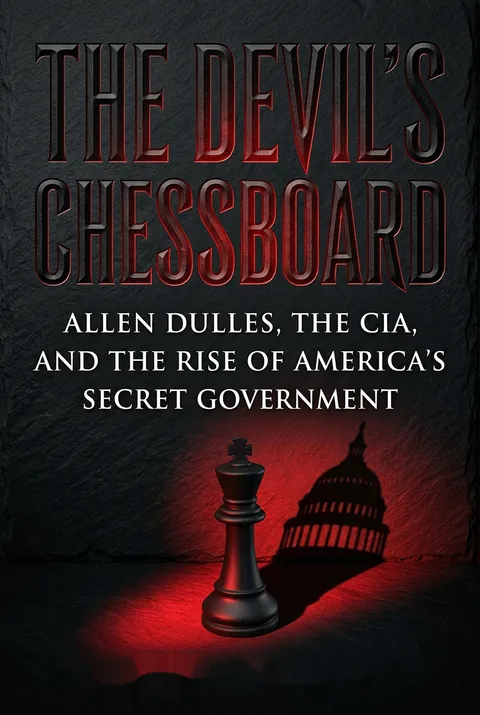

Key Takeaways
1. The Dulles Brothers: Architects of Covert Power
From their earliest days on Wall Street—where they ran Sullivan and Cromwell, the most powerful corporate law firm in the nation—their overriding commitment was always to the circle of accomplished, privileged men whom they saw as the true seat of power in America.
Elite architects. John Foster Dulles and Allen Dulles, through their powerful Wall Street law firm Sullivan & Cromwell, cultivated a deep-seated belief that democracy required careful management by an elite few. They saw themselves as indispensable figures in this "true seat of power," bridging the worlds of business, law, and government. Their early careers were marked by a strategic fixation on global politics, akin to their obsessive chess games.
Corporate-state nexus. The brothers' influence extended far beyond legal counsel, deeply intertwining corporate interests with national policy. Foster, as chief counsel, quietly conferred with global leaders, while Allen, as the "sinister hand," executed the dark deeds required by their imperial vision. This fusion of corporate and state power laid the groundwork for a system where private interests often dictated public policy, a dynamic they believed was essential for America's global standing.
Disdain for democracy. Their actions often demonstrated a profound distrust of elected officials and popular will. Foster openly urged corporate clients to defy New Deal legislation, and Allen blatantly ignored President Roosevelt's wartime policies. They viewed presidents as figures to be manipulated or subverted if they deviated from the elite's vision, believing that their circle of privileged men held the ultimate authority in America.
2. Wartime Treachery: Dulles's Nazi Connections
After the war, Dulles helped a number of notorious war criminals escape via the “Nazi ratlines” that ran from Germany, down through Italy, to sanctuary in Latin America, the Middle East, and even the United States.
Secret wartime diplomacy. During World War II, Allen Dulles, serving as the top U.S. spy in Switzerland for the Office of Strategic Services (OSS), pursued his own foreign policy, often in direct defiance of President Roosevelt. He maintained extensive professional and social ties with Nazi elites, sharing many of their postwar goals, particularly regarding the Soviet Union as the true enemy. This included secret negotiations with Heinrich Himmler's emissaries, undermining Roosevelt's "unconditional surrender" policy.
Protecting Nazi assets. Dulles and his brother Foster, through Sullivan & Cromwell, actively worked to protect the assets of their German corporate clients, even those deeply integrated into the Nazi war machine. Allen used his OSS position to obstruct Project Safehaven, an Allied effort to track and confiscate Nazi wealth, ensuring that these funds could later be repurposed for anti-Soviet operations rather than returned to victims. This involved shredding incriminating evidence and blocking investigations.
Salvaging the Reich's apparatus. Dulles was more interested in preserving elements of the Third Reich's security and industrial apparatus to turn against the Soviet Union than in prosecuting war criminals. He facilitated the escape of numerous notorious Nazis, including SS General Karl Wolff, through "ratlines" to various sanctuaries. This selective justice ensured that many architects of Hitler's regime found new lives of power and affluence, becoming essential confederates in Dulles's burgeoning Cold War intelligence complex.
3. Exploiting the Cold War: Purging the New Deal
The Cold War furies that Nixon and the Dulles brothers helped to unleash scoured all nuance and charity from American politics.
Weaponizing anti-Communism. The Dulles brothers, in alliance with rising politicians like Richard Nixon, masterfully exploited Cold War paranoia to dismantle the remnants of Roosevelt's New Deal. They framed progressive policies and officials as "un-American" or Communist-sympathetic, effectively purging government of those who challenged their corporate-friendly agenda. This strategy transformed political debate into a ruthless ideological battle.
Targeting New Dealers. Figures like Congressman Jerry Voorhis, a staunch New Dealer, and economist Harry Dexter White, a key architect of the Bretton Woods institutions, became targets. Voorhis's efforts to curb corporate power and White's vision for a global financial order that challenged Wall Street were seen as threats. Nixon, backed by Dulles's network, launched smear campaigns, labeling opponents as "pinkos" or "traitors," regardless of their actual affiliations.
The Hiss affair. The Alger Hiss case, where Nixon relentlessly pursued a former State Department official, became a defining spectacle. Despite Hiss's denials and the dubious nature of some evidence, the Dulles-Nixon alliance used the case to discredit the New Deal legacy and solidify their anti-Communist credentials. This era of "scoundrel time" established a new ruling order, replacing Rooseveltian ideals with a militarized, corporate-dominated state.
4. The CIA as a Rogue Empire: Unaccountable Power
Under Allen Dulles, the CIA would become a vast kingdom, the most powerful and least supervised agency in government.
Unleashing the agency. Allen Dulles transformed the CIA from an intelligence-gathering body into an aggressive, covert operations machine, operating with unprecedented autonomy. President Eisenhower, seeking "empire on the cheap," granted Dulles immense license, viewing the CIA as a cost-effective tool to enforce U.S. interests globally, often through "cloak-and-dagger brutality."
"Organized irresponsibility." Dulles cultivated an environment where the CIA operated largely outside democratic checks and balances. He stonewalled congressional oversight, dismissing legislators' concerns about agency activities. This "organized irresponsibility" allowed the CIA to engage in sabotage, subversion, and assassination without meaningful accountability, shaping foreign policy independently of the White House or Congress.
A state within a state. The CIA, under Dulles, became a "closed state within an open state," permeating other government agencies with its loyalists and influencing media narratives. This expansion of secret power, justified by the "permanent war economy" of the Cold War, ensured that the agency's operations, however morally dubious, remained largely hidden from the American public and beyond the reach of democratic control.
5. Mind Control and Human Experimentation: MKULTRA's Dark Side
The CIA chemist preyed on “people who could not fight back,” as one agency official put it, such as seven patients in a federal drug hospital in Kentucky who were dosed with acid for seventy-seven straight days by a Gottlieb-funded doctor who ran the hospital’s addiction treatment program.
Brain warfare. Allen Dulles launched MKULTRA, a secret CIA mind control program, under the guise of countering Soviet "brainwashing" techniques. This "Manhattan Project of the Mind" involved extensive, unethical human experimentation, often on unwitting subjects like drug addicts, mental patients, and prisoners, whom the agency deemed "expendables." The goal was to control human consciousness and create programmable agents or assassins.
Unethical science. The program enlisted dozens of leading universities and hundreds of prominent researchers, many of whom violated ethical standards. Experiments involved dangerous drugs like LSD, insulin shock therapy, and sensory deprivation, often causing severe psychological and physical trauma. Dr. Henry Knowles Beecher, a Harvard-trained physician, and Dr. Donald Ewen Cameron, a Scottish psychiatrist, were key figures, conducting barbaric "de-patterning" and "psychic driving" experiments.
Personal tragedies. The dark reach of MKULTRA extended even to Dulles's own family. His son, Allen Jr., a Korean War veteran suffering brain damage, was subjected to experimental treatments by CIA-connected physicians like Dr. Harold Wolff and Dr. Wilder Penfield. Dulles also arranged for his niece to undergo a lobotomy by a CIA brain surgeon. These personal tragedies underscored the program's ruthless disregard for human well-being, even among those closest to its architects.
6. Regime Change: Protecting Corporate Interests Abroad
The Dulles brothers assured multinational firms that Washington would stop at nothing to protect their overseas investments.
Corporate-driven coups. The Eisenhower-Dulles administration orchestrated violent regime changes in Iran (1953) and Guatemala (1954) to protect U.S. corporate interests, particularly in oil and agriculture. These coups, celebrated internally as triumphs, dismantled fledgling democracies and installed autocratic regimes, ensuring favorable conditions for multinational corporations like Anglo-Iranian Oil and United Fruit Company.
Iran: Oil and the Shah. In Iran, Prime Minister Mohammad Mossadegh's nationalization of the Anglo-Iranian Oil Company prompted a CIA-backed coup. Dulles, with deep ties to U.S. oil companies, framed Mossadegh as a Communist threat, convincing Eisenhower to overthrow the democratically elected leader. The coup restored the Shah's autocratic rule, denationalized Iran's oil industry, and secured a significant stake for American oil producers.
Guatemala: Bananas and Bloodshed. In Guatemala, President Jacobo Arbenz's land reforms, which expropriated uncultivated lands from the United Fruit Company, triggered another CIA-orchestrated coup. Dulles, a former lawyer for United Fruit, again demonized the leader as a Soviet "beachhead." The coup installed a brutal military regime, leading to decades of assassinations, torture, and massacres, transforming Guatemala into one of the twentieth century's most infamous killing fields.
7. The Kennedy Challenge: A President Against the Deep State
Though it was largely hidden from the public, the duel between Kennedy and Dulles would define Washington’s “deep politics” in the early 1960s.
A new vision for America. John F. Kennedy, deeply affected by his wartime experiences and critical of Western imperialism, sought to steer U.S. foreign policy away from the rigid Cold War doctrines of the Eisenhower-Dulles era. He advocated for supporting national liberation movements in the Third World and pursuing détente with the Soviet Union, a stance that put him at odds with the entrenched national security establishment.
Clash with the old guard. Kennedy's efforts to assert presidential control over the military and intelligence agencies were met with fierce resistance. He viewed figures like Joint Chiefs chairman Lyman Lemnitzer and Air Force chief Curtis LeMay as dangerously hawkish, and he found Allen Dulles's CIA to be patronizing and insubordinate. This growing estrangement created a profound rift within his administration, largely concealed from the public.
Defying the establishment. JFK's policies, such as his tax reforms targeting the wealthy and his Alliance for Progress in Latin America, directly challenged the corporate elite and their financial interests. His willingness to question the "crackpot realism" of Cold War orthodoxy and pursue peace initiatives, like the nuclear test ban treaty, solidified his image as an "aberrant president" in the eyes of the deep state, leading to intense hostility.
8. The Bay of Pigs: A Deliberate Trap for Kennedy
Dulles plunged ahead with his hopeless, paramilitary mission—an expedition that he had staffed with “C-minus” officers and expendable Cuban “puppets”—because he was serenely confident that, in the heat of battle, Kennedy would be forced to send the Marines crashing ashore.
A calculated setup. The Bay of Pigs invasion, launched shortly after Kennedy took office, was designed by Allen Dulles and his CIA team to fail as a covert operation. Despite knowing the plan was "unachievable" without direct U.S. military intervention, Dulles presented it to Kennedy as viable, staffing it with "C-minus" officers and "expendable" Cuban exiles. The true objective was to create a crisis that would compel the young president to commit full U.S. military force.
Kennedy's resistance. Kennedy, wary of direct military involvement and international embarrassment, repeatedly downsized the operation and refused to authorize U.S. air cover or ground troops, despite intense pressure from Dulles, the Pentagon, and his national security advisers. He saw through the trap, telling friends, "They couldn't believe that a new president like me wouldn't panic and try to save his own face. Well, they had me figured all wrong."
Dulles's contempt. Dulles's actions during the Bay of Pigs, including his convenient absence in Puerto Rico during the invasion, revealed his profound contempt for Kennedy's authority. He believed he could force the president's hand, confident that Kennedy would ultimately bend to the will of the Washington war machine. The failure of this gambit led to Dulles's ouster, but also fueled a "stuttering rage" within the CIA and Pentagon against the president.
9. The Kennedy Assassination: Dulles's Role in the Cover-up
How did Allen Dulles—a man fired by President Kennedy under bitter circumstances—come to oversee the investigation into his murder?
A strategic appointment. Despite being fired by President Kennedy, Allen Dulles aggressively lobbied for and secured a prominent position on the Warren Commission, the official inquiry into JFK's assassination. This appointment, orchestrated by the national security establishment and Lyndon Johnson, ensured that the investigation would be controlled by those with a vested interest in a specific outcome: a lone gunman theory that protected the CIA and other implicated agencies.
Manipulating the narrative. Dulles, along with John McCloy and Gerald Ford, dominated the commission, steering the inquiry away from any hint of conspiracy. He actively suppressed evidence, such as the CIA's extensive files on Lee Harvey Oswald, and promoted disinformation, including the false claim that Kennedy preferred his Secret Service guards to ride behind his limousine. Dulles's goal was to "lay the dust" of public suspicion and prevent any revelations that could destabilize the government or expose the "deep state."
Oswald as "patsy." The commission's conclusion that Lee Harvey Oswald acted alone, despite glaring inconsistencies in the evidence (e.g., ballistics, eyewitness accounts of shots from the grassy knoll, Oswald's denial of guilt), served to close the case quickly. Oswald's murder by Jack Ruby, broadcast live, further fueled suspicions of a cover-up, but Dulles and his allies ensured that the official narrative remained unchallenged, effectively rewriting history "for the good of the country."
10. The Enduring Shadow: Dulles's Legacy of "Organized Irresponsibility"
Dead for nearly half a century, Dulles’s shadow still darkens the land.
A lasting blueprint. Allen Dulles's legacy is etched into the very fabric of the modern American national security state. He established a blueprint for "organized irresponsibility," where intelligence agencies operate with minimal oversight, engaging in covert actions, assassinations, and psychological warfare, often in defiance of democratic principles. His philosophy that "patriotism set no bounds" on power continues to influence subsequent administrations.
The "deep state" endures. The network of financial, intelligence, and military interests that Dulles helped solidify—what C. Wright Mills termed the "power elite"—persists today. This "deep state" guides national policy regardless of who occupies the White House, ensuring continuity in aggressive foreign interventions and the protection of corporate interests abroad. Dulles's ability to operate above the law, even after his official retirement, demonstrated the true extent of this hidden power.
A chilling confession. James Jesus Angleton, Dulles's loyal acolyte and chief of counterintelligence, offered a chilling deathbed confession, stating that the "founding fathers of U.S. intelligence were liars" driven by a "desire for absolute power." He admitted to doing things he regretted, acknowledging that he had been on a "satanic quest" rather than serving God. This stark admission from within Dulles's inner circle underscores the profound moral cost of the unchecked power he wielded and bequeathed to future generations.
Review Summary
The Devil's Chessboard is a meticulously researched and compelling account of Allen Dulles's role in shaping America's secret government. The book explores Dulles's career from WWII through his tenure as CIA director, detailing his involvement in covert operations, regime changes, and the JFK assassination. Readers praise Talbot's thorough investigation and engaging narrative, though some criticize his bias and speculative conclusions. The book offers a disturbing look at the CIA's influence on U.S. foreign policy and raises questions about democracy and accountability in government.
People Also Read
Download PDF
Download EPUB
.epub digital book format is ideal for reading ebooks on phones, tablets, and e-readers.








































