

Key Takeaways
A pedophile ring pandered children to America's power elite, then vanished from history
The Franklin scandal is the book's central claim. Nick Bryant, an investigative journalist who previously co-authored academic work on disadvantaged children, spent over seven years documenting a nationwide network that allegedly trafficked children to politicians and wealthy businessmen. The front man was Lawrence (Larry) King, a rising Republican star who sang the national anthem at the 1984 GOP convention and threw a $100,000 gala for George H.W. Bush in 1988.
The ring hid behind an Omaha credit union. King managed the Franklin Community Federal Credit Union, looting roughly $40 million while allegedly running the trafficking operation. When federal agents closed Franklin in 1988, whispers of child abuse surfaced. Bryant argues the story was buried by the very agencies sworn to protect children.
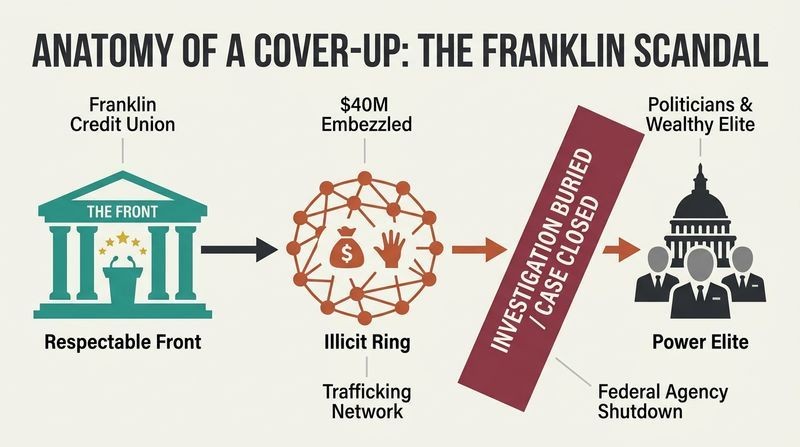
What makes this claim so difficult to evaluate is its structural self-concealment: the alleged victims were drug-addicted felons whose credibility collapses on contact with a courtroom. Bryant is candid that some sources are tenuous, which is itself unusual in conspiracy literature. Skeptics rightly note that two grand juries ruled the allegations a hoax. Yet the pattern Bryant documents (parallel scandals later exposed in Belgium's Dutroux affair and Portugal's Casa Pia) shows that powerbroker abuse networks are not fictional per se. The reader must hold two things at once: extraordinary claims demand extraordinary evidence, and institutional cover-ups genuinely happen.
Compromised victims make the perfect crime: abuse them, then discredit them
The network had a built-in concealment mechanism. Children were molested and hooked on drugs young, then discarded once they aged out of marketability. By adulthood they were addicts, felons, or psychiatric patients whose word could never outweigh a polished politician's. Troy Boner, one victim, described himself and his peers as people who were turned into sex perverts and drug addicts by their abusers.
Credibility becomes the weapon. When Alisha Owen refused to recant, prosecutors paraded her bounced checks, promiscuity, and psychiatric hospitalizations before the jury. The strategy converts the wound into the defense: the more damaged the victim, the less believable the testimony. Eulice Washington overcame a hellish childhood but had four children out of wedlock, so her word against a prominent politician would be a first-round knockout.
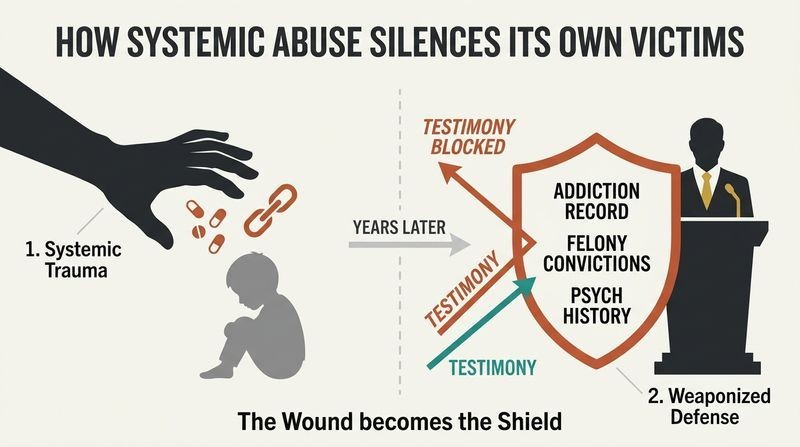
This is the darkest structural insight in the book, and it echoes findings across trauma research. Betrayal trauma theory (Jennifer Freyd) shows that abuse by trusted, powerful figures produces exactly the dissociation, memory fragmentation, and self-destructive behavior that later reads as unreliability. Predators who select marginalized targets exploit what criminologists call the credibility gap. The same dynamic surfaced in the Jimmy Savile and Jeffrey Epstein cases, where victims' histories were weaponized for decades. Bryant's framing is sound: a justice system that requires pristine witnesses is structurally blind to crimes that deliberately destroy their witnesses.
When honest investigators get too close, planes fall out of the sky
Gary Caradori is the tragic heart of the story. A former state trooper and gifted private investigator hired by Nebraska's legislative Franklin Committee, Caradori videotaped over 21 hours of victim testimony and doggedly pursued flight records showing children transported across state lines. He told a senator he had them by the shorthairs after obtaining alleged blackmail photos in Chicago.
Then his plane broke apart mid-air. On July 11, 1990, Caradori's Piper Saratoga disintegrated over an Illinois cornfield, killing him and his eight-year-old son. His briefcase, which almost never left his side, was never recovered. The film in his camera was removed and returned developed. The NTSB found no definitive cause but excluded sabotage. Two days after his death, the FBI subpoenaed all of Caracorp's records.
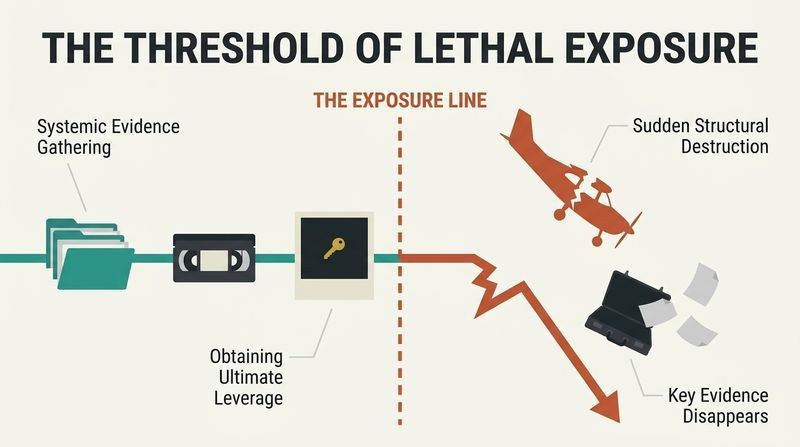
Correlation is not causation, and small aircraft break up in flight for mundane reasons: spatial disorientation, structural overload, pilot fatigue. Bryant honestly reports the official finding. But the surrounding facts (the missing briefcase, the developed film, the timing of the FBI subpoena, Caradori's own stated fear of being framed) create what statisticians call a suspicious cluster. The body count around Franklin (Charlie Rogers, Aaron Owen, Shawn Boner, William Colby) invites the Chinese proverb Bryant cites: kill one man, silence a hundred. Whether coincidence or something worse, the chilling effect on future witnesses was real and measurable.
A grand jury can manufacture reality by choosing which evidence jurors see
Grand juries are prosecutorial theaters, not fair trials. There is no cross-examination and no defense. The special prosecutor alone selects witnesses and evidence. A former chief appellate judge quipped a prosecutor could get a grand jury to indict a ham sandwich. Nebraska's Douglas County grand jury, led by Samuel Van Pelt, deliberated 82 days and declared the whole affair a carefully crafted hoax.
The mechanics reveal the manipulation. The Caradori videotapes shown to grand jurors had been doctored, with corroborating content deleted. Immunity agreements were altered before submission. Van Pelt introduced 87 exhibits on the final day, and possessed phone records disproving the hoax's linchpin (a phantom call) but never confronted the witness with them.
Bryant's critique of the grand jury as an instrument of concealment rather than discovery is legally substantive, not paranoid. Legal scholars have long argued the grand jury has devolved from a check on prosecutorial power into its rubber stamp, which is why England abolished it in 1933. The structural asymmetry Bryant exposes (secrecy plus one-sided evidence selection) is a genuine vulnerability in American jurisprudence. What elevates his case beyond ordinary critique is the documented tampering: doctored tapes and edited immunity agreements are not interpretive disputes but alleged evidentiary crimes that, if true, corrupt the entire proceeding at its root.
The press can bury a story as effectively as any censor by simply echoing officials
Media complicity did the heaviest lifting in the cover-up. The Omaha World-Herald, whose publisher Harold Andersen chaired Franklin's advisory board and was himself named by victims, relentlessly attacked the legislative committee and the victims while validating the hoax verdict. When Concerned Parents picketed, protesters dubbed it the Pravda of the Plains.
National outlets amplified the official story. The New York Times ran two early pieces, then went silent for eighteen months until it could report the hoax conclusion. GQ published an error-riddled hit piece that called the female victim Eulice a 9-year-old boy. Most damning: CBS aired a 48 Hours episode declaring the allegations a hoax on the exact night Owen's jury began deliberating, and several jurors admitted watching it.
Bryant's media analysis anticipates the manufacturing consent critique associated with Herman and Chomsky: outlets rarely need direct orders when structural incentives, source dependence, and access journalism align. The lunch-with-a-key-official pattern he documents at the Washington Post is textbook source capture. The 48 Hours timing is the strongest single data point, because jury contamination is measurable and consequential. The counterargument is Occam's razor: journalists often ignore stories not from corruption but because far-fetched claims with damaged sources rarely survive editorial risk assessment. Both can be true. Institutional caution and active suppression produce identical outcomes, which is precisely what makes cover-ups hard to distinguish from ordinary journalistic timidity.
Blackmail, not policy, may be the hidden currency of Washington power
The DC flipside mirrors Omaha exactly. Washington Times reporter Paul Rodriguez exposed powerbroker Craig Spence, whose Kalorama mansion was wired with two-way mirrors and hidden recording equipment. Spence hosted parties supplying drugs and prostitutes, including minors, to compromise guests, and arranged late-night White House tours (one including a fifteen-year-old). Spence claimed CIA ties and died a supposed suicide in Boston's Ritz-Carlton in 1989.
Sexual compromise is the mechanism. Bryant argues the point of Franklin was not merely gratification but leverage. A single compromising photo of a congressman or judge renders them controllable. He connects this to the CIA's documented Operation Midnight Climax, which used prostitutes and one-way mirrors to blackmail targets, and notes Congress's 12% approval rating in 2008 raises the question of whose will it actually serves.
The blackmail thesis is the book's most provocative and least falsifiable claim, but it rests on more than speculation. Operation Midnight Climax is documented CIA history, and J. Edgar Hoover's use of sexual dossiers is thoroughly established. The logic is sound: kompromat is the oldest tool in intelligence tradecraft, and closeted or philandering officials are structurally vulnerable. What Bryant cannot prove is scope: that blackmail systematically steers legislation rather than occasionally silencing individuals. The Spence case is genuinely strange (the two-way mirrors and midnight tours are Washington Times reporting, not invention). Still, absent the sealed 25,000 documents Bryant references, the systemic claim remains an inference, however unsettling.
Even Boys Town, America's beloved orphanage, allegedly served as a hunting ground
The most sacred institution was not immune. Boys Town, immortalized in the 1938 Spencer Tracy film and holding a net worth of $209 million by 1972, was allegedly plundered by Larry King for underage prostitutes. Bryant tracked down former residents (David Hill, Fred Carter, Tony Harris, Nikolai Cayman, Rue Fox) who independently described being recruited, flown to parties, and paid.
Their stories converged without collusion. Tony Harris described monthly flights to Washington, being picked and paid by well-dressed men, receiving $100 to $500 per encounter. Rue Fox, warned to Bryant as a violent ex-con, broke into tears describing King. A counselor who specialized in abused kids, Leslie Collins, was himself convicted of molesting his stepdaughters and allegedly made introductions to King.
The convergence-without-contact argument is Bryant's strongest methodological move. When geographically scattered, mutually unacquainted sources describe identical specifics (the same names, the same payment structure, the same locations), coincidence becomes statistically strained. This mirrors how corroboration works in the Catholic Church abuse revelations, where independent victims across continents described identical grooming patterns, and institutional protection of predators proved systemic. The Collins detail is particularly damning: placing a convicted pedophile as counselor to abused children is either catastrophic negligence or something worse. Bryant's willingness to report contradictions in his sources (some praised Boys Town even while alleging abuse) strengthens rather than weakens his credibility here.
One woman refused to recant and paid with nine to fifteen years
Alisha Owen is the book's portrait of moral endurance. A twenty-one-year-old serving three to four years for bad checks totaling $736.96, Owen told investigator Caradori she had been abused by police chief Robert Wadman (father of her child), businessman Alan Baer, and others starting at fourteen. Held in solitary for nearly two years, attacked by inmates, her cell raided by the FBI, she still would not recant.
The system spent hundreds of thousands to convict her of perjury. Her attorney Henry Rosenthal battled a judge who threatened him with jail and a prosecutor who objected roughly 200 times in the pretrial hearing alone. The state never entered the DNA test into evidence. She was convicted on all eight counts and told the court that a clean conscience is the only prison no man holds the key to.
Owen's arc reframes the entire book from conspiracy expose to a study of integrity under total institutional pressure. Her fellow accusers (Boner, Danny King) broke under FBI interrogation that Bryant documents breaking people like houses of cards, which paradoxically strengthens her credibility: she had every incentive to fold and freedom was explicitly offered for a recantation. Behavioral economics predicts people take the guaranteed exit; Owen's refusal is an outlier demanding explanation. The unexplained non-introduction of the DNA test is the case's most glaring anomaly. If it proved Wadman was not the father, entering it would have been trivial and devastating. Its absence invites exactly the suspicion Bryant raises.
Federal power was deployed with a fury that itself became evidence
The overkill is Bryant's circumstantial smoking gun. Local corruption cannot explain federal behavior. The FBI allegedly threatened a social worker to forget what she knew, told witness Alan Baer to keep his head down or get it blown off, raided a prisoner's cell over a personal folder, and subpoenaed a dead investigator's records before his body was cold.
Why bring federal firepower to a debunked case? Owen herself concluded local law enforcement lacked the resources and reach to cover up something with so many witnesses and so much corroboration. Bryant notes that officials who prosecuted the cover-up were rewarded: prosecutor Gerald Moran leapfrogged to a district judgeship, Magistrate Kopf became a lifetime-appointed federal judge, and prosecutor Thalken became a magistrate, promotions continuing even after the Bush administration left office.
The disproportionate-response argument is a legitimate inferential tool: investigators routinely reason that the intensity of a cover-up reveals the magnitude of what is hidden. Watergate scaled the same way. The career-advancement pattern Bryant documents is the more testable claim, and patronage for those who deliver desired outcomes is a well-studied feature of institutions. The weakness is that federal aggression can also stem from bureaucratic face-saving: once the FBI publicly declared no substance, admitting error becomes institutionally intolerable, generating escalation independent of any underlying crime. Cognitive dissonance at the organizational level can mimic conspiracy. Bryant's evidence cannot fully separate a cover-up of crime from a cover-up of incompetence.
Ritual abuse and mind control sound insane until you read the peer-reviewed data
Bryant enters the story's most incredible territory carefully. Victims Shawneta Moore and Paul Bonacci described satanic rituals and child sacrifices. Bonacci, diagnosed with multiple personality disorder, claimed he was a subject of a government mind-control program using electroshock, drugs, and hypnosis, methods matching declassified CIA documents on inducing dissociation.
The research is more substantial than the panic suggests. Bryant cites a 2007 Extreme Abuse Survey of over 1,400 respondents, and a 1991 study where 83% of ritual-abuse subjects reported witnessing a human sacrifice, closely matched by the later survey's 82%. Bonacci won a $1 million default judgment against King, with a federal judge writing that King subjected him to organized satanic rituals. Bonacci also gave never-released details of Johnny Gosch's 1982 abduction, corroborated by another runaway.
This is where Bryant risks his hard-won credibility, and he knows it. The satanic-panic of the 1980s produced genuine miscarriages of justice (the McMartin and Kern County cases), and the False Memory Syndrome Foundation arose partly in legitimate response to reckless therapy. Yet Bryant flips the script by noting FMSF advisory-board links to CIA mind-control research, an intriguing if unprovable insinuation. The survey data he cites suffers from self-selection bias: online questionnaires of self-identified survivors cannot establish base rates. The strongest element is Bonacci's Gosch details, since verifiable, never-released facts corroborated by an independent runaway resist easy dismissal. A default judgment, however, means King simply never contested it, not that a court weighed evidence.
A verified Customs report on the Finders cult is what makes the whole story plausible
One documented fact anchors the entire investigation. Bryant, a self-described conspiracy skeptic, was pulled in by an authentic 1987 US Customs report. Police in Tallahassee found six malnourished, feral children with two well-dressed men. Warrants on DC warehouses uncovered instructions for buying, trading, and kidnapping children, telexes ordering the purchase of two children in Hong Kong, and photos of children ritually slaughtering goats.
Then the case simply evaporated. Customs Agent Ramon Martinez was told the investigation had become a CIA internal matter, the report was classified secret, and no further action would be taken. Congressmen Charlie Rose and Tom Lewis tried to hold hearings; the effort died. This documented instance of a child-abuse probe shut down by intelligence agencies gave Bryant the paradigm shift to take Franklin seriously.
The Finders episode functions as Bryant's epistemological keystone: a single well-sourced, on-the-record anomaly that licenses reconsidering everything dismissed as implausible. This is methodologically defensible. When a documented case establishes that a category of event is possible (intelligence agencies quashing child-abuse probes), previously incredible claims move from impossible to merely unproven. The Finders report is real and was reported by US News in 1993. Skeptics counter that the CIA-internal-matter line may reflect an unrelated intelligence connection, not protection of abuse, and the goat-slaughter photos, however grotesque, are not evidence of trafficking. Still, Bryant is right that implausible does not mean contrary to fact, the book's most honest and important epistemic principle.
Analysis
The Franklin Scandal is investigative true crime built as a legal and documentary autopsy rather than a narrative thriller. Bryant, who came to the subject from academic work on impoverished children, positions himself as a reluctant skeptic dragged toward belief by paper trails, a rhetorical stance that is also his strongest credibility asset. The book's central difficulty for any summarizer is epistemic: its core claims are simultaneously monstrous, poorly corroborated by design, and impossible to fully verify or dismiss. Bryant handles this better than most in his genre by repeatedly flagging weak sources, admitting contradictions, and distinguishing documented facts (the Customs report, court transcripts, phone records, Rochon's FBI lawsuit) from inference.
Methodologically, the book's spine is convergent corroboration: geographically dispersed, mutually unacquainted, socially marginalized witnesses describing identical specifics. This is a genuine evidentiary logic, the same one that eventually validated the Catholic Church and Savile revelations. Its vulnerability is that shared cultural scripts, media exposure, and jailhouse networks can also manufacture convergence, which Bryant acknowledges but cannot fully exclude.
The strongest sections are procedural: the doctored videotapes, altered immunity agreements, the 48 Hours broadcast timing, and the career advancement of cover-up participants. These are checkable institutional facts, and they make a persuasive case for cover-up even for readers unconvinced of the underlying trafficking. The weakest sections are the satanic ritual and mind-control chapters, where self-selected survey data and default judgments substitute for adversarial proof.
The book's enduring value lies less in proving its most extreme allegations than in demonstrating a repeatable mechanism: how power protects itself by destroying the credibility of its victims, capturing the press through source dependence, and weaponizing prosecutorial secrecy. Whether or not every Franklin claim is true, that machinery is real, and Bryant documents it with unusual rigor and moral seriousness.
Review Summary
The Franklin Scandal received overwhelmingly positive reviews, with readers praising its thorough investigative journalism and shocking revelations about child abuse and government corruption. Many found it deeply disturbing but important, exposing a dark underbelly of power and exploitation. Readers appreciated Bryant's meticulous research and documentation, though some found the book long and repetitive. Several noted its relevance to contemporary issues of human trafficking and institutional cover-ups. While difficult to read due to its subject matter, most reviewers considered it essential for understanding systemic corruption.
People Also Read




FAQ
1. What is The Franklin Scandal: A Story of Powerbrokers, Child Abuse & Betrayal by Nick Bryant about?
- Investigative exposé: The book uncovers a nationwide child abuse and trafficking ring centered around Omaha’s Franklin Credit Union, implicating powerful politicians, businessmen, and law enforcement.
- Systemic cover-up: It details how government agencies, the justice system, and the media colluded to suppress evidence and silence victims.
- Victim-centered narrative: Through interviews, official records, and firsthand accounts, Bryant reveals the harrowing experiences of abused children and the institutional betrayal they faced.
- Broader implications: The story extends beyond Nebraska, suggesting links to national powerbrokers, the CIA, and a culture of impunity for elite perpetrators.
2. Why should I read The Franklin Scandal by Nick Bryant?
- Unveiling hidden truths: The book exposes a dark chapter in American history that was actively suppressed by mainstream media and authorities.
- Understanding institutional failure: It provides a detailed look at how law enforcement, social services, and the judiciary failed to protect vulnerable children.
- Empathy and advocacy: By humanizing the victims, Bryant encourages readers to advocate for justice and systemic reform.
- Call to action: The narrative challenges readers to question authority, demand transparency, and support investigative journalism.
3. Who are the main figures involved in The Franklin Scandal by Nick Bryant, and what roles did they play?
- Larry King: Alleged ringleader of the pedophile network and manager of the Franklin Credit Union, with deep political connections and a lavish lifestyle.
- Alisha Owen: Central victim who testified about abuse, later convicted of perjury after refusing to recant her allegations.
- Gary Caradori: Lead investigator for the Franklin Committee, whose mysterious death in a plane crash marked a turning point in the cover-up.
- Troy Boner and Paul Bonacci: Victims and witnesses who provided key testimonies, later facing coercion, recantations, and legal battles.
4. How does Nick Bryant describe the experiences of the victims in The Franklin Scandal?
- Severe abuse: Victims endured physical, sexual, and psychological abuse, including forced prostitution and ritualistic ceremonies.
- Systemic betrayal: Many were abused in foster care or institutions like Boys Town, with their reports ignored or suppressed by authorities.
- Intimidation and silencing: Victims faced threats, harassment, and retaliation from both perpetrators and law enforcement.
- Legal and social struggles: Attempts to seek justice were met with skepticism, character assassination, and, in some cases, imprisonment.
5. What role did law enforcement and government agencies play in the cover-up, according to The Franklin Scandal by Nick Bryant?
- Active obstruction: Agencies like the FBI, Omaha Police, and Nebraska State Patrol sabotaged investigations, withheld evidence, and intimidated witnesses.
- Manipulation of justice: Grand juries were influenced to exonerate powerful figures, and prosecutors aggressively targeted victims for perjury.
- Suppression of evidence: Critical documents and testimonies were sealed, doctored, or ignored to protect the network.
- Internal corruption: The book details a toxic culture within the Omaha FBI office, including racism, sexual misconduct, and retaliation against whistleblowers.
6. What was the involvement of Boys Town in the events described in The Franklin Scandal by Nick Bryant?
- Source of victims: Boys Town, a renowned orphanage, was exploited as a reservoir of underage victims for the abuse network.
- Institutional complicity: Staff and counselors were implicated in facilitating or ignoring abuse, and leadership changes followed internal scandals.
- Victim experiences: Former Boys Town students described being recruited, trafficked, and subjected to sadistic abuse and rituals.
- Suppression of reports: Efforts to report abuse were often met with disbelief or active cover-up by the institution.
7. How does The Franklin Scandal by Nick Bryant portray the media’s role in the investigation and cover-up?
- Complicity and suppression: Major outlets like the Omaha World-Herald and national media either ignored, distorted, or actively undermined the investigation.
- Character assassination: Victims and investigators were publicly maligned, and leaks of confidential testimonies damaged credibility.
- Selective reporting: Media coverage often focused on financial crimes or sensationalized aspects, neglecting the core abuse allegations.
- Impact on justice: Media bias influenced public perception and jury opinions, contributing to the silencing of victims and the perpetuation of the cover-up.
8. What was the outcome of the grand jury investigations in The Franklin Scandal by Nick Bryant?
- Failure to indict perpetrators: Despite extensive evidence, grand juries did not indict major abusers like Larry King on child abuse charges.
- Victim prosecution: Victims such as Alisha Owen were indicted and convicted of perjury, reinforcing the official narrative of a “hoax.”
- Manipulation and secrecy: Proceedings were marked by secrecy, manipulation of evidence, and pressure on witnesses to recant.
- Public disillusionment: The grand jury’s reports avoided addressing the full scope of abuse, leading to widespread frustration and mistrust.
9. What happened to key investigators like Gary Caradori in The Franklin Scandal by Nick Bryant?
- Lead investigator: Caradori was hired by the Franklin Committee to uncover the abuse network, gathering crucial evidence and victim testimonies.
- Obstruction and threats: He faced harassment, surveillance, and attempts to discredit his work from law enforcement and political figures.
- Mysterious death: Caradori died in a suspicious plane crash after reportedly obtaining incriminating photographs, with many suspecting foul play.
- Impact on investigation: His death marked the effective end of the Franklin Committee’s momentum and deepened suspicions of a cover-up.
10. How does The Franklin Scandal by Nick Bryant address allegations of satanic ritual abuse and mind control?
- Victim testimonies: The book presents accounts of ritualistic abuse and ceremonies linked to the pedophile network, though corroboration is limited.
- Mind control claims: Victims like Paul Bonacci described being subjected to government mind control experiments involving drugs, hypnosis, and trauma.
- Historical context: Bryant references CIA programs like MK-ULTRA and expert opinions to situate these claims within documented covert experimentation.
- Controversy and skepticism: The author acknowledges skepticism but argues that credible documentation and therapists support the plausibility of these abuses.
11. What evidence and investigative methods does Nick Bryant use in The Franklin Scandal?
- Primary documents: The book relies on grand jury transcripts, court records, FBI reports, and investigative notes to build its case.
- Interviews and testimonies: Bryant conducted extensive interviews with victims, witnesses, investigators, and insiders, providing depth and corroboration.
- Media and government reports: Newspaper articles, television programs, and official investigations are critically analyzed for accuracy and omissions.
- Legal and medical records: The narrative includes medical reports, polygraph results, and psychological evaluations to verify claims and assess credibility.
12. What are the key takeaways and lessons from The Franklin Scandal by Nick Bryant?
- Systemic corruption: The book exposes how political, judicial, and law enforcement institutions can collude to protect powerful abusers and suppress the truth.
- Victim resilience: Despite overwhelming intimidation, victims like Alisha Owen and Paul Bonacci demonstrated remarkable courage in seeking justice.
- Media’s double-edged role: While some outlets aided the cover-up, others highlighted the importance of investigative journalism in exposing corruption.
- Call for accountability: The narrative urges readers to demand transparency, support victims, and remain vigilant against institutional abuse and cover-ups.
Download PDF
Download EPUB
.epub digital book format is ideal for reading ebooks on phones, tablets, and e-readers.








































