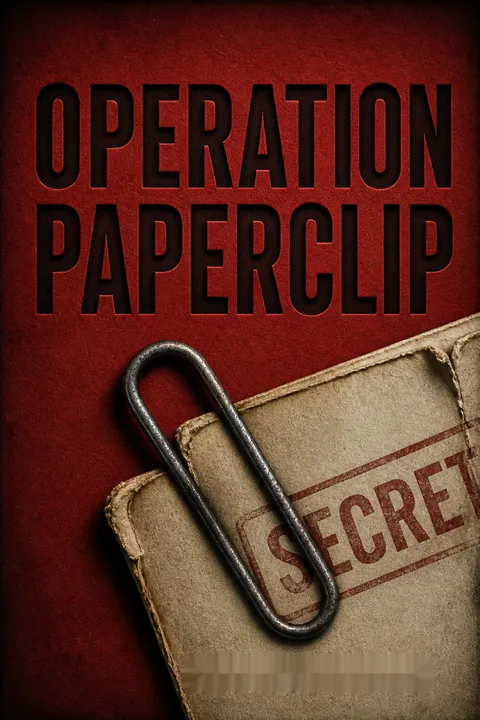

Key Takeaways
1. Operation Paperclip: A Post-War Imperative Driven by Fear
If America didn’t recruit these scientists, the Soviet Communists surely would.
Cold War origins. The U.S. intelligence program, Operation Paperclip, began in May 1945, bringing over sixteen hundred German scientists to America under secret military contracts. This initiative was primarily driven by the escalating Cold War and the urgent need to prevent these valuable technologists from falling into Soviet hands. U.S. officials, including Undersecretary of War Robert Patterson, acknowledged the moral dilemma of hiring "enemies" but deemed it the "lesser of two evils" in the face of a perceived Soviet threat.
Denial program. The Joint Intelligence Objectives Agency (JIOA) was specifically created to manage this recruitment, operating from the Pentagon's elite "E" ring. The JIOA's core mission was to deny the Soviet Union access to German scientific and technological expertise, particularly in areas like rockets, chemical, and biological weapons. This "denial program" became a central tenet of early Cold War strategy, overriding ethical concerns about the scientists' Nazi affiliations.
Total war preparations. By 1946, the Joint Intelligence Committee (JIC) warned the Joint Chiefs of Staff to prepare for "total war" with the Soviets by 1952, including atomic, chemical, and biological warfare. This dire prediction intensified the urgency of Paperclip, leading to "Accelerated Paperclip," which allowed individuals previously deemed undesirable, including high-ranking Nazis, to be brought to the United States, justifying the moral compromises in the name of national security.
2. Moral Compromise: Hiring Nazis for National Security
Hiring dedicated Nazis was without precedent, entirely unprincipled, and inherently dangerous not just because, as Undersecretary of War Robert Patterson stated when debating if he should approve Paperclip, “These men are enemies,” but because it was counter to democratic ideals.
Ethical dilemma. The core of Operation Paperclip involved a profound ethical compromise: the U.S. government knowingly recruited scientists who were not merely "nominal Nazis" but often deeply implicated in the Third Reich's atrocities.
- Fifteen of the twenty-one men highlighted in the book were dedicated Nazi Party members.
- Ten also joined ultra-violent paramilitary squads like the SA and SS.
This decision directly contradicted democratic ideals and sparked intense internal debate among U.S. officials.
War crimes ignored. Many of these scientists had direct ties to Hitler, Himmler, or Göring, and some, like Otto Ambros, were convicted of mass murder and slavery at Nuremberg. Despite these grave accusations, the program prioritized their scientific knowledge over accountability for their past crimes. The prevailing sentiment was that their expertise was too valuable to lose to the Soviets, leading to a deliberate downplaying or concealment of their Nazi affiliations.
"Ends justify means." The program's architects, like John J. McCloy, believed that fostering American military superiority and economic prosperity justified these means. They drew a stark line between "scientists" and "war criminals," often overlooking the fact that many individuals embodied both. This utilitarian approach allowed the U.S. to leverage the very minds that had fueled Hitler's war machine, creating a "headless monster" of unchecked power and moral ambiguity.
3. The Rocket Scientists: From V-2 to Space Race
We felt no moral scruples about the possible future use of our brainchild. We were interested solely in exploring outer space. It was simply a question with us of how the golden cow could be milked most successfully.
V-2 origins. Wernher von Braun, the scientific center of the V-2 rocket program, along with Major General Walter Dornberger and Arthur Rudolph, were instrumental in developing Hitler's "wonder weapon." The V-2, capable of traveling at speeds up to five times the speed of sound, rained terror on European cities. Its production relied heavily on the forced labor of thousands of concentration camp prisoners at Mittelwerk, where conditions were horrific and death rates high.
American recruitment. Despite their deep involvement in a regime that used slave labor for weapons production, von Braun and his team confidently surrendered to the Americans, believing their scientific value would guarantee their future. Major Robert B. Staver, head of Special Mission V-2, recognized the U.S. was twenty years behind Germany in rocket development and saw an opportunity to close that gap by bringing these scientists to America.
Space pioneers. Under Operation Paperclip, von Braun and his team were brought to Fort Bliss, Texas, and later to Redstone Arsenal, Alabama, where they developed ballistic missiles like the Jupiter. Von Braun became a national celebrity, a "prophet of space travel," and eventually the chief architect of NASA's Saturn V rocket, which took man to the moon. His Nazi past, including his SS officer rank, was deliberately whitewashed and kept secret for decades, allowing him to become an American hero.
4. Hitler's Chemists: The Pursuit of Nerve Agents and Poisons
In 1945, in the aftermath of World War II, the U.S. Army Chemical Warfare Service decided to focus its research and development efforts on the German nerve agents, the technological challenges of which promised to ensure the organization’s survival through the period of postwar demobilization and declining military budgets.
Chemical warfare imperative. The U.S. Chemical Warfare Service was stunned by the discovery of Nazi nerve agents like tabun and sarin, realizing America was grossly outmatched. This led to a post-war imperative to acquire German chemical weapons expertise, not only for national security but also to ensure the Chemical Warfare Service's continued relevance and funding. They shipped hundreds of tons of tabun to the U.S. for field tests.
Ambros and Schieber. Key figures like Otto Ambros, codiscoverer of sarin and chief of the Reich's chemical warfare committee, and SS-Brigadeführer Dr. Walter Schieber, who oversaw nerve gas production, were highly sought after. Despite Ambros's conviction for mass murder and slavery at Nuremberg, and Schieber's deep Nazi ties, the U.S. military pursued their knowledge. General Charles E. Loucks, head of the Chemical Corps, even hosted Schieber and other chemists in his home to extract sarin production secrets.
Psychochemical warfare. The pursuit of chemical agents expanded beyond lethality to "incapacitating agents." Dr. L. Wilson Greene, a Chemical Corps director, coined "psychochemical warfare," envisioning drugs that could disable enemies without killing. Paperclip chemist Fritz Hoffmann, despite his anti-Nazi affidavit, became a central figure in this research, traveling globally to collect obscure poisons for the Chemical Corps and the CIA's assassination programs, including those used in MKUltra.
5. Nazi Doctors: Exploiting Medical Crimes for U.S. Research
No effort was made to assess [the doctors’] political and ethical viewpoints, or their responsibility for war crimes.
Aviation medicine. Major General Malcolm Grow and Colonel Harry Armstrong, pioneers in U.S. aviation medicine, sought to capture the Reich's cutting-edge research. They established the U.S. Army Air Forces Aero Medical Center in Heidelberg, secretly employing fifty-eight Nazi doctors, including Dr. Hubertus Strughold, Dr. Theodor Benzinger, and Dr. Siegfried Ruff, to continue their wartime research, often based on horrific human experiments. This violated Allied Control Council Law 25, which prohibited military research in Germany.
Nuremberg trials. Five of these doctors—Benzinger, Ruff, Konrad Schäfer, Hermann Becker-Freyseng, and Oskar Schröder—were arrested and tried at the Nuremberg doctors' trial for medical murder. Dr. Leopold Alexander, a Jewish-Austrian psychiatrist who fled the Nazis, served as a key war crimes investigator, uncovering evidence of freezing, high-altitude, and saltwater experiments on concentration camp prisoners. Despite damning evidence, some, like Benzinger, were mysteriously released and returned to U.S. employ.
Whitewashing and re-employment. Strughold, despite being on the CROWCASS list of suspected war criminals and having knowledge of the Dachau experiments, became the "Father of U.S. Space Medicine" at the School of Aviation Medicine in Texas. His Nazi past was concealed, and he actively recruited other former Nazi doctors. The case of Major General Dr. Walter Schreiber, the Third Reich's surgeon general, who testified against Blome at Nuremberg, further exposed the moral labyrinth, as he too was hired by the U.S. Air Force before public outcry led to his expulsion to Argentina.
6. Deception and Secrecy: The Whitewashing of War Criminals
The purpose of this plan should be understood to be temporary military exploitation of the minimum number of German specialists necessary.
Controlled narrative. From its inception, Operation Paperclip was shrouded in secrecy and deception. The War Department initially issued a two-paragraph press release to "bury the story" and later orchestrated open houses with censored information to portray the German scientists as benign, apolitical figures "vital to national security." This carefully managed public image aimed to counter public outrage and avoid international scandal.
Altering records. The JIOA actively manipulated security reports and visa processes to allow ardent Nazis, including SS and SA members, to enter the U.S. The phrase "no known or alleged war criminal" was subtly changed to "no persons who might try and plan for the resurgence of German military potential," effectively shifting the focus from past crimes to future utility against the Soviets. This involved lying by omission and, in some cases, outright fabrication.
Covert operations. Scientists like SS-Brigadeführer Dr. Walter Schieber, a holder of the Golden Party Badge, were given aliases and transported under escort to avoid detection. The CIA, in particular, embraced this culture of secrecy, using Paperclip scientists in covert programs like Bluebird and Artichoke, which involved "extreme interrogation" and "behavior modification" using drugs like LSD, often on unwitting subjects, further obscuring the ethical lines.
7. The "Headless Monster": Unchecked Power and Covert Operations
Operation Paperclip was becoming a headless monster.
JIOA's unchecked power. The Joint Intelligence Objectives Agency (JIOA), a subcommittee of the Joint Chiefs of Staff, wielded immense power over Operation Paperclip, operating with minimal oversight. Its decisions, driven by Cold War paranoia and the imperative to gain military supremacy over the Soviets, often bypassed established legal and ethical norms, particularly concerning immigration and the prosecution of war criminals.
CIA's deep involvement. The newly formed CIA quickly recognized the value of Paperclip scientists for its own clandestine operations. Programs like Bluebird and Artichoke, focused on "special interrogation methods" and "behavior modification," were conducted at black sites like Camp King, often utilizing Nazi doctors and intelligence officers. This collaboration, however, led to inter-agency conflicts and a "slippery slope" where former Nazis became paid intelligence assets.
Lack of accountability. The secrecy surrounding these programs meant a severe lack of accountability. The destruction of thousands of Paperclip files by a Soviet spy within the JIOA, Lieutenant Colonel Henry Whalen, further obscured the historical record. The tragic death of bacteriologist Frank Olson, covertly drugged with LSD by the CIA, highlighted the extreme and unethical nature of these unchecked operations, where the government itself violated the Nuremberg Code.
8. The Unfolding Legacy: Reckoning with a Troubled Past
The notion that they [the U.S. military and the CIA] employed only a few ‘bad apples’ will not stand up to the new documentation.
Delayed reckoning. For decades, the full extent of Operation Paperclip's moral compromises remained hidden, allowing many Nazi scientists to achieve prominence in the U.S. space and defense programs. Wernher von Braun, Arthur Rudolph, and Hubertus Strughold were celebrated as American heroes, their Nazi pasts carefully whitewashed. This narrative persisted until later investigations and declassifications began to reveal the truth.
Public exposure and outrage. The 1980s brought a turning point with the work of Eli Rosenbaum and Linda Hunt, who, through FOIA requests and diligent reporting, exposed the wartime activities of figures like Arthur Rudolph, leading to his renunciation of U.S. citizenship. Public outrage forced institutions to confront their past, leading to the removal of Strughold's name from a library and the discontinuation of awards named after figures like Richard Kuhn.
Ongoing revelations. The Nazi War Crimes Disclosure Act of 1998 mandated the release of millions of classified documents, revealing a "vast web of profitable relationships" between Nazi war criminals and U.S. agencies. Despite these efforts, many records remain classified or "lost," as seen in the case of Otto Ambros. The ongoing debate over honoring figures like Kurt Debus, an SS member, underscores the persistent challenge of reconciling scientific achievement with a morally compromised past, and the question of "science at any price."
Review Summary
Operation Paperclip receives mixed reviews, with praise for its thorough research and exposure of a controversial U.S. program that recruited Nazi scientists post-WWII. Readers appreciate the detailed accounts of individual scientists and their work. However, some criticize the book's organization and repetitive nature. Many find the moral dilemmas presented thought-provoking, questioning whether the scientific gains justified pardoning war criminals. Despite its flaws, most reviewers consider it an important, eye-opening read that sheds light on a dark chapter of American history.
People Also Read




About the Author
Other books by Annie Jacobsen

Download PDF
Download EPUB
.epub digital book format is ideal for reading ebooks on phones, tablets, and e-readers.








































