

Key Takeaways
The supreme victory is the battle you never have to fight
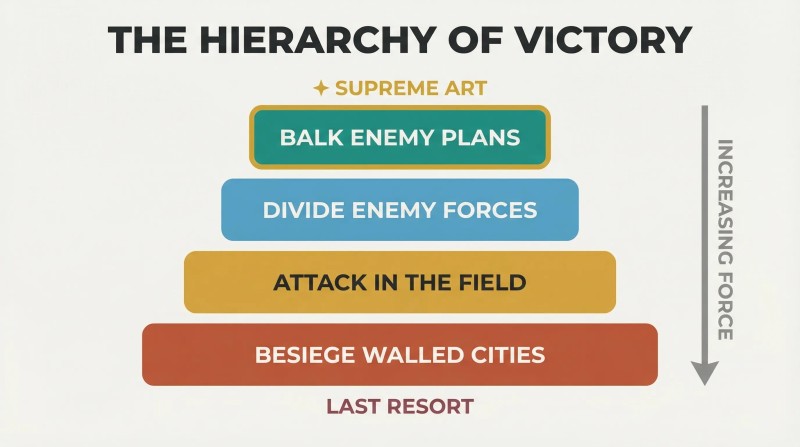
Sun Tzu's central thesis is counterintuitive: the greatest warrior wins not through fighting but through making fighting unnecessary. He ranks generalship in descending order:
1. Balk the enemy's plans
2. Prevent the junction of enemy forces
3. Attack the enemy's army in the field
4. Besiege walled cities (the worst option)
The excellent commander subdues troops without combat, captures cities without siege, and overthrows kingdoms without lengthy operations. His victories appear so effortless that he earns no glory — no reputation for wisdom, no credit for courage. Sun Tzu calls this "attacking by stratagem." The goal is never to destroy the enemy but to break his resistance through superior positioning, preparation, and the display of overwhelming advantage.
Appear weak where you're strong, and strong where you're weak
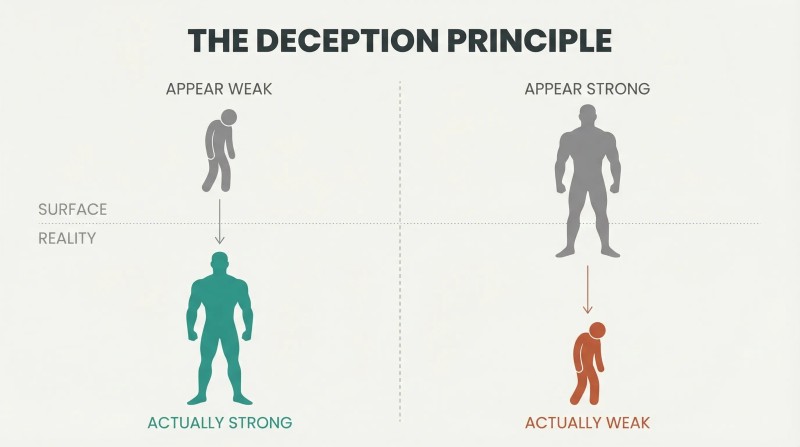
Deception is the master principle. Nearly every tactic in the book flows from this single idea: when you can attack, appear unable. When active, appear inactive. When near, seem far. When far, seem near. Feign disorder to lure opponents into traps. Pretend to be weak so they grow arrogant and careless.
Control the information your opponent receives. Hold out baits to entice. Irritate a hotheaded rival into mistakes. Give no rest to a comfortable one. If his forces are united, find ways to separate them. Conceal your tactical dispositions, and you'll be safe from the subtlest spies. The aim is never to engage the enemy at full strength but to dictate terms so he never realizes what's coming.
Win by knowing three things: your enemy, yourself, your ground
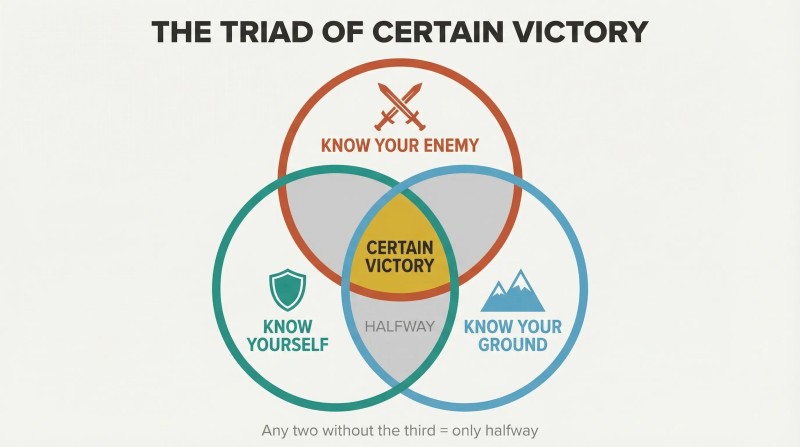
Sun Tzu identifies three layers of knowledge that determine whether victory is partial or complete. Knowing the enemy while ignorant of your own condition gets you only halfway. Knowing both enemy and self but ignoring the terrain still leaves you halfway. Only when all three align — the opponent's dispositions, your own capabilities, and the physical landscape — does victory become certain.
This isn't abstract philosophy. Sun Tzu devotes whole chapters to reading signs: dust rising in a high column reveals chariots advancing; dust low and spread wide means infantry approaching. Birds rising suddenly in flight signal an ambush. Humble words paired with increased preparations mean the enemy is about to strike. The skilled strategist reads the battlefield the way a naturalist reads a forest.
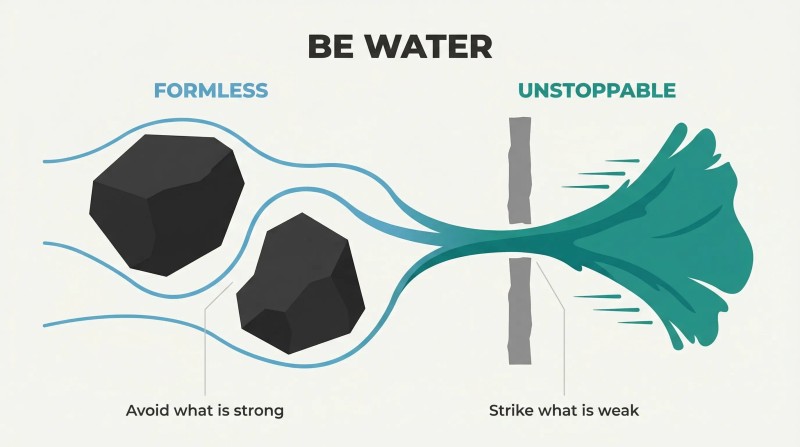
Be water: formless in preparation, unstoppable in attack
Water is Sun Tzu's master metaphor. It naturally flows downhill, finding the path of least resistance — and the warrior should do the same: avoid what is strong, strike at what is weak. Water has no fixed shape; it conforms to whatever ground it crosses. Likewise, the soldier works out victory in relation to the specific foe he faces, never a rigid blueprint.
But water in a torrent is irresistible. Sun Tzu compares a conquering force to "pent-up waters bursting into a chasm a thousand fathoms deep." The principle is rooted in Taoist philosophy: the Tao Te Ching teaches that nothing in the world is softer than water, yet for attacking things hard and strong, nothing surpasses it. Softness and flexibility overcome rigidity every time.
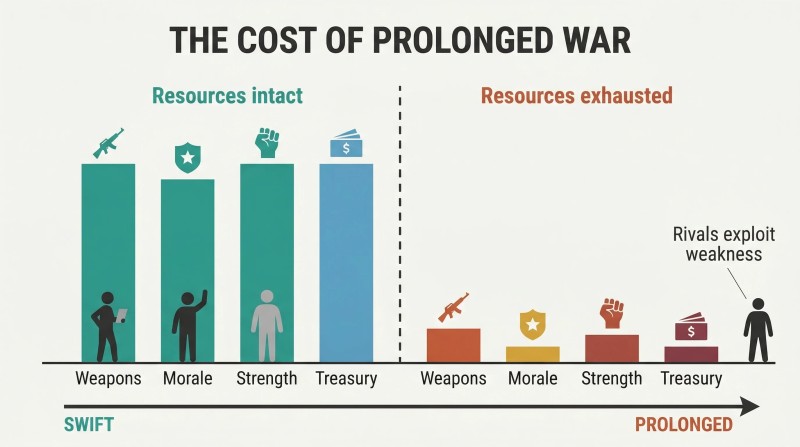
Fight fast or don't fight — prolonged conflict destroys everyone
Sun Tzu warns relentlessly against dragging out conflict. When fighting persists, weapons dull, ardor dampens, strength exhausts, and the treasury drains. Worse, weakened forces invite opportunistic rivals: "Then no man, however wise, will be able to avert the consequences." A wise general never raises a second levy or loads supply wagons more than twice.
The practical math is stark. Sustaining 100,000 troops costs a thousand ounces of silver per day. Government war expenses consume four-tenths of total revenue; families lose three-tenths of income. Sun Tzu's remedy: forage on the enemy's land. One cartload of enemy provisions equals twenty of your own because you eliminate the ruinous cost of long-distance supply lines. Speed isn't just preferable — it's existential.
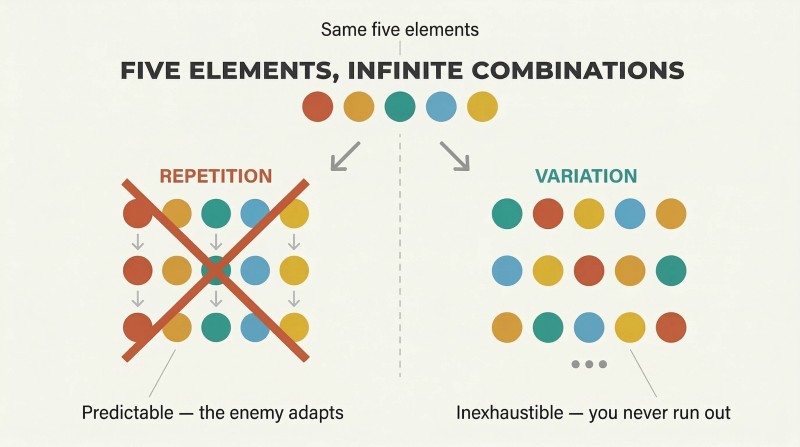
Never reuse the tactic that won your last battle
Predictability is a strategic liability. Sun Tzu insists that methods must be regulated by circumstances, not by what worked before. Victories breed the complacency of repeating old patterns, but every new situation differs. The enemy adapts. Conditions shift. Yesterday's brilliance becomes today's trap.
Finite elements create infinite combinations. Sun Tzu illustrates with a striking analogy: five musical notes yield endless melodies. Five primary colors produce infinite hues. In battle, just two methods — direct and indirect — generate an endless series of maneuvers. "It is like moving in a circle — you never come to an end." The commander who grasps this principle of inexhaustible variation never runs out of options.
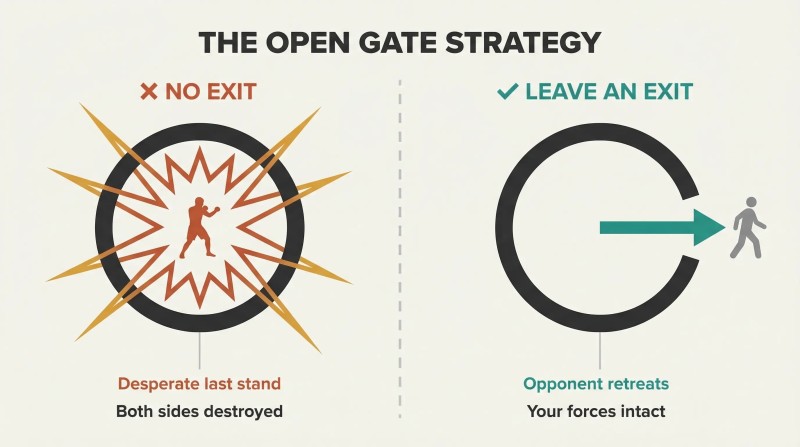
Leave a cornered opponent a way out
Don't press a desperate foe too hard. When you surround an enemy, leave an outlet free. This isn't mercy — it's calculation. An opponent with no escape will fight with the ferocity of total despair, inflicting maximum casualties on both sides. Allowing a retreating foe to disengage shatters his will to continue while preserving your own forces.
Sun Tzu frames this as both ethical and practical. Anger may fade, but destruction cannot be undone. The principle extends far beyond battlefields. In workplace conflicts, family disputes, or negotiations, pressing someone who has zero options guarantees their most dangerous and unpredictable response. The canny strategist always leaves a door open — even if it leads exactly where he wants the opponent to go.
Spend lavishly on intelligence — guessing is the costliest strategy
Foreknowledge is the decisive advantage. Remaining ignorant of the enemy's condition because you begrudge the expense is, Sun Tzu says, "the height of inhumanity" — because ignorance costs far more lives than money. Armies may face each other for years, with victory decided in a single day by information.
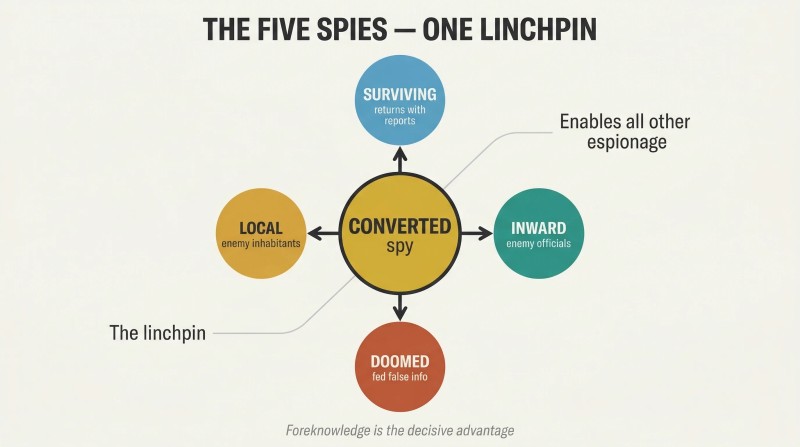
Sun Tzu classifies five types of spies:
1. Local spies — inhabitants of the enemy's district
2. Inward spies — officials within enemy ranks
3. Converted spies — enemy agents turned to your service
4. Doomed spies — agents fed false information to leak
5. Surviving spies — those who return with reliable reports
The converted spy is the linchpin: through their intelligence, all other espionage becomes possible.
Five character flaws doom any leader — watch for recklessness first
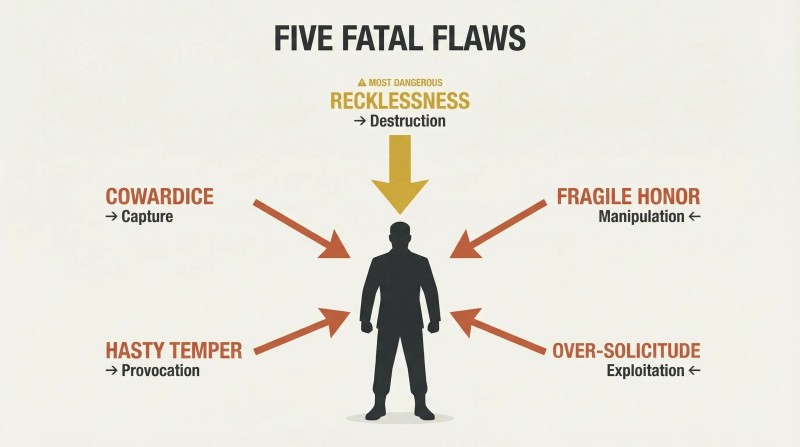
Sun Tzu names five "besetting sins" that ruin commanders:
1. Recklessness — leads to destruction
2. Cowardice — leads to capture
3. A hasty temper — can be provoked by insults
4. Delicacy of honor — sensitive to shame, easily manipulated
5. Over-solicitude for troops — creates exploitable vulnerability
Each flaw is an attack surface. A reckless general launches men like "swarming ants" against fortified cities, losing a third of his force while gaining nothing. A hot-tempered one can be baited into foolish engagements. One overly concerned with honor can be goaded through calculated insults. Sun Tzu doesn't just warn against these faults in yourself — he teaches you to weaponize them against your opponent.
On desperate ground, burn the boats behind you
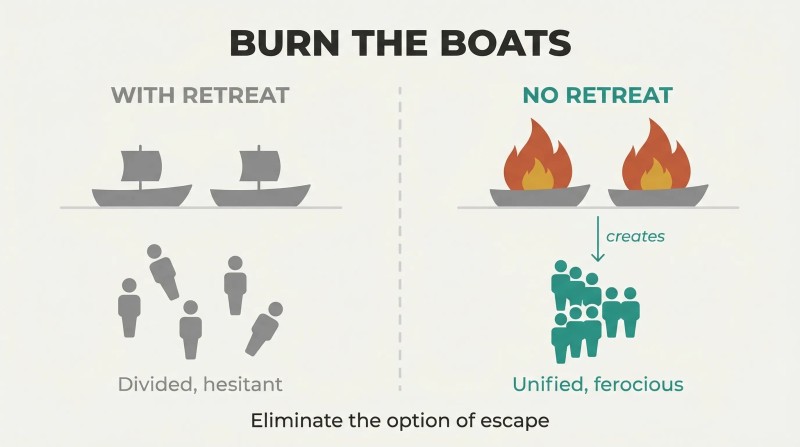
When there's no escape, people fight hardest. Sun Tzu identifies nine varieties of ground, and the most extreme is desperate ground — terrain where survival depends on fighting without delay. His counsel: proclaim to your soldiers the hopelessness of saving their lives any other way. Troops with no retreat lose the sense of fear, stand firm, and fight with ferocity that can never be marshaled through orders alone.
The principle has a vivid image. The commander burns his boats and breaks his cooking-pots, eliminating any possibility of retreat. Sun Tzu compares a committed force to the shuai-jan snake: strike its head and the tail attacks; strike its tail and the head retaliates. Remove the option of escape, and your force becomes a single, unified, reactive organism.
Analysis
The Art of War endures not because it teaches how to fight, but because it teaches when not to. Written roughly 2,500 years ago and attributed to the semi-mythical Chinese general Sun Tzu, this slim treatise operates on a paradox that still startles: the supreme warrior is the one who never draws his sword. Its continued relevance across military academies, corporate boardrooms, and coaching staffs stems from a Taoist philosophical foundation that Western strategic thinkers largely missed. Where Clausewitz — the Prussian theorist who dominated European military thought — normalized war as 'politics by other means' and advocated pursuing it to absolute ends, Sun Tzu treated war as a catastrophic last resort whose aim was the swift restoration of normalcy. British military historian B.H. Liddell Hart argued in 1963 that civilization could have been 'spared much of the damage suffered in the world wars' had Clausewitz's influence been tempered by Sun Tzu's realism and moderation.
What makes the text remarkable is its fractal applicability. The core principles — deception, intelligence, adaptability, restraint — scale cleanly from geopolitics to salary negotiations to parenting disputes. The water metaphor alone contains a complete strategic philosophy: be formless, find the path of least resistance, and when the moment arrives, be irresistible. This is not brute-force thinking; it is systems thinking rooted in ecological observation of how nature actually resolves conflict.
The Landmark Edition's pairing with the Tao Te Ching illuminates something routinely missed in popular readings: Sun Tzu's tactical genius is downstream of Lao Tzu's metaphysics. The insistence on softness overcoming hardness, on the power of emptiness, on the lethal danger of rigidity — these are not incidental themes. They are the operating system on which every specific tactic runs. Readers who absorb only the tactical surface without grasping the Taoist architecture beneath it will possess the letter of the teaching but miss its animating spirit — precisely the error Sun Tzu warns his generals against making.
Review Summary
The Art of War receives mixed reviews, with many praising its timeless wisdom and applicability to modern life, while others find it outdated or overhyped. Readers appreciate Sun Tzu's emphasis on strategy, adaptability, and avoiding conflict when possible. Some find value in applying the principles to business and personal situations. Critics argue the book is repetitive or too simplistic. Many readers note the importance of choosing a good translation to fully appreciate the work's nuances and historical context.
People Also Read


Glossary
The Moral Law
Alignment of ruler and peopleSun Tzu's first of five constant factors governing warfare. Sometimes translated as the Tao or 'the Way,' it refers to the unity of purpose between a ruler and his people such that they follow willingly, undismayed by danger. It represents the rightness of a cause — the alignment that makes people willing to risk their lives without hesitation.
Five Constant Factors
Sun Tzu's war-governing elementsThe five fundamental elements that determine the outcome of war: (1) The Moral Law — alignment of ruler and people, (2) Heaven — weather, seasons, and timing, (3) Earth — terrain, distances, and danger, (4) The Commander — wisdom, sincerity, benevolence, courage, and strictness, and (5) Method and Discipline — organization, logistics, and expenditure. A general must master all five before engaging in conflict.
Five Essentials for Victory
Conditions predicting who winsSun Tzu's five criteria for forecasting victory: (1) knowing when to fight and when not to, (2) knowing how to handle both superior and inferior forces, (3) having an army unified in spirit across all ranks, (4) being prepared while the enemy is unprepared, and (5) having military capacity unhampered by sovereign interference. A commander who meets all five conditions will prevail.
Nine Situations
Battlefield ground classificationsSun Tzu's taxonomy of nine varieties of ground, each demanding different tactics: dispersive (own territory), facile (shallow penetration into enemy land), contentious (advantageous to either side), open (free movement), intersecting highways (key to multiple states), serious (deep in enemy territory), difficult (hard to traverse), hemmed-in (narrow entry and exit), and desperate (survival requires immediate combat).
Desperate Ground
Terrain requiring immediate combatGround on which an army can only be saved from destruction by fighting without delay. Sun Tzu prescribes eliminating all possibility of retreat — burning boats, breaking cooking-pots — to unleash maximum fighting spirit. The most extreme of the nine situations, where the absence of escape transforms fear into ferocity.
Artifice of Deviation
Turning indirect routes into advantageThe strategic art of taking a long, circuitous route while enticing the enemy out of position, thereby reaching the objective before an opponent traveling a seemingly more direct path. It converts apparent disadvantage into surprise by exploiting the enemy's assumptions about distance and timing.
Five Dangerous Faults
Exploitable commander character defectsFive character flaws that ruin generals and can be weaponized against opponents: (1) recklessness, leading to destruction, (2) cowardice, leading to capture, (3) a hasty temper, provokable by insults, (4) delicacy of honor, manipulable through shame, and (5) over-solicitude for troops, creating exploitable anxiety. Sun Tzu calls these the 'besetting sins' of command.
Five Classes of Spies
Intelligence agent taxonomySun Tzu's classification of espionage agents: local spies (inhabitants of the enemy's district), inward spies (officials within enemy ranks), converted spies (enemy agents turned to your service), doomed spies (agents deliberately fed disinformation to leak), and surviving spies (agents who return with firsthand reports). When all five operate simultaneously, Sun Tzu calls it 'divine manipulation of the threads.'
FAQ
What's "The Art of War Landmark Edition" about?
- Classic of Strategy: "The Art of War" is a seminal work on military strategy and tactics, traditionally attributed to the ancient Chinese general Sun Tzu.
- Annotated Edition: This edition includes annotations and an introduction by Mitch Horowitz, providing historical context and modern interpretations.
- Taoist Influence: The book is deeply rooted in Taoist philosophy, emphasizing harmony with the natural order and strategic thinking.
- Dual Content: It also includes Lionel Giles' translation of the Tao Te Ching, offering a broader understanding of the philosophical underpinnings of Sun Tzu's strategies.
Why should I read "The Art of War Landmark Edition"?
- Timeless Wisdom: The strategies and philosophies presented are applicable beyond warfare, offering insights into leadership, conflict resolution, and personal development.
- Modern Relevance: Mitch Horowitz's annotations connect ancient wisdom to contemporary issues, making it relevant for today's readers.
- Philosophical Depth: The integration of the Tao Te Ching provides a deeper philosophical context, enriching the understanding of Sun Tzu's teachings.
- Practical Applications: The principles can be applied in various fields such as business, sports, and personal relationships, making it a versatile guide.
What are the key takeaways of "The Art of War Landmark Edition"?
- Victory Without Conflict: The greatest victory is achieved without fighting, through preparation, knowledge, and strategic advantage.
- Know Yourself and the Enemy: Understanding both your own strengths and weaknesses and those of your opponent is crucial for success.
- Adaptability and Flexibility: Strategies should be adaptable to changing circumstances, much like water conforming to its environment.
- Ethical Considerations: War should be a last resort, and the ultimate goal is the restoration of peace and normalcy.
What are the best quotes from "The Art of War Landmark Edition" and what do they mean?
- "The greatest warrior prevails without fighting": This emphasizes the importance of strategy and preparation over direct confrontation.
- "All warfare is based on deception": Highlights the role of misdirection and surprise in achieving victory.
- "Know your enemy and know yourself": Stresses the importance of self-awareness and understanding the opponent for successful outcomes.
- "He who knows when to fight and when not to fight will win": Underscores the value of discernment and timing in strategic decision-making.
How does Mitch Horowitz's introduction enhance "The Art of War"?
- Historical Context: Horowitz provides background on the historical and cultural context of Sun Tzu's time, enriching the reader's understanding.
- Philosophical Insights: He explores the Taoist principles underlying the text, offering a deeper philosophical perspective.
- Modern Applications: Horowitz connects ancient strategies to modern scenarios, demonstrating their relevance in today's world.
- Comparative Analysis: The introduction compares Sun Tzu's ideas with those of other historical figures, providing a broader intellectual framework.
What is the significance of the Tao Te Ching in "The Art of War Landmark Edition"?
- Philosophical Foundation: The Tao Te Ching offers the philosophical basis for many of Sun Tzu's strategies, emphasizing harmony and natural order.
- Complementary Texts: Reading both texts together provides a more comprehensive understanding of Taoist thought and its application to strategy.
- Moral Guidance: The Tao Te Ching offers ethical insights that complement the strategic advice in "The Art of War."
- Integrated Index: The edition includes an integrated index for cross-referencing concepts between the two works, enhancing the reader's comprehension.
How does "The Art of War" apply to modern business strategies?
- Competitive Advantage: The principles of knowing your competition and leveraging strengths are directly applicable to business strategy.
- Adaptability: Businesses can benefit from the emphasis on flexibility and adapting to changing market conditions.
- Resource Management: Efficient use of resources and minimizing waste are key themes that resonate with modern business practices.
- Leadership: The text offers insights into effective leadership, emphasizing the importance of understanding and motivating teams.
What are the five constant factors in "The Art of War"?
- Moral Law: Aligns the people with their leader, ensuring unity and commitment.
- Heaven: Refers to environmental factors like weather and timing.
- Earth: Involves understanding the terrain and physical conditions.
- The Commander: Represents the virtues of wisdom, sincerity, and courage.
- Method and Discipline: Encompasses organization, logistics, and the structure of the military.
How does "The Art of War" address the concept of deception?
- Strategic Deception: Deception is a core strategy, involving misleading the enemy about your intentions and capabilities.
- Feigning Weakness: Pretending to be weak can lure the enemy into a false sense of security.
- Surprise Attacks: Using unexpected tactics to catch the enemy off guard is a key element of deception.
- Psychological Warfare: Manipulating the enemy's perceptions and emotions is crucial for gaining an advantage.
What role do spies play in "The Art of War"?
- Foreknowledge: Spies provide critical information about the enemy's plans and conditions, essential for strategic planning.
- Types of Spies: Sun Tzu categorizes spies into five types, each serving a specific purpose in intelligence gathering.
- Value of Spies: Spies are considered invaluable assets, deserving of the highest rewards and secrecy.
- Manipulation: Using converted spies to feed false information to the enemy is a sophisticated tactic.
How does "The Art of War" define victory?
- Without Fighting: The highest form of victory is achieved without direct conflict, through strategic superiority.
- Breaking Resistance: Victory involves breaking the enemy's will to fight, often without physical confrontation.
- Restoration of Peace: The ultimate goal of victory is to restore peace and stability, minimizing prolonged conflict.
- Strategic Advantage: Victory is assured when one has a clear understanding of both their own and the enemy's strengths and weaknesses.
What is the relationship between "The Art of War" and Taoism?
- Philosophical Roots: The strategies in "The Art of War" are deeply influenced by Taoist principles, emphasizing harmony and balance.
- Natural Order: Taoism's focus on aligning with the natural order is reflected in Sun Tzu's approach to strategy and conflict.
- Ethical Considerations: Taoism provides a moral framework that guides the ethical use of power and conflict resolution.
- Complementary Texts: The inclusion of the Tao Te Ching in this edition highlights the interconnectedness of strategy and philosophy.
Download PDF
Download EPUB
.epub digital book format is ideal for reading ebooks on phones, tablets, and e-readers.








































