

Key Takeaways
Chase wealth (assets that earn while you sleep), never money or status
Three things people confuse. Naval draws sharp lines. Money is a transferable IOU for other people's time. Status is your rank in the social pecking order. Wealth is the thing you actually want: businesses and assets that generate income without your labor, like a factory, rental property, or software running overnight for customers you never meet.
The practical consequence is that you cannot earn true wealth by trading hours for dollars. Even highly paid lawyers and doctors stop earning the moment they stop working, sleep, or vacation. Naval claims that if dropped penniless on any English-speaking street, he would be wealthy again within five to ten years, because wealth-building is a learnable skillset, not luck. The starting move: figure out what to work on before grinding at anything.
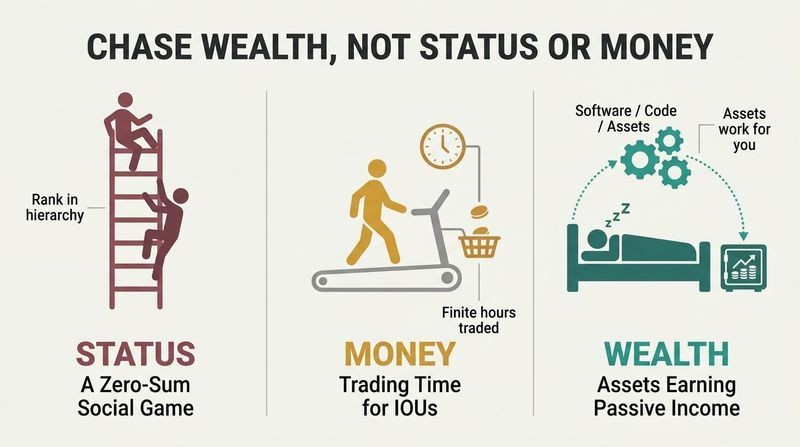
What's striking is how Naval reframes an ancient distinction economists rarely make emotionally vivid. Thomas Piketty's data on capital versus labor returns quietly confirms the same asymmetry: owned capital compounds faster than wages. The wealth-versus-status framing also echoes evolutionary psychology, where status is a fixed-pie primate game and wealth creation is a modern positive-sum invention. One caveat worth noting: the confidence that anyone can rebuild wealth in a decade understates survivorship bias and the role of Naval's education, network, and citizenship. Still, the core mental separation is genuinely useful, because people routinely sabotage wealth by chasing its cheaper cousins, salary and applause.
Build specific knowledge: skills so uniquely yours no one can train a replacement
Knowledge that can't be taught in a classroom. Naval defines specific knowledge as expertise society cannot easily train others to replicate, found by following genuine curiosity rather than whatever job is hot. It feels like play to you but looks like work to everyone else. Signs of yours: what you did effortlessly as a kid, the thing your mother or best friend would identify.
Examples he offers include a natural gift for sales, an obsessive personality that devours a subject, or deep game-theory intuition from a childhood of gaming. His own turned out to be absorbing data, tinkering with technology, and persuading people, not the astrophysics he idolized. His mother spotted it when he was fifteen. The rule that follows: escape competition through authenticity, because copying others means competing, and no one out-competes you at being you.
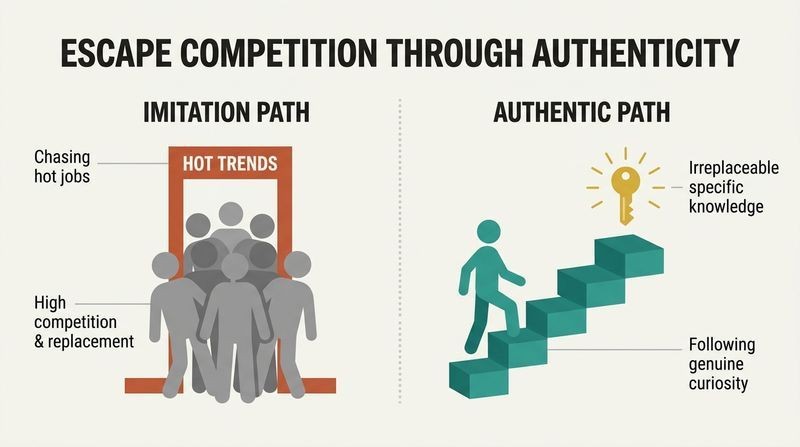
This connects neatly to Cal Newport's "career capital" and to the economics of automation. If a task can be codified into a training manual, it can eventually be codified into an algorithm, which is precisely why routinizable jobs face wage pressure and AI displacement. Naval's insight anticipates that pressure. The weaker link is measurement: "follow your curiosity" can rationalize dilettantism as easily as mastery. The saving discipline is his companion demand to become genuinely the best in the world at your niche, redefining the niche until that's true. Curiosity chooses the direction; obsessive depth earns the reward.
Get leverage from code and media, the only kind requiring no permission
A force multiplier on judgment. Naval names three forms of leverage. Labor (people working for you) is the oldest and, he argues, the worst, messy and one mutiny away from disaster. Capital (money you deploy) scales beautifully and minted last century's fortunes. Both are permissioned: someone must choose to follow you or fund you.
The newest form is permissionless: products with no marginal cost of replication, meaning code and media. A single engineer can create half a billion dollars of value; a podcaster like Joe Rogan earns tens of millions from recordings that work while he sleeps. You need no one's approval to write software, publish, or record. This democratizes wealth: the divide is no longer white-collar versus blue-collar but leveraged versus unleveraged. A leveraged worker can out-produce an unleveraged one by a thousandfold.
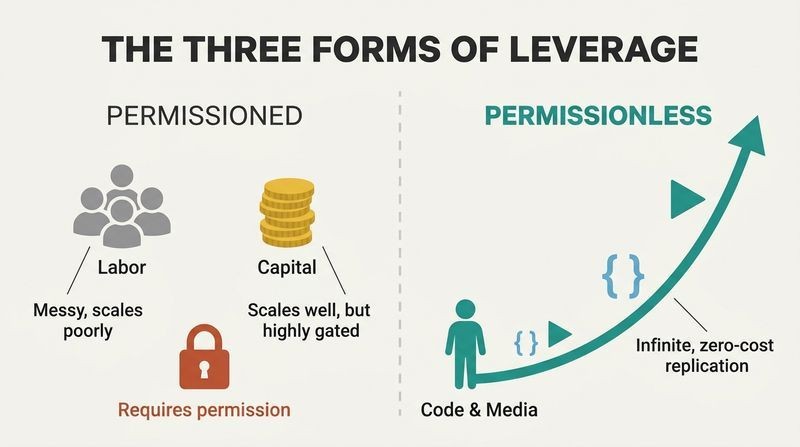
The framing predicts the creator economy with uncanny accuracy. Software and media exhibit near-zero marginal cost, the property Chris Anderson called "free" and economists call non-rivalrous goods, so one good decision scales infinitely. The result is winner-take-most markets, where the best in the world serves everyone (Sherwin Rosen's "superstar economics"). The nuance Naval underplays: permissionless leverage is permissionless to attempt, not to succeed. Distribution, timing, and audience attention are brutally competitive scarcities. Millions publish code and podcasts into the void. The tool is democratized; the outcome remains concentrated. Leverage amplifies judgment, which means it amplifies bad judgment just as ruthlessly.
Own equity, because you can't reach freedom renting out your hours
Ownership versus wage work. Without a piece of the business, your inputs stay chained to your outputs: sleep, retire, or vacation and the income stops. Naval insists real wealth requires owning equity, whether as a founder, an early employee with stock options, or an investor buying shares. Even rich doctors get rich by opening a practice, building a brand, or patenting a device, not by billing hours.
He illustrates with a ladder in real estate. The laborer earns twenty dollars an hour with zero leverage. The contractor earns fifty thousand per project by organizing labor. The developer risks capital and clears hundreds of thousands. The fund manager wields enormous capital leverage. At the top sits a tech-enabled firm like Zillow, combining code, capital, labor, and specific knowledge, with billions in upside. Each rung adds accountability, leverage, and ownership.
The real estate ladder is a clarifying model, essentially a visualization of who bears risk and who captures residual profit, the core of the principal-agent problem. Agency theory (Jensen and Meckling) formalizes exactly this: owners who bear downside behave differently and capture more than salaried agents. Naval's advice aligns with FIRE-movement logic and Robert Kiyosaki's asset emphasis, but with more rigor. A fair challenge: equity concentrates risk as much as reward, and most startups fail. The honest reading is not "quit your job" but "work toward ownership," accumulating skill and credibility until you can take equity stakes without betting the farm on any single one.
Play long-term games with long-term people; all returns come from compounding
Compound interest rules every domain. Money compounding is only the start. Reputation, relationships, and knowledge compound too. A CEO manages billions because decades of visible, high-integrity work earned trust that stacked. Naval describes a fellow investor, Elad Gil, who always rounds deals in Naval's favor, so Naval sends him every deal in return, a relationship that grows richer each iteration.
He pairs this with a jarring claim: 99 percent of effort is wasted. Most term papers, most dates before your spouse, most everything is discarded in the goal sense (though not in the learning sense). The point is not nihilism but focus: when you find the rare 1 percent worth going all-in on, commit for decades and drop the rest. His co-founder Nivi's line captures it: in long-term games everyone gets rich together; in short-term games people just enrich themselves.
The mathematics is unforgiving in Naval's favor: 30 percent compounded over thirty years yields thousands of times the principal, not tens. Game theorist Robert Axelrod showed why iterated games reward cooperation while one-shot games reward defection, which is precisely the long-versus-short distinction restated. Trust, in this light, is not sentimentality but an efficiency technology that eliminates costly renegotiation. The "99 percent wasted" figure is rhetorically punchy but logically slippery, since you cannot identify the golden 1 percent in advance, so the exploration is the price of the discovery. The actionable core survives: identify your durable bets early, then refuse to keep count.
Engineer luck by becoming so distinctive that opportunity hunts you down
Four kinds of luck. Naval, building on his co-founder Nivi, distinguishes them. First is blind luck, pure chance outside your control. Second is luck through hustle, stirring up so much motion that lucky collisions occur. Third is luck you spot because your expertise makes you sensitive to breaks others miss. Fourth, the rarest, is when your unique character and reputation cause luck to seek you out.
His illustration: become the world's best deep-sea diver, and when someone stumbles onto a sunken treasure they cannot reach, their blind luck becomes your engineered luck, because they must come to you. Warren Buffett gets offered bank bailouts and deals nobody else sees precisely because of his reputation. Build a trustworthy, high-integrity, distinctive brand, and you convert chance into something closer to destiny. The goal is to be wealthy in 999 of 1,000 parallel universes.
This is one of the book's most original contributions, transforming luck from a passive lottery into a designable surface. It rhymes with Louis Pasteur's "chance favors the prepared mind" and with Nassim Taleb's advice to maximize exposure to positive Black Swans while capping downside, sometimes called optionality. The fourth type especially resembles building a personal Schelling point: when a rare opportunity appears, everyone independently converges on the one obvious specialist. The subtle risk is attribution error in reverse: branding yourself as the go-to person still depends on a market existing for your specialty. You can prepare the net, but the fish must swim by.
Set an absurdly high hourly rate and defend it ruthlessly
Value your time before anyone else will. Naval argues no one will value you above your own self-assessment, so pick a personal hourly rate that feels ludicrously high and enforce it. Long before he had real money, he told himself he was worth five thousand dollars an hour (in hindsight, about a thousand). The rule: if a task can be outsourced or skipped for less than that rate, do so, whether it's fixing a broken speaker, returning an item, or cooking.
The deeper claim is that judgment, not effort, is what modern leverage rewards. Someone right 85 percent of the time instead of 75 percent steering a hundred-billion-dollar ship is worth hundreds of millions, which is why Buffett spends a year deciding and a day acting, and nobody asks when he wakes up. Aim to be paid for judgment, tracked on outputs, not inputs, so a robot or code does the work.
The hourly-rate heuristic is behavioral economics turned into a personal operating rule. It weaponizes opportunity cost, the concept people intellectually accept yet emotionally ignore when they drive across town to save five dollars. Setting a fixed rate converts fuzzy time-money tradeoffs into instant decisions, reducing decision fatigue. There is a self-fulfilling quality too: acting as though your time is worth a fortune tends to reallocate it toward high-value work, gradually making the claim true. The obvious limit is early-career reality, when you lack both savings and delegatable tasks. The rule works best as an aspiration that pulls behavior forward, not a literal budget from day one.
Happiness is not found but built: a skill, like fitness, you can train
From 2 out of 10 to 9 out of 10. Naval says a decade ago he rated his happiness a 2 or 3 and dismissed the question as unimportant. Today he calls himself a 9, and credits deliberate practice, not money, which he says played only a small part. He reframes happiness as a learnable skill on par with nutrition, dieting, or building muscle, with a genetic range you can still shift methodically.
His working definition: happiness is your default state once you remove the nagging sense that something is missing. Humans are restless survival-and-replication machines, endlessly narrating "I need this, I need that." When nothing feels absent, the mind quiets, and in that internal silence sits contentment. Happiness, in this view, is less about adding positive thoughts (each of which smuggles in a negative opposite) and more about subtracting desire and being present.
The claim that happiness is trainable is now well supported. Sonja Lyubomirsky's research estimates a large portion of happiness is intentional activity rather than fixed set point, and Richard Davidson's neuroscience shows meditation measurably reshapes the brain. Naval's definition, happiness as the absence of felt lack, is essentially Buddhist and Stoic, though he arrives at it empirically. The subtraction framing is a healthy corrective to a self-help industry obsessed with adding positive affirmations. One nuance: some research distinguishes eudaimonic meaning from hedonic contentment, and a life optimized purely for the absence of desire could risk passivity. Naval sidesteps this by pairing inner peace with active self-actualization.
Every desire is a contract you sign to be unhappy until it's fulfilled
The fundamental delusion. Naval's sharpest happiness idea: to desire something is to agree to be discontent until you get it. He confesses to it himself, obsessively browsing car forums for a vehicle he knows he'll stop caring about the instant it arrives. He is addicted not to the car but to the act of desiring, the belief that some external thing will finally deliver lasting joy. That belief, that there exists something out there to make you permanently happy, is the mistake we make all day long.
The prescription is not to eliminate all wanting (you're a living creature meant to act) but to choose desires deliberately. Naval limits himself to one major desire at a time, treating it as the conscious axis of his suffering. He also names hedonic adaptation, the way we swiftly normalize any new pleasure, as the trap that keeps us running.
This crystallizes what psychologists call the hedonic treadmill, documented in Brickman and Campbell's work showing lottery winners and accident victims drift back toward baseline. Naval's contribution is the visceral reframe of desire as a self-authored unhappiness contract, which makes the abstraction actionable: before committing to a want, you inspect its cost. The discipline of a single desire echoes monastic vows of simplicity and modern minimalism. A reasonable pushback: desire also fuels achievement, and a person with zero wants may drift. Naval concedes as much by keeping one live desire, suggesting the goal is curation, not extinction, treating wanting as a scarce, high-stakes resource to allocate carefully.
Stop playing multiplayer status games; the only real scorecard is internal
Life is a single-player game. Naval observes that most pursuits (looking good, making money, buying the big house) are multiplayer competitive games with external validation, while training happiness is a solo game with no applause. He borrows Buffett's thought experiment: would you rather be the world's best lover known as the worst, or the worst known as the best? If you'd pick the internal reality, you understand that all real scorecards are internal.
He attacks envy directly. The cure that finally freed him from jealousy was realizing you cannot cherry-pick pieces of another person's life; envy requires a total, 24/7 swap of their body, reactions, family, and psyche. Once you see it as all-or-nothing, and you'd rather remain yourself, envy dissolves. He also cites the five-chimp theory: you can predict a chimp's behavior from its five closest companions, so choose your five humans, and thus your emotional climate, deliberately.
The single-player framing dovetails with self-determination theory, which finds intrinsic goals (growth, relationships, health) produce durable wellbeing while extrinsic goals (wealth, image, fame) predict anxiety even when achieved. The all-or-nothing envy solution is a clever cognitive reframe, functionally similar to what therapists call decentering, forcing a global comparison that exposes the incoherence of piecemeal jealousy. The five-chimp theory has real empirical cousins in Christakis and Fowler's research showing happiness, obesity, and behaviors spread through social networks. The uncomfortable implication Naval embraces bluntly is that curating friends by their values and stability is not cold, it is emotional hygiene, since moods are contagious whether or not you consent.
Facing any problem, you have three moves: change it, accept it, or leave it
Struggle lives in the fourth option. Naval insists every situation offers exactly three legitimate responses. Change it (which is a desire, so pick few). Accept it. Or leave it. Misery comes from the illegitimate fourth stance: sitting in a thing while wishing it were different, neither fixing nor accepting nor exiting. The single word he repeats to himself most is "accept."
His deepest acceptance hack is contemplating death. On a ten-billion-year cosmic timeline, your life is a firefly's blink; civilizations turn to dust (name one memorable Sumerian). Rather than morbid, he finds this liberating: if none of it ultimately matters, the pressure lifts, and you're free to interpret each moment as positively as possible. He also runs a daily micro-practice, instantly reframing minor annoyances (a flood of unwanted photos becomes a chance to exercise judgment), a habit he trained from taking seconds to near-instant.
The three-options model is quietly one of the most portable tools in the book, functionally identical to the Serenity Prayer and to the Stoic dichotomy of control (Epictetus: some things are up to us, some are not), but stripped of religious framing and made operational. The death-contemplation practice, memento mori, has a long lineage from Seneca to Marcus Aurelius, and modern terror-management research confirms mortality salience reshapes priorities, though it can breed either anxiety or equanimity depending on framing. Naval's daily reframing drill is essentially cognitive reappraisal, the most evidence-backed emotion-regulation strategy in psychology, and his claim that repetition made it near-automatic matches what neuroscience knows about practiced neural pathways.
Analysis
The Almanack is an anthology, not an argument: Eric Jorgenson stitched a decade of Naval Ravikant's tweets, podcasts, and essays into two arcs, wealth and happiness. This structure is both its strength and its summarizing challenge. There is no linear thesis to trace, only a lattice of aphorisms whose power lies in compression. The editor's job, and the summarizer's, is to restore the reasoning that Twitter's character limit stripped away.
What unifies the halves is a single move repeated in two domains: shift from external, zero-sum, other-dependent games to internal, positive-sum, self-authored ones. In wealth, that means abandoning status contests and hourly labor for equity, specific knowledge, and permissionless leverage. In happiness, it means abandoning desire, envy, and social scorecards for presence, acceptance, and internal peace. The same skeleton, escape the multiplayer game, structures both. This is what makes Naval coherent despite the fragmentary format.
The intellectual lineage is eclectic but consistent: Buffett and Munger on compounding and reputation, evolutionary biology on our maladapted survival drives, microeconomics on principal-agent dynamics, and a rationalist Buddhism that keeps only what survives personal verification. Naval's originality is less in the raw ideas (most are ancient) than in translation, rendering Stoic and Buddhist wisdom in the vocabulary of a founder who also happens to have made real money, which grants him credibility that pure philosophers lack.
The honest limitations: heavy survivorship bias (this is one exceptional outcome generalizing itself), a Silicon Valley lens that may not transfer to all economies, and a tendency toward crisp overstatement (99 percent of effort wasted, get rich without luck) that trades nuance for memorability. Read as literal instructions, some claims mislead. Read as high-compression heuristics to be stress-tested in your own life, exactly as Tim Ferriss's foreword advises, the book delivers genuine leverage on the two problems it names.
Review Summary
The Almanack of Naval Ravikant receives mixed reviews, with many praising its wisdom and insights on wealth, happiness, and personal growth. Readers appreciate Naval's concise, thought-provoking ideas and practical advice. Some find the book life-changing and highly recommend it. However, critics argue it lacks structure, contains repetitive content, and offers common-sense advice. The book's free availability is seen as both a positive and a negative. Overall, it's considered a valuable read for those seeking guidance on success and fulfillment, though not without its flaws.
People Also Read







Glossary
Specific knowledge
Unique expertise society can't trainKnowledge you cannot be formally trained for, acquired by pursuing genuine curiosity and innate talent rather than credentials. It feels like play to you but looks like work to others, is often highly technical or creative, and is typically learned through apprenticeship rather than schooling. Because it cannot be easily taught to others, it cannot be outsourced, automated, or cheaply replaced, so society must pay a premium for it.
Wealth (Naval's definition)
Assets earning while you sleepNaval separates wealth from money and status. Wealth is owning assets that generate income independently of your time, such as businesses, equity, real estate, or software running overnight. Money is merely the medium that transfers wealth and time. Status is your rank in the social hierarchy. Only wealth delivers financial freedom, because it decouples earning from the hours you personally put in.
Permissionless leverage
Code and media needing no approvalLeverage from products with no marginal cost of replication, specifically code and media (software, books, podcasts, videos). Unlike labor leverage (which requires people to follow you) and capital leverage (which requires someone to fund you), it needs no one's permission to deploy. Naval calls it the great equalizer and the source of most new fortunes, since it multiplies your output while you sleep without involving other humans.
Productize Yourself
Scale your authentic unique skillsNaval's two-word summary of wealth-building. "Yourself" supplies uniqueness, accountability, and authenticity; "productize" supplies leverage and specific knowledge, meaning you scale your offering through labor, capital, code, or media. The mnemonic prompts two questions: is what I am building authentic to me, and am I scaling it so many people can access it?
Four Kinds of Luck
Ways to engineer fortuneNaval's taxonomy (developed with Babak Nivi) of how luck arrives: (1) blind luck, pure chance; (2) luck through hustle and motion; (3) luck spotted through expertise others lack; and (4) luck attracted by your unique character, reputation, and skill, so opportunities seek you out. The fourth type turns luck into near-destiny by making you the obvious specialist others must approach.
Desire as a contract
Chosen unhappiness until fulfilledNaval's reframe that any desire is an agreement you make with yourself to remain unhappy until you obtain what you want. Because wants are endless and pleasures fade through hedonic adaptation, unmanaged desire produces chronic discontent. The remedy is to hold only one major desire at a time and recognize it as the deliberate axis of your suffering.
Rational Buddhism
Buddhism verified by personal experimentNaval's personal philosophy reconciling Buddhist inner practice with science and evolution. He keeps only teachings he can verify himself or reach through reason (meditation's benefits, the value of a quiet mind), and rejects unfalsifiable claims like past-life karma or chakras. It pairs evolution as the explanation of human behavior with Buddhism as the most time-tested guide to the internal state.
Choiceless Awareness
Nonjudgmental present-moment meditationNaval's preferred meditation, also called Nonjudgmental Awareness. While going about daily life, usually walking in nature and not talking, you accept each moment without labeling or judging anyone or anything. Practiced for ten to fifteen minutes, it produces a peaceful, grateful state and reveals how many everyday thoughts are fear-based or comparative.
Run Uphill heuristic
Choose short-term painful pathA decision rule for close calls: when two options seem roughly equal, take the one more painful in the short term. The brain avoids near-term discomfort, which means the harder path usually carries the long-term gain that compounding rewards. Leaning deliberately into short-term pain counteracts this bias.
FAQ
What's "The Almanack of Naval Ravikant" about?
- Guide to Wealth and Happiness: The book is a compilation of Naval Ravikant's wisdom on building wealth and achieving happiness, curated by Eric Jorgenson.
- Collection of Insights: It includes Naval's thoughts from various sources like tweets, podcasts, and interviews, organized into a coherent guide.
- Two Main Parts: The book is divided into two main sections: Wealth and Happiness, each exploring different aspects of achieving success and contentment in life.
- Public Service: The book is available for free, emphasizing its purpose as a public service to share valuable knowledge.
Why should I read "The Almanack of Naval Ravikant"?
- Unique Perspective: Naval Ravikant offers a unique blend of philosophical and practical advice, making it valuable for personal and professional growth.
- Timeless Wisdom: The book distills timeless principles that can be applied to various aspects of life, from business to personal well-being.
- Actionable Insights: It provides actionable insights and mental models that can help readers make better decisions and improve their lives.
- Free Resource: As a free resource, it offers accessible knowledge without any financial barrier, making it easy for anyone to benefit from Naval's insights.
What are the key takeaways of "The Almanack of Naval Ravikant"?
- Wealth Creation: Wealth is created by owning equity in a business and leveraging specific knowledge, accountability, and long-term thinking.
- Happiness as a Skill: Happiness is a choice and a skill that can be cultivated through presence, acceptance, and reducing desires.
- Mental Models: Understanding and applying mental models from various disciplines can enhance decision-making and personal growth.
- Long-Term Relationships: Building long-term relationships with high-integrity people is crucial for compounding success in life.
How does Naval Ravikant define wealth in the book?
- Wealth vs. Money: Wealth is having assets that earn while you sleep, whereas money is a medium of exchange for time and wealth.
- Ownership of Equity: Owning equity in a business is essential for financial freedom, as it allows for passive income generation.
- Leverage and Judgment: Wealth creation involves using leverage and making decisions based on sound judgment and specific knowledge.
- Technology's Role: Technology democratizes consumption but consolidates production, allowing the best to serve everyone and create wealth.
What is Naval Ravikant's approach to happiness in "The Almanack of Naval Ravikant"?
- Happiness as a Default State: Happiness is the absence of desire and the state when nothing is missing in life.
- Presence and Acceptance: Being present and accepting reality as it is are key components of achieving happiness.
- Skill Development: Happiness is a skill that can be developed through practices like meditation, gratitude, and reducing external dependencies.
- Internal Peace: True happiness comes from internal peace rather than external achievements or possessions.
What are some of the best quotes from "The Almanack of Naval Ravikant" and what do they mean?
- "Desire is a contract you make with yourself to be unhappy until you get what you want." This quote highlights how desires can lead to dissatisfaction and unhappiness.
- "Happiness is a choice you make and a skill you develop." It emphasizes that happiness is not a passive state but an active pursuit.
- "You will get rich by giving society what it wants but does not yet know how to get. At scale." This underscores the importance of innovation and scalability in wealth creation.
- "The three big ones in life are wealth, health, and happiness. We pursue them in that order, but their importance is reverse." It suggests that while people often prioritize wealth, true fulfillment comes from health and happiness.
How does Naval Ravikant suggest building wealth without getting lucky?
- Skill Development: Wealth is a skill that can be learned, focusing on understanding how wealth is created and leveraging specific knowledge.
- Long-Term Games: Play long-term games with long-term people to build trust and compound success over time.
- Equity Ownership: Owning equity in a business is crucial for financial freedom and passive income.
- Leverage and Accountability: Use leverage through capital, people, and products, and embrace accountability to maximize wealth creation.
What is the significance of "specific knowledge" in Naval Ravikant's philosophy?
- Unique to You: Specific knowledge is something you cannot be trained for; it is unique to your interests and talents.
- Pursue Curiosity: It is found by pursuing genuine curiosity and passion rather than following trends.
- Competitive Advantage: Specific knowledge provides a competitive advantage as it cannot be easily replaced or automated.
- Feels Like Play: Building specific knowledge should feel like play to you but appear as work to others, indicating alignment with your natural abilities.
How does Naval Ravikant view the role of mental models in decision-making?
- Foundation for Decisions: Mental models are frameworks that help in understanding and predicting outcomes, crucial for effective decision-making.
- Cross-Disciplinary: They are drawn from various fields like economics, psychology, and game theory, providing a holistic view.
- Simplify Complexity: Mental models simplify complex problems, making it easier to navigate and solve them.
- Continuous Learning: Constantly updating and refining mental models is essential for adapting to new information and challenges.
What does Naval Ravikant mean by "productize yourself"?
- Leverage Uniqueness: "Productize yourself" means leveraging your unique skills and knowledge to create scalable value.
- Accountability and Equity: It involves taking accountability for your work and owning equity in what you create.
- Scalability: Focus on scaling your efforts through media, code, or other means that allow for replication without additional effort.
- Long-Term Focus: Align your work with long-term goals and ensure it is authentic to your interests and abilities.
How does Naval Ravikant suggest dealing with desires and expectations?
- Desire Management: Recognize that desires are self-imposed contracts for unhappiness and choose them carefully.
- Acceptance: Accept reality as it is, reducing the gap between expectations and reality to minimize suffering.
- Internal Focus: Focus on internal peace and contentment rather than external validation or achievements.
- Mindfulness Practices: Use mindfulness and meditation to become aware of desires and manage them effectively.
What is the role of leverage in Naval Ravikant's wealth-building strategy?
- Types of Leverage: Leverage can come from labor, capital, or products with no marginal cost of replication, like code and media.
- Amplifies Efforts: Leverage amplifies your efforts, allowing you to achieve more with less time and resources.
- Permissionless Leverage: Code and media are forms of permissionless leverage, enabling anyone to create and scale without needing others' approval.
- Judgment Multiplier: Leverage acts as a multiplier for your judgment, making it crucial to develop sound decision-making skills.
About the Author
Other books by Eric Jorgenson

Download PDF
Download EPUB
.epub digital book format is ideal for reading ebooks on phones, tablets, and e-readers.








































