

Key Takeaways
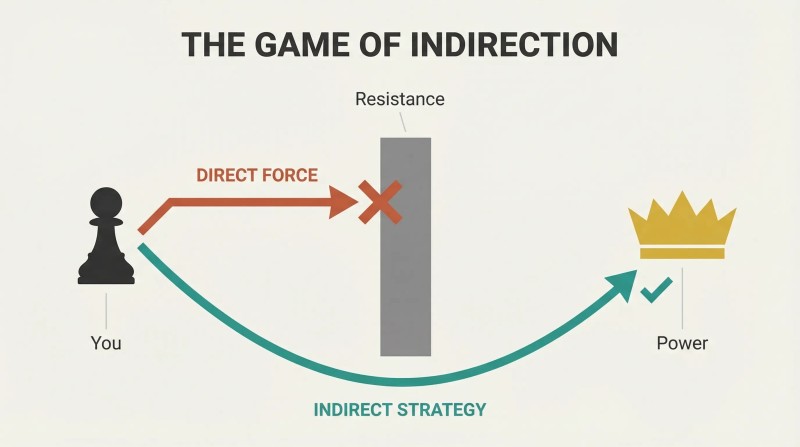
Power is a game of indirection you're already playing
Greene's core argument is blunt: Power dynamics pervade all human interaction, and those who claim to opt out of the game are often the most skilled players — they disguise manipulation behind displays of moral superiority or naïveté. The book models modern life on the Renaissance court, where courtiers had to please masters, outmaneuver rivals, and maintain appearances of civility simultaneously. Greene argues workplaces, social circles, and institutions operate identically today.
The 48 laws are distilled from three thousand years of strategic wisdom — from Sun-tzu and Machiavelli to Bismarck and Talleyrand — united by a single premise: Power favors the indirect. Direct force and overt ambition stir resistance. Charm, deception, and subtle strategy bypass it entirely.
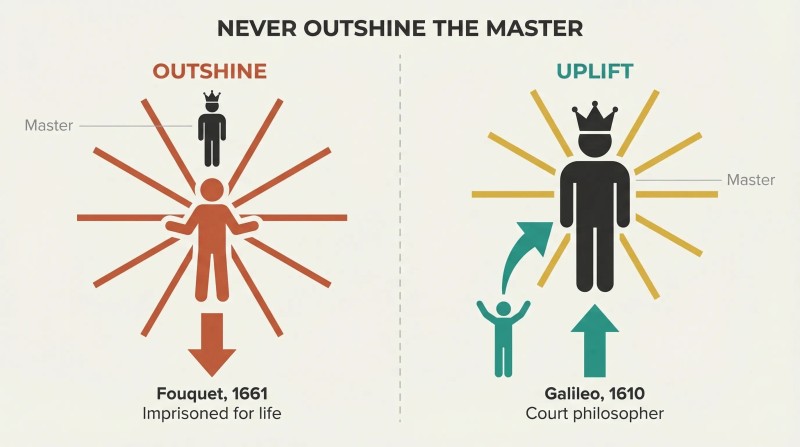
Make those above you feel brilliantly superior, not threatened
This is Greene's Law 1 and arguably the book's most famous principle. In 1661, finance minister Nicolas Fouquet threw the most spectacular party France had ever seen to honor King Louis XIV. The lavish display backfired catastrophically: Louis saw it not as tribute but as rivalry. Fouquet was arrested the next day and spent his final twenty years in solitary confinement.
The astronomer Galileo showed the alternative. Instead of dazzling patrons with his own brilliance, he named Jupiter's moons after the Medici family, linking their dynasty to cosmic forces. Cosimo II made him court philosopher with a full salary. The lesson: Channel your talents to make the master shine brighter, and your ascent is assured.
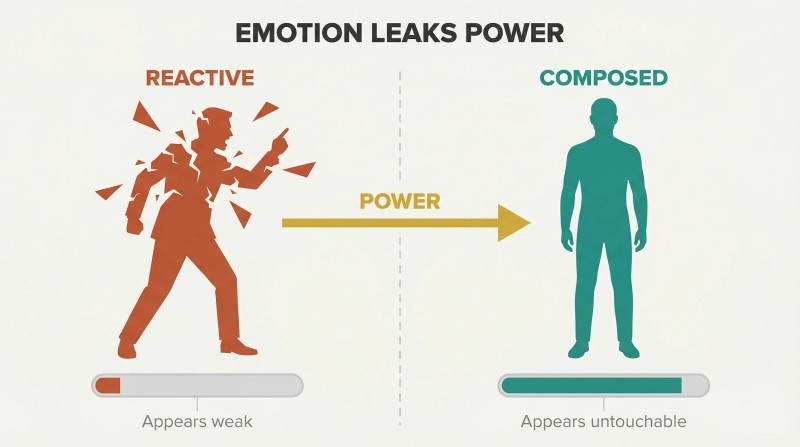
Your emotions are your greatest liability, not your strength
Greene identifies emotional reactivity as the most destructive habit in the power game. Anger clouds judgment and invites retaliation. Love blinds you to manipulation. Impatience makes you predictable. He prescribes a double-faced awareness — one face scanning the past for lessons, the other scanning the future for danger — that only works when emotions are under control.
When Napoleon erupted at Talleyrand — screaming accusations, face red, eyes bulging — the minister simply leaned against the mantelpiece looking bored. Napoleon appeared weak and unhinged. Talleyrand appeared untouchable. The power shifted visibly. The person who keeps calm while others lose composure controls the entire dynamic.
Conceal your true goals behind bland, familiar exteriors
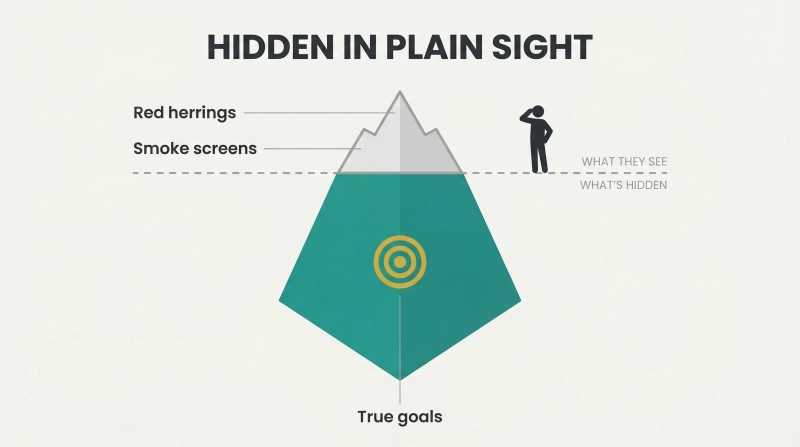
Greene's Law 3 exploits a basic truth: people instinctively trust appearances and can't constantly question what they see. Two techniques dominate. First, red herrings — decoy goals that send rivals chasing phantoms. Bismarck, a passionate militarist, once gave a speech arguing passionately for peace with Austria, fooling the entire Prussian parliament. Years later, from a position of power, he launched the very war he'd publicly opposed.
Second, smoke screens — bland, familiar behavior that lulls suspicion. Con artist Yellow Kid Weil would bait marks with routine business deals, then slip the real con underneath. Greene's key insight: People can only focus on one thing at a time. Give them something obvious and they'll miss what's hidden.
Build your reputation on one quality, then guard it for life
Greene calls reputation the cornerstone of power — a force that intimidates enemies and wins battles before they begin. Chinese general Chuko Liang cultivated such a fearsome reputation for cunning that when enemy commander Sima Yi found him calmly playing his lute atop an unguarded city wall, he ordered an immediate retreat — certain it was a trap. It wasn't. The city was virtually defenseless. But Liang's reputation did what armies couldn't.
Build on a single sterling quality — efficiency, boldness, or honesty — and make it your calling card. Simultaneously, watch for attacks. P. T. Barnum ruined a competitor's reputation by sowing doubts about its financial solvency, causing its stock to plummet before swooping in for the acquisition.

Silence unsettles people far more than your cleverest words
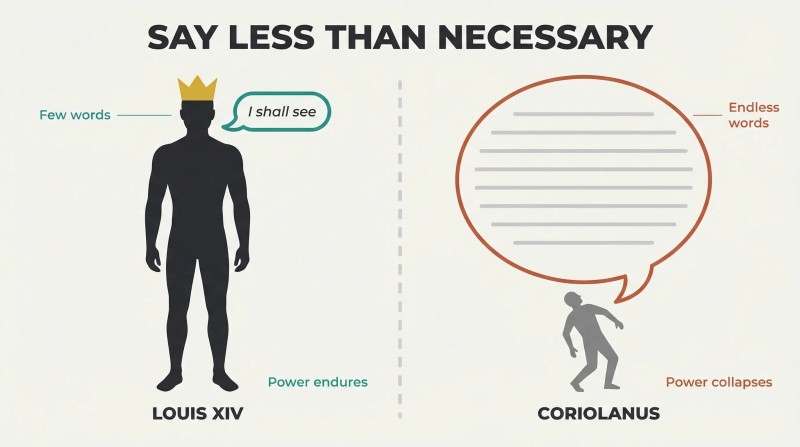
Louis XIV built enormous power on remarkably few words. His ministers would debate for days, present elaborate cases, and the king would reply only "I shall see" — then walk away. No one knew where he stood. No one could manipulate him through flattery or argument. His silence became the foundation of his authority.
Contrast this with Coriolanus, the Roman general who made brilliant speeches but couldn't stop talking. He bragged, insulted opponents, and condemned democracy openly. The citizens who once worshipped him turned hostile. He was banished, then killed. The principle cuts both ways: Even when saying something banal, if you make it vague and sphinxlike, it seems original. But one reckless sentence can undo years of careful positioning.
Former enemies make more loyal allies than comfortable friends
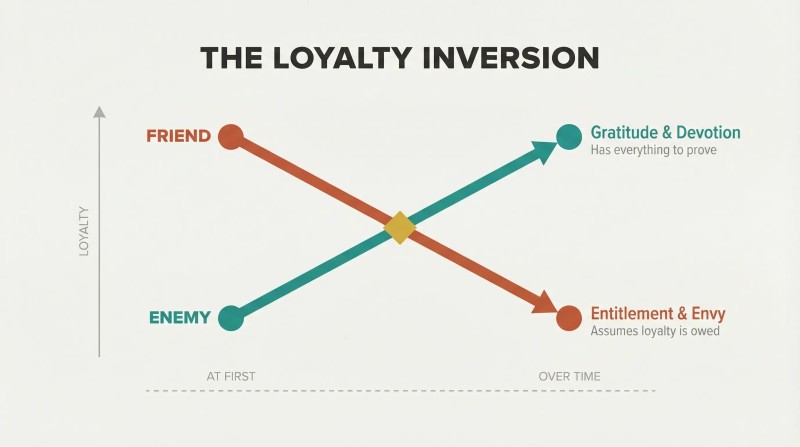
Law 2 is Greene's most contrarian principle. Friends are easily aroused to envy and feel entitled by familiarity. Hire a friend, and they assume loyalty — not merit — earned the position. An enemy, by contrast, has everything to prove. When Chinese Emperor Sung came to power in 959 AD, he bribed his rival generals into retirement with lavish estates, then turned defeated kings into devoted allies through unexpected mercy.
The mechanism is psychological: Receiving a favor from someone you once opposed creates a powerful emotional bond — gratitude mixed with surprise. Talleyrand chose his bitterest enemy, Fouché, as a co-conspirator against Napoleon, knowing their former hatred would forge a stronger alliance than any friendship. The relationship proved fruitful for years.
Win through demonstration, never through argument
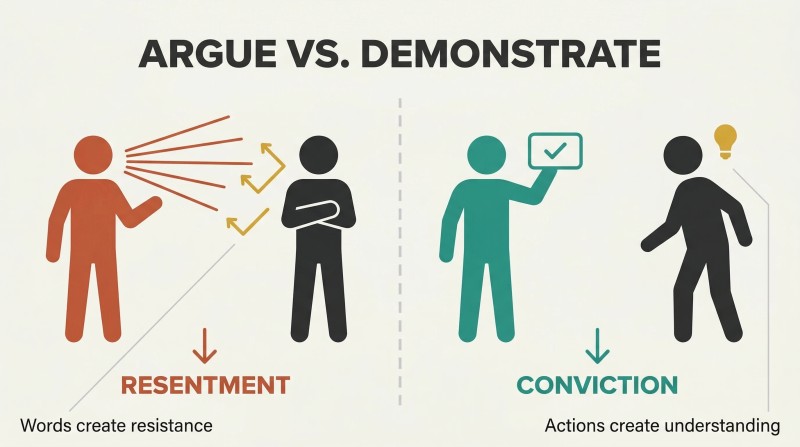
Arguments create resentment that outlasts any momentary agreement. Greene illustrates this with Michelangelo's encounter with Florence's mayor, Soderini, who declared the nose on his David statue too large. Michelangelo didn't argue. He gestured for Soderini to climb the scaffolding, then tapped his chisel while letting marble dust fall from his hand — changing nothing. "I like it better," Soderini said. The nose was untouched.
The principle extends everywhere. When Khrushchev was heckled for not standing up to Stalin, he didn't explain — he barked "Who said that?" into dead silence. After a tense pause: "Now you know why I didn't stop him." In one visceral moment, every person in the room felt the terror of confronting a dictator. No argument could have been as persuasive.
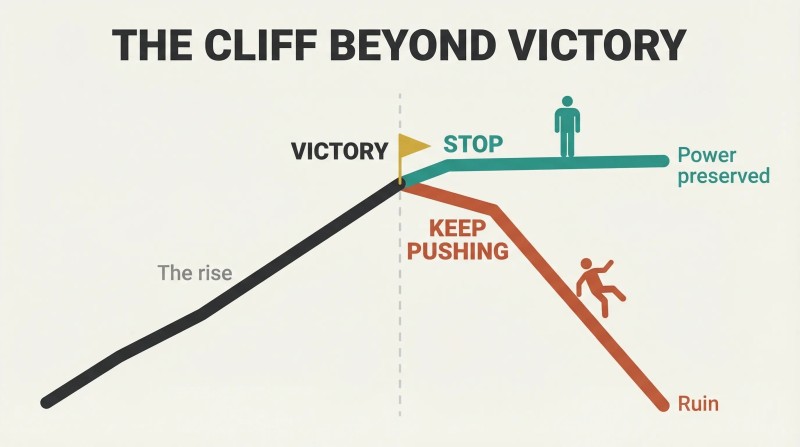
In victory, the greatest danger is not stopping
Cyrus the Great built the Persian Empire through brilliant campaigns — then marched against the Massagetai, a barbarian nation with nothing worth conquering. Queen Tomyris warned him to abandon the enterprise. He ignored her. His tricks briefly worked, but the enraged Massagetai crushed his army. Tomyris shoved his severed head into a wineskin of blood. One act of arrogance undid a lifetime of strategic genius.
Madame de Pompadour understood the opposite. When she could no longer serve as Louis XV's physical companion, she didn't cling — she arranged younger mistresses, knowing none could match her political skills. She remained France's most powerful woman for an unprecedented twenty years. Bismarck, too, refused to push past his goal of German unification, resisting generals who wanted more conquests. Set a goal, reach it, and stop.
Stay formless — rigidity is the first step toward extinction
Greene's final law compares Sparta and Athens. Sparta built history's most fearsome military through rigid training — no arts, no commerce, no flexibility. Athens adapted constantly to trade, democracy, and cultural change. Sparta won their war, but Athenian money then infiltrated the Spartan system, corroding its rigid armor from within. A generation later, Sparta collapsed permanently. Greene connects this to biology: protective armor almost always spells evolutionary doom.
Mao Tse-tung applied this principle in defeating Chiang Kai-shek's vastly larger conventional army. His guerrilla forces dispersed like mercury across China's landscape, never presenting a target, never holding fixed positions. While Chiang's rigid formations sat trapped in cities, Mao's formless strategy surrounded and suffocated them. The fluid always conquers the fixed.

Analysis
Greene's intellectual project synthesizes amoral political philosophy spanning three millennia — from Kautilya's Arthashastra through Machiavelli's Prince to Nietzsche's genealogy of morals. What distinguishes The 48 Laws from its predecessors is its radical democratization of elite knowledge: strategies reserved for princes and courtiers, now presented as a field manual for anyone navigating hierarchies.
The book's most subversive insight isn't any individual law — it's the preface argument that declining to play the power game is itself a power move, usually a dishonest one. By collapsing the distinction between the overtly manipulative and the supposedly virtuous, Greene forces uncomfortable self-examination. The egalitarian who redistributes rewards on their own terms, the brutally honest friend whose candor coerces, the naïf whose innocence is weaponized — Greene exposes each as a strategist in disguise.
The work operates on dual registers simultaneously. Read descriptively, it's an extraordinary anthology of historical case studies in human psychology — how Napoleon was baited into overreach, how Bismarck concealed aggression behind false moderation, how a con artist weaponized the appearance of honesty. Read prescriptively, it becomes a toolkit for manipulation offering no ethical guardrails.
This absence of moral framework is both the book's greatest strength and most significant limitation. Greene correctly observes that power operates independently of morality, but his historical cherry-picking obscures how frequently ruthless power players meet ugly ends — many within his own pages. The Machiavellian tradition he inherits has always struggled with this tension.
Perhaps most durable is Greene's central metaphor: modern life as Renaissance court. In an era of corporate politics, social media performance, and influence culture, the courtier's skills of indirection, emotional regulation, and strategic self-presentation have arguably never been more relevant — or more dangerous to ignore.
Review Summary
The 48 Laws of Power receives polarized reviews. Some praise it as insightful and historically rich, while others criticize it as promoting unethical behavior. Supporters appreciate its strategic advice and historical examples, finding it useful for understanding power dynamics. Critics argue it encourages manipulation and selfishness. Many readers acknowledge the book's controversial nature but find value in its lessons, even if they don't agree with all principles. Some view it as entertaining and thought-provoking, while others see it as potentially dangerous if taken too seriously.
People Also Read



Glossary
Sprezzatura
Making difficulty look effortlessBorrowed from Castiglione's Book of the Courtier and adopted by Greene as a core power principle: the capacity to make whatever one says or does seem uncontrived and effortless, concealing all artistry behind apparent naturalness. Greene extends it beyond courtly manners to all areas of power—never reveal the sweat, practice, or clever tricks behind your accomplishments, or you diminish their impact.
The Surrender Tactic
Yielding outwardly to gain powerGreene's Law 22 framework: When weaker, choose strategic surrender over fighting for honor. Outwardly you submit and turn the other cheek; inwardly you stay firm, using the time to recover strength, study your conqueror's weaknesses, torment them through apparent compliance, and wait for their power to wane. Bertolt Brecht used this before the House Un-American Activities Committee, appearing cooperative while subtly running circles around his interrogators.
The Mirror Effect
Using reflection as strategic weaponGreene's Law 44 framework comprising four distinct tactics: (1) The Neutralizing Effect—mimicking opponents' moves to blind them to your strategy; (2) The Narcissus Effect—reflecting others' psychology to seduce them with a flattering double of themselves; (3) The Moral Effect—giving people a taste of their own medicine to teach lessons through experience rather than words; (4) The Hallucinatory Effect—creating perfect copies of reality to deceive.
Cat's-Paw
Someone doing your dirty workFrom the fable of a monkey using a cat's paw to pull chestnuts from fire. In Greene's framework (Law 26, Part II), a cat's-paw is any person who performs unpleasant, dangerous, or politically risky tasks on your behalf, keeping your hands clean and your involvement hidden. Cleopatra used both Caesar and Marc Antony as cat's-paws to eliminate her rival siblings without appearing to be the agent of their destruction.
Smoke Screen
Bland front disguising real actionsGreene's tactical term (Law 3, Part II) for using a familiar, inconspicuous exterior to conceal deception happening behind the scenes. Unlike the active misdirection of a red herring, the smoke screen works through banality and familiarity—an unreadable facial expression, a routine business transaction, a predictable social persona. The technique exploits people's tendency to focus on one thing at a time and trust what appears ordinary.
Formlessness
Staying fluid and adaptable strategicallyGreene's Law 48 concept: Rather than adopting a fixed form, strategy, or identity that enemies can anticipate and attack, maintain constant fluidity like water or mercury. Greene contrasts this with the 'protective armor' approach exemplified by Sparta—which provides short-term safety but leads to rigidity, loss of adaptability, and eventual collapse. Formlessness is modeled on the Chinese board game wei-chi (go), where mobility and indirect encirclement defeat rigid positional strategies.
The Court
Modern life as power arenaGreene's central metaphor framing the entire book: The dynamics of Renaissance courts—where courtiers had to please masters while competing with peers through indirection, charm, and subtle strategy—persist in every modern office, organization, and social hierarchy. Greene argues the rules are identical: Violent or overt power moves are punished, appearances must be maintained, and the successful navigate through seduction and deception rather than force.
FAQ
What's The 48 Laws of Power about?
- Power Dynamics Explored: The book examines the nature of power and how it operates in social and political contexts. Robert Greene outlines 48 laws that illustrate strategies for gaining and maintaining power.
- Historical Examples: Each law is supported by historical anecdotes and examples from various figures throughout history, showcasing the timelessness of these strategies.
- Cunning and Strategy: Emphasizing cunning, strategy, and manipulation, the book provides insights into achieving personal and professional goals.
Why should I read The 48 Laws of Power?
- Understanding Human Nature: The book offers insights into human behavior and motivations, beneficial for personal and professional relationships.
- Practical Strategies: It presents practical strategies applicable in various situations, from workplace dynamics to personal interactions.
- Cultural Relevance: Themes of power and manipulation are relevant across cultures and eras, making it a valuable resource for anyone interested in leadership or influence.
What are the key takeaways of The 48 Laws of Power?
- Reputation is Crucial: Maintaining a strong reputation is essential for power, as it can intimidate others and create authority.
- Control the Narrative: Drawing others into your plans rather than chasing them is a strategic way to maintain control.
- Actions Over Words: Demonstrating your point through actions is more effective than trying to convince others through debate.
What are the best quotes from The 48 Laws of Power and what do they mean?
- "Never outshine the master.": Advises making those in power feel superior to avoid resentment and retaliation.
- "Court attention at all cost.": Suggests that being noticed is essential for maintaining power; even negative attention can be better than being ignored.
- "Use selective honesty and generosity to disarm your victim.": A single act of honesty can create a false sense of trust, allowing for manipulation later.
How does Robert Greene define power in The 48 Laws of Power?
- Power as Influence: Defined as the ability to influence others and control outcomes, not just authority.
- Dynamic and Fluid: Power is constantly shifting based on circumstances and relationships, requiring adaptability.
- Psychological Aspect: Emphasizes perception and manipulation as significant roles in gaining and maintaining power.
How does The 48 Laws of Power suggest handling enemies?
- Use Enemies to Your Advantage: Former enemies can be more loyal than friends, as they have something to prove.
- Crush Your Enemies Totally: Emphasizes the need to eliminate any threat completely to prevent future retaliation.
- Create Dependence: Making others dependent on you can neutralize potential threats from enemies.
What is the significance of reputation in The 48 Laws of Power?
- Foundation of Power: Reputation is the cornerstone of power, intimidating others and creating authority.
- Vulnerability of Reputation: Once reputation slips, individuals become vulnerable to attacks, making it essential to guard it fiercely.
- Proactive Defense: Advises being alert to potential attacks on your reputation and taking steps to thwart them before they happen.
How can I apply the laws from The 48 Laws of Power in my life?
- Assess Relationships: Evaluate your relationships to identify who holds power and how you can navigate these dynamics to your advantage.
- Practice Discretion: Be mindful of what you reveal about your intentions and maintain an air of mystery to keep others guessing.
- Leverage Skills: Use the skills and knowledge of others to further your own goals, ensuring you receive the credit for their contributions.
What are some examples of the laws in action from The 48 Laws of Power?
- Law 1: Never Outshine the Master: Nicolas Fouquet's story illustrates the dangers of making superiors feel insecure.
- Law 3: Conceal Your Intentions: Otto von Bismarck used deception to achieve political goals, showing the effectiveness of hidden plans.
- Law 15: Crush Your Enemy Totally: Ancient leaders ensured complete defeat of enemies to prevent future threats.
What are the potential pitfalls of following the laws in The 48 Laws of Power?
- Ethical Considerations: Some laws may encourage manipulative or unethical behavior, leading to moral dilemmas.
- Backlash from Others: Certain tactics may provoke resentment, damaging relationships and leading to isolation.
- Overreliance on Tactics: Relying too heavily on these laws can lead to a lack of authenticity in interactions.
How does The 48 Laws of Power address the concept of manipulation?
- Manipulation as a Tool: Presented as a necessary skill in the pursuit of power, often required to achieve one's goals.
- Emotional Influence: Warns against associating with negative individuals, as their emotions can undermine your stability.
- Selective Honesty: Illustrates how manipulation can be achieved through calculated acts of kindness.
What is the overall message of The 48 Laws of Power?
- Power is Inevitable: Power dynamics are inherent in human relationships, and understanding them is essential for success.
- Mastery of Self and Others: Encourages mastering one's behavior and understanding others to navigate social landscapes.
- Pragmatic Approach: Advocates for strategic and thoughtful interactions, leading to greater success and fulfillment.
About the Author
Other books by Robert Greene




Download PDF
Download EPUB
.epub digital book format is ideal for reading ebooks on phones, tablets, and e-readers.








































