

Key Takeaways
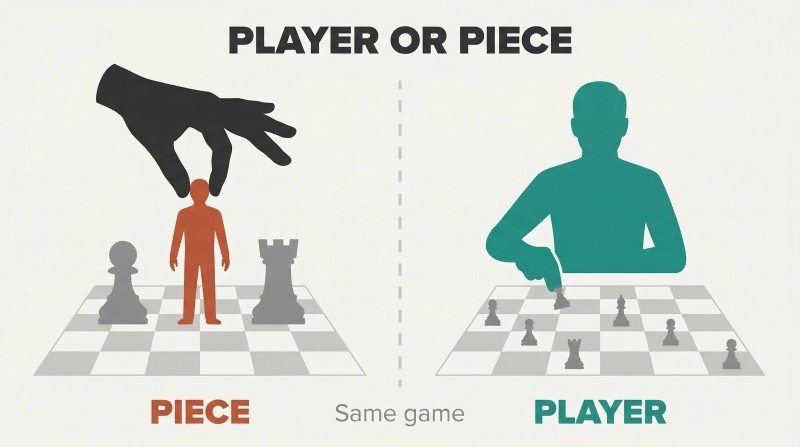
Power is a game you're already playing — learn the rules or lose
Greene's premise is deliberately uncomfortable: Power dynamics are inescapable, and those who claim to opt out — by being perfectly honest, demanding equality, or affecting naivety — are often the game's most skillful players. They wield weakness, moral superiority, or innocence as strategic weapons while disguising their true motives. Even genuine powerlessness, Greene argues, would not publicize itself to gain sympathy.
The 48 laws are distilled from 3,000 years of strategy — from Sun-tzu to Machiavelli to Bismarck — and share a common structure: Each law shows an observance (how following it builds power) and a transgression (how violating it brings ruin). The book's intended function is not to create manipulators but to strip away the dangerous illusion that social life operates on merit and good intentions alone.
Your emotional reactions cost more than any battle — master them first
Anger is the most destructive response. When Napoleon discovered Talleyrand and Fouché conspiring against him, he erupted in a public tirade — screaming insults, face red, eyes bulging. Talleyrand leaned calmly against the mantelpiece, utterly unbothered, and afterward quipped about Napoleon's "bad manners." The spectacle shattered Napoleon's aura of control and, as Talleyrand later observed, marked "the beginning of the end."
Greene's dual strategy: master your own emotions while exploiting others'. Train yourself never to take provocations personally — what seems directed at you usually has deeper, older roots. Meanwhile, recognize that anger, vanity, and fear in others are handles you can grip. The Japanese judge Itakura Shigemune ground tea during court proceedings specifically to monitor his own composure — if the powder came out uneven, he knew he'd lost control.

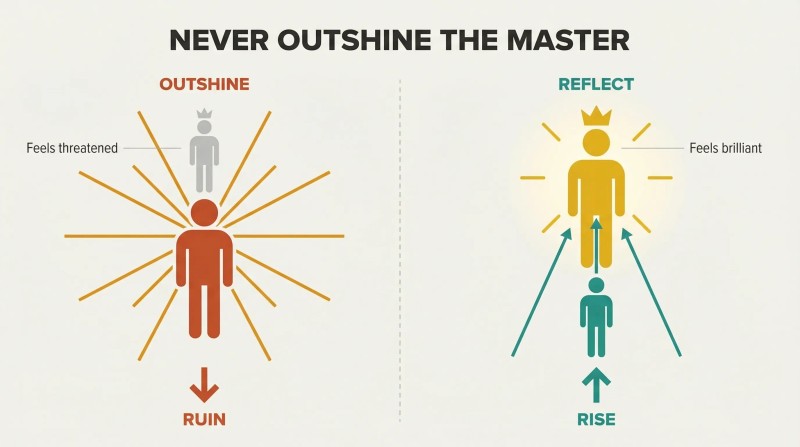
Make those above you feel brilliant, never threatened by you
Nicolas Fouquet destroyed himself with a party. Louis XIV's finance minister threw the most spectacular fête France had ever seen — rare foods, commissioned music, Molière performing, gardens that would inspire Versailles. Every dazzling spectacle reminded the Sun King that his minister was richer, better connected, and more admired. The next day, Fouquet was arrested. He spent his last twenty years in solitary confinement.
Galileo understood the reverse approach. Rather than parading his discovery of Jupiter's moons before competing patrons, he named all four moons after the Medici brothers — linking their dynasty to cosmic forces. The gesture made patron Cosimo II feel luminous rather than inferior. Within months Galileo received a full salary and lifetime appointment as court philosopher. The principle: don't display talents to impress superiors — channel your talents to make them shine brighter.
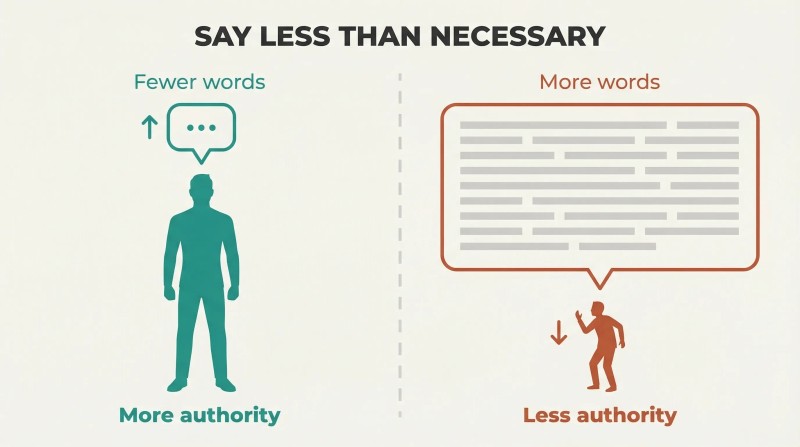
Say less than necessary — silence is more commanding than eloquence
Louis XIV weaponized silence. When ministers brought complex policy debates before him, he would listen inscrutably, then reply with three devastating words: "I shall see." Courtiers never knew where they stood, which kept them anxious, obedient, and constantly revealing themselves. His taciturnity was deliberate — as a young man he'd loved talking — but he recognized that mystery amplified his authority.
Contrast this with Roman general Coriolanus, whose legendary battlefield heroics were annihilated by his uncontrollable tongue. His arrogant speeches, public insults, and boastful tirades turned Roman citizens so fiercely against him that they banished him for life. Andy Warhol discovered the same principle in the art world: "I learned that you actually have more power when you shut up." Your brief comments gain disproportionate attention precisely because they are rare.
Hide your real goals behind the bland and the familiar
Bismarck built an empire on concealed intentions. In 1850, the young Prussian deputy who privately dreamed of crushing Austria delivered a shocking speech praising Austria and opposing war. Pure deception — designed to win the king's trust. From the resulting cabinet appointment, he quietly rebuilt the military and eventually demolished Austria in the Seven Weeks' War, achieving exactly what he'd always wanted.
Greene identifies two core concealment techniques:
1. Red herrings: Dangle a false goal to divert attention, as Marlborough did by capturing a fort he didn't want — tricking the French into destroying it themselves
2. Smoke screens: Project a bland, familiar exterior while your real operation unfolds elsewhere, as Haile Selassie did when he charmed warlord Balcha at a banquet while secretly purchasing every weapon from Balcha's 10,000-man army three miles away

Build one devastating reputation and let it fight your battles
Reputation can turn back armies. During China's War of the Three Kingdoms, general Chuko Liang — "the Sleeping Dragon" — was so renowned for cunning that when enemy commander Sima Yi found him calmly playing a lute atop an undefended city wall, Yi retreated with 150,000 soldiers rather than risk a trap. Liang had no army behind him. His reputation alone repelled an invasion.
Base your reputation on one defining quality and guard it ruthlessly. But also learn to weaponize attacks on rivals' reputations. P. T. Barnum, unable to buy the American Museum because he lacked a name, launched a letter-writing campaign destroying competitor Peale's stock price, then bought the museum himself. Once established, use subtle ridicule rather than direct assault — mockery from a position of strength is far more devastating than blunt attacks that make you look petty.

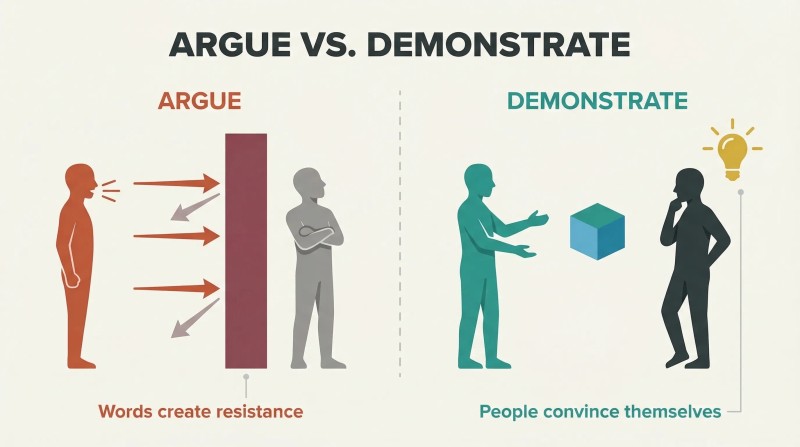
Stop arguing your case — demonstrate it and let people convince themselves
Michelangelo never argued with a patron. When Florence's mayor Soderini complained the nose on the statue of David was too large, Michelangelo didn't debate aesthetics. He led Soderini up the scaffolding, pretended to chisel while secretly dropping marble dust from his palm, and asked, "Look at it now." Soderini beamed: "You've made it come alive!" The nose was completely unchanged — only Soderini's perspective had shifted.
Words invite resistance because everyone considers themselves an authority on opinions. Demonstrated proof bypasses the rational mind entirely. When Khrushchev was heckled about why he hadn't stopped Stalin's crimes, he barked "Who said that?" The terrifying silence that followed made his point viscerally: confronting a tyrant was not as easy as heckling about it afterward. Symbol and action speak a language that argument never reaches.
Become so irreplaceable that your removal would cause chaos
Bismarck rose through dependency, not dominance. As a young deputy, he attached himself not to the strongest faction but to the weakest: indecisive King Frederick William IV. By becoming the spine the king lacked, Bismarck made himself essential. When the next king, William, tried to remove him, he couldn't — Bismarck was the only man who could manage the kingdom's enemies. For decades, every time Bismarck threatened to resign, the king surrendered.
Louis XI's court astrologer found an even more elegant solution. When the suspicious king secretly planned to have him killed, the astrologer simply told him: "I shall die just three days before Your Majesty." Louis not only spared the man — he assigned his finest doctors to keep him alive. True power flows not from isolation but from making others need you more than you need them.

Appeal to what people want, never to what they owe you
Gratitude is a burden people resent. In 433 B.C., both Corcyra and Corinth sent ambassadors to Athens seeking alliance. Corinth delivered an impassioned speech about past favors, shared history, and moral obligation. Corcyra admitted they had never helped Athens before — then simply laid out the strategic advantage of combining their naval forces. Athens chose Corcyra instantly. The practical argument crushed the sentimental one.
When Yelu Ch'u-Ts'ai needed to prevent Genghis Khan from leveling Chinese civilization, he didn't appeal to culture or morality — he showed the barbarian conqueror how much more gold he'd earn by taxing the Chinese rather than slaughtering them. Khan agreed immediately. Self-interest is the one universal language. Find what the other person needs, frame your request around their gain, and resistance evaporates.

Rigid systems and fixed strategies are the easiest to destroy
Sparta is the ultimate cautionary tale. The Spartans built history's most disciplined military, sacrificing art, music, and commerce for pure warfare. Their rigid phalanxes could defeat armies ten times their size. But when they conquered Athens, Athenian wealth and culture flooded in and corroded their inflexible system from within. Thirty years later, Sparta collapsed permanently — destroyed not by a stronger army but by its own inability to adapt.
Mao Tse-tung studied this through wei-chi (the board game go), where fluid, scattered positioning beats concentrated force. Against Chiang Kai-shek's superior Nationalist army, Mao's forces dispersed like mercury — never collecting in one place, never offering a target. The Nationalists couldn't grasp what was happening until their isolated cities were encircled and fell one by one. In power as in evolution, the most adaptable outlast the strongest.

Analysis
Greene's book is routinely dismissed as a sociopath's playbook or Machiavelli-for-dummies. Both readings miss the point. The 48 Laws represents perhaps the most ambitious synthesis of political philosophy since Machiavelli himself — drawing on 3,000 years of cross-civilizational thought from Sun-tzu to Castiglione to Gracián, and distilling it into a grammar of social dynamics.
The book's most destabilizing move is its framing premise: that everyone plays power games, and those who publicly renounce the game are among its most ruthless practitioners. The colleague who weaponizes vulnerability, the manager who demands radical transparency, the moralist who leverages guilt — Greene forces the uncomfortable recognition that these are not exemptions from power dynamics but sophisticated moves within them. This isn't cynicism; it's social pattern recognition applied with Darwinian rigor.
What's underappreciated is Greene's psychological depth. His insistence that emotional mastery precedes strategic mastery places him closer to Marcus Aurelius than to any con artist. The book's most powerful law may be the quietest one: that half of mastery comes from restraint — what you don't do, don't say, don't react to. This is Stoic philosophy wearing the mask of Machiavellian strategy.
The methodology has genuine limitations. Historical anecdote creates survivorship bias — for every Talleyrand who thrived through manipulation, there are leaders who built durable power through authentic trust. The relentless focus on individual agency underestimates structural and institutional forces. And chronic strategic vigilance can erode the very relationships that make power worth having.
The most defensible reading treats the 48 Laws as inoculation rather than instruction. Understanding manipulation is the best protection against it. The book's enduring power lies not in teaching deception but in stripping away the comforting illusion that social life operates on merit alone. If the game is inescapable, better to be an artist than a bungler.
Review Summary
The 48 Laws of Power is a polarizing book that has garnered both fervent praise and harsh criticism. Supporters appreciate its historical insights and practical strategies for navigating power dynamics, while critics argue it promotes unethical behavior. Many readers find it thought-provoking and applicable to various aspects of life, though some struggle with its moral implications. The book's controversial nature has made it popular among diverse groups, from business professionals to celebrities and even prison inmates.
People Also Read



Glossary
Sprezzatura
Making difficulty seem effortlessA Renaissance concept from Baldassare Castiglione's The Book of the Courtier, central to Law 30. It describes the capacity to execute the most difficult tasks with apparent ease and nonchalance, concealing all artistry, effort, and practice. In Greene's framework, sprezzatura is essential because visible effort raises suspicion, diminishes awe, and makes accomplishments seem replicable by anyone willing to work hard enough.
Smoke Screen
Bland facade hiding real actionsA diversionary tactic (Law 3, Part II) where you present a familiar, harmless, or unreadable exterior while secretly executing your real strategy behind it. Unlike red herrings, which actively distract, smoke screens work through blandness and familiarity—lulling targets into complacency. Examples include an unreadable facial expression, a pattern of predictable behavior, or an apparently noble gesture that conceals ulterior motives. The key principle: people can only focus on one thing at a time.
Cat's-Paw
Proxy for your dirty workFrom the fable where a monkey uses a cat's paw to pull chestnuts from fire (Law 26, Part II). In power dynamics, a person used to execute unpleasant, dangerous, or politically costly tasks on your behalf—shielding you from blame and keeping your hands clean. Cleopatra used Julius Caesar and Marc Antony as cat's-paws to eliminate her rival siblings without appearing as their destroyer. The cat's-paw may or may not realize they are being used.
Mirror Effect
Mimicking others to gain powerA strategic technique (Law 44) of reflecting other people's behavior, psychology, or desires back at them. Greene identifies four subtypes: the Neutralizing Effect (copying an enemy's moves to confuse their strategy), the Narcissus Effect (reflecting someone's deepest desires to seduce them), the Moral Effect (giving someone a taste of their own medicine), and the Hallucinatory Effect (creating a perfect copy of reality to deceive). Each exploits the primitive human response to seeing oneself reflected.
Strategy of the Crown
Act royal to become royalGreene's framework (Law 34) for projecting authority regardless of actual status. Based on the principle that confidence radiates outward as a self-fulfilling prophecy: if you set a high price on yourself, others assume you're worth it. Christopher Columbus, the son of a cheese vendor, used this strategy to secure unprecedented titles and funding from European royalty—demanding the same treatment as nobility and receiving it, because his unshakable self-assurance made refusal feel inappropriate.
The Surrender Tactic
Yielding outwardly to gain advantageA strategic maneuver (Law 22) of temporarily appearing to submit to a more powerful opponent in order to buy time, gather intelligence, avoid destruction, and position yourself for a later counterattack. The outward show of weakness masks inner firmness and patience. Bertolt Brecht used this before the House Un-American Activities Committee—charming his inquisitors with apparent deference while running circles around them with ambiguous answers, then leaving the country freely the next day.
Transgression and Observance
Violation vs. application of lawGreene's structural framework for illustrating each of the 48 laws. A 'transgression' presents a historical case where someone violated the law and suffered consequences—usually ruin, exile, or death. An 'observance' demonstrates the same law being skillfully applied, resulting in increased power. Most laws contain examples of both, creating a contrast that makes the principle viscerally clear through narrative rather than abstraction.
FAQ
What's The 48 Laws of Power about?
- Power Dynamics Explored: The 48 Laws of Power by Robert Greene examines the nature of power, its acquisition, and its maintenance. The book provides 48 laws that serve as strategies for gaining and maintaining power.
- Historical Examples: Each law is illustrated with historical anecdotes and examples from various figures, including politicians and military leaders, showcasing the timelessness of these strategies.
- Practical Application: The laws are designed to be applicable in everyday life, helping readers navigate social and professional situations with greater awareness of power dynamics.
Why should I read The 48 Laws of Power?
- Understanding Human Nature: The book offers insights into human behavior and motivations, enhancing interpersonal skills and strategic thinking.
- Timeless Strategies: The laws are based on historical precedents, making them relevant across different cultures and eras, providing tools for various contexts.
- Self-Defense Against Manipulation: Understanding these laws helps readers protect themselves from manipulation, allowing for informed decision-making in relationships.
What are the key takeaways of The 48 Laws of Power?
- Reputation is Crucial: Maintaining a strong reputation is essential for power, as it can intimidate others and provide a buffer against attacks.
- Control Through Indirection: Demonstrating your point through actions is more effective than engaging in verbal disputes.
- Create Dependence: Making others reliant on you for their success and happiness provides a strategic advantage.
What are the best quotes from The 48 Laws of Power and what do they mean?
- "Never outshine the master.": Avoid making superiors feel insecure by showcasing your talents too prominently; make them feel superior to maintain your position.
- "Court attention at all cost.": Being noticed and remembered is essential, as obscurity can lead to powerlessness.
- "Use selective honesty and generosity to disarm your victim.": A single act of honesty can create a facade of trust, allowing for manipulation afterward.
How does Robert Greene define power in The 48 Laws of Power?
- Influence and Control: Power is the ability to influence and control others, shaping their actions and decisions to align with your goals.
- Dynamic and Fluid: Power is constantly shifting based on context and relationships, requiring adaptability.
- Psychological Warfare: Understanding human emotions and motivations is key to gaining an advantage in power dynamics.
What is the significance of Law 1: "Never Outshine the Master" in The 48 Laws of Power?
- Avoiding Threats: Make those above you feel superior to secure your position and avoid conflict.
- Building Alliances: Cultivate supportive relationships with superiors, leading to greater opportunities.
- Strategic Positioning: Position yourself as a valuable asset rather than a threat to those in power.
How does Law 3: "Conceal Your Intentions" work in practice?
- Strategic Deception: Keep your true goals hidden to prevent sabotage and maintain maneuverability.
- Creating Confusion: Uncertainty about your motives can disarm potential adversaries.
- Building Trust: Not revealing your plans can build a facade of trust, allowing others to let their guard down.
What does Law 15: "Crush Your Enemy Totally" mean?
- No Half-Measures: Ensure safety by eliminating threats completely, as leniency can lead to future retaliation.
- Historical Context: Supported by historical examples where leniency led to disastrous consequences.
- Psychological Warfare: Crushing enemies sends a clear message about your power, deterring future challenges.
How can I apply the laws from The 48 Laws of Power in my daily life?
- Strategic Thinking: Consider how each law can be applied in various situations, fostering a proactive approach to social dynamics.
- Self-Reflection: Understand personal strengths and weaknesses to enhance the effectiveness of these strategies.
- Adaptability: Adjust your approach based on the context and environment, as the laws are flexible strategies.
What are the potential risks of applying the laws in The 48 Laws of Power?
- Backlash from Manipulation: Manipulating others can lead to resentment and retaliation if discovered.
- Isolation from Relationships: Constantly applying these laws can lead to isolation, as people may feel used or manipulated.
- Moral Implications: The laws often advocate for ruthless behavior, which can conflict with personal ethics.
How does The 48 Laws of Power address the concept of envy?
- Envy as a Powerful Force: Envy can lead to sabotage and conflict, making it crucial to navigate social dynamics carefully.
- Deflecting Envy: Displaying minor flaws can make you more relatable and less of a target for envy.
- Recognizing Envy's Signs: Be vigilant for signs of envy in relationships to address potential conflicts early.
What is the role of historical examples in The 48 Laws of Power?
- Illustrative Stories: Historical figures illustrate each law, providing concrete examples of these principles in action.
- Lessons from History: Learn from the successes and failures of others, gaining insights into power dynamics.
- Engaging Narrative: The storytelling aspect keeps readers engaged, making the lessons more impactful.
About the Author
Other books by Robert Greene




Download PDF
Download EPUB
.epub digital book format is ideal for reading ebooks on phones, tablets, and e-readers.








































