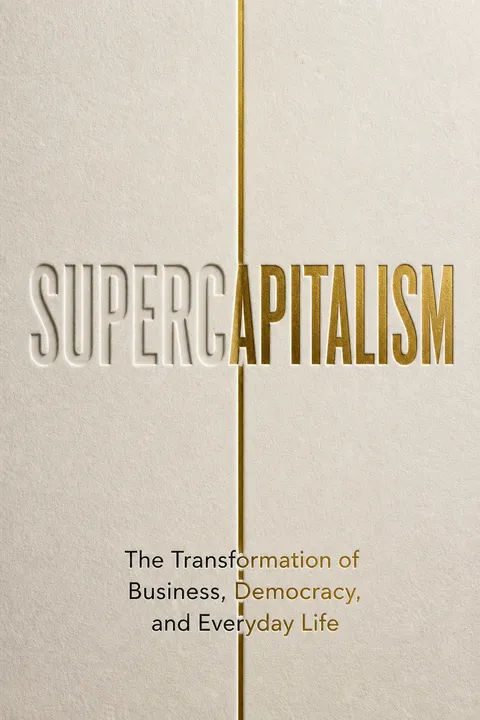

Key Takeaways
1. The Great Paradox: Triumphant Capitalism, Enfeebled Democracy
Capitalism has become more responsive to what we want as individual purchasers of goods, but democracy has grown less responsive to what we want together as citizens.
The modern paradox. While free-market capitalism has conquered the globe and delivered unprecedented consumer choice, our democratic institutions have simultaneously withered. Over the past several decades, the stock market has soared and consumer goods have plummeted in price, yet citizens report a historic sense of political powerlessness.
Erosion of the common good. As capitalism grew hyper-efficient, the democratic mechanisms we once used to temper its harsh inequalities—such as progressive taxation, robust public education, and strong labor unions—steadily eroded.
- In 1964, only 36 percent of Americans felt public officials didn't care what they thought.
- By 2000, over 60 percent of Americans shared this deep sense of political alienation.
- The government is increasingly viewed as run by a few big interests rather than for the benefit of all.
A structural shift. This imbalance is not the result of a moral failing or corrupt politicians, but rather a fundamental structural shift in our political economy. We have transitioned from a system of balanced democratic capitalism to a system of hyper-competitive "supercapitalism" where the market has spilled over into the political arena.
2. The Citizen vs. Consumer-Investor Split Personality
The last several decades have involved a shift of power away from us in our capacities as citizens and toward us as consumers and investors.
Our divided selves. Modern individuals harbor a deep internal conflict, acting as two different people depending on the hat they wear. As consumers and investors, we demand the lowest prices, best deals, and highest stock returns, which we readily get through platforms like Wal-Mart or mutual funds. Yet as citizens, we are appalled by the social consequences of these very demands, such as stagnant wages, outsourced jobs, and environmental degradation.
The hypocrisy trap. This split personality leads to systemic hypocrisies that we struggle to reconcile in daily life. We lament the death of local Main Street businesses while doing the majority of our shopping at big-box retailers.
- We worry about climate change but purchase gas-guzzling SUVs for personal comfort.
- We protest low wages but hunt for cheap goods manufactured in low-wage countries.
- We demand corporate charity while investing in mutual funds that punish companies for philanthropic spending.
Market-driven dominance. Because the market is incredibly adept at catering to our immediate, selfish desires as consumers, it easily overrides our collective aspirations as citizens. Democracy is the only tool we have to resolve this conflict, but it is failing to set the rules that would force us to make ethical trade-offs.
3. The "Not Quite Golden Age" of Democratic Capitalism (1945–1975)
Roughly between 1945 and 1975, America struck a remarkable accommodation between capitalism and democracy.
A balanced era. In the three decades following World War II, the United States achieved an unprecedented alignment between economic productivity and social equity. This period saw the highest degree of income equality in modern history, alongside robust job security and high public trust in democratic institutions.
The engine of equality. The post-war economy was built on high-volume mass production, which required a large, stable middle class with the purchasing power to buy what was produced.
- Real median family income doubled between 1947 and 1973.
- Top marginal tax rates reached 91 percent under President Eisenhower without stifling growth.
- Over a third of the private-sector workforce belonged to a labor union, ensuring profits were shared.
Imperfections of the past. Despite its economic success, this era was not a perfect utopia, as systemic inequalities remained deeply entrenched. Women and racial minorities were largely excluded from the prosperity, civil liberties were threatened by McCarthyism, and corporate life was often conformist and dull. Yet, the system possessed a democratic framework capable of slowly expanding rights and addressing these glaring flaws.
4. Oligopolistic Stability and the Rise of the Middle Class
The system for producing goods and services was far more predictable and stable than it is today, and more concentrated in a relatively few large firms...
The power of oligopolies. The post-war economy was dominated by a handful of giant corporations in each major industry that informally coordinated prices and avoided cutthroat competition. Because these oligopolies faced minimal domestic or foreign rivalry, they could plan production years in advance and guarantee stable profit margins.
The corporate-labor truce. To maintain the uninterrupted production lines essential for economies of scale, giant firms willingly shared their profits with organized labor.
- The "Big Three" automakers (GM, Ford, Chrysler) set industry-wide wage standards.
- Wages and benefits rose in tandem with productivity, averaging 2.5 to 3 percent annual growth.
- Employers provided tax-free health insurance and pensions, creating a private social safety net.
The consumer tradeoff. The price of this highly stable and equitable system was a severe limitation on consumer choice and financial innovation. Products changed slowly, styling was prioritized over technological breakthroughs, and passive investors accepted modest, predictable returns because better deals simply did not exist.
5. The Myth of Corporate Statesmanship and Social Responsibility
These business leaders could afford to be corporate statesmen—acting, in their view, for the betterment of the nation rather than strictly for the benefit of their own consumers and shareholders—because the oligopolistic system allowed them the license to be statesmen.
The benevolent CEO. During the mid-twentieth century, corporate executives viewed themselves not as mere agents of shareholders, but as professional trustees balancing the interests of employees, consumers, and the public. These "corporate statesmen" actively supported national initiatives like the Marshall Plan and full-employment policies, believing that what was good for the country was good for their firms.
A luxury of low competition. This apparent corporate benevolence was not due to superior moral character, but was a direct product of the stable, non-competitive economic structure of the era.
- CEOs faced no threat of hostile takeovers or aggressive activist investors demanding short-term returns.
- Firms could absorb the costs of generous wages and community investments without fear of being undercut by rivals.
- The lack of intense global competition allowed executives the luxury of long-term planning and civic engagement.
The modern reality. Today, expecting modern executives to act as corporate statesmen is a dangerous illusion. In a hyper-competitive global market, any CEO who attempts to prioritize social goals over shareholder value will be swiftly replaced by the market, making voluntary corporate social responsibility an obsolete concept.
6. How Cold War Tech and Deregulation Shattered the Old Truce
The shift began when technologies developed by government to fight the Cold War were incorporated into new products and services.
Shattering the old order. The stable, oligopolistic system of democratic capitalism did not collapse on its own; it was dismantled by technological innovation and deregulation. Technologies originally funded by the military to fight the Cold War—such as computers, fiber optics, satellite communications, and containerized shipping—suddenly made global supply chains possible.
Unleashing hyper-competition. These technological breakthroughs allowed new, nimble competitors to bypass the high entry barriers of established industries, shattering the planning systems of giant corporations.
- The cost of transporting and processing information plummeted, enabling global manufacturing.
- Deregulation in transportation, finance, and telecommunications stripped away government-guaranteed profits.
- The old industry-wide labor agreements collapsed as companies were forced to cut costs to survive.
The birth of supercapitalism. This transition marked the death of the post-war truce and the birth of supercapitalism. The economic game became infinitely more dynamic, innovative, and responsive to consumers, but it simultaneously destroyed the stable jobs, secure benefits, and community ties that had anchored the middle class.
7. The Rise of Supercapitalism and the Aggregation of Consumer Power
Consumer power became aggregated and enlarged by mass retailers like Wal-Mart... Investor power became aggregated and enlarged by large pension funds and mutual funds...
The new power brokers. In the era of supercapitalism, power shifted decisively away from giant producers and labor unions toward aggregated consumers and investors. Retail giants like Wal-Mart harnessed the collective buying power of millions of consumers to force suppliers to slash prices, while massive mutual and pension funds did the same for investors.
The squeeze on labor. While this shift delivered a golden age of low prices and high investment returns, it placed an unbearable squeeze on workers and local communities.
- To meet the demands of Wal-Mart and Wall Street, companies outsourced production to low-wage nations.
- Traditional labor unions lost their bargaining leverage, leading to stagnant wages and eroded benefits.
- Local Main Street retailers were decimated by big-box stores that offered deals no small business could match.
The systemic trap. We cannot blame corporations like Wal-Mart for this outcome; they are simply playing by the hyper-competitive rules of supercapitalism. If a company attempts to raise wages or protect local communities voluntarily, it will be instantly punished by consumers fleeing to cheaper rivals and investors moving their capital elsewhere.
8. The True Solution: Redrawing the Boundary Between Market and State
Keeping supercapitalism from spilling over into democracy is the only constructive agenda for change.
Fixing the rules. The fundamental crisis of our time is not that capitalism is too greedy, but that supercapitalism has invaded and overwhelmed our democratic process. Because companies must compete fiercely for every advantage, they pour billions of dollars into lobbying and political campaigns, drowning out the voices of ordinary citizens.
A clear boundary. To restore democracy, we must stop treating corporations as citizens with political rights and instead view them as what they are: mere bundles of contracts designed to make a profit.
- We must ban corporate contributions and lobbying to prevent businesses from writing their own regulatory rules.
- We must stop demanding "corporate social responsibility" and instead use democratic laws to mandate fair play.
- We must establish clear rules on wages, health care, and the environment that apply equally to all competitors.
The citizen's choice. The ultimate choice belongs to us. We must be willing to sacrifice some of our benefits as consumers and investors—accepting slightly higher prices or lower stock returns—in order to achieve the social justice, environmental safety, and democratic integrity we desire as citizens.
Review Summary
People Also Read







About the Author


Download PDF
Download EPUB
.epub digital book format is ideal for reading ebooks on phones, tablets, and e-readers.








































