

Key Takeaways
Capitalism is already dead, strangled by its own mutant offspring
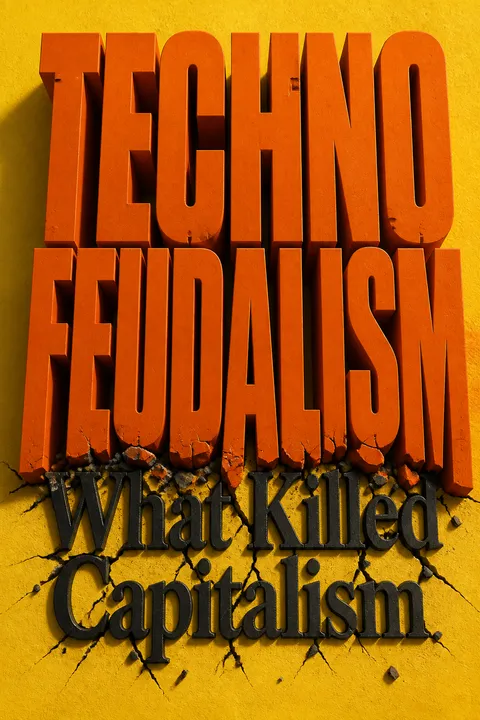
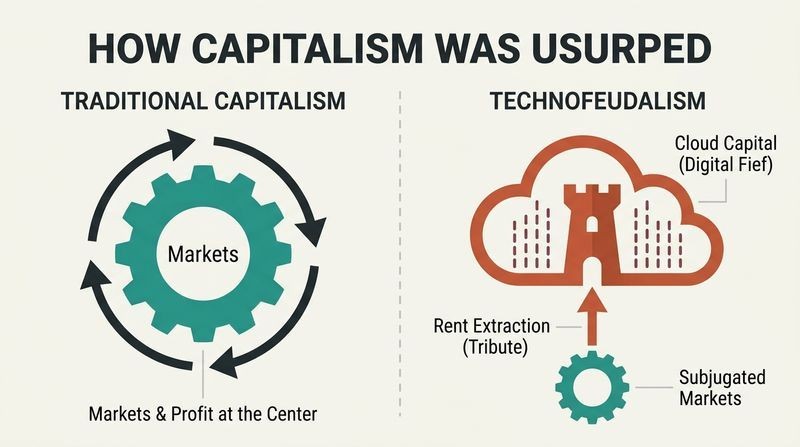
Varoufakis's central claim is audacious: capitalism no longer runs our economies. Its two engines, markets and profit, have been shoved aside and replaced by their feudal predecessors, digital platforms (fiefs) and rent. He calls the successor system technofeudalism. The killer was not socialism or revolution but capital itself, in a mutated form he names cloud capital.
Two developments did the deed: the privatisation of the internet by American and Chinese Big Tech, and the way central banks flooded the system with money after the 2008 crash. Markets and profits still exist, he concedes, just as they existed under feudalism. They simply no longer sit at the center of the system. Amazon, he argues, looks like a market but functions like a medieval fiefdom where one lord takes a cut of everything.
What's provocative here is the framing that capitalism died from success, not failure, echoing Schumpeter's idea that capitalism's achievements corrode its foundations. Skeptics reasonably counter that rentier behavior, monopoly, and enclosure have always coexisted with capitalism, so calling this a new epoch may overstate a difference of degree. Yet the value of the thesis is diagnostic: naming a system shapes what we notice and resist. Comparisons to Shoshana Zuboff's surveillance capitalism and Cedric Durand's technofeudalism show a cluster of thinkers converging on the same unease from different angles, which lends the intuition weight even if the precise label stays contested.
Cloud capital reproduces itself for free using your unpaid labor
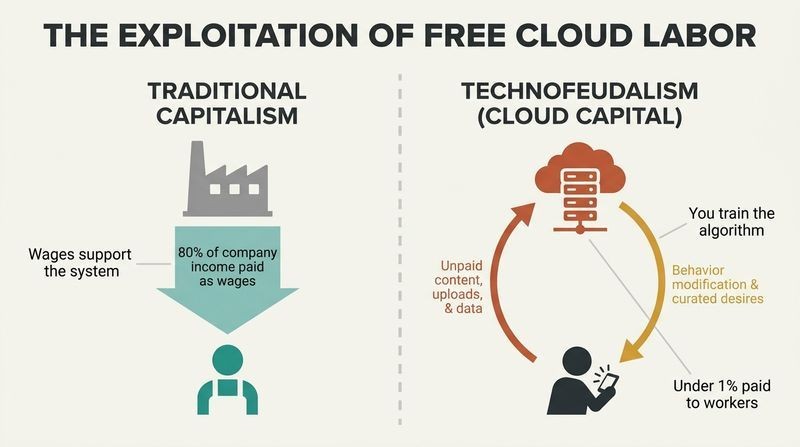
Traditional capital (machines, factories) is reproduced inside workplaces by waged workers. Cloud capital, the networked machinery, servers, and self-learning algorithms behind devices like Alexa, breaks this rule. Its most valuable component is not hardware but content: your Instagram photos, TikTok videos, Amazon reviews, and location pings. You produce that content, unpaid, enriching a tiny group of owners Varoufakis calls cloudalists.
The numbers are stark. Workers at firms like General Electric collect roughly 80% of company income in wages. Big Tech workers collect under 1%, because most of the labor is done free by billions of users. Alexa, he argues, trains you to train it, in an endless loop, until it can curate your desires and modify your behavior, a power Don Draper could only dream of.
This extends Dallas Smythe's 1970s concept of the audience commodity, that broadcasters sell viewers' attention, into something more totalizing: users now build the productive asset itself. The framing dovetails with debates over unpaid digital labor and Tiziana Terranova's free labor thesis. A fair challenge: many users derive genuine consumer surplus (connection, entertainment, navigation) that unpaid-labor accounting ignores, so the relationship is not purely extractive. Still, the asymmetry Varoufakis highlights, that value flows overwhelmingly to owners while risk and effort are socialized across users, is empirically hard to dispute, and it reframes the innocent scroll as an act of production.
Platforms like Amazon are not markets but private fiefdoms
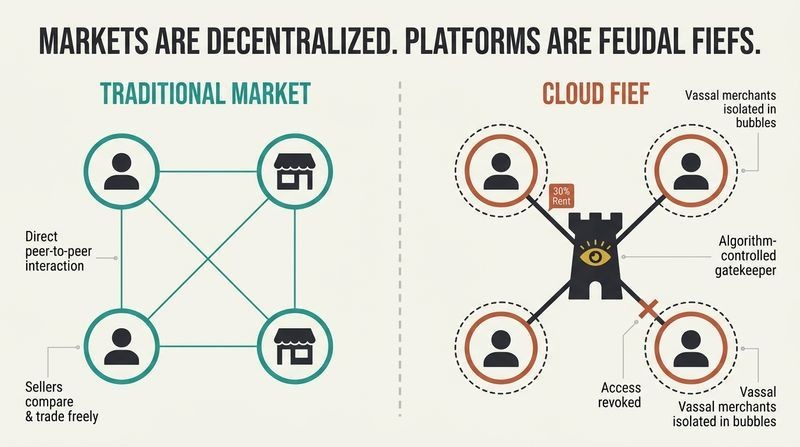
Varoufakis insists that entering amazon.com means exiting capitalism. A real market, even an ugly monopolized one, lets buyers meet, compare, and organize. On Amazon, an algorithm isolates every buyer from every other buyer and every seller from every seller, showing each a bespoke, curated view engineered for the owner's benefit. He calls this a cloud fief.
Within it, vendors become vassal capitalists: they still own their vans and factories and hire waged workers, but they must sell through the fief and hand over a cut (Apple's App Store famously takes 30%). This is not profit; it is cloud rent, the digital heir to feudal ground rent. The overlord no longer sends thugs to break knees. He simply removes a link, and your business vanishes from the online world.
The distinction between a market and a fief is the analytical heart of the book, and it is genuinely useful. Antitrust scholarship (Lina Khan's work on Amazon's structural conflicts of interest) independently reaches similar conclusions: a platform that is simultaneously marketplace, seller, and rule-setter cannot be a neutral market. Where Varoufakis pushes further is denying it is a market at all. One could object that curated, intermediated exchange is still exchange, and that TikTok versus Netflix competition looks marketlike. His rebuttal, that fiefs compete for migration rather than on price or quality, is sharp but not airtight.
After 2008, central-bank money replaced profit as the economy's fuel
Varoufakis marks 12 August 2020 as the day the age of cloud capital arrived: Britain announced its worst recession in history, and the London stock market rose. Traders reasoned that dismal news guarantees more money-printing from panicky central banks, so shares must climb. Profit had become optional.
Since 2008, central banks poured trillions into finance to save banks. But austerity killed the customers, so businesses refused to invest, using free money to buy back their own shares instead. Interest rates went negative, money became a bad to be offloaded. Goldman Sachs even published a Non-Profitable Technology Index; loss-making tech firms saw share values rise 500%. Amazon booked billions in Ireland and paid zero corporate tax because it posted no profit. Bezos and Musk saw paper wealth balloon roughly twentyfold between 2010 and 2021.
This is the book's most testable macroeconomic claim, and it aligns with the secular-stagnation literature (Summers) and post-Keynesian critiques of quantitative easing inflating asset prices rather than investment. The mechanism, that cheap money signals danger and thus suppresses rather than stimulates real investment, is a neat inversion of textbook logic and finds support in the weak capex of the 2010s. A nuance worth flagging: the post-2022 rate hikes, which Varoufakis addresses, complicate the story. Yet his point that the bubble left durable cloud infrastructure behind, much as the dot-com bust left fiber optic cable, is historically astute and blunts the it-was-just-a-bubble rebuttal.
Rent's revenge over profit is what marks the new epoch
The difference between rent and profit is subtle but decisive. Both are money left after costs. Profit flows to those who invest in things that could be created again, better, by a competitor, so profit is vulnerable to competition (Sony's Walkman fell to Apple's iPod). Rent flows from privileged access to something in fixed supply, land, a platform, so competition is the rentier's friend: a landlord grows richer in his sleep as neighbors improve the area.
Capitalism triumphed when profit overwhelmed rent. Rent survived parasitically, like remora fish feeding off sharks. Cloud capital reversed this. When Apple invited third-party developers to build apps and took a fixed cut, it created an army of unwaged laborers and vassals paying cloud rent. Varoufakis argues the world economy is now lubricated less by profit and more by rent.
Reviving the classical rent-versus-profit distinction (Smith, Ricardo, who warned rising rent stunts growth) gives the book intellectual spine. It connects to contemporary work by Brett Christophers on rentier capitalism and Mariana Mazzucato on value extraction versus creation. The strongest version of the argument is that platform economics genuinely inverts competitive dynamics: network effects make incumbency self-reinforcing in ways a better mousetrap cannot dislodge. The weaker link is definitional; distinguishing rent from profit in messy reality (is Apple's cut for a genuinely valuable service rent or a return on investment?) is precisely the ambiguity Varoufakis notes bedeviled his own students.
You are now both a cloud prole and a cloud serf
Varoufakis splits the exploited into two roles. Cloud proles are waged workers driven to physical limits by algorithms: Amazon warehouse staff scanning 1,800 packages an hour, echoing Chaplin's Modern Times, but now the taskmaster is a neural network that hires, paces, and fires without empathy or explanation. Their suffering is old wine in new bottles, recognizable to any nineteenth-century millworker.
Cloud serfs are all of us outside work, laboring free to reproduce cloud capital. This is the genuinely new condition. Tesla owners upload driving data (and their music choices) that enrich the company merely by driving. We do it willingly, even joyfully, which does not change that we are unpaid manufacturers enriching billionaires in California and Shanghai. The medieval serf at least knew the sheriff was coming for the harvest.
The prole/serf split is rhetorically effective, but the serf analogy invites scrutiny. Medieval serfs were bound by law and violence; cloud serfs can, in principle, log off. Varoufakis anticipates this, arguing exit is increasingly impractical as cash, local shops, and offline life disappear, a point that resonates with research on digital exclusion and the coercive architecture of choice. The deeper insight connects to Cory Doctorow's chokepoint analysis and Johann Hari's work on stolen attention: consent extracted under conditions of engineered dependency and manipulated focus is thin consent. Whether that constitutes serfdom or merely a lopsided bargain is the live question.
Labor's hidden second nature is the secret source of all profit
Long before cloud capital, Varoufakis learned from his parents that things have dual natures. His mother, a chemist, was paid for her time but never for her passion. From this he draws a distinction: commodity labor is the time and skills a worker leases for a wage; experiential labor is the effort, flair, and inspiration that can never be bought (you cannot order someone to be spontaneous or shed a genuine tear).
Here lies capitalism's secret. Employers can only purchase a worker's time, not their eureka moments or authentic smiles, yet it is precisely that uncommodifiable experiential labor that breathes exchange value into products. Profit is the gap between the wage paid for commodity labor and the value created by experiential labor. Einstein himself, in a 1949 essay, agreed that a worker's pay is not determined by the value of what he produces.
This is Marx's labor theory of value (labor power versus labor) recast in accessible language, and the dual-nature framing is pedagogically elegant. The theory remains contested; mainstream economics rejects it in favor of marginalism, where value derives from subjective preference at the margin rather than embedded labor. Varoufakis knows this and treats economics as contested ideological terrain rather than objective science, a candid disclaimer. The enduring power of the idea is less as price theory than as a moral lens: it names the gap between what is extracted and what is compensated, which is exactly the gap cloud capital widens by harvesting experiential contributions for nothing.
The US-China rivalry is a turf war between two cloud fiefs
Varoufakis reframes the New Cold War as class conflict, not ideology. For decades a Dark Deal held: America ran trade deficits absorbing Chinese goods, and Chinese capitalists recycled their dollar profits into Wall Street, real estate, and Treasuries. This worked because dollars could only be usefully spent by returning to America.
Cloud capital broke the deal. TikTok earns dollars on US soil without shipping any physical goods, so it needs neither America's deficit nor the dollar's supremacy. China's Big Five (Alibaba, Tencent, Baidu, Ping An, JD) fused cloud capital with finance, creating cloud finance and a digital yuan that bypasses Western banks entirely. When Washington froze $300 billion of Russian central-bank reserves after the Ukraine invasion, it spooked every dollar-holder and pushed money toward China's alternative. Biden's 2022 microchip ban was, Varoufakis argues, naked technofeudal class war.
The geopolitical chapter is the book's boldest extrapolation and its most speculative. The insight that dollar hegemony serves German exporters and Saudi sheikhs as much as Americans, so its defenders are global, is genuinely clarifying and cuts against lazy de-dollarization narratives. Michael Pettis's work on trade imbalances as class conflict, which Varoufakis cites, grounds the argument. The vulnerability is prediction: cloud finance and the digital yuan remain marginal, and network effects that entrench the dollar could equally entrench it against challengers. Reframing chip sanctions purely as class interest also underweights genuine military-technological competition, which national-security realists would insist is not mere cover.
Social democracy is dead because there is no capital to tame
Social democracy worked when governments could referee between industrial bosses and organized labor, taxing profits to fund hospitals and pensions. Two things killed it. After 1971, social democrats struck a Faustian bargain with finance: deregulate the banks, and skim a few crumbs off the winnings to fund the welfare state. They became lotus eaters, morally complicit, and when 2008 hit they lacked the tools to say enough.
Now the referee has no leverage. Cloudalists fear no unions, because cloud proles are too scattered to organize and cloud serfs do not see themselves as workers. Old remedies fail: you cannot regulate prices when services are already free, and you cannot break up Amazon the way Standard Oil was split into regional oil companies. The left, meanwhile, has traded class struggle for identity politics that power finds easy to mouth and ignore.
The claim that free services neuter price regulation is genuinely underappreciated in policy debates, which still reach reflexively for antitrust tools designed for tangible goods. The observation that identity-based recognition can be embraced rhetorically while economic extraction proceeds untouched echoes Nancy Fraser's distinction between recognition and redistribution, and Adolph Reed's critiques from the left. Where Varoufakis may overreach is declaring social democracy strictly impossible rather than merely harder; the EU's Digital Markets Act and interoperability mandates suggest states retain some regulatory imagination. His retort, that such measures nibble at symptoms while ownership of cloud capital stays concentrated, is the crux of whether reform or structural change is required.
Crypto promised escape but became another tool of the overlords
Bitcoin's 2008 white paper thrilled Varoufakis: an algorithm letting people transact while bypassing every parasitic financial institution. It attracted anarchists, socialists, and cypherpunks alike. But betrayal was hard-wired into the design. Nakamoto capped supply at 21 million coins to create scarcity, which guaranteed that the moment Bitcoin succeeded as a currency it would stop working as one and become a speculative pyramid, early adopters enriched as latecomers pile in.
The libertarian faction won, and crypto degenerated into a volatile casino: Beeple sold a digital collage for $69.3 million, a director sold an audio file of himself flatulating for $85. Worse, the real beneficiaries became the very institutions crypto meant to topple: JPMorgan, Goldman Sachs, Visa, and Mastercard now run their own blockchains. Under technofeudalism, crypto simply aids cloud-capital accumulation.
The structural critique, that a fixed-supply currency is deflationary by design and therefore self-defeating as money, is sound monetary economics and predicted crypto's evolution into a speculative asset rather than a medium of exchange. Varoufakis is careful to separate blockchain (a fascinating tool) from cryptocurrency (a false promise), a distinction often lost in hype cycles. He even reveals he designed a blockchain-based parallel payment system as Greek finance minister in 2015. The measured position, that a technology's emancipatory potential depends entirely on the ownership structure it operates within, is a useful corrective to both crypto utopianism and blanket dismissal, and applies equally to AI.
Own cloud capital collectively or stay a serf forever
Varoufakis's escape route rests on a slogan: to own our minds individually, we must own cloud capital collectively. In his novel Another Now he sketches a system. Companies become democratized: every employee gets one non-tradable share and one vote, abolishing the divide between wage-earners and profit-takers and killing the stock market. Central banks give everyone a free digital wallet with a basic income, draining power from private banks. Land is managed as a commons through randomly selected citizen juries.
Crucially, resistance uses the cloud's own tools. He calls it cloud mobilization: imagine a coordinated one-day boycott of Amazon by both warehouse workers and millions of customers, minimal personal sacrifice for maximal collective damage to the share price. This inverts the brutal old calculus of the strike, where workers risked everything for uncertain, shared gains.
Cloud mobilization is the book's most original activist contribution, and the game-theoretic reframing (from maximin sacrifice to minimax) is clever: digital coordination could lower the cost of collective action that historically doomed strikes. The #MakeAmazonPay campaign shows early real-world traction. The blueprints, though, invite the classic objections to any utopia: would one-share-one-vote firms attract the capital and risk-taking they need, and can citizen juries govern complex economies? Varoufakis's honesty about his own panic writing them, and his insistence on using existing flawed humans rather than idealized ones, disarms some criticism. The deeper wager is that naming an alternative, however imperfect, is a precondition for imagining any exit at all.
Analysis
Technofeudalism is a hybrid: part economic treatise, part memoir addressed to Varoufakis's late father, part activist manifesto. The epistolary framing (answering his father's 1993 question about whether the internet would make capitalism invincible or reveal its weakness) is more than a device; it lets a former finance minister explain derivatives, Bretton Woods, and machine learning without jargon, using metallurgy, Homer, and Star Trek as scaffolding. The accessibility is the book's great strength and occasionally its weakness, as vivid metaphor sometimes substitutes for empirical burden of proof.
The core argument has three moving parts that must all hold: that cloud capital is qualitatively new (not just bigger capital), that central-bank money displaced profit as the system's fuel, and that rent has structurally overtaken profit. Each is defensible individually; the claim that together they constitute a post-capitalist epoch deserving a new name is where reasonable economists diverge. Critics like Doctorow and some Marxists argue this is capitalism intensified, not superseded, monopoly rent has always haunted the system. Varoufakis's rejoinder, drawn from Simone Weil, is that naming shapes perception and therefore resistance, just as calling the 1770s economy capitalism (a century before capital fully dominated) sharpened understanding of an unfolding transformation.
What distinguishes the book from adjacent work (Zuboff's surveillance capitalism, Durand's technoféodalisme) is Varoufakis's insistence that Big Tech firms are not merely monopolists harvesting data but a new ruling class extracting rent from capitalists themselves, who become vassals. That relational claim, capitalist subordinated to cloudalist, is the genuinely fresh contribution.
The weakest sections are predictive: the digital yuan and cloud finance remain marginal, and dollar hegemony's inertia is formidable. The strongest are diagnostic and moral, the anatomy of how free services disarm regulation, how attention is engineered, and how the liberal individual dissolves into curated data. Even readers who reject the technofeudal label will find the lens clarifying, and the closing call to collective ownership and cloud mobilization gives the pessimism an actionable edge.
Review Summary
Technofeudalism by Yanis Varoufakis explores how Big Tech companies have transformed capitalism into a new economic system based on rent-seeking rather than profit. Varoufakis argues that these "cloudalists" extract value from users and smaller businesses, creating a feudal-like structure. While some readers find his analysis compelling and thought-provoking, others criticize his lack of originality or overstatement of the changes. The book combines economic theory, personal anecdotes, and cultural references to examine the shift in global power dynamics and propose potential solutions.
People Also Read



FAQ
What's Technofeudalism: What Killed Capitalism about?
- Exploration of Technofeudalism: The book discusses the emergence of technofeudalism as a new socio-economic system that has replaced capitalism.
- Cloud Capital Focus: It introduces cloud capital, a form of capital operating through digital platforms and algorithms, as the dominant economic force.
- Historical Context: Varoufakis provides a historical narrative connecting capitalism's evolution to technofeudalism, emphasizing technology's role in this transformation.
Why should I read Technofeudalism: What Killed Capitalism?
- Understanding Modern Economics: The book offers insights into the current economic landscape, explaining how capitalism has evolved into technofeudalism.
- Critical Analysis: Varoufakis provides a critical perspective on cloud capital and technofeudalism, encouraging readers to consider future implications for work and inequality.
- Engaging Narrative: The author uses personal anecdotes and historical references to make complex economic theories accessible and engaging.
What are the key takeaways of Technofeudalism: What Killed Capitalism?
- Capitalism's Decline: Varoufakis argues that capitalism has been replaced by technofeudalism, where cloud rent and digital fiefs dominate.
- Cloud Capital's Rise: The book emphasizes the emergence of cloud capital, allowing a new ruling class, the cloudalists, to extract value without traditional profit mechanisms.
- Societal Impact: The shift affects labor, democracy, and social structures, leading to increased inequality and economic exploitation.
What is technofeudalism according to Yanis Varoufakis?
- New Economic System: Technofeudalism is a system where digital platforms and cloud-based services dominate, replacing traditional capitalist structures.
- Cloud Rent Focus: The system shifts from profit generation to cloud rent extraction, derived from users' data and attention.
- Power Dynamics: A small number of cloudalists control vast resources, akin to feudal lords and serfs.
How does Varoufakis define cloud capital in Technofeudalism: What Killed Capitalism?
- Digital Transformation: Cloud capital arises from the digital economy, characterized by extracting value from users without traditional labor.
- Self-Reproducing System: It reproduces itself through unpaid user labor, generating content and data.
- Algorithmic Control: Algorithms enhance user experience while manipulating behavior, creating dependency and control.
What are the implications of cloud rent as discussed in Technofeudalism: What Killed Capitalism?
- Shift from Profit to Rent: Cloud rent becomes the primary economic driver, extracting wealth from users rather than traditional business practices.
- Economic Inequality: Wealth generated by cloud capital is concentrated among a few cloudalists, exacerbating inequality.
- Market Dynamics: Traditional competition is replaced by algorithmic control and monopolistic practices of cloud platforms.
How does Varoufakis describe the Great Inflation in Technofeudalism: What Killed Capitalism?
- Surge in Prices: The Great Inflation is marked by a sudden increase in prices, attributed to pandemic-induced supply chain disruptions.
- Power Dynamics: Inflation reflects power struggles between capital, labor, and government, each navigating to protect their interests.
- Long-term Effects: It may entrench technofeudalism, diminishing workers' political power and economic stability.
What is the significance of the New Cold War in Technofeudalism: What Killed Capitalism?
- Geopolitical Tensions: The New Cold War involves escalating tensions between the U.S. and China, particularly in technology and cloud capital.
- Impact on Cloud Capital: This rivalry influences the development and control of cloud capital, affecting global trade and investment.
- Class Struggles: The conflict reflects internal societal conflicts, calling for a united front among workers globally.
How does Technofeudalism: What Killed Capitalism address the future of labor?
- Transformation of Work: Labor is transformed under technofeudalism, with many workers becoming cloud proles or serfs.
- Need for Solidarity: Varoufakis emphasizes solidarity among workers to combat challenges posed by cloud capital.
- Vision for Change: He envisions labor redefined through democratic ownership and control of cloud capital for economic equity.
What solutions does Varoufakis propose in Technofeudalism: What Killed Capitalism?
- Collective Ownership: Advocates for collective ownership of cloud capital to reclaim power from cloudalists.
- Cloud Mobilization: Introduces cloud mobilization, using digital platforms to organize collective actions against exploitation.
- Political Engagement: Calls for increased political engagement to challenge technofeudalism's structures.
What are the best quotes from Technofeudalism: What Killed Capitalism and what do they mean?
- “The thing that has killed capitalism is … capital itself.”: Highlights the argument that capital's evolution has rendered traditional capitalism obsolete.
- “Markets and profits have been evicted from the epicentre of our economic and social system.”: Emphasizes technofeudalism's replacement of traditional market dynamics.
- “Cloud capital has demolished capitalism’s two pillars: markets and profits.”: Underscores the shift in economic structures, with cloud capital dominating over capitalist principles.
How does Varoufakis connect technology and capitalism in Technofeudalism: What Killed Capitalism?
- Historical Relationship: Traces the historical relationship between technological advancements and economic systems.
- Technological Determinism: Argues that social and political contexts determine technology's utilization and beneficiaries.
- Future Implications: Understanding this relationship is crucial for navigating technofeudalism's challenges and envisioning a more equitable future.
About the Author


Download PDF
Download EPUB
.epub digital book format is ideal for reading ebooks on phones, tablets, and e-readers.








































