


Plot Summary
Prologue
A shadow stirs deep in darkness beneath the earth, urged awake by whispers5 promising blood. A shaggy beast with split hooves and curling horns lies dying in the dirt, its guts spilling onto ancient bones. The shadow feeds on terror and gore, its smoky tendrils pushing into warm viscera.
Arteries, veins, bone, sinew materialize. A heart drums. The shadow becomes a beast with a muzzle and teeth,2 and it howls. The whispers ask if it remembers its name. It does not. But they promise it will, and that the people above will too. They point toward a sliver of light at the top of a long shaft.
The prologue establishes the novel's creation myth in miniature: life birthed from death, consciousness from blood, identity from violence. The cave is a womb and a tomb, the beast an emergent consciousness already manipulated by unseen forces. The whispers, later revealed as the wildfolk, are simultaneously midwives and puppet masters. Their promise that 'they will remember your name' frames the entire narrative as a recovery of lost identity, a journey from monster to god through the recovery of memory, worship, and purpose.
The Goat and the Pit
Abitha1 chases her escaped goat Samson into the Connecticut woods in March 1666, following split-hoof tracks to a circle of standing stones around a petrified stump. The tracks vanish into a cave.
She crawls inside, nearly falls into a deep pit, and hears children whispering in an unknown tongue before something touches her. She scrambles out, sees a vision of a giant crimson-leafed tree that vanishes, replaced by a sapling. Her husband Edward4 finds her, brings her home. Later, Edward4 returns to the cave to build a gate.
Lured by a child's voice crying for help, he ventures deeper into the darkness, finds child-faced spirits,5 and falls into the shaft. At the bottom, the horned beast2 drinks his blood as he dies. The next day, neighbors find only his tooth.
The cave functions as a threshold between worlds, a vaginal mouth that swallows both goat and husband, birthing Abitha's solitary ordeal. The standing stones and petrified tree mark the site as pre-Christian sacred ground, now corrupted by the wildfolk's desperation. Edward's death is not just personal tragedy but symbolic: the gentle, awkward man who loved drawing and poetry is consumed by older, hungrier forces, leaving Abitha exposed to the village's rapacious patriarchy at her most vulnerable moment.
Wallace Claims His Due
Wallace,3 Edward's4 older brother, visits the night of the disappearance to announce he has put their farm up as collateral for failed tobacco debts to Lord Mansfield. He demands they become tenants or lose everything.
Abitha1 rails against him, and Wallace3 threatens to have her whipped for insubordination. After Edward's4 funeral, a hollow casket containing only clothes and a tooth, the ministers and Wallace3 discuss her future. Wallace3 wants her as a servant. Citing widow's law, she claims the right to work the farm in Edward's4 stead and fulfill the debt.
Reverend Carter,6 despite misgivings, upholds her claim. Wallace3 rages, then visits Lord Mansfield and Magistrate Watson11 in Hartford, who suggest that angels must sometimes do dark deeds in the name of the Lord.
Wallace embodies Puritan patriarchy's fusion of economic predation and moral righteousness. He weaponizes his father's legacy, his brother's perceived weakness, and the community's religious structures to justify theft. Abitha's invocation of widow's law is a radical act of legal self-possession in a society where women are property. The Hartford power brokers' sanctioning of dark deeds reveals the complicity between religious authority, economic power, and violence that will drive the entire tragedy forward.
The Beast in the Barn
Working alone, Abitha1 struggles to hitch the mule and breaks down weeping. She hears giggling in the barn. The horned beast,2 accompanied by three child-faced creatures, an opossum,5 a raven, and a floating fish,13 corners her.
When the beast2 clasps her throat, their heartbeats merge and she plunges into a shared vision: a village burning, two horned shadows tearing each other apart, then millions of spiders consuming everything. Days later, weakened by drought and starvation, she nearly falls into her well.
She awakens to find her bucket retrieved, filled with wild berries. The beast2 returns, no longer hostile but desperate, asking her help to understand who he is. She names him Samson2 after her lost goat and makes offerings: a flower crown and honey brittle.
This encounter dramatizes the novel's core dialectic: fear becoming intimacy, predator becoming partner. The merged heartbeat is both violation and communion, forcing Abitha to experience Samson's fractured psyche. Her naming him is profoundly powerful: she creates an identity that overwrites 'devil' with a more benign possibility. The offerings awaken buried memories of worship, suggesting Samson was once something other than a monster. Their relationship becomes a mutual redemption project built on recognition rather than fear.
Corn from Blood and Song
Samson2 convinces Abitha1 that proper tribute can unlock his magic. She offers honey brittle with a prayer-like invocation, naming him Lord Samson.2 He places her hand on the withered earth and together they channel a pulse from deep underground.
The cornstalks respond: they green, grow tall, and sprout heavy ears of corn before her eyes. Abitha1 weeps with joy and terror, knowing she has crossed a line. She sees Edward's4 ghost at the forest edge watching with empty eye sockets.
Forest, the opossum wildfolk,5 later confronts Samson,2 revealing he lured Edward4 into the pit by mimicking a goat, and that Samson2 fed on the body. Enraged, Abitha1 attacks Forest.5 Samson2 stops her, and she must reckon with the truth: her ally is also her husband's devourer.
The corn miracle is an erotic union with the land, subverting Puritan theology where agricultural bounty comes only from God's grace earned through moral purity. Here it comes from blood, song, and a pact with a horned spirit. Forest's revelation forces Abitha into moral complicity: she cannot unknow what Samson is. Her choice to continue the bargain despite knowing the truth makes her an active participant in her own damnation according to her culture's terms, and her own liberation according to the novel's pagan counter-theology.
Honey from the Air
Wallace3 recruits a Pequot man named Jesus Thunderbird14 and two others to steal Abitha's1 corn, disguising himself as an Indian. They raid the barn at night, but the cart breaks under the impossible weight of corn. Wallace,3 in a frenzy, sets the barn ablaze.
Abitha1 catches them and shoots Wallace3 in the leg. Samson2 kills one of the Pequot men, who calls him Hobomok2 before dying. The barn and corn are destroyed. Desperate, Abitha1 works a spell with Samson2 and her bees, conjuring massive amounts of honeycomb along her fences.
She sells it in Hartford for enough wampum to pay her debt. On October first, Wallace3 arrives with the sheriff10 and ministers to evict her. She reveals the payment, witnessed and accepted. Wallace3 erupts, screaming witchcraft.
The bee magic is a triumph of feminine, generative sorcery over masculine, extractive economics. Where Wallace deals in debt, tobacco speculation, and theft, Abitha conjures value from collaboration with nature. The honey becomes a sacrament of her bond with Samson. Wallace's eruption when faced with her success reveals that his crusade was never about fairness but about control: a woman succeeding independently is, to him, inherently demonic. The name Hobomok now haunts Samson, a key to his buried past.
The Witch's Crown
Wallace,3 his son Isaac, and the fanatical old witch-hunter Ansel Fitch8 spy on Abitha's1 farm. They see her weaving a circlet of flowers, bones, and hair for Samson.2 When they confront her, Wallace3 beats her savagely, breaking her leg. Abitha,1 desperate, hums and summons her bees, which swarm and sting Wallace3 mercilessly. He flees.
In Sutton, Wallace3 presents the crown as proof of witchcraft. Ansel8 rounds up girls who bought charms from Abitha,1 including Wallace's3 daughter Charity.17 They claim the charms burned them, crying out in feigned agony. Martha Carter, recovering from measles, is pressured to describe a horned shadow2 at her bedside. The hysteria spreads, and Abitha1 is arrested.
This chapter anatomizes how witch panics are manufactured. The girls' performances are both coerced and opportunistic: in a society that gives women no power, claiming victimhood grants attention and moral status. Ansel's zealotry fills his empty life with purpose. Wallace's greed provides the fuel. The crown, a genuine pagan offering, becomes evidence because its meaning is deliberately misread. Abitha's defensive use of the bees, while justified self-defense, provides the eyewitness proof the conspiracy needs to transform suspicion into prosecution.
The Shaman's Masks
Following the Pequot,14 Samson2 arrives at a village and climbs to a cave filled with masks. The ancient shaman Mamunappeht9 greets him, revealing Samson's2 own charred skull on the wall.
Through the mask's visions, Samson2 sees his past: he was a golden stag, a forest god worshipped by the first tribes, until the wildfolk's blood magic twisted him into Hobomok,2 a demon of slaughter. The shaman9 offers sanctuary: the spiders of sleep, which can silence his demons. Samson2 accepts. Forest,5 Sky, and Creek13 attempt a rescue.
Forest5 enters the cave, removes the mask from the skull, and forces Samson2 to face all his memories, including the truth that Mamunappeht9 orchestrated Pawpaw's original destruction. Samson2 integrates his fractured selves, shatters his skull, and destroys the shaman.9
The shaman's cave is a museum of stolen souls, each mask a trophy of conquest. Mamunappeht presents himself as rescuer while being the original predator who manipulated both people and wildfolk into mutual destruction. Samson's integration of his golden stag self and his demon self is the novel's psychological core: wholeness requires accepting the capacity for both creation and destruction. Forest's sacrifice redeems his earlier betrayal. The wildfolk's original sin was weaponizing their guardian's love into genocide.
The Court of Righteous Men
Abitha1 stands trial in the Sutton meetinghouse. Magistrate Watson11 and Captain Moore12 orchestrate proceedings designed for conviction. Ansel8 presents the crown, charms, and Edward's4 nude drawing of Abitha1 as evidence of bewitchment. Wallace3 and Isaac testify to the bee attack. The girls perform their burning-charm act in court. Booka,16 Abitha's1 one-eyed cat, is caged and presented as her familiar spirit.
When the cat16 is brought forth, the girls clutch their throats and scream. Martha Carter, weeping, describes the horned shadow2 at her bedside. Despite Abitha's1 defiance, the jury finds her guilty of witchcraft and sentences her to hang. Sarah Carter7 is also accused of aiding a witch and faces interrogation unless she confesses.
The trial is a masterclass in manufactured justice where every piece of evidence is either fabricated, coerced, or deliberately misinterpreted. The girls' synchronized performances reveal how group hysteria functions as social theater, each performer reinforcing the others' lies. Booka, a rescued disabled cat, becomes proof of diabolism. The trial also fractures Puritan authority: Reverend Carter is stripped of his role for showing conscience. Justice here is not discovery but performance of power, a ritual sacrifice dressed in legal robes.
The Weight of God
Captain Moore12 tortures Sarah Carter:7 stripped and probed for devil's marks, then cut with hooked knives. She refuses to confess. The next day, she is laid on the ground, a heavy door placed on her, and stones piled atop it, slowly crushing her. After hours, her daughter Martha begs her to confess to save her life. Sarah7 breaks, sobbing that she aided the witch.1
Abitha1 is bound and hung upside down from an oak to die slowly. Guards torment her, hanging her dead cat16 against her face. That night, Samson2 arrives transformed: black antlers, golden eyes. He kills two guards with a tomahawk, frees Abitha,1 and offers her a choice: crawl away a cripple or drink his blood and walk as a creature of vengeance.
The torture sequences are the novel's most brutal indictment of Puritan theocracy. Sarah's pressing literalizes the crushing weight of patriarchal religious authority on women's bodies and souls. Her confession, extracted only to save her daughter, is the novel's most tragic moment: love itself weaponized into self-damnation. Abitha's inverted hanging is a perverse crucifixion, and Samson's arrival is not rescue but recruitment: he offers not salvation but transformation, not forgiveness but the power to become what her persecutors already believed she was.
A Witch Is Born
Abitha1 drinks Samson's2 blood, choosing vengeance over survival. A serpent spirit from deep in the earth enters her, merging with her soul. She kills a guard to seal the binding. Her body transforms: her feet become hooves, small horns sprout from her forehead, her senses sharpen to predator keenness.
The twelve ancestral mothers appear as ghosts and gift her a new braided necklace, making her the thirteenth link in an unbroken chain of cunning women. She and Samson2 hunt the remaining guards. She calls mosquitoes and insects to blind and swarm them, then cuts them down with a captured cutlass. She finds the guard Garret15 in the stables and burns him alive for killing her cat.16 Captain Moore12 she guts and leaves to die slowly.
Abitha's transformation is a dark apotheosis. She does not just survive her persecution; she metabolizes it into power. The serpent spirit represents chthonic feminine rage: ancient, patient, and lethal when roused. Her hooves and horns make her body legible as monster in Puritan terms but also as divine in pagan terms. The ancestral mothers' blessing sanctifies her vengeance as continuity rather than deviance. She retains moral discernment, sparing Sheriff Pitkin: her wrath is not mindless fury but righteous judgment with a specific, earned target list.
Wallace's Beetle Baptism
Abitha1 gallops on her new hooves to Wallace's3 farm. She finds him at dinner with his wife Anne and daughter Charity.17 She breaks his limbs, rendering him helpless on the floor. Then she hums to the wood beetles living in the cabin's timbers, calling them forth by the hundreds. They crawl onto Wallace3 and begin burrowing into his living flesh as he screams.
She carves an L for Liar into Charity's17 forehead and damns the girl, telling her the Devil has already claimed her soul. She leaves Wallace3 to be consumed. Meanwhile, Ansel8 and Magistrate Watson11 flee in a wagon that crashes. Abitha1 catches the judge11 and forces him to cut out his own tongue with a knife. Ansel8 gallops back toward Sutton.
Wallace's death by beetle is poetic justice rendered in the language of the natural world he sought to exploit. The beetles, like the bees before them, are Abitha's allies now, the wilderness answering her call. Charity's scar and damnation are crueler than death: a life sentence of Puritan terror, knowing the Devil waits for her. The magistrate's self-mutilation mirrors his crimes: the tongue that condemned innocents is sacrificed to his own survival instinct. Abitha's vengeance is methodical, creative, and total.
Slewfoot Burns the Meetinghouse
Ansel8 reaches Sutton, where townsfolk have barricaded themselves in the meetinghouse with muskets. Abitha1 charges after him but is shot multiple times and collapses, dying. Reverend Carter6 drags her behind trees. Samson,2 enraged, summons ghostly prehistoric beasts, mammoths, saber-toothed cats, giant bears, that circle the meetinghouse.
The spirits draw musket fire while Samson2 tosses torches onto the roof. The building ignites. Most of Sutton perishes inside as the roof collapses. Samson2 captures Ansel.8 He and Reverend Carter6 try to heal Abitha1 together, calling on Mother Earth and the Christian God, but she slips toward death. Her final vision reveals all gods as one interconnected whole before her eyes close and her heartbeat fades.
The meetinghouse burning inverts the Puritan project: the building meant to keep wilderness and devilry at bay becomes a communal tomb. Samson's use of ghost animals as decoys is tactically brilliant and symbolically perfect: the fears the Puritans projected onto nature return to consume them. Abitha's dying vision of cosmic oneness, all gods, all life, one substance, is the novel's theological climax. It reconciles the pagan and Christian threads, suggesting that the true heresy is not witchcraft but the insistence on a single, exclusive deity who demands the destruction of all others.
The Fruit of Pawpaw
Samson2 carries Abitha's1 body back to her farm, to the dying Pawpaw sapling within the stone circle. He calls the twelve ancestral mothers, who appear as ghosts before the standing stones. He drags Ansel8 to the sapling and slits his throat, drenching the roots in blood. He summons the great serpent, Mother Earth, who rises and pours through him.
The sapling revives: crimson leaves unfurl, flowers bloom, three egg-shaped fruits swell and ripen. Samson2 plucks one, crushes the bloody pulp over Abitha's1 mouth. She gasps back to life. Edward's4 spirit, now whole and at peace, appears briefly before ascending. The wildfolk5 skeletons dance around the tree, and Samson2 declares the circle will continue.
This resurrection synthesizes the novel's competing theologies. Ansel's blood is both pagan sacrifice and divine punishment for his witch-hunting zealotry. The Pawpaw fruit is Eden's apple inverted: it does not damn but restores, knowledge bringing not exile but belonging. Edward's healed spirit signals that Abitha's path, however dark, has not damned those she loved. The wildfolk skeletons dancing around the reborn tree suggest that even the novel's most tragic figures are redeemed through the restored cycle. Abitha's resurrection is not Christian miracle but pagan rebirth: she returns to her transformed existence.
Epilogue
In 1972, two hunters, Mike and Tim, follow large hoofprints into a hidden canyon in West Virginia's Monongahela National Forest. They find a tree with brilliant crimson leaves and egg-shaped fruit, a curtained hut, and a woman with goat legs, small horns, and a braided necklace.1 She greets them warmly, noting she does not get much company.
Enchanted by sweet smoke from her fire, they lay down their rifles and drift to sleep. She mentions that Samson2 will join them soon. When asked who Samson2 is, she replies simply: the Devil.2 Child-faced wildfolk creatures5 emerge from rocks and bushes, surrounding the sleeping men.
The epilogue extends the novel's timeline across three centuries, confirming Abitha's immortality and Samson's continued existence as guardians of a hidden wilderness. Their role has shifted from vengeance-driven destruction to something more ambiguous: they are now predators who lure unwary men into their enchanted domain. The hunters' casual poaching and sexual entitlement mark them as spiritual successors to Wallace's entitled masculinity. The 1972 setting suggests the old gods have adapted rather than vanished, waiting in America's remaining wild places for those who stumble into their territory.
Analysis
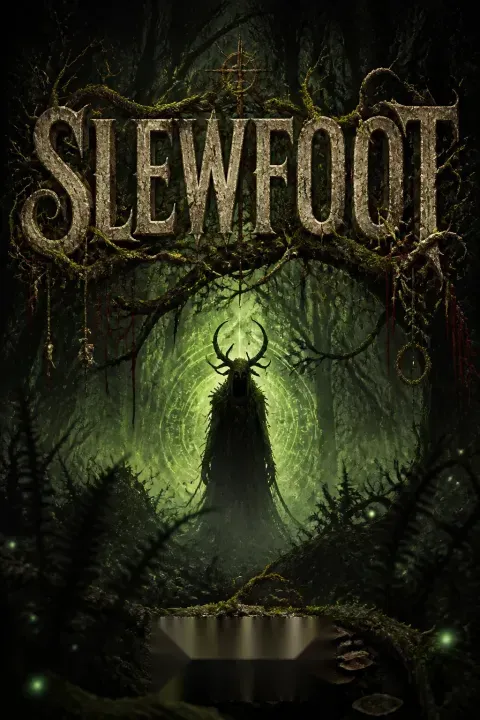
Brom's Slewfoot operates as a furious rebuttal to the Puritan witch-trial narrative, told from the perspective of the accused. The novel asks a devastating question: if a society has already decided you are evil, what is left but to become what they fear? Abitha's1 transformation from scrappy widow to horned creature of vengeance is not a fall but an apotheosis. The book meticulously documents how patriarchal power, economic greed, and religious fanaticism manufacture a witch, and then dares the reader to judge her for embracing the role.
The novel's genius lies in its refusal to separate pagan and Christian spiritualities. Reverend Carter6 and Samson2 pray together over Abitha's1 dying body. The twelve ancestral mothers appear alongside ghostly prehistoric beasts. Abitha's1 final vision reveals all gods as manifestations of a single interconnected reality. This is not a story about choosing between Christ and the Devil but about recognizing that the true evil is the certainty that one's god demands the destruction of all others. The Puritans' unforgivable sin is not doctrinal error but the violence they commit in the name of their exclusive truth.
Samson's2 psychological journey mirrors Abitha's1 external one. Both are fractured beings seeking wholeness. His integration of the golden stag (nurturing forest god) and the charred demon (traumatized weapon of vengeance) offers a model of healing through acceptance rather than suppression. The wildfolk's5 tragedy is that they could not accept both aspects of their guardian, pushing him toward pure destruction and thereby creating the monster they needed him to be.
The novel's feminist argument is threaded throughout: Abitha's1 body is the contested territory. The Puritans seek to control her hair, her clothes, her speech, her labor, her sexuality. Her transformation gives her body back to her in a form they can only read as monstrous but she experiences as liberation. The hooves that let her outrun horses, the horns that mark her as divine, the serpent within that makes her lethal: all are reclamations. She becomes the witch they accused her of being and finds it glorious.
Yet Brom does not let vengeance feel clean. Samson's2 eyes hold 'utter and profound sadness' even as the meetinghouse burns. Sarah Carter,7 broken by torture, condemns Abitha1 as the source of her ruin. The epilogue, set in 1972, shows Abitha1 still luring hunters to their doom centuries later, suggesting that the cycle of predation and punishment has no natural endpoint. The forest gods endure, but their existence is still defined by conflict with the humans who encroach on their territory. The circle continues, but it is a circle of blood.
Review Summary
Slewfoot receives mostly positive reviews, praised for its atmospheric writing, compelling characters, and dark themes. Readers appreciate the blend of historical fiction, folklore, and horror set in 1666 Puritan New England. The protagonist Abitha and her relationship with the enigmatic Slewfoot/Samson are highlights. Some criticize pacing issues and uncomfortable scenes. The book's illustrations enhance the reading experience. Overall, it's recommended for fans of dark fantasy, witch stories, and feminist revenge tales, though some found it morally confusing or historically inaccurate.
People Also Read



Characters
Abitha Williams
Defiant widow turned cunning womanA young Englishwoman sold by her father into marriage and shipped to the Connecticut colony. She is barely twenty, small and wiry with striking green eyes and long auburn hair she refuses to cut short despite Puritan laws. Her mother was a cunning woman who taught her root remedies, charms, and the old ways before dying of plague when Abitha was twelve. Her father, a drunk who believed her mother damned, burned all her magical belongings and forced Abitha to swear never to practice the crafts. In the New World, she finds herself trapped between her husband Edward's4 gentle awkwardness, his brother Wallace's3 predatory greed, and a Puritan community that sees her spirited nature as sin. She possesses a ferocious will to survive that repeatedly astonishes those who underestimate her. Beneath her profane, quick-tempered exterior lies a deep capacity for loyalty and a hunger to be truly seen and loved.
Samson (Father)
Awakened forest spirit, lost godAn ancient entity reborn in a cave from blood and shadow, initially taking the form of a shaggy goat-beast with curling horns and silver eyes. He has no memory of his past, only fractured visions of slaughter, worship, and a great crimson-leafed tree. The wildfolk5 call him Father and insist he is their guardian, the slayer meant to drive humans from the land. But beneath their programming, he senses a different nature: a healer, a fertility spirit who once received offerings and blessed crops. He is profoundly lonely, tormented by spiders in his mind and by the growing evidence that he may be the Devil himself. His relationship with Abitha1, who names him Samson and makes him offerings, awakens memories of being worshipped as a horned forest god. He desperately wants to be more than a monster.
Wallace Williams
Greedy brother, land-hungry patriarchEdward's4 older brother and Abitha's1 primary antagonist. A large, brash, physically imposing man who inherited both family farms and feels entitled to everything his father built. He speaks constantly of honoring their father's legacy but uses it to justify exploiting Edward4 and Abitha1. His failed tobacco venture, driven by dreams of building a plantation empire, has left him deeply in debt to the powerful Lord Mansfield. He views Abitha's1 resistance as an affront to natural order, a woman defying male authority, and his hatred of her becomes an obsession. He is not a cartoon villain but a man whose greed and pride have curdled his soul, making him capable of arson, conspiracy, and ultimately murder. He genuinely believes himself the righteous party, God's instrument against a witch.
Edward Williams
Gentle, awkward husband and artistAbitha's1 husband, about ten years her senior, with a stooped back that makes him walk with a hunch. He has difficulty reading people's intentions, making him vulnerable to his brother Wallace's3 manipulations. Despite his social awkwardness, he possesses a hidden artistic gift: his drawings of Abitha1 grow increasingly skilled and loving. He secretly collects books beyond the Bible, a sin in Puritan society. His relationship with Abitha1 is tender but chaste, more fatherly than passionate, until she draws out his hidden romantic nature. His death in the cave leaves Abitha1 utterly alone and sets the entire tragedy in motion.
Forest
Wildfolk leader, desperate manipulatorAn opossum-bodied wildfolk with the face of a human child and small, black, firefly-lit eyes. He is the most vocal and cunning of the three wildfolk who serve Samson2. He orchestrated the blood ritual that resurrected Father and is single-mindedly devoted to protecting the Pawpaw sapling. His hatred of humans, born from centuries of conflict and near-extinction, drives him to manipulate, lie, and ultimately attempt murder to keep Samson2 focused on slaughter. He carries immense guilt for his role in corrupting Samson's2 original nature with the blood magic that turned him into Hobomok, though he struggles to admit this to himself.
Reverend Thomas Carter
Sutton's principled head ministerThe stern but fair-minded head minister of Sutton, a lean man nearing fifty with severe eyes and an unyielding commitment to the community's laws. He broke away from Hartford years ago over theological disputes with men like Magistrate Watson11, whom he considers morally corrupt. He is rigid in doctrine but capable of genuine compassion, granting Abitha1 leave from church during her hardship and ruling in her favor against Wallace3. His integrity becomes his vulnerability when Hartford's power brokers see him as an obstacle. He loves his wife Sarah7 and daughter Martha deeply, and their suffering at the hands of the witch trial breaks something fundamental in him.
Sarah Carter (Goodwife Carter)
Village matriarch, secret sympathizerThe minister's wife and the de facto leader of Sutton's women. She presents a rigid, austere exterior, enforcing sumptuary laws and proper behavior with cold authority. But beneath this, she carries a secret: her own grandmother was a cunning woman, and she understands Abitha's1 remedies in ways she cannot publicly admit. She shows Abitha1 crucial kindness, warning her of Wallace's3 schemes and providing food. Her maternal desperation when her daughter Martha falls ill leads her to accept Abitha's1 magical healing, a choice that eventually makes her vulnerable to the witch-hunters. She is a woman caught between her public role and her private conscience.
Ansel Fitch
Zealous witch-hunter and fanaticA thin, craggy man in his late fifties with bulging, shifty eyes and a bitter face. He is obsessed with finding devils, demons, and witches, spending his days spying on neighbors and examining animal tracks for signs of Satan. The community regards him as a loon but also fears his accusations, since he successfully identified a witch years ago. He keeps detailed drawings of suspicious hoofprints and believes himself God's special watchman against evil. His fanaticism makes him Wallace's3 perfect tool: he genuinely believes in the witchcraft he helps fabricate, giving the conspiracy the fervor of true conviction. He is a lonely, broken man who has found purpose in persecution.
Mamunappeht
Ancient demon shaman, soul collectorA preternaturally ancient being who predates the Pequot, having arrived with the great ice. He appears as a wiry man with ghostly white skin, dark vertical scars down his face, and silver hair in two long braids. He lives in a cave filled with masks, each containing a captured soul, including Samson's2 own skull. He is a manipulator who orchestrated the original destruction of the Pawpaw tree and the wildfolk5 by weaponizing the first tribes' hunger for magic. He presents himself as a benevolent guide offering Samson2 peace through oblivion, but his goal is to possess the reborn Pawpaw and rule over all people and spirits.
Sheriff Noah Pitkin
Honorable lawman caught in hysteriaSutton's sheriff, a lean, well-built man in his late twenties who inherited the position from his father. He is competent with sword and pistol but fundamentally decent in a community where decency is increasingly punished. He shows Abitha1 genuine kindness, bringing her breakfast during her imprisonment and protecting her from vigilante violence. He is attracted to her, a fact that humanizes them both. When the witch panic spirals beyond control, he is powerless to stop the judicial machinery but does what small mercies he can, including organizing the town's defense when the supernatural threat becomes undeniable.
Magistrate Watson
Corrupt Hartford judge, political schemerA pudgy, middle-aged magistrate who wears a powdered wig and immaculately tailored clothing. He represents Hartford's political establishment and has a long-standing vendetta against Reverend Carter6, who broke away from his influence years ago. He is more concerned with consolidating power than with justice, viewing the Sutton witch trial as an opportunity to crush his old rival. He bends the law freely to achieve his ends, sanctioning torture and manipulating testimony. His authority is backed by Captain Moore's12 militia, making him effectively a military governor once he arrives in Sutton.
Captain John Moore
Brutal enforcer and torturerA hard-looking man dressed all in black with dark, piercing eyes. He carries a flintlock pistol and sword and serves as Magistrate Watson's11 muscle. He fought alongside Wallace's3 father in earlier wars, giving him a personal connection to the case. He is the one who physically tortures Sarah Carter7, probing her body for devil's marks and cutting her with hooked knives. He is efficient, cruel, and utterly convinced of his righteousness. When Abitha1 transforms, he dismisses reports of a demon as drunken hysteria, insisting it is merely an Indian in disguise, a fatal underestimation.
Sky and Creek
Silent wildfolk companionsTwo of the three wildfolk who attend Samson2. Sky takes the form of a raven with human hands instead of claws and blue-tinted flesh. Creek is a floating fish who swims through air as though it were water. Both have the faces of children and communicate without words, through emotional projection.
Jesus Thunderbird
Pequot mercenary, reluctant accompliceA short Pequot man who wears English clothes and speaks multiple languages with mimic-perfect accents. He gave himself his grandiose name, believing names hold power. Desperate to appease his demanding wife, he agrees to help Wallace3 steal corn, a decision he instantly regrets when violence erupts.
Garret
Sadistic guard and cat-killerA burly, middle-aged guard with a leathery, weathered face who has fought in various colonial wars. He openly mocks witch trials as nonsense but participates in torture with relish. He kills Abitha's1 cat Booka16 and torments her with the corpse, an act of casual cruelty that seals his fate.
Booka
Abitha's rescued familiar-catAn orange, one-eyed tabby cat Abitha1 rescued from village dogs. His back healed poorly, leaving him bent and twisted. He is her constant companion during her solitary months on the farm. The witch-hunters present him as her demonic familiar, and his execution becomes a symbol of their casual cruelty.
Charity Williams
Wallace's ambitious, lying daughterWallace's3 teenage daughter who resents Abitha1 and is jealous of the attention she receives from young men. She provides crucial false testimony at the trial, claiming Abitha1 whispered to her in dreams and that charms burned her. Her theatrical performances help condemn both Abitha1 and Sarah7.
Plot Devices
The Pawpaw Tree
Source of wildfolk magic and resurrectionAn ancient, colossal tree that was the heart of the wildfolk's5 power and the source of magical crimson fruit. It was burned to a petrified stump by lightning after Mamunappeht's9 assault centuries ago. A small sapling now grows from the ruins, fed by the blood sacrifices of wildfolk5. The tree produces crimson, egg-shaped fruit that contains immense magic: it can resurrect the dead, heal the dying, and potentially restore the wildfolk5 to their former glory. The sapling's health is directly tied to Samson's2 power and sanity. When Samson2 and Abitha1 use magic for their crops, they inadvertently drain the magic the tree needs, causing it to wither. Its restoration at the novel's climax, through Ansel's8 blood sacrifice, represents the renewed covenant between the land, its spirits, and Abitha1.
The Chain of Braids
Ancestral conduit of cunning women's powerA necklace made from thirteen loops of braided auburn hair, each loop contributed by a successive generation of cunning women in Abitha's1 maternal line. It is fastened with a copper serpent pin. Abitha's1 mother used it to conjure spirits and strengthen her magic, drawing on the collective power of all thirteen mothers. Abitha1 recovers it from her traveling bag when she needs her mother's guidance most. When she touches it, she smells lavender and sage and feels her mother's presence. The Puritan guards later burn it, devastating Abitha1 and severing her from her lineage. After her transformation, the twelve ancestral mothers appear as ghosts and present her with a new braid, incorporating her own hair as the thirteenth link, formally inducting her into their sisterhood of witches.
Samson's Blood
Transformative magic, binding agentThe black blood of the horned beast2 carries both healing and transformative properties. When Samson2 touches Abitha1 in the barn, their merged heartbeat triggers visions and awakens latent magical sight within her. His blood heals her broken leg after the hanging. When she drinks it willingly, it initiates a full metamorphosis: the serpent spirit enters her, her feet become hooves, horns sprout from her forehead, and she gains enhanced senses, speed, and the ability to communicate with insects and animals. The blood also binds her to Samson2, the earth, and her own rage, making transformation a choice rather than a curse. The blood magic requires consent and emotional truth: it will not bind unless the recipient's heart is fully committed to the choice.
The Masked Skulls
Soul prisons, shaman's power sourceThe walls of Mamunappeht's9 cave are covered in hundreds of masks and skulls, each containing a captured soul. The shaman9 draws his power and immortality from these trapped spirits. Samson's2 own charred skull hangs among them, his consciousness imprisoned within. The mask forces visions upon whoever peers into it, revealing truths the shaman9 wants them to see. Removing the mask from the skull restores Samson's2 access to his complete memories. Each smashed mask releases a soul and weakens the shaman9, aging him rapidly. When Samson2 destroys all the masks, Mamunappeht9 crumbles to dust. The skulls represent the shaman's9 parasitic relationship with the wildfolk5 and the spiritual ecology he has corrupted.
Wildfolk Blood Ritual
Corrupted resurrection, source of HobomokThe spell the wildfolk5 used to resurrect Father2 involved mixing their own blood with the pulp of nine Pawpaw fruits. The ritual was intended to give Samson2 the strength to fight Mamunappeht9, but the wildfolk's5 hatred and desire for vengeance poisoned the potion. It transformed the forest god into Hobomok, a demon of slaughter, by infecting him with demons that split his soul and drove him to massacre the very people who had worshipped him. The spell's corruption is why Samson2 experiences two warring selves, the golden stag and the charred demon, struggling within him. Only by facing and integrating both aspects can he become whole. The ritual represents the novel's central theme: that violence used in the name of protection corrupts the protector.
About the Author

Download PDF
Download EPUB
.epub digital book format is ideal for reading ebooks on phones, tablets, and e-readers.








































