
Key Takeaways
1. The Prophecy: A Looming Financial Storm
"The full impact of this law change will not be felt for twenty-five to fifty years . . . long after I am gone. I wish I could tell them to prepare now . . . but how do I tell them about the future?"
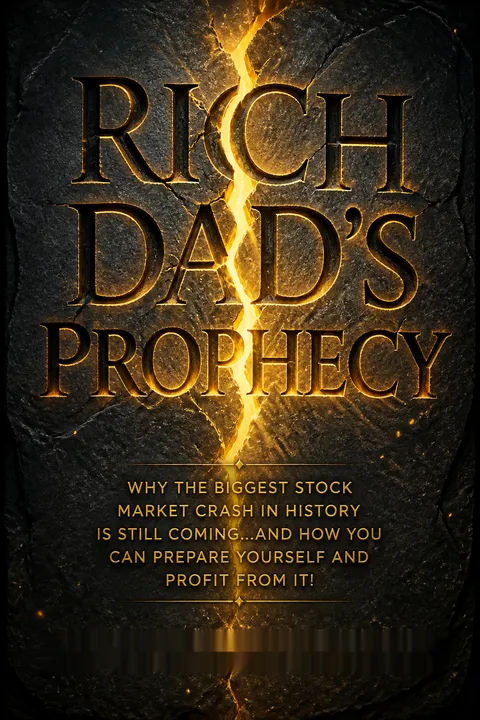
A dire prediction. Robert Kiyosaki's "Rich Dad" foresaw a massive stock market crash, not as an isolated event, but as the inevitable consequence of a fundamental shift in financial responsibility. This prophecy, made decades ago, is rooted in the 1974 ERISA law and a widespread lack of financial education. The Enron scandal served as an early, extreme warning of what was to come for millions.
Noah's Ark analogy. Rich Dad used the story of Noah to emphasize vigilance and preparation. He taught that true business owners and investors must cultivate a vision for the future, acting with faith and courage to build their "ark" before the storm hits. Many people, however, remain complacent, hoping the "fairy tale" of easy retirement will continue.
Gloom and boom. This isn't a book of pure pessimism, but rather a "gloom and boom" outlook. While a significant market downturn is predicted, it also presents immense opportunities for those who are financially educated and prepared. The goal is to be proactive, learn, and build a robust financial future, regardless of market conditions.
2. The Great Shift: From Defined Benefit to Defined Contribution
"So while ERISA was passed as a benefit to employees, it was in many ways more of a benefit to the employer. In many cases the expense of retirement has transferred from the employer to the employee."
ERISA's unintended consequences. The Employee Retirement Income Security Act (ERISA) of 1974, while intended to protect employees' retirement money, inadvertently shifted the burden of retirement planning from employers (Defined Benefit or DB plans) to employees (Defined Contribution or DC plans, like 401(k)s). This change significantly reduced employer costs but left employees largely unprepared.
The three-legged stool. Traditionally, retirement was supported by Social Security, personal savings, and company pensions. ERISA effectively weakened the company pension leg, forcing individuals to rely more heavily on their own savings and investment decisions. This created a precarious situation for many, as evidenced by the Enron crisis where employees lost their retirement savings.
A generational problem. Rich Dad viewed ERISA as his generation (World War II) passing a financial problem onto the baby-boom generation and beyond. His generation largely enjoyed secure DB plans, while subsequent generations face the uncertainty of DC plans without adequate financial literacy. This intergenerational transfer of financial burden is a core element of the coming crisis.
3. Financial Illiteracy: The Root Cause of the Crisis
"The problem is not the lack of diversification. The problem is a lack of financial education and financial sophistication . . . flaws that simple diversification alone cannot solve."
Beyond diversification. While financial planners often advise "diversify, diversify, diversify," Rich Dad argued this is merely a "protection against ignorance." The real issue is a systemic lack of financial education, leaving millions vulnerable to market fluctuations and misleading advice. Alan Greenspan himself called for improved financial literacy in schools.
Foxes and chickens. Rich Dad used the analogy of a fox raising chickens to describe Wall Street's role in financial education. Financial institutions, driven by profit, often provide sales pitches disguised as advice, encouraging people to invest in products that benefit the institutions more than the individual. This creates a false sense of security among uninformed investors.
The cost of ignorance. Without proper financial education, people are easily swayed by glitter over gold, making poor investment decisions. The rapid growth of the financial planning industry, often staffed by quickly trained salespeople, further exacerbates this problem. True financial literacy empowers individuals to make informed choices, rather than blindly trusting others.
4. Question Your Assumptions: Markets Don't Always Go Up
"Any professional investor who has taken the time to study the history of markets knows that all markets go up and all markets go down. A true professional investor would never bet their future on the assumption that markets only go up . . . yet that is what millions of people are doing."
The "works like a charm" fallacy. Many financial planning formulas are based on the assumption of continuous market growth, leading to advice like "systematic withdrawal works like a charm." However, historical data, such as the 1929 crash, demonstrates that markets can remain down for extended periods, devastating retirement portfolios. This exposes a critical flaw in relying solely on upward market trends.
Mandatory selling. A significant flaw in DC plans is the mandatory withdrawal requirement at age 70.5. As millions of baby boomers reach this age, they will be legally compelled to sell shares, creating a massive supply of sellers. This imbalance of supply and demand will inevitably drive market prices down, regardless of other factors.
Beyond bull markets. Most retirement portfolios are designed to perform well only in bull (upward) markets. Professional investors, however, understand that markets move in three directions: up, down, and sideways. Relying on diversification alone is insufficient when two out of three market directions can lead to losses, especially for those nearing or in retirement.
5. Assets vs. Liabilities: The Core of Financial Control
"If you want to be rich, you must know the difference between an asset and a liability."
Cash flow is king. Rich Dad taught that the direction of cash flow determines if something is an asset or a liability. An asset puts money into your pocket, while a liability takes money out of your pocket. This fundamental distinction is often misunderstood, leading many to purchase liabilities (like a personal residence with a mortgage) believing them to be assets.
The financial statement as a diagnostic tool. Just as a doctor uses blood tests, a personal financial statement (income and balance sheet) is crucial for diagnosing financial health. Without it, individuals cannot accurately assess their true financial position or identify "fool's gold" investments that glitter but don't generate income.
All assets are also liabilities. A critical lesson is that every asset has the potential to become a liability. This inherent risk means that even seemingly secure investments can turn detrimental, especially during market downturns. Financial literacy is essential to navigate this reality and ensure one's "ark" is filled with true, cash-flowing assets.
6. Master Your Emotions: Fear and Greed Drive Markets
"If you cannot control your emotions you cannot control your money."
Emotional investing is dangerous. Money is an inherently emotional subject, and uncontrolled emotions often lead to poor financial decisions. The story of the Essex whaling ship, where fear of "cannibals" led the crew to a more perilous journey and eventual cannibalism, illustrates how emotional thinking can lead to self-fulfilling prophecies in finance.
Three levels of thought. Rich Dad identified three levels of thought: lower (emotional, fear-driven), middle (rational, technical skills), and higher (wisdom, intuition). Most people remain stuck in lower-level emotional thinking when it comes to money, preventing them from making rational, informed investment choices.
Education as emotional control. Financial education empowers the middle mind to overcome the fears and doubts of the lower mind. Learning technical skills and gaining real-world experience builds confidence, allowing investors to make decisions based on logic rather than panic. This emotional control is vital for navigating volatile markets and avoiding costly mistakes.
7. Control the Rules: Quadrants and Leverage
"The more security you seek, the less freedom you have."
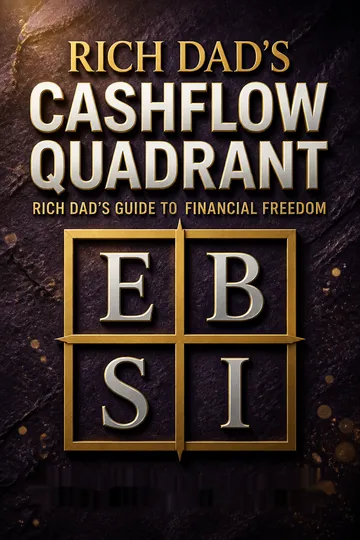
Different rules for different quadrants. The CASHFLOW Quadrant (Employee, Self-employed, Business owner, Investor) highlights that each quadrant operates under different rules, especially concerning taxes and leverage. Employees (E) and self-employed (S) individuals often seek security, but at the cost of financial freedom and favorable tax rules.
Tax advantages of the rich. Laws like the 1943 Current Tax Payment Act and the 1986 Tax Reform Act created distinct advantages for business owners (B) and investors (I). These quadrants offer greater control over income, expenses, and the ability to use pre-tax dollars, unlike the E quadrant where taxes are paid first.
Good debt vs. bad debt. Rich Dad taught the crucial distinction between good debt (debt that makes you rich, like for investment properties) and bad debt (debt that makes you poor, like for consumer goods). Leveraging good debt, rather than saving, can accelerate wealth creation, but requires financial literacy and a willingness to operate under different rules.
8. Build Your Ark: Businesses and Real Estate
"A lot of great fortunes in the world have been made by owning a single wonderful business. If you understand the business, you don’t need to own very many of them."
Beyond paper assets. While DC plans often limit investors to paper assets like mutual funds, Rich Dad advocated building or acquiring businesses and real estate. These asset classes offer greater control, potential for higher returns, and significant tax advantages not available to traditional stock investors.
Starting small, thinking big. The author's journey began with small real estate deals, gradually scaling up to larger apartment complexes and commercial properties. This incremental approach builds experience and confidence. Examples include:
- Private Real Estate Partnerships (PREPs) for shared risk and high cash flow.
- Triple Net Lease properties for steady, tax-advantaged income without management headaches.
- Starting a part-time business to gain entrepreneurial skills and tax benefits.
Four types of income from real estate. Investing in real estate through a business can generate:
- Rental income
- Depreciation (phantom cash flow)
- Appreciation
- Tax advantages
This multi-faceted income stream provides greater security and higher returns than traditional savings or diversified mutual funds.
9. Invest Your Time Wisely: Get Rich in Your Spare Time
"How many times do I have to remind you that you do not get rich at work? How many times do I have to remind you that you get rich in your spare time?"
Work for yourself, not just others. Many people love their jobs but fail to invest time in building their own financial future. Rich Dad emphasized that true wealth is created in one's spare time, by acquiring skills and assets that generate income independently of a job. The author's experience at Xerox, where he honed sales skills for a charity in his free time, exemplifies this principle.
Velocity of money. Increasing the speed at which your money returns to you is crucial for gaining time. Investments with higher returns (e.g., 50% annually vs. 5%) significantly reduce the time it takes to recoup initial capital and achieve financial freedom. This requires a commitment to continuous financial education and practical application.
Education is an investment in time. Gaining financial literacy involves a three-step process:
- Defining your "why" (goals and motivation).
- Acquiring technical knowledge (courses, books, seminars).
- Gaining real-world experience through trial and error (starting small, learning from mistakes).
This investment in self-education ultimately saves time, reduces risk, and leads to greater financial control.
10. Vision for the Information Age: Invisible is Best
"In the Industrial Age, big was better. In the Information Age, invisible is best."
Ephemeralization and the future. Dr. R. Buckminster Fuller's principle of ephemeralization suggests that technology starts small, grows big, and then either disappears or becomes invisible. The attack on the World Trade Center, symbols of Industrial Age "bigness," may signal a shift towards an invisible economy where smaller, more agile entities thrive.
Watching for change. To see the future, one must observe what is becoming "too big" and anticipate its replacement by something smaller or invisible. Examples include:
- The decline of giant airlines replaced by smaller business jets and video conferencing.
- The potential obsolescence of physical stock exchanges by cyberspace trading.
- The rise of invisible businesses like network marketing, operating from homes.
Government and the invisible economy. The invisible economy of the Information Age presents challenges for Industrial Age governments, particularly in tax collection and border definition. This growing disconnect could weaken national currencies and necessitate a re-evaluation of governmental roles. Vigilance regarding government's handling of social programs and inflation is crucial.
11. You Are the Captain: Take Control of Your Destiny
"Inside each of you is a rich person, a poor person, and a middle-class person. It is up to you to decide which person you become."
Drawing out your potential. Education, derived from the Latin "educo" (to draw out), is about choosing which version of yourself to become. Following Rich Dad's path meant choosing an uncertain, challenging destiny over a guaranteed, but ultimately limiting, one. This journey involves learning from failures and embracing personal accountability.
Money doesn't make you rich. True wealth comes not from having money, but from the financial intelligence and wisdom gained through study, practice, and overcoming adversity. Rich Dad, despite his limited formal education, became a genius by facing the "real world" early and developing his financial abilities.
Fiduciary responsibility to self. Rich Dad emphasized the importance of being trustworthy, or "fiduciary," to oneself and one's family. This means taking control of your education and destiny, preparing for challenges, and consistently calling forth the "rich person" within. The coming financial storm is an opportunity to do just that, transforming potential crisis into personal growth and financial freedom.
Review Summary
Rich Dad's Prophecy receives mixed reviews. Some readers find it insightful, praising its financial education and perspective on investing. They appreciate Kiyosaki's emphasis on financial literacy and taking control of one's financial future. However, critics argue the book is repetitive, lacks concrete advice, and makes questionable predictions. Some reviewers note that the book's warnings about market crashes and retirement plans are still relevant, while others criticize Kiyosaki's self-promotion and potentially risky financial advice. Overall, readers seem to find value in the book's core message but disagree on its execution and specifics.
People Also Read

Rich Dad Series


About the Author
Other books by Robert T. Kiyosaki
Download PDF
Download EPUB
.epub digital book format is ideal for reading ebooks on phones, tablets, and e-readers.








































