

Key Takeaways
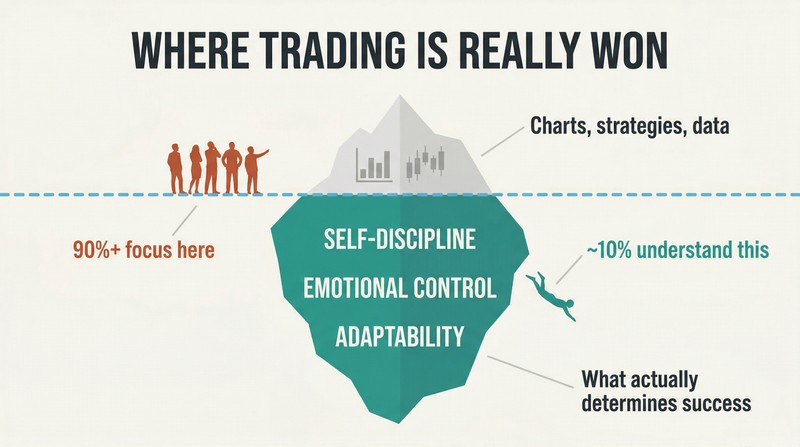
Over 90% of traders lose — the gap is psychological, not technical
Douglas knows this firsthand. Eight months after moving to Chicago to pursue his trading dreams, he lost his house, car, and flawless credit — then filed bankruptcy. At Merrill Lynch's second-largest commodity office, 38 account executives had zero consistently profitable customers. The typical customer lost their entire stake within four months. On the trading floor, the same pattern: everyone confused, impulsive, asking each other for confirmation.
The difference between winners and losers isn't information. The tiny minority who succeed describe their edge in identical terms: self-discipline, emotional control, and the ability to change their minds to flow with the market. Trading looks deceptively easy — no physical effort, enormous returns possible in seconds — which creates inflated expectations that lead to disappointment, psychological damage, and fear.
The market is never wrong — only you can be
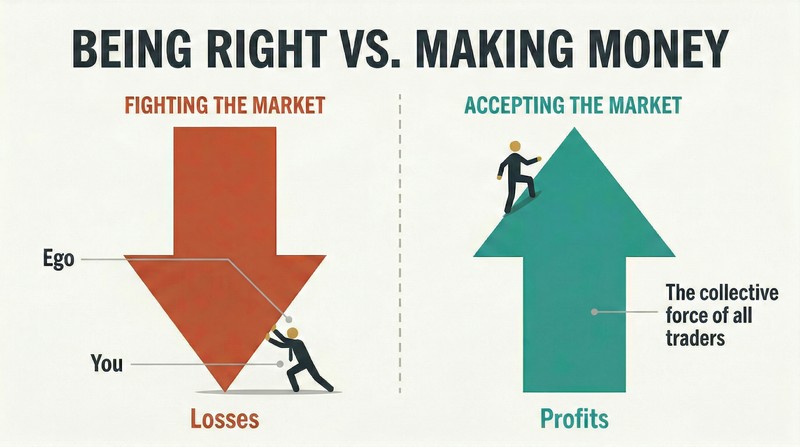
Two traders agreeing on a price make a market. That trade is right by definition — it happened. Your analysis, credentials, and reasoning are irrelevant unless you can personally trade enough volume to move prices. If the collective force of participating traders pushes prices against your position, they're right and you're losing money. Period.
Douglas frames this as an identity-level shift. Traders must decide what matters more — being right or making money — because the two aren't always compatible. The market reflects the collective beliefs of all participants about future value. Fighting that force to prove your superior reasoning is the most expensive form of ego gratification in existence. Accepting the market's rightness is the prerequisite for everything else Douglas teaches.
Trying to avoid losses is precisely how you create them
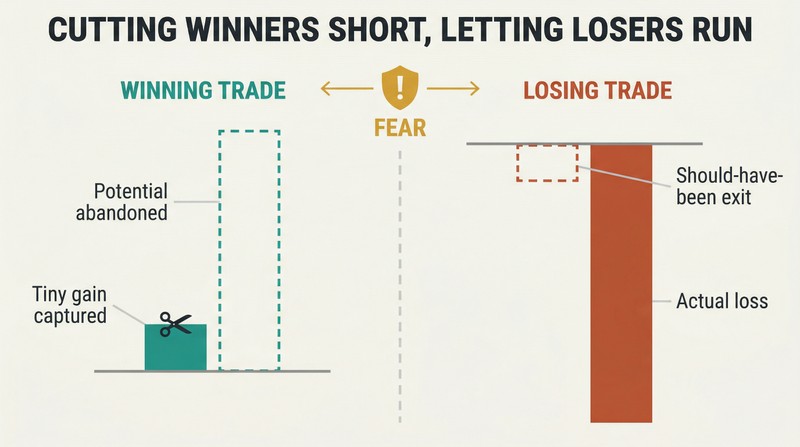
Fear works like tunnel vision. When you fear losing, you focus on information confirming your position and block evidence suggesting you're wrong. In a losing trade, you fixate on any scrap of hope the market will come back. In a winning trade, you obsess over the market stealing your profits. The result is the classic destructive pattern: cutting winners short and letting losers run.
Douglas illustrates the mechanism clearly. A trader afraid of losing, in a profitable position, will exit early for a tiny gain — ignoring massive remaining potential — because all his attention is locked onto what the market might take away. In a losing position, the same trader ignores all exit signals, building catastrophic losses. The fear meant to protect him manufactures the exact outcome he dreads.
In trading, doing nothing is how you lose everything
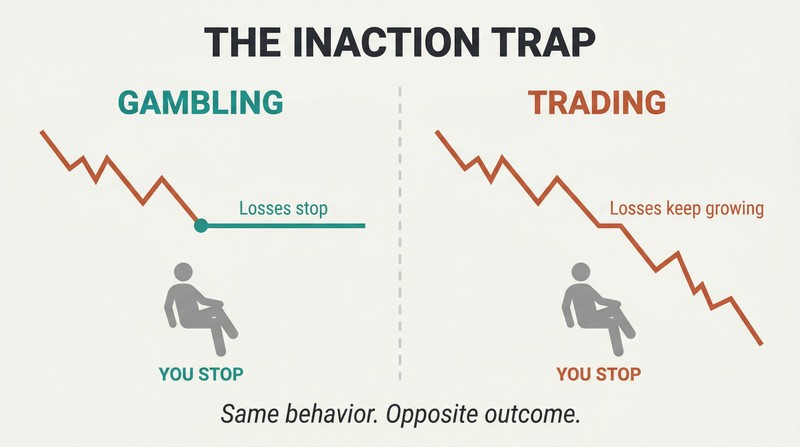
Douglas draws a sharp line between trading and gambling. In blackjack or craps, you're an "active loser" — you must place a bet to risk money, and each game ends automatically. Do nothing, and you stop losing. Trading inverts this: you become what Douglas calls a "passive loser." Once in a trade, losses mount indefinitely while you sit frozen. The market never forces you out. The event has no built-in ending.
This structural difference makes trading psychologically lethal. The market constantly whispers: why confront the pain of admitting you're wrong when the price might come back? Why choose loss when inaction preserves hope? Every unconfronted fear about failure or being wrong silently drains accounts while traders wait for rescue that rarely arrives.
Write your own trading rules, then obey them like law
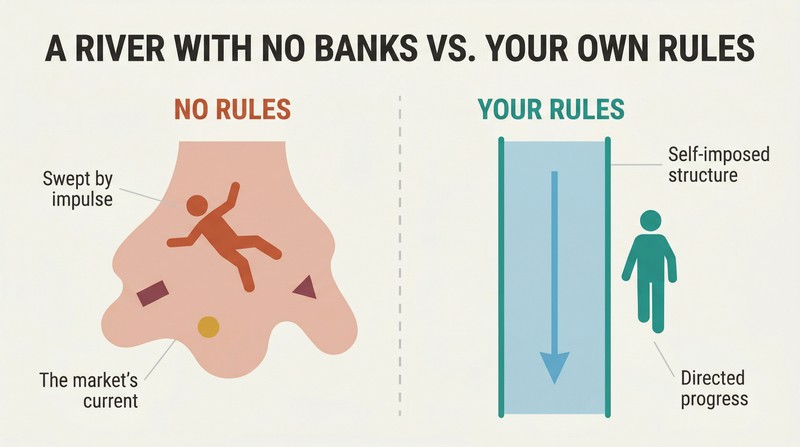
The market is a river with no banks. No external rules, no defined beginning or end, no one stopping you from standing in traffic. Without self-imposed structure, you'll be swept by the crowd, your own impulses, and random events. Most traders avoid creating rules because rules demand accountability — and accountability means you can't blame the market when things go wrong.
Douglas describes floor traders who deliberately don't track their positions, hoping to find themselves accidentally flat at day's end. Others seek opinions instead of trusting their own superior analysis — just to shift blame if trades fail. The paradox: the only way to learn trading is to make yourself accountable by creating structure, but accountability requires accepting complete responsibility for outcomes.
Predefine every loss before you ever enter the trade
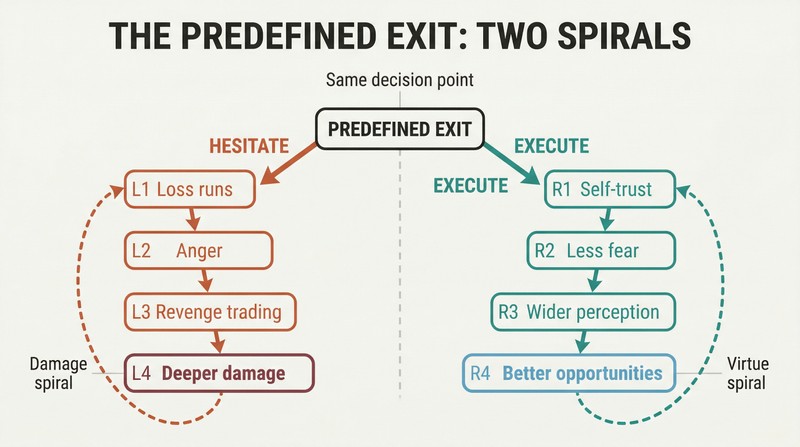
Douglas's most concrete prescription has two parts. First, before entering any trade, determine what the market must do to tell you the trade is no longer valid. Second, execute that exit immediately upon perception — no considering, weighing, or judging. If you find yourself deliberating, you've already failed the rule. Hesitation invites the market's most dangerous temptation: the possibility of being made whole.
This rule compounds psychologically. Following it builds self-trust, which reduces fear, which widens perception, which reveals better opportunities. Violating it does the opposite: letting a loss run triggers anger, then revenge trading, then taking bad tips, deepening the damage spiral. Douglas notes most successful traders learned loss acceptance only after losing a fortune — you can learn it deliberately through disciplined practice.
Replace fear with self-trust as your risk limiter
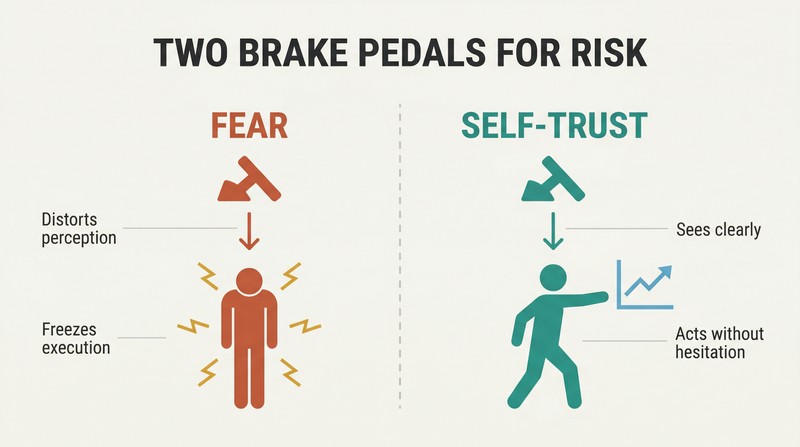
Every trader needs a brake pedal, but fear is the wrong one. Fear distorts perception and freezes execution. Douglas proposes self-trust instead: the deep knowledge that you will act in your own best interest without hesitation under any market condition. When you trust yourself to cut losses, reverse positions, and take profits according to plan, the market's unpredictability stops being threatening.
Douglas defines self-confidence as "an absence of fear" and self-trust as knowing what to do at the moment it needs to be done, then doing it without hesitation. With self-trust, you don't need fear's protection because you know you'll respond appropriately to anything. Without it, even brilliant market analysis is useless — you'll be paralyzed at the moment of execution, watching perfect setups pass.
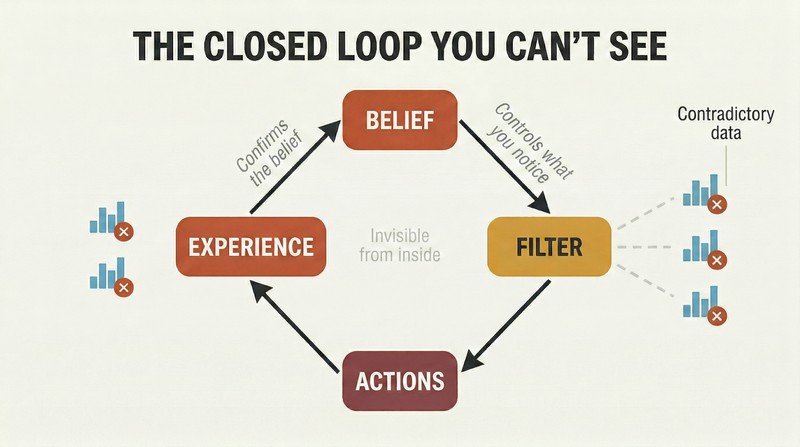
Your beliefs filter market data into a closed loop you can't see
A Chicago TV show placed a man on Michigan Avenue with a "FREE MONEY" sign, pockets stuffed with cash. Out of hundreds of passersby, exactly one person asked — for a quarter. A businessman literally refused cash handed to him. Nobody could perceive reality because nothing inside their mental framework matched "strangers give away free money."
Douglas calls this a closed loop. Your belief controls what information enters awareness. The filtered information confirms the belief. Your actions align with filtered data. The experience reinforces the original belief. Everything seems self-evident — from the inside, the loop is invisible. For traders, this means your conviction about what the market "can't do" prevents you from seeing evidence it's doing exactly that — until what Douglas calls a "forced awareness" shatters the illusion painfully.
Become an expert at one repeating pattern before expanding
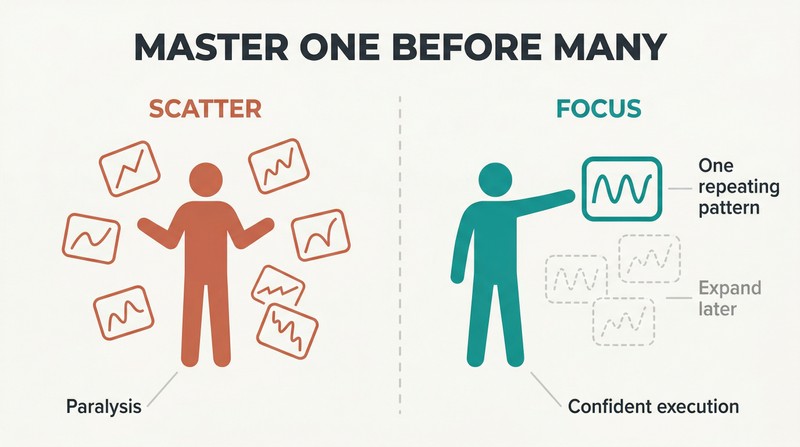
More information doesn't improve trading decisions — it creates paralysis. Douglas prescribes starting with one simple, preferably mechanical trading system that identifies a single repeating pattern. Understand every relationship within it. Execute it flawlessly. Let all other opportunities pass without regret.
This feels counterintuitive, but Douglas reframes the math. What's the rush? The market will exist tomorrow. The goal isn't maximum profit now; it's minimum damage while building foundational skills. Many traders become expert analysts who can't make a dime because psychological damage from early reckless trading prevents execution. Nothing is more frustrating than knowing exactly what will happen next and being unable to act. Start small, build confidence through competence, and expand only when execution becomes second nature.
Your equity curve is a chart of your self-worth
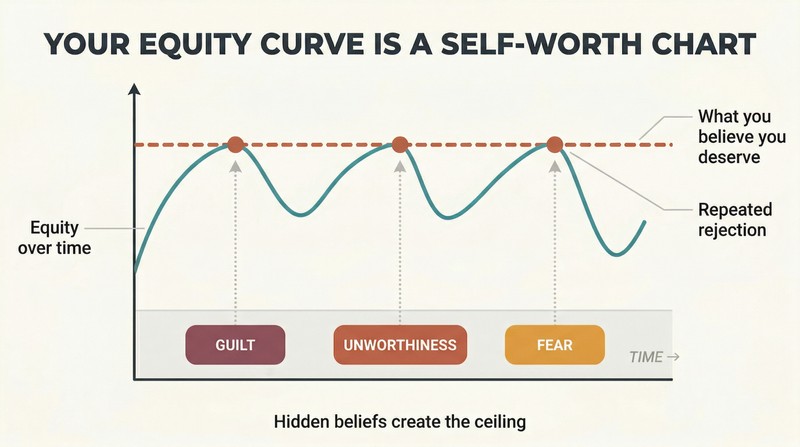
Douglas describes a wealthy floor trader who could consistently buy the exact low and sell the exact high of the day — but held for only one or two ticks because past burns left him desperate for any win. When he tried compensating by trading 20 contracts without developing the skills, he lost $3,000 in a single day, wiping out weeks of careful profits. His problem wasn't market knowledge. It was self-acceptance.
Some brokerage firms actually keep equity charts on individual traders the way traders chart markets — with support, resistance, and consolidation zones. These psychological patterns predict when a trader is about to blow up. The implication: if you want more money from the market, the work isn't better analysis. It's identifying beliefs about guilt, worthiness, and speculation that argue against letting yourself keep what you earn.
Analysis
Douglas's The Disciplined Trader arrived in 1990 as arguably the first systematic treatment of trading psychology, predating the behavioral finance revolution that would later produce Kahneman's popular work. What makes the book intellectually distinctive is its attempt to build a complete model of mind-market interaction from first principles rather than borrowing from existing cognitive science.
Douglas's central insight — that fear narrows perception, creating the very outcomes feared — anticipates what psychologists now call 'threat rigidity' and what behavioral economists describe as loss aversion under stress. But Douglas goes further by proposing a recursive mechanism: fear distorts perception, distorted perception produces losses, losses deepen fear, deeper fear produces greater distortion. This feedback loop explains why many traders' performance degrades over time rather than improving with experience. Experience without psychological repair simply compounds the damage.
The book's weakest section is its extended treatment of 'mental energy' and memory storage, borrowing pseudoscientific analogies between thought and electricity that haven't aged well. Douglas's claim that memories exist as electrical charges immune to time contradicts modern neuroscience's understanding of memory reconsolidation. However, the practical insight underneath — that unprocessed emotional experiences distort future perception regardless of elapsed time — remains clinically sound and aligns with contemporary trauma research.
What gives the book lasting relevance is its structural diagnosis of why trading is categorically different from other professional environments. The 'passive loser 'concept — that inaction increases loss rather than stopping it — is perhaps the most underappreciated insight in trading literature. It explains why disciplined professionals from other fields routinely fail at trading: every other domain rewards patience and deliberation, while trading punishes inaction during losses.
Douglas essentially describes what modern psychology would call experiential avoidance and proposes acceptance-based strategies years before Acceptance and Commitment Therapy became mainstream. His framework for self-discipline as a learnable mental technology, not an innate trait, was ahead of its time and remains more actionable than most contemporary trading psychology literature.
Review Summary
The Disciplined Trader receives mostly positive reviews for its insights on trading psychology. Readers appreciate the author's personal experiences and practical advice on developing mental discipline. Many consider it essential reading for traders, praising its exploration of fear, greed, and self-control in trading. Some criticize the writing style as repetitive or difficult, while others find the concepts applicable beyond trading. The book is particularly valued for its focus on the psychological aspects of trading, which many readers believe account for a significant portion of trading success.
People Also Read



Glossary
Forced awareness
Reality shatters your mental defensesDouglas's term for the painful moment when market reality overwhelms a trader's psychological defenses—denials, rationalizations, and illusions. Occurs when losses accumulate to such magnitude that mental distortions can no longer bridge the gap between expectations and actual conditions. Typically creates shock and can cause lasting psychological damage that generates future fear.
Passive loser
Losing by doing nothingDouglas's structural distinction between trading and gambling. In gambling, you must actively place a bet to lose money (active loser), and each game ends automatically. In trading, once a position is open, losses accumulate indefinitely through inaction. The trader must actively participate to end losses. This makes every unconfronted psychological issue potentially catastrophic.
Perceptual distortion
Unconscious filtering of threatening informationThe mental system's automatic process of shaping, altering, and selectively excluding environmental information to avoid the pain of acknowledging conflict between expectations and reality. Creates an illusion of shared reality with the market. Operates unconsciously, making the trader believe they are perceiving objectively when they are seeing only what their beliefs permit.
Quality of energy
Emotional charge stored in memoriesDouglas's framework for how experiences are recorded in memory with either positively or negatively charged emotional energy, depending on whether the experience was pleasurable or painful. Positive energy promotes openness, curiosity, and learning. Negative energy generates fear and restricts perception. The charge does not weaken over time and continues influencing behavior until actively changed.
Demand-backed expectations
Emotionally rigid market predictionsExpectations about market behavior that carry an emotional demand that the market must conform. Rooted in the social habit of controlling one's environment to get desired outcomes. When the market violates these expectations, the trader experiences anger and engages in perceptual distortion. The opposite of the objective stance Douglas advocates.
Uncommitted assessments of the probabilities
Objective, detached market observationDouglas's term for evaluating what the market is likely to do next without emotional attachment to any particular outcome. No commitment means no distortion—the trader simply observes what is happening as an indication of what will probably happen next. Requires releasing demand-backed expectations and accepting that anything can happen.
Significant reference points
Price levels that trigger group reactionsPrice levels where large numbers of traders have taken opposing positions and where expectations about market direction will be either validated or invalidated. Includes previous highs, lows, support, and resistance levels. When the market reaches these points, one group's disappointment triggers liquidation, creating significant price momentum as losers compete for the diminishing supply of counterparties.
Random winning and random losing
Profiting without knowing whyA psychological condition where a trader cannot define what behavior produced a win or loss because trades were unplanned and unstructured. Creates intense anxiety because success cannot be replicated and losses cannot be prevented. The trader feels powerless and out of control, often developing superstitious beliefs to explain random outcomes.
FAQ
What's "The Disciplined Trader" about?
- Core Focus: "The Disciplined Trader" by Mark Douglas is a guide to developing the mental discipline necessary for successful trading.
- Psychological Emphasis: It emphasizes that success in trading is 80% psychological and 20% methodology, focusing on mental discipline over technical skills.
- Adapting Mindset: The book provides insights into adapting one's mindset to the unique psychological challenges of the trading environment.
Why should I read "The Disciplined Trader"?
- Transformative Approach: Reading the book can transform your trading approach by focusing on psychological aspects that often hinder success.
- Overcoming Barriers: It helps identify and overcome psychological barriers such as fear and greed, which can sabotage trading efforts.
- Practical Techniques: The book offers practical techniques for developing self-discipline and emotional control, essential for objective trading decisions.
What are the key takeaways of "The Disciplined Trader"?
- Psychology Over Methodology: Success in trading is largely determined by psychological factors rather than technical skills.
- Self-Discipline and Control: Developing self-discipline and emotional control is crucial for making objective decisions and managing risk.
- Adapting to Market Conditions: Traders must learn to adapt their mindset to the ever-changing market environment, focusing on probabilities.
How do beliefs affect trading according to Mark Douglas?
- Beliefs Define Reality: Beliefs shape our perception of market information, influencing what we perceive as possible.
- Closed-Loop Systems: They create closed-loop systems that reinforce themselves, making it difficult to perceive alternatives.
- Impact on Experience: Traders' experiences in the market reflect their beliefs, which can limit or expand their perception of opportunities.
What is the "new thinking methodology" proposed by Mark Douglas?
- Adapting Mindset: The methodology involves changing one's mindset to align with the realities of the trading environment.
- Focus on Probabilities: Traders are encouraged to focus on probabilities rather than certainties, accepting that losses are natural.
- Developing Mental Flexibility: It emphasizes mental flexibility, allowing traders to shift perspectives and adapt to market conditions.
How does fear impact trading according to "The Disciplined Trader"?
- Limiting Perception: Fear narrows a trader's focus, causing them to miss opportunities and perceive threats where none exist.
- Hesitation and Inaction: It can lead to hesitation and inaction, preventing traders from executing trades even when opportunities are clear.
- Self-Sabotage: Fear often results in self-sabotage, where traders unconsciously act against their best interests.
What techniques does Mark Douglas suggest for overcoming psychological barriers in trading?
- Self-Reflection: Traders are encouraged to reflect on their beliefs and emotions, identifying and addressing limiting factors.
- Developing Discipline: Establishing and adhering to a set of trading rules helps build discipline and reduce emotional decision-making.
- Releasing Fear: Techniques include visualization, affirmations, and focusing on probabilities rather than certainties.
How does Mark Douglas define the trading environment?
- Unlimited Potential: The market offers unlimited potential for profit and loss, making it essential to manage expectations and emotions.
- Perpetual Motion: Prices are in perpetual motion, requiring traders to be adaptable and responsive.
- Psychological Challenges: The trading environment presents unique psychological challenges, necessitating a new way of thinking.
What are the three stages to becoming a successful trader according to Mark Douglas?
- Perceiving Opportunity: Develop the ability to perceive high-probability opportunities objectively, free from emotional biases.
- Executing Trades: Overcome fear and hesitation, trusting oneself to act appropriately under any market condition.
- Accumulating Profits: Allow one's account balance to grow by maintaining discipline and avoiding self-sabotage.
How does Mark Douglas suggest traders develop self-discipline?
- Establishing Rules: Create a set of rules to guide behavior, reducing impulsive and emotional decision-making.
- Consistent Practice: Regular practice and reflection on trading experiences help reinforce discipline and build confidence.
- Accountability: Holding oneself accountable for trading outcomes fosters responsibility and adherence to rules.
What is the role of adaptability in trading success?
- Changing Conditions: Adaptability is crucial for responding effectively to changing market conditions.
- Learning and Growth: It is linked to learning and growth, expanding understanding of market dynamics.
- Balance and Satisfaction: A trader's satisfaction and success are related to their ability to adapt and maintain balance.
What are some of the best quotes from "The Disciplined Trader" and what do they mean?
- "The market is always right": Emphasizes accepting market conditions as they are, rather than imposing expectations.
- "Success in trading is 80 percent psychological and 20 percent one's methodology": Highlights the critical role of psychology in trading success.
- "You create the market that you experience in your own mind": Reflects the idea that traders' perceptions shape their market experience.
About the Author
Other books by Mark Douglas
Download PDF
Download EPUB
.epub digital book format is ideal for reading ebooks on phones, tablets, and e-readers.








































