

Key Takeaways
"The real world" is a cowardly excuse, not a place
Naysayers weaponize realism. When you pitch a fresh idea, someone inevitably says it would never fly in the real world. Fried and Hansson, who ran the software company 37signals with sixteen people scattered across eight cities on two continents, argue that phrase is a mask for pessimism. The people who invoke it expect new ideas to fail and want to drag you into their gloom.
Their own company broke every rule. They attracted millions of customers with no salespeople and no advertising, shared their trade secrets publicly, and stayed profitable through two recessions. Each of those moves flunks the conventional real-world test, yet worked. The lesson: that world is real for the discouraged, but it has nothing to do with what you can build.
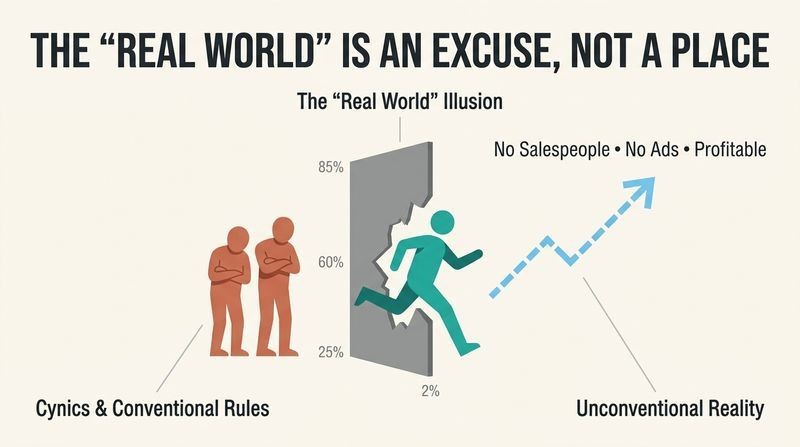
What's striking is how this reframes skepticism as a psychological defense rather than sober analysis. Behavioral economists call this status quo bias, the tendency to treat the familiar as inherently safer. The authors are right that incumbents underestimate outsiders, but the framing risks survivorship bias: 37signals is one profitable success cited against thousands of rule-breakers who did fail. The sharper reading is not that constraints are illusions but that many are self-imposed conventions nobody has audited. The useful discipline is asking which rules are physics and which are merely inherited habit dressed up as inevitability.
Call your business plan what it is: a guess
Plans masquerade as control. Long-range planning assumes you can predict markets, competitors, and the economy. You can't. The authors suggest renaming your business plan a business guess, your financial plan a financial guess. The relabeling deflates the false authority these documents carry and frees you to improvise when reality shifts.
You know most when you're doing, least before you start. Yet plans get written at the very beginning, the moment of maximum ignorance. Worse, a plan lets the past dictate the future: "this is where we're going because it's where we said we'd go." Their prescription is granular: decide what to do this week, not this year. Figure out the single most important next thing and do that. Winging it beats blindly following a map disconnected from the terrain.
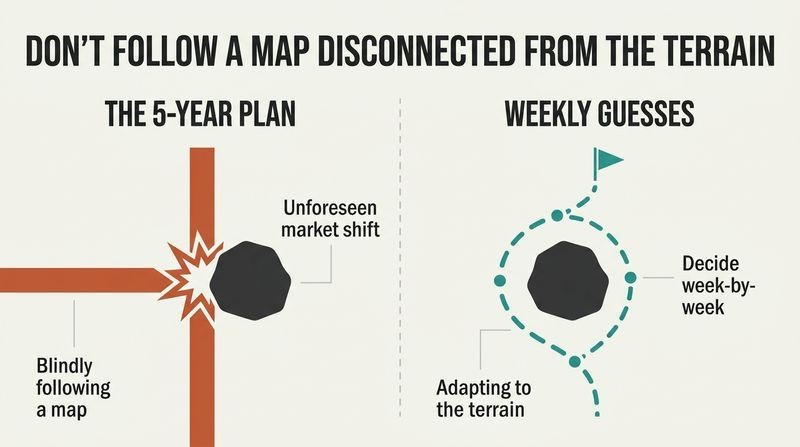
This echoes military doctrine that no plan survives contact with the enemy, and Eisenhower's line that plans are useless but planning is indispensable. The distinction matters: the authors attack the rigid document, not the thinking. Research on strategic planning by Henry Mintzberg supports them, showing most successful strategy is emergent rather than deliberate. The nuance they underweight is capital intensity. A software firm can pivot weekly; a semiconductor fab or biotech trial commits years and billions upfront, where directional guessing is catastrophic. Their advice fits low-mass service businesses beautifully, but scales poorly where lead times are long and reversals ruinous.
Build an actual business, not a startup postponing profit
Startups pretend gravity doesn't exist. A startup, the authors say, is treated as a magical place where expenses are someone else's problem and revenue is a someday concern. That's a fairy tale. Every business obeys the same rule: money in must exceed money out, or you're gone. A company with no path to profit isn't a business, it's a hobby.
Outside money is Plan Z. Raising capital surrenders control, prioritizes cashing out over building quality, is addictive, distracting, and usually a bad deal when you have no leverage. Service businesses rarely need it. Related warnings: don't build to flip (you need a commitment strategy, not an exit strategy), and you need far less than you think. When 37signals launched Basecamp, they shared an office, ran on one server, and the founder answered support emails himself.
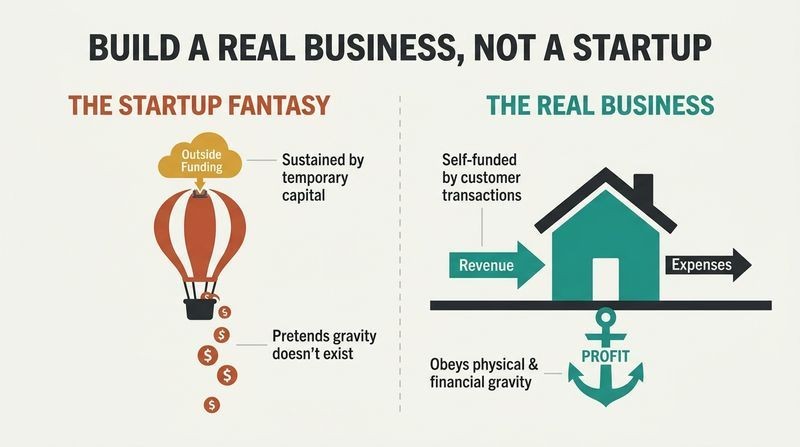
Written in 2010, this reads as a direct rebuke of the venture-capital blitzscaling ethos that Silicon Valley canonized. The bootstrapping thesis has aged into a genuine movement, with companies like Mailchimp (sold for roughly twelve billion dollars without raising venture money) vindicating it. Yet the dichotomy is too clean. Network-effects businesses like Uber or Facebook plausibly required capital to win winner-take-all markets before rivals; profit-from-day-one would have surrendered the field. The authors' model optimizes for durable independence and owner autonomy, not market domination. Both are legitimate games, but they are different games with different rules, and conflating them misleads founders in each.
Solve a problem you personally have
Scratch your own itch. The surest path to a great product is building something you want to use. You become your own expert, judging quality directly instead of guessing at strangers' needs, no focus groups required. 37signals built its contact manager Highrise because it needed one.
The canon of self-solvers is long. James Dyson invented the bagless vacuum because his own cleaner kept losing suction. Bill Bowerman poured rubber into his family's waffle iron to make lighter running shoes, birthing Nike's waffle sole. Vic Firth crafted better drumsticks because the store-bought ones failed him on stage, and now ships tens of thousands daily. Mary Kay knew her skincare worked because she used it. When you own the problem, every one of the hundred tiny daily design decisions gets easier, and you'll care enough to stay with it for years.
This is the entrepreneurial equivalent of writing what you know, and it has strong empirical backing. Eric von Hippel's MIT research on user-driven innovation found that a large share of breakthrough products originate with lead users solving their own frustrations, not with firms doing market research. The advantage is tacit knowledge: you feel the problem in a way surveys can't capture. The limitation is representativeness. Your itch may be idiosyncratic, or you may be a wealthy technologist whose problems diverge from a mass market's. The correction is not to abandon the principle but to verify your itch is shared before betting the company on it.
Ship half a product now, not a half-assed whole later
Constraints breed creativity, so launch early. Limited time, money, and people force focus. Southwest flies only Boeing 737s so any crew can work any flight and every part fits every plane. Cut ambition in half: a kick-ass half beats a half-assed whole. The authors trimmed their own manuscript from 57,000 words to about 27,000 and call it better for the cut.
Find the epicenter and launch. Ask what your offering cannot exist without. A hot dog stand survives losing the mustard and relish but not the hot dogs, so perfect the dog first. Then launch before you're comfortable: ask what you'd cut if you had to ship in two weeks, and the essentials become obvious. Basecamp launched without any way to bill customers, because monthly billing gave a thirty-day window to build that later.
The empirical child of this philosophy is Eric Ries's Lean Startup and its minimum viable product, which turned iterate-in-public into orthodoxy. The underlying logic is sound: real feedback beats imagined perfection, and constraints are documented drivers of creativity, as studies on functional fixedness and bounded ideation show. The danger the authors underplay is category-dependent. Reid Hoffman's advice that if you aren't embarrassed by your first release you launched too late works for web apps where updates are free. It fails for medical devices, aircraft, or trust-critical products where a botched first impression is fatal and version two never gets a hearing.
Guard long stretches of uninterrupted time like sleep
Interruption, not workload, is why you stay late. People do their best work early morning or late night precisely because nobody's around. Taps on the shoulder, chats, and pings feel harmless but shatter the day into fragments. The authors compare deep focus to REM sleep: you don't drop into it instantly, and any interruption forces you to restart the climb. They call the deep state the alone zone.
Meetings are the worst offenders. A one-hour meeting with ten people isn't a one-hour meeting, it's ten hours of lost productivity, closer to fifteen once you count the mental cost of stopping and restarting. Their fixes: declare no-talk periods (say, 10 a.m. to 2 p.m.), favor asynchronous tools like email over interruptive calls, and if you must meet, set a timer, invite few, meet at the site of the problem, and end with one person owning the solution.
Cal Newport's Deep Work later formalized this with cognitive science on attention residue, the finding by Sophie Leroy that switching tasks leaves part of your mind stuck on the previous one, degrading performance. The multiplier framing of meeting cost is a genuinely useful accounting trick that few managers apply. The tension is that some work is irreducibly collaborative, and the authors' own remote model depends on a few hours of daily overlap. The honest synthesis is that interruption and collaboration are different things: scheduled, bounded synchrony can be productive, while ambient, unpredictable interruption is corrosive. The goal is protecting maker time, not abolishing conversation.
Beat rivals by doing less and pouring yourself in
Underdo the competition. The arms-race instinct, matching every feature and outspending every rival, is a trap that keeps you perpetually defensive and reactive. Instead, solve the simple problems well and leave the hairy ones to competitors. The Flip camcorder captured huge market share while deliberately lacking a big screen, photos, memory cards, optical zoom, menus, settings, and a viewfinder. It did a few things and did them delightfully.
Decommoditize by injecting yourself. Since success invites copycats, make you part of the product. A Zappos sneaker is identical to any other store's, but CEO Tony Hsieh's customer-service obsession (scriptless calls, every employee starting on phones and in the warehouse) is impossible to copy. Joel Salatin's Polyface farm sells a philosophy of grass-fed, antibiotic-free, never-shipped meat that agribusiness structurally cannot match. Competitors can clone your features, never your convictions.
The underdoing thesis is Clayton Christensen's disruption theory in plain clothes: incumbents over-serve customers with features nobody wants, opening the low end to simpler, cheaper entrants. The Flip is a textbook case, though its later demise (Cisco shut it down after smartphones absorbed the camcorder) reveals the strategy's fragility against convergence rather than against feature-bloated rivals. The decommoditize point connects to brand economics and what Byron Sharp calls distinctiveness. Pouring personality into a product raises switching costs through affinity, not lock-in. The caveat: personality-as-moat depends on founders whose convictions actually resonate, and it protects margins less reliably than patents, scale, or network effects.
Say no by default and let customers outgrow you
No is your priority tool. Saying yes to features, deadlines, and mediocre ideas builds a pile so tall you can't see what matters. The authors advise defaulting to no, even to good ideas, and being honest rather than confrontation-averse. ING Direct became America's fastest-growing bank by refusing credit cards, brokerage accounts, and even deposits above a maximum, keeping its offering radically simple. Don't blindly obey "the customer is always right": if a few patrons want bananas in the lasagna, refuse, because pleasing vocal outliers can ruin the dish for everyone.
Let customers outgrow you. When loyal early users demand power features to match their growing complexity, adding them can scare off the far larger pool of newcomers. The authors would rather users eventually outgrow a simple product than never grow into a bloated one, because basic needs are constant and newcomers always outnumber veterans.
Steve Jobs's dictum that focus means saying no to a thousand good things is the same creed. The insight cuts against the loudest-voice bias baked into feedback channels, where a squeaky minority gets mistaken for the market. Product managers know this as the feature-creep death spiral, quantified by studies showing most software features go largely unused. The outgrow-you stance is bolder and more contestable. It deliberately caps a customer's lifetime value and bets on a bottomless top-of-funnel. For a mass-market simple tool that works, but in enterprise software, where a handful of whale accounts fund everything, refusing to grow with them can be existential rather than principled.
Out-teach competitors instead of outspending them
Teaching builds loyalty money can't buy. Most businesses sell or service, never teach, so teaching is open territory. The Hoefler type foundry teaches designers about typography; Etsy runs seller workshops; wine merchant Gary Vaynerchuk drew tens of thousands of daily viewers teaching about wine. Big competitors can afford a Super Bowl ad but won't teach, because secrecy and legal red tape paralyze them. Small firms can.
Emulate chefs and build an audience. Famous chefs like Mario Batali publish their recipes and demonstrate techniques on TV, and nobody opens a restaurant next door and destroys them, because a recipe is far easier to copy than a business. Share everything you know. Meanwhile, build an audience through blogging, speaking, and video so people come to you rather than you buying their attention. And remember marketing is not a department: every email, error message, invoice, and after-dinner mint markets your company.
This anticipated the content-marketing and creator-economy explosion by a decade. The mechanism is reciprocity and authority, principles Robert Cialdini documented: give genuine value freely and people feel obligated and grant you trust. Modern proof is everywhere, from HubSpot building a public company on educational content to countless founders building audiences before products. The overlooked cost is that teaching well is a real craft demanding sustained output, and attention has grown vastly more contested since 2010. The advice that a recipe won't sink a chef is comforting but not universal; in pure-information businesses where the recipe is the product, radical transparency can erode the very margin you depend on.
Hire only when the pain is unbearable, then test-drive
Hire to kill pain, not for pleasure. Ask what happens if you don't hire: can software, a process change, or simply not doing it solve the problem? Hire only when there's more work than you can handle for a sustained stretch and quality is slipping. Passing on great people you don't need beats parking talent in invented roles that breed artificial busywork.
Judge work, not credentials. Resumes are near-useless spam, easy to mass-blast and impossible to verify; read the cover letter for a real human voice instead. Years of experience barely matter after the first six months to a year. Formal pedigree is overrated (more top-500 CEOs got undergraduate degrees from the University of Wisconsin than from Harvard). Instead, test-drive candidates on a small paid project, as BMW does with a simulated assembly line and Cessna with a role-play executive day. Hire managers of one who set their own direction, and hire the best writer, because clear writing signals clear thinking.
The test-drive prescription aligns with a robust finding in industrial psychology: work-sample tests predict job performance far better than unstructured interviews or resume screening, per Schmidt and Hunter's landmark meta-analysis. Betting on writing quality is a shrewd proxy in an era of remote, asynchronous, text-based work, where the ability to think clearly on the page is nearly synonymous with the ability to think. The hire-when-it-hurts rule guards against the empire-building that inflates headcount and slows firms. Its blind spot is proactivity: some capabilities (a first salesperson, a security engineer) must precede acute pain, because by the time it hurts, the damage is already done.
Culture is a patina you grow, not paint you apply
You don't install culture, it accrues. Mission statements, foosball tables, and slogans are artificial culture, paint slapped on. Real culture is patina: the byproduct of consistent behavior over time. Reward sharing and you get a sharing culture; reward trust and trust takes root. New companies simply don't have a culture yet, and no declaration can manufacture one.
Trust people like adults. Treat employees like thirteen-year-olds needing permission for every expense and you get children's work. Send people home at 5, because those with full lives outside work use their office hours efficiently. Sound like yourself in all communication, dropping corporate jargon and legalese for how you'd actually talk. Ban the poisonous words need, must, can't, easy, just, only, and fast, which force false black-and-white standoffs. And retire ASAP: when everything is urgent, nothing is, and you manufacture stress that breeds burnout.
Edgar Schein, the foundational scholar of organizational culture, argued precisely this: culture is the accumulated learning of a group, embedded in behavior and assumptions, not in posters. The authors translate his academic model into blunt operating advice. The send-people-home-at-5 stance is validated by productivity research showing output collapses beyond roughly fifty hours a week, and by Parkinson's Law, that work expands to fill the time available. The language observations are subtle and underrated: words like just and easy smuggle assumptions that trigger conflict, a point communication theorists make about presupposition. The gap is scale. Behavior-driven culture propagates cleanly at sixteen people but requires deliberate ritual and structure to survive rapid growth.
Inspiration has an expiration date, so act while it's fresh
Ideas are immortal, inspiration is milk. Everyone has ideas and they last forever, which is exactly why they're cheap. What's perishable is inspiration, the charged motivational state that makes work fly. It spoils like fruit. If a project grips you on a Friday, the authors say, cancel the weekend and dive in, because inspiration is a productivity multiplier that can compress two weeks of work into twenty-four hours.
Momentum compounds through small wins. This closes a thread running through the book: making a decision is progress, long lists breed guilt so break them into tens, break big estimates into week-sized chunks, and celebrate quick wins every couple of weeks to keep morale and motivation alive. The through-line is that motion and motivation feed each other, and both decay if you wait for the perfect moment, which never arrives.
Neuroscience lends support: motivation is partly a dopaminergic state tied to novelty and anticipated reward, and it genuinely fades as a stimulus loses freshness. Behavioral research on the intention-action gap, notably Peter Gollwitzer's work on implementation intentions, shows that the distance between feeling motivated and acting is where most goals die. The authors' remedy, act immediately, is one valid response. A complementary one they don't emphasize is building systems that generate progress without relying on fickle inspiration at all, since disciplined habit outlasts any mood. The strongest operators pair both: they seize inspiration when it strikes and install routines for the many days it doesn't.
Analysis
Rework is a manifesto disguised as a business book, delivered in short, punchy essays that read like a founder ranting over coffee. Its power lies in compression and contrarianism: nearly every chapter attacks a sacred cow of conventional management, from five-year plans to venture funding to open-plan meetings. The authors' authority is autobiographical. 37signals (later Basecamp) was living proof that a tiny, remote, profitable, ad-free company could thrive, which lets them argue from lived counterexample rather than theory.
The book's intellectual coherence comes from a single underlying variable the authors call mass. Everything they recommend, staying small, avoiding debt, saying no, launching early, trusting employees, cutting meetings, reduces organizational mass so the company can change direction cheaply. This is essentially a bet on optionality and adaptability over scale and prediction, a stance that anticipates lean startup methodology, remote-work culture, and the bootstrapping movement that flourished in the following decade.
The honest limitation is scope. Rework generalizes from a specific case: a high-margin, low-capital software business selling to a fragmented long tail of small customers. Its advice is close to universally correct for that context and increasingly shaky as you move toward capital-intensive, network-effect, or regulation-heavy industries where planning, funding, and scale are not vanities but survival requirements. The blitzscaling giants that came to dominate the 2010s broke nearly every rule in this book and won, which does not falsify the authors so much as reveal they were describing one viable game, not the only one.
Read correctly, Rework is less a rulebook than a permission slip and a bias-corrector. Its lasting value is teaching founders to audit inherited assumptions, to ask which conventions are physics and which are merely fashion, and to default toward less: less planning, less mass, less noise, and more shipping.
Review Summary
Rework receives mixed reviews, with many praising its concise, practical advice for entrepreneurs and small businesses. Readers appreciate its unconventional approach to work, challenging traditional business practices. The book's simple language and short chapters make it an easy read. Critics argue some advice is obvious or not applicable to all industries. Many find it inspirational, while others see it as oversimplified. Overall, reviewers agree it offers valuable insights for startups and small businesses, but may not be as useful for larger organizations or those seeking in-depth analysis.
People Also Read





FAQ
What's "Rework" about?
- Focus on simplicity: "Rework" by Jason Fried emphasizes the importance of simplicity in business operations, advocating for straightforward, practical approaches over complex strategies.
- Challenge traditional norms: The book encourages readers to question conventional business wisdom, suggesting that many traditional practices are outdated and inefficient.
- Experience-based insights: The authors draw from their own experiences at 37signals, sharing real-world examples of how they successfully navigated business challenges.
- Practical advice: It offers actionable advice for entrepreneurs and business owners on starting, running, and growing a business without unnecessary complications.
Why should I read "Rework"?
- Fresh perspective: "Rework" provides a refreshing take on business management, challenging readers to rethink their approach to work and productivity.
- Actionable insights: The book is filled with practical tips that can be immediately applied to improve business operations and personal productivity.
- Inspiration for change: It inspires readers to break free from traditional constraints and pursue innovative, efficient ways of working.
- Proven success: The advice is backed by the authors' success with 37signals, making it credible and relatable for aspiring entrepreneurs.
What are the key takeaways of "Rework"?
- Embrace simplicity: Simplifying processes and focusing on what truly matters can lead to more effective and efficient business operations.
- Question norms: Don't blindly follow traditional business practices; instead, evaluate what works best for your specific situation.
- Start small: Begin with what you have and grow organically, avoiding unnecessary expenses and complications.
- Prioritize action: Focus on doing rather than planning excessively, as real progress comes from taking action.
How does "Rework" suggest handling competition?
- Ignore the competition: The book advises not to obsess over competitors, as this can lead to stress and distraction from your own goals.
- Focus on uniqueness: Instead of copying others, inject your unique perspective and values into your product or service.
- Underdo competitors: Offer a simpler, more focused product rather than trying to outdo competitors with more features.
- Pick a fight: Position yourself as the alternative to a competitor, which can help differentiate your brand and attract loyal customers.
What does "Rework" say about planning?
- Planning is guessing: The book argues that long-term planning is often futile because it involves too many unknowns and variables.
- Focus on now: Instead of extensive planning, concentrate on what you can do immediately to move forward.
- Be flexible: Plans should be adaptable, allowing you to pivot and respond to changes as they occur.
- Avoid overplanning: Excessive planning can lead to inaction and missed opportunities, so prioritize action over perfect plans.
How does "Rework" address productivity?
- Interruption is the enemy: The book highlights that interruptions are a major barrier to productivity and suggests creating uninterrupted work periods.
- Meetings are toxic: Meetings are often unproductive and should be minimized or structured to be more efficient.
- Good enough is fine: Strive for progress over perfection, as waiting for perfect conditions can delay important work.
- Quick wins: Focus on achieving small victories to build momentum and maintain motivation.
What hiring advice does "Rework" offer?
- Hire when it hurts: Only hire when absolutely necessary, ensuring that the workload justifies the addition of new team members.
- Do it yourself first: Understand the job by doing it yourself before hiring someone else, which helps in making informed hiring decisions.
- Pass on great people: Avoid hiring talented individuals if there isn't a clear need for their skills, as this can lead to unnecessary complexity.
- Hire great writers: Good writing skills indicate clear thinking and effective communication, valuable traits in any employee.
What does "Rework" say about company culture?
- Culture happens naturally: Culture is a byproduct of consistent behavior and cannot be artificially created through policies or slogans.
- Decisions are temporary: Embrace the ability to change decisions as circumstances evolve, rather than being rigid.
- Avoid bureaucracy: Policies should not be created in response to isolated incidents, as this leads to unnecessary complexity.
- Trust employees: Treat employees like adults, allowing them autonomy and avoiding micromanagement.
How does "Rework" suggest handling mistakes?
- Own your bad news: Be transparent and take responsibility for mistakes, as this builds trust with customers.
- Speed changes everything: Respond quickly to issues, as promptness can defuse negative situations and improve customer relations.
- Apologize sincerely: Avoid non-apology apologies; instead, offer genuine apologies that take responsibility and seek to make amends.
- Learn from success: Focus on learning from successes rather than dwelling on failures, as this provides actionable insights for future growth.
What are the best quotes from "Rework" and what do they mean?
- "Planning is guessing": This quote emphasizes the uncertainty inherent in long-term planning and encourages focusing on immediate actions.
- "Workaholics aren't heroes": It challenges the glorification of overwork, suggesting that efficiency and smart work are more valuable.
- "Meetings are toxic": Highlights the often unproductive nature of meetings and the need to minimize them for better productivity.
- "Emulate chefs": Encourages sharing knowledge and being open about processes, as transparency can build trust and differentiate a business.
How does "Rework" redefine entrepreneurship?
- Rejects traditional labels: The book suggests moving away from the term "entrepreneur" to "starter," emphasizing action over titles.
- Focus on starting: Encourages individuals to begin projects without waiting for perfect conditions or labels.
- Embrace smallness: Being small is seen as an advantage, allowing for agility and focus on core values.
- Prioritize passion: Start with what you love and build a business around it, rather than following conventional paths.
What is the "Rework" approach to marketing?
- Marketing is constant: Every interaction with customers is a form of marketing, not just traditional advertising efforts.
- Build an audience: Focus on creating valuable content that attracts and retains an audience, rather than relying solely on paid advertising.
- Out-teach competitors: Use teaching as a marketing tool to build trust and differentiate from competitors.
- Embrace obscurity: Use the early stages of a business to experiment and learn without the pressure of widespread attention.

Download PDF
Download EPUB
.epub digital book format is ideal for reading ebooks on phones, tablets, and e-readers.








































