
Key Takeaways
1. The Deep Roots of Religion in Evolutionary Play
Man plays only when he is in the full sense of the word a man, and he is only wholly Man when he is playing.
Play's primal freedom. Long before humans, play emerged in mammals and birds as a realm of freedom from the immediate struggle for existence. This "relaxed field" allowed for spontaneous, purposeless activity, driven by the sheer joy of abundant energy. This biological heritage laid the groundwork for complex human behaviors, including ritual and culture.
From animal play to human ritual. Animal play, characterized by limited immediate function, endogenous motivation, and repeated performance, provided the evolutionary template for human ritual. Early human rituals, like animal play, were often joyful, embodied, and egalitarian, fostering social cohesion and a sense of shared identity. This suggests that ritual, as a form of "serious play," is deeply ingrained in our biological and cultural makeup.
Ritual as a cultural engine. Human ritual, by creating a "relaxed field" through collective effort and surplus resources, allowed for the imaginative enactment of events and the exploration of "how things ought to be." This capacity for symbolic representation, rooted in play, became a powerful engine for cultural development, enabling early societies to model their social order, communicate complex emotions, and transmit rudimentary skills, long before the advent of formal language.
2. Humanity's Multiple Realities: Beyond the Everyday
The everyday world of common-sense objects and practical acts is, as Schutz says, the paramount reality of human experience—paramount in the sense that it is the world in which we are most solidly rooted, whose inherent actuality we can hardly question (however much we may question certain portions of it), and from whose pressures and requirements we can least escape.
Beyond the paramount reality. While daily life, characterized by pragmatic striving and fundamental anxiety, serves as our "paramount reality," humans constantly navigate multiple other realities. These non-ordinary realities, such as dreams, games, art, science, and religion, offer escapes from utilitarian pressures and provide alternative frameworks for meaning. They challenge the notion that the everyday world is the only reality.
Religious reality as B-cognition. Religious experience often aligns with Abraham Maslow's "Being cognition" (B-cognition), a state of participation and wholeness that transcends the "Deficiency cognition" (D-cognition) of daily life. This unitive experience, marked by a union of subject and object and a transcendence of ordinary time and space, is a profound encounter with non-ordinary reality. Examples include:
- Jonathan Edwards's "sense of the glory of the Divine Being."
- Václav Havel's "profound amazement at the sovereignty of Being."
- Wallace Stevens's "moments of awakening."
The symbolic bridge. These multiple realities are not watertight compartments but constantly overlap, with symbols acting as bridges. An ordinary object can become extraordinary, imbued with deeper meaning, transforming our perception of the everyday. This capacity for "beyonding"—seeing the realm of daily life in terms of a realm beyond it—is crucial for human understanding and prevents us from being trapped in a "dreadful immanence."
3. Mimetic and Mythic Cultures: The Foundations of Human Meaning
The highest level of processing in the mimetically skilled brain is no longer the analysis and breakdown of perceptual events; it is the modeling of these events in self-initiated motor acts.
From episodic to mimetic. Human cultural evolution began with "episodic culture," shared with higher mammals, where life is lived in the present as a series of concrete events. The crucial leap was to "mimetic culture," enabling conscious control over action to imaginatively enact past or future events. This prelinguistic stage, evident in early toolmaking and shared attention, allowed humans to model events through embodied action, laying the groundwork for complex communication and social learning.
Ritual as mimetic core. Mimetic culture found its most complex expression in ritual, which served as a "musilanguage"—a proto-language and proto-music involving meaningful gesture and sound. Rituals, with their rhythmic movements, shared attention, and collective effervescence, were constitutive of early human societies, fostering solidarity and defining group identity. They provided the "external support system" necessary for the eventual emergence of full language.
Mythic narratives emerge. With the development of full grammatical language, "mythic culture" arose, expanding human capacity for comprehensive modeling of the universe through narrative. Myths, as "unified, collectively held systems of explanatory and regulatory metaphors," provided a coherent understanding of existence, causality, and social norms. While ritual preceded myth, they became deeply intertwined, with myths often serving as the scenarios for rituals, and rituals enacting the truths embedded in myths.
4. The U-Shaped Curve of Despotism: From Egalitarian Bands to Archaic States
There appear to be two components of this kind of egalitarian social control. One is the moral community incorporating strong forces for social conformity . . . The other ingredient is the deliberate use of social sanctioning to enforce political equality among fully adult males.
Egalitarianism as active suppression. While our primate relatives exhibit despotic dominance hierarchies, early human hunter-gatherer societies were remarkably egalitarian. This wasn't due to an absence of the "disposition to dominate," but rather to "reverse dominance hierarchies" where the community actively suppressed potential upstarts through ridicule, shunning, and even execution. This collective dominance ensured political equality among adult males and enabled the formation of stable pair-bonding and families.
The return of hierarchy. With the advent of agriculture, increased population density, and surplus resources, a "U-shaped curve of despotism" emerged. Societies transitioned from egalitarian bands to hierarchical chiefdoms and then to early states, where power became concentrated in the hands of a few. This shift was often driven by:
- Economic intensification requiring institutionalized leadership.
- The closing of open frontiers, leading to conflict over resources.
- The rise of organized warfare, elevating successful warriors.
Nurturance and dominance intertwined. In these emerging hierarchies, the "disposition to nurture" became intertwined with the "disposition to dominate." Leaders, like the Tikopia chiefs, were seen as "caring for" their people, organizing economic activities and redistributing resources, but this generosity also served to legitimize their authority and reinforce their superior status. The act of giving, as Marcel Mauss noted, often establishes dominance, creating a complex interplay of obligation and submission.
5. Archaic Religion: The Sacred Fusion of God and King
Just as class has replaced real and metaphorical kinship as a basis for organizing society, so religious concepts replaced kinship as a medium for social and political discourse.
The king as divine mediator. In archaic societies, the emergence of the state fundamentally transformed religious life. The divine and the human realms, once loosely connected in tribal societies, became tightly integrated through the figure of the king, who was often considered divine or semi-divine. This "God-King" complex served as the central legitimating ideology for the new class hierarchies, replacing kinship as the primary organizing principle of society and religious discourse.
Ritual and power. Archaic rituals, unlike the communal celebrations of tribal societies, became highly centralized and focused on the king. Grand, often monumental, rituals like the Hawaiian luakini temple ceremonies or the Egyptian pyramids, were performed by priests (or the king himself) to magnify royal power, ensure cosmic order, and secure the king's immortality. Human sacrifice, where present, epitomized the king's ultimate authority and his unique role as mediator between the earthly and divine.
Cosmic order as a state. The cosmos itself was often conceived as a state, mirroring the earthly political order. Gods were kings and queens, with their own hierarchies and courts, and their benevolence was crucial for the prosperity of the realm. The king, as the earthly representative or even incarnation of the gods, was responsible for maintaining this cosmic-social harmony. This compact symbolism, where supernatural, natural, and social orders were fused, provided a powerful, if often oppressive, framework for understanding existence.
6. The Axial Age: A Global Shift Towards Transcendence and Critical Thought
All these civilizations display literacy, a complex political organization combining central government and local authorities, elaborate town-planning, advanced metal technology and the practice of international diplomacy. In all these civilizations there is a profound tension between political powers and intellectual movements. Everywhere one notices attempts to introduce greater purity, greater justice, greater perfection and a more universal explanation of things.
A new era of questioning. The Axial Age (roughly 800-200 BCE) marked a pivotal period where, across diverse civilizations, a "breakthrough" in human consciousness occurred. This era saw the rise of "second-order thinking"—thinking about thinking—which led to a critical re-evaluation of existing social, political, and religious assumptions. This intellectual ferment was often fueled by social stress, incessant warfare, and the destabilizing effects of growing trade and urbanization.
Transcendence and universal ethics. A defining feature of the Axial Age was the emergence of a "transcendental breakthrough," where new models of reality, apprehended mystically, prophetically, or rationally, were propounded as alternatives to prevailing cosmological models. This led to a profound tension between the mundane and a newly conceived transcendent order, fostering the development of universal ethical principles that challenged the particularistic norms of archaic societies.
The rise of the "renouncer." This period saw the emergence of "renouncers"—figures like the Hebrew prophets, Greek philosophers, Indian ascetics, and Chinese sages—who stood outside traditional power structures. These individuals, often marginalized or persecuted, offered radical critiques of existing social injustices and moral failings. Their teachings, often preserved in written texts and transmitted through new educational institutions, laid the foundations for the great world religions and philosophical traditions that continue to shape humanity.
7. Ancient Israel: Covenant, Justice, and the Portable Faith
There is, therefore, no voice more central to Judaism than the voice heard on Mount Sinai.
From tribal gods to Yahweh alone. Ancient Israel's axial breakthrough involved a radical redefinition of the divine-human relationship, moving from a polytheistic tribal religion focused on local and family gods to the "Yahweh-alone" movement. This shift, intensified by Assyrian imperial pressure, culminated in the Deuteronomic tradition, which posited a unique covenant between Yahweh and the people of Israel, superseding the archaic model of divine kingship.
The text as God's word. The Torah, particularly Deuteronomy, became the central text, embodying God's word and serving as the ultimate authority for the Israelite people. This "religion of the text" provided a portable framework for identity and practice, enabling the community to survive political subjugation and the loss of land and monarchy. The covenant demanded not just collective loyalty, but also individual commitment, fostering a new sense of personal responsibility and an internalized "love" for God.
Ethical universalism and social critique. The Hebrew prophets, acting as "renouncers," fiercely criticized social injustice and the moral failings of kings and people, demanding that "justice roll down like the waters, and righteousness like an ever-flowing stream." They envisioned a future where God's universal justice would prevail, and the people would live by a law written on their hearts. This profound ethical universalism, combined with a unique historical narrative of promise, unfaithfulness, punishment, and redemption, laid the groundwork for Judaism and its Abrahamic successors.
8. Ancient Greece: The Polis, Tragedy, and the Birth of Philosophy
The Greeks invented politics, and made political relationships the core of the form of state which they called the polis.
The unique citizen-state. Unlike other archaic societies ruled by kings, ancient Greece developed the polis—a "citizen-state" where authority resided in the community of citizens, not a monarch. This unique political form, emerging from a "Dark Age" of retribalization, fostered open discussion, argument, and a strong sense of civic identity. This environment, combined with growing literacy and economic innovation, provided fertile ground for critical thought.
Tragedy as self-examination. Greek tragedy, performed in the context of Dionysiac festivals, served as a profound form of collective self-examination. Plays by Aeschylus, Sophocles, and Euripides explored the ambiguities of human existence, the limits of rationality, and the tragic consequences of hubris and moral conflict. This "religious problematization" challenged conventional wisdom and forced citizens to confront the complexities of their own society, its grandeur, and its ethical failings.
From wisdom to philosophy. The transition from practical "wisdom" (sophia) of the Seven Sages to theoretical "philosophy" began with thinkers like Xenophanes, Heraclitus, and Parmenides, who critically questioned traditional myths and sought universal truths about the cosmos and being. Socrates, through his relentless questioning and pursuit of self-knowledge, completed this axial shift, making the examination of the soul and the search for objective truth central. Plato, building on Socrates' legacy, created a vast philosophical system that synthesized mimetic, mythic, and theoretic modes of thought, laying the foundation for Western philosophy and science.
9. Ancient China: The Way of Virtue, Ritual, and the Mandate of Heaven
The Master said, He who by reanimating the Old can gain knowledge of the New is fit to be a teacher.
Reanimating the Way. Ancient China's axial age, marked by unparalleled continuity from its archaic past, saw Confucius emerge as a pivotal figure. He responded to the social and political turmoil of the Spring and Autumn period by reanimating the ancient Zhou traditions of ritual (li) and virtue (de). Confucius redefined the "gentleman" (junzi) from a hereditary noble to a moral exemplar, emphasizing self-cultivation and universal ethical principles like humaneness (ren) and fairness (shu).
Heaven's moral mandate. The concept of the "Mandate of Heaven" (Tian ming), which justified the Zhou conquest, was transformed into a conditional moral imperative: rulers' legitimacy depended on their virtuous conduct and care for the people. This provided a powerful standard for criticizing corrupt governance and advocating for a just social order. While not explicitly theological in the Western sense, Heaven remained a transcendent moral force, guiding human affairs and inspiring ethical action.
Diverse responses to turmoil. The Warring States period saw a "hundred schools" of thought, including Mohism, which advocated "universal love" (jian ai) and utilitarian ethics, and Daoism, which emphasized non-action (wuwei) and a return to a simpler, more natural way of life. These diverse traditions, often in dialogue or opposition to Confucianism, explored alternative paths to social harmony and individual flourishing. Despite their differences, they collectively contributed to a rich intellectual landscape that profoundly shaped Chinese civilization, balancing the pursuit of individual integrity with the demands of social responsibility.
10. Ancient India: Dharma, Karma, and the Renouncer's Path
The highest dharma seems to be knowing the highest dharma for whatever particular situation one is in, and recognizing that situation within an ontology that admits virtually endless variation and deferral in matters of formulating and approaching ‘the highest.’
From ritual to knowledge. Early Vedic India, rooted in tribal and archaic structures, developed a complex ritual system (exemplified by the Agnicayana sacrifice) that upheld a hierarchical social order (the varna system). The "Middle Vedic Transformation" saw the emergence of paramount chiefdoms and a Brahmin-Ksatriya alliance, with rituals serving to integrate society and ensure the ruler's immortality. However, the Upanishads, emerging in a period of social change, introduced a radical shift from ritual action (karma) to salvific knowledge (jñāna), positing the identity of the individual self (ātman) with ultimate reality (brahman).
The renouncer's challenge. This Upanishadic breakthrough, while cognitively axial, initially lacked a strong ethical universalism. It was the "renouncer" tradition, particularly Buddhism, that completed India's axial ethicization. The Buddha rejected the hereditary basis of the varna system and the authority of Vedic rituals, proclaiming a universal path to liberation (nirvana) from the endless cycle of rebirth (samsara) and suffering (dukkha). His "Dhamma" emphasized ethical conduct, compassion, and wisdom, accessible to all regardless of caste or gender.
Dharma's enduring tension. While Buddhism offered a "parallel society" of monks and laity, the broader Indian tradition, as codified in texts like Manu's Dharmaśāstra and the epics (Ramayana, Mahabharata), grappled with the tension between universal ethics and particularistic caste duties (svadharma). Dharma, encompassing ritual, social norms, and righteousness, remained a complex, context-sensitive concept. This enduring tension between axial universalism and archaic particularism shaped India's unique civilizational trajectory, leading to a limited state system and a vibrant, diverse religious landscape.
11. Axial Utopias: Imagining a Transformed World
For behold, I create new heavens and a new earth; and the former things shall not be remembered or come into mind.
Visions of a better world. The axial age, born from the legitimation crisis of archaic states, spurred profound social criticism and the imagination of radically transformed societies. These "axial utopias" offered visions of a world free from the oppression, injustice, and violence endemic to existing power structures. They were not mere escapist fantasies but powerful critiques, challenging the status quo and inspiring movements for change.
Play as utopian blueprint. These utopian visions often contained a strong element of "play," envisioning a "relaxed field" where the struggle for existence was suspended. Plato's ideal city, though rigorously structured, aimed to liberate its citizens from coercion and allow for the pursuit of wisdom. The Buddhist "universal empire of renunciation" in the Temiya Jataka depicted a world of non-violence and joy, free from worldly desires. The Confucian ideal of a society governed by virtue and ritual, and the prophetic vision of a "new heavens and a new earth" in Isaiah, all imagined a world where justice and harmony prevailed, and human flourishing was paramount.
The enduring challenge. While these utopias were rarely, if ever, fully realized in practice, they provided enduring normative standards against which existing societies could be judged. They demonstrated that a different, more humane world was conceivable, even if its full actualization remained elusive. The tension between these ideals and the "gentle violence" of established social orders continues to fuel ethical and political reflection, reminding humanity of its potential for both profound good and devastating harm.
12. Deep History's Urgent Lesson: The Imperative of Global Awakening
Only 10% of the world’s species survived the third mass extinction. Will any survive this one?
The sixth extinction. Our current era marks the "sixth great extinction event," uniquely caused by human activity. Beginning with over-hunting by early humans and accelerating dramatically with agriculture and industrialization, humanity has waged "war on ecosystems," leading to unprecedented species loss, environmental degradation, and climate change. This ecological crisis, coupled with global inequalities and the threat of atomic warfare, underscores the urgent need for a profound shift in human consciousness and action.
Beyond triumphalism. The metanarrative of human evolution, while revealing increasing capacities and cultural complexity, offers no grounds for triumphalism or the belief in inevitable progress. History is replete with both triumphs and horrors, and the "legitimation crisis" of state societies, first articulated in the Axial Age, remains unresolved. We must critically examine how our theories, practices, and stories have justified oppression and environmental destruction, rather than assuming our own cultural superiority.
The call for mutual understanding. The ultimate practical intent of understanding deep history and religious evolution is to foster a global awakening. This requires moving beyond ethnocentrism and recognizing the inherent value of diverse cultural and religious traditions. By engaging in mutual discussion and striving to understand others on their own terms, we can cultivate a "cosmopolitan point of view" that acknowledges our shared humanity and the imperative to restrain violence, promote justice, and protect our planet. The axial insights, though ancient, offer vital resources for navigating our present challenges and imagining a more humane future.
Review Summary
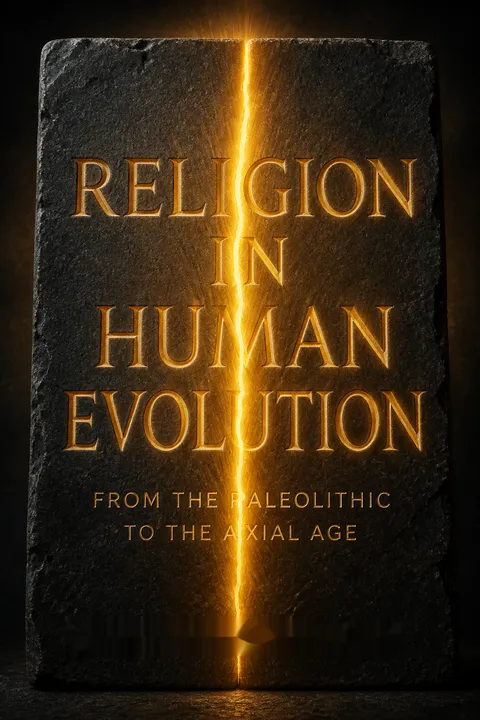
Religion in Human Evolution by Robert N. Bellah traces religion's development from the Paleolithic to the Axial Age using interdisciplinary approaches spanning sociology, biology, psychology, and history. Bellah argues religion evolved through mimetic, mythic, and theoretic stages, emphasizing play's biological and cultural importance. The book extensively examines tribal societies, archaic states, and four Axial Age civilizations: Israel, Greece, China, and India. Reviewers praise Bellah's erudition and ambitious scope but note the dense, challenging prose requiring serious engagement. Most appreciate his argument against scientific reductionism while acknowledging religion's cultural complexity and pluralism.
People Also Read


About the Author

Download PDF
Download EPUB
.epub digital book format is ideal for reading ebooks on phones, tablets, and e-readers.








































