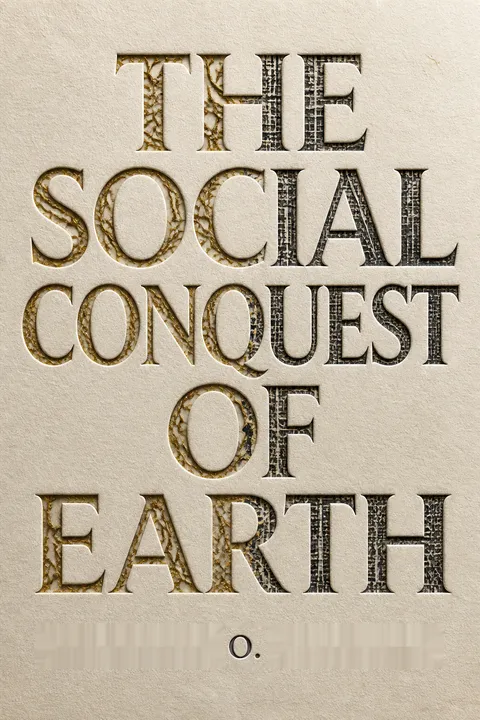

Key Takeaways
1. The Human Condition: An Evolutionary Riddle
Humanity today is like a waking dreamer, caught between the fantasies of sleep and the chaos of the real world.
The ultimate questions. Paul Gauguin's profound questions—"Where do we come from?", "What are we?", "Where are we going?"—form the core of the human condition, a riddle that religion, philosophy, and introspection have historically failed to fully solve. The author argues that these traditional approaches, rooted in myth or limited by conscious perception, cannot unravel the deep biological origins of our existence.
Science as the key. Unlike myth-making or introspection, science offers a real, testable creation story of humanity, progressively built through empirical evidence. To understand ourselves, we must answer two fundamental questions: why advanced social life exists at all, and what forces brought it into being. This requires integrating knowledge from diverse fields, from molecular genetics to archaeology.
A unique perspective. To gain perspective on human social evolution, the author proposes comparing humanity with other social conquerors of Earth, particularly the highly social insects like ants, bees, wasps, and termites. Just as biologists learn about human genetics from bacteria, or neural organization from roundworms, studying social insects can illuminate the underlying principles of our own social origins and meaning.
2. Two Paths to Eusociality: Humans vs. Insects
The physiology and life cycle in the ancestors of the social insects and those of humans differed fundamentally in the evolutionary pathways followed to the formation of advanced societies.
Divergent evolution. Humans and social insects, the two great social conquerors of Earth, achieved eusociality—advanced social life with altruistic division of labor—through radically different evolutionary paths. Insects, encased in exoskeletons and limited in size, relied on small brains and pure instinct, with winged queens dispersing to found new colonies alone.
Mammalian constraints. Prehuman ancestors, being large and relatively immobile mammals, could not store sperm or easily disperse like insect queens. Their social grouping had to be built on personal bonds and alliances, necessitating higher intelligence. This fundamental difference meant that human eusociality evolved through a complex interplay of individual and group selection, rather than the queen-to-queen selection seen in insects.
Consequences of divergence. The slow pace of insect evolution allowed coevolution with the biosphere, making them vital, sustainable elements. In contrast, Homo sapiens emerged rapidly, spreading globally in the last 60,000 years, without time for other species to adapt to our onslaught. This led to the unprecedented dismantling of the biosphere, a consequence of our unique evolutionary trajectory.
3. Humanity's Unique Evolutionary Journey
Homo sapiens is the only species of large mammal—thus large enough to evolve a human-sized brain—to have made every one of the required lucky turns in the evolutionary maze.
A series of preadaptations. The evolution of humanity was an improbable journey through an "evolutionary maze," where each step was a full-blown adaptation that also served as a preadaptation for the next. Key preadaptations included:
- Existence on land, enabling fire control.
- Large body size, allowing for a human-sized brain.
- Grasping hands with soft, spatulate fingers, freeing them from locomotion.
- Bipedalism, further freeing hands for tool manipulation and throwing.
Critical innovations. The shift to a substantial meat diet, obtained through scavenging and hunting, provided higher energy for brain development and fostered cooperation. The control of fire, a unique hominid achievement, improved food processing and defense. Campsites, serving as defensible "nests," became crucial for group cohesion, division of labor, and the development of social intelligence.
The cognitive leap. These preadaptations and innovations, culminating in the Homo erectus stage, set the stage for the rapid growth of the human brain and the "creative explosion." The ability to build mental scenarios, plan strategies, and engage in complex social interactions drove the evolution of higher intelligence, distinguishing our lineage from all other primates.
4. Multilevel Selection: The Engine of Human Nature
Unfortunately for this perception, the foundations of the general theory of inclusive fitness based on the assumptions of kin selection have crumbled, while evidence for it has grown equivocal at best.
Critique of kin selection. For decades, kin selection and inclusive-fitness theory were the dominant explanations for altruism and social evolution, positing that individuals cooperate due to shared genes with relatives. However, this theory has been shown to be mathematically and biologically incorrect, failing to account for the rarity of eusociality, the existence of diplodiploid eusocial species, and the complex dynamics of social interactions.
A new paradigm. A new theory of eusocial evolution, developed by Martin Nowak, Corina Tarnita, and the author, provides separate accounts for insects and humans. For social insects, evolution is primarily individual-level (queen-to-queen), with workers being phenotypic extensions of the queen. For humans, the dynamics are driven by multilevel selection, an interaction between individual and group selection.
The power of group selection. Multilevel selection posits that groups with more cooperative and altruistic members are more likely to outcompete groups composed of selfish individuals. This force, acting on emergent group traits like communication, division of labor, and cohesion, can override individual-level selection, which favors selfish behavior within a group. This dynamic is crucial for understanding the evolution of complex human societies.
5. The Chimeric Human: Virtue and Sin
It was therefore inevitable that the genetic code prescribing social behavior of modern humans is a chimera.
Conflicted impulses. The human genetic code is a "chimera," a blend of traits favoring individual success within a group and traits favoring group success in competition with other groups. This inherent conflict means that selfishness, cowardice, and unethical competition (products of individual selection) are perpetually at odds with altruism, honor, and duty (products of group selection).
An enduring struggle. This "unavoidable and perpetual war" between our "poorer and better angels" is the essence of the human condition. If individual selection completely dominated, societies would dissolve. If group selection completely dominated, human groups would become rigid, ant-like colonies. The balance creates the dynamic tension that defines human social life.
The humanities' domain. The eternal ferment generated by multilevel selection is the very subject of the social sciences and humanities, which explore the proximate expressions of human sensations and thought. Understanding this biological foundation unlocks the ultimate causes of our complex behaviors, providing a deeper self-understanding and a pathway to exploring beyond our inherited "box" of human nature.
6. Tribalism and War: Our Deep-Seated Instincts
To form groups, drawing visceral comfort and pride from familiar fellowship, and to defend the group enthusiastically against rival groups—these are among the absolute universals of human nature and hence of culture.
The tribal imperative. Humans possess a fundamental instinct for tribalism, a biological product of group selection. People are compelled to belong to groups, finding identity and meaning, and then to enthusiastically defend their group against rivals. This manifests in everything from sports fandom to ethnocentrism and religious allegiance.
War as a hereditary curse. Group-versus-group competition, a principal driving force in human evolution, has ingrained a "bloody nature" in us. War and genocide have been universal and eternal, respecting no particular time or culture, as evidenced by archaeological sites, historical accounts, and even chimpanzee behavior. This aggression, while destructive, also fostered solidarity and enterprise within groups.
Population dynamics and conflict. Exponential population growth, coupled with the territorial imperative, has historically led to conflict over resources. The Neolithic revolution, while increasing food supply, did not change human nature; populations simply grew until resources became limiting again, perpetuating territorial struggles. Our instincts, inherited from Paleolithic ancestors, remain unprepared for the complexities of modern civilization.
7. Human Nature as Epigenetic Rules
Human nature is the inherited regularities of mental development common to our species.
Beyond genes and culture. Human nature is not merely the underlying genes or the cultural universals, but rather the "epigenetic rules"—genetic biases in how our senses perceive, how we represent the world, the options we favor, and the responses we find rewarding. These rules, evolved through gene-culture coevolution, guide our learning and shape our cultural expressions.
Prepared learning. These behaviors are not hardwired reflexes, but are "prepared": we are innately predisposed to learn certain things swiftly (e.g., fear of snakes, attraction to parkland) and "counterprepared" to learn others. This explains why certain responses feel "natural" even though they are learned, and why cultural innovations are often channeled by these genetic constraints.
Gene-culture coevolution. This intricate interplay, where genes affect culture and culture reciprocally affects genes, is exemplified by:
- Lactose tolerance: Mutations allowing adult milk consumption spread culturally with herding.
- Incest avoidance: The "Westermarck effect" (sexual aversion to those raised intimately) is a universal epigenetic rule, reinforced by exogamy in primates and humans.
- Color vocabulary: Innate color perception biases how languages develop color terms, as shown by the Berlin-Kay and Rosch experiments.
8. Morality and Honor: Products of Group Selection
Human beings are prone to be moral—do the right thing, hold back, give aid to others, sometimes even at personal risk—because natural selection has favored those interactions of group members benefitting the group as a whole.
The biological basis of ethics. Morality, including empathy and cooperation, is not solely a cultural construct but has deep biological roots, primarily shaped by group selection. Groups with more altruistic members outcompeted those with fewer, fostering traits that benefit the collective, even at individual cost.
Coercive empathy. Neurobiological research suggests that the brain has mechanisms for "coercive empathy," where individuals automatically feel the pain of others, blurring the distinction between self and other. This "loss of information" can inhibit unethical actions, as the attacker temporarily puts herself in the victim's place, driven by shared fear.
Cooperation and leveling. Human cooperation is an evolutionary puzzle, extending to unrelated strangers even when reproductive gains are minimal. This is explained by a mix of innate responses:
- Status seeking by individuals.
- Leveling of high status by the group (e.g., through humor, criticism).
- Impulse to punish non-cooperators ("altruistic punishment").
These behaviors, interlocked in cause and effect, originated by group selection to maintain group cohesion and fairness.
9. Religion: A Tribal Adaptation
The illogic of religions is not a weakness in them, but their essential strength.
Evolutionary origins. Organized religion is presented as a product of evolution by natural selection, primarily an expression of tribalism. Creation myths, moral precepts, and claims of divine privilege serve to bind group members, foster in-group altruism, and assert superiority over rival groups.
The power of myth. Creation myths, often derived from folk memories, dreams, drug-induced hallucinations, or mental illness, provide explanations for existence and mortality. Shamans and leaders interpret these visions, asserting control over tribal fate and sacralizing communal actions. The "illogic" of these myths is their strength, as acceptance binds members and reinforces group identity.
Benefits and drawbacks. Religions offer profound psychological security, community, comfort, and inspiration for the creative arts. However, they are also "stultifying and divisive," encouraging ignorance, distracting from real-world problems, and often leading to disastrous actions due to their inherent tribalism and dogmatic claims of supernatural authority.
10. The Creative Arts: Expressions of Our Evolved Mind
The creative arts became possible as an evolutionary advance when humans developed the capacity for abstract thought.
Biological filters. The richness of the creative arts, from visual art to music and literature, is filtered through the narrow biological channels of human cognition. Our limited sensory perception (e.g., tiny visual spectrum, poor smell/taste) means our art is uniquely human, shaped by our evolved sensory apparatus.
Aesthetic universals. Neurobiological studies reveal innate aesthetic preferences, such as a preference for visual patterns with about 20% redundancy—a complexity level found in many forms of art and design. Similarly, biophilia, the innate affiliation with nature, drives preferences for savanna-like parklands with water, reflecting our ancestral African habitats.
Music and language. Music, a human universal, likely arose as a spin-off of speech, sharing syntactic elements and neural processing. While language acquisition is fast and autonomous, music is slower and requires practice, suggesting it's a newer evolutionary development. Both, however, are expressions of the human mind's capacity for abstract thought, which emerged before language itself.
11. A New Enlightenment: Science for Self-Understanding
Earth, by the twenty-second century, can be turned, if we so wish, into a permanent paradise for human beings, or at least the strong beginnings of one.
The unfinished epic. Humanity is the "growing point of an unfinished epic," and self-understanding requires integrating history, prehistory, and biology. We are a biological species, exquisitely adapted to Earth, with our complex behaviors and even free will ultimately rooted in our evolutionary past.
The path forward. The author advocates for a "new Enlightenment" based on reason and scientific self-understanding. This means acknowledging the chimeric nature of human morality (saint and sinner), understanding tribalism's deep roots, and respectfully repudiating dogmatic claims of divine authority that foster ignorance and division.
Our sole responsibility. We are alone on this planet, solely responsible for our actions. We must cease destroying our birthplace, addressing environmental crises like biodiversity loss and climate change. Science, as the wellspring of testable knowledge, is crucial for distinguishing truth from falsehood and guiding us toward a sustainable future. The delusion of colonizing other star systems as an escape is dangerous; instead, we should focus on making Earth a permanent paradise.
Review Summary
The Social Conquest of Earth explores eusociality and evolution through Wilson's expertise in social insects. The central argument proposes group selection over kin selection as evolution's primary driver, examining how humans developed cooperation, culture, language, and tribalism. Reviews highlight Wilson's elegant prose and fascinating insights comparing ants to humans, though some found the mathematical arguments dense or unconvincing. Critics note the book's controversial rejection of inclusive fitness theory and occasional tangential moralizing. Most readers appreciated the biological perspective on human nature's inherent conflict between selfishness and altruism, finding it enlightening despite varying comprehension levels.
People Also Read

The Anthropocene Epoch Series
About the Author

Download PDF
Download EPUB
.epub digital book format is ideal for reading ebooks on phones, tablets, and e-readers.








































