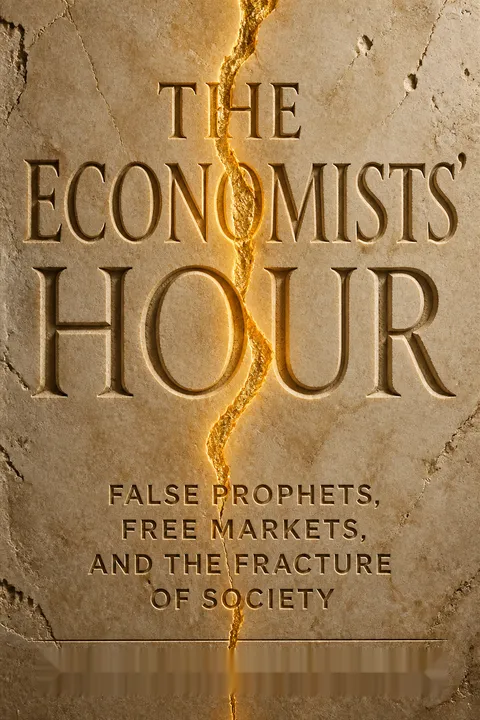

Key Takeaways
1. The Economists' Hour: A Paradigm Shift
But the economists’ hour failed to deliver on its premise. The single-minded embrace of markets has come at the expense of economic equality, of the health of liberal democracy, and of future generations.
A new breed. As the post-World War II economic boom faltered in the late 1960s, a new breed of economists gained unprecedented influence, fundamentally reshaping the modern world. Their core belief was that governments should cease managing the economy, trusting markets to deliver steady growth and broad prosperity.
Unleashing markets. Over four decades, from 1969 to 2008, these economists played a leading role in curbing government intervention, unleashing corporations, and accelerating globalization. They persuaded political leaders to reduce taxation, deregulate industries, and end military conscription, believing markets offered superior solutions to bureaucrats.
Counting the costs. This era, dubbed the "Economists' Hour," ultimately failed to deliver on its promise of broad prosperity. The relentless pursuit of market efficiency came at a significant cost to economic equality, the vitality of liberal democracy, and the well-being of future generations, leading to widespread challenges to its once-dominant assumptions.
2. From Civic Duty to Market Incentives
Friedman was a formidable academic, crowned with a Nobel Prize in economics in 1976, yet he deserves to be remembered chiefly as one of the most influential ideologues of the twentieth century, the forceful prophet of a conservative counterrevolution that reshaped life in the United States and around the world.
Ending the draft. Milton Friedman, a leading free-market ideologue, played a pivotal role in persuading President Richard Nixon to end military conscription in 1973. Friedman argued that the draft was an "involuntary servitude" and a "tax" on young men, proposing an all-volunteer military recruited through competitive wages.
Market logic applied. This shift replaced the concept of universal civic obligation with market-based incentives, asserting that individuals should only serve if compensated at their market value. Friedman's argument resonated with a public increasingly prioritizing individual rights over community needs, especially amidst the Vietnam War.
A new era. The successful transition to an all-volunteer force, despite initial skepticism, marked Friedman's first major policy triumph and a significant step in applying market logic to non-economic spheres. It demonstrated the power of economic ideas to reshape deeply ingrained social institutions.
3. Conquering Inflation, Sacrificing Jobs
Inflation is always and everywhere a monetary phenomenon.
Keynesian dominance. Post-WWII, Keynesian economics dominated, with governments believing they could manage the economy to ensure full employment, often accepting a trade-off between unemployment and inflation (the "Phillips curve"). This led to aggressive fiscal and monetary stimulus in the 1960s.
Stagflation's challenge. The stagflation of the 1970s, characterized by rising unemployment and inflation, discredited Keynesian approaches and opened the door for Friedman's monetarism. Friedman argued that inflation was solely caused by governments printing too much money and could only be cured by restricting the money supply.
Volcker's shock. Paul Volcker, appointed Fed chairman in 1979, embraced monetarism, drastically tightening the money supply and driving interest rates to over 20%. This caused a severe recession and widespread job losses but successfully broke inflationary expectations, resetting the focus of macroeconomic policy from employment to price stability, with President Reagan's crucial support.
4. Tax Cuts: The Supply-Side Promise
If you tax a product less results / If you subsidize a product more results / We've been taxing work, output and income and subsidizing non-work, leisure and unemployment. / The consequences are obvious!
A contrarian recipe. Economist Robert Mundell proposed a radical idea in the early 1970s: cutting taxes could simultaneously reduce inflation and unemployment by stimulating economic supply. This challenged both Keynesian and monetarist orthodoxies, which saw tax cuts as either inflationary or irrelevant to inflation.
The Laffer Curve. Arthur Laffer popularized this "supply-side" theory with his famous curve, illustrating that beyond a certain point, higher tax rates become counterproductive, reducing revenue by discouraging work and investment. Supply-siders argued that cutting top tax rates would incentivize the wealthy to work harder and invest more, with benefits trickling down to everyone.
Reagan's legacy. President Reagan adopted supply-side economics, implementing massive tax cuts in 1981. Despite predictions of increased revenue, these cuts led to soaring federal deficits and a dramatic rise in income inequality. Nevertheless, the political victory for lower top tax rates and reduced government redistribution proved enduring.
5. Corporations Unleashed: The Antitrust Shift
A constitution is not intended to embody a particular economic theory, whether of paternalism and the organic relation of the citizen to the state or of laissez faire.
Protecting small business. Historically, American antitrust law aimed to prevent corporate concentration and protect small businesses, even if it meant higher prices for consumers. This reflected a democratic ideal of economic autonomy and a distrust of concentrated power.
Efficiency over equity. The Chicago School economists, including George Stigler, Aaron Director, and Robert Bork, spearheaded a counter-revolution, arguing that antitrust law should solely focus on maximizing consumer welfare through lower prices. They asserted that large corporations were often efficient and that markets naturally prevented collusion.
Judicial transformation. Through academic influence and judicial appointments, this view permeated the federal courts, leading to a dramatic decline in antitrust enforcement. The result was a wave of corporate consolidation across industries, shifting power from workers to employers and raising concerns about its impact on democracy and innovation.
6. Deregulation's Double-Edged Sword
The market isn't above the nation and above the state. It’s up to the state, the nation, to keep an eye on the market.
The regulated era. For much of the 20th century, many industries, like airlines and trucking, were heavily regulated as "natural monopolies" to ensure stable service and protect consumers. This often resulted in higher prices but also guaranteed service and quality.
Economists' critique. Economists like Alfred Kahn, supported by consumer advocates like Ralph Nader, argued that such regulations stifled competition and protected inefficient companies at the expense of consumers. They advocated for deregulation to unleash market forces.
Mixed outcomes. The deregulation of airlines and trucking in the late 1970s led to significantly lower prices and increased choice for consumers. However, it also resulted in reduced worker wages, diminished service quality, and increased consolidation, demonstrating that while markets can be efficient, their outcomes are not always equitable or socially optimal.
7. Quantifying Life: The Rise of Cost-Benefit Analysis
In many respects lives and dollars are incommensurable, but unfortunately the planners must compare them.
Military origins. The application of cost-benefit analysis in government began in the military under Robert McNamara and Charles Hitch in the 1960s, aiming to make defense spending more efficient. This involved quantifying goals, options, and their respective costs and benefits.
Expanding scope. This analytical approach expanded to civilian agencies like the EPA and OSHA, where economists like Jim Tozzi and W. Kip Viscusi began to quantify the monetary value of intangible benefits, including a "statistical life." This allowed for a more "rational" assessment of health, safety, and environmental regulations.
Ethical dilemmas. While increasing the rigor of policy-making, this practice sparked ethical debates about the morality of assigning a dollar value to human life and other non-market goods. It also risked displacing democratic judgment with expert calculations, often obscuring the distributional impacts of policies.
8. Global Markets, Unstable Currencies
When goods don’t cross borders, soldiers will.
Bretton Woods' stability. After WWII, the Bretton Woods system fixed major currency exchange rates to stabilize global trade and prevent the competitive devaluations that contributed to the Great Depression. The US dollar became the de facto global currency, backed by gold.
Friedman's critique. Milton Friedman argued that fixed exchange rates suppressed trade and deferred necessary economic adjustments, advocating for floating rates determined by financial markets. He predicted these would adjust smoothly and efficiently, fostering greater prosperity.
Volatility and imbalances. The system's collapse in the early 1970s led to floating exchange rates, but not the stability Friedman envisioned. Instead, it ushered in an era of currency volatility, massive financial speculation, and persistent trade imbalances. This benefited consumers with cheaper imports but severely damaged domestic manufacturing in the US, as other nations strategically managed their currencies.
9. Chile's Shock Therapy: A Cautionary Tale
I would have helped just the same.
US influence. Post-WWII, the US actively promoted free-market economics in Latin America, often clashing with local economists who favored state-led industrialization. The University of Chicago played a key role, training a generation of Latin American economists.
Pinochet's experiment. In Chile, a group of Chicago-trained economists, "Los Chicago Boys," implemented radical free-market reforms under Augusto Pinochet's authoritarian regime after the 1973 coup. This included drastic cuts in government spending, extensive privatization, and aggressive trade liberalization, often referred to as "shock treatment."
Growth with inequality. While these policies led to significant economic growth and a reduction in extreme poverty, they also resulted in high unemployment, soaring inequality, and required brutal suppression of dissent. The Chilean experience became a controversial symbol of market fundamentalism, demonstrating that economic efficiency could be achieved at immense social and political cost.
10. Financial Deregulation: The Road to Crisis
Markets can correct excess far better than any government.
Post-Depression safeguards. Following the Great Depression, the US implemented strict financial regulations, including interest rate caps and a separation between commercial and investment banking, to prevent malfeasance and ensure stability.
Efficient markets theory. The "efficient markets theory," popularized by economists like Eugene Fama, argued that financial markets perfectly reflected all available information, making them inherently stable and self-correcting. This intellectual framework provided a powerful justification for deregulation.
Unchecked risk. The dismantling of these regulations, driven by industry lobbying and economists' influence, led to explosive growth in complex financial products like derivatives. This unchecked risk-taking, coupled with a belief in market self-correction, culminated in the 2008 global financial crisis, highlighting the catastrophic consequences of prioritizing market freedom over prudent oversight.
11. The Cost of Efficiency: Inequality and Social Strain
The struggle of men for larger incomes was good because in the process they learned independence, self-reliance, self-discipline — because, in short, they became better men.
Plutocratic gains. The policies of the "Economists' Hour" disproportionately benefited a wealthy minority, leading to a dramatic resurgence of income inequality in the United States. The share of economic output going to workers steadily declined from the early 1970s.
Eroding worker power. Factors like the high dollar, a single-minded focus on low inflation, and the erosion of union power (often viewed by economists as market distortions) accelerated the decline of manufacturing jobs and suppressed wages. The expanding service economy, with its prevalence of low-paid jobs, further exacerbated this trend.
Undermining society. This growing inequality has profound societal consequences, including reduced social mobility, distorted public policy (favoring elites and providing minimal support for the poor), and a weakened sense of shared purpose. It has made society less resilient and more susceptible to political fragmentation.
12. Beyond the Hour: A Call for Reassessment
Development has to be more concerned with enhancing the lives we lead and the freedoms we enjoy.
The end of an era. The 2008 financial crisis definitively exposed the failures of market fundamentalism, leading to a brief, reluctant return to Keynesian stimulus policies globally. However, austerity quickly reasserted itself, and the underlying issues of unchecked financial power and inequality remained largely unaddressed.
A new path. The crisis highlighted that markets are human constructs, not natural forces, and can be designed to serve broader societal goals beyond mere efficiency. This calls for a re-evaluation of economic policy, moving beyond the narrow focus on maximizing output to explicitly consider the distribution of costs and benefits.
Rebuilding markets. Future policies must prioritize a strong social safety net, invest in public goods like education and infrastructure, and actively manage markets to ensure fairness and opportunity for all. This means recognizing that sometimes, the right answer is to make markets less efficient or even to do without them entirely, to strengthen social bonds and liberal democracy.
People Also Read









Download PDF
Download EPUB
.epub digital book format is ideal for reading ebooks on phones, tablets, and e-readers.








































