Key Takeaways
1. Racism's Western Genesis & Definition: A Historical Construct of Power and Difference
It is when differences that might otherwise be considered ethnocultural are regarded as innate, indelible, and unchangeable that a racist attitude or ideology can be said to exist.
Defining Racism. Racism is more than mere ethnocentric dislike or xenophobia; it's a specific historical construct, primarily a product of the West, that emerged between the fourteenth and fifteenth centuries. It involves a mindset that perceives "them" as permanently and unbridgeably different from "us," justifying the use of power to establish a permanent group hierarchy. This distinction is crucial because it separates racism from general group prejudice or cultural intolerance, which might allow for assimilation or conversion.
Two Core Components. The author's conception of racism rests on two fundamental pillars: difference and power. It's not just about theorizing human variations or disliking another group; it actively seeks to establish or maintain a racial order where one group dominates another based on allegedly innate traits. This can manifest in various ways, from pervasive social discrimination to genocide, all denying the possibility of coexistence on equal terms or the ability of individuals to change their ethnoracial identity.
Premise of Equality. Paradoxically, Western racism developed in a context that presumed human equality, either spiritual (all equal before God) or temporal (all "men" born free and equal). This premise created an incentive to deny the full humanity of certain groups, compelling the dominant to invent "extraordinary deficiencies" to justify their exclusion from the promise of equality. This dialectical interaction between a premise of equality and intense prejudice is unique to the full flowering of Western racism.
2. Medieval Roots: From Religious Intolerance to Protoracism Against Jews and Africans
If racial antisemitism had medieval antecedents in the popular tendency to see Jews as agents of the Devil and thus, for all practical purposes, beyond redemption and outside the circle of potential Christian fellowship, the other principal form of modern racism—the color-coded, white-over-black variety—did not have significant medieval roots and was mainly a product of the modern period.
Antisemitism's Genesis. Medieval anti-Judaism, initially based on religious belief and collective guilt for the Crucifixion, intensified in the 12th-14th centuries. Jews were increasingly demonized through folk myths like ritual murder accusations and associations with the Devil, pushing them "outside the pale of humanity." This protoracism viewed Jews as intrinsically evil, beyond redemption, laying a foundation for later racial antisemitism, even if official Church doctrine still held out the possibility of conversion.
Spanish Limpieza de Sangre. The Spanish doctrine of limpieza de sangre (purity of blood) in the 15th-16th centuries marked a critical shift. It stigmatized Jewish converts (conversos) based on the belief that their "impure blood" made them incapable of true conversion, regardless of their professed faith. This was arguably the first true anticipation of racism, as it represented the stigmatization of an entire ethnic group based on indelible deficiencies, overriding religious status for inherited ancestry.
African Slavery and Blackness. While medieval Europe showed some "Negrophilia," the association of blackness with servitude began in Iberia, influenced by Islamic practices. When Portuguese navigators began acquiring slaves from West Africa in the mid-15th century, the identification of black skin with servile status became complete. Initially justified by religious status (paganism), the Curse of Ham myth and the unique dark pigmentation of Africans soon became part of the rationale, suggesting a divine designation for slavery.
3. Enlightenment's Paradox: Science, Classification, and the Rise of Modern Racism
Whatever their intentions, Linnaeus, Blumenbach, and other eighteenth-century ethnologists opened the way to a secular or scientific racism by considering human beings part of the animal kingdom rather than viewing them in biblical terms as children of God endowed with spiritual capacities denied to other creatures.
Scientific Classification. The Enlightenment, with its emphasis on reason and scientific inquiry, inadvertently provided a new framework for racism. Naturalists like Carl Linnaeus (1735) and Johann Friedrich Blumenbach (1776) began classifying humans into distinct "races" based on physical characteristics, primarily skin color. While they often acknowledged a common human origin, their descriptions and implicit rankings (e.g., Europeans as "acute, inventive," Blacks as "crafty, indolent") laid the groundwork for a secular, scientific racism.
Aesthetic and Environmental Justifications. Beyond classification, Enlightenment thinkers like Buffon and Meiners also ranked races based on aesthetic judgments, correlating physical beauty (often neoclassical ideals) with intelligence. While environmental theories (climate, customs) were used to explain racial variations, they didn't preclude assumptions of current inferiority. This meant that even if uplift was theoretically possible, it was seen as a very long-term prospect, justifying present-day subjugation.
Voltaire's Contradictions. Voltaire, a leading Enlightenment figure, exemplified the era's paradox. He was a theoretical racist, advocating polygenesis (multiple human origins) and holding derogatory views of blacks and Jews, whom he saw as embodying religious fanaticism. Yet, he also championed religious toleration and civil liberties, criticizing slavery. This highlights how Enlightenment rationalism could simultaneously challenge old hierarchies based on faith while creating new ones based on "reason" and "science."
4. Democratic Revolutions & the Crystallization of Racist Ideologies
The age of democratic revolution that dawned in the last quarter of the eighteenth century brought serious challenges both to the institution of black slavery and to the legalized pariah status of European Jews.
Egalitarian Challenge. The American, French, and Haitian Revolutions, proclaiming universal rights and equality, posed a direct challenge to existing systems of black slavery and Jewish ghettoization. The doctrine that "all men are created equal" was difficult to reconcile with lifetime servitude or legal discrimination unless the targeted groups were deemed less than fully human, forcing societies to either extend rights or invent new justifications for exclusion.
Civic Nationalism's Paradox. In nations embracing civic nationalism (citizenship based on universal rights), biological unfitness became a convenient exclusionary principle. While France, for example, theoretically extended rights to Jews and abolished slavery, it also saw polygenetic theories flourish to justify re-enslavement or to exclude those deemed "incompetent" for full citizenship. This allowed for the maintenance of hierarchies under the guise of scientific rationale, especially in the absence of significant racial minorities.
German Romantic Nationalism. In contrast, German romantic nationalism, championed by figures like Herder and Fichte, explicitly rejected Enlightenment universalism. It defined national identity through an ethnic, linguistic, and cultural "Volksgeist" (folk soul), which was seen as unique and eternal. This cultural essentialism laid the foundation for a form of racism that viewed Jews as an alien, parasitic growth incapable of true assimilation into the German nation, setting the stage for the "Jewish question."
5. Emancipation's Backlash: US White Supremacy & German Antisemitism
Racism is always nationally specific. It invariably becomes enmeshed with searches for national identity and cohesion that vary with the historical experience of each country.
Analogous Emancipations. The 19th century saw limited emancipations for blacks in the United States and Jews in Germany, both aiming for equal citizenship but facing significant backlash. In both cases, federalism hindered full equality, rapid industrialization created new economic competition, and the fate of emancipation was tied to liberal political movements. Economic downturns, like the Panic of 1873, further fueled resentment and provided fodder for racist propaganda.
Distinct Economic Contexts. Despite similarities, the economic and social contexts differed significantly. In the US, freed slaves primarily competed with lower- and working-class whites, leading to a "white working-class racism" that reinforced social status. In Germany, Jews, having achieved prosperity in commerce and professions, were seen as competitors by the middle and professional classes, fueling anxieties about Jewish power and "conspiracy."
Divergent Stereotypes and National Identity. These contexts shaped distinct racist obsessions. American white supremacists stereotyped blacks as innately incompetent, savage, and sexual predators, posing a threat of "degeneration." German antisemites, however, feared Jews as cunning, materialistic, and hostile to German culture, portraying them as "too modern" and agents of unwanted change. While Americans defined themselves as "white," Germans embraced an "Aryan" identity, explicitly distinguishing themselves from "Semites."
6. The Twentieth Century's Racist Regimes: Climax of Ideology & Practice
But racist principles were not fully codified into laws effectively enforced by the state or made a central concern of public policy until the emergence of what I will call “overtly racist regimes” during the past century.
Defining Overtly Racist Regimes. The 20th century witnessed the horrifying culmination of racism in "overtly racist regimes" like the American South (Jim Crow), South Africa (apartheid), and Nazi Germany. These regimes were characterized by:
- An official, explicitly racist ideology.
- Laws forbidding interracial marriage ("race purity").
- State-mandated social segregation.
- Exclusion from public office and voting rights for outgroup members.
- Deliberate economic deprivation of the stigmatized group.
These features distinguish them from other "racialized societies" with informal discrimination.
Modernization as Precondition. Modernization, with its urbanization, industrialization, and bureaucratic methods, was a crucial precondition for these regimes. Traditional, informal hierarchies could not be sustained in modern environments, necessitating codified rules and regulations to maintain white supremacy or ethnic status. The Holocaust, for instance, was deeply dependent on modern bureaucratic efficiency and advanced technology.
National Humiliation and Imperialism. A common factor in these regimes was the identification of the racial "Other" with national defeat or humiliation. African Americans were seen as complicit in Southern defeat, Jews blamed for Germany's WWI loss, and Africans as enemies of Afrikaner self-determination. Western imperialism also provided a legitimizing context, with ideologies like "The White Man's Burden" justifying racial domination, though German colonialism in Africa was particularly brutal and genocidal.
7. Holocaust & Cold War: The Retreat of Overt Racism
The resulting shock and mortification did more to discredit racism—at least in its blatant ideological forms—than had any previous historical event.
The Holocaust's Impact. World War II and the Holocaust served as a turning point, revealing the horrific logical outcome of extreme racism. The systematic murder of six million Jews by the Nazis shocked the world, profoundly discrediting blatant ideological racism and the eugenics movement. This moral revulsion led to a global shift in international norms, making overt racism morally indefensible and prompting a reevaluation of human rights.
Cold War and Decolonization. The Cold War further incentivized racial reform, particularly in the United States. Jim Crow segregation became an international liability, providing Soviet propaganda with ammunition and embarrassing the US in its competition for influence in the newly decolonized nations of Asia and Africa. This geopolitical pressure, combined with the civil rights movement, led to the dismantling of legalized segregation and anti-miscegenation laws in the US.
Apartheid's Demise. South Africa's apartheid regime, which matured after WWII, initially benefited from Cold War alliances, presenting itself as an anti-communist bastion. However, as decolonization progressed and the Cold War ended, international condemnation and economic sanctions mounted. The global revulsion against official racism, fueled by the memory of the Holocaust and the success of civil rights movements elsewhere, ultimately undermined white South Africans' will to defend apartheid, leading to its eventual collapse.
8. Racism's Enduring Legacy & New Forms: Cultural Essentialism and Ethno-Religious Conflict
Unfortunately racism survives even in the carefully delineated sense that has governed this study of its history.
Persistence of Racism. Despite the discrediting of overt, biological racism and the overthrow of overtly racist regimes, racism persists. Its legacy leaves many previously stigmatized groups in economically and psychologically vulnerable positions, making true equality difficult to achieve. This can lead to "pathologies" that, in turn, seem to confirm negative stereotypes, perpetuating a cycle of disadvantage even without explicit legal discrimination.
"New Racism" and Cultural Essentialism. In contemporary Western societies, a "new racism" has emerged, where "culture" is reified and essentialized to do the work of "race." This involves attributing unchangeable, often negative, cultural traits to immigrant groups or racial minorities, justifying discrimination. For example, in the US, discrimination against African Americans is sometimes rationalized by claims of "dysfunctional" subcultures, while in Europe, immigrant groups are deemed incapable of assimilating to the dominant culture.
Ethno-Religious Conflicts. While racism in its historical sense may be less intellectually respectable, the world faces a surge in bitter ethno-religious conflicts. These often involve groups differentiated by authentic cultural or religious beliefs rather than genetic "race." While religious intolerance can be devastating, it theoretically offers an "escape hatch" through conversion, making it potentially less rigid than ethnoracial differences. However, the politicization of faith and militant sectarianism pose a significant threat to global peace in the 21st century.
Review Summary
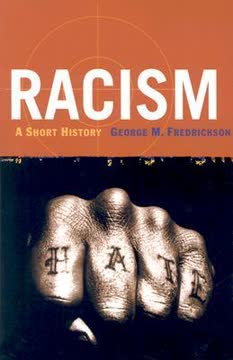
Racism: A Short History by George M. Fredrickson receives mixed reviews averaging 3.77/5 stars. Readers praise its comparative analysis of antisemitism and white supremacy, particularly examining Nazi Germany, the Jim Crow South, and apartheid South Africa. Many appreciate Fredrickson's narrow definition of racism requiring institutionalized systems based on immutable differences. Critics argue this definition excludes important examples like European imperialism and Native American persecution. Several reviewers note the dry academic style and lack of personal narratives from oppressed groups. The historical overview, especially of medieval origins, receives consistent praise, though some find coverage of certain regions incomplete.
People Also Read