
Key Takeaways
1. Writing as a Force: To Haunt, Clarify, and Liberate
Though we do not wholly believe it yet, the interior life is a real life, and the intangible dreams of people have a tangible effect on the world.
The power of language. From childhood, the author was enchanted by words, from the Last Poets to "The Duel" in Childcraft, recognizing their ability to "haunt"—to deeply resonate and provoke thought. This early love for language, its rhythm and content, instilled a belief that writing could transcend mere craft and serve a larger emancipatory mandate, especially for people whose humanity was constantly questioned.
Journalism's stark clarity. A Sports Illustrated article about quadriplegic Darryl Stingley shattered the author's childhood myths of violence always losing, revealing a world where "evil did win, sometimes—maybe most times." This journalistic encounter, devoid of magic or myth, illuminated a new, disturbing wisdom: bad things happen simply because they can, and this clarity, delivered through personal narrative and testimony, made him stronger.
From haunted to ghost. This profound experience, coupled with a house overflowing with books on "the community," taught him that words could haunt not only in form but in content, linking personal ecstasy to political purpose. He realized that the goal was to move from being haunted by words to becoming the ghost—the writer who wields language to illuminate, confront, and undo the violence in the world, joining beauty to politics.
2. Unpacking "Home": The Weight of Inherited Narratives
I had traveled enough in my life to be familiar with the amazement that comes upon you when the country becomes real.
Revolutionary art's legacy. Growing up, the author was surrounded by his parents' "revolutionary art"—from pencil sketches of pharaohs to unopened product packages featuring Black people, all challenging the denigrating images of their youth. His mother's sketch of his father reading, captioned "Daddy says he reads to learn," underscored a lifelong quest for knowledge to combat the narratives that inscribed racial inequality as natural.
Confronting Niggerology. His first trip to Dakar, long deferred, was weighed down by the "canon" of white supremacy, exemplified by figures like Josiah Nott who crafted elaborate theories to justify Black inferiority and enslavement. Despite his upbringing in the "vindicationist tradition"—insisting on a "Black Egypt" to reclaim history—the author found himself still fearing that the Niggerologists were right, a realization that struck him with profound sadness upon seeing Dakar's "abandoned remnants" of a gym.
The ghosts of the Middle Passage. Standing on the beach in Dakar, looking out at the Atlantic, the author felt a deep sadness, realizing he had "come home, and ghosts had come back with me." This journey was not just to a physical place but to a "Big Bang" of collective trauma, where countless worlds died for a new one to be born. He understood that "home" was not a fact but a need, a wish, a dream, haunted by the legacy of the Middle Passage and the pervasive reach of racialized beauty standards.
3. Education's True Purpose: Beyond Banking, Towards Critical Consciousness
The more completely they accept the passive role imposed on them, the more they tend simply to adapt to the world as it is and to the fragmented view of reality deposited in them.
The struggle with schooling. As a child, the author struggled with the rigid demands of school—sitting still, following directions—despite being bright and loving to learn. His report cards consistently noted his "restlessness" and inability to "follow directions," leading to a deep shame and the fear that he was a "problem child" destined for failure, a common fate for Black boys who didn't conform.
Learning beyond the desk. He thrived when learning was tangible and experiential, like crafting an imaginary shark for a science project or connecting math concepts to real-world scenarios of debt and exploitation. This revealed that "learning" often felt like a "bait and switch," prioritizing orderly conduct over genuine comprehension. He found his true learning in making the abstract concrete, a process writing perfectly facilitates.
Challenging banking education. Paulo Freire's concept of "banking education," where students passively receive and repeat information, resonated deeply. This system, which stifles critical consciousness and encourages adaptation to the status quo, makes him sad for all the young people still laboring under it. His own teaching philosophy, born from leading writing workshops in prison, emphasizes comradeship and challenging students as humans, not animals to be tamed.
4. The War on Words: Challenging "Divisive Concepts" and Censorship
Whatever the attempt to ape the language of college students, it was neither “anguish” nor “discomfort” that these people were trying to prohibit. It was enlightenment.
The backlash against truth. The summer of 2020, marked by protests and the rise of "The 1619 Project," sparked a fierce counter-revolution against "divisive concepts" in education. Executive Order 13950 and its state-level variants aimed to excise any teaching that caused "discomfort, guilt, anguish" based on race, effectively weaponizing the language of safety against critical inquiry.
Mary Wood's stand. In South Carolina, teacher Mary Wood faced threats to her job for teaching Between the World and Me, as students claimed it made them "ashamed to be Caucasian" and that "systemic racism" was "illegal." This incident highlighted how the language of "discomfort" was being co-opted to prohibit enlightenment, to prevent students from questioning national dogmas and forming their own conclusions.
Art as political possibility. The author realized that the fight against book bans and censorship was not just about his work but about the future of writing itself—the boundaries of imagination and the depth of questions allowed. He saw that the "Redeemers" of this age sought to preserve an austere, authoritarian learning system, fearing that writers might convince children they had the power to form their own dogmas, thus killing a future where different policies and possibilities could be imagined.
5. Zionism's Shadow: A "Gigantic Dream" Built on Plunder
I was seeking a world beyond plunder—but my proof of concept was just more plunder.
A flawed model for reparations. The author's essay, "The Case for Reparations," drew on Germany's payments to Israel as a model for addressing historical debt. At the time, he had a vague notion of injustice in Palestine but lacked clarity. His trip revealed that Israel, far from being a pure example of justice, was a state where "separate and unequal was alive and well," with a two-tier society and policies of occupation.
The "gigantic dream" of Herzl. Theodor Herzl, the father of Zionism, envisioned Palestine as "a land without a people, and a people without a land," viewing Palestinians as mere "scenery" to be "expropriated gently." This narrative, echoed by figures like Golda Meir, denied the existence of a Palestinian people, justifying their displacement and the creation of a Jewish state through a colonial lens.
Colonialism's familiar script. Zionism's founders, like Eliezer Ben-Yehuda and Ze'ev Jabotinsky, openly spoke of "colonizing" Palestine and "mastering the land," believing the "Arab race" to be "five hundred years behind us." This echoed the language of American expansionism and the "conquest of Indians," framing the project as an "outpost of civilization against barbarism" and reinforcing a narrative of racial superiority.
6. The Illusion of Innocence: When Victims Become Victimizers
I could hear that same pain in Avner’s and Guy’s words. They were raised under the story that the Jewish people were the ultimate victims of history. But they had been confronted with an incredible truth—that there was no ultimate victim, that victims and victimizers were ever flowing.
A painful realization. The author's visit to Yad Vashem, the Holocaust Remembrance Center, was profoundly moving, yet it was juxtaposed with the reality of Israeli soldiers carrying large guns, protecting a state that was actively oppressing Palestinians. This led to a painful realization: his own writing had, in some ways, "reduced people, diminished people, erased people" by using Israel as a model without fully understanding its own colonial practices.
The flow of victimhood. Conversations with Israeli dissidents like Avner Gvaryahu and Guy Butavia revealed their own struggle with Israel's actions. They were raised believing in Jewish victimhood, but confronted the truth that "there was no ultimate victim, that victims and victimizers were ever flowing." This pain stemmed from discovering their complicity in a system of "Jewish supremacy" that mirrored the very injustices their people had suffered.
A system of plunder. The author saw that Israel's "gigantic dream" was not just a righting of historical wrongs but a continuation of plunder, where the security of the Jewish state was achieved "at the expense of the other." This meant that his "proof of concept" for reparations was, in fact, "just more plunder," forcing him to confront the uncomfortable truth that oppression can deceive even its victims, leading them to perpetuate similar injustices.
7. The Nakba: A Perpetual Catastrophe and Intimate Loss
We live, if we are able to live, in an infant past, planted in fields that were ours for hundreds of years until a moment ago, before the dough rose and coffeepots cooled…
The tools of occupation. In the West Bank, the author witnessed a sophisticated arsenal of control: drones, observation towers, earth mounds, trenches, gates, and checkpoints, all designed to make Palestinians "feel the hand of occupation constantly." This system, which included home invasions and the arbitrary detention of families, aimed to sunder a people from itself, eroding communal bonds and transforming everyday life into an "impossible obstacle course."
Susya's ongoing struggle. In Susya, a makeshift village in Area C, Nasser Nawaj'ah's family faced constant threat of demolition, their ancestral cave homes declared an "archaeological site" by Israeli settlers. This bureaucratic violence, coupled with direct settler aggression, illustrated the "sin of abstraction"—how land theft was not just policy but a daily, intimate plunder of homes and livelihoods, leaving residents in a perpetual state of limbo.
A unique catastrophe. The author came to understand the Nakba, "the catastrophe," as a specific and ongoing process of ethnic cleansing, distinct from analogies like Jim Crow or apartheid. It was not just state violence or legal inequality, but an intimate, perpetual theft of home and history, where the loss of centuries-old fields was measured in moments, and the vanquisher's flags waved a short walk away, making the pain of agony glow.
8. The Writer's Debt: Seeing Beyond One's Own Story
I want to tell you I was wrong. I want to tell you that your oppression will not save you, that being a victim will not enlighten you, that it can just as easily deceive you.
A stunted worldview. The author reflected on his early career, where, despite his skepticism of the gift of "folk wisdom," he found himself in newsrooms with no Black editors, reinforcing parts of his thinking that dovetailed with those around him. This environment, lacking Palestinian writers or editors, stunted his worldview, leading him to regret "smart-ass contrarianism" and "mean prose" in his rush to publish.
The sin of incuriosity. His journey to Palestine revealed his own "incuriosity" and the limits of his sense of reparations, forcing him to confront how he had "reduced people, diminished people, erased people" in his own writing. He realized that his initial model for reparations, Germany's payments to Israel, was flawed because it was "just more plunder," failing to see the victims of Zionism.
Stewardship and solidarity. The author's pen skipped as he wrote about Zionism's victims, acknowledging the complexity of Palestinian identity beyond victimhood. He felt the warmth of solidarity with "conquered peoples" finding each other across oceans, but also the weight of his stewardship as a writer. He realized that his writing had soared, but his stewardship had faltered, necessitating a new beginning to truly see a people whose oppression depended on their erasure.
9. Colonialism's Enduring Logic: From Jim Crow to Apartheid
Righteous violence vented on some brutish, blighted lower caste has always been the key to entry into the fraternity of Western nations.
The "Jewish democracy" illusion. The author noted the symmetry between the bromides of "America as the oldest democracy" and "Israel as the only democracy in the Middle East," both relying on excluding vast populations. He realized that "Jewish democracy" meant a democracy for Jewish people alone, with Palestinians facing shorter lives, poverty, and legal discrimination, including "admission committees" that barred them from certain neighborhoods.
Israel as apartheid's arsenal. The historical record revealed Israel's deep affinity and lucrative arms trade with apartheid South Africa, a partnership driven by shared interests in maintaining racialized control. This alliance, which included sharing "best practices" for divorcing a people from its freedoms, showed that Israel was not just an ally but "the very arsenal of apartheid," a fact that contradicted its self-proclaimed anti-racist mission.
The logic of "savagery." Zionism, from its inception, positioned itself as "an outpost of civilization against barbarism," echoing the racist cynicism at the core of colonialism. Figures like Benny Morris described Palestinians as "barbarians who want to take our lives," justifying their confinement in "something like a cage." This dehumanization, reminiscent of American narratives about Native Americans, revealed that the "gigantic dream" of Zionism was built on the same logic of racial hierarchy and plunder.
10. The Power of Shared Struggle: Finding Comrades in the Fire
All classes of a people under social pressure are permeated with a common experience; they are emotionally welded as others cannot be.
The spiritual advantage. Alain Locke's concept of a "vast spiritual endowment" for people under social pressure resonated with the author's experience. This shared condition, born from living "just outside its liberal declarations," creates a unique "spiritual advantage" and a profound understanding of the "fire that sets our words alight," fostering a deep connection among those who comprehend the struggle.
Solidarity across chasms. In Senegal, the author found comrades—activists and writers fighting state corruption and homophobia—who understood the "hypocrisies, the lies, the Niggerology." In Palestine, he witnessed Palestinians invoking Black writers like Baldwin and Baraka, revealing how these voices illuminated their own struggle. These encounters, across centuries and oceans, forged a powerful sense of solidarity, proving that "the first word written on the warrant of plunder is Africa."
The enduring message. The author's journey, from his Baltimore childhood to the streets of Dakar and the occupied territories of Palestine, underscored the interconnectedness of oppression and the enduring power of stories. He realized that his own writing had, in some ways, gotten to Palestine before him, creating unexpected bridges of understanding. This shared struggle, this "communing with those with whom the endowment is shared," is where the highest meaning lies, and where the lines of identity and experience bend in amazing ways.
Review Summary
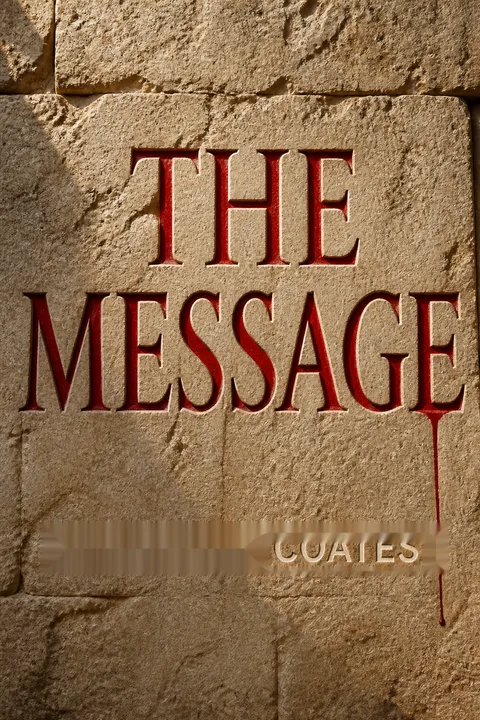
The Message receives mostly positive reviews, praised for its thought-provoking content and powerful prose. Many readers appreciate Coates' perspective on race, education, and the Israeli-Palestinian conflict. Critics argue the book oversimplifies complex issues and presents a biased view. Supporters find it insightful and haunting, while detractors call it antisemitic and lacking context. The book's discussion of Palestine generates the most controversy, with some praising its honesty and others condemning its portrayal of the conflict.
People Also Read








About the Author
Other books by Ta-Nehisi Coates
Download PDF
Download EPUB
.epub digital book format is ideal for reading ebooks on phones, tablets, and e-readers.








































