

Key Takeaways
The skills nobody teaches you are the ones deciding your salary
Ordinary skills, extraordinary payoff. Manoj Tripathi's core argument is that nine everyday abilities we all technically possess but rarely deliberately sharpen (observation, connecting dots, communication, purpose, dreams, out-of-the-box thinking, perseverance, deep diving, and prediction) quietly separate top managers from everyone else. He calls them ignored skills precisely because they feel too obvious to study.
Attitude first, skill second. The book notes that employers hire fresh graduates on attitude, betting skills can be built later. It cites the Carnegie Institute of Technology finding that roughly 85% of financial success comes from personality and the ability to communicate, negotiate, and lead, with only 15% attributed to technical knowledge. The overweight person who knows the risks but never acts is Tripathi's metaphor: we ignore self-improvement not from ignorance but from the invisibility of the obvious.
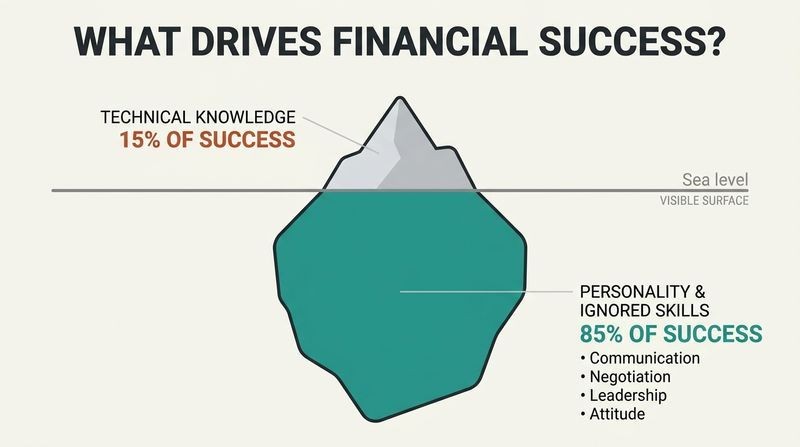
What's compelling is the framing of skill as acquirable rather than innate, echoing Carol Dweck's growth mindset research. The Carnegie statistic, however, deserves scrutiny: it dates back nearly a century and gets recycled across motivational literature without rigorous replication. The deeper truth holds regardless. Angela Duckworth's grit studies and Daniel Goleman's emotional intelligence work both confirm that non-technical competencies compound over a career. The book's real insight is behavioral economics in disguise: we systematically under-invest in things that are free, available, and undramatic, precisely because scarcity signals value to our brains.
Watching is passive; observing means examining until hidden patterns surface
Observation is interrogation, not glancing. Tripathi distinguishes seeing from truly observing, which means examining carefully enough to make a sound judgment. Howard Schultz noticed one tiny Seattle shop ordering an abnormal number of plastic cone filters from his employer, investigated, and turned that curiosity into Starbucks. Newton watched apples fall like everyone else but asked why downward rather than sideways.
The fish that taught patience. Harvard biologist Louis Agassiz handed a student a fish and left. After an hour the student thought he knew everything. Days of forced re-examination revealed scale patterns, tooth placement, and coloration he had entirely missed. The lesson: first-glance confidence is the enemy of discovery. Malcolm Gladwell's thin-slicing concept works only because a mind is pre-loaded with years of accumulated observation.
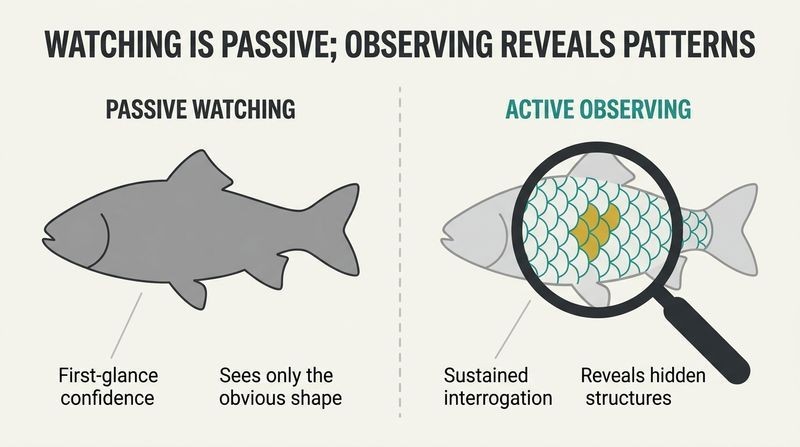
The Agassiz fish story is a genuine classic in scientific pedagogy, and its power lies in exposing a cognitive trap psychologists call premature closure: the brain declares a problem solved to conserve energy. Tripathi rightly links observation to curiosity, but he understates a risk. Observation without hypothesis can drift into aimless noticing. The most productive observers, from Darwin to Sherlock Holmes, pair open attention with a question that filters signal from noise. Schultz did not just see filter numbers; he asked what they meant. Attention is the raw material, but framing is the refinery.
Every success has a hidden supply chain of unrelated causes
Connect dots backward to see the whole picture. Tripathi shows how seemingly unrelated events chain into outcomes. Mumbai became India's financial capital partly because the 1869 Suez Canal cut the London-to-Mumbai distance by roughly 40%, flooding the port with cotton trade. India's 1960s Green Revolution was triggered when US President Lyndon Johnson throttled wheat aid to punish India for supporting Vietnam, forcing self-reliance by 1971.
Distant decisions, local devastation. US cotton subsidies collapsed global prices and contributed to Indian farmer suicides thousands of kilometers away. Alan Turing's codebreaking of Germany's Enigma machine may have shortened World War II by two years and saved two million lives, while also birthing modern computing. The skill: trace genesis to understand and predict.
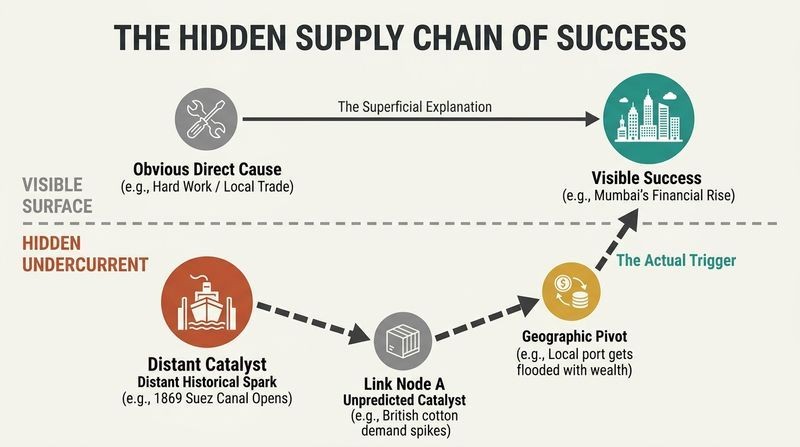
This is systems thinking rendered as storytelling, and it connects naturally to Donella Meadows' work on interconnected feedback loops and Nassim Taleb's warnings about hidden causal chains. Steve Jobs' famous line that dots can only be connected looking backward carries a caution the book could stress more: hindsight narrative is seductive and prone to what Taleb calls the narrative fallacy, where we impose tidy causation on messy randomness. The genuine skill is not just retrospective storytelling but forward-looking humility about how many invisible variables shape any outcome. Correlation dressed as destiny remains a trap.
Your tone carries the message; words are just the packaging
Non-verbal channels dominate. Citing interpersonal communication research, Tripathi claims 93% of communication is non-verbal (posture, facial expression, gesture, eye contact, tone), and that 90% of fights ignite from how something was said, not what. Margaret Thatcher hired a National Theatre tutor to lower and steady her voice.
Reframe for the listener's world. Steve Jobs' engineers wanted to advertise the iPod as a 1.8-inch device holding 5GB. Jobs translated it into 1,000 songs in your pocket. Roosevelt's Depression-era fireside chats used plain language, the greeting my friends, and direct you and I address to rebuild bank confidence within weeks. Churchill's we shall fight on the beaches speech persuaded Parliament to reject negotiating with Hitler. Communication is the tool leaders wield against uncertainty.
The 93% figure traces to Albert Mehrabian's 1960s studies, and it is one of the most misquoted numbers in popular psychology. Mehrabian's research applied narrowly to situations where verbal and non-verbal signals conflict on feelings and attitudes, not to communication broadly. Taken literally, it would mean words barely matter, which is absurd for a legal brief or a physics lecture. That said, the underlying wisdom is sound and echoes Aristotle's rhetoric: ethos and pathos (credibility and emotion, largely conveyed through delivery) often move audiences more than logos alone. Jobs' reframing is a masterclass in what marketers call benefit-led messaging.
Purpose outperforms paychecks and may literally extend your life
Meaning is a productivity and survival engine. Tripathi invokes the Japanese concept of ikigai (reason for being) and Dan Buettner's finding that people with a strong sense of purpose live longer. He cites a Shell Oil study suggesting employees who retired at 55 tended to die earlier than those who worked until 65, arguing that purpose loss, not age, drives decline. Retirement and infancy are framed as life's two most vulnerable windows.
Sell dreams, not sugar water. Steve Jobs recruited Pepsi president John Sculley with a single question: did he want to keep selling sugar water or come change the world? Sculley left a prestigious, secure role for a seven-year-old startup. Organizations from Google to Merck codify purpose statements precisely because purpose-driven employees give 100%.
The purpose-longevity link has real empirical backing beyond the book. Patricia Boyle's research at Rush University found higher purpose associated with roughly half the mortality risk over follow-up periods, and Viktor Frankl's logotherapy built an entire clinical framework on meaning as psychological survival. One caveat: the Shell early-retirement finding has been contested, with later analyses suggesting healthier people simply choose to keep working, a selection effect rather than causation. The Jobs-Sculley story carries irony the book omits, since Sculley later pushed Jobs out of Apple. Purpose recruits talent, but shared purpose does not guarantee shared vision.
When conventional techniques cap your ceiling, invent an unreasonable new one
The Fosbury Flop principle. At the 1968 Olympics, Dick Fosbury cleared the high jump bar backwards, arching over head-first, while everyone else used face-forward straddles. Critics called him the world's laziest jumper. He won gold, broke the record, and every champion since copies him. Crucially, his innovation depended on environment: his school had installed deep foam landing mats, making a backward, spine-first landing survivable.
Reframe the problem, not the process. When India's Drug Price Control Order froze Vicks' prices, a Proctor and Gamble employee suggested reclassifying it as Ayurvedic medicine, which was exempt from price controls, unlocking growth. A toothpaste factory spent 80 lakh rupees on a precision scale to catch empty boxes; a floor worker solved it with a 500 rupee fan that blew the light empty boxes off the belt.
The Fosbury story is the book's strongest illustration because it makes a subtle point most innovation talk misses: breakthroughs are often co-produced by enabling infrastructure, not lone genius. Without foam mats, the Flop would have broken necks. This mirrors economist W. Brian Arthur's work on how technologies unlock adjacent possibilities, and Steven Johnson's concept of the adjacent possible. The 500 rupee fan versus 80 lakh scale is a parable about expertise bias: credentialed consultants engineer complexity while frontline workers see simplicity. Toyota's kaizen philosophy institutionalizes exactly this, harvesting shop-floor ingenuity that boardrooms routinely overlook.
Talent gets you noticed; refusing to quit gets you the gold
Perseverance as the deciding variable. Tripathi stacks failure resumes to prove the point. Karoly Takacs, a world-class Hungarian pistol shooter, lost his right (shooting) hand to a grenade in training, then taught himself to shoot left-handed and won Olympic gold a decade later. Thomas Edison amassed 1,093 patents, insisting genius was 1% inspiration and 99% perspiration, and even salvaged a failed ore-mining venture by extracting one cement-industry invention from its wreckage.
Failure as tuition. Abraham Lincoln endured his mother's death, business bankruptcy, lost elections, a fiancee's death, and a nervous breakdown before the presidency. Einstein did not speak until four, was expelled, and was rejected by Zurich Polytechnic. Michael Jordan missed over 9,000 shots and lost nearly 300 games, and named that as the reason he succeeded.
These stories are inspiring but suffer from survivorship bias, the same flaw the book itself brilliantly diagnoses elsewhere with the WWII armored-plane example. For every persevering Edison, thousands persisted equally hard and still failed, but they do not write memoirs. Duckworth's grit research adds needed nuance: persistence pays only when directed at goals aligned with genuine aptitude and passion, otherwise it becomes what psychologists call escalation of commitment, throwing good effort after bad. The mature reading is not persevere at everything but persevere strategically, coupling stubbornness on goals with flexibility on methods, exactly as Takacs switched hands rather than switching dreams.
Data from survivors alone will steer you catastrophically wrong
The armored plane paradox. In WWII, engineers wanted to reinforce British planes where returning aircraft showed the most bullet holes: wings and tail. A statistician realized the fatal error. Those planes came back despite that damage. The undamaged zones on survivors (cockpit and engine) were exactly where hit planes died and never returned. Armor belonged on the clean spots. This is survivorship bias.
Ask the customers who never came. Tripathi's friend surveyed only his existing shoppers, who suggested more variety and city advertising, none of which worked. The real problem, discovered by asking employees' neighbors who avoided the store, was no parking and a pricey reputation. Loyal customers arrived by public transport and never complained. Feedback from fans hides your fatal flaws.
This is the book's sharpest analytical gem, and the WWII example (attributed to statistician Abraham Wald of the Statistical Research Group) is a canonical teaching case in modern data science. The insight generalizes ferociously: mutual fund performance charts exclude dead funds, entrepreneurship advice comes from winners, and medical trials that drop non-completers distort results. The retail parable extends it into everyday business, echoing Clayton Christensen's jobs-to-be-done principle of studying non-consumers. The practical discipline is brutal but simple: always ask who is missing from your dataset. The most important information usually resides with the people who never showed up.
Judge devotion by difficulty, not by counting; statistics lie without context
Numbers without context deceive. In Tripathi's retelling of a Hindu myth, the sage Narad chanted Vishnu's name a thousand times daily and assumed he was the greatest devotee. Vishnu named a farmer who chanted only twice. To prove the point, Vishnu asked Narad to circle the Earth carrying a lit lamp without letting it extinguish. Consumed by the difficult task, Narad forgot to chant even once, while the busy farmer still managed twice. Raw counts ignored the burden behind them.
Diamonds, water, and marginal utility. Water sustains life yet costs little; diamonds are useless yet cost fortunes. The law of diminishing marginal utility explains it: abundance destroys perceived value, scarcity inflates it. Apply it to yourself: are you in a high-supply or high-demand skill profile? If high-supply, upskill immediately.
The diamond-water paradox is one of economics' oldest puzzles, dating to Adam Smith and resolved by the marginalist revolution of the 1870s (Jevons, Menger, Walras). Tripathi's career application is genuinely useful and anticipates what labor economists call skill-biased technical change: automation floods certain skill markets while scarce, hard-to-replicate skills command premiums. The Narad parable is a quietly sophisticated critique of vanity metrics, the modern disease of measuring what is easy to count (chants, hours logged, emails sent) rather than what is hard and meaningful. Goodhart's Law lurks here: when a measure becomes a target, it stops measuring what matters.
Read the trend, then check whether the trend is about to break
Prediction is the CEO's core job. Tripathi argues forecasting ability, built on observation and experience, is why leaders out-earn laborers. Indra Nooyi predicted consumers shifting toward healthy food and steered PepsiCo's money into R&D for low-calorie products despite board pressure for quick marketing returns. Kodak's engineer invented the digital camera in 1975, but management, addicted to film profits, buried it and went bankrupt in 2012. Nokia, Xerox, and National Geographic similarly failed to foresee disruption.
Beware naive trend extrapolation. Manufacturing migrated from Japan to South Korea to China to Vietnam chasing cheap labor, so the obvious next stop looks like sub-Saharan Africa. Wrong. Robotics and AI will pull production back to developed nations, breaking the pattern. Straight-line forecasting fails at inflection points.
This pairs beautifully with Schumpeter's creative destruction, the idea that innovation continuously demolishes old industries to birth new ones, which the book invokes directly. Kodak is the textbook disruption case, though the fuller story is subtler: Kodak actually invested heavily in digital but could not cannibalize its film margins fast enough, a dilemma Clayton Christensen dissected as the innovator's dilemma. The trend-breaking warning about reshoring is prescient and aligns with recent economic shifts toward automation and nearshoring. The meta-lesson unifies the whole book: prediction rests on observation, connecting dots, deep diving, and resisting the seductive tidiness of extrapolation. Every ignored skill feeds forecasting.
Analysis
Manoj Tripathi's book is an anthology of persuasion built from more than fifty short stories, structured around nine competencies he brands ignored skills. It belongs to the Indian popular self-help and business tradition, written for aspiring managers climbing from junior to middle and senior roles. Its method is accretive rather than argumentative: pile up vivid anecdotes (Newton's apple, Starbucks' filters, the Fosbury Flop, Enigma, farmer suicides, the armored planes) until the reader intuits a principle. The strength is memorability and breadth; the weakness is analytical looseness. Statistics like the 93% non-verbal claim and the Carnegie 85/15 split are recycled from motivational folklore without rigorous sourcing, and many stories lean on survivorship bias, an irony given that the book itself contains the single best popular explanation of survivorship bias via Abraham Wald's WWII bombers.
What elevates the work above generic motivational fare is its distinctly Indian macroeconomic lens. Tripathi is at his most original when connecting dots across policy and history: the Suez Canal building Mumbai, US wheat diplomacy sparking the Green Revolution, the Freight Equalization Policy hollowing out mineral-rich states, and Punjab's slide from India's richest state to ninth. These passages function as accessible development economics, teaching systems thinking and second-order consequences (the cobra effect, the sparrow famine) with genuine sophistication.
The deepest coherence lies in how the nine skills nest. Observation feeds curiosity, curiosity enables connecting dots, dots enable deep diving, and deep diving enables prediction, the highest-paid skill of all. Communication and purpose are the social multipliers; perseverance and out-of-the-box thinking are the temperament. Read holistically, the book argues that competitive advantage comes not from rare technical knowledge but from disciplined attention to the ordinary. That thesis is sound, well-illustrated, and underexploited by most readers, which is precisely Tripathi's point. The execution is uneven, but the central provocation earns its place.
Review Summary
Power of Ignored Skills is praised for its engaging storytelling and focus on often overlooked soft skills. Readers appreciate the real-life examples and anecdotes illustrating nine key skills, including observation, connecting dots, and perseverance. The book is described as thought-provoking, easy to read, and valuable for personal and professional development. While some found the content repetitive or lacking depth, most reviewers recommend it as an insightful read, particularly for young professionals and those seeking to enhance their skills.
People Also Read









FAQ
What's "Power of Ignored Skills" about?
- Focus on Ignored Skills: The book emphasizes the importance of skills that are often overlooked but play a crucial role in personal and professional success.
- Nine Key Skills: It covers nine specific skills, including observation, connecting the dots, communication, purpose, dreams, out-of-the-box thinking, perseverance, deep diving, and prediction.
- Skill Acquisition: The author argues that these skills can be acquired and developed, regardless of one's starting point.
- Anecdotal Evidence: The book uses anecdotes and stories from history and contemporary examples to illustrate the significance of these skills.
Why should I read "Power of Ignored Skills"?
- Enhance Personal Growth: The book provides insights into developing skills that can significantly impact your personal and professional life.
- Practical Examples: It offers practical examples and stories that make the concepts relatable and easier to understand.
- Skill Development: It encourages readers to actively work on improving these often-ignored skills, which can lead to better decision-making and success.
- Broaden Perspective: Reading this book can help you see the value in skills you might have previously overlooked, broadening your perspective on personal development.
What are the key takeaways of "Power of Ignored Skills"?
- Observation is Crucial: Being observant can lead to better understanding and decision-making in both personal and professional contexts.
- Connecting the Dots: Understanding how different events and facts relate can provide deeper insights and foresight.
- Communication Matters: Effective communication, both verbal and non-verbal, is essential for success and leadership.
- Purpose Drives Success: Having a clear purpose can motivate and guide you towards achieving your goals.
What are the best quotes from "Power of Ignored Skills" and what do they mean?
- "People’s minds are changed through observation and not through argument." - This highlights the power of observation in influencing and understanding others.
- "You can’t connect the dots looking forward; you can only connect them looking backwards." - Emphasizes the importance of reflecting on past experiences to understand the present and future.
- "A man’s character may be learned from the adjectives which he habitually uses in conversation." - Suggests that the way we communicate reveals much about our character.
- "Dream is not that which you see while sleeping; it is something that does not let you sleep." - Stresses the importance of having a dream or goal that drives you to action.
How does Manoj Tripathi define "Power of Observation"?
- Understanding the World: Observation is described as a way of understanding the world by carefully watching and analyzing events and behaviors.
- Subconscious Registration: The brain constantly observes and registers events, even subconsciously, which influences decisions and actions.
- Historical Significance: The book discusses how observation has been a key factor in human evolution and knowledge transfer.
- Practical Application: Observation is crucial in professional settings, such as evaluating proposals or understanding market trends.
What is the "Power of Connecting the Dots" according to Manoj Tripathi?
- Holistic Understanding: Connecting the dots involves putting together various facts and ideas to see the bigger picture.
- Informed Decisions: This skill helps in making informed decisions by understanding the historical context and future implications.
- Examples Provided: The book provides examples like the impact of the Suez Canal on Mumbai's growth and the US government's policies affecting Indian farmers.
- Skill Development: It encourages readers to develop this skill through curiosity, knowledge, and common sense.
How does "Power of Communication" impact success according to the book?
- Non-Verbal Importance: The book highlights that 93% of communication is non-verbal, emphasizing the importance of tone and body language.
- Historical Examples: It uses examples like Winston Churchill's speeches and Franklin D. Roosevelt's fireside chats to show how effective communication can change outcomes.
- Professional Relevance: Communication skills are crucial in professional settings for leadership, negotiation, and team alignment.
- Personal Growth: Improving communication skills can enhance personal relationships and social interactions.
What does Manoj Tripathi say about the "Power of Purpose"?
- Purpose as Motivation: A clear purpose drives motivation and aligns efforts towards achieving goals.
- Organizational Impact: Companies with a strong purpose see increased productivity, employee engagement, and customer loyalty.
- Personal Fulfillment: Having a purpose can lead to a more fulfilling life and even impact longevity, as seen in studies on Japanese Ikigai.
- Examples Used: The book uses examples like Steve Jobs convincing John Scully to join Apple by appealing to a higher purpose.
How does "Power of Dreams" influence success according to the book?
- Dreams as a Compass: Dreams provide direction and motivation, helping individuals align their efforts towards achieving significant goals.
- Historical Impact: The book cites Martin Luther King Jr.'s "I Have a Dream" speech as an example of how dreams can inspire and drive social change.
- Personal Stories: It includes stories of individuals like Walt Disney, who achieved success by dreaming big and persevering.
- Encouragement to Dream: The book encourages readers to have dreams that drive them to action and success.
What is "Power of Out-of-the-Box Thinking" and its significance?
- Creative Problem Solving: Out-of-the-box thinking involves approaching problems from new and unconventional perspectives.
- Historical Examples: The book provides examples like Dick Fosbury's high jump technique and Proctor & Gamble's rebranding of Vicks as Ayurvedic.
- Business Innovation: It highlights how companies like Uber and Airbnb have succeeded by thinking differently and disrupting traditional models.
- Encouragement to Innovate: Readers are encouraged to embrace creativity and innovation in their personal and professional lives.
How does Manoj Tripathi explain the "Power of Perseverance"?
- Persistence Despite Challenges: Perseverance is about continuing efforts despite difficulties or delays in achieving success.
- Historical Figures: The book shares stories of individuals like Thomas Edison and Abraham Lincoln, who succeeded through perseverance.
- Overcoming Failures: It emphasizes that failures are part of the journey and perseverance is key to overcoming them.
- Encouragement to Persist: Readers are encouraged to keep moving forward, regardless of obstacles, to achieve their dreams.
What is the "Power of Deep Diving" and its importance?
- Thorough Investigation: Deep diving involves a detailed analysis and understanding of a subject or problem.
- Avoiding Superficiality: The book warns against superficial knowledge and emphasizes the importance of deep understanding.
- Examples Provided: It uses examples like the importance of science and technology for national development and the economic challenges faced by Punjab.
- Skill Development: Readers are encouraged to develop this skill for better decision-making and strategic thinking.
Download PDF
Download EPUB
.epub digital book format is ideal for reading ebooks on phones, tablets, and e-readers.








































