

Key Takeaways
Being top 25% in three fields beats top 1% in one
The math favors the generalist. Hollins argues that chasing elite mastery in a single discipline is a statistical dead end: by definition, only 1 percent of people occupy the top 1 percent. But reaching the top 25 percent of three or more fields is achievable for almost anyone, and the combination makes you rare and hard to replace.
A polymath (from the Greek for "having learnt much") is someone accomplished across multiple disciplines who creatively fuses them. The real power is not the individual skills but the collisions between them. Benjamin Franklin embodied this: inventor of bifocals and the lightning rod, founder of America's first fire department and a university, diplomat, and co-author of the Declaration of Independence, all at once.
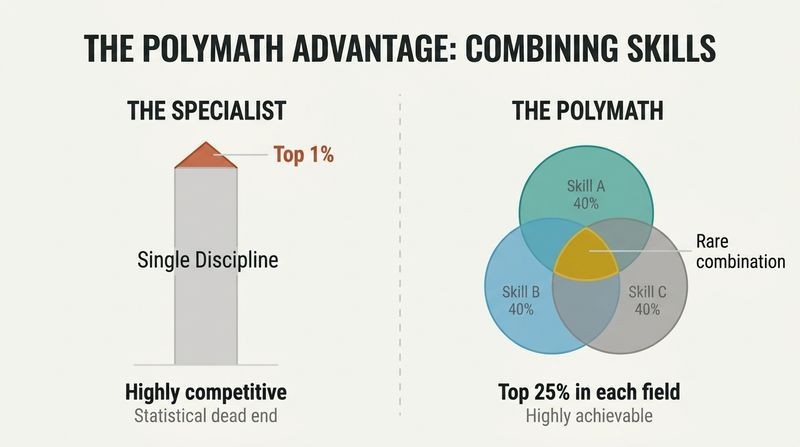
The arithmetic is seductive but worth stress-testing. Reaching the top 25 percent of a field is often far easier than the remaining climb, which is precisely why 25th-percentile competence rarely commands a premium on its own. The value emerges only when combinations are scarce and useful. This aligns with economist David Ricardo's comparative advantage and with modern labor research showing hybrid roles (data plus design, medicine plus coding) command wage premiums. The deeper claim, echoed in Scott Page's work on cognitive diversity, is that varied toolkits solve problems monolithic expertise cannot. Franklin is a vivid mascot, though survivorship bias lurks: we remember the polymaths who succeeded, not the dabblers who spread themselves thin.
Deep expertise can blind you to obvious solutions
The Einstellung effect is expertise's hidden tax. German for "setting" or "attitude," it describes how prior knowledge locks you into familiar solutions and blocks better ones. In the 1942 Luchins water jar experiments, subjects taught a complex formula kept applying it even when a far simpler answer appeared, while novices with no formula spotted the easy route immediately.
Hollins pairs this with the proverb about the person holding a hammer who sees only nails. Karl Duncker's candle problem showed the same trap: given a candle, matches, and a box of tacks, people fixated on the box's usual function and failed to see it could become a shelf. The lesson: a purely T-shaped profile (broad but shallow up top, one deep spike) can imprison you in your own knowledge.
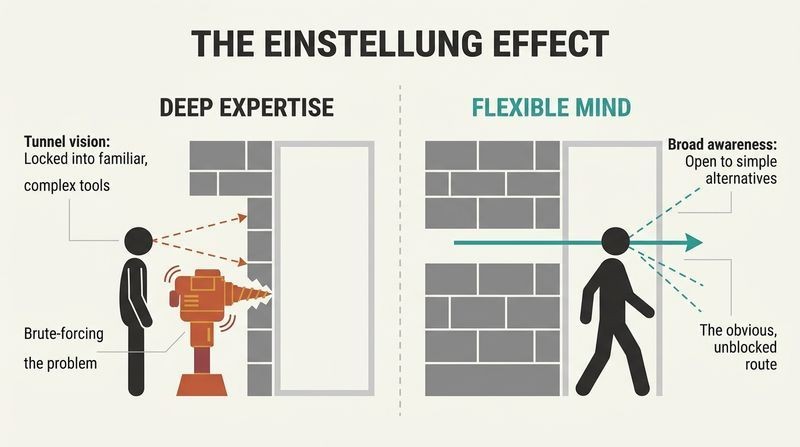
This is one of the book's sharpest counterintuitive points, and it is well supported. Psychologists call the candle-problem trap functional fixedness, and it connects to Thomas Kuhn's observation that scientific revolutions often come from outsiders or the young, unencumbered by a field's reigning paradigm. Philip Tetlock's forecasting research adds nuance: narrow experts ("hedgehogs") were routinely outpredicted by wide-ranging "foxes." The caveat Hollins underplays is that expertise also enables pattern recognition and legitimate intuition, as Gary Klein documents in firefighters and nurses. The honest synthesis: expertise is a liability for novel problems and an asset for familiar ones. Knowing which situation you face is itself a meta-skill.
Stop defining yourself with labels that quietly cage you
Identity is a self-fulfilling prophecy. Hollins argues polymaths refuse fixed self-labels: political party, personality type, "I'm a numbers person, not an arts person." Each label silently narrows what experiences you allow yourself. Tell yourself you hate R&B and you skip an artist you might have loved. Repeat any identity claim often enough and your actions bend to confirm it.
The polymathic mind treats identity as fluid and provisional. It couples this with an experimental stance (test assumptions rather than accept them), a beginner's mindset drawn from the Zen concept of Shoshin (approaching even familiar material with fresh eyes and "dumb" questions), and comfort with uncertainty. Ask yourself: are you the same person you were twenty years ago? If not, why behave as if today's identity is final?
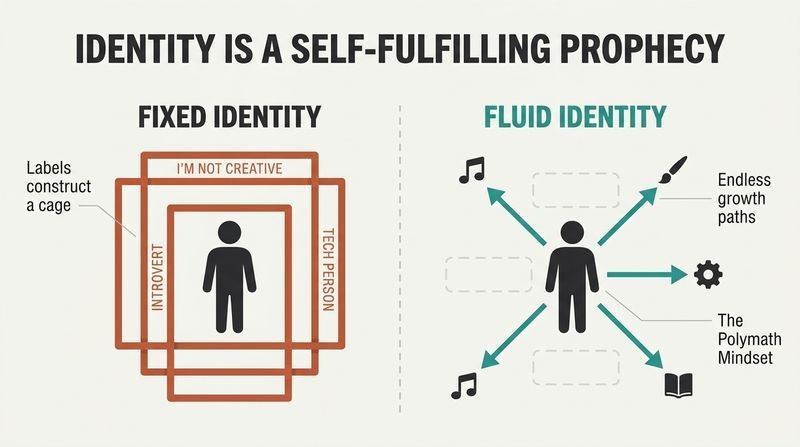
This resonates with Carol Dweck's growth mindset and with narrative-identity research by Dan McAdams showing the stories we tell about ourselves shape behavior. The beginner's mindset also has empirical backing: the generation effect shows we retain material better when we generate questions and answers ourselves rather than passively receive them. One tension worth naming: identity is not purely a cage. It provides commitment, continuity, and the deliberate practice that mastery demands. Someone who reinvents themselves every month accumulates shallow starts. The wisest reading treats labels as removable scaffolding, held loosely enough to revise but firmly enough to finish what curiosity begins.
The four-minute mile proves belief unlocks what seems impossible
Barriers are often mental, not physical. For decades runners stalled near 4:01, and experts declared the sub-four-minute mile biologically impossible. In 1954 Roger Bannister, a working medical student, believed otherwise and ran 3:59.4. The revealing part: within two months John Landy broke it too, and over a dozen runners crossed the barrier within the decade.
Nothing changed physically in those runners. No new training, no winged feet. What changed was belief. Bannister redefined the possible and everyone else inherited the certainty. Hollins ties this to agency, the conviction that output tracks input. Polymaths believe their goal sits just out of reach, which keeps them striving rather than resigned. Without belief, you impose an arbitrary ceiling and may never even start.
The Bannister story is self-help canon, and it is genuinely instructive, though it deserves cleaner framing. The pileup of sub-four milers owed something to improved tracks, pacing tactics, and training science, not belief alone. Still, the psychological mechanism is real: expectancy effects and self-efficacy, rigorously studied by Albert Bandura, show that believing a task is achievable changes effort, persistence, and physiological arousal. The placebo literature and stereotype-threat research demonstrate that expectations measurably alter performance. The honest version of Hollins's point is not that belief is sufficient, but that disbelief is often disqualifying. It ends the attempt before biology or skill ever gets a vote.
Learn any subject with the LPLT loop: learn, play, learn, teach
A ten-step system compressed into a mantra. Hollins offers a repeatable process for going from novice to functional expert. The front end sets direction: get a broad overview, narrow the scope to something masterable in weeks, define success concretely ("I'll know I've learned Italian Renaissance art when I could pass as a Uffizi tour guide"), and compile resources widely without filtering.
Then you build a curriculum, ruthlessly filter to one or two best resources, and break the subject into modules. For each module you run the core loop, memorably abbreviated LPLT:
1. Learn just enough basics to begin
2. Play and explore until real questions surface
3. Learn deeply to answer those questions
4. Teach someone else to expose your gaps
Teaching is the step most people skip and the one that cements understanding.
The architecture is sound and echoes established learning science. Defining measurable success mirrors deliberate-practice research by Anders Ericsson, which stresses specific goals over vague exposure. The "play before you learn" sequence exploits the generation effect and productive failure, studied by Manu Kapur, where struggling before instruction deepens retention. Teaching as the capstone is the protege effect, and it underlies the Feynman technique. One friendly critique: the promise of mastering a subject in "a few weeks" oversells. What the method reliably delivers is functional literacy, enough to hold a conversation, build a skill stack, or make cross-disciplinary connections, not genuine expertise, which still demands years.
Take notes in four passes to build a second brain
Notetaking as active processing, not passive copying. Hollins rejects the standard transcription approach because it never forces comprehension. His four-pass method leaves blank lines under each note for later work:
1. Record details normally as you encounter material
2. Rephrase in your own words, adding questions and clarifying significance
3. Connect the note to the broader topic (cause and effect, relationships, why it matters)
4. Summarize each page and answer lingering questions
His example: a raw note about Henry VIII eating twenty meats per meal gets rephrased, then linked to peasant diets, his obesity, and public resentment. By the end you have reviewed the same material four times in four distinct ways, transforming inert facts into an integrated, retrievable structure that becomes your external memory.
This is elaborative encoding done deliberately, and cognitive psychology strongly endorses it. Rephrasing in your own words is the summarization strategy validated in Dunlosky's landmark review of study techniques, and forcing connections triggers what memory researchers call the levels-of-processing effect: deeper semantic processing yields far stronger recall than shallow copying. The method also resembles the Cornell system and Niklas Luhmann's Zettelkasten, the slip-box that produced dozens of books. The honest tradeoff Hollins names himself: it is slow. For high-volume or low-stakes material, four passes is overkill. The method earns its cost on subjects you intend to genuinely master and reuse, where retrieval strength compounds over time.
Breakthroughs hide in the space between unrelated disciplines
Creativity is combinatorial, not spontaneous. Frans Johansson's Medici effect, named for the Florentine family who gathered artists, philosophers, and mathematicians in one place and helped spark the Renaissance, holds that new ideas erupt when different fields collide. Brian Uzzi's analysis of over 26 million scientific papers found the highest-impact work came from teams with atypical background combinations, often drawing at least 10 percent of citations from outside fields.
Einstein called his version combinatory play. He played violin during research breaks, and the mental act of fusing insights across domains, he believed, was the essential feature of productive thought. Practically: read your chemistry text like a novelist, ask what Marx would say about the gig economy, pursue hobbies deliberately distant from your day job. The gap between fields is where the magic lives.
The evidence here is unusually strong for a self-help book. Uzzi's citation study is real and striking, and the broader finding that innovation clusters at disciplinary boundaries is well documented in the science-of-science literature. Arthur Koestler called this "bisociation," the collision of two unrelated frames. Steven Johnson's "adjacent possible" and the history of evolutionary psychology and behavioral economics illustrate whole fields born from cross-pollination. The subtle risk is romanticizing serendipity. Fruitful combination usually requires genuine depth in at least one domain first, otherwise the connections are superficial. Einstein's violin did not make him a physicist; his physics made the violin generative. Depth and breadth are partners, not rivals.
Build a rare skill stack of three complementary, not random, talents
Uniqueness through combination, coined by Scott Adams. Skill stacking means becoming very good (top 10 to 15 percent) at three or four skills that reinforce each other, rather than elite at one. Adams, creator of Dilbert, admitted he was not the best artist, businessperson, or comedian, but the intersection of decent drawing, business school training, and workplace wit made him nearly unique and worth an estimated 75 million dollars.
The skills must be compatible, not scattered. Writing plus HTML plus social media savvy turns a merely good writer into a self-publishing brand. A stockbroker who adds Mandarin and biotech knowledge outcompetes bilingual peers. But typing, tap-dancing, and shelling peanuts stacks into nothing useful. A 2017 Boston Consulting Group study found firms with more diverse skill backgrounds earned 19 percent more revenue.
Skill stacking is the book's most practical export and holds up well against career research. It operationalizes the top-25-percent thesis into an actionable audit: identify what everyone in your field already has, then add adjacent scarce skills. The Venn-diagram framing captures why hybrids are hard to replace and hard to automate. The critical nuance is Adams's own qualifier, easily lost: the skills must combine toward a coherent goal, and there must be market demand for that particular intersection. A stack of unrelated competencies produces a jack of all trades in the pejorative sense. The best stacks are also legible to others, which is why personal branding often becomes the connective tissue.
Growth requires embracing discomfort as a deliberate inoculation
Self-discipline is a vaccine against future adversity. Hollins insists there are no shortcuts to polymathy. Starting any new field from zero is confusing, tedious, and frustrating, and the only real cost is tolerating that discomfort. He reframes distress as something to practice while life is still easy, so you are prepared when hardship arrives uninvited. Walking barefoot now makes you less dependent on shoes later.
He invokes Marcus Aurelius, who chided himself at dawn for wanting to stay warm under the blankets instead of doing the work he was made for. Polymaths, in this reading, love their pursuits enough to endure the unpleasant parts, shifting focus from outcomes to process. When you commit to forever experimenting, adjusting, and trying again, failure becomes data rather than humiliation, and you win regardless of any single result.
The Stoic framing is apt and increasingly validated. Deliberately courting manageable stress to build resilience is the logic behind Nassim Taleb's antifragility and behind hormesis in biology, where small doses of a stressor strengthen the system. Exposure therapy in clinical psychology works on the same principle. Voluntary discomfort was a core Stoic practice, praevisio, rehearsing hardship in advance. The process-over-outcome pivot also mirrors flow research by Csikszentmihalyi, where intrinsic engagement outlasts external reward. The honest caution: not all discomfort is generative. Chronic, uncontrollable stress corrodes rather than builds. The distinction is between chosen, bounded challenge and imposed, relentless strain. Hollins means the former.
History's greatest minds succeeded because of range, not despite it
Diversity, fearlessness, and obsessive curiosity recur across eras. Hollins profiles polymaths spanning 4,500 years. Leonardo da Vinci dissected corpses, sketched helicopters and tanks centuries early, and painted the Mona Lisa. Goethe founded a literary movement and served as a war commissioner while researching botany and color theory. Thomas Young, a physician, both proved light behaves as a wave (overturning Newton) and helped decode the Rosetta Stone. Descartes gave us Cartesian coordinates and "I think, therefore I am." Imhotep, in 27th-century BC Egypt, was physician, architect of the first pyramid, and irrigation engineer.
Three threads unite them: they diversified across fields, they pursued ideas fearlessly despite ridicule (Young was mocked for years), and they were driven by curiosity that functioned like an itch they had to scratch, not by money or fame.
The historical gallery is inspiring, but readers should apply a survivorship filter. These figures are remembered precisely because their range paid off; countless contemporaries who spread themselves thin vanished from record. Many also enjoyed inherited wealth and patronage, as Hollins acknowledges, which bought the freedom to explore, a luxury unavailable to most. What travels across centuries and holds up is the psychological profile: intrinsic curiosity, tolerance for disapproval, and refusal to accept disciplinary boundaries as real. That profile is teachable in a way genius is not. The realistic takeaway is not to become da Vinci, but to adopt his orientation toward the world within one's own constraints.
Analysis
Polymath sits in a crowded self-improvement niche and distinguishes itself less through original research than through synthesis and packaging. Its thesis is genuinely useful and somewhat contrarian in an age that worships specialization: cultivate range, because rare combinations of moderate skills beat singular mastery on both economic and creative grounds. The book's spine is the movement from why (breadth wins) to who (the polymathic mindset) to how (the ten-step learning system, the four-pass notes, skill stacking) to proof (historical exemplars). This is a sensible architecture, and the how chapters are the most valuable, offering procedures a reader can execute Monday morning.
The intellectual weaknesses are typical of the genre. Evidence is deployed selectively and rhetorically rather than systematically; single studies (Root-Bernstein on Nobel laureates, Uzzi on citations, the BCG revenue figure) are cited as settled proof of sweeping claims. The historical polymaths suffer from acute survivorship bias, and Hollins concedes most enjoyed aristocratic freedom without fully reckoning with how much that undercuts the "anyone can do this" premise. The Bannister and hammer-nail motifs are self-help clichés, though they happen to illustrate real mechanisms (self-efficacy, functional fixedness).
What genuinely holds up connects to serious scholarship the book never cites: the generation effect and protege effect behind LPLT, Tetlock's foxes outforecasting hedgehogs, Koestler's bisociation, Ericsson on measurable goals, and the science-of-science finding that innovation clusters at disciplinary boundaries. The strongest, most defensible chapter is skill stacking, which converts an abstract ideal into a concrete career audit and dovetails with labor-market evidence that hybrid roles command premiums. The book's real contribution is not novelty but usable framing. It gives a permission structure and a toolkit to the naturally curious person who has been told to pick a lane. Read as a practical operating manual rather than a rigorous argument, it earns its place: modest in originality, above average in actionability.
Review Summary
Polymath receives mixed reviews with an average rating of 3.74/5. Readers appreciate the book's introduction to polymathy and its benefits, but criticize repetition and lack of depth. Some find it motivating and informative, especially for beginners, while others feel it falls short on practical guidance. The book's strengths include its organization, chapter summaries, and historical examples of polymaths. Critics argue it oversimplifies the path to becoming a polymath and focuses too much on career advancement rather than intellectual curiosity.
People Also Read





Glossary
Polymath
Expert across multiple integrated fieldsFrom the Greek for "having learnt much," a person accomplished in several distinct disciplines who creatively fuses them rather than specializing in one. Hollins frames the modern polymath's goal not as matching Leonardo but as reaching the top 10 to 25 percent of three or more complementary fields, making the individual rare, adaptable, and difficult to replace.
T-shape, pi-shape, comb-shape, star-shape
Skill-profile geometry metaphorsVisual metaphors for knowledge profiles. Horizontal bars represent breadth across fields; vertical bars represent depth in one. A T-shape is broad-but-shallow with one deep spike; pi has two deep areas; comb has several; star radiates interests in all directions. Hollins urges aiming beyond T-shape toward pi, comb, or star to maximize creative combinations and reduce replaceability.
Einstellung effect
Expertise blocks better solutionsGerman for "setting" or "attitude," a cognitive trap where prior knowledge and habitual formulas prevent someone from seeing simpler or novel solutions. Demonstrated in the 1942 Luchins water jar experiments, where subjects trained on a complex method missed an obvious easier one. Related to functional fixedness, illustrated by Duncker's candle problem.
Medici effect
Innovation from colliding disciplinesCoined by Frans Johansson, the surge of new ideas that occurs when different fields, backgrounds, and disciplines intersect. Named for the Medici family, whose gathering of diverse thinkers in Renaissance Florence helped spark an explosion of creativity. Supported by Brian Uzzi's finding that the highest-impact scientific papers draw on atypical combinations of sources.
Combinatory play
Einstein's cross-domain idea fusionEinstein's term for the mental process of taking signs, images, and insights from different domains and recombining them, which he considered the essential feature of productive thought before words or logic enter. Illustrated by his violin playing during research breaks, which he credited with helping him approach physics problems from fresh angles.
Skill stacking
Combining several moderate complementary skillsPopularized by Dilbert creator Scott Adams, the strategy of becoming very good (top 10 to 15 percent) at three or four compatible skills that reinforce each other, rather than elite at one. The rare combination creates unique, hard-to-replace value. Adams cited his own blend of decent drawing, business knowledge, and humor as an example.
LPLT (Learn, Play, Learn, Teach)
Four-part module learning loopHollins's mnemonic for the core learning cycle applied to each module of a subject: learn just enough basics to start, play and explore freely until genuine questions arise, learn deeply to answer those questions, then teach the material to someone else to expose and close comprehension gaps.
Shoshin (beginner's mindset)
Studying with fresh, open eyesA Zen Buddhist concept meaning an attitude of openness, eagerness, and absence of preconceptions when studying, even at an advanced level. Hollins argues it outperforms the expert mindset because beginners ask more questions, make fewer assumptions, and avoid the blind spots that come from believing one already knows the answers.
FAQ
What's "Polymath: Master Multiple Disciplines, Learn New Skills, Think Flexibly, and Become Extraordinary Autodidact" about?
- Overview: The book by Peter Hollins explores the concept of polymathy, which involves mastering multiple disciplines and developing a flexible, adaptable mindset.
- Purpose: It aims to guide readers on how to become extraordinary autodidacts, or self-taught individuals, by learning new skills and thinking creatively.
- Structure: The book is divided into chapters that cover the mindset of a polymath, steps to become one, and historical examples of famous polymaths.
- Goal: Ultimately, it encourages readers to cultivate a well-rounded skill set that can be applied across various fields for personal and professional growth.
Why should I read "Polymath" by Peter Hollins?
- Skill Development: The book provides practical steps to develop a diverse set of skills, making you more versatile and competitive in various fields.
- Mindset Shift: It encourages a shift from specialization to a broader, more integrated approach to learning and problem-solving.
- Historical Insights: By examining historical polymaths, the book offers inspiration and lessons on how to apply their strategies in modern contexts.
- Personal Growth: It emphasizes the importance of lifelong learning and adaptability, which are crucial in today's rapidly changing world.
What are the key takeaways of "Polymath" by Peter Hollins?
- Diverse Knowledge: Embrace a wide range of interests and skills to become more adaptable and innovative.
- Beginner's Mindset: Maintain curiosity and openness to new experiences, even in areas where you are already knowledgeable.
- Skill Stacking: Combine multiple skills to create a unique value proposition, rather than relying on being the best in one area.
- Fearlessness and Authenticity: Pursue your interests boldly and authentically, without being constrained by conventional labels or expectations.
How does Peter Hollins define a polymath in "Polymath"?
- Definition: A polymath is someone who has learned much and is accomplished in multiple disciplines, thriving in the field of human inquiry itself.
- Renaissance Men: They are often referred to as "Renaissance men," capable of blending academic fields or creating new ones from scratch.
- Superpowers: Polymaths seem to possess superpowers due to their prowess in multiple realms of knowledge, inspiring others to imagine the limits of human understanding.
- Learnable Quality: Hollins emphasizes that polymathy is not an inherent quality but can be learned and cultivated by anyone.
What is the "Einstellung effect" mentioned in "Polymath"?
- Definition: The Einstellung effect describes the phenomenon where existing knowledge and expertise can hinder creative problem-solving.
- Fixed Thinking: It occurs when experts rely too heavily on their established knowledge, making it difficult to see alternative solutions.
- Example: The book cites experiments where experts failed to find simpler solutions because they were stuck in their preconceived methods.
- Polymathic Approach: By diversifying knowledge and maintaining a beginner's mindset, polymaths can avoid this effect and remain open to new ideas.
What is the "10-step process" for becoming a polymath in "Polymath"?
- Broad Overview: Start by gaining a broad understanding of the subject you wish to learn.
- Narrow the Scope: Focus on specific areas within the subject that interest you the most.
- Define Success: Clearly define what success looks like for you in mastering this subject.
- Compile Resources: Gather a wide range of resources to support your learning journey.
How does "Polymath" suggest using notes effectively?
- Second Brain: Notes function as a second brain, helping you organize, review, and synthesize information.
- Four-Step Method: The book recommends a four-step method: detailed notetaking, summarizing in your own words, connecting to the larger lesson, and answering remaining questions.
- Active Engagement: This method encourages active engagement with the material, making it easier to retain and apply knowledge.
- Deep Understanding: By revisiting and transforming information multiple times, you achieve a deeper understanding of the subject.
What is "skill stacking" according to "Polymath"?
- Concept: Skill stacking involves combining multiple skills to create a unique value proposition, rather than excelling in just one area.
- Top Percentile: Aim to be in the top 10-15% of several skills, rather than the top 1% of one skill.
- Synergy: The skills should be related or complementary, enhancing each other to make you more competitive.
- Practical Example: The book uses Scott Adams, creator of Dilbert, as an example of someone who successfully used skill stacking.
What is "combinatory play" as discussed in "Polymath"?
- Einstein's Method: Combinatory play is a concept introduced by Albert Einstein, involving the combination of different disciplines to spark creativity.
- Cross-Disciplinary: It encourages engaging in activities outside your main field to gain new perspectives and insights.
- Creative Breakthroughs: By combining elements from different areas, you can arrive at innovative solutions and ideas.
- Practical Application: The book suggests using combinatory play to enhance problem-solving and creativity in your own pursuits.
How does "Polymath" address the fear of failure?
- Experimental Mindset: The book encourages adopting an experimental mindset, viewing failures as opportunities for learning and growth.
- Redefining Failure: Failure is reframed as a necessary part of the learning process, not a reflection of personal inadequacy.
- Resilience: Polymaths are described as resilient individuals who thrive in conditions of uncertainty and change.
- Focus on Process: Emphasize the joy of the learning process itself, rather than fixating on outcomes or achievements.
What are some historical examples of polymaths mentioned in "Polymath"?
- Leonardo da Vinci: Known for his contributions to art, science, and engineering, da Vinci is the quintessential polymath.
- Johann Wolfgang von Goethe: A celebrated writer and scientist, Goethe made significant contributions to literature and natural sciences.
- Thomas Young: Known for his work in physics, medicine, and linguistics, Young exemplifies the diverse interests of a polymath.
- Imhotep: An ancient Egyptian polymath, Imhotep was a physician, architect, and engineer, known for designing the first pyramid.
What are the best quotes from "Polymath" by Peter Hollins and what do they mean?
- "The quest of polymathism is something that could very well boost your life to new heights." This quote emphasizes the transformative potential of becoming a polymath.
- "Being a polymath is actually easier, from this point of view." It suggests that achieving proficiency in multiple areas can be more attainable than mastering one.
- "Polymaths will not only engage with life in deeply fulfilling ways, they’ll bring value to others in ways that are directly profitable to them." This highlights the personal and professional benefits of polymathy.
- "Growth is exponential, when your strategy is combinatorial." This quote underscores the power of combining diverse skills and knowledge for exponential growth.
About the Author
Other books by Peter Hollins



Download PDF
Download EPUB
.epub digital book format is ideal for reading ebooks on phones, tablets, and e-readers.








































