
Key Takeaways
1. Dialectic: The Art of Winning, Not Truth
Controversial Dialectic is the art of disputing, and of disputing in such a way as to hold one's own, whether one is in the right or the wrong—per fas et nefas.
Human nature's baseness. Schopenhauer posits that while Logic concerns itself with objective truth and the laws of thought, Dialectic is the art of intellectual combat, focused solely on winning an argument. This distinction arises from the inherent obstinacy and vanity of human nature, where individuals prioritize appearing right over actually being right. When confronted with differing opinions, people rarely question their own reasoning first, instead assuming the opponent is mistaken.
Victory over veracity. The primary goal in a dispute, for most individuals, shifts from discovering truth to preserving their ego and proving their initial stance. This often leads to intellectual dishonesty, where one might defend a proposition even if they secretly doubt its veracity, hoping to find a valid proof later or simply to wear down the opponent. The temptation to be dishonest is great, as yielding to an opponent's apparent correctness might mean abandoning a potentially true position prematurely.
Natural vs. formal dialectic. While everyone possesses a "natural Dialectic" learned through experience, it is not as reliable as natural Logic. Many are easily confounded by superficial arguments, even when objectively correct. Therefore, a formal study of controversial Dialectic is valuable, not to promote dishonesty, but to recognize and counter the tricks opponents employ, and even to use them oneself when necessary to secure victory.
2. Mastering the Stratagems of Controversy
The science of Dialectic, in one sense of the word, is mainly concerned to tabulate and analyse dishonest stratagems, in order that in a real debate they may be at once recognised and defeated.
Recognize the tricks. Schopenhauer meticulously outlines 38 stratagems, or "tricks," used in disputation, emphasizing that understanding them is crucial for both defense and offense. These tactics range from subtle linguistic manipulations to outright personal attacks, all designed to secure victory regardless of objective truth. The goal is to equip one with the tools to navigate the often-unscrupulous landscape of intellectual combat.
Common deceptive tactics. Some frequently employed stratagems include:
- Extension: Exaggerating an opponent's statement to make it easier to refute, while narrowing one's own.
- Homonymy: Exploiting words with multiple meanings to shift the argument's focus.
- Argumentum ad hominem: Attacking the opponent's character or consistency rather than their argument.
- Diversion: Changing the subject when losing ground, or introducing irrelevant but emotionally charged topics.
- Appeal to Authority (ad verecundiam): Citing respected figures or universal prejudices, even if irrelevant or fabricated, to sway the audience.
Winning at all costs. These stratagems highlight the pragmatic, often cynical, reality of debates where the appearance of truth often trumps its substance. By cataloging these methods, Schopenhauer provides a manual for intellectual self-defense, enabling one to identify when an opponent is employing a trick and how to counter it, or even to employ such tactics oneself when the situation demands it for victory.
3. Beauty vs. Interest: Art's True Purpose
Beauty, however, in its general aspect, is the inseparable characteristic of the idea when it has become known.
Beauty: knowledge for intellect. Schopenhauer distinguishes between "beauty" and "interest" in art, particularly poetic art. Beauty, he argues, is the true end of art, residing in the clear revelation of universal ideas inherent in the world and humanity. It appeals to the pure perceptive intellect, requiring a complete suppression of the individual will, and offers a deeper, more objective understanding.
Interest: engagement for the will. Interest, conversely, arises when art represents events that stir personal concern or sympathy, akin to real-life experiences. It engages the will, creating anxiety, curiosity, and emotional investment in the narrative's outcome. While interest can make a work popular and entertaining, it often lacks true aesthetic value, as seen in many dramas or novels that captivate but offer little profound insight.
Compatibility and hierarchy. While interest can be compatible with beauty, it is not its primary aim and can even be detrimental if it overshadows the contemplation of ideas. Masterpieces like Shakespeare's plays or Homer's epics, though beautiful, often lack high "interest" in the sense of plot complexity or suspense, yet they gain value through repeated engagement. Interest serves as a "thread" to hold the "pearls" of poetic ideas together, a necessary material basis, but beauty remains the soul and ultimate purpose of art.
4. The World's Indifference and Human Egoism
Our temperament is so despotic that we are not satisfied unless we draw everything into our own life, and force all the world to sympathise with us.
Solitary suffering. When great affliction strikes, humans are often hurt by the world's indifference, finding it intolerable that life continues its mechanical round unaffected by their pain. This inherent desire for universal sympathy stems from a despotic temperament that seeks to draw everything into its own orbit. When genuine sympathy is hard to come by, people often resort to "blabbing out" their woes to others, who may listen with curiosity but rarely with true empathy.
Self-centered existence. Schopenhauer asserts that men are "entirely self-centred, and incapable of looking at things objectively." This egoism means that individuals primarily perceive others and the world through the lens of their own interests and how things relate to their personal will. This fundamental subjectivity makes genuine, disinterested connection rare, leading to a constant struggle for personal advantage, even in seemingly benign interactions.
The illusion of friendship. True friendship, based on objective merit, is rare because most people are like dogs, loving those who "pat them and give them bits of meat." Men of great intellectual worth often have few friends because their clear sight discerns defects, and their rectitude is constantly offended by human baseness. This self-centeredness, while often leading to superficiality, is also what makes life endurable, as an exaggerated interest in oneself prevents it from becoming utterly uninteresting.
5. Happiness as Negative: The Pursuit of Contentment
Every happiness that a man enjoys, and almost every friendship that he cherishes, rest upon illusion; for, as a rule, with increase of knowledge they are bound to vanish.
Happiness as absence of pain. Schopenhauer argues that happiness is fundamentally negative, experienced primarily as the cessation or absence of pain. When we are perfectly at ease, we are often unconscious of it; it is only when this state vanishes that the positive feeling of something lacking alerts us to the happiness we once possessed. This perspective suggests that life is inherently painful, and contentment is a temporary reprieve rather than a lasting state.
The illusion of desire. Our constant discontent is rooted in the impulse of self-preservation, which drives us to focus on what we lack, rather than appreciating what we have. This egoistic maxim, while useful for acquiring means, ultimately destroys the end of contentment. True wisdom lies in waiting for needs to announce themselves, rather than actively seeking out desires that, once fulfilled, quickly lose their luster.
Courage in truth. Despite the illusory nature of happiness and friendship, one must courageously pursue truth and settle accounts with oneself and the world. The greatest affliction is the feeling of one's own worthlessness; conversely, a secure consciousness of one's worth can alleviate almost all other sufferings. This inner conviction provides a powerful comfort, allowing one to endure hardships and find peace even without external pleasures or friends.
6. The Isolation and Paradox of Genius
The difference between a genius and an ordinary man is a total diversity of world and existence.
Intellect over will. Schopenhauer defines genius as a state where the knowing subject, or intellect, predominates over the will. Unlike ordinary individuals whose knowledge is primarily engrossed by their personal will and its objects, the genius's intellect transcends this, engaging in pure, objective contemplation of ideas. This fundamental difference creates a distinct mode of existence, where the genius perceives the world in a way inaccessible to the common person.
Awkwardness and moral complexity. Men of genius, having more mind than character, are often awkward in daily life and may even appear morally weak or contemptible. While they possess a deeper understanding of virtue, their actions may not always align with their noble thoughts, as the "grosser elements of this earth" hinder their flight. They are like artists without technique, struggling to manifest their profound insights in the practical world.
Beyond ordinary morality. Genius is characterized by a knowledge of ideas, unconcerned with the principle of causation that governs the will. This detachment from the will's demands makes them incapable of great villainy, as they vividly recognize the idea behind potential crimes, directing their intelligence to overcome violent desires. They are, in a sense, "beyond morality," achieving redemption not through conventional virtue but through their unique path of knowledge and artistic expression.
7. Human Nature is Unchangeable: Adapt, Don't Persuade
It is only after we have obtained a clear and profound knowledge of this fact that we give up trying to persuade people, or to alter them and bring them round to our way of thinking.
Stubborn persistence. As children, we believe things are disposed to yield to us, but maturity reveals the inexorable character of natural laws and the stubborn persistence of human character. No amount of entreaty, example, or benefit will fundamentally alter a person's inherent ways; each individual is compelled to follow their own mode of acting and thinking with the necessity of a natural law.
Futility of persuasion. Recognizing this unalterable nature leads to the realization that attempting to persuade or change others is largely futile. Instead, wisdom dictates that we accommodate ourselves to others where they are indispensable, and keep our distance where agreement is impossible. Even in intellectual matters, where laws of thought are universal, the human intellect is "coloured by interest and passion," making true communication of truth uncertain.
The "like knows like" principle. The Pythagorean principle that "like is known only by like" explains why individuals understand others only to the extent they resemble them. Common elements of human nature are easily perceived, but superior qualities remain invisible to those who lack them. This leads to the isolation of great minds, who must either "make a fool of the fools" or withdraw, as mingling with the crowd forces them to diminish themselves.
8. Embrace Resignation and Self-Knowledge for Peace
A good supply of resignation is of the first importance in providing for the journey of life.
Resignation from disappointed hopes. Life's journey is fraught with uncertainty, discomforts, and dangers. A crucial provision for navigating it is a "good supply of resignation," which must be extracted from disappointed hopes. The sooner one accepts the limitations and inherent difficulties of existence, the better equipped one is to proceed.
The Aristotelian mean. While ill-suited for moral law, the Aristotelian principle of the mean—avoiding extremes—serves as an excellent rule for worldly wisdom and a happy life. Folly often drives us from one vice into its contrary, or leads us to exhaust ourselves pursuing one satisfaction while neglecting a hundred others. The maxims "nothing in excess" ([Greek: Maeden agan]) and "be surprised at nothing" (nil admirari) are therefore invaluable for a balanced existence.
Inner unity is a myth. The idea of achieving complete inner unity, where two voices no longer speak in contradiction, is an impossible philosophical pretension. As humans, we are inherently at war with ourselves, constantly battling conflicting desires and possibilities. True character lies in recognizing which part of oneself smarts most under defeat and allowing reason to guide that part to victory, accepting the inevitable pain of this lifelong struggle.
Review Summary
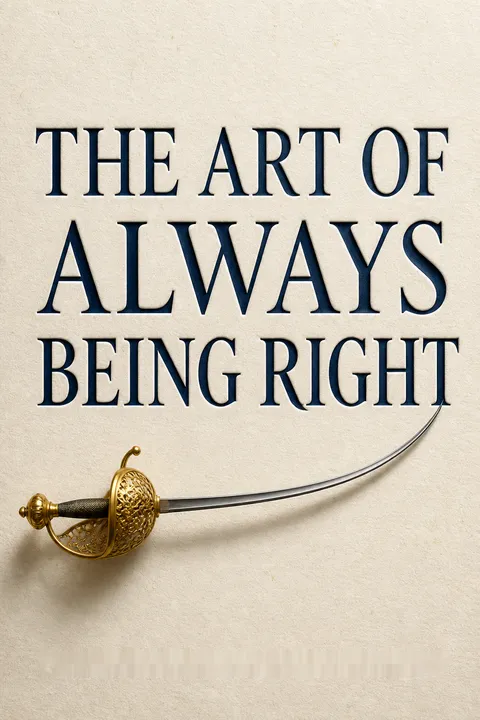
The Art of Always Being Right presents 38 strategies for winning arguments regardless of truth. Reviews reveal mixed reactions: many appreciate Schopenhauer's darkly humorous examination of human vanity and debate tactics, recognizing these fallacies in everyday discourse. Several Persian reviewers note the book's cynicism about reaching truth through logical discussion, with some finding it practical for identifying manipulative tactics while others reject its unethical approach. Critics cite poor organization, insufficient examples, and missing counter-strategies. Most agree the book exposes human nature's tendency toward victory over truth, though opinions differ on whether employing these tactics is justified.
People Also Read







About the Author




Download PDF
Download EPUB
.epub digital book format is ideal for reading ebooks on phones, tablets, and e-readers.








































