

Key Takeaways
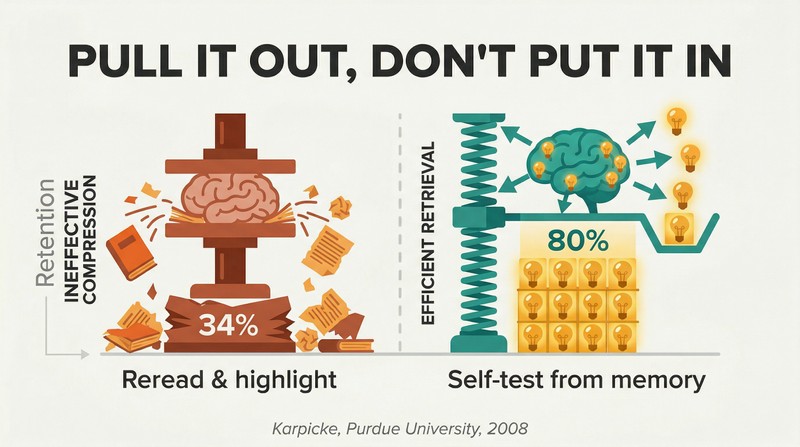
Self-test instead of reread: that one switch doubles retention
School trained you for passivity. We were taught to memorize and regurgitate — highlight, reread, repeat. It feels productive, but it barely works. A 2008 Purdue University study by Jeffrey Karpicke found that students who used active recall — testing themselves from memory — remembered 80% of new vocabulary, versus just 34% for those who only passively reviewed. The gap is enormous.
If your practice feels easy, it's not working. Flash cards succeed precisely because they force retrieval, not recognition. Every method in this book — deliberate practice, interleaving, spaced repetition — builds on this single principle: struggle is the signal that learning is actually happening. Comfort is the signal it's not.
Find the 20% of subskills that drive 80% of your progress
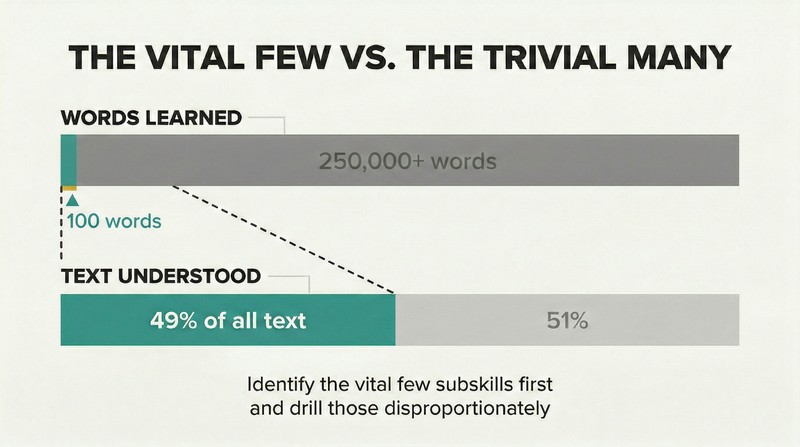
Most skills are bundles of subskills. Building a house isn't one skill — it's carpentry, electrical work, planning, and dozens more. Rapid skill acquisition starts with deconstructing your target skill into these components, then applying the Pareto principle: 80% of your results come from just 20% of your subskills.
Language learning proves this dramatically. Dr. Paul Nation's research shows the 10 most common English words comprise 23.7% of all text. A mere 100 words covers 49%. Dr. Alexander Arguelles found that only 2,500 words are needed to express anything you could ever want to say — out of 250,000+ English words. Whatever you're learning, identify the vital few subskills first and drill those disproportionately.
Drill your weakest spots, not the parts you already nail
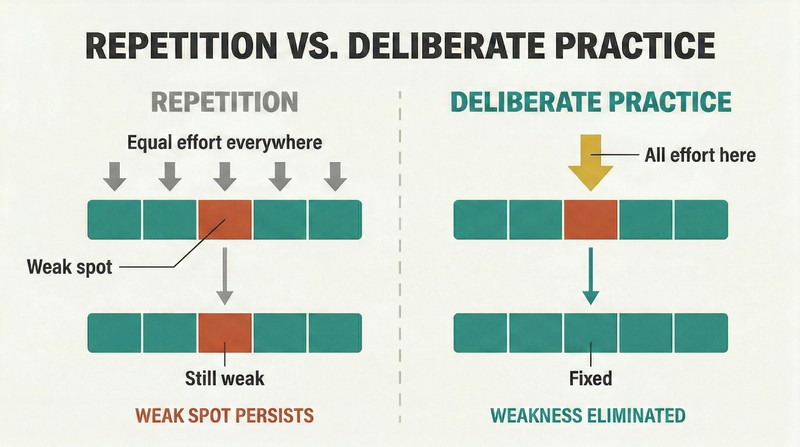
Deliberate practice is targeted and systematic. Unlike mindless repetition, it requires you to identify specific weaknesses and drill them relentlessly. Cal Newport used this to master discrete mathematics: he copied propositions onto blank paper, worked proofs independently, consulted sources only when stuck, then aggressively reviewed the ones he couldn't recall. He earned the highest grade in his entire class.
The piano analogy makes it concrete. If a song has trouble spots in the middle but everything else sounds fine, most people keep playing the whole piece. Deliberate practice demands you isolate the weak middle section and drill it until it's on par. Crucially, muscle memory doesn't distinguish good habits from bad — it cements whatever you repeat. Start slow and stop before fatigue makes you sloppy.
Mix topics within each session — interleaving beats block study
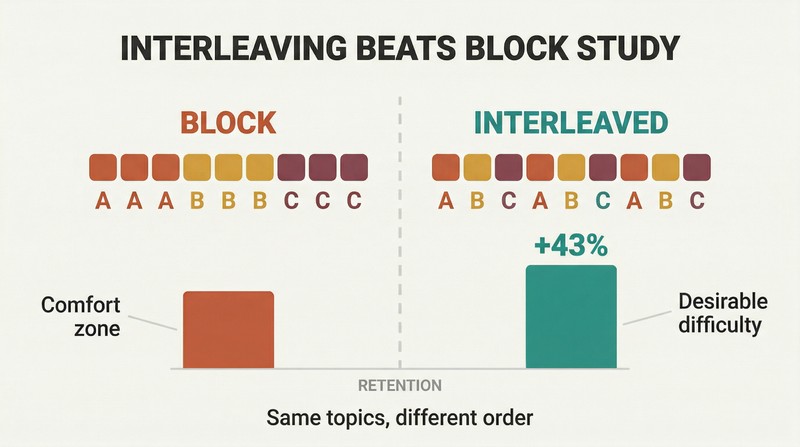
Interleaved practice means shuffling topics within a session. Instead of studying in blocks — all exponents, then all graphing, then all radicals (AAABBBCCC) — you alternate between them (ABC). Research shows interleaving produces a 43% increase in learning and retention compared to block study.
Three mechanisms explain the advantage. First, interleaving pushes you out of your comfort zone — the difficulty itself deepens learning. Second, each topic switch forces active recall since you can't coast on pattern recognition. Third, mixing related concepts builds unexpected connections between them, strengthening neural pathways. The caveat: this isn't multitasking. Stick to three or four related subjects — scales, chord progressions, and picking exercises on guitar, for instance — not wildly unrelated disciplines.
Study five minutes daily, not five hours on Saturday
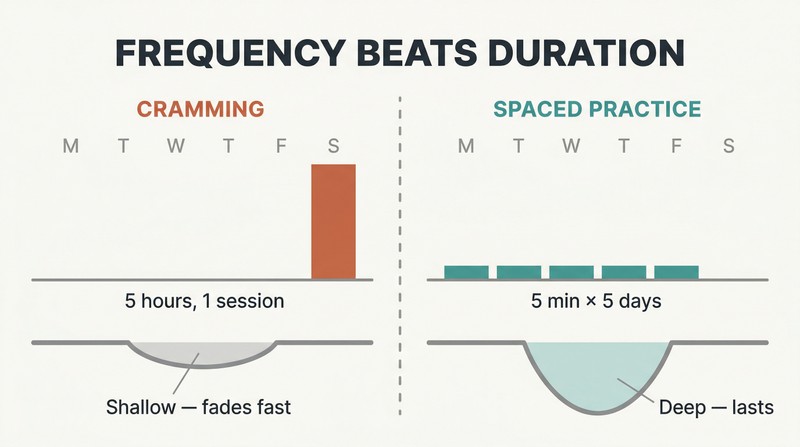
Spaced repetition prioritizes frequency over marathon sessions. The author demonstrates this with a Spanish history study plan: learn material Monday morning, review Monday evening (20 min), attempt active recall Tuesday morning (15 min), and continue brief sessions through Friday. Total additional time: roughly 75 minutes across the week. Yet you've revisited the material six extra times and likely committed most of it to memory.
Think of memory as a garden path. Each pass wears it deeper, but the ground needs time between passes to settle. Sleep is when synaptic connections physically form. Cramming is like stomping one patch of dirt and expecting a permanent trail. Even reviewing something once before sleep dramatically outperforms doing nothing at all.
Ask 'why' until you can't answer — that's your blind spot
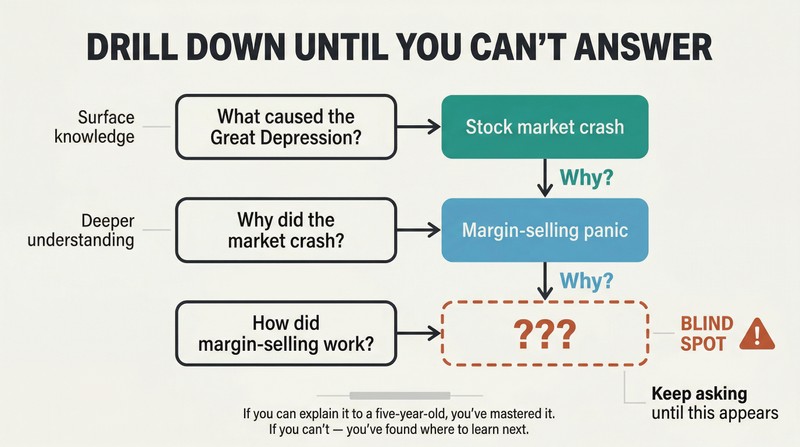
Elaborative interrogation is the "why chain" kids use naturally. Ask a question about your subject, answer it, then ask why that answer is true — and keep going. When you can no longer credibly answer, you've found a blind spot, a gap that surface-level knowledge hides. The author walks through the Great Depression as an example: What caused it? A stock market crash. Why did that happen? Margin-selling. How did margin-selling work? And so on.
The Feynman Technique formalizes this in four steps:
1. Choose a concept
2. Explain it in plain language, as briefly as possible
3. Identify where your explanation breaks down — those are blind spots
4. Create an analogy that maps the concept to something familiar
Pick a problem worth solving — the learning takes care of itself
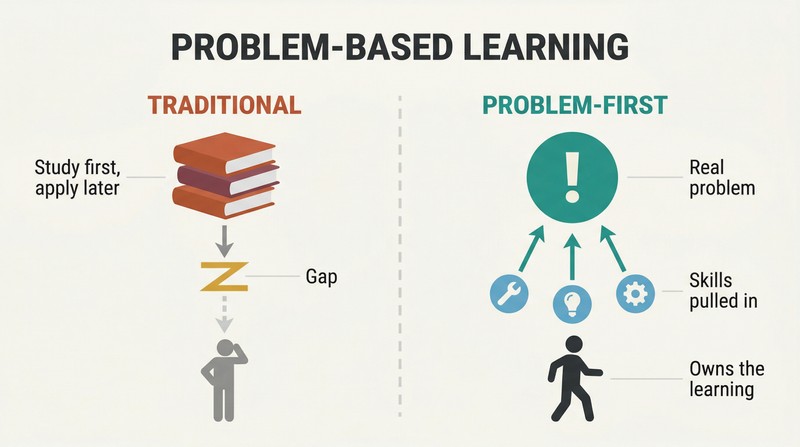
Problem-based learning flips the traditional model. Instead of learning information first and then applying it, you start with a real problem and acquire skills as a necessary byproduct of solving it. Medical schools pioneered this in the 1960s: students diagnosed real patient cases rather than memorizing textbooks, picking up clinical reasoning along the way.
The author's own teenage experience illustrates it vividly. Wanting to impress a girl in Spanish class who kept turning around to ask him for help, he studied obsessively — creating massive flash card sets, looking up obscure phrases, becoming fluent faster than anyone. He earned an A+. PBL works because real stakes produce real ownership: you own the problem, so you own the learning.
Be top 10% in three related skills, not top 1% in one
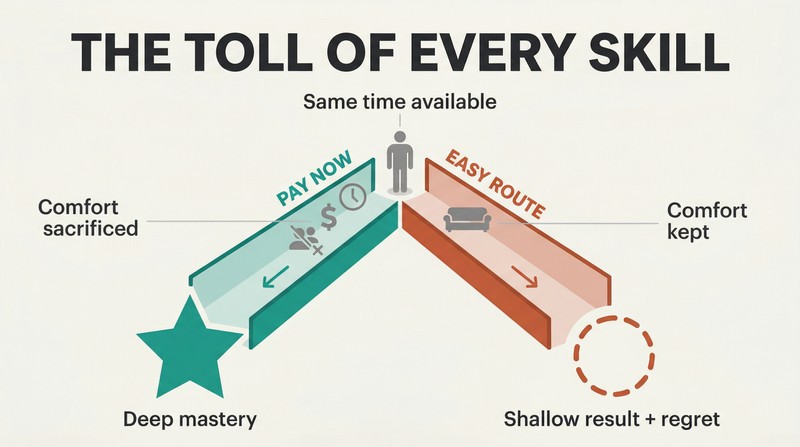
Skill stacking was popularized by Dilbert creator Scott Adams. Adams isn't the best cartoonist, funniest comedian, or sharpest businessperson — but combined, those above-average abilities created a comic strip syndicated in 65 countries with a reported $75 million net worth. A 2017 Boston Consulting Group study found that companies with more diverse skill sets produced 19% more revenue.
The math favors breadth over depth. Getting into the top 1% takes Carnegie Hall – level dedication. But reaching the top 10 – 15% in three complementary skills is far more attainable — often requiring just a few books and deliberate practice. A top-5% writer who also learns basic HTML and social media marketing can build, promote, and monetize their own platform, outearning more talented writers who can only write.
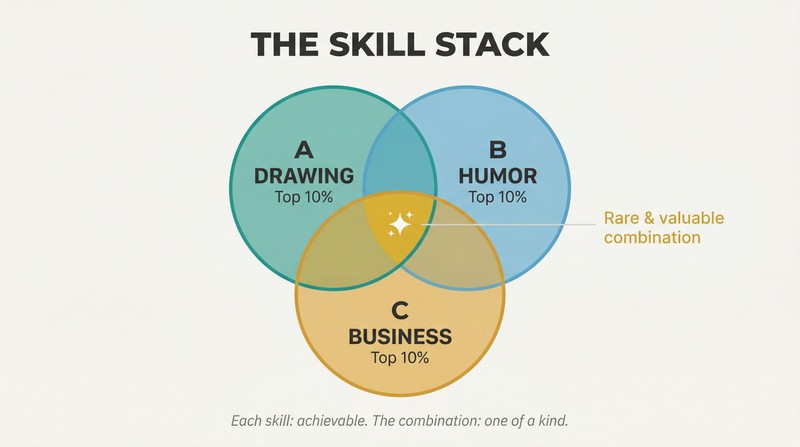
Your friends' habits are contagious — choose your circle deliberately
Social influence is measurable and massive. A New England Journal of Medicine study tracked 12,067 people over 32 years and found that when a friend became obese, a person's own risk rose 57%. For close mutual friends, the spike was a staggering 171% — regardless of geographic distance. Your circle doesn't just reflect you; it shapes you.
Curate your influences ruthlessly. Remove "Negative Nancys" who project their own fears onto your ambitions. Find mentors who earned skills from scratch — not natural talent — because they can articulate every step. Daniel Coyle's talent hotbeds, like Florentine art guilds and Brazilian futsal cooperatives, show that immersion in skilled communities makes expertise the new normal, even for the weakest member.
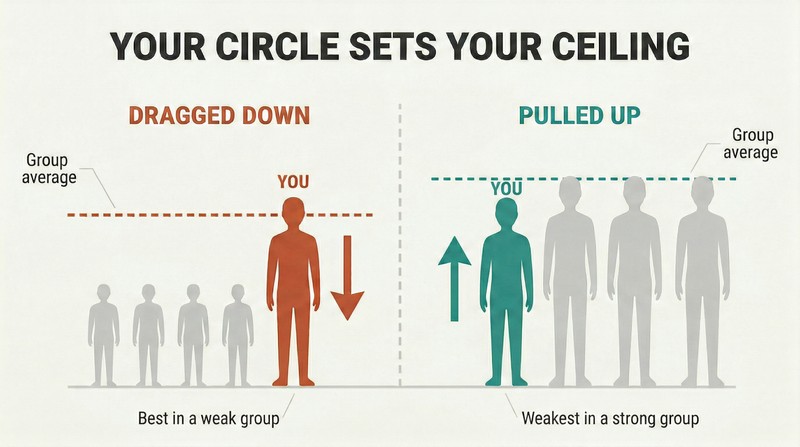
Redesign your space so the right choice requires zero willpower
Tiny environmental tweaks yield outsized results. Brian Wansink's Cornell study found that switching from 12-inch to 10-inch plates reduced food consumption by 22% — a two-inch change producing a one-fifth reduction. Mihaly Csikszentmihalyi calls this changing the activation energy: lower the effort needed to start good behaviors, raise it for bad ones.
Practical applications are deceptively simple. Place your instrument in the middle of the room with instructions on where to pick up. Put your gym bag in front of the door. Leave work materials where you can't avoid them. Conversely, hide distractions in another room — or inside five nested containers like a Russian nesting doll. The goal: make learning the default path, not a daily willpower battle you're likely to lose.
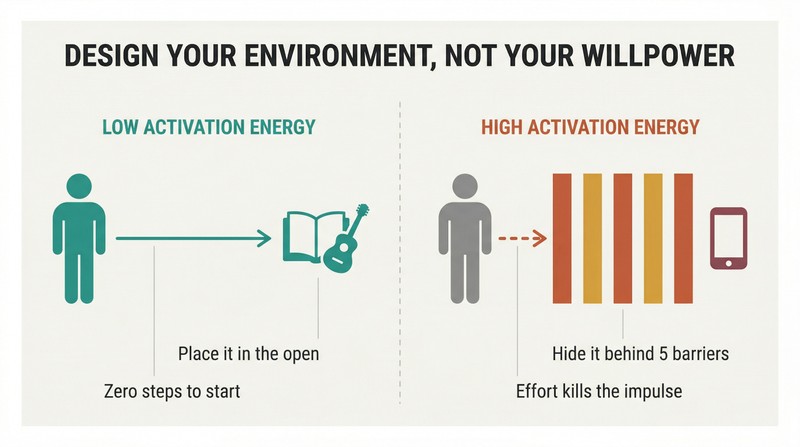
You already have the time — you just haven't made the sacrifice
Every skill demands an opportunity cost. The author contrasts two aspiring web designers: one invests money, time, and social life into comprehensive coding courses and emerges highly skilled. The other takes the free, easy route and gets a cookie-cutter website with zero transferable knowledge. The difference wasn't talent — it was willingness to sacrifice short-term comfort.
Set realistic expectations and push through confusion. A University College London study found habits take an average of 66 days to form; other research suggests 25 – 30 hours to conquer a skill's basics. Michael Gelb's concept of confusion endurance reminds us that feeling lost and frustrated is the normal state of learning, not a sign of failure. Thomas Edison reframed 1,000 failed attempts at the light bulb as "an invention with 1,000 steps."
Analysis
Peter Hollins' book occupies a peculiar niche in the learning-science genre: it is less a work of original research than a curated anthology of established cognitive science findings, repackaged for the self-directed learner. The book's core strength is synthesis. Hollins weaves together Anders Ericsson's deliberate practice framework, the Ebbinghaus spacing effect (formalized here as spaced repetition ), interleaving research from cognitive science, and Bloom's taxonomy into a single operational playbook. Few books manage to cover this much pedagogical ground while remaining genuinely accessible.
The skill stacking chapter, drawing on Scott Adams' framework, represents the book's most distinctive strategic contribution. While the practice techniques tell you how to learn, skill stacking tells you what to learn — a question most learning books neglect entirely. The Pareto principle applied to subskills is similarly valuable, offering learners a triage framework before they even begin practicing.
Where the book falters is in scientific rigor. The learning pyramid, which Hollins himself acknowledges has been largely debunked, is still presented as a useful heuristic — a somewhat contradictory stance. The specific retention percentages (5% for lectures, 90% for teaching) are not empirically validated, and presenting them alongside genuine research like Karpicke's active recall study creates an uneven epistemic floor. Similarly, the 'average of your five closest friends' claim is more motivational aphorism than established science.
What elevates the book above a typical self-help compilation is its emphasis on metacognition — thinking about your own thinking. The elaborative interrogation method, Feynman Technique, and Bloom's taxonomy all serve as mirrors that force the learner to confront what they don't know. This is perhaps Hollins' most important implicit argument: that the primary obstacle to learning isn't lack of effort or talent but a chronic inability to see one's own knowledge gaps. In a world saturated with Dunning-Kruger overconfidence and passive content consumption, tools for honest self-assessment may be the most valuable learning technology of all. The book's greatest service is making these tools accessible to people who were never taught them in school.
Review Summary
The Science of Rapid Skill Acquisition receives mixed reviews. Many readers find it a useful introduction to learning techniques, praising its clear organization and practical tips. Some appreciate the concise overview of concepts like deliberate practice, interleaved learning, and the Feynman technique. However, critics argue it lacks depth, originality, and scientific rigor. Some reviewers note that much of the information is available elsewhere or repetitive from the author's other works. Overall, it's seen as a decent starting point for those new to learning strategies, but potentially redundant for experienced readers.
People Also Read







Glossary
Deliberate practice
Targeted drilling of weaknessesPurposeful, systematic practice that identifies specific weaknesses and drills them with focused attention, as opposed to mindless repetition. The learner breaks their skill into subskills, pinpoints where they falter, and concentrates effort on those trouble spots until they reach a target level of competence. Mistakes are corrected before they become ingrained habits.
Interleaved practice
Mixing topics within sessionsA study method that mixes multiple related topics or skills within a single session (ABC pattern) rather than completing one topic before moving to the next (AAA pattern). Research shows it improves retention by 43% over block practice by forcing active recall, preventing pattern-based coasting, and strengthening connections between concepts.
Spaced repetition
Frequent, distributed review sessionsA learning strategy that distributes practice across multiple short sessions over days or weeks rather than concentrating it in long blocks. Also called distributed practice. Based on the principle that frequency of exposure matters more than duration, and that the brain needs rest periods—particularly sleep—to form neural connections and consolidate memories.
Problem-based learning
Learning through solving problemsA method where the learner starts with a real problem or goal and acquires knowledge and skills as a byproduct of solving it, rather than learning information first and applying it later. Originated in 1960s medical education where students learned through real patient cases. The learner must identify what they know, what they still need, and piece together solutions independently.
Elaborative interrogation
Self-questioning to find gapsA self-questioning technique where the learner asks successive 'why' and 'how' questions about a topic, following each answer with a deeper question—similar to a child's 'why chain.' The point where the learner can no longer answer reveals blind spots in understanding that need to be addressed through further study.
Feynman Technique
Simplify to reveal blind spotsA four-step comprehension method named for physicist Richard Feynman: (1) choose a concept, (2) explain it in plain language as if to a child, (3) identify where the explanation breaks down to reveal blind spots, and (4) create an analogy mapping the concept to something familiar. Inability to simplify indicates incomplete understanding.
Bloom's Taxonomy
Six-level comprehension hierarchyA six-level hierarchy of comprehension created by Benjamin Bloom in 1956 (updated 2001), ascending from Remember to Understand to Apply to Analyze to Evaluate to Create. Each level requires mastery of the previous one. Used as a personal barometer to identify where one's understanding currently falls and what cognitive work is needed to advance.
Skill stacking
Combining multiple above-average skillsA strategy popularized by Scott Adams (creator of Dilbert) where instead of pursuing top 1% mastery in a single skill, one develops top 10–15% proficiency in three or four complementary skills. The unique combination of ordinary individual skills creates more differentiation and market value than any single skill alone.
Confusion endurance
Persisting through learning discomfortA concept from Michael Gelb's book on Leonardo da Vinci describing the ability to persist through the discomfort, uncertainty, and frustration that inevitably accompany the early and middle stages of learning a new skill, rather than abandoning the task when it becomes difficult or confusing.
Active recall
Self-testing from memoryA learning strategy where the student retrieves information from memory through self-testing rather than passively reviewing notes or rereading material. A 2008 Purdue study by Jeffrey Karpicke found 80% retention with active recall versus 34% with passive review. Flash cards are the classic active recall tool.
Activation energy
Effort to start an activityAs used by Mihaly Csikszentmihalyi (author of Flow), the amount of effort required to begin a particular activity. Applied to learning environments: lower the activation energy for desirable behaviors (keep instruments visible, resources within reach) and raise it for undesirable ones (hide distractions in another room or behind barriers).
Subskills
Components of a larger skillThe individual component skills that combine to form a larger, complex skill. For example, guitar playing comprises subskills like finger dexterity, reading music, rhythm, and hand strength. Identifying and prioritizing the most impactful subskills—using the Pareto principle—accelerates overall skill acquisition by focusing effort where it matters most.
FAQ
What's "The Science of Rapid Skill Acquisition" about?
- Overview: The book by Peter Hollins focuses on advanced methods to learn, remember, and master new skills and information quickly and efficiently.
- Purpose: It aims to provide readers with strategies to accelerate their learning process, making it applicable to both personal and professional development.
- Content Structure: The book is divided into chapters that cover various aspects of skill acquisition, including strategic planning, practice techniques, and managing expectations.
Why should I read "The Science of Rapid Skill Acquisition"?
- Practical Techniques: The book offers actionable strategies that can be applied to any skill you wish to learn, making it highly practical.
- Efficiency in Learning: It emphasizes methods that enhance learning speed and retention, which is beneficial in today's fast-paced world.
- Personal Growth: By mastering new skills rapidly, you can improve your life circumstances and open up new opportunities.
What are the key takeaways of "The Science of Rapid Skill Acquisition"?
- Stages of Learning: Understanding the four stages of learning helps in planning the next steps effectively.
- Deliberate Practice: Focused and systematic practice is crucial for improving performance.
- Skill Stacking: Combining multiple skills can make you more unique and valuable than mastering just one.
How does Peter Hollins define "Deliberate Practice"?
- Purposeful and Systematic: Deliberate practice involves focused attention with the specific goal of improving performance.
- Identify Weaknesses: It requires identifying and drilling down on areas where you falter.
- Avoid Mindless Repetition: The practice should be intentional and not just repetitive motions.
What is "Skill Stacking" according to Peter Hollins?
- Multiple Skills: Instead of mastering one skill, aim to be in the top 10-15% in several complementary skills.
- Unique Value: This combination makes you more unique and valuable in the job market.
- Example: Scott Adams, creator of Dilbert, used skill stacking by combining business knowledge, humor, and artistic skills.
What is "Elaborative Interrogation" in the context of this book?
- Self-Explanation: It involves creating explanations for why certain facts are true, similar to a child's "why chain."
- Identify Blind Spots: This method helps in discovering areas where your understanding is lacking.
- Deep Comprehension: It encourages a deeper understanding of the subject matter by questioning the "why" and "how."
How does the "Feynman Technique" help in learning?
- Simplify Concepts: Write down an explanation of the concept in simple terms to test your understanding.
- Identify Gaps: This method helps in identifying gaps in your knowledge.
- Use Analogies: Creating analogies further tests your understanding and helps in explaining concepts to others.
What role do "Social and Physical Surroundings" play in skill acquisition?
- Social Influence: The people you surround yourself with can either support or hinder your learning process.
- Physical Environment: Your environment should be designed to minimize distractions and make learning easier.
- Role Models and Mentors: Having role models and mentors can provide guidance and motivation.
What is "Interleaved Practice" and why is it effective?
- Mixing Topics: It involves mixing the practice of several related skills in a single session.
- Better Retention: This method improves the brain's ability to discriminate between concepts and strengthens memory associations.
- Active Engagement: It keeps the brain engaged by preventing rote responses and encouraging active recall.
How does "Spaced Repetition" enhance learning?
- Frequency Over Duration: Focus on frequent, shorter study sessions rather than long, infrequent ones.
- Memory Retention: This method helps in moving information from short-term to long-term memory.
- Avoid Cramming: It is more effective than cramming, as it allows the brain time to process and make connections.
What are the best quotes from "The Science of Rapid Skill Acquisition" and what do they mean?
- "When you lose, don’t lose the lesson." This quote emphasizes the importance of learning from mistakes rather than being discouraged by them.
- "The elevator to success is out of order, but the stairs are always available." It highlights the necessity of hard work and persistence in achieving success.
- "You know nothing." This mindset encourages continuous learning and openness to new information.
How does Peter Hollins suggest managing expectations in learning?
- Realistic Goals: Set achievable expectations to avoid discouragement and maintain motivation.
- Long Road Ahead: Understand that learning is a gradual process and requires time and effort.
- Opportunity Costs: Be prepared to make sacrifices in terms of time, effort, and sometimes money to achieve your learning goals.
About the Author
Other books by Peter Hollins





Download PDF
Download EPUB
.epub digital book format is ideal for reading ebooks on phones, tablets, and e-readers.








































