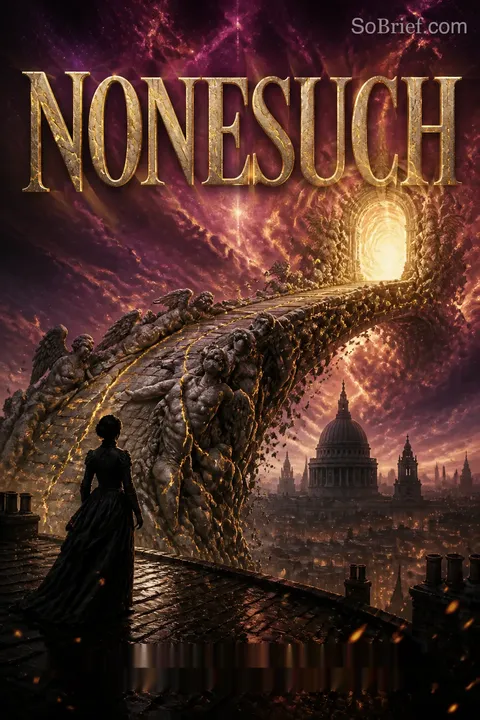

Plot Summary
Blackout Spell Unleashed
In the tense, dim world of wartime London, Iris Hawkins, a sharp, ambitious secretary in a City brokerage, impulsively recites a magical spell after hours in her office. The blackout, meant to shield the city from bombers, becomes the backdrop for something stranger: the awakening of a supernatural force. The Mariner statue outside her window comes alive, its stone eyes opening, and demands to know what she wants. Iris, half-mocking, asks to know "where all past years are." This moment, both absurd and terrifying, sets in motion a chain of events that will entwine magic, history, and the fate of the city. The spell's consequences ripple outward, drawing Iris into a world where the boundaries between the ordinary and the uncanny are dangerously thin.
City of Women and War
As war looms, London's rhythms shift: men vanish to the front, and women fill the city's offices, buses, and shelters. Iris navigates this new world, balancing her ambitions with the daily grind and the ever-present threat of bombs. The city's energy is anxious, its pleasures tinged with desperation. Nights are spent in Anderson shelters, days in the office, and the city's women—clerks, typists, and secretaries—become its backbone. The blackout deepens the sense of isolation and possibility. Iris's life is shaped by both the mundane (rationing, paperwork, office politics) and the extraordinary (the lingering effects of her spell, the sense that something unseen is watching). The city's transformation is both social and supernatural, as old hierarchies falter and new dangers emerge.
Nightclub Encounters and Divides
Iris's world expands when she's swept into the bohemian nightlife of pre-Blitz London. At a Soho club, she meets Eleanor, a sculptor; Miles, a clever socialist broker; Lall, a beautiful, icy BBC producer; and Geoff, a shy, technical genius. The evening is a collision of class, desire, and intellect. Iris's quick wit and ambition set her apart, but also expose her vulnerabilities. Rivalries flare—especially with Lall, whose contempt is as sharp as her cheekbones. The night is charged with flirtation, jealousy, and the sense that the city's future is being negotiated in its clubs as much as its boardrooms. The boundaries between friend and foe, lover and rival, are blurred, and the city's magic—both literal and metaphorical—begins to gather around Iris.
Lovers, Rivals, and Angels
Iris's impulsive connection with Geoff, the awkward, brilliant engineer, becomes a catalyst for both passion and peril. Their night together is electric, but leaves Geoff emotionally raw and Iris haunted by guilt and confusion. Meanwhile, the Watcher—a supernatural entity awakened by Iris's spell—begins to stalk her, its presence felt in the city's shadows. Lall's rivalry with Iris intensifies, fueled by jealousy and a sense of entitlement. The city's angels—beings of air and signal, both beautiful and terrifying—hover at the edges of perception, their motives unclear. The boundaries between love, rivalry, and the supernatural blur, as Iris is drawn deeper into a web of desire, ambition, and otherworldly threat.
The Watcher's Pursuit
The Watcher, a monstrous, shifting figure with a face of old newspaper, begins to pursue Iris across the city. Its presence is felt in the blackout's deepest shadows, in alleys and on rooftops, always just out of sight but never far away. Iris's fear grows as the Watcher's attacks become more brazen, culminating in a terrifying chase through the city's bomb-darkened streets. She seeks help from Geoff's father, Cyprian Hale, who reveals the Watcher's origins in a secret magical order and provides her with a dangerous charm to banish it. The confrontation in Leadenhall Market is a battle of wits, courage, and magic, with Iris using both her intellect and the charm to set the Watcher's captive spirit free. The victory is bittersweet, leaving Iris shaken and changed.
Markets, Money, and Betrayal
As the war deepens, the City's financial markets are transformed by regulation, scarcity, and fear. Iris, ambitious and clever, navigates the shifting landscape, seeking both survival and opportunity. She becomes a double agent of sorts, selling information to rival brokers while maintaining her position at C&B. The confiscation of foreign assets, the closure of markets, and the relentless paperwork of war finance create both drudgery and moments of insight. Iris's relationship with her boss, Mr. Cornellis, is marked by mutual respect and hidden secrets. The boundaries between loyalty and betrayal blur, as everyone scrambles to adapt to a world where the old rules no longer apply and the future is up for grabs.
The Order's Secrets
The magical order that once bound the Watcher is revealed to be entangled with the city's fascist undercurrents. Lall, the beautiful and ruthless BBC producer, emerges as both a rival and a threat, her ambitions fueled by both personal grievance and political ideology. The Order's secrets—rituals, statues, and the possibility of altering history—become the battleground for control of the city's fate. Iris and Geoff, aided by Cyprian Hale's knowledge and Eleanor's connections, race to decipher the Order's manuscripts and understand the network of enchanted statues that form a bridge to "Nonesuch," a place outside time where the past can be changed. The stakes are nothing less than the survival of the city—and the world as they know it.
Bombs, Bridges, and Statues
As the Blitz intensifies, the city is battered nightly by bombs, fire, and fear. Amid the chaos, Iris discovers that the enchanted statues scattered across the City form a magical bridge—a path to Nonesuch, where history can be rewritten. Lall, driven by a twisted sense of duty and love, seeks to use the bridge to undo the war's suffering, even if it means surrendering Britain to fascism. Iris, haunted by guilt and loss, must risk everything to stop her. The journey across the bridge is a surreal, perilous odyssey through twisted space and time, each statue a trap, each step a test of courage and resolve. The city's fate hangs in the balance, as magic and history collide.
The Bridge to Nonesuch
Iris, bound and helpless, is dragged by Lall across the magical bridge, each arch a new ordeal—vertigo, fire, the jaws of enchanted statues, the warping of space and time. Geoff, guided by the angel Raphael, follows to rescue her, risking his own life and sanity. At the bridge's end lies Nonesuch, a palace outside time, guarded by beings of impossible beauty and logic. Here, Lall seeks to rewrite history, to erase the war and its losses, but at the cost of freedom and the future. Iris, forced to confront her own capacity for violence and mercy, must make an impossible choice: to kill or to forgive, to change the past or to accept its pain. The journey is both literal and psychological, a confrontation with the deepest truths of love, loss, and hope.
Love, Loss, and Survival
The aftermath of the magical battle is marked by both relief and devastation. Geoff's father is killed in a bombing, leaving Geoff orphaned and adrift. Iris, wracked by guilt over her actions and the choices she's made, struggles to find meaning and forgiveness. Their love, tested by trauma and the demands of survival, becomes both a refuge and a challenge. The city, battered but unbroken, offers moments of grace: a Christmas service in a candlelit church, the comfort of friends, the promise of a future together. The war continues, but so does the possibility of happiness, rebuilt from the ruins.
The Enemy Within
The battle against Lall and the Order is mirrored by the city's struggle against fascism in its political and social forms. The Black House, the British Union of Fascists, and the insidious spread of hate are as dangerous as any spell or statue. The city's resilience is tested not just by bombs, but by betrayal, prejudice, and the temptation to surrender to despair or easy answers. Iris's victory is not just over magic, but over the forces that would erase difference, memory, and hope. The enemy is within as much as without, and the fight is ongoing.
The End of All Things
In Nonesuch, Iris is offered the chance to undo her greatest loss—the death of her brother in a childhood fire—at the price of erasing everything she has become. The temptation is overwhelming, but the cost is the loss of love, self, and the hard-won wisdom of suffering. The palace's guardians warn her, but the choice is hers. The act of mercy and the act of violence are intertwined; to save one life is to risk losing another. The end of all things is not destruction, but the erasure of meaning, memory, and selfhood. Iris's ultimate decision is both a sacrifice and a redemption.
The Price of Hope
The city survives the Blitz, battered but unbowed. Iris and Geoff, scarred by loss and haunted by what might have been, choose to build a life together. The price of hope is the acceptance of pain, the refusal to surrender to despair or to the false promise of erasing the past. The city's magic is not in its statues or its spells, but in the resilience of its people, the stubbornness of love, and the willingness to hope even when there are no guarantees. The future is uncertain, but it is theirs to make.
A City Remade by Fire
The great firestorm of December 29, 1940, devastates the City, but also marks a turning point. The magical network is broken, the threat of Nonesuch ended. The city's ruins are both a wound and a promise: what is lost cannot be restored, but what remains can be rebuilt. Iris, battered and exhausted, finds herself both a survivor and a witness. The city's endurance is mirrored in her own, and in the lives of those she loves. The fire remakes not just buildings, but hearts and hopes.
The Choice to Remember
In the aftermath, Iris is offered the chance to forget her pain, to rewrite her story, to become someone untouched by loss. But she chooses instead to remember—to carry the scars, the grief, and the love that have made her who she is. The city, too, chooses to remember, its ruins a testament to both suffering and survival. The story ends not with triumph or erasure, but with the quiet, stubborn choice to go on, to hope, and to remember.
Analysis
"Nonesuch" is a dazzling, genre-defying novel that fuses historical fiction, magical realism, and psychological drama into a meditation on memory, loss, and the stubbornness of hope. Set against the backdrop of the London Blitz, it explores how ordinary people—especially women—navigate a world shattered by war, prejudice, and the temptation to rewrite the past. The novel's central metaphor—the bridge to Nonesuch—serves as both a literal path to changing history and a symbol of the choices we make about what to remember and what to let go. Spufford's narrative insists that the price of hope is the acceptance of pain, that true resilience lies not in erasing suffering but in carrying it forward, transformed. The novel's women are its heroes: ambitious, wounded, fiercely alive, remaking themselves and their city in the face of destruction. "Nonesuch" is ultimately a celebration of endurance, love, and the refusal to surrender to despair or easy answers. Its lesson is both timely and timeless: that the future is made not by erasing the past, but by choosing, again and again, to remember, to hope, and to go on.
Review Summary
Nonesuch receives mostly positive reviews, with many praising its vivid portrayal of Blitz-era London, richly drawn characters—particularly protagonist Iris—and ambitious genre-blending of historical fiction and urban fantasy. Readers frequently highlight Spufford's distinctive prose and the compelling romance between Iris and Geoff. Common criticisms include pacing issues, overly dense writing, and the book's cliffhanger ending marked "To be continued," which frustrates many readers. Some find the fantasy elements underdeveloped or unnecessary, while others feel the book is overlong.
People Also Read

Characters
Iris Hawkins
Iris is the novel's heart: a working-class secretary with a mind for finance, a hunger for more, and a past marked by trauma and loss. Her intelligence and wit set her apart, but also isolate her. She is both a survivor and a risk-taker, drawn to danger—whether in love, magic, or ambition. Her relationships are complex: with Geoff, she finds both passion and vulnerability; with Lall, rivalry and a mirror of her own ambition; with the city, a sense of both belonging and exile. Iris's journey is one of self-discovery, as she confronts her own capacity for violence, mercy, and hope. Her psychological depth is marked by her refusal to be defined by her wounds, even as she is shaped by them. She is both the city's child and its challenger, a woman remaking herself in a world remade by war.
Geoffrey "Geoff" Hale
Geoff is a technical genius, awkward and earnest, whose innocence is both a strength and a vulnerability. Raised by a distracted, mystical father after his mother's death, Geoff is marked by loneliness and a longing for connection. His relationship with Iris is transformative, awakening both desire and fear. He is drawn into the magical conflict by love and loyalty, risking everything to save Iris and the city. Geoff's development is a journey from innocence to experience, from passivity to agency. His kindness is matched by a stubborn intelligence, and his capacity for care is both his gift and his burden. The loss of his father deepens his sense of isolation, but also propels him toward a new kind of partnership with Iris—a love forged in fire and loss.
Lady Lalage "Lall" Cunningham
Lall is both antagonist and mirror: a privileged, brilliant woman whose ambition and sense of entitlement are matched only by her capacity for cruelty. Her rivalry with Iris is fueled by jealousy, class, and a desperate need for control. Lall's journey is one of transformation: from fascist ideologue to a woman driven by love and a twisted sense of mercy. Her willingness to use magic to rewrite history is both a bid for power and an act of self-sacrifice. Psychologically, Lall is marked by a profound inability to accept vulnerability or loss, leading her to acts of both violence and tenderness. Her relationship with her ambulance crew reveals a capacity for love that is ultimately self-destructive. Lall is both villain and victim, her fate a warning about the dangers of unchecked will and the refusal to accept the limits of power.
Cyprian Hale
Geoff's father, Cyprian, is a relic of a vanished world: a former clergyman turned occultist, whose obsessions with magic and the Order have left him both wise and helpless. He is both a source of knowledge and a burden, his inability to cope with reality forcing Geoff into premature adulthood. Cyprian's kindness is genuine, but his detachment from the world is both comic and tragic. His death in the Blitz is a moment of profound loss, marking the end of innocence for both Geoff and Iris. Psychologically, Cyprian represents the dangers of nostalgia and the refusal to engage with the present, but also the enduring power of love and eccentricity.
Mr. Cornellis
Iris's boss at C&B, Mr. Cornellis is a figure of stability and decency in a world of chaos. His Jewish heritage and commitment to both his clients and his community make him both vulnerable and resilient. He is both mentor and foil to Iris, recognizing her talent and ambition while also embodying the limits of the old order. His secret involvement in smuggling bonds to help Jewish refugees reveals a hidden courage and a willingness to bend the rules for a higher good. Psychologically, Cornellis is marked by a deep sense of responsibility, a capacity for hope, and a quiet, understated heroism.
Eleanor Armbruster
Eleanor is a sculptor, a friend and occasional confidante to Iris, and a bridge between the worlds of art, politics, and magic. Her relationship with Miles Ormond is marked by mutual respect and independence. Eleanor's presence in the novel is a reminder of the possibilities of female friendship, artistic ambition, and the importance of community. She is both a witness and a participant in the city's transformation, her art reflecting the fractured, resilient spirit of London. Psychologically, Eleanor is marked by a calm self-assurance, a refusal to be defined by others' expectations, and a quiet, persistent hope.
Miles Ormond
Miles is a socialist broker, a man of both intellect and pragmatism, whose connections and insights help Iris navigate the world of finance and politics. His relationship with Eleanor is one of equals, marked by mutual respect and a shared commitment to both art and justice. Miles's role in the novel is both practical and symbolic: he represents the possibility of change from within the system, the importance of alliances, and the value of both skepticism and hope. Psychologically, Miles is marked by a dry wit, a capacity for friendship, and a willingness to act when it matters.
Raphael (the Angel)
Raphael is the supernatural presence at the heart of the novel's magical conflict: an angel of air and signal, both beautiful and terrifying, whose motives are both protective and inscrutable. Raphael's interventions are marked by both compassion and a strict adherence to rules, forcing Iris and Geoff to confront the limits of power and the dangers of tampering with time. Psychologically, Raphael is both a mirror and a challenge: a being who embodies both the promise and the peril of hope, the necessity of limits, and the cost of mercy.
Sonia, Delia, Mrs. Sinclair
These women, Iris's colleagues at C&B, represent the resilience, humor, and solidarity of London's working women. Their presence grounds the novel in the everyday realities of war: rationing, paperwork, gossip, and the quiet heroism of survival. Psychologically, they are marked by a mixture of stoicism, wit, and the capacity to endure. Their relationships with Iris are both supportive and competitive, reflecting the complexities of female friendship and ambition in a world turned upside down.
The Watcher
The Watcher is the monstrous, shifting entity awakened by Iris's spell: a being of old newspaper and shifting form, both terrifying and pitiable. Its pursuit of Iris is both a literal threat and a metaphor for the inescapability of the past, the dangers of unchecked power, and the costs of magic. Psychologically, the Watcher represents both the city's haunted history and the personal traumas that shape and pursue the characters. Its eventual release is both a victory and a loss, marking the end of one kind of danger and the beginning of another.
Plot Devices
The Bridge to Nonesuch
The central plot device is the existence of a hidden magical network in the City of London: a series of enchanted statues, each containing a captive angel, which together form a bridge to "Nonesuch," a place outside time where the past can be altered. This bridge is both a literal and metaphorical path, its traversal a test of courage, wit, and resolve. Each arch is a new ordeal—physical, psychological, and magical—reflecting the dangers of tampering with history and the costs of power. The bridge's existence is both a secret weapon and a threat, its use governed by strict rules and the risk of catastrophic consequences. The device allows the novel to explore themes of memory, loss, and the temptation to rewrite the past, while grounding the supernatural in the city's physical and historical reality.
Dual Narrative Structure
The novel's structure alternates between the intimate, psychological journeys of its characters and the broader sweep of historical events: the Blitz, the transformation of London, the rise and fall of fascism. This dual narrative allows for both a close focus on character and a panoramic view of the city's fate. The use of foreshadowing—both magical and mundane—creates a sense of inevitability and suspense, as personal choices are mirrored by historical turning points. The interplay between the ordinary and the extraordinary, the personal and the political, is central to the novel's emotional and narrative power.
Magical Realism and Psychological Depth
The novel's magic is both literal (spells, angels, enchanted statues) and metaphorical (the magic of love, hope, and survival). The supernatural is woven seamlessly into the fabric of wartime London, its rules and dangers reflecting the psychological realities of trauma, ambition, and desire. The use of magical realism allows for a deep exploration of character: Iris's magic hand, the Watcher's pursuit, the bridge to Nonesuch—all serve as externalizations of internal conflicts. The novel's psychological realism is heightened by its attention to detail, its nuanced portrayal of relationships, and its willingness to confront both the darkness and the possibility of redemption.
Thematic Motifs: Memory, Loss, and Hope
The novel is rich in motifs: the blackout, the city's statues, the recurring threat of fire, the tension between remembering and forgetting. These motifs serve as both plot devices and symbols, grounding the supernatural in the realities of war and survival. The tension between the desire to erase pain and the necessity of remembering is central, as is the question of what it means to hope in a world without guarantees. The novel's use of repetition, echo, and transformation creates a sense of both continuity and change, mirroring the city's own endurance.
Download PDF
Download EPUB
.epub digital book format is ideal for reading ebooks on phones, tablets, and e-readers.








































