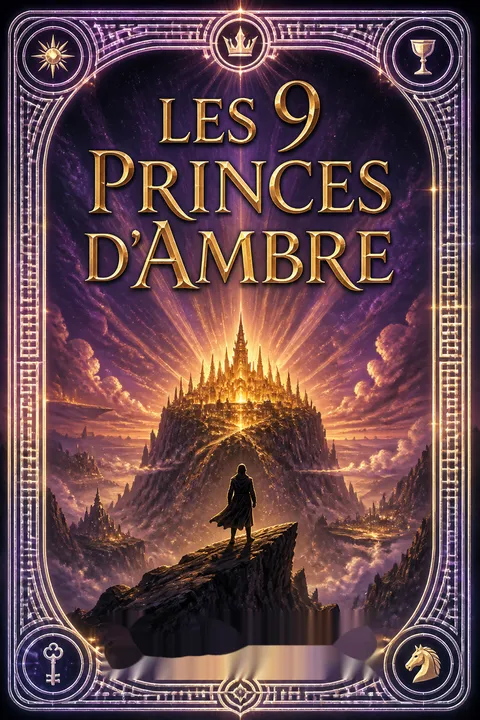

Résumé de l'intrigue
Awakening in Shadows
Corwin, the protagonist, regains consciousness in a hospital, his memory shrouded in fog. He quickly realizes he's being kept sedated against his will, and his instincts warn him of danger. Driven by suspicion and a fierce will to survive, he fakes compliance, overpowers his captors, and escapes. The world feels unfamiliar, and even his own name is uncertain. As he pieces together fragments of memory, he senses a deep, violent past and a burning need for answers. The emotional weight of isolation and paranoia presses on him, but his determination to reclaim his identity and agency is palpable. This chapter sets the tone for a journey of self-discovery, danger, and the relentless pursuit of truth.
The Fog of Memory
Corwin's search for identity leads him to the supposed sister who checked him into the hospital. He visits her, playing along with her expectations, and tries to extract information without revealing his amnesia. Their conversation is a tense dance of half-truths and veiled threats, revealing a family dynamic fraught with suspicion and rivalry. Corwin's memories flicker—names like Eric, Julian, and Bleys surface, each carrying emotional weight. The sense of urgency intensifies as he realizes he's entangled in a high-stakes game among powerful siblings. The emotional arc is one of confusion, anger, and the first stirrings of purpose as Corwin resolves to uncover the truth and reclaim his place in this mysterious family drama.
Sister's Gambit
Corwin's sister, Flora, is both a source of comfort and a potential betrayer. Their interactions are layered with manipulation, as each tries to gauge the other's intentions. Flora's warnings about Eric and hints about other siblings' ambitions deepen Corwin's sense of peril. The emotional tension is heightened by moments of genuine affection, quickly undercut by mutual distrust. Corwin's memories sharpen, and he begins to suspect that his accident and subsequent imprisonment were orchestrated by his own kin. The chapter explores themes of loyalty, betrayal, and the complexities of familial love, as Corwin navigates the treacherous waters of sibling rivalry and political intrigue.
Cards of Destiny
Alone in Flora's library, Corwin discovers a hidden deck of magical cards—Trumps—each depicting a member of his family. Handling the cards triggers a flood of memories: faces, names, and the realization that these are not ordinary siblings but princes and princesses of a place called Amber. The cards are cold, lifelike, and charged with power, symbolizing both connection and rivalry. Corwin's sense of self solidifies as he recognizes his own card and those of his brothers and sisters. The emotional impact is profound—a mix of nostalgia, longing, and the dawning awareness of his true heritage. The cards become a central plot device, linking the family across worlds and hinting at deeper powers.
The Gathering Storm
Corwin's brother Random arrives, pursued by monstrous assassins from the Shadows. Together with Flora, they fend off the attackers in a violent, chaotic battle, revealing the family's superhuman abilities and the dangers that stalk them. The aftermath cements a wary alliance between Corwin and Random, both recognizing the necessity of cooperation in the face of greater threats. The emotional tone shifts from suspicion to camaraderie, as shared danger forges bonds. The chapter underscores the relentless peril surrounding the family and the need for unity, even among rivals, when confronted by forces from beyond their reality.
Road to Amber
Corwin and Random set out on a perilous journey toward Amber, traversing a landscape that changes with their will—a phenomenon known as walking through Shadow. The road is fraught with obstacles, both natural and supernatural, as reality bends and reshapes itself according to their desires and memories. Corwin's amnesia becomes a liability, forcing him to rely on Random's guidance. The journey is a test of endurance, wit, and trust, as the brothers navigate ever-stranger worlds, pursued by enemies and haunted by the past. The emotional arc is one of growing confidence and the rekindling of Corwin's sense of purpose as he draws closer to his true home.
The Forest and the Hunt
Entering the Forest of Arden, Corwin and Random are hunted by their brother Julian, master of the forest and its deadly hounds. A high-speed chase and brutal confrontation ensue, showcasing the family's extraordinary prowess and the lethal stakes of their rivalry. Corwin's physical and mental resilience are pushed to the limit as he battles Julian and his monstrous beasts. The encounter ends with Julian's defeat and capture, but the victory is bittersweet—trust remains elusive, and the path to Amber is still fraught with danger. The chapter explores themes of rivalry, survival, and the blurred line between kinship and enmity.
The Pattern's Secret
Seeking to restore Corwin's lost memories, the siblings journey to Rebma, the underwater reflection of Amber. There, Corwin must walk the Pattern—a mystical labyrinth that tests his will and identity. The ordeal is harrowing, forcing Corwin to confront his entire past, from ancient battles to personal traumas. Each step on the Pattern is a struggle against overwhelming resistance, but with every victory, his memories and powers return. The emotional climax is one of catharsis and rebirth, as Corwin emerges whole, fully aware of his heritage, abilities, and the monumental task ahead: reclaiming Amber from his usurping brother, Eric.
The Siege of Amber
Reunited with his memories and powers, Corwin allies with his brother Bleys to challenge Eric's rule. Together, they raise vast armies from the Shadows and launch a daring assault on Amber. The campaign is epic and tragic—battles against monstrous foes, betrayals, and devastating losses. The brothers' forces are decimated by storms, magical traps, and the relentless defenses of Amber. The emotional toll is immense, as Corwin witnesses the deaths of countless followers and the collapse of their grand ambitions. The siege culminates in a desperate, bloody ascent of Kolvir, Amber's mountain, where heroism and futility intertwine.
The King's Curse
The assault on Amber ends in disaster. Corwin is captured, his army destroyed, and he is brought before Eric for public humiliation. Forced to crown his brother, Corwin seizes a moment of defiance, cursing Eric with all the power of a prince of Amber. In retaliation, Eric has Corwin's eyes burned out and casts him into the deepest dungeon. The emotional nadir is reached—Corwin is broken, blinded, and abandoned, yet his curse begins to manifest, unleashing chaos upon Amber. The chapter is a meditation on suffering, vengeance, and the indomitable will that refuses to be extinguished, even in utter darkness.
Years of Darkness
Corwin endures years of blindness and isolation in the dungeons of Amber. Time loses meaning as he cycles through despair, rage, and resignation. Occasional visits from old friends bring fleeting comfort, but the world above moves on without him. Yet, the blood of Amber is resilient—slowly, Corwin's eyes regenerate, a miraculous testament to his heritage. The emotional journey is one of endurance and transformation, as suffering tempers Corwin's resolve and prepares him for a new beginning. The darkness becomes both prison and crucible, forging a deeper strength and a renewed sense of purpose.
The Prisoner's Escape
Corwin's salvation comes in the form of Dworkin, the mad sorcerer and creator of the Trumps. In a surreal encounter, Dworkin sketches a magical gateway on the cell wall, allowing Corwin to escape through a Trump-portal to the distant lighthouse of Cabra. The escape is both literal and symbolic—a passage from darkness to light, from helplessness to agency. Corwin's ingenuity and the unpredictable aid of family magic underscore the themes of resilience and the enduring bonds of blood, even among the most fractured of families.
The Lighthouse Refuge
Safe in the lighthouse, Corwin recuperates under the care of Jopin, the keeper. The months spent in quiet isolation allow him to heal physically and emotionally, to reflect on his failures and the cost of ambition. The friendship with Jopin offers a rare respite from the endless machinations of Amber's royal family. Yet, the world is not at peace—Corwin senses the lingering effects of his curse and the unfinished business that calls him back to the struggle for Amber. The chapter is a pause, a gathering of strength before the final reckoning.
The Curse Unleashed
Before departing Cabra, Corwin observes the Valley of Garnath, now transformed into a haunted, monstrous landscape—a direct result of his curse upon Eric. The valley has become a new pathway for evil into Amber, a manifestation of Corwin's pain and rage. The realization is sobering; power wielded in anger has unforeseen and lasting consequences. The emotional arc is one of regret and responsibility, as Corwin acknowledges the darkness he has unleashed and the burden he must bear in setting things right.
The Promise of Vengeance
Recovered and resolute, Corwin sets out from Cabra, determined to reclaim Amber and fulfill his promise of vengeance against Eric. He sails into Shadow, seeking the means to challenge the throne once more. The chapter closes with a sense of hope and foreboding—a hero reborn, tempered by suffering, and driven by an unbreakable will. The emotional resonance is one of anticipation, as Corwin embraces his destiny, ready to face whatever trials await in the eternal struggle for Amber.
Analysis
"Nine Princes in Amber" is a masterwork of fantasy that explores the interplay of memory, identity, and power within a family of near-immortal beings. At its core, the novel is a meditation on the nature of reality—how it is shaped by will, perception, and the legacies of the past. Corwin's journey from amnesiac exile to reborn contender mirrors the universal quest for self-knowledge and agency. The narrative's structure—fragmented, recursive, and dreamlike—reflects the instability of both memory and the multiverse, inviting readers to question the boundaries between truth and illusion. The family dynamic is both archetypal and deeply personal, capturing the tensions of love, rivalry, and betrayal that define human relationships. The novel's use of magical devices—the Trumps, the Pattern, Shadow—serves as both plot machinery and metaphor, illustrating the power and peril of creation, choice, and ambition. Ultimately, "Nine Princes in Amber" is a story of resilience: the capacity to endure suffering, to adapt, and to reclaim one's destiny, even in the face of overwhelming odds. Its lessons are timeless—about the costs of power, the dangers of hatred, and the redemptive potential of self-discovery and hope.
Résumé des avis
Reviews for Nine Princes in Amber are mixed, averaging 4.04/5. Fans praise Zelazny's imaginative multiverse concept, fast-paced action, and the clever use of amnesia to immerse readers in the world of Amber. Corwin is lauded as a compelling protagonist with a distinct voice. Critics cite uneven writing, inconsistent dialogue blending archaic and 1970s slang, shallow characterization, and rushed battle sequences. Some feel the worldbuilding lacks depth, while others consider it a pioneering classic that influenced countless fantasy writers.
Les lecteurs ont aussi lu
Characters
Corwin
Corwin is the central figure—a prince of Amber, initially stripped of memory and power, but driven by a fierce will to survive and reclaim his birthright. His journey is one of self-discovery, resilience, and transformation. Corwin's relationships with his siblings are complex, marked by rivalry, affection, and betrayal. Psychologically, he is both ruthless and introspective, capable of great violence and deep regret. His development is shaped by suffering—imprisonment, blinding, and loss—yet he emerges stronger, wiser, and more determined. Corwin embodies the archetype of the exiled hero, whose quest for identity and justice is both personal and cosmic.
Eric
Eric is Corwin's chief antagonist—a charismatic, cunning, and formidable prince who seizes the throne of Amber. His relationship with Corwin is defined by rivalry, mutual hatred, and a shared sense of destiny. Eric's psychological profile is that of a Machiavellian ruler, willing to employ any means to secure power. He is both admired and feared by his siblings, and his actions—blinding Corwin, orchestrating betrayals—reveal a capacity for cruelty and strategic brilliance. Eric's reign is haunted by Corwin's curse, and his development is a study in the costs of ambition and the fragility of power.
Random
Random is a younger prince, resourceful, unpredictable, and fiercely independent. Initially pursued and endangered, he becomes Corwin's key ally in the journey to Amber. Random's relationship with Corwin evolves from suspicion to genuine camaraderie, forged in shared danger and mutual goals. Psychologically, Random is both sentimental and pragmatic, capable of loyalty but always wary of betrayal. His development reflects the challenges of trust and the necessity of alliance in a family where every bond is fraught with risk.
Flora (Florimel)
Flora is Corwin's sister, a master of social maneuvering and self-preservation. Her interactions with Corwin are marked by a blend of affection, rivalry, and calculation. Flora's primary motivation is survival—she aligns herself with the strongest power, shifting loyalties as circumstances demand. Psychologically, she is perceptive, adaptable, and emotionally guarded. Flora's development highlights the complexities of familial love in a world where trust is a luxury and betrayal a constant threat.
Bleys
Bleys is a flamboyant, brilliant tactician, eager to challenge Eric's rule. His alliance with Corwin is both pragmatic and fraternal, driven by shared ambition and mutual respect. Bleys is a risk-taker, willing to gamble everything for a chance at the throne. Psychologically, he is confident, charming, and occasionally reckless. His development is marked by heroism and futility—the failed assault on Amber is both his greatest triumph and his undoing, revealing the limits of even the most audacious plans.
Julian
Julian is the master of the Forest of Arden, a prince whose loyalty to Eric is unwavering. He is methodical, disciplined, and emotionally distant, embodying the archetype of the implacable pursuer. Julian's relationship with Corwin is adversarial, defined by past grievances and present conflict. Psychologically, he is driven by duty and a rigid sense of order. His development is a study in the dangers of loyalty and the costs of enmity within a family of rivals.
Caine
Caine is a prince whose primary allegiance is to himself. He is shrewd, adaptable, and skilled in both diplomacy and warfare. Caine's relationships are transactional—he shifts sides as it suits his interests, making him both a valuable ally and a dangerous foe. Psychologically, Caine is pragmatic, calculating, and emotionally detached. His development underscores the theme of shifting alliances and the moral ambiguity that pervades the royal family.
Gerard
Gerard is the physically strongest of the princes, known for his straightforwardness and integrity. He is less ambitious than his siblings, often serving as a stabilizing force in the family's conflicts. Gerard's relationship with Corwin is marked by respect and a degree of trust, though he is wary of being drawn into schemes. Psychologically, Gerard is honest, dependable, and somewhat naïve in the context of Amber's political machinations. His development highlights the value of loyalty and the tragedy of being caught between greater powers.
Deirdre
Deirdre is Corwin's favorite sister, a figure of beauty, strength, and vulnerability. Her rescue and subsequent involvement in Corwin's quest add emotional depth and personal stakes to the narrative. Deirdre's relationship with Corwin is one of genuine affection, contrasting with the suspicion that marks other sibling bonds. Psychologically, she is courageous, compassionate, and marked by a sense of loss. Her development serves as a reminder of what is at stake in the struggle for Amber—not just power, but family and love.
Dworkin
Dworkin is the enigmatic architect of Amber's magical systems, a figure both revered and feared. His appearance in Corwin's cell is surreal and transformative, providing the means of escape and underscoring the unpredictable nature of power in Amber. Psychologically, Dworkin is brilliant, eccentric, and unstable—a genius whose creations shape the fate of worlds. His development is peripheral but pivotal, embodying the theme of magic as both salvation and danger.
Plot Devices
Amnesia and Unreliable Memory
The story's opening device—Corwin's amnesia—serves as both a plot catalyst and a means of exposition. It allows the reader to discover the world of Amber alongside the protagonist, creating suspense and empathy. The gradual return of memory is mirrored by the unfolding of the central conflict, with each revelation raising new questions and stakes. This device also enables deep psychological exploration, as Corwin's identity is reconstructed through action, interaction, and ordeal.
The Trumps
The Trumps—magical tarot-like cards depicting the royal family—are a central plot device, enabling instant communication and travel across worlds. They symbolize both the bonds and the rivalries of the family, serving as tools of alliance, betrayal, and escape. The Trumps also function as a metaphor for fate and agency, with each card representing a possible path or outcome. Their use introduces elements of unpredictability, magic, and the interconnectedness of the narrative's many threads.
The Pattern
The Pattern is a magical construct that grants the power to walk through Shadow, shaping reality itself. Walking the Pattern is both a rite of passage and a crucible, forcing the protagonist to confront his deepest fears and memories. It serves as a narrative turning point, restoring Corwin's identity and abilities. The Pattern embodies themes of order, destiny, and the cost of power, and its traversal marks the transition from victim to agent, from exile to contender.
Shadow and Reality
The concept of Shadow—an infinite array of parallel worlds, all reflections of Amber—enables a narrative of constant transformation and possibility. The ability to walk through Shadow is both a gift and a curse, offering escape, adventure, and danger. This device allows for a fluid, dreamlike narrative structure, where reality is malleable and the boundaries between worlds are porous. It also serves as a metaphor for identity, choice, and the search for meaning in a multiverse of possibilities.
Family Rivalry and Betrayal
The central conflict of the narrative is the struggle among the royal siblings for the throne of Amber. Alliances shift, betrayals abound, and every relationship is fraught with suspicion. This device creates a web of intrigue, suspense, and emotional complexity, as love and hate coexist in every bond. The family dynamic is both universal and heightened, reflecting the psychological realities of rivalry, ambition, and the longing for acceptance and power.
Foreshadowing and Prophecy
Throughout the narrative, foreshadowing is used to build tension and anticipation. Corwin's curse, the transformation of Garnath, and the unresolved fates of missing siblings all point to future upheavals. Prophetic dreams, omens, and the magical properties of the Trumps and Pattern reinforce the sense that destiny is both inescapable and mutable, shaped by the choices and passions of the characters.
Télécharger le PDF
Télécharger l'EPUB
.epub digital book format is ideal for reading ebooks on phones, tablets, and e-readers.








































