
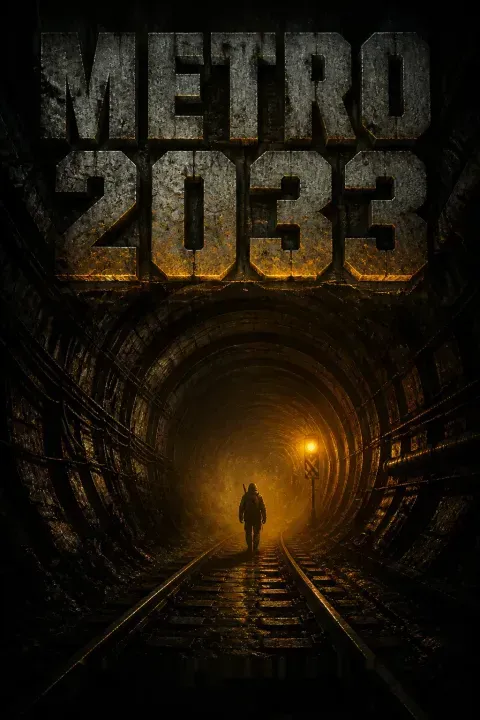


Plot Summary
Hunter's Mission Launched
While Artyom1 stands patrol at VDNKh, a stranger named Hunter2 questions him about his stepfather Sukhoi.5 Later, in their tent, Hunter2 and Sukhoi5 argue bitterly about the dark ones: Sukhoi5 sees them as evolution's replacement for humanity, inevitable extinction.
Hunter2 rejects this as defeatism. Before leaving, Hunter2 pulls Artyom1 aside and extracts a secret in exchange for a mission. Artyom1 confesses that as a child he and his friends opened the hermetic gate at the Botanical Gardens station, climbing to the surface.
Hunter2 connects this to the dark ones' incursions and announces he will investigate their nest. He hands Artyom1 a metal capsule and orders him to deliver it to a man named Melnik4 in Polis if Hunter2 does not return within two days.
This exchange mirrors a Faustian bargain stripped of supernatural trappings. Hunter, who calls himself a macrophage of the metro's immune system, entrusts a reluctant boy with existential responsibility. The childhood confession operates as original sin: Artyom's curiosity literally opened the door to the threat. Hunter's self-appointed role as exterminator reflects a worldview where complex threats are reduced to targets, a philosophy the novel's climax will devastatingly undermine. The capsule becomes the first link in a causal chain that transforms Artyom from passive station-dweller into an unwilling agent of fate.
The Pipe's Maddening Voice
Artyom1 joins a caravan heading south toward Rizhskaya. In the tunnel between Alekseevskaya and Rizhskaya, he begins hearing a whistling whisper that no one else perceives. The noise grows deafening yet remains inaudible to the others. One by one his companions collapse: the commander drops unconscious, Kirill walks like a sleepwalker into the darkness, a rearguard sits weeping on the rails.
Artyom1 alone retains his senses. He slaps Zhenya14 awake, chases down Kirill and shines a light into his closed eyes to break the trance, and convinces the weeping man to help push the cart forward by telling him the voices want him to assist. Once clear of the broken pipe, everyone recovers, remembering nothing.
This episode introduces the metro as a sentient, hostile architecture. The pipe becomes a conduit for something the novel will later theorize as trapped souls or low-frequency sound waves, but its effect is consistent: it dissolves agency and reason. Artyom's immunity marks his first separation from ordinary humanity, hinting at the telepathic receptivity that the dark ones have been cultivating in him. His pragmatic response, slapping and tricking his companions back to functionality, reveals a nascent leadership forged in crisis rather than choice.
Bourbon's Prophetic Death
At Rizhskaya, a trader named Bourbon13 hires Artyom1 to guide him through a black, sound-swallowing tunnel toward Sukharevskaya. As they walk, Bourbon's13 speech transforms into cryptic, archaic pronouncements about darkness dominating eternally.
Artyom1 is too dulled to notice the change until Bourbon13 turns to him with contracted pupils, announces he has died, and collapses. Artyom1 drags the body forward, stumbling over other corpses from a previous caravan, until an old man finds him.
The rescuer, who calls himself Khan,3 dismisses Bourbon13 as dead and leads Artyom1 to the half-station of Sukharevskaya. Later, Khan3 reveals he performed funeral rites for Bourbon13 while Artyom1 slept, having been warned of Artyom's1 arrival in a vision sent by a shaven-headed man in white.2
Bourbon's death, with its eerily scripted final words, transforms the tunnel noise from nuisance into lethal force. His borrowed prophecies suggest the pipes carry not mere sound but fragments of consciousness, a digital afterlife of trapped souls. Khan's introduction as a man who believes himself Genghis Khan reincarnated and who freely admits his own madness while wielding genuine clairvoyance sets up the novel's central epistemological puzzle: in the metro, the line between revelation and delusion has no stable boundary.
Khan Forges a Caravan
At Sukharevskaya, a thin man tells a story about plague at Aviamotornaya. A bearded thug named Ace decides the man must be a carrier and prepares to execute him as prophylaxis. Artyom1 tries to intervene but Khan3 stops him. The terrified man flees into the southern tunnel, where his screams cut off instantly.
Khan3 then addresses the agitated crowd, declaring the air is poisoned and they must all leave immediately for Kitai Gorod. When Ace challenges his authority, Khan3 locks eyes with him and commands submission. Ace drops his weapon. Khan3 later explains that people are jackals but he is a wolf, and that some stations know him only by that name. A caravan of ten forms within minutes.
Khan's manipulation of the mob demonstrates raw charismatic power operating beneath any coherent ideology. He weaponizes the very superstition that paralyzes others, redirecting fear from paralysis into motion. His self-identification as a wolf among jackals echoes Nietzsche's master morality while simultaneously evoking the literal predators humans have become underground. The caravan he assembles is not a community but a temporary pack, held together by the alpha's will alone, a microcosm of every political arrangement in the metro.
Kitai Gorod Under Siege
The caravan reaches Kitai Gorod, a sprawling market station split between Slavic and Caucasian gangs. Artyom1 eats at a restaurant, listens to musicians, and observes the chaotic commerce. Suddenly gunfire erupts from the Tretyakovskaya tunnel: masked attackers in camouflage are slaughtering the Slavic bandits.
Artyom1 runs toward the Kuznetsky Most tunnel with fleeing civilians. In the chaos he encounters an elderly man, Mikhail Porfirevich,7 collapsed with heart trouble beside his disabled grandson Vanechka. Artyom1 retrieves nitroglycerine from the old man's bag and helps them both escape into the tunnel. Behind them, Kitai Gorod burns.
The attack on Kitai Gorod shatters the illusion that any station is truly safe, even one governed by brutal equilibrium. Artyom's decision to stop for Mikhail and Vanechka, when every instinct screams for self-preservation, is his first fully moral act of the journey. It also initiates a recurring pattern: Artyom collects the wounded and helpless, and those attachments will later become the source of his deepest guilt. The fascists' masked raid foreshadows their later role as the novel's most nakedly ideological evil.
The Fourth Reich's Justice
At Kuznetsky Most, a border guard helps Mikhail7 and Artyom1 slip past the Red Line agents pursuing Mikhail7 for seditious talk about University station. They press on toward Pushkinskaya, now part of the Fourth Reich. In the approach tunnel they find three executed bodies with signs warning non-Russians away.
At the fascist checkpoint, an officer demands Mikhail7 undress for a search. When Vanechka lunges at the officer, the man shoots the boy twice. Artyom1 tears free from the soldiers holding him, retrieves his hidden machine gun, and fires a burst into the officer's chest. He is beaten unconscious and awakens in a cage at Tverskaya station, sentenced to hang at dawn.
The Fourth Reich scenes distill ideology into its purest form: arbitrary classification followed by extermination. The officer's bureaucratic sadism and the swastika-derivatives on every wall demonstrate how thoroughly pre-war racism has adapted to underground conditions. Artyom's killing of the officer is not heroism but instinct, an act his body performs before his mind can consent. The chapter title, 'Du Stirbst' (You Die), comes from the German poem Mikhail had been reciting, and its fatalism now applies to Artyom's own situation.
Rescued at the Gallows
Artyom1 spends his final hours in a cage at Tverskaya, his cellmate a dark-haired man named Ruslan. At four in the morning, guards take him to a scaffold on the tracks. The executioner fits a noose around his neck. As the officer reads the sentence, gunfire erupts from the tunnel. A smoke bomb fills the station. Artyom1 loses consciousness as the rope tightens.
When he wakes, a narrow-eyed man is slapping his cheeks. He has been rescued by the First International Red Fighting Brigade in the name of Ernesto Che Guevara, a band of Trotskyite revolutionaries who oppose both the Red Line's Stalinism and the fascists. Their commissar, Rusakov,11 welcomes Artyom1 aboard their motorized trolley.
The rescue arrives with the mechanical absurdity of a deus ex machina yet feels earned because the novel has established the metro as a web of competing ideologies, each generating its own armed factions. The revolutionaries, with their dog-eared Che portrait and dialectical arguments about headless mutants, are simultaneously ridiculous and noble. Their intervention severs Artyom from certain death while demonstrating that even the most marginal political sect can alter individual fates in this fragmented world.
Escape Through Excrement
The revolutionaries deposit Artyom1 at Paveletskaya, a station missing its hermetic gate, where 'newcomers' crawl down from the surface at night. A guard named Mark befriends Artyom1 and wagers him against the station chief's champion rat in a race. Mark's rat freezes; they lose. Both are sentenced to one year cleaning Hansa latrines.
For five days Artyom1 shovels filth, becoming invisible through sheer repulsiveness. Noticing the guard at the tunnel exit has momentarily disappeared, Artyom1 walks out covered in excrement, passes through Dobryninskaya unchallenged, and exits Hansa territory. At Serpukhovskaya, a rosy-cheeked man named Brother Timothy approaches him with unusual kindness, offering shelter.
The latrine sequence literalizes the novel's undercurrent of abjection. Artyom's fall into filth becomes his paradoxical salvation: humans recoil from their own waste, and that recoil creates an invisibility cloak more effective than any stealth technology. The rat race itself mirrors the metro's broader economy, where life and freedom are wagered on arbitrary outcomes. Mark's impulsive bet, rooted in a midlife hunger for meaning and ownership, nearly destroys both men but ultimately opens the route Artyom needs.
The Watchtower's Hollow Gospel
Brother Timothy leads Artyom1 to a train called the Watchtower, where a congregation of Jehovah's Witnesses lives. After washing and feeding Artyom,1 Timothy brings him to a sermon by Elder John, who explains that Armageddon has already occurred, the survivors in the metro are God's chosen people, and the thousand-year reign of Christ will soon transform the earth into paradise.
Artyom,1 listening to the crowd's ecstatic responses, finally asks what Jehovah says about headless mutants. The room goes cold. Artyom1 walks out, passing a staged morality play about a bullied boy. Timothy follows, begging him to return and listing sins to avoid. Artyom1 runs back into the tunnel, pursued by shouts about the borrowed cassock he is still wearing.
The Jehovah's Witness episode serves as Artyom's first systematic encounter with organized religion as explanatory framework. Elder John's narrative cleverly repurposes nuclear catastrophe as divine justice, offering survivors the flattering role of the elect. Artyom's question about headless mutants punctures this closed system: it is the question faith cannot answer because the mutants are empirically real while the God who would explain them is not. His departure, stealing a cassock, is both escape and desecration, a small rebellion against meaning imposed from without.
Polyanka's Fateful Conversation
In the tunnel to Polyanka, Artyom1 experiences a phantom pursuer whose steps echo his own and a whisper that tells him to wait. He stops, then continues. At Polyanka, an abandoned station filled with junk and a cat, two older men named Yevgeny Dmitrievich and Sergei Andreyevich sit by a fire burning books.
They tell him legends of Metro-2 and the Unseen Watchers. Sergei Andreyevich then explains his theory: life has no predetermined fate, but if a person makes consistently right choices at crossroads, events begin arranging themselves into a plot.
Randomness yields to narrative logic. Artyom1 leaves with renewed conviction, walking into the final tunnel toward Polis. Later, the officers at Polis will dismiss Polyanka as a gas-induced hallucination.
Sergei Andreyevich's theory of emergent fate provides the philosophical spine for everything that follows. It is neither determinism nor chaos but a third option: meaning as achievement rather than discovery. The theory reframes Artyom's journey not as divine mission but as self-authored narrative, a plot he writes through persistence. The ambiguity, whether the Polyanka encounter was real or hallucinatory, is the point: it functions regardless. The cat staring with unnervingly intelligent eyes embodies this epistemological uncertainty.
Polis Rejects Its Supplicant
Artyom1 reaches Borovitskaya station, the entrance to Polis. Border guards contact Melnik.4 While waiting, Artyom1 meets Daniel,6 a young Brahmin who explains Polis's caste system: Brahmins guard knowledge, kshatriyas are warriors, and the Council shares power between them.
Daniel6 reveals that the Great Library above contains a single Book with black pages and gold letters that records all future history. The next morning, Artyom1 delivers Hunter's capsule to Melnik,4 then addresses the Council.
The military officers scoff at his claims, and the Council announces Polis will not help VDNKh. Afterward, Daniel6 secretly brings Artyom1 to a darkened room where Brahmin elders propose a trade: retrieve the Book from the Library, and they will give Artyom1 knowledge to destroy the dark ones.
Polis, the metro's last bastion of civilization, reveals itself as a paralyzed oligarchy whose vaunted knowledge serves institutional stasis rather than action. The Brahmins' secret offer exposes the Council's public refusal as theater: power operates through backroom deals, and the Book they seek is not wisdom but leverage. The revelation that the Library's millions of volumes exist to conceal one volume of prophecy transforms the surface into a temple whose true god is information asymmetry. Artyom accepts the bargain not from faith but from absence of alternatives.
Librarians in the Stacks
Artyom,1 Daniel,6 Melnik,4 and a stalker named Ten ascend to the surface and enter the Great Library. In the Main Reading Room, grey humped creatures called librarians attack. Melnik4 and Ten hold them off while Artyom1 and Daniel6 flee through labyrinthine corridors to the stack archives. On the nineteenth level, as Daniel6 stoops to tie his bootlace, a librarian attacks him from behind, ripping open his belly.
Artyom1 finds Daniel6 seated in a pool of blood, the creature hiding behind him mimicking their words. Daniel6 begs Artyom1 to shoot. Artyom1 fires a full-auto burst through his friend into the librarian. Before dying, Daniel6 presses a blood-soaked envelope into Artyom's1 hand. Artyom1 escapes the Library alone, unable to find the Book.
The librarian sequence recasts knowledge as predator. These creatures, once human library staff mutated by radiation, now guard their domain with simian ferocity and a terrifying capacity for vocal mimicry. Daniel's death by book-stack is the novel's cruelest irony: the Brahmin who revered knowledge is gutted amid the very volumes his caste worships. Artyom's mercy killing, firing through his friend to hit the creature behind him, marks his loss of innocence more than any previous violence. He has now killed both enemy and ally.
A Photograph in the Ruins
Melnik4 tells Artyom1 he cannot return to Polis empty-handed and sends him alone across two kilometres of surface to Smolenskaya. Artyom1 walks Kalininsky Prospekt pursued by pack predators that stalk him from side streets.
He takes shelter in an apartment building, firing at the beasts from a fourth-floor window. While waiting, he explores the preserved rooms and finds a children's book containing a photograph of a smiling woman holding a toddler. The inscription reads 'Little Artyom1 is 2 years and 5 months old.'
He stares at the image, recognizing something in the woman's smile, but cannot confirm if this is his lost mother. He pockets the photo and flees as dawn approaches, barely reaching the Smolenskaya entrance ahead of the pursuing creatures.
The photograph functions as the novel's most intimate revelation, offering Artyom a possible origin story at the exact midpoint of his quest to save his home. The uncertainty, Sukhoi later cannot confirm the woman's identity, is crueler than denial: Artyom may have found his mother's apartment by pure chance, or fate may have guided him there. The scene also underscores the surface as a museum of interrupted lives, where domestic objects remain frozen mid-gesture, awaiting owners who will never return.
Captives of the Worm
At Kievskaya, Artyom1 accompanies watch commander Anton8 on patrol in the blocked tunnels toward Park Pobedy. Anton's8 young son Oleg9 secretly follows, bringing a music box. Oleg9 places the box against a pipe and Artyom1 hears an answering melody from the dead station. That night Oleg9 disappears. Artyom1 and Anton8 find a hidden ceiling hatch and descend toward Park Pobedy, following painted snake symbols.
They are shot with paralysing needles by shaven-headed savages who worship the Great Worm, a subterranean deity they believe created all tunnels and life. The priest,12 an educated old man who cynically invented the religion, lectures Artyom1 on how faith functions as social control. The savages plan to eat the prisoners at a holiday feast.
The Children of the Worm represent the metro's most developed alternative society: a functioning culture built entirely on rejection of pre-war technology and values. The priest's confession that he fabricated the Great Worm religion while believing in none of it exposes faith as a technology of governance no less instrumental than the machines his followers abhor. The cannibalism, presented as 'necessary evil' for protein, literalizes the Hobbesian state of nature while the priest's philosophical sophistication makes him the novel's most unsettling villain: a man who understands exactly what he is doing.
The Kremlin's Living Hunger
Melnik's4 Spetsnaz team storms Park Pobedy, rescuing Artyom1 and Anton8 while taking the priest12 hostage. They retreat through Metro-2's secret tunnels toward the Kremlin station. There they discover a palatial underground hall where a brown, oily, pulsating mass has overrun the platform.
The entity attacks their minds, inducing euphoric surrender. One fighter walks calmly into the mass and is consumed. The group climbs onto an armored train and tries singing to resist the psychic assault.
Little Oleg,9 overcome, jumps from the train roof with a happy laugh and vanishes into the seething substance. His father Anton's8 scream of anguish breaks the spell on the others. Melnik4 detonates a flamethrower fuel pack, driving the mass back, and the survivors flee into the tunnels.
The Kremlin entity literalizes the metro's darkest theme: that the structures of the old world, its seats of power especially, have become actively hostile organisms. The creature that now inhabits the Kremlin's underground is simultaneously a biological weapon gone feral and a metaphor for totalitarian absorption of individual will. Oleg's death, happy and unresisting, is the novel's most painful moment precisely because the child does not understand he is dying. His father's grief, converting to the scream that saves the others, makes survival itself feel like theft.
The Missile Unit Awakens
The party escapes Metro-2. Melnik4 splits the group: he and the grieving Anton8 continue toward the preserved missile unit while Artyom1 and a fighter named Ulman10 return to Prospect Mir. Melnik's4 team finds four Smerch multiple-launch rocket systems preserved in oil.
Anton,8 despite his son's death, mechanically operates the equipment he once served in the Rocket Forces. Meanwhile, Artyom1 and Ulman10 travel through Mayakovskaya and Byelorusskaya, observing the metro's varied societies.
Artyom1 detours to VDNKh for a final goodbye to his stepfather Sukhoi,5 learning his friend Zhenya14 died in a dark one attack. Sukhoi5 refuses to evacuate, choosing to die defending the station. Artyom1 leaves him behind, ascending the VDNKh escalator to the surface for the last time.
The parallel journeys, Melnik toward the weapons, Artyom toward the observation post, complete the novel's transformation from quest narrative to military operation. Anton's automaton-like competence in the missile unit, performing his old function despite total emotional devastation, embodies the novel's view of professional identity as both prison and refuge. Artyom's farewell to Sukhoi carries the weight of a deathbed scene, both men knowing they will not meet again. The phrase 'born to creep' from the chapter title now resonates as both human limitation and survival strategy.
The Tower and the Truth
Artyom,1 Ulman,10 and a driver named Pavel take a fire truck to the Ostankino television tower. They climb over a thousand steps to the observation deck. Through binoculars, Artyom1 sees the dark ones' nest in the Botanical Gardens, a pulsing membrane alive with black figures.
Ulman10 establishes radio contact with Melnik4 and feeds coordinates. As the first missile streaks across the sky, Artyom1 suddenly experiences full telepathic connection with the dark ones. He sees their world: they are not enemies but a new branch of humanity, born from radiation, seeking communication.
They have been calling to him for years, through dreams, through the pipes. He was to be the bridge between species. The missiles strike, and Artyom1 feels thousands of consciousnesses extinguish. He tears off his gas mask, weeping.
The climax inverts every assumption the novel has built. The dark ones, portrayed throughout as nightmarish invaders, are revealed as humanity's evolutionary successors attempting peaceful contact. The 'noise' in the pipes, the hypnotic gazes, the recurring dreams were all attempts at communication that human fear interpreted as attack. Artyom's entire mission, the quest he believed was saving civilization, has instead annihilated the one species that might have rescued it. The tragedy is total: he has become the agent of genocide while believing himself a savior. The tears he sheds are for both species.
Born to Creep Homeward
As the Botanical Gardens burn beneath a mushroom cloud of black smoke, Artyom1 descends the Ostankino tower's endless staircase. He ignores Ulman's10 triumphant shouts about frying the 'black bitches.' The telepathic presence that had filled his mind, that had offered meaning and connection, is gone.
He understands now that the dark ones were humanity's only chance to evolve past its self-destructive patterns, and he personally ensured their extermination. Returning to the metro, he is returning home, but the home he saved is a tomb. The novel ends with Artyom1 walking back underground, carrying the photograph of his possible mother, knowing he has preserved a world that may not deserve preservation.
The final chapter title, 'Born to Creep,' repurposes the novel's epigraph about the metro being a place of heightened danger into a statement of human nature. Having crawled from the surface into underground shelter, having crept through tunnels for survival, humanity is constitutionally incapable of the openness the dark ones offered. The ending refuses catharsis. Artyom saved VDNKh, completed his mission, but the victory is ash in his mouth. The photograph of the woman who might be his mother becomes the only talisman against meaninglessness: a fragile connection to a past that, unlike the future, is at least known.
Analysis
Metro 2033 functions as a sustained philosophical argument disguised as a post-apocalyptic journey. Each station Artyom1 visits represents a different answer to the question of how humanity should organize itself after catastrophe: fascism, communism, theocracy, military rule, anarchic capitalism, primitive tribalism, and technocratic isolation. None of these systems proves adequate. The novel's dark brilliance lies in making its reader complicit in the same xenophobic logic that drives its protagonist. For four hundred pages, the dark ones are presented as incomprehensible monsters, their attacks described in visceral horror. Only in the final pages does Glukhovsky reveal that their 'attacks' were attempts at communication, their 'howls' were songs of peace, and the psychic disturbances plaguing Artyom1 were telepathic overtures seeking an intermediary. The tragedy is not that humanity is evil, but that it is terrified. Fear, the novel argues, is a more destructive force than hatred. The metro's inhabitants have been so thoroughly conditioned by survival that they cannot recognize a helping hand when it is extended, they interpret difference as threat by default. This is not a novel about nuclear war but about the war that continues inside every human mind: between the instinct to destroy what we do not understand and the capacity to transcend that instinct. Artyom's1 tears on the tower are not for the dark ones alone. They are for a humanity that, in saving itself, has proven it may not deserve saving.
Review Summary
Metro 2033 receives mixed reviews, with praise for its atmospheric post-apocalyptic setting in Moscow's metro system and thought-provoking themes. Critics appreciate the unique world-building and philosophical elements but note pacing issues and underdeveloped characters. Some find the writing style engaging, while others struggle with the translation. The novel's ending is often highlighted as a powerful twist. Despite its flaws, many readers consider it a compelling and immersive dystopian tale that offers a fresh perspective on the genre.
People Also Read
Characters
Artyom
Reluctant savior on a doomed missionA young man in his early twenties who has lived almost his entire life underground at VDNKh station. Saved from a rat infestation as a toddler by his stepfather Sukhoi5, he carries unresolved trauma about his lost mother and a childhood escapade opening a hermetic gate that may have admitted the dark ones. Artyom is neither warrior nor intellectual, but possesses an unusual sensitivity to the metro's psychic phenomena, hearing things others cannot. He accepts Hunter's2 mission less from courage than from a combination of guilt, restlessness, and the weight of others' expectations. His journey strips away his naivety station by station, forcing him to kill, to witness atrocities, and ultimately to comprehend that his heroic quest has been a genocide. By the end, he is hollowed out, carrying only a photograph that may show his mother and the knowledge that meaning is not discovered but constructed.
Hunter
The metro's immune system crusaderA stalker who describes himself as a macrophage, a cell that hunts and destroys threats to the larger organism of the metro. Bald, powerfully built, and carrying an arsenal including a silenced Stechkin pistol, Hunter operates with cold pragmatism. He dismisses Sukhoi's5 philosophical despair as the dark ones' psychic manipulation, believing any threat can be liquidated through sufficient force. His decision to investigate the Botanical Gardens alone stems from supreme confidence in his own lethality. He gives Artyom1 the capsule and mission as insurance, not because he expects to fail, but because he understands contingencies. His fate remains unknown throughout the novel, his disappearance a haunting absence that drives Artyom1 forward. Hunter embodies the metro's dominant response to threats: identify, isolate, destroy, an approach the climax reveals as catastrophically wrong.
Khan
Wandering philosopher and wolf-prophetAn older man who claims to be the latest incarnation of Genghis Khan and lives at the half-station of Sukharevskaya. With a sculpted grey beard and penetrating eyes that shift from gentle wisdom to predatory ferocity, Khan has rejected standardized time, keeping his own calendar counting backward. He believes the souls of the dead are trapped in the metro's pipes, unable to reach any afterlife, and that this explains the voices Artyom1 hears. He possesses genuine clairvoyant abilities, receiving a vision from Hunter2 that warns him of Artyom's1 arrival. His philosophy blends mysticism with brutal pragmatism, he calls humans jackals and himself a wolf, and he demonstrates hypnotic power over crowds. He trades Artyom's1 inherited Guide map for a manual-charging flashlight, setting Artyom1 on the path toward Kitai Gorod.
Melnik
Colonel stalker and tactical leaderA grey-haired, powerfully built stalker who commands respect throughout the metro. Melnik wears a black navy cap and speaks in clipped, telegraphic sentences like Hunter2, to whom he is connected through their shared profession. As a colonel in the stalker network rather than Polis's military hierarchy, he operates outside formal command structures. He receives Artyom1 at Polis, organizes the Library expedition, and becomes the de facto leader of the missile mission. Pragmatic to his core, he tells Artyom1 he cannot return to Polis without the Book, sends him alone across the surface, and later splits his forces to complete the military objective. His competence is absolute, but it serves a goal that the ending reveals as catastrophic. He sings the Soviet war anthem to resist the Kremlin entity, a detail that captures his generation's reflexive patriotism.
Sukhoi
Artyom's stepfather and station administratorThe man who saved five-year-old Artyom1 from the rat flood at Timiryazevskaya, pulling him onto a motorized trolley. Now an administrator at VDNKh who conducts diplomatic expeditions to neighboring stations, Sukhoi raised Artyom1 with love but without fully integrating him into his dangerous work. He has grown increasingly despairing about humanity's prospects, believing the dark ones represent an evolutionary successor species that will inevitably replace Homo sapiens. His argument with Hunter2 in Chapter 2 frames the novel's central philosophical conflict. When Artyom1 returns to say goodbye, Sukhoi refuses to evacuate, choosing to die defending his station rather than abandon the wounded. His final gift to Artyom1 is not hope but a cryptic note from Khan3.
Daniel
Brahmin guide to the Great LibraryA young, slender member of the Brahmin caste at Polis who befriends Artyom1 and hosts him overnight. Daniel is bookish and curious about the outside metro, having taken vows that restrict him to Polis's stations. He reveals to Artyom1 the secret of the Book of the Future hidden in the Great Library, a folio with black pages and gold lettering. Despite his fear of librarians, he volunteers to accompany the expedition as the Brahmins' representative. In the stack archives, he is mortally wounded by a librarian that disembowels him. Before dying, he gives Artyom1 an envelope containing the map to the preserved missile unit, a gift that violates his caste's instructions and ultimately enables the destruction of the dark ones. His card catalogue divination, drawing a random card, proves meaningless.
Mikhail Porfirevich
Old intellectual fleeing persecutionAn elderly man Artyom1 rescues during the fascist attack on Kitai Gorod. Mikhail lives at Barrikadnaya with his disabled grandson Vanechka, traveling to purchase heart medication. He speaks wistfully about his pre-war apartment with oak floors, bookshelves, and a view of the city, and recites German poetry about death and glory. His nostalgia for the surface world and his intellectual gatherings where he discussed the mythical University station have made him a target of the Red Line's secret police. At the fascist checkpoint, his grandson is shot and Mikhail himself is beaten to death during interrogation. He represents the vanishing generation that remembers civilization before the fall, and his death extinguishes that memory.
Anton
Grieving father and missile manWatch commander at Kievskaya station and a former career soldier who served in the Russian Rocket Forces, operating tactical missile systems like the Tochka and Iskander. Anton lives with his wife and three children, including his inquisitive son Oleg9, who knows his father's military secret. When Oleg9 is abducted by the Children of the Worm, Anton pursues his son into Park Pobedy with desperate single-mindedness. After witnessing Oleg's9 death in the Kremlin station, he becomes emotionally catatonic but mechanically functional, using his old expertise to operate the preserved Smerch missile systems. His professional skill enables the destruction of the dark ones, making him an unwitting instrument of genocide while already hollowed out by personal loss.
Oleg
Anton's curious young sonAnton's8 eldest child, a bright boy fascinated by his father's secret past as a missile man. Oleg carries a torn military patch and a music box, using the latter to play melodies through the tunnel pipes. He follows his father on patrol despite his mother's protests, and Artyom1 allows him to experiment with the pipes. That night, the Children of the Worm abduct him, taking advantage of his susceptibility to their music. In the cannibal station, he is indoctrinated into believing the Great Worm religion and briefly condemns his father to death before Melnik's4 team rescues him. During the escape through the Kremlin station, he succumbs to the entity's psychic lure and jumps happily into the consuming mass, his death breaking the trance that held the others.
Ulman
Spetsnaz fighter and pragmatic soldierA broad-shouldered, crew-cut fighter in Melnik's4 special forces team, probably only slightly older than Artyom1. Ulman operates with professional efficiency, killing a sleeping cannibal guard without compunction, and maintains a sardonic worldview that dismisses philosophical questions as adolescent distraction. He believes the purpose of life is simply to raise children and fulfill orders. Assigned to accompany Artyom1 to the Ostankino tower, he handles the radio coordination with Melnik4 while Artyom1 spots the dark ones' nest. His triumphant reaction to the missile strikes, celebrating the destruction of the 'black bitches,' represents the metro's default xenophobia that the novel's climax condemns. He is competent, loyal, and utterly incapable of questioning the righteousness of his mission.
Rusakov
Che Guevara brigade commissarThe handsome, leather-coated commissar of the First International Red Fighting Brigade, a Trotskyite splinter group that opposes both the Stalinist Red Line and the fascists. Rusakov rescues Artyom1 from hanging at Tverskaya, welcomes him aboard a motorized trolley, and offers him a place in the revolution. He wears a flag bearing Che Guevara's image and debates ideology with his multi-ethnic team. After escorting Artyom1 to Paveletskaya, he gives him a captured fascist machine gun and a final revolutionary slogan: 'No pasarán!'
The Park Pobedy Priest
Cynical creator of the Worm religionAn educated old man, formerly a university student of philosophy and psychology, who invented the Great Worm religion to control the savage cannibals of Park Pobedy. He freely admits to Artyom1 that he does not believe in the deity he created, viewing religion as a necessary technology for social cohesion. His hatred of pre-war technological civilization is genuine; he sees the missile men who destroyed the world as unforgivable sinners. When Melnik's4 team captures him, he commits suicide with a hidden paralysing needle rather than enter the Kremlin, the one place his manufactured faith could not protect him from.
Bourbon
Trader who hires Artyom as guideA rough trader at Rizhskaya who hires Artyom1 to escort him through the dangerous tunnel to Sukharevskaya. Bourbon carries a modified Kalashnikov and a rucksack containing, unknown to Artyom1, a mystical Guide map. Mid-tunnel, the sonic attack that killed others affects Bourbon differently: he begins speaking in archaic prophetic language before announcing his own death and collapsing. His corpse is later given funeral rites by Khan3. His rucksack yields the Guide, which Khan3 immediately recognizes and covets, trading Artyom1 a special flashlight for it.
Zhenya
Artyom's best friend at VDNKhArtyom's1 best friend and companion on the childhood expedition to the Botanical Gardens surface. Zhenya lives with his parents and younger sister, works at the tea factory, and collects stories from traders about the wider metro, including tales of magicians, ghosts, and phantom trains. He joins the caravan to Rizhskaya with Artyom1. Later, while Artyom1 is on his journey, Zhenya is killed during a dark one attack on VDNKh, a death that Artyom1 learns about only during his final return home.
Plot Devices
The Noises in the Pipes
Malevolent sonic psychic attacksThroughout several tunnels, broken or intact pipes emit sounds that affect humans differently: some hear deafening noise, others enter trances, speak prophecies, or die. Khan3 theorizes these are the trapped souls of everyone who has died in the metro, unable to reach any afterlife since nuclear war destroyed heaven and hell. The voices can drive people mad, kill them outright, or induce hallucinations. Artyom1 alone seems partially immune, able to hear the noise without losing his mind. The final revelation reframes these phenomena: they were the dark ones' telepathic attempts at communication, distorted and made dangerous by the pipes' acoustics and human fear's interpretation of the unfamiliar as hostile.
The Guide Map
Living mystical navigation toolA yellowed postcard-sized map found in Bourbon's13 rucksack, imprinted with 'Happy New Year 2007!' Khan3 immediately recognizes it as a legendary Guide, one of only a few in the entire metro, capable of showing the holder safe routes and warning of dangers. When Khan3 holds it, the card becomes inexplicably heavy. The Guide's markings indicate which tunnels are safe and which are death, and it responds to the user's intentions. Khan3 covets it so intensely that his face transforms with greed, and Artyom1 trades it for a hand-charging flashlight and a conventional map. The Guide represents the metro's residual magic, objects that function beyond rational explanation.
Hunter's Capsule
Message token initiating the questA small metal cylinder made from a machine-gun cartridge case, screwed shut, that Hunter2 gives to Artyom1 before departing for the Botanical Gardens. Artyom1 wears it around his neck throughout his journey, the fascist executioner mockingly tucks it into his pocket before the hanging. When Artyom1 finally delivers it to Melnik4 at Polis, the stalker opens it to find a scrap of paper with a note from Hunter2. Though the note's exact contents are never revealed, it confirms Artyom's1 story and activates Melnik's4 involvement. The capsule functions as a physical symbol of promise and obligation, and its delivery completes the first half of Artyom's1 mission.
The Missile Unit Map
Key to apocalyptic weaponryA bloodstained sheet of drafting paper folded inside the envelope Daniel6 gives Artyom1 as he dies. The map, provided by the Brahmin elders as their promised payment for retrieving the Book, shows the location of a preserved Smerch multiple-launch rocket system in a military bunker connected to Metro-2. The notations indicate intact installations capable of covering 400,000 square meters per salvo. Though the Brahmins likely intended the map as leverage or contingency, its use becomes the mechanism for the dark ones' destruction. The map transforms Artyom's1 mission from information-gathering to active genocide, though he does not understand this until the missiles are already in flight.
Oleg's Music Box
Catalyst for abduction and connectionA small metal box with a hand crank that plays a melancholy mechanical melody. Oleg9 uses it as a toy, pressing it against metal objects to amplify the sound. When he places it against a pipe in the tunnel toward Park Pobedy, the music travels through the pipe network, and an answering melody returns from the dead station. This exchange attracts the Children of the Worm, who use music and pipes to lure victims. The music box thus directly causes Oleg's9 abduction. Artyom1 later finds the dropped box in the tunnel, which leads him and Anton8 to the hidden ceiling hatch and into captivity. The device links childhood innocence with fatal consequences.
FAQ
Synopsis & Basic Details
What is Metro 2033 about?
- Post-nuclear Moscow survival: In 2033, after a nuclear war, survivors live in Moscow's metro system, forming independent stations with diverse ideologies.
- Artyom's perilous mission: A young man named Artyom is chosen to venture into the heart of the Metro to warn of a grave danger threatening his station and the entire network.
- Humanity's last refuge: The story explores the challenges and adventures of Artyom as he tries to protect the last remnants of civilization from a sinister threat lurking in the Metro's depths.
Why should I read Metro 2033?
- Immersive post-apocalyptic world: Glukhovsky crafts a believable and terrifying world within the Moscow Metro, exploring the psychological impact of nuclear war and societal collapse.
- Exploration of complex themes: The novel delves into themes of fear, prejudice, ideology, and the search for meaning in a seemingly hopeless situation.
- Character-driven narrative: Artyom's journey is compelling, as he confronts both external dangers and his own internal struggles, making him a relatable and engaging protagonist.
What is the background of Metro 2033?
- Nuclear annihilation: The story is set in the aftermath of a devastating nuclear war that has rendered the surface world uninhabitable due to radiation and destruction.
- Moscow Metro as refuge: The Moscow Metro, originally built as a bomb shelter, becomes the last refuge for survivors, transforming into a network of interconnected city-states.
- Emergence of new societies: Within the Metro, different ideologies, religions, and power structures emerge, leading to conflicts and alliances between stations.
What are the most memorable quotes in Metro 2033?
- Kan's aurora recognition: "Who has the valor and perseverance necessary to pass his life in the darkness, will be the first that recognizes the dawning of the aurora." This quote encapsulates the theme of hope emerging from despair.
- Cartel in a Metro wagon: "Dear Muscovites and guests of our capital! The Moscow Metro is a transport company that always offers great dangers." This quote highlights the constant threat and precariousness of life in the Metro.
- Sukhoy's Homo Novus: "Those Negros are not phantoms, nor vampires. They are the Homo novus, the next evolutionary stage, better adapted than ours to the environment. They are the future!" This quote defines the conflict and the theme of evolution.
What writing style, narrative choices, and literary techniques does Dmitry Glukhovsky use?
- Atmospheric and descriptive prose: Glukhovsky uses vivid descriptions to create a claustrophobic and unsettling atmosphere, immersing the reader in the dark and dangerous world of the Metro.
- First-person perspective: The story is told from Artyom's point of view, allowing the reader to experience his fears, hopes, and struggles firsthand, creating a sense of intimacy and immediacy.
- Exploration of philosophical and ideological themes: Glukhovsky weaves complex philosophical and ideological discussions into the narrative, prompting readers to consider questions about human nature, society, and the meaning of existence.
Hidden Details & Subtle Connections
What are some minor details that add significant meaning?
- The tea of VDNKh: The station's famous tea, made from dried mushrooms, symbolizes resourcefulness and adaptation, but also the limited resources and altered reality of Metro life.
- The old uniforms: The faded uniforms of former Metro employees represent a longing for the past and a connection to a time before the apocalypse.
- The children's drawings: The drawings and graffiti found throughout the Metro offer glimpses into the hopes, fears, and distorted realities of the children born and raised underground.
What are some subtle foreshadowing and callbacks?
- Artyom's childhood adventure: The seemingly insignificant act of opening the door at Botanicheski Sad foreshadows the later emergence of the Black Ones and Artyom's responsibility for the ensuing events.
- Hunter's warnings: Hunter's initial concerns about the Black Ones and their influence on people's minds foreshadow the psychological challenges Artyom faces later in his journey.
- The recurring image of the Kremlin: The image of the Kremlin, both as a symbol of hope and a source of danger, recurs throughout the novel, highlighting the complex relationship between the past and the present.
What are some unexpected character connections?
- Hunter and Sukhoy's past: The revelation of Hunter and Sukhoy's shared history adds depth to their characters and highlights the interconnectedness of the Metro's inhabitants.
- Artyom and the "macrophages": Hunter's self-description as a "macrophage" connects him to the larger theme of the Metro as a living organism, with individuals playing specific roles in its survival.
- The connection between different stations: The interconnectedness of the stations, through trade, alliances, and conflicts, reveals the complex social and political web that binds the Metro together.
Who are the most significant supporting characters?
- Hunter: Hunter's role is to set Artyom on his journey, and his mysterious background and motivations add intrigue to the story.
- Kan: Kan's philosophical insights and guidance provide Artyom with a deeper understanding of the Metro's mysteries and the nature of good and evil.
- Sukhoy: Sukhoy's love and guidance provide Artyom with a moral compass and a sense of belonging in a world of chaos and uncertainty.
Psychological, Emotional, & Relational Analysis
What are some unspoken motivations of the characters?
- Hunter's self-destruction: Hunter's willingness to sacrifice himself to eliminate the Black Ones may stem from a deep-seated guilt or a desire for redemption.
- Sukhoy's overprotectiveness: Sukhoy's reluctance to involve Artyom in dangerous missions may be rooted in his fear of losing him, stemming from the trauma of losing Artyom's mother.
- Kan's detachment: Kan's philosophical detachment and willingness to sacrifice others for the greater good may be a defense mechanism against the emotional toll of living in a world of constant suffering.
What psychological complexities do the characters exhibit?
- Artyom's survivor's guilt: Artyom grapples with guilt over surviving the rat attack on Timiryasevskaya, fueling his desire to prove himself and protect others.
- Hunter's nihilism: Hunter's cynicism and willingness to embrace violence may be a result of his experiences fighting the Metro's horrors, leading him to question the value of human life.
- Sukhoy's disillusionment: Sukhoy's initial optimism gradually gives way to disillusionment as he witnesses the Metro's decline, leading him to question the possibility of a better future.
What are the major emotional turning points?
- Artyom's encounter with the Black Ones: The initial encounter with the Black Ones instills a deep-seated fear and sets him on his path to understanding them.
- Hunter's entrustment of the mission: Hunter's decision to entrust Artyom with the mission marks a turning point in Artyom's life, forcing him to confront his fears and embrace his destiny.
- The destruction of the Black Ones: The destruction of the Black Ones, while seemingly a victory, leaves Artyom questioning the morality of his actions and the true nature of the threat.
How do relationship dynamics evolve?
- Artyom and Sukhoy's father-son bond: Their relationship evolves from a simple bond of care to one of mutual respect and understanding, as Artyom matures and Sukhoy confronts his own limitations.
- Artyom and Hunter's mentor-student dynamic: Their relationship is characterized by a power imbalance, with Hunter serving as a mentor and Artyom as a student, but it also reveals a shared sense of responsibility for the Metro's fate.
- Artyom's relationships with fellow travelers: His interactions with fellow travelers, like Bourbon and Kan, highlight the diverse range of personalities and ideologies within the Metro, and the challenges of forming meaningful connections in a world of constant danger.
Interpretation & Debate
Which parts of the story remain ambiguous or open-ended?
- The true nature of the Black Ones: Whether the Black Ones were truly a threat or simply misunderstood remains open to interpretation, prompting readers to question the nature of good and evil.
- The meaning of Artyom's visions: The significance of Artyom's visions and their connection to the Black Ones' telepathic abilities remains ambiguous, leaving readers to ponder the nature of consciousness and the power of the mind.
- The future of the Metro: The ending offers a glimmer of hope, but the future of the Metro remains uncertain, leaving readers to imagine the challenges and possibilities that lie ahead.
What are some debatable, controversial scenes or moments in Metro 2033?
- The destruction of the Black Ones: The decision to destroy the Black Ones is a controversial moment, raising questions about the morality of preemptive action and the potential for peaceful coexistence.
- Artyom's reliance on violence: Artyom's reliance on violence throughout his journey is a debatable aspect of his character, prompting readers to consider the consequences of using force in a post-apocalyptic world.
- The portrayal of different ideologies: The novel's portrayal of different ideologies, such as communism and fascism, has been subject to debate, with some critics arguing that it reinforces certain stereotypes.
Metro 2033 Ending Explained: How It Ends & What It Means
- Artyom's choice to destroy the Black Ones: Artyom, guided by his understanding of the Black Ones' intentions, chooses to activate the missile system and destroy their home, believing it is the only way to save the Metro.
- The tragic consequences of fear: The ending highlights the tragic consequences of fear and misunderstanding, as the Metro's inhabitants are ultimately responsible for the destruction of a potentially peaceful species.
- A glimmer of hope for the future: Despite the destruction, Artyom holds onto the hope that humanity can learn from its mistakes and strive for a future where coexistence is possible, suggesting a potential for growth and understanding.
Metro Series
Download PDF
Download EPUB
.epub digital book format is ideal for reading ebooks on phones, tablets, and e-readers.








































