


Key Takeaways
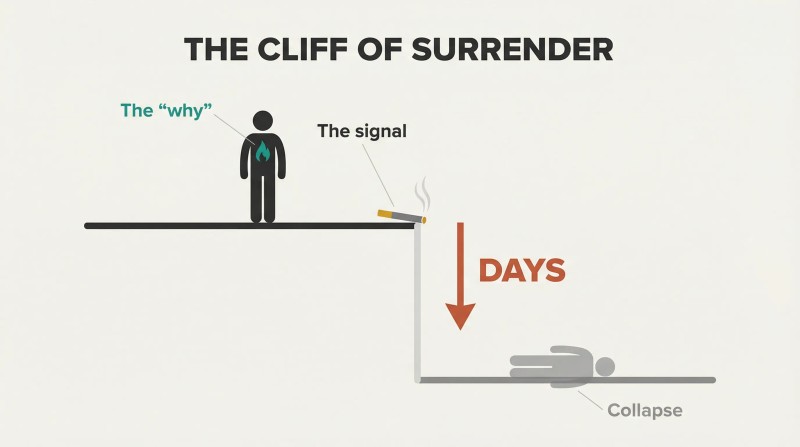
Prisoners who lost their "why" died within days
Viktor Frankl noticed a grim signal in the concentration camps. Cigarettes were the most valuable currency — tradeable for soup, bread, survival itself. When a prisoner smoked his own stash instead of trading it, everyone knew: he'd pronounced his own death sentence. Frankl, a psychiatrist imprisoned in four Nazi camps including Auschwitz, watched this pattern repeat with clinical precision.
The body followed the mind's surrender. A senior block warden named F — — dreamed a voice promised liberation by March 30, 1945. When the date passed without freedom, F — — collapsed with typhus fever and died within two days. The camp's chief doctor reported that the death rate spiked dramatically between Christmas 1944 and New Year's — prisoners had staked their hope on being home by the holidays, and when hope collapsed, their immune systems followed.
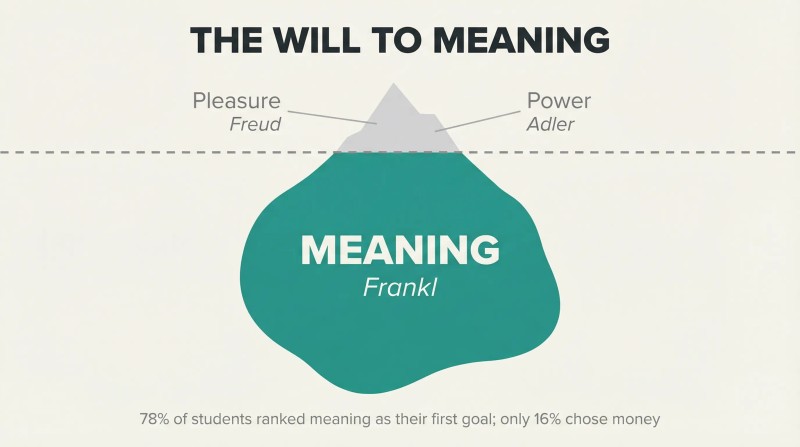
Meaning — not pleasure or power — is the deepest human drive
Frankl's logotherapy challenges both Freud and Adler. Where Freud built psychology around the pleasure principle and Adler around the drive for power, Frankl identified a more fundamental motivation: the will to meaning — the striving to find purpose in one's life. Logotherapy, from the Greek logos meaning "meaning," became known as the Third Viennese School of Psychotherapy. A survey of 7,948 students at 48 American colleges confirmed the priority: 78% said their first goal was "finding a purpose and meaning to my life," while just 16% checked "making a lot of money."
Misdiagnosed meaning-hunger wastes years on the couch. A diplomat spent five years in psychoanalysis, where his therapist traced job dissatisfaction to unconscious father hatred. The real problem? He needed a career change. After switching professions, he reported contentment for years — no couch required.
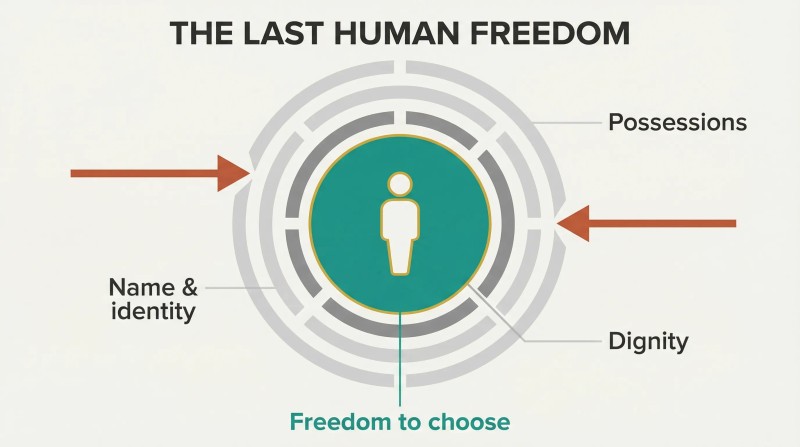
No one can strip your freedom to choose how you respond
This is Frankl's most enduring insight. In a system designed to annihilate personhood — where prisoners became numbers, stripped of possessions, names, hair, and dignity — some chose compassion. Frankl remembers men who walked through the huts comforting others, giving away their last piece of bread. They were few, but sufficient proof that external conditions do not fully determine internal responses.
The inner decision shaped the person, not the environment. Whether a prisoner became brutal in the fight for survival or retained his dignity was ultimately a choice. Frankl argues this applies beyond camps: in illness, loss, or injustice, we always retain this irreducible freedom. Biology, psychology, and sociology influence us — but they do not finalize us. Man is ultimately self-determining.
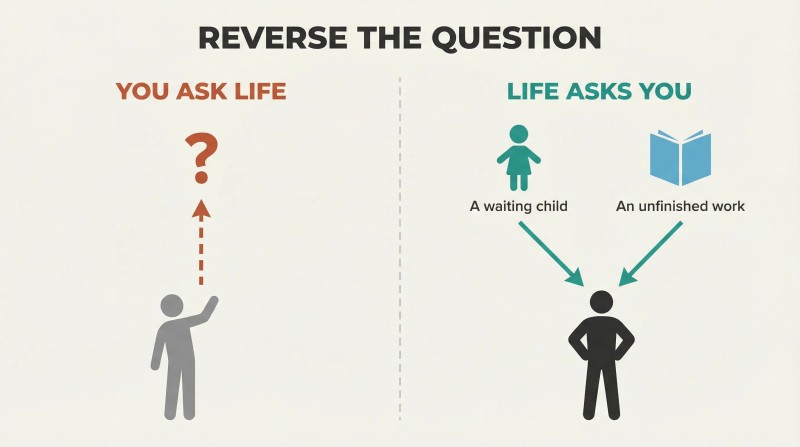
Stop asking life for meaning — it's asking you
Frankl proposes a Copernican shift in how we think about purpose. Instead of demanding answers from life — "What's the point?" — recognize that life is questioning you through your specific circumstances, right now. Your response isn't in meditation or philosophy; it's in right action. Each situation is unique, each moment demands a unique answer, and no one can answer for you.
Two suicidal prisoners proved the reversal's power. One had a child who adored him, waiting in a foreign country. The other had an unfinished series of scientific books no one else could complete. When each realized something irreplaceable still needed him — a child's love, an intellectual legacy — suicide became illogical. They found their "why" and could bear the "how."
Three paths to meaning: create, love, or bear suffering with dignity
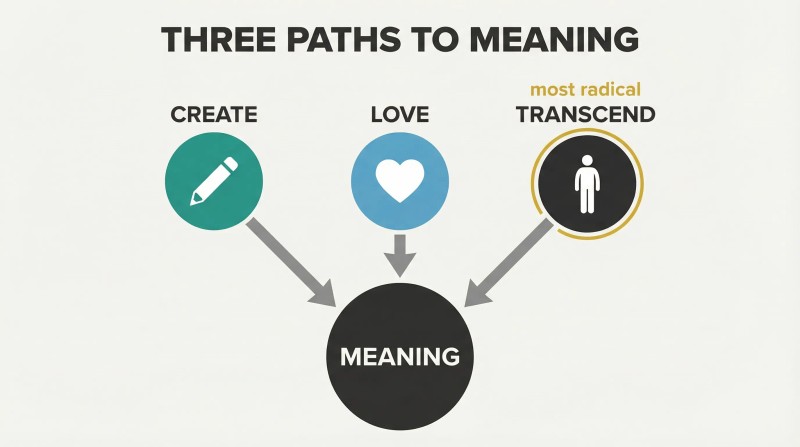
Frankl identifies three avenues to meaning:
1. Creating a work or doing a deed — achievement and contribution
2. Experiencing something or encountering someone — beauty, truth, love
3. Choosing one's attitude toward unavoidable suffering — transforming tragedy into triumph
The third path is the most radical. An elderly doctor consulted Frankl, paralyzed by grief two years after his wife's death. Rather than offering consolation, Frankl asked: "What would have happened if you had died first?" The doctor grasped it instantly — his survival spared his beloved wife that same crushing grief. His suffering became a sacrifice with meaning, and the despair released its grip. Frankl insists: this third path applies only when suffering truly cannot be removed. Unnecessary suffering is masochistic, not heroic.
Love can sustain you even when the beloved is gone
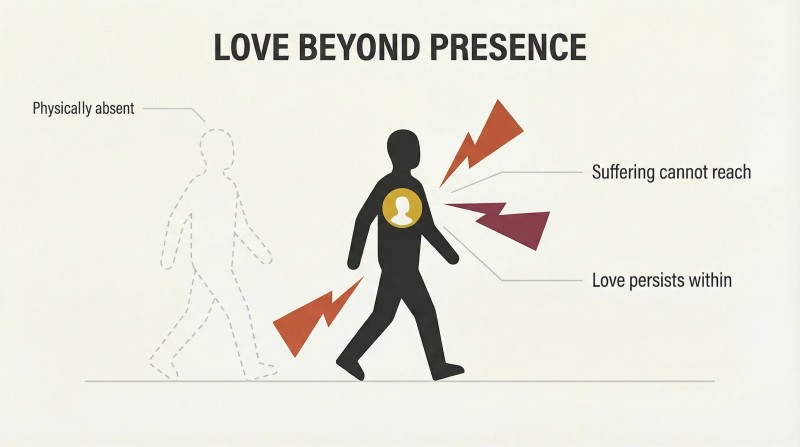
During frozen predawn marches to work sites, Frankl's mind escaped the horror by clinging to his wife's image with extraordinary vividness. He heard her voice, saw her smile, felt her presence — though he had no way of knowing whether she was still alive. She wasn't; Tilly had died at Bergen-Belsen. Yet the power of that love didn't depend on her physical presence or even her existence.
Love, in Frankl's framework, grasps the innermost core of another person. It perceives not just who someone is but who they could become — and by loving them, helps actualize those potentialities. In the camps, this inner connection provided a lifeline that starvation, beatings, and dehumanization could not sever. Love, Frankl concludes, is as primary a human phenomenon as any drive.
Suffering expands like gas — its "size" is always relative
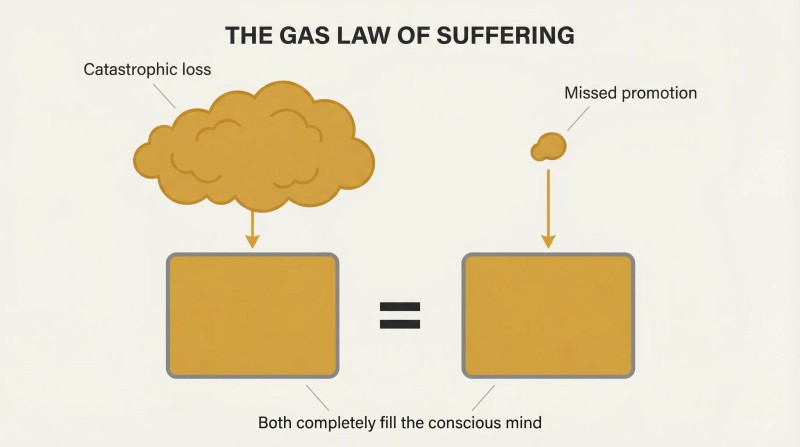
Frankl draws a striking analogy. Pump gas into an empty chamber — regardless of the chamber's size, the gas fills it completely and evenly. Suffering works identically. A catastrophic loss and a missed promotion both flood the entire conscious mind. This explains how camp prisoners could feel genuine, overwhelming joy over absurdly small mercies.
When Frankl's transport bypassed the Mauthausen death camp and headed "only" for Dachau, prisoners literally danced in the train car. Upon arrival, the thrilling news: this camp had no gas chamber. They laughed and celebrated despite standing outside in freezing rain all night. Conversely, prisoners envied ordinary convicts — imagining their toothbrushes, mattresses, and monthly mail. Suffering's relativity cuts both ways: tiny joys become enormous when the baseline is extreme.
Happiness arrives only when you stop chasing it directly
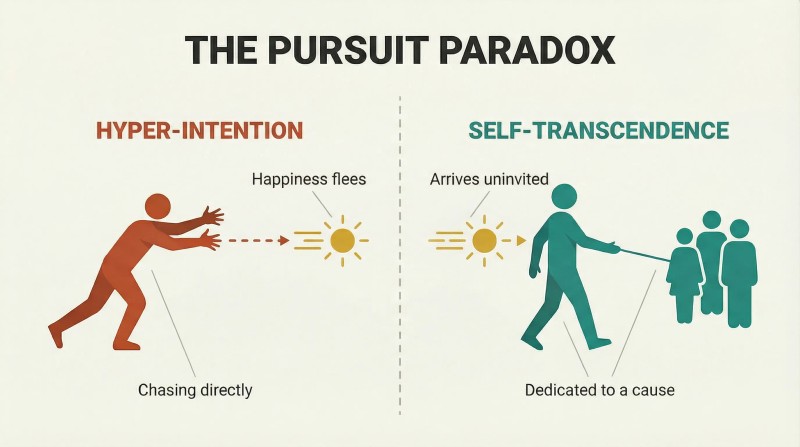
Frankl coined the term "hyper-intention" to describe how trying too hard produces the opposite result. The more a person grasps at pleasure, the more it evades them — visible in sexual neurosis, where performance anxiety produces the very failure it fears. Likewise, someone commanded to "be happy" can only produce an artificial smile, like saying "cheese" for a camera.
Self-transcendence is the antidote. Frankl argues that self-actualization is only possible as a side-effect of self-transcendence — forgetting yourself by dedicating yourself to a cause or another person. The more you focus outward, the more human you become. Meaning is found in the world, not inside your own psyche. Turn toward something larger than yourself, and fulfillment follows uninvited.
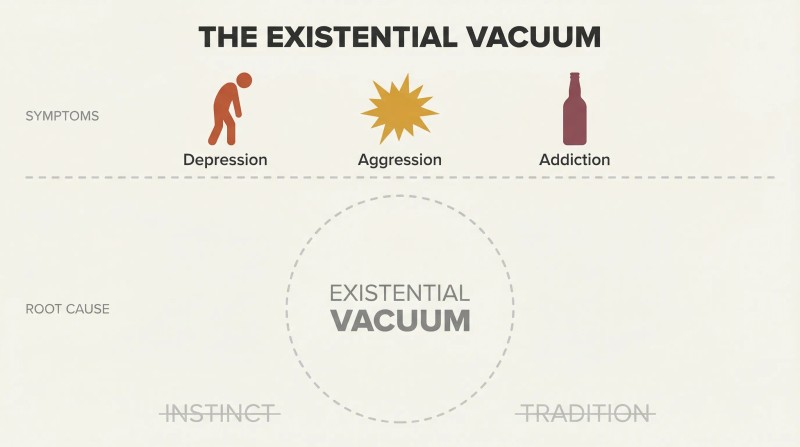
Modern emptiness breeds depression, aggression, and addiction
Frankl calls this epidemic the "existential vacuum" — a pervasive inner emptiness born from the collapse of instinct and tradition. Without instinct dictating behavior or tradition prescribing values, modern humans default to conformism or totalitarianism. Among Frankl's American students, 60% showed a marked degree of existential vacuum, versus 25% of Europeans.
The vacuum has measurable clinical consequences. Frankl diagnosed "Sunday neurosis" — depression surfacing when the busy week ends and the void becomes visible. Research supported the link: 90% of alcoholics studied by Annemarie von Forstmeyer suffered from abysmal meaninglessness, and 100% of drug addicts in Stanley Krippner's research believed "things seemed meaningless." When Frankl persuaded unemployed patients to volunteer in meaningful unpaid activities, their depression disappeared — despite unchanged economic circumstances.
Overcome anxiety by deliberately intending what you fear
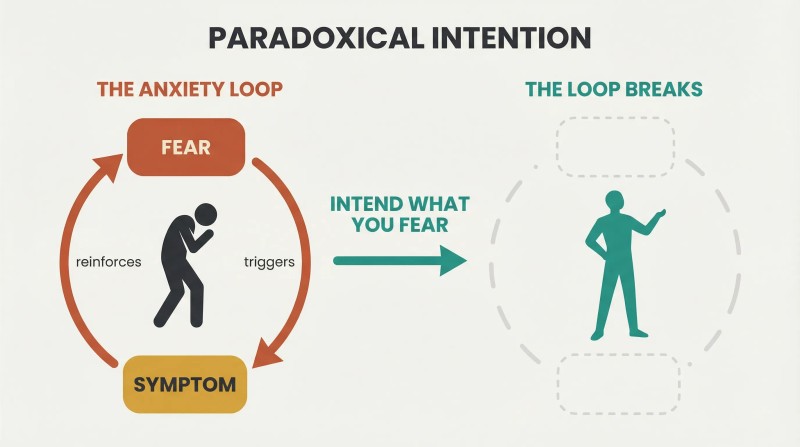
Paradoxical intention is Frankl's most practical therapeutic technique. It works by weaponizing humor against fear. A young physician with a four-year sweating phobia was told to deliberately try to sweat as much as possible. He resolved to "pour at least ten quarts!" Result: permanent relief within one week. A bookkeeper with crippling writer's cramp was told to scrawl as badly as he could — and found he simply couldn't scribble when he tried.
The technique breaks the vicious cycle of anticipatory anxiety, where fearing a symptom triggers the symptom, which reinforces the fear. By deliberately and humorously intending the feared outcome, the patient detaches from the neurotic loop. Frankl applied it successfully to phobias, obsessive-compulsive disorders, insomnia, and stuttering — sometimes resolving decades-old conditions in single sessions.
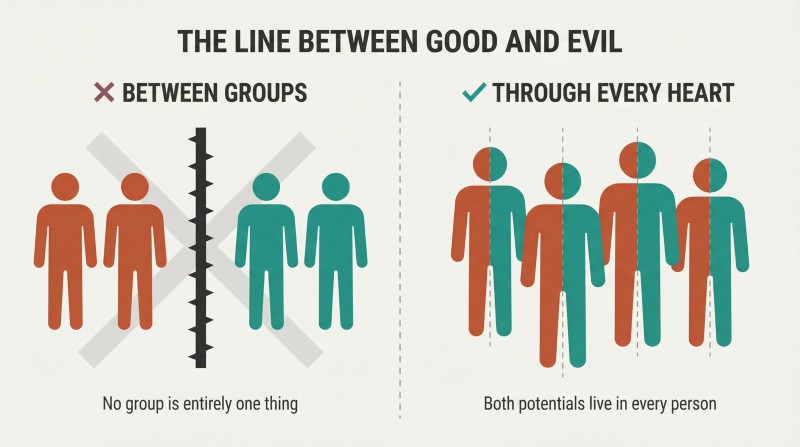
Good and evil cut through every heart, not between groups
Frankl resists easy moral categories. Among the SS guards, some were clinical sadists; others purchased medicine for prisoners from their own pockets. Among the Capos — prisoners given authority over fellow inmates — many proved more brutal than the guards themselves. A foreman once secretly gave Frankl a piece of bread, risking punishment; the act moved Frankl to tears. Decency was not determined by which side of the barbed wire a man stood on.
The story of Dr. J is Frankl's most startling evidence. Known as "the mass murderer of Steinhof" for his fanatical role in the Nazi euthanasia program, Dr. J later died in a Soviet prison — but not before becoming "the best comrade you can imagine," consoling fellow prisoners and living to the highest moral standard. If even he could transform, Frankl argues, no human being is fully determined by their past.
Analysis
Frankl's masterwork operates on a structural tension most books in either the memoir or self-help genre cannot achieve: it earns its prescriptions through testimony. The logotherapy framework — will to meaning, existential vacuum, paradoxical intention — would read as clinical abstraction without the Auschwitz narrative, and the memoir would remain harrowing but ultimately passive without theoretical scaffolding. This mutual validation is the book's architectonic genius and the reason it has outlasted both the Holocaust memoir genre and the mid-century psychotherapy schools that surrounded it.
The most philosophically daring move is Frankl's inversion of the meaning question. Where Sartre declared existence absurd and demanded we forge meaning ex nihilo, Frankl argues meaning already exists in each situation — waiting to be perceived, like a Gestalt figure emerging from background. This positions logotherapy as an unusual bridge between Continental phenomenology and clinical practice, distinct from both existentialist despair and positivist reductionism.
Critics rightly note that 'meaning through suffering' risks becoming a dangerous justification for not alleviating preventable pain — or worse, a tool of oppression ('your suffering has meaning, so endure it'). Frankl anticipated this objection repeatedly, insisting unnecessary suffering is masochistic. Yet the boundary between 'unavoidable' and 'avoidable' is precisely where the framework grows murky in application. Modern readers in relative comfort may too easily categorize addressable discomfort as meaningful rather than fixable.
The book's enduring power lies in its refusal to reduce humans to any single mechanism — pleasure-seeking, power-seeking, or environmentally determined. Frankl's insistence on the defiant power of the human spirit is ultimately an anthropological claim: humans are meaning-making creatures first, and everything else — neurosis, despair, even heroism — follows from whether that drive is fulfilled or frustrated. With rates of depression, anxiety, and 'deaths of despair' climbing across wealthy nations decades later, the existential vacuum Frankl diagnosed reads less like psychiatric theory and more like prophecy.
Review Summary
Man's Search for Meaning is a deeply impactful book that combines Viktor Frankl's experiences in Nazi concentration camps with his psychological theories. Many readers find it profoundly moving and insightful, praising Frankl's resilience and wisdom. The book explores the importance of finding meaning in life, even in the darkest circumstances. While some find the second half on logotherapy less engaging, most consider it a transformative read that offers valuable perspectives on human suffering, resilience, and the search for purpose.
People Also Read







Glossary
Logotherapy
Meaning-centered psychotherapyFrankl's psychotherapeutic approach, called the Third Viennese School of Psychotherapy, from the Greek logos (meaning). Unlike Freudian psychoanalysis (retrospective, pleasure-focused) or Adlerian psychology (power-focused), logotherapy is future-oriented and helps patients discover concrete meaning in their lives. It treats neuroses rooted in existential frustration rather than solely in psychological conflict.
Will to meaning
Primary human motivational forceFrankl's central concept: the striving to find meaning in one's life is the most fundamental human drive, more basic than Freud's 'will to pleasure' or Adler's 'will to power.' When this drive is frustrated, it produces existential frustration that can manifest as neurosis, depression, or aggression. Frankl contrasts it with views that reduce meaning-seeking to a secondary rationalization of instinctual drives.
Existential vacuum
Inner emptiness from meaninglessnessA widespread feeling of emptiness and meaninglessness that Frankl identified as a defining condition of modern life. It results from the loss of animal instincts (which once guided behavior) and the erosion of traditions (which once prescribed values). Manifests primarily as boredom and can drive depression, aggression, and addiction. Frankl found it in 60% of his American students and 25% of European students.
Noögenic neuroses
Neuroses from existential problemsNeuroses that originate not in psychological conflicts between drives and instincts (psychogenic neuroses) but in existential problems—specifically, frustration of the will to meaning. From the Greek noös (mind), referring to the specifically human spiritual dimension. These neuroses require logotherapy rather than conventional psychotherapy, because their root cause is a crisis of meaning, not a buried trauma.
Paradoxical intention
Deliberately intending what you fearA logotherapeutic technique in which a phobic or obsessive-compulsive patient is invited to deliberately wish for or intend the very thing they fear. By using humor and exaggeration to embrace the feared outcome, the patient breaks the vicious cycle of anticipatory anxiety. Frankl developed it in 1939 and applied it to sweating phobias, writer's cramp, insomnia, stuttering, and washing compulsions—sometimes achieving permanent relief in a single session.
Tragic optimism
Optimism despite pain, guilt, deathThe capacity to remain optimistic in the face of what Frankl calls the tragic triad—pain, guilt, and death. It involves three transformations: turning suffering into human achievement, deriving from guilt the opportunity to change for the better, and deriving from life's transitoriness an incentive to take responsible action. It is not commanded or forced but emerges from finding meaning within tragic circumstances.
Hyper-intention
Excessive striving that backfiresThe counterproductive effect that occurs when a person tries too forcefully to achieve something—particularly pleasure, sleep, or sexual performance. The excessive intention produces exactly the failure it seeks to prevent. Frankl uses it to explain why happiness cannot be pursued directly and why the pleasure principle is, paradoxically, a 'fun-spoiler.' Countered therapeutically by paradoxical intention and dereflection.
Dereflection
Redirecting attention away from oneselfA logotherapeutic technique that counters hyper-reflection—excessive self-focused attention that worsens neurotic symptoms. Dereflection redirects the patient's attention away from themselves and toward a partner, task, or meaning to fulfill. It is ultimately possible only when the patient orients toward their specific vocation or mission in life. Used alongside paradoxical intention in treating sexual neuroses and anxiety disorders.
Self-transcendence
Pointing beyond oneself to meaningFrankl's term for what he considers a constitutive characteristic of human existence: being human always means being directed toward something or someone other than oneself—a meaning to fulfill or a person to love. Self-actualization is achievable only as a side-effect of self-transcendence, never by direct pursuit. The more one forgets oneself in service to a cause or another person, the more fully human one becomes.
Tragic triad
Pain, guilt, and deathThe three inescapable aspects of human existence that Frankl identifies in logotherapy: pain (unavoidable suffering), guilt (the reality of human fallibility), and death (the transitoriness of life). Rather than reasons for despair, each element of the triad offers an opportunity: suffering can be transformed into achievement, guilt into self-improvement, and mortality into an incentive for responsible action. Forms the basis for tragic optimism.
FAQ
What's "Man's Search for Meaning" about?
- Holocaust Experience: The book is a profound reflection on Viktor E. Frankl's experiences as a Holocaust survivor, detailing his time in Nazi concentration camps.
- Search for Meaning: It explores the idea that finding meaning in life is the primary motivational force in humans, even in the most harrowing circumstances.
- Logotherapy: Frankl introduces and explains his psychological approach, logotherapy, which focuses on the future and the meanings to be fulfilled by the patient.
- Human Resilience: The narrative emphasizes the human capacity to endure suffering and find purpose, even in the face of unimaginable adversity.
Why should I read "Man's Search for Meaning"?
- Inspiration and Hope: The book offers a powerful message of hope and resilience, showing how individuals can find meaning in life despite suffering.
- Psychological Insight: It provides a unique perspective on human psychology, particularly through the lens of logotherapy, which can be applied to personal growth.
- Historical Context: Frankl's firsthand account of life in concentration camps offers valuable historical insights into the human condition during the Holocaust.
- Universal Themes: The book addresses universal themes of suffering, love, and the search for purpose, making it relevant to a wide audience.
What are the key takeaways of "Man's Search for Meaning"?
- Meaning in Suffering: Suffering is an inevitable part of life, but individuals can find meaning in how they respond to it.
- Freedom of Choice: Even in the most restrictive conditions, people have the freedom to choose their attitude and find purpose.
- Logotherapy Principles: The book outlines the principles of logotherapy, emphasizing the importance of finding meaning in life as a path to mental health.
- Human Dignity: Frankl highlights the importance of maintaining human dignity and inner freedom, regardless of external circumstances.
What is logotherapy, as described by Viktor E. Frankl?
- Meaning-Centered Therapy: Logotherapy is a form of psychotherapy that focuses on the search for meaning in life as the central human motivational force.
- Future Orientation: Unlike other therapies, logotherapy is less introspective and more focused on future goals and meanings to be fulfilled.
- Existential Frustration: It addresses existential frustration, which arises when individuals cannot find meaning in their lives, leading to noögenic neuroses.
- Self-Transcendence: The therapy encourages individuals to transcend themselves by finding meaning in work, love, and suffering.
How did Viktor E. Frankl survive the concentration camps?
- Mental Resilience: Frankl maintained mental resilience by focusing on future goals, such as reuniting with his wife and completing his work on logotherapy.
- Inner Freedom: He emphasized the importance of inner freedom, choosing his attitude towards suffering and maintaining a sense of purpose.
- Love and Memory: Thoughts of his wife and the love they shared provided him with strength and hope during his imprisonment.
- Observing and Learning: Frankl observed the behavior of fellow prisoners, learning from those who found meaning and maintained dignity despite suffering.
What are the main concepts of logotherapy?
- Will to Meaning: The primary drive in humans is the search for meaning, which is more fundamental than the pursuit of pleasure or power.
- Existential Vacuum: A sense of meaninglessness can lead to existential frustration, which logotherapy aims to address.
- Self-Transcendence: True fulfillment comes from transcending oneself by serving a cause or loving another person.
- Attitudinal Change: Logotherapy helps individuals change their attitudes towards unavoidable suffering, finding meaning even in adversity.
What is the "existential vacuum" mentioned in the book?
- Feeling of Emptiness: The existential vacuum is a widespread feeling of emptiness and meaninglessness in modern society.
- Loss of Traditions: It arises from the loss of traditional values and instincts that once guided human behavior.
- Manifestations: This vacuum often manifests as boredom, depression, aggression, and addiction.
- Logotherapy's Role: Logotherapy seeks to fill this vacuum by helping individuals find personal meaning and purpose in life.
How does Viktor E. Frankl define the "will to meaning"?
- Primary Motivation: The will to meaning is the primary motivational force in humans, driving them to find purpose in life.
- Unique and Specific: Each person's meaning is unique and must be fulfilled by them alone, providing a sense of significance.
- Contrast with Other Drives: It contrasts with Freud's pleasure principle and Adler's will to power, focusing instead on meaning as the central human drive.
- Life's Questions: Frankl suggests that life asks questions of individuals, and they must respond by finding meaning through responsibility.
What are some of the best quotes from "Man's Search for Meaning" and what do they mean?
- "He who has a why to live can bear almost any how." This quote emphasizes the power of having a purpose, which enables individuals to endure hardships.
- "Everything can be taken from a man but one thing: the last of the human freedoms—to choose one's attitude in any given set of circumstances." It highlights the importance of inner freedom and personal choice, even in dire situations.
- "When we are no longer able to change a situation, we are challenged to change ourselves." This quote underscores the potential for personal growth and transformation in the face of unchangeable circumstances.
- "Life is never made unbearable by circumstances, but only by lack of meaning and purpose." It suggests that meaning and purpose are essential for enduring life's challenges.
How does "Man's Search for Meaning" address the concept of suffering?
- Inevitable Part of Life: Frankl acknowledges that suffering is an unavoidable aspect of human existence.
- Finding Meaning: The book emphasizes that individuals can find meaning in how they respond to suffering, transforming it into a personal achievement.
- Attitudinal Shift: By changing one's attitude towards suffering, it can become a source of growth and strength.
- Responsibility to Suffer Well: Frankl argues that individuals have a responsibility to bear their suffering with dignity and purpose.
What is the "tragic optimism" discussed in the book?
- Optimism Despite Tragedy: Tragic optimism refers to maintaining hope and finding meaning in life despite its inevitable tragedies, such as pain, guilt, and death.
- Human Potential: It involves recognizing the potential for growth and achievement even in the face of suffering and adversity.
- Transforming Negatives: Tragic optimism encourages individuals to turn life's negative aspects into positive or constructive outcomes.
- Not Forced Optimism: Frankl notes that optimism cannot be forced but must arise naturally from finding meaning in life's challenges.
How does Viktor E. Frankl's personal story enhance the message of "Man's Search for Meaning"?
- Authenticity and Credibility: Frankl's firsthand experiences in concentration camps lend authenticity and credibility to his insights on suffering and meaning.
- Personal Transformation: His personal journey from despair to finding meaning serves as a powerful example of the principles he advocates.
- Empathy and Understanding: Frankl's story fosters empathy and understanding, as readers can relate to his struggles and triumphs.
- Inspiration and Hope: His survival and subsequent achievements inspire hope and demonstrate the resilience of the human spirit.
About the Author
Other books by Viktor E. Frankl




Download PDF
Download EPUB
.epub digital book format is ideal for reading ebooks on phones, tablets, and e-readers.








































