


Key Takeaways
Society built an Extrovert Ideal — and half the population pays the price
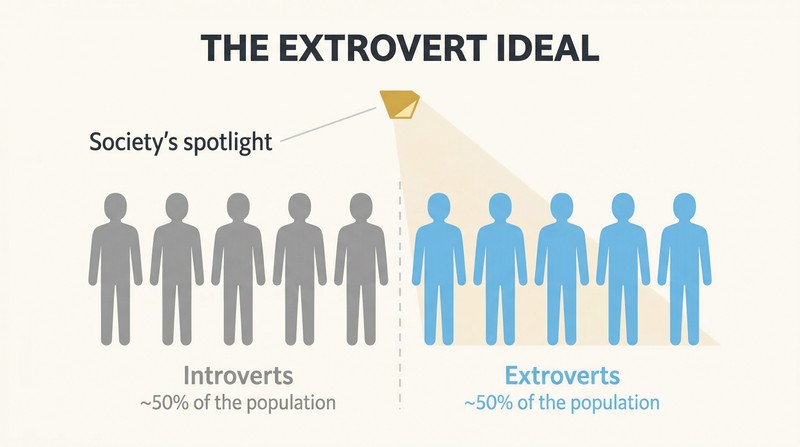
Around 1900, America shifted from a Culture of Character — valuing inner virtue, discipline, and honor — to a Culture of Personality, prizing charm, charisma, and magnetism. Dale Carnegie's rise from shy farmboy to public-speaking icon embodied this shift. Cain calls the resulting belief system the Extrovert Ideal: the omnipresent assumption that the ideal self is gregarious, alpha, and comfortable in the spotlight. It now dominates schools, workplaces, and churches.
Yet one-third to one-half of Americans are introverts. Studies show talkative people are rated as smarter, better-looking, and more desirable as friends — despite no evidence linking volubility to intelligence. Many introverts hide their nature so effectively they fool even themselves, living under what amounts to an oppressive standard that discounts a trait at the core of who they are.
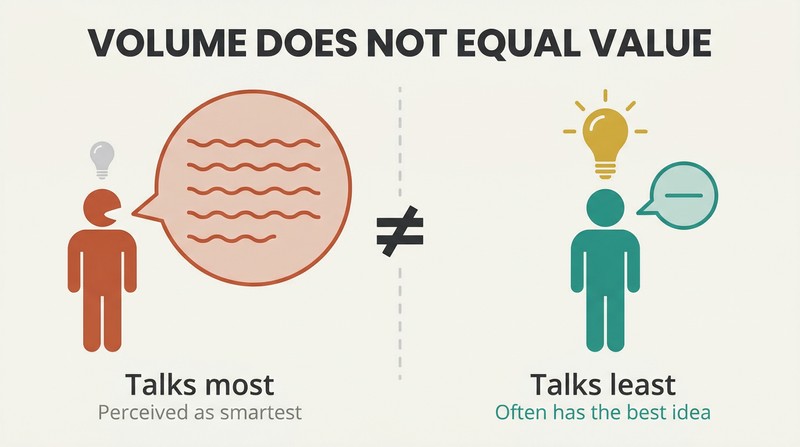
The loudest person in the room is rarely the one with the best idea
Talkers are mistakenly rated smarter. College students who spoke first and most were rated highest for creativity and analytical skill — despite having no better suggestions or SAT scores than quieter peers. UC Berkeley professor Philip Tetlock found the most famous, confident TV pundits make worse predictions than random chance. We also rate fast talkers as more capable, compounding the bias.
Groups amplify this error. At Harvard Business School, the Subarctic Survival Situation exercise had teams rank salvaged items for wilderness survival. One group's outdoorsman had life-saving expertise but was overruled because he expressed it too softly. The U.S. Army has a name for this dynamic: "the Bus to Abilene" — everyone follows whoever initiates action, even when nobody actually wanted to go.
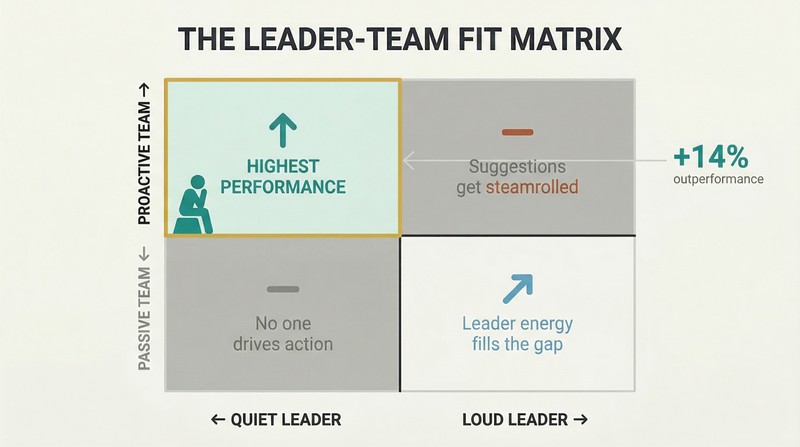
Quiet leaders outperform charismatic ones when employees take initiative
Charisma is overrated at the top. Management theorist Jim Collins found that the best-performing companies were led by Level 5 Leaders — people described as quiet, humble, modest, and self-effacing. Darwin Smith, the shy CEO of Kimberly-Clark, wore J.C. Penney suits and puttered alone on his Wisconsin farm, yet generated stock returns four times higher than the market over twenty years.
The match between leader and team matters. Wharton professor Adam Grant studied a national pizza chain and found introverted leaders' stores outperformed extroverted leaders' by over 14% — but only when employees were proactive. With passive employees, extroverted leaders did better. Introverts listen, implement others' ideas, and create a virtuous cycle of initiative. Extroverts risk stamping over good suggestions along the way.
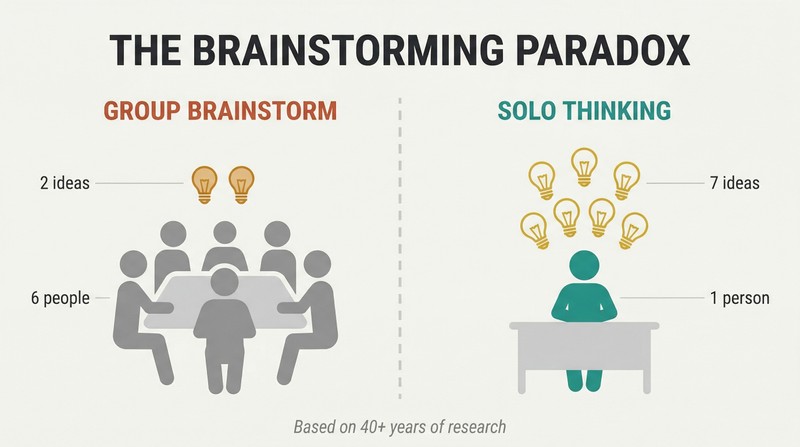
Stop brainstorming in groups — solo thinking produces better ideas
Forty years of research confirms it: people working alone produce more and better ideas than brainstorming groups. Performance worsens as group size increases. Three culprits: social loafing, production blocking (only one person talks at a time), and fear of looking stupid. The one exception is electronic brainstorming, where larger online groups outperform individuals — because the process preserves solitude.
Open offices compound the damage. In the Coding War Games study, 62% of top programmers had private workspaces versus only 19% of the worst. Steve Wozniak designed the first Apple PC during solitary late nights, not in group sessions. Cain calls the worship of constant face-to-face collaboration the New Groupthink — and argues it stifles the very creativity it claims to promote. Even Wozniak's advice to aspiring inventors is blunt: "Work alone."
The babies who cry loudest at new stimuli become the quietest teens
Harvard psychologist Jerome Kagan exposed four-month-olds to new sights, sounds, and smells. About 20% kicked and cried vigorously — he called them high-reactive. Counterintuitively, these infants were most likely to become quiet, careful teenagers. The placid babies often grew into bold extroverts. The mechanism: high-reactive infants have more excitable amygdalas, making them more sensitive to all novelty — not just people — throughout life.
Nature is powerful but not absolute. Twin studies show introversion-extroversion is 40 – 50% heritable. Cain compares personality to a rubber band — we can stretch, but only so far. Neuroscientist Carl Schwartz used fMRI to scan adults who'd been Kagan's infant subjects and found their amygdalas still reacted more strongly to unfamiliar faces, decades later. The footprint of temperament never fully disappears.
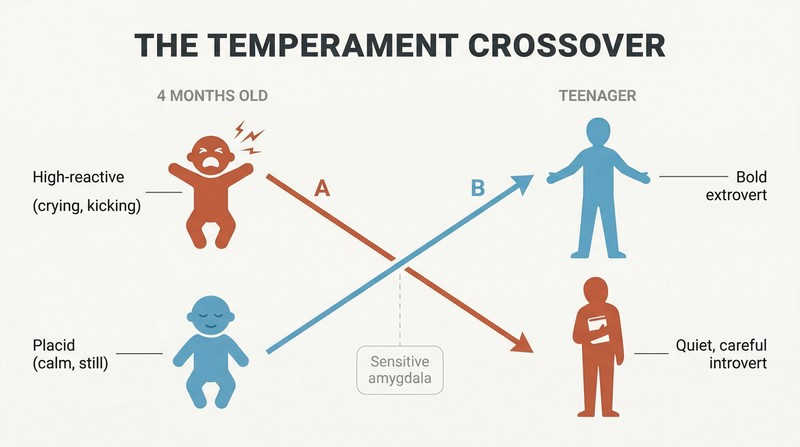
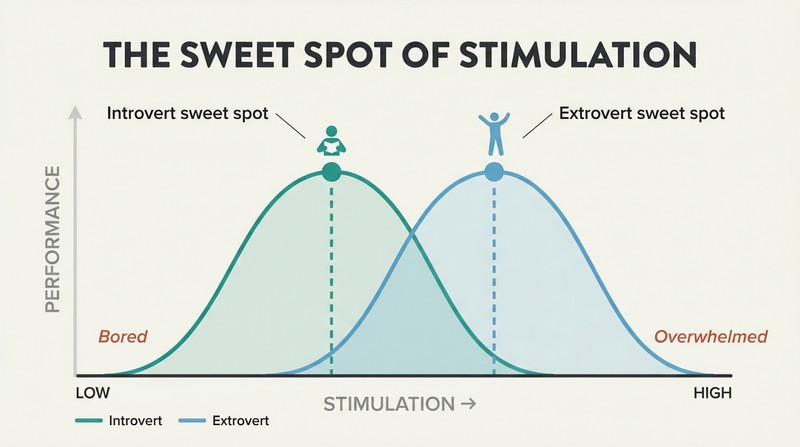
Find your sweet spot of stimulation — then design your life around it
Introverts and extroverts need different stimulation levels. In one classic experiment, introverts chose to work at 55 decibels while extroverts preferred 72. Both performed equally well at their chosen levels — but swapping volumes tanked performance for both groups. Even lemon juice on the tongue produces more salivation in introverts, evidence of their greater physical sensitivity to stimuli.
Your sweet spot is where you're optimally stimulated — not bored, not overwhelmed. Knowing it lets you choose careers, homes, and social schedules that energize rather than drain you. A tax lawyer named Esther couldn't speak extemporaneously no matter how expert she became — overarousal hijacked her short-term memory. Her solution: insisting on advance notice for all presentations, preparing thoroughly, and performing comfortably inside her sweet spot.
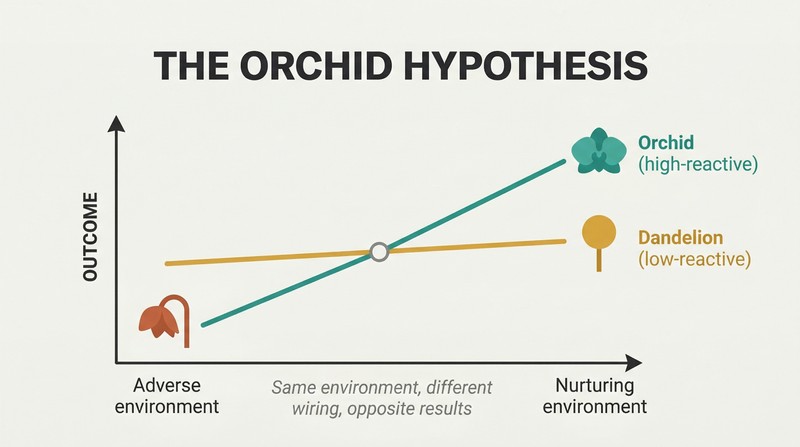
High-reactive kids are orchids — fragile in bad soil, magnificent in good
The Orchid Hypothesis holds that high-reactive children are more strongly affected by all experiences — positive and negative. Under adversity, they wilt more than resilient "dandelion" children. But with nurturing, they outperform less sensitive peers. Studies show orchid children raised in stable homes have fewer emotional problems, better social skills, and even stronger immune systems than their lower-reactive counterparts.
Sensitivity fuels both vulnerability and conscience. Psychologist Elaine Aron found highly sensitive people process information more deeply, notice subtleties others miss, and feel emotions with unusual intensity. Psychologist Grazyna Kochanska showed high-reactive toddlers feel more guilt after accidentally breaking a toy — and by age six are more empathic and moral. Eleanor Roosevelt exemplified this: her sensitivity made her FDR's conscience, championing the disenfranchised because she couldn't help feeling what others felt.
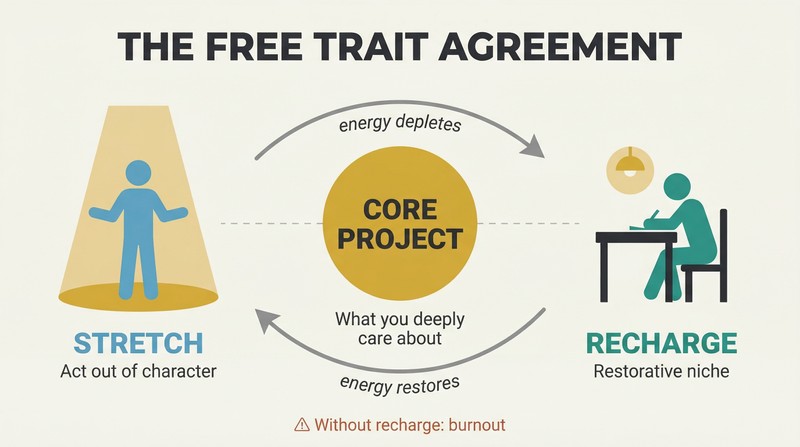
Act out of character for your core projects — then retreat to recharge
Free Trait Theory explains how introverts can thrive in extroverted roles. Psychologist Brian Little — a deep introvert who won Harvard's teaching award — argues we can act against our nature in service of core personal projects: work, people, or causes we value deeply. Little lectures with passion because he loves his students, then hides in bathroom stalls to recover. He calls these recovery spaces restorative niches.
But stretching too far causes real damage. Little pushed himself until he collapsed with double pneumonia. Prolonged emotional labor increases stress, burnout, and cardiovascular risk. Cain recommends a Free Trait Agreement: a deliberate deal with yourself to act out of character some of the time in exchange for being yourself the rest. To identify your core projects, ask: What did I love as a child? What work do I gravitate to? Whose career makes me jealous?
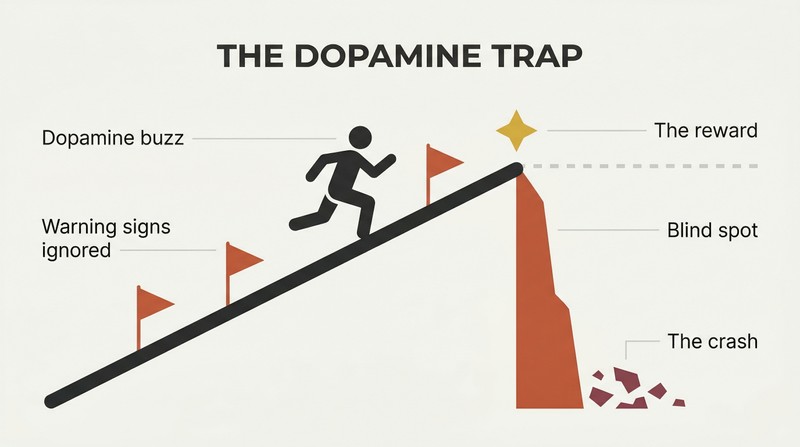
Extroverts chase dopamine buzz — which can blind them to danger
Reward sensitivity may be what makes extroverts extroverted. Their dopamine pathways are more active, generating an energizing "buzz" from pursuing rewards — money, status, social connection. This drives both their charisma and their risk-taking. In one study, extroverts showed stronger brain responses to amphetamines that activate dopamine; in another, more reward-region activity when winning gambling games.
Wall Street crashed partly because introverts were silenced. Psychologist Joseph Newman found that after mistakes, introverts slow down to reflect while extroverts speed up — missing warning signals. Cautious analysts at Enron and major banks were overruled by confident rainmakers. Meanwhile, investors like Warren Buffett and Seth Klarman — introverts who insulate themselves from groupthink — predicted crashes others dismissed. Buffett warned of the dot-com bubble in 1999; his Sun Valley audience applauded politely, then ignored him.
Don't label quiet children as broken — find them one friend and one passion
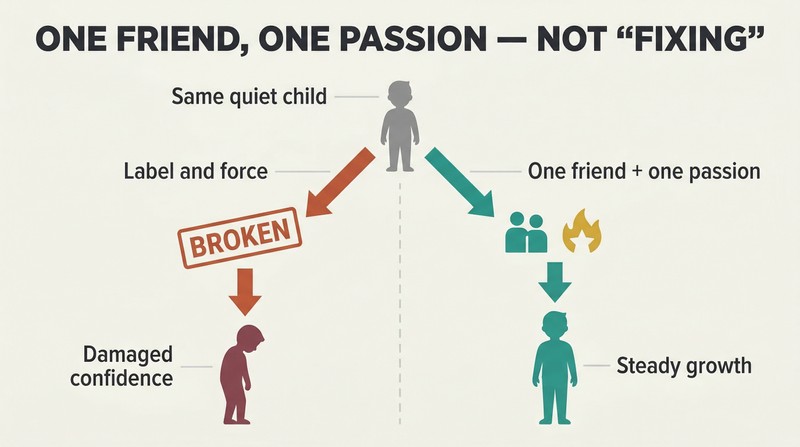
Schools are built for extroverts. Desks in pods, participation grades, and group projects sap introverted children's energy. In one fifth-grade classroom, a gifted writer named Maya sat silently while louder classmates dominated, eventually writing her own name over and over as if to reassert her identity. Research shows children need just one or two solid friendships — not popularity — for healthy development.
Gradual exposure builds confidence; forced performance destroys it. Cain advises introducing new situations step by step, never shaming children or calling them "shy." Deep passions matter more than social breadth: David Weiss, a painfully awkward kid who picked up drumming in middle school, credits that single passion with transforming his entire life trajectory. Dr. Jerry Miller warns that treating a healthy introverted child as defective — what he calls an iatrogenic problem — can damage the very self-esteem parents hope to build.
Analysis
Quiet is fundamentally a civil rights argument for temperament diversity, and its achievement lies in weaving neuroscience, cultural history, and corporate critique into a single coherent thesis. Cain's central innovation is naming the Extrovert Ideal — giving an invisible cultural force an identity, much as Betty Friedan did with 'the feminine mystique' for gender. Before this book, introversion was studied in psychology labs but hadn't been framed as a cultural justice issue.
The strongest sections are the workplace chapters. The brainstorming-doesn't-work data and the open-office critique have aged remarkably well; the 2020 remote-work revolution inadvertently ran Cain's experiment at global scale, and many organizations discovered that distributed, asynchronous work did not destroy productivity. Her argument that electronic collaboration outperforms face-to-face brainstorming proved prescient in the Zoom era.
A productive tension runs through the book: Cain argues the problem is systemic — institutions designed for extroverts — yet most practical advice is individual (find your sweet spot, create restorative niches, negotiate Free Trait Agreements ). This mirrors a pattern common in social-justice-adjacent self-help: diagnosing structural problems while offering personal workarounds. A more radical version might have focused entirely on institutional redesign.
The biological chapters present their own complexity. Kagan's high-reactivity research convincingly demonstrates a physiological basis for temperament, but the book occasionally conflates related-but-distinct constructs — introversion, shyness, high sensitivity, and neuroticism — under one umbrella. Academic psychologists have noted this imprecision. Cain acknowledges the definitional complexity in her appendix but, for narrative coherence, treats these as overlapping facets of one archetype. This is a defensible literary choice, though readers should understand that 'sensitive introvert' and 'non-anxious introvert' may have quite different neurobiological profiles.
Perhaps the book's most lasting contribution is permission: it freed millions of people to stop performing extroversion and start designing lives that fit their actual nervous systems. That is no small thing.
Review Summary
Quiet: The Power of Introverts in a World That Can't Stop Talking is praised for validating introverts' experiences and challenging societal bias towards extroversion. Readers appreciate Cain's insights on introvert strengths, workplace dynamics, and cultural differences. The book offers scientific research, personal anecdotes, and historical examples to support its arguments. Many introverts find it affirming and enlightening, though some criticize its potential bias against extroverts. Overall, reviewers consider it a valuable read for understanding personality differences and fostering a more inclusive society.
People Also Read



Glossary
Extrovert Ideal
Cultural bias favoring extroversionCain's term for the omnipresent Western belief that the ideal self is gregarious, alpha, and comfortable in the spotlight. It shapes hiring decisions, classroom design, religious culture, and social norms, treating introversion as somewhere between a disappointment and a pathology rather than a legitimate personality style.
New Groupthink
Worship of constant face-to-face collaborationCain's term for the contemporary phenomenon that elevates teamwork above all else, manifesting as open office plans, mandatory brainstorming sessions, and cooperative classroom learning. It assumes creativity comes from gregarious interaction, despite decades of research showing individuals often generate more and better ideas working alone.
High-reactive
Infants highly sensitive to stimuliJerome Kagan's term for the approximately 20% of infants who cry, kick, and pump their arms vigorously when exposed to new sights, sounds, and smells. Counterintuitively, these babies are more likely to become quiet, cautious, introverted children and adults, because their excitable amygdalas make them more sensitive to all novelty.
Orchid Hypothesis
Sensitive kids thrive or wilt dramaticallyA theory championed by psychologist Jay Belsky proposing that high-reactive children are like orchids: they wilt easily under adversity but, given nurturing conditions, grow stronger and more capable than their less sensitive 'dandelion' peers. The same genetic sensitivity that creates vulnerability also enables exceptional empathy, conscience, and achievement.
Free Trait Theory
Acting out of character strategicallyPsychologist Brian Little's theory that while we have fixed personality traits, we can act out of character in service of 'core personal projects'—work, people, or causes we deeply value. An introvert can perform as an extrovert for meaningful goals but needs restorative niches to recover, and risks burnout if the performance is prolonged.
Restorative niche
Recovery space for your true selfBrian Little's term for any place or time where you return to your authentic personality after acting out of character. It can be physical (a private office, a bathroom stall between speeches), temporal (quiet weekends before big meetings), or behavioral (choosing email over face-to-face meetings). Essential for preventing burnout from prolonged pseudo-extroversion.
Free Trait Agreement
Negotiated deal for authenticity timeBrian Little's concept of a deliberate arrangement—with a partner, employer, or yourself—to act out of character some of the time in exchange for permission to be your true self the rest. Examples include a couple agreeing to socialize two nights per month instead of every weekend, or an employee negotiating work-from-home days.
Deliberate Practice
Focused solo skill-building at limitsPsychologist Anders Ericsson's term for the specific type of practice that produces expertise: identifying tasks just beyond your current ability, working on them with intense concentration, monitoring progress, and revising. It is best conducted alone because it requires self-directed focus on personal weaknesses—something group settings rarely allow.
Reward sensitivity
Dopamine-driven pursuit of rewardsA psychological trait describing how strongly motivated a person is to seek rewards like money, status, sex, and social connection. Extroverts tend to be more reward-sensitive due to more active dopamine pathways, which fuels both their sociability and their susceptibility to overconfidence and excessive risk-taking.
FAQ
What's Quiet: The Power of Introverts in a World That Can't Stop Talking about?
- Focus on Introversion: The book explores the strengths and value of introverts in a society that often prioritizes extroverted traits. It highlights how introverts contribute significantly to creativity, leadership, and innovation.
- Cultural Critique: Susan Cain critiques the "Extrovert Ideal," a cultural bias that favors outgoing personalities over reflective ones, affecting education, work, and personal relationships.
- Scientific Insights: The narrative combines personal anecdotes with scientific research on personality psychology, including studies on temperament and the biological basis of introversion and extroversion.
Why should I read Quiet: The Power of Introverts in a World That Can't Stop Talking?
- Understanding Yourself: If you identify as an introvert or know someone who does, this book provides valuable insights into the introverted experience and helps appreciate introverted traits.
- Cultural Awareness: It encourages readers to recognize and challenge societal norms that undervalue introverted qualities, promoting more inclusive environments.
- Practical Advice: Susan Cain offers strategies for introverts to thrive in an extroverted world, including tips on public speaking and effective communication.
What are the key takeaways of Quiet: The Power of Introverts in a World That Can't Stop Talking?
- Value of Solitude: Solitude is essential for creativity and productivity, with many great ideas stemming from quiet reflection rather than groupthink.
- Diversity of Personalities: A balance of introverted and extroverted individuals in teams enhances collaboration and problem-solving.
- Empowerment for Introverts: Introverts are encouraged to embrace their nature and recognize their potential to lead and contribute significantly.
What are the best quotes from Quiet: The Power of Introverts in a World That Can't Stop Talking and what do they mean?
- “The world needs introverts.”: This quote emphasizes the crucial role introverts play in society, challenging the notion that only extroverts can be successful.
- “There’s zero correlation between the gift of gab and good ideas.”: It critiques the belief that talkative individuals are more intelligent, highlighting that introverts often have profound insights.
- “We make a grave mistake to embrace the Extrovert Ideal so unthinkingly.”: This warns against societal bias favoring extroversion, urging recognition of introverted qualities.
How does Susan Cain define introversion in Quiet: The Power of Introverts in a World That Can't Stop Talking?
- Inner World Focus: Introversion is a preference for the inner world of thought and feeling, with introverts recharging by spending time alone.
- Not Synonymous with Shyness: Introversion is not the same as shyness; introverts can be socially skilled but may find social interactions draining.
- Biological Basis: Research suggests introversion has a biological component, including differences in brain activity and sensitivity to stimulation.
What is the Extrovert Ideal, as described in Quiet: The Power of Introverts in a World That Can't Stop Talking?
- Cultural Norm: The Extrovert Ideal is the belief that extroverted traits are superior and more desirable, promoting outgoing, sociable, and assertive behaviors.
- Impact on Behavior: This ideal influences behavior in schools and workplaces, often undervaluing introverted individuals and favoring group work.
- Consequences for Introverts: It pressures introverts to conform to extroverted norms, causing stress and self-doubt, while Cain advocates for recognizing introverts' contributions.
How can introverts thrive in an extroverted world, according to Quiet: The Power of Introverts in a World That Can't Stop Talking?
- Embrace Your Nature: Introverts should accept their personality and recognize their strengths, boosting confidence.
- Prepare for Social Situations: Preparation before social activities, like public speaking, can help introverts feel more comfortable.
- Seek Solitude: Carving out time for solitude is crucial for recharging and engaging with personal interests without social pressure.
How does Quiet: The Power of Introverts in a World That Can't Stop Talking address the concept of leadership?
- Introverted Leaders: Introverts can be effective leaders, bringing thoughtful decision-making and deep listening skills to their roles.
- Collaboration and Team Dynamics: Diverse leadership styles within teams enhance creativity and problem-solving.
- Courage to Lead: Introverts are encouraged to embrace their leadership potential, recognizing their quiet strength as a powerful asset.
What practical advice does Quiet: The Power of Introverts in a World That Can't Stop Talking offer for public speaking?
- Preparation is Key: Emphasizes the importance of preparation, including practicing speeches and familiarizing oneself with the audience.
- Start Small: Begin with smaller speaking opportunities to build confidence, gradually increasing audience size.
- Focus on the Message: Concentrate on the content rather than anxiety, shifting focus to the audience's needs to alleviate pressure.
How does Quiet: The Power of Introverts in a World That Can't Stop Talking address workplace dynamics between introverts and extroverts?
- Team Collaboration: Workplaces often favor extroverted behaviors, but Cain suggests creating environments for both collaborative and independent work.
- Leadership Styles: Introverted leaders can excel, bringing thoughtful decision-making and careful listening to their roles.
- Cultural Shift Needed: Calls for a cultural shift to recognize and value introverts' contributions, rethinking open office plans and encouraging diverse communication styles.
How does Quiet: The Power of Introverts in a World That Can't Stop Talking suggest parents can support introverted children?
- Encourage Individual Interests: Nurture the child's unique interests and passions, building confidence and identity.
- Respect Social Preferences: Recognize and respect the child's need for solitude and downtime, allowing them to decline social invitations.
- Teach Social Skills Gradually: Help develop social skills through gradual exposure, role-playing, and discussing strategies for engaging with peers.
How does Quiet: The Power of Introverts in a World That Can't Stop Talking relate to the concept of “soft power”?
- Definition of Soft Power: Soft power is the ability to influence through quiet strength and empathy, often a trait of introverts.
- Examples of Soft Power: Successful introverted leaders like Warren Buffett and Rosa Parks illustrate effective leadership without conforming to extroverted norms.
- Encouragement for Introverts: Introverts are encouraged to embrace their soft power as a valuable asset in personal and professional contexts.
About the Author
Other books by Susan Cain

Download PDF
Download EPUB
.epub digital book format is ideal for reading ebooks on phones, tablets, and e-readers.








































