

Key Takeaways
Romantic love is an attachment bond, not a rational bargain
Love finally makes scientific sense. Sue Johnson, creator of Emotionally Focused Therapy (EFT), argues that adult romantic love is the same survival-driven bond a baby forms with its mother, transferred to a partner. British psychiatrist John Bowlby discovered that humans are wired to seek a few precious others who hold and protect us, from cradle to grave. This drive is innate, not learned.
The evidence overturns old myths. For decades, love was dismissed as too irrational for science. Then fMRI scanners let researchers watch brains in love. The finding: our first instinct is neither sex nor aggression but contact and comforting connection. When Johnson blurted out to a skeptical colleague that love affairs are not bargains but emotional bonds, she named the paradigm shift this whole book rests on.
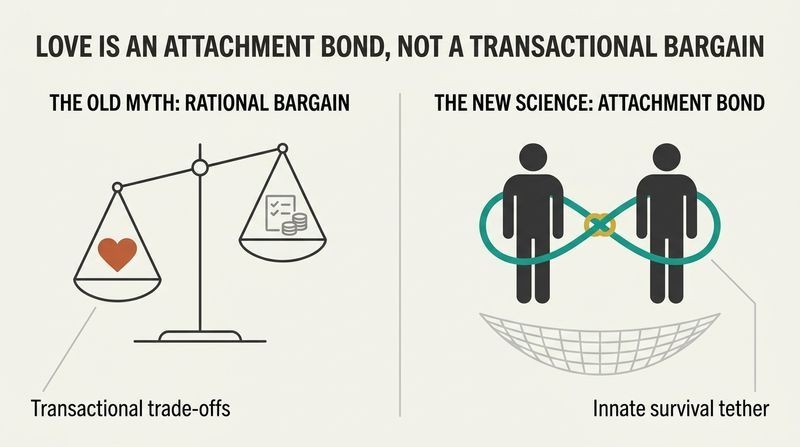
What's striking is how this reframes therapy's target. If love is an attachment system rather than a negotiation, then communication drills and chore-splitting treat symptoms, not causes. Johnson's claim aligns with primatologist Frans de Waal's work showing mammals are wired for connection, and with Harry Harlow's monkeys clinging to cloth mothers over wire ones that dispensed food. A fair challenge: attachment theory can feel totalizing, explaining every conflict as a bonding cry. Critics note it may underweight material stressors, power imbalances, and genuine incompatibility. Still, as an organizing lens, it does what exchange theory never could: it predicts why couples fight the way they do.
Emotional dependency is your greatest strength, not a weakness
The cult of self-sufficiency is backwards. Western culture treats needing others as immature, urging us to draw an emotional moat around ourselves. Johnson flips this: strong emotional connection signals mental health, while isolation is the actual killer. Early studies found that 31 to 75 percent of institutionalized children died before age three despite being fed and sheltered. Prisoners in solitary confinement call their experience a living death.
Connection is medical infrastructure. A good relationship beats a careful diet and vitamins for longevity. Married bypass patients are three times more likely to be alive fifteen years later than unmarried ones. Emotional support lowers blood pressure and strengthens immune function. Johnson coins the paradox: being effectively dependent makes us more independent, because a secure base is the launchpad from which we bravely explore the world.
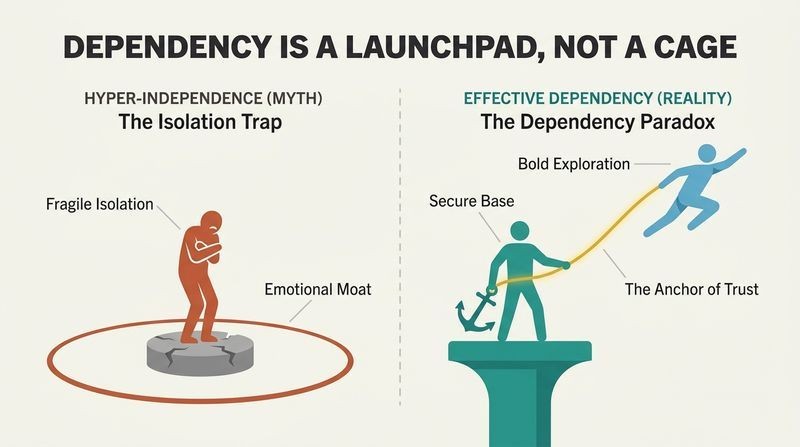
This dovetails with John Cacioppo's loneliness research showing social isolation rivals smoking as a mortality risk, and with the Harvard Study of Adult Development, which found relationship quality at 50 predicted health at 80 better than cholesterol. The dependency paradox has empirical teeth: Brooke Feeney's studies show partners who accept dependence become more autonomous, not less. The nuance worth flagging is cultural. Interdependence norms vary widely, and what reads as healthy closeness in one society reads as enmeshment in another. Johnson's universalism is mostly defensible given the biology, but the optimal dose of visible dependency is genuinely calibrated by context.
Your attachment style runs a hidden if-this-then-that love script
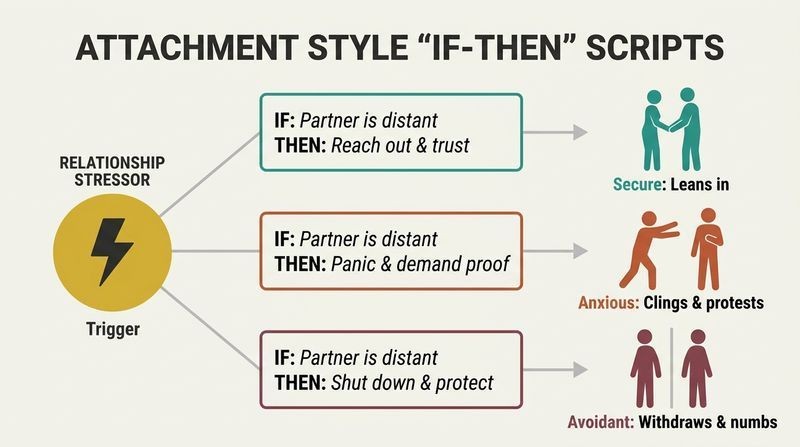
Three habitual strategies form in childhood. Bowlby and Mary Ainsworth's Strange Situation experiment (toddler left, then reunited with mother) revealed three patterns that carry into adult romance:
1. Secure: comfortable with closeness, trusts partners will respond.
2. Anxious: craves reassurance, fears abandonment, seeks constant proof of love.
3. Avoidant: suppresses needs, distrusts others, keeps emotional distance.
Styles shape how we dance under threat. Jeff Simpson's studies found secure and anxious people reach for partners when stressed, while avoidants withdraw. Anxious partners catastrophize during internal conflict. Crucially, styles are stable but not fixed: an anxious woman paired with a consistently responsive secure man can gradually rewrite her template. Johnson's own relatives illustrate the three, including an avoidant uncle who couldn't touch his wife yet died by suicide three months after she passed.
The Minnesota Longitudinal Study gives this unusual weight: attachment security at age one predicted conflict-resolution skill with romantic partners at 21. That is a rare 20-year through-line in psychology. A useful extension is Kim Bartholomew's four-category model, which splits avoidance into dismissing and fearful types, capturing people who both crave and dread closeness. The practical payoff is diagnostic humility. Recognizing your own script stops you from reading a partner's withdrawal as malice rather than a learned self-protection. The caveat: self-report attachment measures are noisy, and people often shift styles across different relationships, so treating a label as destiny misreads the theory.
Naming an emotion is the first move that tames it
Emotion is intelligence, not noise. The old Cartesian view treated feelings as our lower animal nature to be conquered by reason. Neuroscience reversed this: emotion is a rapid signaling system that sorts what matters and readies action. It moves faster than thought, taking about 100 milliseconds to register a change in another's face.
Labeling calms the alarm. UCLA's Matthew Lieberman showed people angry faces. When subjects identified the sex of the face, the amygdala stayed lit. When they labeled the emotion, the brain calmed down. Meanwhile, James Gross found that suppressing emotion backfires: it heightens amygdala activity and, contagiously, stresses your partner too. Reappraisal (reframing the situation) works better because it intervenes as emotion forms, before the volcano caps and explodes. The functional move in love is to share feelings, not swallow them.
Lieberman's affect labeling finding has become foundational to mindfulness-based therapies and even hostage negotiation training, where naming the other person's emotion defuses it. There is a neat convergence with Daniel Kahneman's fast and slow systems: emotion is System 1, and naming recruits the prefrontal System 2 to modulate it. The subtle tension is that suppression is not always maladaptive. Cross-cultural work by Iris Mauss suggests that in cultures valuing emotional restraint, suppression carries less physiological cost. Johnson's advice to share rather than stifle is sound for intimate partners specifically, where the relationship itself depends on the signal getting through, but it generalizes less cleanly to every social context.
A loved one's hand literally rewires how your brain feels pain
Love is measurable in the scanner. Jim Coan put happily married women in an fMRI and threatened them with ankle shocks. Alone, their threat circuits blazed and the shock hurt most. A stranger's hand helped a little. Their husband's hand nearly silenced the alarm, and they rated the same shock as merely uncomfortable. Connection is the natural antidote to fear and pain.
Therapy can restore that buffer. When Johnson ran the study on distressed couples, a husband's hand did nothing at first, because he was not a safety cue. After twenty sessions of EFT, the women's alarm was virtually erased when holding his hand. This was the first proof that changing how partners interact changes the brain itself. Rejection also shares neural real estate with physical pain, which is why Tylenol can dull hurt feelings.
Coan's hand-holding study is now a landmark in social neuroscience, and his social baseline theory extends it elegantly: the brain treats a reliable partner as a resource that lowers the metabolic cost of managing threat, effectively outsourcing self-regulation. Naomi Eisenberger's Cyberball work on social pain reinforces the overlap between rejection and physical injury in the anterior cingulate. The transformative claim here is that couple therapy produced a measurable neural change, which pushes back against the assumption that adult brains and bonds are fixed. One caution: fMRI studies with small samples have faced replication scrutiny, so the direction of the effect is robust even if precise magnitudes deserve modesty.
Secure attachment causes great sex, not the other way around
We have the sex-love arrow backwards. Culture insists good sex builds a bond. Johnson's research shows secure bonding produces the best, most orgasmic sex. She names three modes tied to attachment style:
1. Sealed-off sex (avoidant): focused on sensation and performance, emotionally walled off, needs constant novelty.
2. Solace sex (anxious): used as reassurance you are loved, emotionally charged but anxious.
3. Synchrony sex (secure): open, playful, communicative, deeply satisfying.
Safety unlocks eroticism. Feeling protected lets partners experiment without fear of rejection. Distressed couples blame up to 70 percent of their misery on sex, while contented couples credit it for under a quarter of their happiness, revealing sexual trouble as a symptom of the fraying bond. Women's desire especially depends on safety: brain scans show only women activate judgment and safety regions in response to sexual cues.
This inverts the pop-sex-manual industry and aligns with Rosemary Basson's influential circular model of female desire, which replaced the linear desire-arousal-orgasm sequence with a feedback loop driven by emotional intimacy. Gurit Birnbaum's diary studies of sexual fantasy give the attachment-sex link real granularity. Where Johnson is most provocative is her critique of internet porn as a catastrophe for bonding, framing compulsive use as a failed substitute for secure attachment. That argument is contested. Some sex researchers see moderate porn use as benign, and the addiction framing remains scientifically unsettled. Still, the core insight, that eroticism flourishes on a platform of felt safety, has strong clinical support.
Humans are naturally monogamous, wired by the molecule oxytocin
Fidelity is biological, not aspirational. Against the fashionable claim that monogamy is unnatural, Johnson marshals evidence that we are built to bond with one partner. The clearest proof is prairie voles, which have oxytocin receptors and mate for life, versus montane voles, which lack them and abandon their mates. Block a prairie vole's oxytocin and it becomes promiscuous.
Oxytocin is the master chemical of connection. Nicknamed the cuddle hormone and the molecule of monogamy, it surges during breastfeeding, orgasm, and even at the mere thought of a loved one. It quiets the amygdala, boosts trust, and helps us read faces accurately. In one study, men given oxytocin who were in committed relationships kept 10 to 15 centimeters farther from an attractive stranger than single men did. Affairs, Johnson argues, spring not from a roving nature but from a weak or starved bond.
The vole research (Sue Carter, Thomas Insel) genuinely reshaped how biologists think about pair-bonding, and the two-species contrast is one of neuroscience's cleaner natural experiments. That said, extrapolating from voles to humans invites caution. Only about 3 to 5 percent of mammals pair-bond, and human mating systems are strikingly flexible across cultures and history, including widespread polygyny. Oxytocin is also not a simple love drug: it can amplify in-group favoritism and even envy, as Carsten De Dreu's work shows. Johnson's stronger, defensible point is not that infidelity never happens but that we are equipped for durable bonds, so straying signals a broken connection rather than fulfilled biology.
Fights are protests against lost connection, not battles over content
The real fight is never about the dishes. Beneath conflicts over money, in-laws, and chores runs one question: are you there for me? Johnson calls the recurring demand-withdraw pattern the Protest Polka, an objection to disconnection. One partner criticizes to force a response, the other stonewalls to protect themselves, and each move deepens the other's panic.
Two toxins erode love. Criticism and stonewalling are corrosive. Jill Hooley's fMRI work found that hearing a mother's criticism failed to activate the brain region that soothes distress in formerly depressed people; she calls criticism low-grade punches to the brain. Ed Tronick's Still Face experiment shows the cost of stonewalling: when a mother goes blank, her baby frantically tries to reengage, then collapses into despair. Adults do the identical sequence. Ted Huston's study found couples split not from too much conflict but from too little affection and responsiveness early on.
Huston's longitudinal data are the quiet bombshell here: the death of a marriage is better predicted by the erosion of warmth than by the frequency of arguments, which challenges the intuitive belief that fighting couples are doomed. This complements John Gottman's finding that master couples are not conflict-free but repair-skilled, and that contempt is the strongest divorce predictor. The Protest Polka reframing is clinically powerful because it converts a partner's rage from an attack into a distress signal, which changes how the other responds. The limit is that not all criticism masks a bid for connection. Sometimes a complaint is just a legitimate grievance that deserves a straightforward fix.
Repair the small tears constantly; even great couples misread 70% of cues
Love is meeting, missing, and finding each other again. Relationships are never static; they cycle through attunement, misattunement, and reconnection. Ed Tronick found that even happily bonded mothers and infants miss each other's signals fully 70 percent of the time. Adults miss even more. Stability depends not on avoiding rifts but on mending the tiny, constant ones.
Buffer, balance, bounce. Jessica Salvatore's Minnesota research found that even people with insecure histories had lasting relationships if their partner could recover from an argument and steer them back to warmth. A more secure partner buffers your fear, helps you rebalance, and together you bounce back. Set up reconnection rituals: one couple used a simple Where are you? check-in, where each reports their emotional state. Renewing vows yearly rather than by the decade builds the same deliberate attentiveness.
The 70 percent miss rate is oddly liberating. It reframes misattunement as the normal texture of intimacy rather than evidence of failure, echoing the psychoanalyst Donald Winnicott's good-enough mother, who succeeds precisely by imperfect attunement and reliable repair. Salvatore's finding that a partner's repair skill can compensate for one's own insecure history is genuinely hopeful and underappreciated: it means a relationship is a two-person system where one secure member can stabilize the dyad. The actionable core, small frequent repairs over grand gestures, mirrors habit science, where consistency beats intensity. A reasonable critique is that chronic one-sided repair labor can quietly exhaust the more secure partner over years.
Hold Me Tight conversations turn hidden fears into a stronger bond
Renewal is a two-step process. First, couples must recognize and halt their negative cycle, naming it as the shared enemy rather than blaming each other. Larry and Prue called theirs the Pit. Second, and harder, withdrawn partners must open up emotionally and blaming partners must ask for what they need from a place of vulnerability.
The transforming exchange. Johnson calls these Hold Me Tight conversations. Partners tune into their softer emotions, turn them into clear signals, state attachment needs directly, and respond to each other with empathy. Patrick, a results-driven businessman who wanted to fix his marriage in two sessions, eventually told his wife he felt he could run a company but not hold onto her. That raw admission, met with her tenderness, began a new bonding cycle. Sixteen studies validate EFT, with a 70 to 75 percent success rate that holds years later.
EFT's evidence base is unusually strong for couple therapy, and the mechanism, restructuring the emotional bond rather than teaching negotiation, distinguishes it from behavioral approaches that often fade once the exercises stop. The Hold Me Tight structure operationalizes vulnerability in a way that Brene Brown's research on shame and courage independently corroborates: naming fear aloud to a responsive listener is what builds trust. A grounded caveat: these conversations presume a partner capable of responsiveness. In relationships marked by ongoing abuse, contempt, or one partner's refusal to engage, prescribing more vulnerability can be harmful. EFT works best when both people still want the bond and neither is unsafe.
Attachment wounds must be healed, never just papered over
Some injuries detonate a bond in one moment. Beyond slow erosion, Johnson identifies attachment injuries: single betrayals at moments of acute need. An affair is the obvious one, but so is a husband who froze during his wife's miscarriage, or a spouse who refused to drive a partner to a dying parent. The wound answers the core question, will you be there when I need you, with a resounding no.
Forgiveness follows a map. Johnson's team built the Attachment Injury Resolution Model. The hurt partner voices the pain without character attacks; the injuring partner listens, resists defensiveness, and acknowledges the specific hurt; a sincere apology follows; the hurt partner states what they need to heal; together they build a new story. With infidelity, Johnson stresses it is usually the depth of deception, not the sex itself, that wounds. In studies, injured couples reconciled in twelve to thirteen EFT sessions.
The insight that betrayal trauma tracks deception more than the sexual act echoes Jennifer Freyd's betrayal trauma theory, which holds that harm from a trusted attachment figure damages differently than harm from a stranger, precisely because it violates the safety the bond is supposed to provide. Johnson's structured forgiveness model is valuable because most cultural scripts on forgiveness come from religion or philosophy and offer exhortation without process. A sharp question the framework raises: is reconciliation always the goal? The model risks implying that a healed bond is the success metric, when for some injuries, especially repeated ones, a clear-eyed separation may be the healthier resolution.
Screens and robot companions are counterfeiting the connection we need
We are engineering loneliness. Just as science cracks love's code, society builds a world where bonds are harder to form. In 1950, four million Americans lived alone; by 2012, over thirty million did. Sherry Turkle warns that our devices make us expect more from technology and less from each other. The average teen sends over three thousand texts a month. Robots like Paro the seal and Roxxxy are marketed to comfort the lonely elderly and single, offering a performance of care without any feeling behind it.
Empathy can be taught, and must be. Mary Gordon's Roots of Empathy brings a mother and infant into classrooms so children learn the language of feelings; nasty behavior dropped 61 percent. Johnson argues society should treat connection as public health, noting emotional isolation is deadlier than smoking, and calls for parental leave, walkable communities, and relationship education.
Turkle's Alone Together thesis has only sharpened since publication, with rising evidence linking heavy adolescent social media use to anxiety and depression, though causation remains fiercely debated by researchers like Jonathan Haidt and skeptics like Candice Odgers. The Roots of Empathy data are encouraging and fit a broader movement in social-emotional learning, yet a single program cannot offset structural drivers of isolation. Johnson's most bracing move is treating loneliness as a policy failure rather than a personal one, echoing former US Surgeon General Vivek Murthy's declaration of a loneliness epidemic. The tension worth naming: a substitute relationship, even a robot, may genuinely be better than nothing for an isolated senior, which complicates a pure rejection of the technology.
Analysis
Love Sense is a science-driven manifesto disguised as a relationship guide. Sue Johnson, a clinical psychologist and the architect of Emotionally Focused Therapy, synthesizes attachment theory, affective neuroscience, and three decades of clinical research into a single unifying claim: romantic love is a biological survival code, and it is knowable, malleable, and repairable. The book's power comes from consilience. Johnson braids Bowlby's attachment theory, Harlow's monkeys, Coan's fMRI hand-holding studies, Tronick's Still Face experiment, and vole neurobiology into one coherent account that dismantles the romantic myth that love is a mystery beyond our control.
The intellectual contribution is the reframe. Where earlier therapy treated conflict as a skills deficit or a projection of childhood wounds, Johnson locates the root in the fear of losing emotional connection. This is a genuine paradigm shift with clinical consequences: EFT targets the bond rather than the argument, and its outcome data (roughly 70 to 75 percent success, durable at follow-up) are strong for the field.
The book's limitations are the limitations of attachment theory itself when applied maximally. Nearly every phenomenon, sex, infidelity, depression, even civilizational decline, gets read through the bonding lens, which risks explanatory overreach. The vole-to-human leap on monogamy is suggestive rather than conclusive, and the anti-pornography argument leans on a contested addiction model. The final chapter's expansion from couples to society, leadership, and policy is inspiring but thinner than the clinical core.
What endures is the practical optimism. Johnson gives readers a vocabulary (the Protest Polka, Hold Me Tight conversations, attachment injuries) and a defensible thesis: dependency is strength, emotion is intelligence, and safety, not novelty, is the true engine of lasting passion. In an era of rising isolation, the argument that connection is medical infrastructure, not a luxury, feels less like self-help and more like public health.
Review Summary
Love Sense receives generally positive reviews, with readers praising Johnson's accessible writing style and scientific approach to understanding relationships. Many find the book insightful and helpful for improving their own relationships. Some criticize the heteronormative perspective and dismissal of non-monogamous relationships. Readers appreciate the focus on attachment theory and emotional connection. The book's examples and experiments receive mixed reactions. Overall, reviewers find the book informative and valuable for understanding the science behind love and relationships.
People Also Read





FAQ
What's Love Sense about?
- Exploration of Love: Love Sense by Sue Johnson delves into the science of romantic relationships, emphasizing that love is a vital survival mechanism, not just an emotion.
- Attachment Theory: The book is grounded in attachment theory, which suggests that adult romantic love is an attachment bond similar to that between a mother and child.
- Emotionally Focused Therapy (EFT): Johnson introduces EFT as a method to help couples repair and strengthen their emotional bonds, supported by clinical studies and real-life examples.
Why should I read Love Sense?
- Revolutionary Insights: The book challenges the notion that romantic relationships are inherently unstable, offering a fresh perspective on love through scientific understanding.
- Practical Guidance: Readers will find practical advice and exercises to create and sustain loving relationships, making it a valuable resource for improving romantic life.
- Addressing Loneliness: In a time of prevalent loneliness, Love Sense emphasizes the importance of secure attachments and emotional connections.
What are the key takeaways of Love Sense?
- Love as Survival: Love is essential for human survival, acting as a protective bond that fosters emotional security.
- Attachment Styles: The book outlines secure, anxious, and avoidant attachment styles and their influence on romantic relationships.
- EFT's Effectiveness: Emotionally Focused Therapy is highlighted as a successful method for repairing relationships, with a 70-75% success rate.
What is Emotionally Focused Therapy (EFT) according to Love Sense?
- Therapeutic Approach: EFT is a structured approach to couple therapy that focuses on creating a secure emotional bond between partners.
- High Success Rate: Johnson notes that EFT has a 70-75% success rate in helping couples repair their relationships.
- Practical Exercises: The book includes exercises based on EFT principles, allowing couples to engage in meaningful conversations that strengthen their emotional connection.
How does attachment theory relate to romantic relationships in Love Sense?
- Foundation of Relationships: Attachment theory posits that early relationships with caregivers shape our ability to form emotional bonds in adulthood.
- Three Attachment Styles: Secure, anxious, and avoidant attachment styles affect relationship dynamics and individual behaviors.
- Impact on Behavior: Understanding attachment styles can help couples navigate their interactions more effectively.
How can couples improve their emotional connection according to Love Sense?
- Open Conversations: Couples should prioritize open and honest discussions about their feelings and needs to foster understanding and intimacy.
- Active Listening: Listening attentively without interrupting or judging shows that you value your partner's perspective.
- Rituals of Connection: Establishing regular rituals, like date nights, helps couples reconnect and strengthen their bond.
What role does oxytocin play in relationships according to Love Sense?
- Cuddle Hormone: Oxytocin promotes bonding and emotional connection, released during physical touch like hugging and intimacy.
- Impact on Behavior: It reduces stress and anxiety, allowing individuals to feel more secure in their relationships.
- Supports Monogamy: Oxytocin reinforces the bond between partners, encouraging prioritization of romantic connections.
How does Love Sense address the challenges of parenthood in relationships?
- Transition Stress: The arrival of a child can strain relationships, often leading to decreased marital satisfaction.
- Importance of Support: Partners need to support each other during this transition, as secure attachments help navigate parenthood challenges.
- Impact on Children: The quality of the couple's relationship directly affects their children's emotional well-being.
What are the emotional dynamics discussed in Love Sense?
- Emotions as Signals: Emotions serve as vital signals that guide behavior in relationships, enhancing communication and connection.
- Fear and Vulnerability: Fear often underlies conflicts, leading to defensive behaviors; addressing these fears fosters emotional safety.
- Empathy and Connection: Empathy is crucial for maintaining a healthy bond, as tuning into a partner's emotions fosters deeper connections.
How does Love Sense address the issue of divorce?
- Rising Divorce Rates: Johnson discusses increasing divorce rates, particularly among older couples, reflecting changing attitudes toward marriage.
- Importance of Emotional Bonds: Strong emotional bonds are essential for sustaining long-term relationships and preventing divorce.
- Strategies for Prevention: The book offers strategies to strengthen emotional connections and address issues before they escalate.
What are some practical exercises included in Love Sense?
- Experiments for Couples: The book features exercises to help couples explore emotional dynamics and improve their connection.
- Reflective Practices: Reflective practices allow individuals to examine their attachment styles and emotional responses.
- Building Emotional Safety: Exercises focus on creating a safe space for partners to express vulnerability and seek comfort.
What are the best quotes from Love Sense and what do they mean?
- "Love is good sense.": Emphasizes that love is a logical and essential part of human existence, leading to healthier relationships.
- "Unless you love someone, nothing else makes any sense.": Highlights love's centrality in life, providing meaning and purpose.
- "Love consists in this, that two solitudes protect and touch and greet each other.": Reflects mutual support and connection, emphasizing emotional safety and responsiveness.
About the Author
Download PDF
Download EPUB
.epub digital book format is ideal for reading ebooks on phones, tablets, and e-readers.








































