


Key Takeaways
Your fights are never about the dishes; they're cries for safety
The problem is not the problem. When couples argue about keys on a table, crumbs on a counter, or an unwalked dog, the surface topic is code for a deeper question: Do I matter to you? Will you be there when I reach for you? Menanno calls these underlying longings attachment needs, and every silent treatment, eye roll, or blowup is a misguided attempt to get them met.
The trash still needs taking out. She isn't dismissing real logistics. But the deeper block is almost always communication rooted in attachment insecurity. Andrew and Jen fought about a key hook and ended in deafening silence, forgetting what started it but remembering how alone they felt. Fix the safety, and the logistics become solvable.
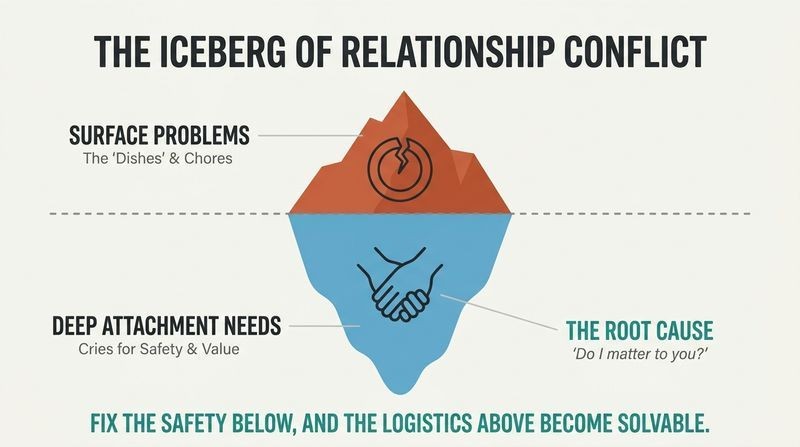
This reframe echoes Gottman's finding that most perpetual conflicts (roughly 69%) are never resolved because they rest on unmet emotional needs, not solvable problems. What's valuable here is the shift from content to process: stop litigating facts, start decoding meaning. A caution worth adding: not every complaint is symbolic. Sometimes crumbs are just crumbs, and chronic over-interpretation can itself become exhausting, a pattern Menanno acknowledges when she distinguishes filtering-for-the-negative from genuine concern. The skill is discernment, learning when a small irritation carries attachment weight and when it deserves a shrug.
Half of us never learned words for our deepest relationship hungers
Needs live in the body first. Just as a baby feels hunger before learning the word, your nervous system registers attachment distress (tight chest, quickened breath, racing heart) long before your mind can name it. Most people grew up without anyone labeling these states, so they act out the pain instead of speaking it. Menanno suggests the phrase "to feel close to you, I need to know..." as a template: that you value me, that my feelings are valid, that you'll respond when I reach.
At least half of us carry insecure attachment. If your childhood caregivers couldn't consistently tune in, you likely gravitate toward relationships that feel good then curdle into distress. Naming needs is the first step to getting them met.
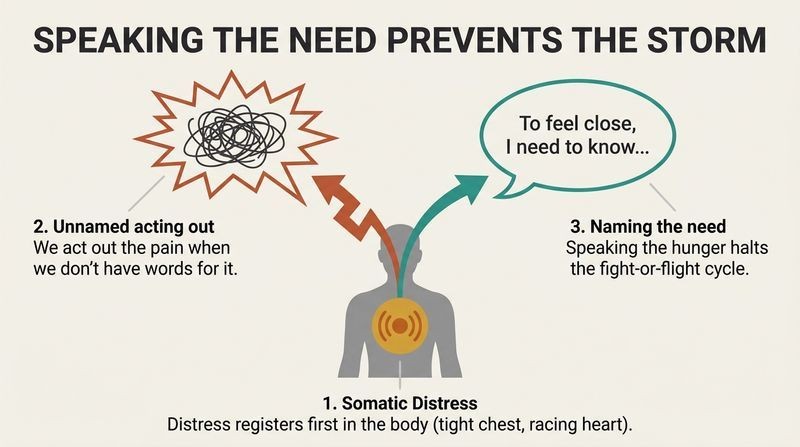
The hunger analogy is pedagogically sharp because it naturalizes needs that our culture often shames as weakness or codependency. Affective neuroscience supports the claim: interoception, the ability to sense internal bodily states, correlates strongly with emotional regulation, and alexithymia (difficulty identifying feelings) predicts relationship dysfunction. Menanno's insistence that naming precedes managing parallels Dan Siegel's "name it to tame it." One nuance: labeling can intellectualize emotion, letting avoidant partners describe feelings without actually feeling them. The book's deeper aim is felt experience, not vocabulary drills, a distinction easy to lose when needs become a checklist.
Anxious chases, avoidant flees, and each one fuels the other
Three insecure styles, one origin. Attachment styles form in childhood based on how caregivers met your emotional bids. The anxious-attached learned to get big (protest, criticize, cling) because attention came inconsistently; their core fear is abandonment. The avoidant-attached learned to shut down and deactivate needs because emotions brought rejection or shame; their core fear is failure. The disorganized-attached, often shaped by trauma, swing unpredictably between craving and pushing away.
Opposites attract and then collide. Most insecure people pair with other insecure people, and anxious-avoidant is the most common match. One turns up the heat seeking connection; the other cools things down avoiding conflict. Each reinforces the other's worst fear, creating a self-perpetuating loop that feels like incompatibility but is actually a fixable dance.
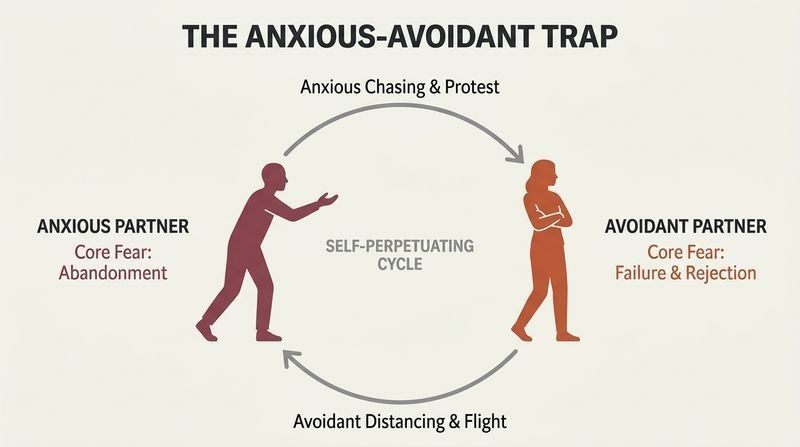
The anxious-avoidant "trap" is one of attachment theory's most replicated findings, though the gender skew Menanno cites (roughly 75/25 for both) reflects tendencies, not destiny. What's astute is reframing the pairing as a homeostatic system: the couple unconsciously splits emotional labor, one person carrying all the pursuit, the other all the distance. Systems theory calls this complementarity. The hopeful implication is that changing one node shifts the whole. A limitation: attachment styles are measured inconsistently across research, and self-typing risks becoming an identity or an excuse ("I'm just avoidant") rather than a starting point for change.
Only 50% attunement in childhood is enough to raise a secure kid
Good-enough beats perfect. Research cited by Menanno suggests children need attuned, responsive caregiving only about half the time to develop secure attachment. Parents yell, get distracted, and send kids to their rooms when they need a hug, and it's fine, because what matters is the overall emotional climate, not isolated failures. Secure kids don't grow up in flawless homes; they grow up with enough warmth to trust that comfort is available.
Climate versus weather. Menanno's central metaphor: secure couples live in a warm climate with occasional bad weather (ruptures they repair). Insecure couples experience so many unrepaired storms that bad weather becomes the climate. Temperament matters too, through the "goodness of fit" between parent and child, but adults create the environment.
The 50% figure (drawn from Woodhouse et al.'s secure-base research) is liberating and quietly radical against a culture of anxious, optimizing parenthood. It resonates with Winnicott's "good-enough mother" and Ed Tronick's still-face experiments, which found that healthy dyads spend much of their time in mismatch and repair, not seamless sync. The reparative move, not the absence of rupture, builds resilience. This reframes attachment security as a skill of recovery rather than a state of perfection, a distinction that extends naturally to adult relationships, where the capacity to mend outperforms the fantasy of never fighting.
Treat the negative cycle, not your partner, as the enemy
Externalize the pattern. When two insecure partners try to discuss something hard, they fall into a predictable loop: one accuses, the other defends, the first protests louder, the second shuts down. Menanno calls this the negative cycle, and it, not your partner, is the real enemy. "Buying the reframe" means seeing that even vicious-looking behavior is a bungled reach for closeness.
Name it to defuse it. In the heat of a fight, say it aloud: "This is our negative cycle. Let's not let it win." Watch for common traps: Who's the Bad Guy? (both fight to avoid blame), Who Gets to Hurt Worse? (both compete for most-wounded), and The Miss (both misread each other's intentions). Naming the trap creates just enough distance to choose differently.
Externalization is borrowed from narrative therapy (Michael White), where separating the person from the problem reduces shame and defensiveness. Positioning the cycle as a third entity is clever because it converts a zero-sum blame contest into a shared enemy, activating cooperation. Neurobiologically, labeling an experience recruits the prefrontal cortex and dampens amygdala reactivity, so "naming the cycle" isn't just rhetoric, it's regulation. The risk is weaponization: "you're doing the cycle again" can become a new accusation. Menanno guards against this by insisting the reframe requires genuine ownership, not a clever way to relocate fault onto the pattern while dodging accountability.
It takes two to fight but only one to stop
Interrupt before you prevent. You can't always avoid negative cycles, so the first skill is stopping one mid-spiral. Catch the first flush of a trigger, then choose a different move. Viktor Frankl's insight applies: between stimulus and response lies a space, and in that space is freedom. Even getting from throwing a plate to throwing a dish towel counts as growth.
Self-regulate, then co-regulate. Ground yourself first (box breathing, body scanning, mentalizing a warm memory), because you can only calm your partner if you're calm. Co-regulation, offering a steady presence through touch, tone, or validation, is the fastest exit because it replaces the disconnection of a fight with connection. When you can't manage that, take a break of five minutes to a day, always agreeing to return.
The distinction between co-regulation and appeasement is crucial and underappreciated. Both look like calming your partner, but one is motivated by connection and the other by fear of conflict, and nervous systems detect the difference. Polyvagal theory (Stephen Porges) grounds this: humans co-regulate through subtle cues of safety, prosody, facial warmth, touch, that signal the social engagement system. Menanno's practical framing (regulate self before other) mirrors the airplane oxygen-mask logic. The honest caveat she includes: if only one partner ever does the regulating, that imbalance itself becomes unsustainable, and modeling can only carry a relationship so far.
Vulnerability means risking rejection, not just crying loudly
Exposure, not expression. Many people think being emotional equals being vulnerable. Not so. Long tearful rants and angry protests can actually be protective. True vulnerability means engaging in words or behaviors that expose you to possible emotional pain: setting a boundary despite fearing rejection, admitting you overspent instead of hiding it, saying "I'm scared you'll abandon me" instead of attacking. As EFT therapists quip, "no risk it, no biscuit."
It's about your relationship with yourself. The real question isn't whether your partner responds perfectly. It's whether you can survive the feelings that arise if they don't. Vulnerability exposes you to hurt but doesn't guarantee it, and the alternative, a lifetime of hiding, hurts more. This willingness to be seen is the crux of moving from protective communication to secure love.
The reframe that emotional volume can be a defense against genuine exposure is one of the book's sharpest insights. Brené Brown's research converges here: vulnerability is uncertainty, risk, and emotional exposure, not oversharing or catharsis. Menanno adds a useful twist by locating vulnerability in the self-relationship, reframing it as a test of one's own distress tolerance rather than a bid for a particular reaction. This inoculates against the transactional trap of "I was vulnerable, so you must reward me." The clinical wisdom, that anger and tears often shield deeper fear and shame, aligns with EFT's model of primary versus secondary emotions.
Validate the feeling, not the facts, especially the anger
Validation is not agreement. You can validate your partner's emotional experience without conceding they're factually right. When a partner says "you always make bad money decisions," you needn't accept that distortion; you validate the fear and helplessness underneath. Menanno's rule: validate what you want to grow. Empathy is the internal experience of feeling with someone; validation puts it into words that land between you.
Anger softens when it's heard. Counterintuitively, validating anger defuses it rather than fueling it. Unvalidated anger hardens; met anger relaxes because it no longer has to fight to be seen. You don't have to tolerate yelling or name-calling, but you can say, "It makes sense you're mad; I'd be mad too if I felt my needs didn't matter." As she notes, everyone wants their own anger validated but resists validating others'.
The claim that validation de-escalates anger is well-supported by DBT, where validation is a core skill for defusing emotional dysregulation, and by hostage-negotiation tactics, where acknowledging a person's emotional reality lowers threat. The neuroscience of "feeling felt" (Siegel) suggests that being accurately mirrored calms the limbic system. What Menanno adds practically is the anger-specific application, since anger is the emotion people most fear validating, wrongly assuming it rewards bad behavior. The nuance she preserves: validating the emotion while boundarying the behavior. The line between validation and manipulation (saying what someone wants to hear to shut them up) is thin, and partners detect fakery instantly.
EVVICT shame from your home with six deliberate habits
Shame drives the whole machine. Shame, the belief that you are bad, unworthy, or unlovable, develops from repeated childhood messages and fuels insecure attachment. It shows up as overreacting, blaming, rigidity, withdrawal, and criticism, all attempts to keep the feared badness hidden. The antidote is acceptance, and Menanno offers the acronym EVVICT to build a shame-free environment:
1. Empathy (feel some of what your partner feels)
2. Validation (put understanding into words)
3. Vulnerability (risk exposure)
4. Influence (guide without controlling)
5. Curiosity (seek to understand, not judge)
6. Tolerance (let the small stuff go)
Separate the person from the behavior. "You're irresponsible" becomes "When plans change last-minute, I feel left in the dark." This dissolves shame over time, because shame cannot survive in an atmosphere of acceptance.
The framework usefully operationalizes an abstract goal (less shame) into teachable behaviors, and the person-versus-behavior distinction echoes decades of parenting research (Haim Ginott, Carol Dweck) showing that criticizing character rather than conduct breeds defensiveness and fixed mindsets. The influence-versus-control distinction is particularly mature: control demands instant compliance and springs from fear, while influence tolerates ambiguity and springs from confidence. One tension worth flagging: shame and healthy guilt sit close together, and the book rightly preserves guilt ("I did something hurtful") as motivating while rejecting shame ("I am bad"). Collapsing the two, a common therapeutic overcorrection, can leave people unaccountable. EVVICT works only alongside genuine responsibility.
Repair deep betrayals by expanding space for pain, never rushing it
Attachment injuries need more than apology. Some wounds (an affair, a partner absent during a crisis, chronic dishonesty) are attachment injuries: betrayals so profound that the relationship can't thrive until trust rebuilds. Menanno's client Leah broke her leg and waited alone in the ER for hours while her husband Max finished work; his childhood-rooted terror of failure made him unable to grasp her devastation. Healing required Max to accept the injury occurred and let Leah share her pain without defending himself.
Avoid the five traps. Healing conversations derail through negative cycles, shame spiraling, making excuses, changing the subject, and rushing ("how many times must we do this?"). Trust runs on the nervous system's timeline, not willpower. You don't tell a scraped knee to hurry; you clean it and give it space. Repeat the conversation until the crying stops, because people stop crying when they finally get what they need.
Menanno's approach mirrors Gottman's atonement-attunement-attachment model and Sue Johnson's EFT protocol for attachment injuries, both emphasizing that the injured partner must feel fully witnessed before the relationship moves on. The insight that mistrust is a nervous-system survival response, not a choice, reframes forgiveness as something cultivated rather than willed, which relieves the injured party of pressure to "just get over it." The reframe of Max's apparent callousness as its own trauma response is compassionate but risks sliding toward excusing harm; the book guards this by insisting understanding is not justification and that the wounded partner's pain gets airtime first, the wounding partner's context much later.
Growth is never linear; measure fewer, milder, faster-repaired fights
Two steps forward, one back. Menanno insists growth always follows a jagged upward trend with peaks and valleys, never a straight line. Backslides aren't failure; they're where deeper wounds finally feel safe enough to surface. Once a couple gains awareness of attachment concepts, they never fully return to square one. A relationship that feels good 10% of the time climbing to 20% is real progress.
Track three metrics. Assess security by whether negative cycles are (1) less frequent, (2) less intense, and (3) repaired faster. Early on, couples might not speak for a week after a rupture; later, minutes. She also warns of the "empty bucket" phase: after you stop fighting but before you rebuild closeness, things can feel flat and distant. That's normal, the dirty water is drained before clean water fills it.
Framing progress as nonlinear inoculates couples against the demoralization that ends many change efforts prematurely, a pattern well-documented in behavior-change research, where lapses predict abandonment only when interpreted as total failure (the abstinence-violation effect). The three concrete metrics (frequency, intensity, repair speed) are smart because they make invisible progress measurable, countering the human negativity bias that fixates on the latest bad fight. The empty-bucket metaphor names a genuinely confusing stage that couples often misread as the relationship dying. One extension: tracking positive bids and shared joy, not just reduced conflict, matters too, since absence of fighting is not the same as presence of connection.
You can't force your partner to change, so become the change
Pressure creates its own negative cycle. When one partner (usually the anxious one) pushes hard for change, researches solutions, and demands couples therapy, the other (usually avoidant) distances, and "working on the relationship" becomes its own toxic loop. Menanno's food analogy: enthusiasm about a healthy diet curdles into surveillance ("did you have your green smoothie?"), the partner rebels, and now food has a negative cycle. Trying to control someone is the fastest way to ensure they resist, because people rebel to preserve dignity.
Model what you want to grow. Instead of coercing, change the environment and be the change: if you want validation, validate; if you want curiosity, be curious; if you want your partner in therapy, validate their resistance first. Even if they never join you, your own growth toward a secure relationship with yourself is a guaranteed win that outlasts any single partnership.
This is systems theory made actionable: in any interdependent system, unilateral change in one element shifts the whole, a principle Murray Bowen called "differentiation of self." The counterintuitive move, meeting a partner's resistance to help with validation rather than argument, applies motivational interviewing's core finding that people change when they feel autonomous, not cornered. The reactance literature (Brehm) confirms that perceived threats to freedom trigger backlash. Menanno's most durable reframe is that self-growth is non-contingent: it pays dividends regardless of the partner's response. The unstated tension, staying and growing alone versus leaving, is real, and the book resists both codependent over-staying and premature exit, landing on clarity as the goal.
Analysis
Secure Love is a practitioner's translation of Emotionally Focused Couples Therapy (EFT), the model developed by Sue Johnson from the attachment research of Bowlby, Ainsworth, Hazan, and Shaver. Menanno's contribution is not theoretical novelty but accessibility: she converts clinical concepts into scripts, acronyms, and kitchen-table examples drawn from her practice and her million-follower Instagram audience. The book's structure mirrors a course of therapy, moving from understanding attachment styles, to spotting negative cycles, to interrupting and repairing them, to real-world complications like sex, trauma, and addiction.
The central thesis is elegant and empirically grounded: relationship distress is rarely about compatibility or the surface content of arguments; it is about attachment insecurity expressed through self-reinforcing negative communication cycles. This reframe carries genuine explanatory power and aligns with Gottman's decades of observational research showing that how couples fight predicts divorce better than what they fight about.
What distinguishes the book within a crowded genre is its insistence on the felt experience over intellectual understanding, and its compassionate reframing of "bad" behaviors (the avoidant's stonewalling, the anxious partner's protest) as misguided reaches for safety. This de-shaming stance is therapeutically wise and humane.
The book's limitations are worth noting. Attachment-style self-typing, while heuristically useful, oversimplifies a construct that researchers measure inconsistently and that shifts across relationships. The near-exclusive focus on communication risks underplaying structural stressors (money, caregiving load, discrimination) that Menanno acknowledges but subordinates. And the emphasis on staying and repairing, though balanced by her disclaimer about abuse and deal-breakers, may keep some readers over-invested in unworkable partnerships.
Still, the practical yield is high. The distinction between co-regulation and appeasement, the reframe of vulnerability as exposure rather than expression, and the three-metric growth model (fewer, milder, faster-repaired cycles) give readers concrete, testable tools. For couples stuck in the anxious-avoidant loop, this is a genuinely useful field manual.
Review Summary
Secure Love receives overwhelmingly positive reviews, with readers praising its insightful approach to attachment theory and practical advice for improving relationships. Many find it eye-opening and transformative, comparing it to months of therapy. The book is lauded for its accessible language, real-life examples, and actionable scripts. Readers appreciate the author's empathetic tone and emphasis on self-reflection. While primarily aimed at couples, single readers also find value in understanding attachment styles and improving self-awareness.
People Also Read









FAQ
What's Secure Love about?
- Focus on Relationships: Secure Love by Julie Menanno is centered on creating and maintaining healthy, lasting relationships through understanding attachment styles.
- Attachment Theory: The book explores the four main attachment styles—secure, anxious, avoidant, and disorganized—and their impact on relationship dynamics.
- Practical Guidance: Menanno provides tools and strategies for improving communication, resolving conflicts, and fostering emotional safety and connection.
Why should I read Secure Love?
- Improve Relationship Skills: It offers a framework for enhancing relationship skills, applicable whether you're in a relationship or seeking one.
- Universal Appeal: The insights are relevant to various relationships, including romantic, friendships, and family dynamics.
- Expert Insights: Authored by a therapist experienced in Emotionally Focused Therapy, the book is grounded in research and clinical practice.
What are the key takeaways of Secure Love?
- Understanding Attachment Needs: Recognizing and articulating attachment needs is crucial for emotional closeness and safety.
- Negative Cycles: Identifying and interrupting negative communication cycles is essential for relationship health.
- Vulnerability and Co-Regulation: Emphasizes the importance of vulnerability and mutual emotional support in creating secure attachments.
What are the best quotes from Secure Love and what do they mean?
- “Love is a constant process...”: Highlights the dynamic nature of relationships, requiring ongoing effort and understanding.
- “The problem is not the problem.”: Suggests that surface issues often mask deeper attachment needs and fears.
- “The negative cycle is the enemy.”: Reminds that negative communication patterns harm relationships, not the partners themselves.
How does Secure Love define attachment styles?
- Attachment Styles Overview: Categorizes styles into secure, anxious, avoidant, and disorganized, shaped by early experiences.
- Secure Attachment: Involves comfort with intimacy, trust, and effective communication of needs.
- Anxious and Avoidant Styles: Anxious individuals seek closeness but fear abandonment, while avoidant individuals distance themselves to avoid vulnerability.
What is attachment theory, as explained in Secure Love?
- Foundation of Relationships: Posits that childhood bonds with caregivers shape adult relationship dynamics.
- Four Attachment Styles: Secure, anxious, avoidant, and disorganized styles reflect different ways of managing attachment needs.
- Impact on Adult Relationships: Understanding one's attachment style aids in recognizing patterns and improving emotional safety.
How can I identify my attachment style using Secure Love?
- Self-Reflection Questions: Menanno provides questions to assess attachment style based on emotional responses and behaviors.
- Recognizing Patterns: Examining past relationships helps identify recurring patterns aligned with specific styles.
- Understanding Triggers: Paying attention to emotional triggers during conflicts aids in understanding one's attachment style.
What are negative cycles, and how do they affect relationships?
- Definition of Negative Cycles: Patterns of communication leading to conflict and emotional disconnection.
- Impact on Emotional Safety: Create an environment of insecurity and fear, breaking down communication and trust.
- Breaking the Cycle: Recognizing and interrupting these cycles is crucial for fostering healthier communication.
How can I interrupt a negative cycle in my relationship?
- Recognize the Cycle: Identify when a negative cycle begins by noting discomfort or tension.
- Take a Break: Agree to pause and cool down if emotions run high, allowing for self-regulation.
- Use Attachment-Friendly Language: Re-engage with language that emphasizes connection and understanding.
What role does vulnerability play in building secure relationships?
- Foundation of Connection: Essential for creating emotional intimacy and trust, allowing partners to share their true selves.
- Encourages Open Communication: Fosters a safe space for dialogue about feelings and concerns.
- Strengthens the Bond: Leads to stronger emotional bonds through mutual support during difficult times.
What is the EVVICT model mentioned in Secure Love?
- EVVICT Model Explained: Stands for Empathy, Validation, Vulnerability, Influence, Curiosity, and Tolerance.
- Empathy and Validation: Emphasizes understanding and acknowledging each other's feelings for emotional safety.
- Curiosity and Tolerance: Encourages understanding your partner's perspective and letting go of minor grievances.
How does Secure Love address sexual connection in relationships?
- Importance of Physical Connection: Sexual connection is vital for emotional intimacy and relationship satisfaction.
- Negative Sex Cycles: Negative communication cycles can lead to diminished intimacy, requiring underlying issues to be addressed.
- Open Communication About Sex: Advocates for transparency about sexual needs and desires to enhance connection.
Download PDF
Download EPUB
.epub digital book format is ideal for reading ebooks on phones, tablets, and e-readers.








































