

Key Takeaways
Avoiding conflict quietly kills more marriages than fighting does
The Gottmans open with a couple who divorced over a puppy, but the puppy was never the point. It symbolized his craving for freedom and her longing for family, dreams neither ever voiced. Their unspoken standoff literally petrified into mummified dog poop under a desk.
Silence is not safety. A study found 80% of divorcing couples cited growing apart and lost closeness, not fighting, as the cause. One outwardly peaceful couple the Gottmans treated could barely answer basic questions about each other's lives. The husband had swallowed his resentment for months because he 'didn't want to fight.' Conflict, done right, is how two people stay legible to each other. The absence of friction often signals disconnection, not harmony.
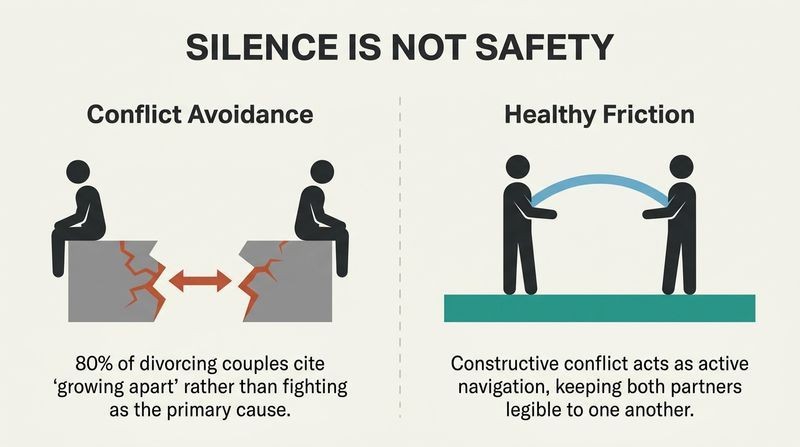
The counterintuitive claim, that conflict avoidance is riskier than conflict itself, aligns with attachment research showing that emotional responsiveness, not placidity, predicts durable bonds. Sociologist John Cacioppo's work on loneliness reinforces the point: perceived disconnection corrodes health even inside a marriage. One caution worth noting: the book distinguishes healthy avoidance (stable couples content with differences) from corrosive avoidance. Not every quiet couple is doomed. The real diagnostic is whether unspoken issues generate distance and resentment or whether both partners genuinely feel at peace leaving certain differences alone.
The first three minutes of a fight predict its ending 96% of the time
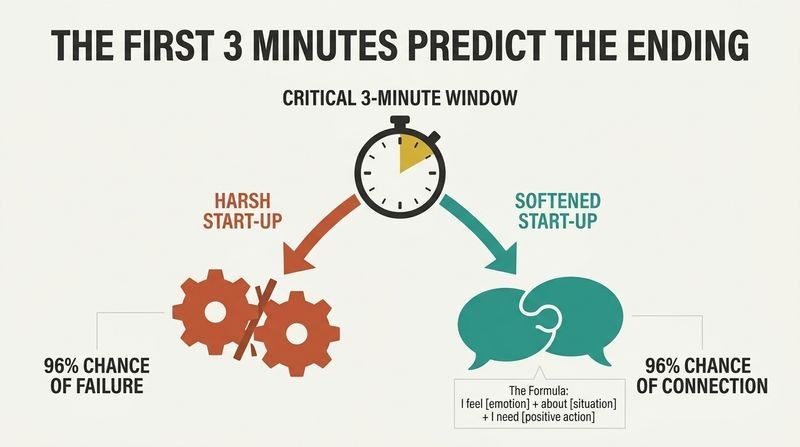
After coding thousands of couples in their Love Lab down to the hundredth of a second, the Gottmans found that how a conflict opens determines how it closes 96% of the time. Start harshly and you rarely recover, even if you attempt repairs midway. A negative opening jams the machinery like stuck pinball flippers.
This narrow window is actually good news: it is a precise, high-leverage intervention point. The fix is the softened start-up, a formula borrowed from studying master diplomats who raised complaints without blame, criticism, or contempt. The structure: 'I feel (emotion) about (situation) and I need (positive need).' Describe yourself, not your partner's flaws. Skip 'you always' and 'you never.' State what your partner can do to shine, not how they failed.
The three-minute finding is among the Gottmans' most cited and most debated. Critics like Richard Heyman have questioned whether prediction accuracy holds up outside the lab's controlled conditions, and replication of the exact percentages has been uneven. Still, the underlying mechanism is robust: harsh openings trigger defensiveness, a documented physiological cascade. The diplomatic parallel is elegant. Anatol Rapoport's negotiation research and modern nonviolent communication converge on the same move: lead with your own experience, not accusation. The softened start-up is essentially cognitive reframing applied in real time, harder than it sounds when adrenaline is rising.
69% of your relationship problems will never be solved, and that's normal
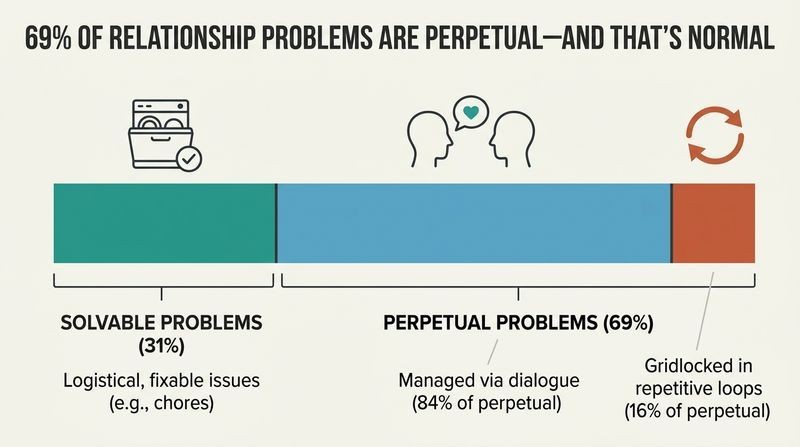
The Gottmans divide conflicts into two types. Solvable problems are logistical and fixable, like who loads the dishwasher. Perpetual problems stem from enduring differences in personality, values, and lifestyle, and roughly 69% of all conflicts fall into this category. You do not marry your clone; you marry someone whose differences once attracted you and now sometimes grate.
The myth that all conflict must be resolved causes enormous damage. Couples fight the same fight for years, changing only their hairstyles. When perpetual problems calcify into painful, repetitive, hopeless cycles, that is gridlock (16% of perpetual issues reach this state). The goal is not resolution but dialogue: managing the difference with humor and acceptance rather than trying to convert your partner into you.
This reframe is quietly radical in a culture obsessed with problem-solving. It resonates with acceptance-based therapies like ACT, which teach that struggling against unchangeable realities amplifies suffering. There is liberation in naming a problem 'perpetual' and lowering the stakes. One extension: the 69% figure implies compatibility is less about finding someone with no friction and more about choosing friction you can live with affectionately. Esther Perel makes a similar point, that we should ask not 'is this solvable' but 'can I make peace with this difference.' The risk is using 'perpetual' as an excuse to avoid genuinely solvable issues.
Any conflict style works if positives outnumber negatives five to one
The Gottmans identify three healthy conflict styles: avoidant (agree to disagree), validating (calm, collaborative problem-solvers), and volatile (passionate, loud, but loving). Early researchers believed validators were the only successful type. Reanalysis with finer coding proved that wrong. Any style thrives if it hits the magic ratio: five positive interactions for every negative one during conflict, and 20:1 outside conflict.
Negativity simply hits harder, which is why the scale is not 1:1. Positives include a nod, a joke, empathy, an apology, or owning your part. The 'Duke and Duchess of Windsor,' a wildly volatile couple, thrived because their fights brimmed with laughter. Two styles are always toxic, though: hostile and hostile-detached, defined not by volume but by contempt, defensiveness, and near-total absence of positivity.
The magic ratio is the Gottmans' signature quantification of emotional life, and it has entered popular psychology, though the precise 5:1 number has drawn methodological scrutiny. What holds up strongly is the asymmetry principle: negative events weigh more than positive ones, echoing Baumeister's 'bad is stronger than good' and Kahneman's loss aversion. The practical genius is decoupling relationship health from temperament. A shy avoider and a fiery volatile are both told: you are not broken, just watch your ratio. This dissolves needless shame. The hostile categories usefully clarify that the enemy is contempt, not intensity.
Contempt is toxic, but anger is a signal to lean in
Anger surprised the Gottmans. They expected it to predict divorce; it didn't. What poisons relationships are the Four Horsemen: criticism (attacking character), contempt (mockery, superiority), defensiveness (counterattacking), and stonewalling (shutting down). Contempt is the single strongest predictor of divorce.
Anger itself is an 'approach emotion.' Neuroscientist Richard Davidson found that anger, like curiosity and joy, lights up the brain's left frontal region associated with engaging rather than withdrawing. Anger arises from a blocked goal and carries useful information; it puts your complaint 'in italics.' The cultural double standard runs deep: men are permitted anger but not vulnerability, women permitted sadness but not anger. The Gottmans urge dropping the shame around anger while ruthlessly evicting the Four Horsemen, especially contempt.
Separating anger from contempt is a crucial and underappreciated distinction. Much pop advice lumps all 'negative' emotion together, counseling people to calm down when they should be listening to what the anger is telling them. Davidson's approach/withdrawal model gives this real neurological grounding. The gendered analysis is sharp and socially relevant: research on the 'anger double bind' shows women are penalized professionally and personally for expressing anger men express freely. One nuance: anger's usefulness depends heavily on delivery. Anger wrapped in contempt becomes indistinguishable from attack, so the line between healthy anger and a Horseman is thinner in practice than in theory.
When your heart races past 100 bpm, stop the fight immediately
Flooding is the physiological hijacking of your nervous system during conflict. Heart rate rockets past 100 beats per minute (sometimes to 195), stress hormones flood the body, and you drop into fight, flight, or freeze. In this state you literally cannot process information, hear your partner, or access learned skills. Men flood faster and take longer to recover, an evolutionary holdover from ancestral threat response.
The move is to recognize your personal warning signs (tight jaw, hot face, spinning mind) and take a break. Announce it, name a return time, leave visual range, and do something genuinely soothing, not ruminating. Take at least 20 minutes (the time needed to metabolize stress hormones) but no more than 24 hours. Never say 'you seem flooded'; say 'I need a break.'
The 20-minute floor is physiologically grounded and practically vital, since most people return to a fight while still biochemically activated and simply reignite it. Polyvagal theory (Stephen Porges) offers a complementary lens: flooding is the autonomic nervous system leaving the 'social engagement' state, making empathy neurologically unavailable. The instruction not to ruminate during breaks is key and often ignored; research on distraction versus rumination shows that stewing prolongs arousal. The gender difference in flooding is intriguing but should not become an excuse. The deeper skill is interoception, the ability to notice bodily signals early, which mindfulness training measurably improves.
Stop trying to win the argument; try to win the moment
Because most conflicts are perpetual, the goal during a fight cannot be resolution. Reframe it: the goal is not to win, persuade, or even solve. The goal is to make this single interaction more positive than negative. The Gottmans call this 'solving the moment.'
Three tools carry you there. First, self-soothe when flooded. Second, express your actual needs rather than expecting mind-reading. Many escalations happen because people assume their partner knows what they need and is withholding it. The Gottmans use an 'Expressing Needs' card deck to help people who literally cannot name what they want. Third, make and accept repair attempts, any gesture that de-escalates: a joke, an apology, a hand reached out. Repairs succeed based not on eloquence but on the friendship underneath.
The finding that repair success depends on the relationship's health, not the repair's wording, is profound and slightly humbling. It means clumsy 'I'm sorry, let me try again' lands beautifully between connected partners, while poetic apologies bounce off resentful ones. This echoes therapy outcome research showing the alliance matters more than technique. The mind-reading trap the Gottmans identify maps onto what psychologists call the 'transparency illusion,' our false belief that our inner states are obvious to others. Naming needs explicitly is deceptively difficult because many adults were never taught they were entitled to have needs at all, a theme the book returns to repeatedly.
Every trivial fight hides a dream; interview your partner to find it
When couples get stuck in gridlock over something seemingly petty, the topic is an iceberg tip. Beneath lies a dream, value, or history. The Gottmans discovered this in their own six-year fight over buying a cabin: she needed wilderness to feel safe (a refuge from an abusive childhood home), he feared accumulating property (his parents fled the Holocaust with nothing). Once shared, compromise came in days.
The intervention is 'dreams within conflict.' One partner speaks, one listens like a curious friend, asking a fixed set of questions: What do you believe about this? Does it connect to your history? Why does it matter? What is your ideal dream here? Then switch. No persuading, no solving. In workshops, this unlocks gridlock 87% of the time. Understanding must precede resolution.
This is the book's emotional core and its most therapeutically sophisticated move. It operationalizes what depth psychology has long claimed, that surface conflicts are proxies for deeper existential material. The structured interview format is clever because it removes the debate reflex; you cannot argue while asking questions. Studs Terkel's oral history method, which the Gottmans credit, informs the stance of reverent curiosity. A connection worth drawing: this mirrors motivational interviewing in clinical psychology, where change emerges from being understood rather than argued with. The 87% figure comes from workshop self-reports, so treat it as directional, but the mechanism (understanding disarms defensiveness) is well supported.
You gain power in a marriage only by accepting your partner's influence
The Gottmans borrow from aikido, the martial art of 'yielding to win,' where you flow with your opponent's energy rather than blocking it. In relationships, the more you let your partner influence you, the more influence you gain. Men who refused to share power with their wives had an 81% chance of divorce.
Refusing influence makes you a rock in the trail: your partner simply routes around you, and you become powerless. Zero-sum thinking, where one partner's win requires the other's loss, is measurably lethal. In a 20-year study, 58% of husbands in zero-sum couples died, versus 20% in collaborative couples, because chronic conflict kept their heart rates and stress hormones elevated. The alternative is 'thinking for two': asking what is best for us, not me.
The mortality statistic is arresting and reflects a genuine literature linking marital hostility to cardiovascular and immune damage (see Kiecolt-Glaser's wound-healing studies). The aikido framing is more than metaphor; it reframes yielding as strength rather than defeat, which matters given how deeply masculinity scripts equate flexibility with weakness. The gender focus is empirically grounded but could feel dated to some readers; the underlying principle applies to anyone clinging to control. Game theory offers a rigorous backbone here: the Nash equilibrium the book references shows cooperation often yields better outcomes for both parties than competitive strategies, provided trust exists. Without trust, influence-accepting feels like surrender.
Compromise by mapping your non-negotiable core and your flexible edges
The Bagel Method makes compromise concrete. Each partner draws two circles. The inner circle holds your non-negotiables, the core of your dream you cannot surrender without losing yourself. The outer ring holds everything you can flex on: timing, location, cost, frequency, sequence.
A retired couple, Vince and Jenny, were deadlocked: he wanted to sail the world, she wanted to move to her family's Iowa farm. Polar opposites, seemingly zero-sum. But once they separated core from flexible, they found enormous overlap. Neither wanted their dream without the other. They decided to base on the farm, take a sailing course, then buy a boat. The insight: people cling so tightly to the whole dream that they cannot see how much of it is actually negotiable detail.
The Bagel Method's power is that it externalizes an internal muddle. When dreams live only in your head, everything feels non-negotiable because it is all fused together. Forcing the distinction between essence and implementation is a technique shared with principled negotiation (Fisher and Ury's 'Getting to Yes' urges separating positions from underlying interests). The visual format matters cognitively; drawing reduces the abstraction that fuels stalemate. One honest limit the book acknowledges: some inner circles genuinely collide, like one partner wanting children and the other not. No method dissolves that. The Bagel clarifies whether you face a solvable overlap or a true fork in the road.
Unprocessed fights don't fade; they fester and rewrite your memory
The Zeigarnik effect, named for a 1920s psychologist who noticed waiters remembered unpaid orders vividly but forgot them once settled, explains why bad fights haunt you. Unfinished emotional business stays razor-sharp in memory. Worse, every time you replay a fight, memory edits itself to favor you, so two people end up with two incompatible, self-serving versions.
The Gottmans offer a five-step processing tool for regrettable incidents, usable years later: 1. Share feelings (not why). 2. Describe your subjective reality and validate part of your partner's. 3. Identify your triggers from your past. 4. Take responsibility and apologize specifically. 5. Make one constructive plan each. The cardinal rule: both realities are valid; there is no objective 'God camera' of what happened. Cool down first, and never apologize before you understand what you're apologizing for.
Grounding repair in memory science elevates this above generic 'talk it out' advice. The reconsolidation research is real and unsettling: memories are not recordings but reconstructions, altered each retrieval (Elizabeth Loftus's work is foundational). This dissolves the futile 'who's right' war, since accuracy is genuinely unrecoverable. The sequencing insight, that premature apology fails because it precedes understanding, counters our instinct to rush closure. The trigger step connects present conflict to attachment history, echoing Sue Johnson's emotionally focused therapy. One practical caution the book gives: this tool handles discrete incidents, not chronic betrayal or abuse, which require professional help. Knowing the tool's boundaries is part of using it wisely.
Analysis
Fight Right distills five decades of observational research into a rare artifact: a relationship book built on data rather than intuition. The Gottmans' Love Lab, with its second-by-second SPAFF coding and now AI emotion detection, gives their claims a physiological spine most self-help lacks. Heart rates, stress hormones, and 90%-plus divorce prediction accuracy anchor advice that could otherwise float on platitude.
The book's central inversion is its most valuable contribution: conflict is not the enemy of love but its instrument. This reframe cascades through everything. If most problems are perpetual (69%), then resolution is the wrong goal and dialogue the right one. If the enemy is contempt rather than anger, then suppression backfires and expression, done cleanly, connects. If memory self-corrupts, then winning the factual argument is impossible and understanding is all that remains.
Methodologically, readers should hold the precise statistics loosely. The Gottmans' prediction figures come largely from post-hoc coding of couples whose outcomes were already known, and independent replication has been mixed. The percentages (96%, 87%, 5:1) function better as memorable directional truths than as physical constants. What is robustly supported is the qualitative architecture: the Four Horsemen, the corrosiveness of contempt, the asymmetry of negativity, the physiology of flooding, and the primacy of repair.
The book's deepest wisdom is almost philosophical. It treats every mundane fight as a portal to existential material, dreams, histories, wounds, and insists that ordinary people are all secret philosophers negotiating the eternal tension between the individual and the collective, the I and the we. Its weakness is scope: the tools assume goodwill and safety, and the authors are careful to fence off abuse, addiction, and betrayal as requiring more. Within those bounds, it is among the most practically actionable relationship guides available, less about loving more and more about fighting better.
Review Summary
Fight Right receives overwhelmingly positive reviews for its practical advice on handling conflict in relationships. Readers appreciate the research-based insights, relatable examples, and actionable strategies. Many found the book transformative for their relationships, praising its emphasis on empathy, effective communication, and addressing underlying issues. The 5:1 positive-to-negative interaction ratio and the importance of repair attempts are highlighted as key concepts. Some readers expressed discomfort with certain couple examples but overall found the book invaluable for improving relationship dynamics.
People Also Read






FAQ
What's Fight Right about?
- Conflict Resolution Focus: Fight Right by Julie Schwartz Gottman and John Gottman explores how couples can transform conflict into connection, emphasizing that conflict is a natural part of relationships.
- Understanding Conflict Styles: The authors categorize conflict styles into avoidant, validating, and volatile, helping couples navigate disagreements more effectively.
- Practical Tools Provided: The book offers tools and interventions based on decades of research, such as softened start-ups and managing flooding during conflicts.
Why should I read Fight Right?
- Improve Relationship Dynamics: The book helps you understand relationship dynamics and handle conflicts constructively, leading to healthier communication patterns.
- Research-Backed Strategies: The Gottmans provide evidence-based strategies tested with thousands of couples, making the advice credible and applicable.
- Enhance Emotional Connection: It focuses on fostering emotional intimacy and connection, crucial for long-term relationship satisfaction.
What are the key takeaways of Fight Right?
- Conflict is Inevitable: Conflict is a natural part of any relationship, and the key is learning how to manage it effectively.
- Softened Start-Ups: Expressing feelings and needs without blame can significantly improve conflict discussions.
- Flooding and Its Effects: Recognizing and managing the physiological response of flooding is essential for maintaining productive dialogue.
What are the best quotes from Fight Right and what do they mean?
- “Conflict is connection.”: This quote highlights that conflict, when handled correctly, can lead to deeper understanding and intimacy.
- “You’re not fighting about a puppy!”: It illustrates that many conflicts are about deeper values and needs, not the surface issue.
- “Flooding shows up differently in all of us.”: Emphasizes that each person has unique signs of emotional overwhelm during conflict.
What are the five fights everybody has in Fight Right?
- The Bomb Drop: Initiated with criticism or blame, leading to defensiveness and escalation; softened start-ups can prevent this.
- The Flood: Overwhelmed by emotions, leading to withdrawal or aggression; recognizing flooding and taking breaks can help.
- The Shallows: Surface-level disagreements masking deeper issues; explore underlying emotions and needs.
- The Standoff: Entrenched positions with no budging; focus on understanding each other's perspectives.
- The Chasm in the Room: Significant issues left unaddressed, creating emotional distance; open communication is crucial.
How can I implement softened start-ups from Fight Right?
- Express Your Feelings: State how you feel about a situation without blaming your partner.
- Describe the Situation: Outline the problem using neutral language to explain what’s bothering you.
- State Your Needs: Express what you need from your partner to improve the situation.
What is flooding, and how do I manage it according to Fight Right?
- Understanding Flooding: A physiological response to emotional overwhelm during conflict, hindering productive communication.
- Recognize Your Signs: Identify your own signs of flooding, such as a racing heart or tight muscles.
- Take a Break: Communicate your need for a break, step away to self-soothe, and return when calmer.
What is the "Bagel Method" in Fight Right?
- Visualizing Compromise: A tool to identify nonnegotiable needs and areas of flexibility in a conflict.
- Facilitates Open Discussion: Helps couples understand what they can compromise on without sacrificing essential needs.
- Promotes Mutual Understanding: Encourages dialogue where both partners express their dreams and needs.
How do I process a fight according to Fight Right?
- Five-Step Process: Includes sharing feelings, describing realities, discussing triggers, taking responsibility, and planning for the future.
- Focus on Individual Experiences: Each partner shares their feelings and perceptions without blaming the other.
- Validation and Apology: Emphasizes validating feelings, taking responsibility, and offering sincere apologies.
What are "Dreams Within Conflict" in Fight Right?
- Exploring Underlying Needs: Refers to deeper values, beliefs, and needs underlying disagreements.
- Facilitates Empathy: Encourages partners to empathize with each other's perspectives.
- Structured Conversation: Involves asking specific questions to uncover these dreams and address core issues.
What is the significance of repair attempts in Fight Right?
- Preventing Escalation: Repair attempts prevent conflicts from escalating into more significant issues.
- Strengthening Bonds: Successful couples make and recognize repair attempts, maintaining emotional connection.
- Magic Ratio: Emphasizes five positive interactions for every negative one, with repair attempts contributing significantly.
How can I avoid the "zero-sum" mindset in conflicts?
- Understanding Cooperative Gain: A zero-sum mindset is detrimental; aim for cooperative gain where both partners benefit.
- Yielding to Win: Accept influence from each other, fostering collaboration and honoring both partners' needs.
- Focus on Shared Goals: Shift focus from individual wins to shared goals for more satisfying outcomes.
About the Author
Other books by Julie Schwartz Gottman
Download PDF
Download EPUB
.epub digital book format is ideal for reading ebooks on phones, tablets, and e-readers.








































