

Plot Summary
The Purple Feet Ruse
Cal1 stands in a red phone box in Edinburgh's Meadows while his father John2 reads from Galatians. Their weekly call follows a ritual: Cal1 rings, hangs up after three pips, and John2 calls back to save on long-distance charges. Cal1 never mentions he is homeless, stealing food from classmates, working for exploitative Albanian cleaners who deduct half his wages.
Cal1 never mentions the Welshman he sleeps with or the credit card debts swallowing him. Then John2 mentions Ella's3 feet, purple as calf liver, her heart failing. The implication lands with calibrated weight: Cal1 has had his fun, and it is time to return.
On the ferry home, he swallows an ecstasy pill, washes it down with cider, and watches the harbour recede. Everything he owns fits in a backpack and a doubled bin bag. When neighbor Innes MacInnes4 spots him and offers a lift, Cal1 invents a friend he must meet, anything to delay the homecoming he both craves and dreads.
The opening establishes the central architecture of deception that governs this family. John's lie about Ella's health is not merely a plot device but a diagnostic tool: it reveals how love in this household cannot be requested directly, only engineered through guilt and obligation. Cal's hidden homelessness and debt mirror his father's larger secret, a symmetry the novel will unpack over hundreds of pages. The twenty-hour journey home, longer than the geographic distance warrants, becomes a metaphor for the psychological distance Cal must travel to return to himself. The ecstasy pill is darkly ironic: a drug associated with club euphoria taken to numb the pain of returning to the place where joy was first foreclosed.
A Flaming Prodigal Returns
John2 waits at the bus shelter for hours. When Cal1 finally steps down, his father2 recoils. The lime-green cap hides hair hacked and bleached to an angry ginger, dark roots framing the damage. John2 snatches the hat off and the flames whip about Cal's1 face.
The ripped jeans, the charity-shop bomber jacket with electrician's tape sealing a tear, the nylon shirt covered in medallion prints: John2 asks whose clothes these are, appalled by the confused signal between masculine and feminine. Cal1 retorts about his father's2 old wedding photos, the Kevin Keegan perm years. Tension crackles between them in the Land Rover as John2 drives too fast along the ribbon road.
But when Ella3 appears in the middle of the road, floating on a sea of damp sheep, the brittleness softens momentarily. Cal1 throws his arms around her, reenacting a reunion scripted in childhood memory, while John2 unloads the bags and hums, already calculating what must be corrected.
Cal's return in flamboyant poverty dramatizes the core conflict between island conformity and mainland self-expression. His bleached hair is both a provocation and a shield, a costume that announces his difference while protecting him from having to articulate it. John's disgust carries the particular venom of the parent who sees his own repressed otherness mirrored in his child. The language of color throughout the novel is never incidental: John, the precentor who can distinguish forty dye lots, reads Cal's appearance as a chromatic betrayal. Ella's positioning in the middle of the road, surrounded by sheep, establishes her as the mediating force between the two men, the bellwether of the household.
The Van Keeps Its Secrets
Cal1 finds Doll Macdonald5 at the slipway, stacking creels without raising his head. The young fisherman is taller and broader now, his flaxen hair tousled, his body caught between puppy fat and muscle. But his greeting is cold. He accuses Cal1 of thinking himself too good for Falabay, of barely making time during Christmas visits.
Cal1 scrambles to explain his poverty, his grandmother's health. Doll5 drinks a can of McEwan's Export and lists the drinks he has already consumed that day: liner, steadier, day-facer, livener, brightener, bracer. When Cal1 asks if he has done something to offend, Doll's5 bitterness spills out.
Cal1 upped and left as it suited him and now expects everything unchanged. In a moment of desperate, half-mad provocation, Cal1 offers to perform oral sex on Doll.5 Their eyes lock and break away. Doll5 busies himself with the creels, waiting for Cal1 to leave before he will come ashore.
This scene excavates the buried strata of a relationship that was never nameable as love. Doll's elaborate taxonomy of drinking stages doubles as a suicide note delivered in installments. His resentment toward Cal is not about abandonment in the ordinary sense but about being left with an intimacy that had no language and no future. Cal's crude offer registers as both a sincere reach for connection and a self-destructive impulse, blurring the line between care and provocation. The Bedford van that once housed their furtive encounters now rusts on the shore, a monument to what could never be acknowledged, waiting to become a tomb.
Fist in the Lord's Car
John2 waits by the front door with brass weaving shears, having anticipated Cal's1 disobedience. Cal1 refuses to cut his hair before church. In the car afterward, the tension detonates. John2 demands Cal's1 Walkman, then punches him in the face, three more blows following with increasing fury.
His vision fragments into a flick-book: Cal's1 mouth knotting, teeth cracking together, the desperate scratch of Ella's3 tights as she throws herself between them across the gear stick. Cal1 scrabbles for the door handle, a thing he has opened a thousand times, now impossible to locate.
When John2 catches his own reflection in the wing mirror, he sees a devil wearing his face. He reaches over Ella3 and opens the door, shoving Cal1 out onto the road. Later, Cal1 crouches by a rock pool, dunking his bloodied face in the salt water again and again until the pink dissipates.
The beating in the car crystallizes the novel's central question about the relationship between piety and violence. John's faith has given him no tools to love his son as he is, only the discipline to punish what he cannot accept. The brass shears, instruments of his weaving craft, become weapons, collapsing the distinction between creation and destruction. Ella's body thrown across the gear stick is the physical manifestation of her role as buffer between the two men. When John sees the devil in his own reflection, the moment carries the full weight of Calvinist self-scrutiny: the doctrine that was meant to save him has only taught him to recognize his own damnation.
Billy's Brutal Rejection
Cal1 discovers a personal ad from a man in Inverness named William,14 an ex-rugby player seeking his Johnny Marr. He composes a reply, describing his swimmer's physique, his love of the Smiths and Northern Soul, his textile skills.
He includes a doctored school photo and a drawing of his erection, traced on foolscap and coloured with peach watercolour reconstituted with spit. Later, seized by manic inspiration, he knits a pink woolen phallus, a cocksock complete with foreskin and inverted seam, and mails it with the letter. Weeks pass. Finally a parcel arrives at Beady's12 shop.
Inside are the returned photo, the knitted penis, and a note scrawled on Cal's1 own letter. Billy14 writes that he does not think Cal1 is what he is looking for, and wishes him all the best. Cal1 reads it in his bedroom, the rejection burning with the particular shame of having been too visible, too strange, too much.
The knitted phallus episode walks a knife edge between comedy and tragedy. Cal's gift is simultaneously a craftsman's calling card, an intimate self-portrait, and a howl of loneliness so raw it cannot help but repel. The rejection lands harder because Billy asks for a photo, not a confession. Cal cannot calibrate the distance between self-expression and self-exposure; he was raised in a culture that made no such distinction. The returned parcel is an exile notice from the mainland's gay world, which proves as inhospitable as the island. He is too weird for both worlds, a predicament the novel refuses to resolve neatly.
Isla Among the Midges
Isla Macdonald6 finds Cal1 behind the inn, eating Flash's10 leftover korma drowned in mayonnaise. She is almost nineteen now, tall and flat-chested, wearing her father's moth-eaten Fairisle and her brother Doll's5 old work boots. Her hair is gathered into two soft buns like fluffy bear ears.
She is furious he never stopped to say hello, never answered the community's expectation that they would reunite. They bicker and then soften. Isla6 is heading to Glasgow University in weeks, top of her year. Cal1 offers advice: keep her faith to herself, kiss as many boys as possible, don't buy new clothes to impress people she should ignore.
She laughs and calls him a child. In the midge-clouded dusk, he hugs her and peppers her cheek with dry kisses until she groans. She slips a pulpy paperback into her waistband and he notices the little pink flowers on her undervest.
Isla enters the narrative as the road not taken and the future foreclosed. The community's assumption that she and Cal would eventually marry has structured both their lives, and both have rebelled against it in different ways. Her academic brilliance (eighth in all Scotland) challenges the island's limited scripts for women. Cal's advice to her, equal parts protective and cynical, reveals his own ambivalence about the mainland he both longs for and distrusts. The pink flowers on her undervest, glimpsed by accident, register with the force of a stolen intimacy, reminding both characters of the childhood closeness they have lost and the adult distance they must now navigate.
Exiled from the Lord's Table
At the Communion service, the church divides between the Saved and the Unsaved. A white cloth marks the boundary. Doll5 sits among the confirmed members, his mother Sarah beside him, his new shoes pinching, his body lacquered in deodorant to mask the previous night's gin. Then Reverend Rose9 summons him.
The elders form a semicircle around Doll5 in the corner while the congregation holds its breath. What is said cannot be heard, but everyone understands: Doll5 is being publicly rebuked for his drinking. His face cycles through shame, then settles into a smug defiance that only exposes how wounded he is.
Cal1 watches from the Unsaved section, furious and powerless. That night, lying on the floor of his own room because visiting elders have taken the beds, Cal1 begs his father2 to intervene. John2 reveals the elders are discussing moving Doll5 into the byre with the sheep. Cal1 threatens to move in beside him.
The Communion shaming scene exposes the machinery of social control that operates beneath the surface of pious community. The elders' semicircle is both a physical barricade and a ritual enactment of exclusion. Doll's defiant smirk, which the community reads as insolence, is actually the rictus of a young man who has no other armor. The detail that Cal is himself excluded from the inner circle of the Saved links their fates: both are young men the church does not know how to love. John's tearful conversation with Cal afterward reveals the terrifying gap between his public role as enforcer and his private sympathies as a father.
A Kiss in Oban
Innes4 agrees to take Cal1 to the mainland to look at vans, on condition John2 never learns of it. They travel separately and meet in Oban's modest town square. The day passes in awkward drinking, first at a pub, then at a chippie amid late-night crowds.
Back in their tartan-wallpapered hotel room, Cal1 strips naked, dries himself slowly before Innes,4 slips into a silk lace dress he knitted at college. They talk in the gap between their single beds, hands bumping in the dark. Cal1 asks about love. Innes4 confesses he loved once but could not leave Falabay.
Finally Cal1 crawls across and kisses him. Innes4 does not kiss back. He simply tolerates it, a pitying smile on his face. Cal1 retreats to his bed, humiliated. In the morning, Cal1 wakes alone. Innes4 has left money on the dresser and vanished. Cal1 waits for hours before accepting the rejection.
The Oban trip is the novel's most extended exploration of desire misdirected and intimacy impossible. Cal performs his body for Innes as a substitute for the confession he cannot make to his father: see me, want me, save me. Innes, for his part, studies Cal's back and sees only the ghost of the man he actually loves, John. The silk dress Cal knitted in college carries additional weight: it represents his artistic achievement, his queerness, his longing to be seen as beautiful, all rejected by a man who cannot afford to acknowledge any of it. The two single beds, separated by a narrow gap their hands can bridge but their bodies cannot cross, literalize the distance between them.
The Elders' Bargain
Cal1 returns home to find the good room filled with church elders: Reverend Rose,9 Flash,10 Shockie, Donnie Macdonald,11 old MacInnes, Innes,4 and his father.2 They have gathered because Isla Macdonald,6 home from university, is seven months pregnant and refuses to name the father.
Gossip has placed Cal1 as the most likely candidate. Donnie11 sits with his large hands on his large knees, speaking to the rug. The minister deploys a gentle, relentless pressure, suggesting Cal1 should search his heart and reconsider his interest in Isla.6
When Cal1 insists the baby cannot be his, Flash10 reluctantly mentions the Glaswegian fishermen stranded in the bay months earlier, one blonde man in particular seen laughing with Isla.6 Donnie11 shoves Cal1 off his stool. John2 apologizes for his son's1 refusal. The minister gives Cal1 a final warning: think carefully, it is not a matter for the thinking.
This scene stages a community tribunal that is also a forced marriage negotiation. The men's physical discomfort in the cramped room mirrors their moral discomfort with the situation they are engineering. Isla is absent, her body a problem to be solved by male consensus. The minister's distinction between thinking and feeling, between what is right and what is desired, reveals the theological violence at the heart of their intervention. Cal's refusal, while honest, is also self-protective: marrying Isla would lock him into a life he has been fleeing. Yet his refusal leaves her exposed to far worse consequences, a moral bind the novel refuses to resolve cleanly.
Ella Breaks Her Silence
After the elders leave, John2 and Cal1 fight again. John2 slaps Cal,1 wrestles him, tears Innes's4 shirt from his back. In the kitchen afterward, Ella3 tends to Cal's1 wounds. Then she begins speaking in broken Gaelic, revealing she has understood the language for years, learning it in secret while listening to John2 and Cal's1 phone calls.
She understood every slight, every exclusion, every cruelty the island women delivered in the old tongue, smiling all the while. Then she hands Cal1 an envelope stuffed with nearly three thousand pounds, money she shaved from church offerings over decades, a quiet rebellion against the ministers who preached damnation for boys like him.
She tells him to make himself happy. She asks him directly if he is a homosexual. He lies. She lets the lie stand, but her eyes say she knows. He asks her to move in with his mother.7 She agrees.
Ella's Gaelic revelation is the novel's most structurally elegant reversal. The language that was used to exclude her became her secret weapon of surveillance, allowing her to gather intelligence on both her oppressors and her beloved grandson. Her theft from the church offerings is not presented as sin but as righteous redistribution, a feminist subversion of patriarchal religious authority. The money she gives Cal carries the weight of decades of silent witnessing. Her direct question about his sexuality, and his reflexive lie, crystallize the tragedy of a family where love coexists with denial. She has given him both material means for escape and psychological permission to use them.
Death in the Bedford Van
In the early hours, lights appear on the shoreline. Cal's father2 wakes him and they drive to the commotion. Their neighbors gather by the water's edge, dark backs forming a wall. Doll5 lies in the mouth of the rusted Bedford van, wearing only faded boxer shorts, his denims around his ankles.
His skin is powder blue, chalky as if he would rasp to the touch. His lips are a blue-grey absence of color. Innes4 kneels and closes Doll's5 eyes, wipes the bile from his lips, tucks his flaccid penis back inside his underwear. Sarah Macdonald sails across the rocks, her long skirt caught in the wind, her throat so raw with screaming that only a grating rasp escapes.
Donnie11 stands over his son5 as though guarding him. The women form a wall around Sarah and help her dress her dead son in his father's warm clothes. The procurator fiscal later reports saltwater in Doll's5 lungs: he drowned, though not in the sea.
Doll's death in the Bedford van completes the arc that began with Cal's crude proposition in the same location. The van, which once housed adolescent experiments and later became a solitary drinking den, transforms into a coffin. The medical detail about dry drowning adds a layer of grotesque poetry: Doll died not in the sea he worked every day but on land, hours later, the saltwater already inside him. Innes's gesture of tucking Doll's exposed penis away is an act of posthumous dignity, restoring to death the modesty that life denied him. The women's wall around Sarah, parallel to the men's wall of backs, establishes the gendered division of grief that will define the aftermath.
Grief and Secrets
They carry Doll's5 coffin along the ribbon road, the heaviest body Cal1 has ever borne. Sarah refuses to be left behind with the other women and marches toward the Atlantic cemetery until the elders concede and ferry her by van. At the gathering afterward, Cal1 finds Isla6 upstairs in Doll's5 old room.
She is heavy with the baby, her never-cut hair now chopped into a frumpy bob. She tells him she knows about the van, knows what he and Doll5 did there together, saw them through the window one summer evening before he left for college. She will not tell anyone, she says, but not for Cal's1 sake or Doll's.5
She does it for her mother. Cal's1 composure fractures. Downstairs, the women sing Gaelic laments while the men drink whisky in the burnt-out shell of the neighboring house. Isla's6 father bursts in, suspicious, but Isla6 deflects him with a plea of shared grief.
Isla's revelation that she witnessed Cal and Doll together reconfigures everything the reader understood about her character. Her silence has been not ignorance but protection, a burden she has carried alone through her own sexual shaming. The symmetry is devastating: both she and Cal have been punished for desires that do not fit the community's narrow scripts. Her decision to keep the secret for her mother's sake, not theirs, underscores the novel's thesis about family as the ultimate loyalty structure. The men drinking in the burnt house while the women sing in the intact one creates a diptych of gendered mourning: destruction and endurance, silence and song.
The Bellwether Departs
Ella's3 departure day arrives. Innes4 loads her belongings into his sheep van while Cal1 and Isla6 prepare a farewell lunch of spoots and samphire. But before Ella3 leaves, she confronts John2 by the buried caravan. She reveals she knows about his decades-long relationship with Innes4 and challenges him to claim his happiness.
John2 retaliates with his own revelation: he has always known about her church theft and has been covering the shortfall. He forces her to reconsider the tenancy agreement that would leave him homeless. Ella3 leaves for Grace's7 house, defeated in this round but not broken.
Then Cal1 and John2 visit the MacInnes croft and learn from Sorley8 that Innes4 has left the island entirely, possibly for good. He sold the tenancy to his brother, packed a mattress into his van, and drove away. Sorley8 shows them Innes's4 new passport photo. John2 takes it and will not return it.
This turning point layers three departures that are also reckonings. Ella's exit is both a physical relocation and the culmination of her long game against John, now complicated by his countermove about the stolen money. The revelation that John has known about her theft and silently covered it for years transforms our understanding of their relationship: they have been locked in a mutual surveillance that is also a mutual dependence. Innes's disappearance lands as a structural shock: the man who built an elaborate weaving shed to entice John into domestic partnership has given up waiting and fled. John's theft of the passport photo is a small, desperate act of possession, a relic clutched from a faith that has failed.
Chasing the Portree Ferry
On the hillside, tending a lame lamb, John2 finally breaks. A sob tears from him, raw and unfamiliar. He confesses he loves Innes4 and would chase him if he knew which direction he went. Cal,1 processing the revelation with a strange calm, discovers a QSL radio card Sorley8 overlooked: Innes4 has left a meeting place, Portree on Skye, this very evening.
It is already past seven. Cal1 manufactures a Christian justification: John2 must go after the lost sheep, a mission of pastoral concern. He drives his father2 to the Macdonald house and convinces Donnie11 to ferry John2 across the Minch in his creeling boat.
While John2 hesitates on the doorstep, Cal1 speeds home, packs his father's2 belongings into bin bags, and calls a shop in Portree. He asks the shopgirl to find the tall man with sad green eyes and tell him to wait. Then, alone in the empty house, Cal1 speaks to Ishbel the bellwether ewe. He asks her to bring his grandmother3 home.
The final turning point inverts the novel's opening: where John once called Cal home through deception, Cal now sends John away through a more generous lie. The biblical framing of the lost sheep is simultaneously sincere and strategic, giving John the cover story he needs to pursue the love he has denied himself for thirty years. The phone call to Portree is an act of narrative repair: Cal cannot undo the decades of concealment, but he can ensure the ending is not another abandonment. His address to Ishbel the ewe, which would read as madness in any other context, here registers as both grief and inheritance. He has become the bellwether now, the one who leads the flock, and the house is his to hold.
Analysis
Douglas Stuart's third novel operates as a kind of radiograph, exposing the bone structure beneath the skin of a remote Presbyterian community. Falabay is a place where everyone knows everything, yet the most important truths remain unspeakable. The novel's title encodes its deepest concern: Cal1 is John of John, son of John, defined by patrilineage, yet what passes between father and son is not inheritance but a shared capacity for concealment. Both men are queer. Both have built lives around the management of a secret that, if spoken, would destroy them. The difference is generational: John2 chose the closet as a permanent dwelling; Cal,1 born into his father's2 architecture of lies, must decide whether to inhabit it or demolish it.
The novel's most radical gesture is its refusal to condemn John.2 His violence toward Cal,1 his emotional cruelty toward Ella,3 his decades of infidelity to Innes's4 patience, are all rendered with the clarity of moral realism rather than the heat of judgment. John2 is not a villain but a tragedy: a man whose faith taught him to hate the very love that might have saved him. When Cal1 finally understands his father's2 secret, his response is not anger but a strange, generative grief. The son who was called home through a lie now sends his father away through a more generous fiction, a mission to retrieve a lost sheep.
The supporting characters form a chorus of the damaged. Doll Macdonald5 drowns on dry land in the van where he and Cal1 once touched each other in the dark. Isla,6 pregnant by a stranger, refuses to repent because she cannot repent something that felt like agency. Ella,3 the Glaswegian outsider, steals from the church and gives the money to her grandson,1 a redistribution of resources that is also a redistribution of moral authority. The novel suggests that survival in such a community requires a kind of strategic dishonesty, a careful curation of which truths to tell and which to bury.
What makes the novel more than a study in repression is its commitment to the possibility of change. Cal's1 final act, arranging his father's2 escape while choosing to stay and hold the croft, reverses the expected trajectory. The queer son does not flee to the city; the closeted father does. The house that was a prison becomes, in Cal's1 hands, something closer to a sanctuary. He speaks to the bellwether ewe, asking her to bring Ella3 home, and the madness of the gesture is also its sanity: he has learned, finally, to believe in the impossible.
Review Summary
John of John garners widespread acclaim for its vivid portrayal of a gay son returning to his conservative Hebridean island community, navigating repression, family secrets, and religious pressure alongside his father. Most reviewers praise Stuart's rich characterization, atmospheric prose, and emotionally resonant storytelling. The slow pacing draws occasional criticism, and one reviewer strongly objects to certain thematic elements, but the majority consider it equal to or surpassing Stuart's previous work, with many predicting Booker recognition.
People Also Read


Characters
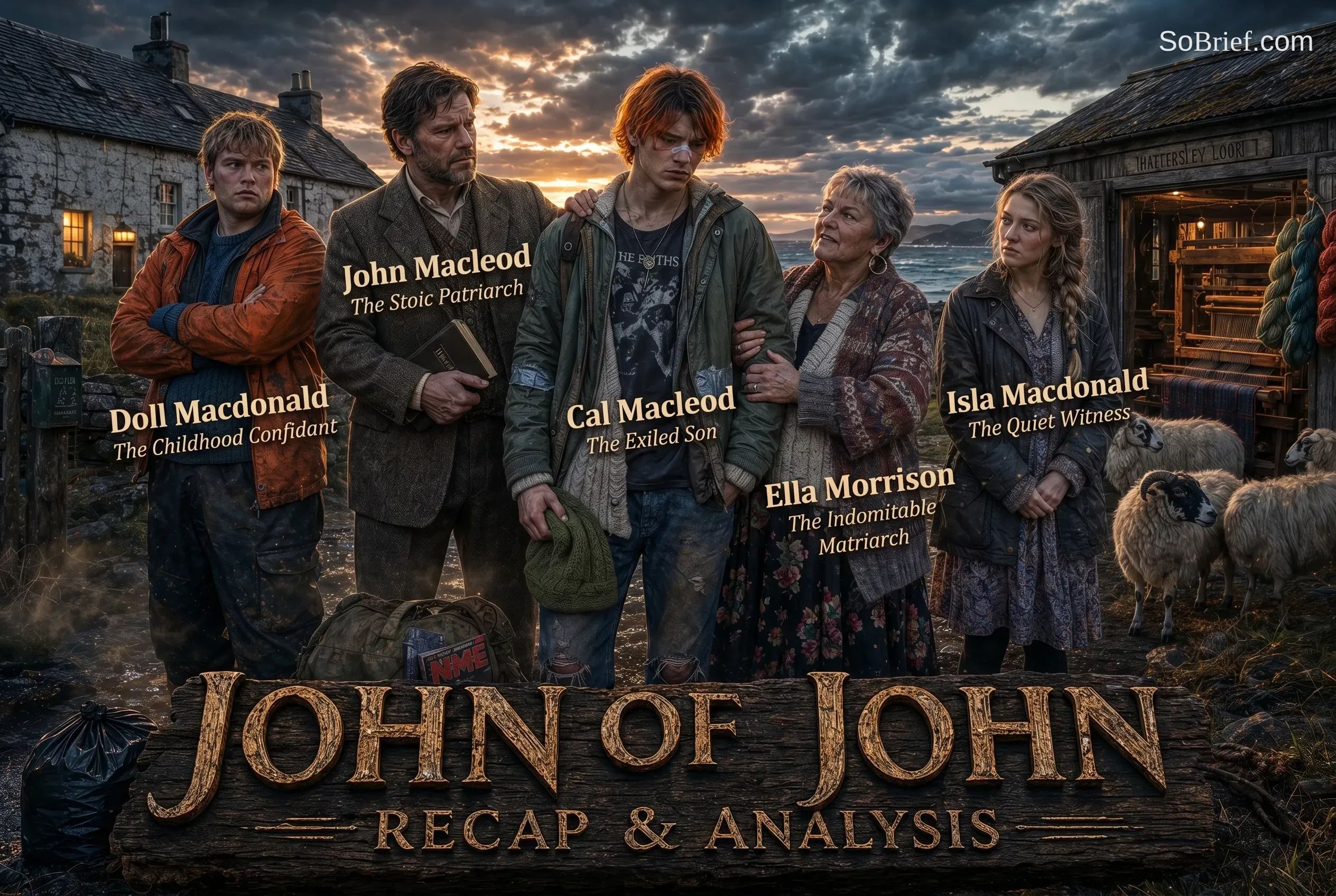
Cal Macleod
Prodigal son, queer weaverJohn-Calum Macleod, called Cal, is twenty-two when the novel opens, a recent art school graduate with a first-class degree in textiles and no job. He speaks Gaelic and English, shifts between them depending on audience. His sexuality is known only to himself and, by the end, to a select few; he has survived by compartmentalizing, presenting a version of himself calibrated to each observer. His relationship with his father2 is the central wound of his life: he craves John's2 approval while resenting the religious constraints that make approval conditional. Cal is talented, impulsive, and cruel in moments of pain, as when he offers Doll5 transactional sex or mocks Innes4. He is also capable of extraordinary generosity, demonstrated in his final gift to his father2: the freedom to chase the love Cal's existence was used to conceal.
John Macleod
Closeted father, church precentorJohn Macleod is forty-six, a weaver and precentor of the small Presbyterian church in Falabay. His life is structured around concealment: he has loved his neighbor Innes4 since he was fourteen, married Grace7 to be near him, and has spent decades performing the role of abandoned husband while secretly maintaining a relationship with Innes4. His faith is genuine but tortured; he prays constantly for deliverance from desires he cannot renounce. He is exacting with color, with language, with the warp and weft of cloth, and with the moral accounting of his neighbors. His violence toward Cal1, particularly the beating in the car, stems from self-hatred projected outward: he punishes in his son1 what he cannot accept in himself. His greatest failure is not his sexuality but his inability to tell the truth to those who love him.
Ella Morrison
Matriarch, secret rebelEleanor Morrison is Cal's1 Glaswegian grandmother who arrived on Harris after the war, married a gentle islander named Calum, and never left. She is short, plump, with grey hair cropped in an unintentionally chic mannish cut and brassy gypsy hoops she never removes. Ella has survived four decades in a community that never fully accepted her by cultivating a performance of cheerful incomprehension: she pretended not to understand Gaelic while secretly learning it, using her linguistic invisibility to gather intelligence. She taught Cal1 profanity as a secret language between them, an antidote to his father's2 dourness. Her theft from church offerings, a few pounds at a time over decades, is presented not as moral failure but as righteous redistribution, funding the escape she always hoped her grandson1 would make.
Innes MacInnes
Gentle bachelor, John's secret loveInnes MacInnes is a bachelor in his late forties, known as Innes Ciùin (Gentle Innes) to distinguish him from his flint-hearted father. He is tall, with tawny thinning hair and an unfailing smile that appears whether he shares good news or bad. He has loved John Macleod2 since they were boys, and his entire life has been organized around the hope that they might one day be together. He builds radios to reach distant strangers because he cannot speak his truth to those nearby. His patience is both his greatest virtue and his tragedy: he has waited decades for John2 to choose him, accepting ever-shrinking offers of intimacy. When Cal1 propositions him in Oban, Innes's refusal carries the weight of a man who has already given his heart elsewhere, to a man who will not claim it publicly.
Doll Macdonald
Childhood friend, secret loverDonald Macdonald, called Doll, is the only son in a house full of sisters, a young fisherman trapped by obligation to his father's boat and the croft he will inherit. He is tall, broad, with flaxen hair and a body thick with muscle over padding. He and Cal1 engaged in furtive sexual encounters throughout their adolescence, encounters that Cal1 initiated and Doll participated in while maintaining plausible deniability. Doll's drinking is both symptom and cause of his despair: he cannot leave Falabay, cannot love openly, cannot imagine a future that differs from his father's life. His resentment toward Cal1 for escaping to the mainland masks a deeper grief at being left behind with secrets that have no language. He is the novel's most vivid casualty of a community that offers no legitimate path for young men who do not fit.
Isla Macdonald
Bright sister, unexpected allyIsla Macdonald is Doll's5 eldest sister, nearly nineteen when the novel begins, academically brilliant (eighth in all Scotland for her Highers) and desperate to escape to Glasgow University. She has a quick mind, an old-looking face the island women call 'an auld face,' and a history with Cal1 that the community assumed would lead to marriage. She becomes pregnant by a Glaswegian fisherman who briefly stranded in the bay, a stranger who treated her as if she knew her own mind. Her refusal to repent or to name the father costs her membership in the church. She is one of the few people who knows about Cal1 and Doll's5 sexual relationship, having witnessed them through the van window, and she keeps this secret out of protection for her mother rather than loyalty to the men involved.
Grace Macleod
Absent mother, soap-makerGrace is Cal's1 mother who left John2 when Cal1 was eight, after discovering her husband's relationship with Innes4. She now lives on the west coast of Lewis with John's2 brother Uilleam, raising four young children and running a handmade soap business. She is striking, self-contained, and carries the guilt of having abandoned her son without ever moving far enough away to truly sever the tie. She and Ella3 maintain a close relationship, and Grace holds the tenancy to the croft after Ella3 transfers it to her, a move that threatens John's2 security. She has never told Cal1 the true reason she left his father.
Sorley MacInnes
Educated brother, petty tyrantSorley is Innes's4 younger brother, a university-educated man with a PhD in French History who returned to the island penniless and now lords his education over his practical, unlettered brother. He and Innes4 have not spoken a direct word to each other in sixteen years, communicating only through intermediaries. He is being pursued by Anna-Marie13 the nurse, a pursuit he resists until the novel's end. His acquisition of the croft tenancy from Innes4, funded by a loan, represents the final transfer of power between the brothers.
Reverend Rose
Minister, velvet enforcerThe minister of the Falabay parish delivers his judgments with a gentle smile and a swallowed giggle that belies the hardness underneath. He presents himself as merely another lost sheep, but his sermons and his private interventions reveal a chilling clarity about social control. He orchestrates the public shaming of Doll5 and the private pressure on Cal1 to marry Isla6, always framing coercion as pastoral care. His decision to accept donations toward Innes's4 weaving shed for John2 suggests either complicity or willful blindness regarding their relationship.
Flash Calder
Innkeeper, reluctant witnessAonghas Calder, nicknamed Flash for once shimmying to a Boney M song, runs the unlicensed inn that serves as the community's informal gathering place. He is one of the few men who treats Cal1 with uncomplicated warmth, offering him shifts cleaning toilets and collecting glasses. He is married to Jeanie and cares for his aging father Airchie. He identifies the Glaswegian fisherman as the likely father of Isla's6 baby, reluctantly implicating himself in the community's judgment of his niece.
Donnie Macdonald
Grieving fisherman fatherDonnie is Doll5 and Isla's6 father, a large man who operates one of the few remaining creeling boats in Falabay. He is caught between his love for his children and the community's expectations of piety and discipline. He participates in the public shaming of his son and the pressuring of Cal1 to marry his pregnant daughter, but his anger cracks open into helpless grief after Doll's5 death. His willingness to ferry John2 across the Minch to chase Innes4 represents a small act of solidarity between men who understand more than they say.
Beady-Màiri
Shopkeeper, community sentinelBeady-Màiri runs the local shop that serves as the community's supply hub and information exchange. She is Donnie Macdonald's11 sister and uses her central position to monitor everyone's business. Her violet eyes in a pale face give her a penetrating, unsettling quality. She stitches Cal's1 eyebrow after his father2 beats him and secretly sells him hair dye on the Sabbath, suggesting a complexity beneath her busybody exterior.
Anna-Marie Di Rollo
Glaswegian nurse, persistent suitorA nurse who moved from Glasgow to the islands to pursue Sorley MacInnes8 after meeting him at the hospital where his father was treated. She stitches Cal's1 hand, commiserates about the MacInnes brothers, and eventually succeeds in her pursuit when Sorley8 agrees to marry her. Her loud laugh and unfiltered warmth contrast with the island's culture of restraint.
Billy Tudhope
Lonely hearts respondentA twenty-seven-year-old ex-rugby player from Inverness who places a personal ad seeking his Johnny Marr. He lives with his mother and disabled brother, runs the books at his uncle's garage, and wants someone closer to home for pints and companionship. His curt rejection of Cal's1 knitted phallus lands as one of the novel's crueler small moments.
Plot Devices
The Hattersley Loom
Inheritance and entrapmentThe iron domestic loom in John's2 weaving shed is both the family's livelihood and Cal's1 destined inheritance. Hand-weaving Harris Tweed is governed by strict rules: one weaver per loom, one weaver per cloth. John's2 proposal that they work in secret shifts violates this egalitarian code, introducing Cal1 to the compromises required to survive. The loom's rhythm becomes the metronome of Cal's1 entrapment: every yard he weaves ties him more tightly to the life he fears. Yet his skill with textiles is also his ticket out, the talent that won him a first-class degree and the dream of a different life. The loom embodies the central tension of the novel: the beauty and craft of tradition versus its power to immure those who practice it.
The Bedford Van
Secret sanctuary, then tombThe rusted Bedford van, abandoned on the shore by Innes4, serves multiple functions across the novel. It was the site of Cal1 and Doll's5 adolescent sexual encounters, a private space where desires that had no language could be acted out under the guise of teenage experimentation. After Cal1 left for the mainland, the van became Doll's5 solitary drinking den, stripped of seats and doors, exposed to the elements. Innes4 uses it as a retreat, storing whisky in the glovebox and pinning tarpaulin across the doorway. The van's final transformation is into a death site: Doll's5 body is found in its mouth, denims around his ankles, having drowned on dry land. It is the novel's most potent symbol of hidden lives and the violence of exposure.
Ella's Stolen Church Money
Secret rebellion and escape fundFor decades, Ella3 has been skimming small amounts from the weekly church offerings John2 gives her to pass on. She accumulates nearly three thousand pounds in an old electricity bill envelope. The theft is her quiet rebellion against a church that preached damnation for boys like Cal1 and demanded wifely obedience from women. John2 has known about the theft for years and has been covering the shortfall from his own pocket, transforming what Ella3 thought was a private insurrection into a mutually sustained secret. The money becomes Cal's1 escape fund, then his gift to Isla6, then the means by which he buys Doll's5 car. It circulates through the community as an instrument of care rather than corruption.
QSL Radio Cards
Connection and farewellInnes's4 bedroom is filled with radios, and his sole hobby is bouncing signals across the world, collecting QSL confirmation cards from distant places: Gran Canaria, Berlin, Düsseldorf, Verona. The cards represent his thwarted desire for connection, his need to be acknowledged by strangers because intimacy at home is impossible. His final QSL card is left with a Portree address, date, and time, a last attempt to reach John2 before he leaves Scotland. The card functions as both a suicide note to their relationship and an invitation to resurrection, forcing John2 to choose between the safety of concealment and the risk of pursuit.
The Croft Tenancy
Power, home, and leverageThe croft tenancy on the land the Macleod family has worked for generations is not owned but held by license from the aristocratic landlords through the Crofting Commission. Ella3, as the surviving Morrison, holds the tenancy and plans to assign it to her daughter Grace7 rather than to John2, who is not blood kin. This transfer becomes the central power struggle of the novel's domestic politics. John's2 awareness of the plan, and his countermove using Ella's church theft as leverage, reveals the transactional nature of family loyalty. The tenancy represents home itself: who has the right to stay, who must leave, and what debts are owed across generations.
Download PDF
Download EPUB
.epub digital book format is ideal for reading ebooks on phones, tablets, and e-readers.








































