


Key Takeaways
Without one of seven Powers, your business has no real strategy
Power is the holy grail. Helmer defines Power as the set of conditions that let a business earn persistent returns above its cost of capital even when talented, well-funded competitors are attacking. Every Power needs two ingredients working together:
1. A Benefit: something that materially improves cash flow through higher prices, lower costs, or less required investment.
2. A Barrier: an obstacle that stops competitors from copying the Benefit and competing it away.
Benefits are common. Any cost-cutting drive creates one. Barriers are rare, which is why Helmer advises strategists to always look at the Barrier first. His central claim is bold and empirical: across 200-plus consulting cases and hundreds of student studies, only seven Power types have ever appeared. Lack all seven and, in his words, you are vulnerable, period.
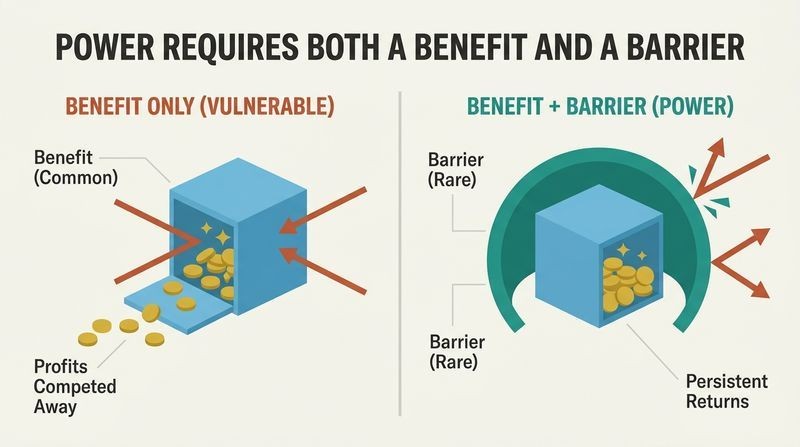
What's striking is how Helmer reduces a field with over five million scholarly articles to a single organizing idea. His Benefit-plus-Barrier test echoes economist Joan Robinson and the industrial-organization tradition on barriers to entry, but he sharpens it for practitioners. The claim that exactly seven Powers exist is unfalsifiable in the strict sense, yet valuable as a checklist. A useful tension: Porter's Five Forces analyzes industry attractiveness, while Helmer zeroes in on the individual firm's defensible edge. Readers should treat seven as a working taxonomy, not gospel. The deeper discipline is asking, relentlessly, why can't a smart rival copy this?
Value equals market size multiplied by Power, nothing else
Strip strategy down to arithmetic. Helmer's Fundamental Equation of Strategy expresses a business's value as current market size, times a market growth factor, times long-term market share, times long-term differential margin (profit above the cost of capital). Rearranged, it reads: Value equals Market Scale times Power. The market terms capture how big the prize is. Share and margin together capture whether competition arbitrages your profits away.
Intel proves the point. Intel entered both memory chips and microprocessors as first mover, with identical world-class management, technology, and capital. Memories collapsed to zero value as competitors drove margins negative. Microprocessors became a 150 billion dollar empire. Same company, same market scale, same operational excellence. The only difference was Power: microprocessors had a Barrier competitors could not breach, memories did not.

The Intel memory-versus-microprocessor contrast functions as a natural experiment, the kind economists dream of, because it holds nearly every variable constant except Power. This is methodologically elegant. The equation also delivers a sobering corrective to short-termism: Helmer notes that for a company growing 10 percent annually, the next three years account for only about 15 percent of its value. The bulk lives in the out-years, which is why persistence matters so much. One caveat: estimating long-term share and margin ex ante is brutally hard, which is precisely why the qualitative Power lens exists to guide judgment where spreadsheets fail.
Make content a fixed cost and scale becomes a weapon
Scale Economies: costs fall as volume rises. When per-unit cost declines with size, the leader can profitably match any price the follower sets, so gaining share becomes a losing bet for smaller rivals. Netflix engineered this deliberately. Streaming looked like a commodity anyone could enter, because content owners charged per subscriber (a variable cost). Netflix's move into exclusives and originals, starting with the 100 million dollar bet on House of Cards, converted content into a fixed cost.
The math becomes brutal for challengers. Spread 100 million dollars across 30 million subscribers and it costs roughly 3 dollars each. A rival with one million subscribers pays 100 dollars each. Helmer measures this leverage with Surplus Leader Margin: the margin the leader earns while pricing so the follower makes zero. It equals scale-economy intensity times scale advantage.
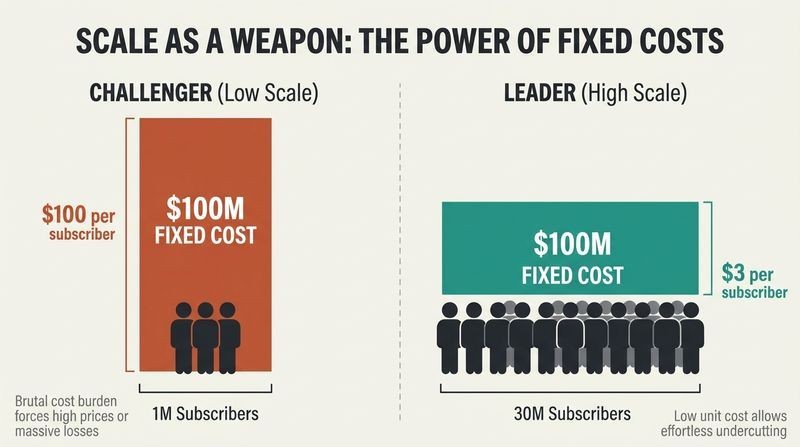
The fixed-versus-variable cost reframing is the strategic heart here and generalizes far beyond streaming. Software, semiconductors, and pharmaceutical research all live on this logic: enormous upfront costs, trivial marginal costs. What Helmer adds is the insight that firms can actively convert variable costs into fixed ones to manufacture Scale Economies where none existed. That is agency, not fate. A nuance worth flagging: Scale Economies only bite when a market matures enough that retaliation is credible and expected. In hyper-growth phases, a leader may lack the discipline or visibility to punish challengers, which is why Helmer ties this Power to a specific developmental window.
In network businesses, second place is often worthless
Network Economies: value grows with the user base. When a product becomes more valuable as more people use it, the leader can charge more, and followers face a value deficit so large that no realistic discount closes it. BranchOut learned this the hard way. In 2012 the professional-networking app peaked near 14 million users by piggybacking on Facebook, raised 49 million dollars, then collapsed within months once Facebook banned its spammy invites. LinkedIn, with its walled-off professional network, was untouchable.
Tipping points make these winner-take-all. Helmer notes the Barrier can be so extreme that a follower would have to pay users to switch. Even Google, with limitless resources, could not dislodge Facebook using Google Plus. The strategic imperative is stark: scale faster than anyone before a rival tips the market, because catch-up is usually impossible.
The boundedness insight deserves emphasis: network effects only extend as far as the network's actual boundaries. Facebook and LinkedIn coexist because personal and professional networks are genuinely separate, which is why BranchOut's bridge collapsed. This qualifier tempers Silicon Valley's blind faith in network effects. Sangeet Choudary and others have shown many so-called network businesses have weak, local, or multi-homing-prone effects that never tip. Helmer's own footnote warns that if the network benefit is too small relative to costs, no profitable player exists at all. The practical danger he identifies is burning capital chasing scale on an uncertain assumption about how strong the effect really is.
Beat giants by choosing a model they dare not copy
Counter-Positioning is Helmer's signature invention. A newcomer adopts a superior business model that the incumbent refuses to imitate because copying it would damage their existing business. Vanguard is the archetype. John Bogle launched low-cost index funds in 1976 to near silence, raising only 11 million dollars. By 2015 Vanguard managed over 3 trillion dollars. Fidelity could easily have built index funds. It chose not to, because cannibalizing its lucrative high-fee active funds would have destroyed more value than the new business created.
The Barrier is self-inflicted paralysis. Helmer calls it collateral damage, and identifies three flavors:
1. Milk: rationally harvesting the declining old business.
2. History's Slave: cognitive bias dismissing the upstart.
3. Job Security: managers protecting their own incentives.
Incumbents typically cycle through denial, ridicule, fear, anger, and belated capitulation.
Counter-Positioning is the book's most original contribution because it reframes incumbent failure as rational, not stupid. This directly challenges the lazy narrative that fallen giants simply lacked vision. Kodak, Helmer argues, was not blind: digital imaging was genuinely a bad business for a film company, which makes it disruption but not Counter-Positioning. That distinction is sharper than Christensen's Disruptive Innovation, which conflates several mechanisms. The unsettling implication for leaders: the very profitability of your flagship becomes the trap, since higher incumbent margins raise the challenger's leverage. A tactical gem Helmer offers challengers: stay humble and understated, so the incumbent's cognitive bias keeps them asleep longer.
Lock in customers by making leaving painfully expensive
Switching Costs explain loyalty without love. Customers stay locked to a supplier when abandoning it forfeits value from prior purchases. SAP's enterprise software is despised yet sticky: surveys found 43 percent unhappy with performance, yet 89 percent expecting to keep paying maintenance fees. Helmer sorts these costs into three types:
1. Financial: the outright cost of new systems and complements.
2. Procedural: retraining staff and the risk of migration errors.
3. Relational: severing trusted human and community bonds.
Migration risk is real, not theoretical. When Hewlett-Packard botched a single SAP changeover in 2004, stalled orders cost it 160 million dollars. Suppliers amplify these costs by piling on add-on products and acquisitions, so a customer becomes ever more entangled. Crucially, the Benefit only appears when selling follow-on products to customers you already captured.
Switching Costs are a non-exclusive Power, meaning SAP, Oracle, and IBM can all enjoy them simultaneously, which distinguishes them from winner-take-all network effects. The behavioral economics angle enriches Helmer's typology: procedural and relational costs map onto status-quo bias and loss aversion documented by Kahneman and Tversky, where perceived switching pain often exceeds actual cost. That psychological inflation is itself a moat. A limitation Helmer flags honestly: technological discontinuities can vaporize Switching Costs overnight, which is why incumbents like SAP scramble toward cloud offerings. The lesson for buyers is equally sharp: negotiate hardest before you are captured, because afterward the vendor holds every card.
Brand Power is earned only through decades of consistency
Branding: the same object, worth more. Helmer defines Branding narrowly as durable extra value attributed to an objectively identical offering, arising from the seller's history. A gemologist valued a Costco diamond ring higher than a comparable Tiffany ring, yet Tiffany charged nearly double. The Benefit flows from two sources:
1. Affective valence: good feelings, like preferring Coke even after a blind taste test reveals no difference.
2. Uncertainty reduction: peace of mind, like paying 117 percent more for Bayer aspirin identical to generic.
The Barrier is time itself. Helmer calls it hysteresis: brands can only be built through long, consistent, reinforcing action, which is why Tiffany's century of curation cannot be rushed. The danger is dilution. When Halston chased mass-market dollars at J.C. Penney, luxury retailer Bergdorf Goodman dropped it and the brand never recovered.
Helmer's insistence that Branding differs from marketing's loose notion of brand recognition is a useful scalpel. Coca-Cola's Super Bowl ads reflect Scale Economies, not Branding Power, because RC Cola could make every right move and still lose on relative scale. Confusing the two would misdiagnose the moat. The affective-valence point connects to research in neuroeconomics, where Read Montague's brain-imaging studies showed brand labels literally alter which neural reward regions activate during taste tests. Branding is thus partly a perceptual reality, not mere delusion. One boundary Helmer draws well: business-to-business goods rarely sustain brand premiums, since professional buyers fixate on objective deliverables over identity signaling.
A cornered resource creates hits rivals cannot poach or replicate
Cornered Resource: exclusive access to a coveted asset. Pixar's first ten films averaged a 94 percent Rotten Tomatoes score and roughly quadruple the industry's typical profitability, an unprecedented streak in a business where hits are supposed to be random. Helmer locates the Power not in any individual but in the Brain Trust, the battle-hardened creative core forged during Toy Story's brutal production. The Barrier here is fiat: the resource is available to one firm by decree, whether personal loyalty, a patent, or property rights.
Five tests separate real Power from noise. A genuine Cornered Resource must be:
1. Idiosyncratic (hard to explain why you have it).
2. Non-arbitraged (you do not pay away its full value).
3. Transferable (creates value elsewhere too).
4. Ongoing (removing it kills returns).
5. Sufficient (enough on its own for differential returns).
The five tests are the practical payload, because executives routinely mistake any valuable asset for Power. The non-arbitraged test is especially sharp: a Brad Pitt boosts box office but captures his own value in salary, so a movie star is coveted yet not a source of Power. Compensation eats the rent. This aligns with the resource-based view in academic strategy, particularly Barney's VRIN criteria (valuable, rare, inimitable, non-substitutable), but Helmer's non-arbitraged condition adds an economic rigor VRIN often glosses. The Pixar case raises a live question Helmer honestly confronts: is a team-based Cornered Resource renewable? If the Brain Trust ages out without replacement, the Power decays, making succession the central strategic risk.
Some advantages take so long to build they can't be copied
Process Power is operational excellence plus hysteresis. Toyota went from 0.1 percent US market share in 1969 to near-parity with GM, built on the Toyota Production System (TPS): just-in-time, kaizen, kanban, andon cords. What makes TPS Power is not the visible techniques but the invisible system beneath them. GM's NUMMI joint venture let its people tour, question, and copy everything, yet GM still could not replicate the results at its other plants.
The Barrier is complexity plus opacity. TPS was built bottom-up over decades of trial and error, never fully codified, largely tacit. Even Toyota took 15 years to transfer it to suppliers. Helmer calls this Power rare precisely because operational improvement is common, but improvement locked behind an unyielding time constant is not. No amount of money buys the years required.
Helmer's most counterintuitive move is separating Process Power from ordinary operational excellence, which Michael Porter famously insisted is not strategy because it is imitable. The reconciliation is elegant: Process Power equals operational excellence plus a Barrier of time. The NUMMI puzzle, that transparency did not enable imitation, points to what Polanyi called tacit knowledge, the reality that we know more than we can tell. Organizational routines resist transfer because they live in relationships and habits, not manuals. Helmer rightly warns this Power is genuinely scarce, invoking the Experience Curve data to show most cost improvements are widely shared, not proprietary. Toyota may be the exception that proves how hard Process Power is.
Every Power begins with invention, never with a plan
Me too won't do. In the dynamics half of the book, Helmer argues the first cause of every Power is invention: of a product, process, business model, or brand. Planning can amplify Power once it exists, but it cannot conjure it. Netflix did not spreadsheet its way to streaming dominance. It crafted its way there through years of experimentation, arriving at originals only in 2011, four years after launching streaming.
Invention delivers a one-two punch. It opens the door to Power and simultaneously expands market size, both halves of the value equation. Helmer identifies three routes to the compelling, gotta-have value that drives adoption:
1. Capabilities-led, like Adobe building Acrobat from its graphics expertise.
2. Customer-led, like Corning cracking fiber optics for a known need.
3. Competitor-led, like Sony's PlayStation out-innovating Nintendo with 3D.
Helmer borrows Mintzberg's distinction between crafting and designing strategy, and it lands. The Netflix and Adobe stories both show that compelling value often emerges through messy iteration, not visionary foresight. Acrobat nearly died twice before the internet accidentally created its use case. This echoes the lean-startup emphasis on discovery over planning, and Schumpeter's creative destruction as the engine of value. The tension with the rest of the book is productive: statics tells you which destinations are worth reaching, dynamics admits you cannot map the route in advance. A caution the three paths illuminate: capabilities-led invention is riskiest, since the customer need is unknown, so it demands an early Barrier before betting big.
Each Power has a window that opens once and slams shut
Timing is destiny. Helmer's Power Progression maps when each Power can first be established, using business growth to mark three stages: origination (before takeoff), takeoff (explosive growth, roughly above 30-40 percent annually), and stability (growth has slowed). The available Powers differ by stage:
1. Origination: Counter-Positioning and Cornered Resource.
2. Takeoff: Scale Economies, Network Economies, and Switching Costs.
3. Stability: Process Power and Branding.
Intel made it under the wire. Its Scale, Network, and Switching Cost advantages all had to be captured during the PC takeoff of the late 1970s and early 1980s. Winning the IBM contract during that surge was decisive. Had a rival won it, Helmer argues, Intel as we know it would not exist. Once takeoff ends and rivals understand the stakes, the window for these three Powers closes forever.
The Power Progression is the book's most actionable diagnostic, because it tells a leader which two or three Powers to even bother pursuing given their current growth stage. That focus is genuinely scarce in strategy work. Helmer distinguishes his stages from the familiar product life cycle, and the difference matters: origination can precede any sales, and stability spans most of the traditional maturity phase. His warning about false positives is worth underlining: booming early financials can mask the absence of Power, and when growth slows, competitive arbitrage arrives like a bill coming due. The CEO who welcomes a deep-pocketed rival as market validation has misread the takeoff race entirely.
Analysis
7 Powers occupies an unusual niche: a strategy book written by a practicing economist and hedge-fund investor rather than a consultant or professor, which gives it an empirical, value-obsessed spine most competitors lack. Helmer's ambition is to pass a single test he calls simple but not simplistic. The framework is not simplistic because he derives it from first principles, mapping every element to the net present value of free cash flow. It is simple because it reduces to one word, Power, and seven recognizable types.
The book's genuine intellectual contribution is threefold. First, the Benefit-plus-Barrier decomposition, with the injunction to always examine the Barrier first, because Benefits are ubiquitous and Barriers are what actually create durable value. Second, Counter-Positioning, which reframes incumbent collapse as economically rational rather than incompetent, a sharper instrument than Christensen's disruption because it isolates collateral damage as the specific mechanism. Third, the Power Progression, which adds a temporal dimension most static frameworks ignore, telling founders which Powers are even reachable given their growth stage.
The work sits in productive dialogue with Porter, whose Five Forces analyze industry structure, and with the resource-based view of Barney and Nelson and Winter. Helmer's advance over the RBV is the non-arbitraged test: a resource is only Power if you do not pay away its rents, which explains why movie stars and star CEOs rarely qualify.
The honest limitations are two. The claim of exhaustiveness rests on Helmer's own caseload, not independent verification, though he concedes new Powers could be appended. And the framework is descriptive more than generative: it helps you recognize Power once glimpsed, but the dynamics section admits invention itself is crafted, not planned, meaning strategy guides the search without guaranteeing the find. That intellectual humility, rare in the genre, is a strength. The reader leaves with a durable lens for distinguishing real moats from expensive illusions.
Review Summary
7 Powers receives mixed reviews, with ratings ranging from 2 to 5 stars. Many readers praise its concise framework for business strategy, highlighting its practical applications and real-world examples. Critics argue that the content is not groundbreaking and relies heavily on existing concepts. Some appreciate the mathematical approach, while others find it unnecessary. The book's focus on seven key strategic positions (powers) is generally well-received, though some readers desire more depth and case studies. Overall, it's considered a valuable resource for those interested in business strategy.
People Also Read










FAQ
What's "7 Powers: The Foundations of Business Strategy" about?
- Overview of the book: "7 Powers" by Hamilton Wright Helmer is a comprehensive guide to understanding the fundamental determinants of business strategy and value creation.
- Core concept: The book introduces the concept of "Power," which refers to the conditions that create the potential for persistent differential returns in business.
- Framework: Helmer outlines seven types of strategic power that businesses can leverage to gain a competitive advantage.
- Purpose: The book aims to provide a practical framework for business leaders to identify, create, and maintain strategic advantages in their industries.
Why should I read "7 Powers: The Foundations of Business Strategy"?
- Strategic insights: The book offers deep insights into the nature of competitive advantage and how it can be achieved and sustained.
- Practical application: Helmer provides actionable strategies that can be applied to real-world business scenarios, making it valuable for business leaders and strategists.
- Comprehensive framework: The seven powers framework is a unique and comprehensive approach to understanding business strategy.
- Expert endorsements: The book is praised by industry leaders like Reed Hastings and Daniel Ek, highlighting its relevance and impact.
What are the key takeaways of "7 Powers: The Foundations of Business Strategy"?
- Power is essential: The book emphasizes that having at least one of the seven powers is crucial for a business to achieve sustainable competitive advantage.
- Invention is key: Invention is the first step towards creating power, whether through products, processes, or business models.
- Timing matters: The book outlines the importance of timing in establishing power, particularly during the takeoff stage of a business.
- Strategic focus: Businesses must focus on creating compelling value and identifying opportunities for power to succeed in the long term.
What are the seven powers outlined in "7 Powers: The Foundations of Business Strategy"?
- Scale Economies: Achieving lower per-unit costs with increased production volume.
- Network Economies: Increasing the value of a product as more people use it.
- Counter-Positioning: Adopting a superior business model that incumbents cannot mimic without damaging their existing business.
- Switching Costs: Creating value loss for customers who switch to a competitor.
- Branding: Building a durable attribution of higher value to a product through historical information about the seller.
- Cornered Resource: Gaining preferential access to a coveted asset that enhances value.
- Process Power: Developing complex processes that competitors cannot easily replicate.
How does Hamilton Helmer define "Power" in "7 Powers: The Foundations of Business Strategy"?
- Definition: Power is defined as the set of conditions creating the potential for persistent differential returns.
- Components: It requires both a benefit, which improves cash flow, and a barrier, which prevents competitors from arbitraging away the benefit.
- Strategic importance: Power is the core concept of strategy and is essential for creating business value.
- Long-term focus: The book emphasizes that power must be sustainable to ensure long-term competitive advantage.
What is the "Fundamental Equation of Strategy" in "7 Powers: The Foundations of Business Strategy"?
- Equation: The equation is NPV = M0 g s m, where NPV is the net present value of expected future free cash flow.
- Components: M0 represents current market size, g is the discounted market growth factor, s is long-term market share, and m is long-term differential margin.
- Purpose: This equation links strategy to business value by quantifying the impact of market size and power.
- Strategic focus: It highlights the importance of both market scale and power in determining business value.
How does "7 Powers: The Foundations of Business Strategy" address the role of invention in strategy?
- Invention as a starting point: The book emphasizes that all power starts with invention, whether in products, processes, or business models.
- Creating value: Invention is crucial for creating compelling value that drives market size and opens opportunities for power.
- Strategic differentiation: "Me too" strategies won't suffice; businesses must innovate to achieve a competitive edge.
- Guidance for leaders: The book provides a framework for leaders to identify and leverage invention to establish power.
What is the "Power Progression" in "7 Powers: The Foundations of Business Strategy"?
- Concept: The Power Progression maps when power must be established by power type, indicating the timing of strategic opportunities.
- Stages: It divides the business lifecycle into origination, takeoff, and stability stages, each with different power opportunities.
- Strategic timing: The progression helps businesses understand when to focus on different types of power to maximize value.
- Practical application: It serves as a guide for leaders to align their strategic efforts with the right timing for power establishment.
What are some of the best quotes from "7 Powers: The Foundations of Business Strategy" and what do they mean?
- "Making a small number of decisions wisely is far more important than making a lot of decisions correctly." This quote emphasizes the importance of strategic focus and prioritization in business decision-making.
- "If you don’t get your strategy right, you are at risk." This highlights the critical role of strategy in ensuring business success and sustainability.
- "Strategy serves best not as an analytical redoubt, but rather in developing the 'prepared mind' of those on the ground." This underscores the practical application of strategy in real-world business scenarios.
- "The first cause of a strategy is invention." This quote stresses the importance of innovation as the foundation of strategic advantage.
How does "7 Powers: The Foundations of Business Strategy" differentiate between Strategy Statics and Strategy Dynamics?
- Strategy Statics: Focuses on understanding strategic position at a single point in time, emphasizing the importance of power.
- Strategy Dynamics: Explores the development of strategy over time, addressing how businesses can establish power.
- Complementary perspectives: Both statics and dynamics are essential for a comprehensive understanding of business strategy.
- Practical application: The book provides insights into how businesses can navigate both static and dynamic aspects of strategy to achieve success.
How can "7 Powers: The Foundations of Business Strategy" be applied to real-world business scenarios?
- Framework for analysis: The seven powers framework can be used to analyze and assess a company's strategic position and opportunities.
- Guidance for leaders: Business leaders can use the book's insights to identify and create strategic advantages in their industries.
- Practical strategies: The book offers actionable strategies for leveraging power to achieve competitive advantage and business value.
- Case studies: Real-world examples and case studies in the book illustrate how the concepts can be applied in practice.
What is the significance of the "7 Powers" framework in "7 Powers: The Foundations of Business Strategy"?
- Comprehensive approach: The framework provides a comprehensive approach to understanding and achieving strategic advantage.
- Exhaustive coverage: It covers all attractive strategic positions for businesses, ensuring no viable strategy is overlooked.
- Practical tool: The framework serves as a practical tool for business leaders to navigate complex strategic landscapes.
- Enduring relevance: The seven powers are applicable to businesses across industries and stages, making the framework enduringly relevant.
Download PDF
Download EPUB
.epub digital book format is ideal for reading ebooks on phones, tablets, and e-readers.








































