
Key Takeaways
1. The "Big Lie" of Wages: Bargaining Power, Not Just Skills, Determines Pay
The greatest hoax of our time is the success of employers in persuading the American public—and many American workers themselves—that bargaining power has nothing to do with pay.
Debunking the myth. The prevailing "human capital story" claims that every worker's wages are automatically determined by their individual productivity and skills, justifying vast income disparities. This theory, endlessly repeated by policy makers and pundits, suggests that if a janitor earns vastly less than a hedge fund manager, it's because their skills are valued less by impersonal, competitive markets. However, this is a self-serving myth for the economic elite, as society would collapse without low-paid essential workers, and individual productivity is often impossible to measure precisely in complex organizations.
Bargaining power's role. In reality, wages, along with working conditions and benefits, are largely determined by the relative bargaining power between workers and employers. Unlike the "general equilibrium" theory of economics, most markets, including labor markets, do not have a single, objective price. As Adam Smith observed, employers typically hold much greater bargaining power than isolated individual workers, leading to a "higgling of the market" where the stronger party dictates terms.
US exceptionalism in inequality. International comparisons reveal that wage inequality has grown far more extremely in the United States than in Western Europe or East Asia. This disparity cannot be solely attributed to global or technological forces, as the "human capital story" suggests. Instead, it points to unique American institutional factors, primarily the deliberate weakening of worker bargaining power, which has been taken to an extreme in the U.S. compared to other developed nations.
2. American Worker Power Was Deliberately Destroyed, Not Lost to Inevitable Forces
American worker power was murdered by American business and its allies among American politicians and policy makers.
Decimation of unions. Despite consistent public approval for labor unions, private sector union membership in the U.S. plummeted from 35.7% in 1953 to a mere 6.2% in 2019. This drastic decline was not an accident or an inevitable outcome of globalization or technology. It was the direct result of a concerted, half-century-long campaign by American businesses and their political allies to systematically dismantle organized labor.
Union-busting industry. A flourishing industry of management consultants, law firms like Littler Mendelson, and strike management firms specializes in "union avoidance." Companies like Apple, Amazon, and Google have secretly engaged these firms, spending hundreds of millions annually, to intimidate workers through tactics such as:
- "Captive audience meetings"
- Compiling employee dossiers
- Co-opting diversity initiatives to undermine solidarity
This aggressive stance reflects a deep-seated hostility to worker rights, exemplified by Silicon Valley leaders who falsely claimed collective bargaining was incompatible with innovation.
Beyond unions: rigged employment practices. Even for the 94% of private sector workers not represented by unions, employers further suppress bargaining power through various practices. These include informal "salary bands" that collude to fix wages, illegal "no-poach agreements" preventing companies from hiring each other's employees, mandatory "non-compete clauses" for even low-wage workers, and "forced arbitration" that denies workers access to courts. The "fissured workplace" model, where full-time employees are replaced by poorly paid contractors, further shifts costs and risks onto workers and taxpayers.
3. Global Labor Arbitrage: Offshoring and Exploitative Immigration Suppress Wages
The widespread use of offshoring by American employers to weaken or destroy American unions and replace American workers with foreign workers is the subject of the next chapter.
Offshoring for cheap labor. "Global labor arbitrage" involves firms exploiting international differences in regulations, taxes, or wages. One primary form is offshoring, where production is moved to low-wage, non-union workers in other countries. This was prophetically described by Charles A. Beard in 1934, who warned that abolishing tariffs would lead industries to relocate to regions with cheap, unorganized labor. This became reality after the Cold War, with "free trade agreements" like NAFTA and the WTO facilitating the transfer of U.S. manufacturing to nations like China and Mexico.
Debunking automation and humanitarian claims. Neoliberal economists and pundits often claimed manufacturing job losses were due to automation or that offshoring was a humanitarian act, bringing prosperity to the "Third World." However, studies show "the China shock" was a major factor, and the U.S. lags in robot density compared to countries that modernized their manufacturing. The "trickle-down" prosperity in East Asia was actually due to strong state-led industrial policies, not just foreign sweatshops. Claims of consumer benefits from cheaper imports often ignore the devastating costs to American workers and the national industrial base.
Weaponizing immigration. The second form of global labor arbitrage involves leveraging immigration to bring foreign workers into the U.S. willing to work for lower wages. Historically, labor unions opposed mass immigration to protect domestic workers, a stance echoed by civil rights leaders like A. Philip Randolph and Cesar Chavez, who fought against the use of migrant workers to suppress farm wages. Today, tech and finance industries exploit H-1B "indentured servants" by paying them below-market wages, denying them the right to quit, and using them to replace American workers, despite claims of a "skills shortage."
4. The "Anti-Worker Welfare State" Subsidizes Low-Wage Employers at Taxpayer Expense
The business model of twenty-first-century American neoliberal capitalism is privatizing the benefits and socializing the costs of cheap labor.
Shift to low-wage/high-welfare. The U.S. has transitioned from a "living-wage/social-insurance" model (New Deal era) to a "low-wage/high-welfare" system since the 1980s. In this model, employers are permitted to pay poverty wages, and American taxpayers are forced to cover the gap through means-tested public assistance programs like food stamps, Medicaid, and housing vouchers. This effectively subsidizes corporations like Walmart and McDonald's, whose full-time employees often cannot survive without government aid.
Vicious cycle of dependency. This system creates a perverse incentive: taxpayers enable employers to pay low wages, while the low benefits of welfare programs compel recipients to take any available job, no matter how poorly paid. This traps workers in a cycle of dependency on both exploitative employers and punitive welfare bureaucracies, undermining their self-reliance and bargaining power. For example, a New York worker earning minimum wage might receive public wage subsidies and welfare benefits amounting to nearly 87% of their market pay, highlighting the extent of taxpayer subsidy.
Defamilizing welfare policies. Even child-care policies are shaped by employer interests. Instead of flexible cash subsidies that allow parents to choose care options (including staying home), neoliberal policies push for government-subsidized institutional day care. This aims to maximize "female labor force participation" to boost GDP and corporate profits, effectively increasing the labor supply and further suppressing wages, rather than supporting family choices or investing in productivity-enhancing technology.
5. The Credential Arms Race: A Desperate Scramble for Economic Security
The credential arms race, in turn, contributes to the four concurrent crises of the American regime today: the demographic crisis, the social crisis, the identity crisis, and the political crisis.
Crumbling ladders to the middle class. The collapse of organized labor and worker bargaining power has eliminated many middle-income jobs that once provided a pathway to the middle class for high school graduates. In response, Americans are now engaged in a desperate "credential arms race," seeking expensive university diplomas or occupational licenses as the new "tickets" to economic security and a middle-class lifestyle. This trend mirrors the decline of private sector unionization, with both phenomena showing inverse correlation over the last half-century.
Credential premiums vs. union benefits. While college degrees and occupational licenses offer wage premiums (15-80% higher pay) comparable to or exceeding the union wage premium (around 10%), their societal effects differ. Unions benefit non-union workers through "union threat" and competitive wage pressure. In contrast, credentials artificially shrink the pool of qualified workers, allowing insiders to charge more, but do not uplift the broader non-credentialed workforce. The barriers to entry for many licensed professions are often unnecessarily complex and time-consuming, designed to limit competition.
University as a "sweatshop." The modern American university, despite rising tuition, increasingly resembles a "Victorian sweatshop." A small elite of tenured professors and overpaid administrators (often in make-work DEI roles) presides over a growing "proletariat" of poorly paid, non-tenure-track adjuncts and lecturers. This administrative bloat and exploitation of labor, combined with credential inflation (where a BA is the new high school diploma), means students incur massive debt for diplomas whose value constantly declines, often leading to underemployment in jobs that don't require a degree.
6. Low Wages and Credentialism Fuel America's Interconnected Social Crises
Thanks to a similar cascade effect, for want of good wages, American society is in danger.
Demographic decline. The credential arms race, with its demands for prolonged education and delayed career stability, forces many Americans to postpone or forgo marriage, family formation, and childbearing. This contributes to falling fertility rates, far below desired levels, as financial insecurity and the need to achieve professional rank become preconditions for starting a family. The "diploma divide" in marriage reflects this, with more educated, financially secure couples being more likely to marry and stay married.
Social isolation and despair. For those unable to climb the credential ladder, the American dream often turns into a nightmare of insecure, low-wage work or welfare dependency. This fuels "deaths of despair" (suicide, alcohol, opioid addiction) among working-class Americans, particularly in deindustrialized regions. The destruction of private sector unions, once centers of social life, along with declining church attendance, has also led to an epidemic of loneliness and anomie, replacing a rich associational life with social deserts.
Identity politics and political polarization. The "Great Awokening" and the weaponization of identity politics are driven by college-educated Americans competing for scarce elite jobs. University admissions and corporate DEI bureaucracies increasingly prioritize "identity credentials," creating a zero-sum battle for status. This, combined with the decline of working-class political influence and the rise of affluent, ideological primary voters and donors, has transformed American politics from transactional compromise to bitter, elite-driven culture wars, further polarizing society.
7. Neoliberal Globalization Myths Mask Corporate Self-Interest and National Decline
Globalization was and is a deliberate government policy, undertaken by the government of the United States and other national governments to serve the interests of politically powerful employers and investors who seek to use global labor arbitrage, in the form of offshoring or immigration, in order to cripple or destroy organized labor and weaken the bargaining power of workers at home and abroad.
Eclipsed by China. The U.S. has been dramatically eclipsed by China as the world's dominant manufacturing power, losing critical supply chains and industries—from textiles to advanced semiconductors and wind turbines. This decline is not an accident but a direct consequence of American corporations' relentless pursuit of cheap labor abroad, facilitated by "free trade agreements" that prioritized corporate profits over national industrial capacity and worker well-being.
False narratives of inevitability. For decades, the American public was fed myths by politicians, pundits, and academics that globalization was an "inevitable force of nature" or that automation was solely responsible for job losses. These narratives dismissed any criticism as xenophobic or economically ignorant. However, respected economists like John Maynard Keynes and Paul A. Samuelson have long questioned the universal benefits of free trade, especially when one trading partner benefits from increasing returns to scale or when it leads to national harm.
The "curse of hegemony." The U.S. government tolerated this self-destructive corporate behavior due to a mix of corruption (corporate influence, revolving door between government and lobbying), the "curse of hegemony" (ceding industries to allies in exchange for military deference), and a complacent belief in a permanent American lead in technological innovation. This allowed corporations to "export factories" rather than factory products, prioritizing private corporate interests over national workers and manufacturers, all under the guise of consumer benefit.
8. A New American System: Strategic Trade and Immigration to Rebuild National Prosperity
Instead, the focus of national economic policy should be on productivity growth.
Return to national developmentalism. The U.S. must abandon the failed neoliberal globalization model and return to its historical tradition of "national developmentalism," exemplified by figures like Hamilton, Lincoln, and FDR. This "new American System" for the 21st century should prioritize productivity growth over mere workforce growth as the primary driver of GDP. Strategies that increase GDP by making workers toil longer hours, delaying retirement, or pushing family caregivers into the workforce, or by importing low-productivity, low-wage immigrants, should be rejected.
Strategic trade for high-value industries. A new system of "mixed trade" is essential, with different rules for different sectors. This includes:
- Selective protectionism to localize critical defense and high-value-added civilian industries
- Selective free trade for low-value-added goods or commodities
- Reciprocal trade with economies of similar wage levels
- Managed trade influenced by diplomatic and military considerations
This approach would prevent corporations from offshoring vital supply chains and rebuild America's productive capacity.
Immigration reform for worker power. Immigration policies must be reformed to limit corporate labor arbitrage. This means cracking down on employers who hire illegal immigrants (employer sanctions), abolishing exploitative guest-worker programs like H-1B and H-2B, and implementing a merit-based immigration system (like Canada's) that selects skilled immigrants based on objective criteria, not corporate demand for pliable labor. Restricting the supply of low-wage immigrant workers would create tight labor markets, forcing employers to raise wages and invest in laborsaving technology, thereby boosting productivity in sectors like construction and agriculture.
9. Restoring Worker Power Requires New Models: Sectoral Bargaining, Wage Boards, and Stronger Worker Rights
Only such a restoration of worker power can ensure that all Americans will have a share of the gains from a new economic strategy of national development in a new American System.
Beyond the Wagner Act. The traditional enterprise-based collective bargaining system of the 1935 Wagner Act has been effectively destroyed in the private sector and cannot be revived. Instead, the U.S. needs innovative approaches to strengthen worker power. This includes a national system of "sectoral bargaining" for large, concentrated industries like manufacturing, infrastructure, and logistics, similar to the successful Railway Labor Act of 1926, which covers entire industries rather than individual firms. This would ensure national wage standards and prevent a race to the bottom among states.
Wage boards for low-wage sectors. For decentralized, low-profit service sectors where traditional unionization is impractical, "wage boards" (or worker standard boards) offer a solution. These tripartite commissions, comprising representatives from labor, business, and government (and sometimes consumers), would set minimum wages and working standards for entire occupations or industries at state or municipal levels. Historically, figures like Winston Churchill advocated for such boards to combat "parasitic trades" that relied on taxpayer subsidies for low wages, recognizing that higher wages can stimulate efficiency and innovation.
Legislative strengthening of individual rights. Complementing collective bargaining and wage boards, legislative reforms are crucial to shift bargaining power towards individual workers. This includes outlawing:
- "At-will employment" (which allows termination without cause)
- Non-compete clauses
- No-poach agreements
- Mandatory arbitration clauses in employment contracts
These practices, currently used by employers to minimize worker power, must be eliminated to ensure basic worker dignity and autonomy, even for those without formal collective representation.
10. Embrace a "Living-Wage/Social-Insurance" Economy Rooted in the Work Ethic
For those attracted to the ideal of a wage earner’s republic, the low-wage/high-welfare system of the contemporary United States is a dystopian nightmare.
The ideal: living wage and social insurance. The U.S. must transition from its current "low-wage/high-welfare" system to a "living-wage/social-insurance" economy. This means full-time workers should earn enough to cover recurrent expenses for their families and contribute to comprehensive social insurance (unemployment, sickness, disability, retirement, family care), eliminating the need for means-tested public assistance. This model aligns with a republican ethic of minimizing dependence on both employers and the state, fostering pride and self-reliance through earned benefits.
Distinguishing social insurance from welfare. Most Americans, unlike some elites, recognize a fundamental moral difference between contributory social insurance (like Social Security and Medicare, funded by payroll taxes) and non-contributory public assistance ("welfare"). Social insurance embodies the "work ethic," where benefits are earned through contributions, reflecting mutual aid among workers. President Roosevelt himself championed payroll taxes for Social Security to ensure workers had a "legal, moral, and political right" to their benefits, making them politically resilient.
Expanding earned benefits. Instead of cutting "entitlements," the U.S. needs more social insurance programs. Expanding universal family benefits, such as child-care and family caregiver benefits, funded by payroll taxes, would increase overall worker compensation, compelling employers to either reduce profits or pass costs to consumers. This would privatize the costs of labor, ending the taxpayer subsidy for cheap-labor employers. While this might increase the "tax wedge," it would create a more equitable and dignified society, reinforcing working-class solidarity and economic security.
Review Summary
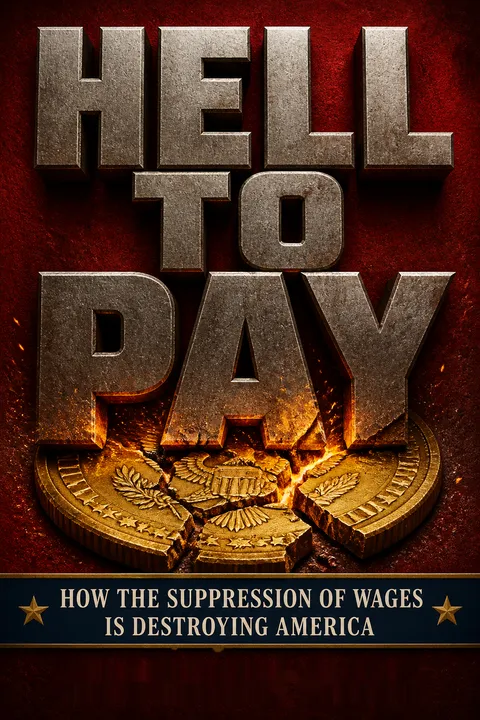
Hell to Pay by Michael Lind examines how wage suppression and worker disempowerment affect American society. Reviews average 3.93/5, with readers praising Lind's well-researched arguments against the "neoliberal elite" and his advocacy for strengthening labor unions and collective bargaining. While some found the book thought-provoking and informative, critics noted it lacked thorough solutions and contained excessive political bias. Readers appreciated his historical analysis and proposals for transitioning from a low-wage welfare system to a living-wage economy, though opinions diverged on his immigration stance.
People Also Read







About the Author


Download PDF
Download EPUB
.epub digital book format is ideal for reading ebooks on phones, tablets, and e-readers.








































