
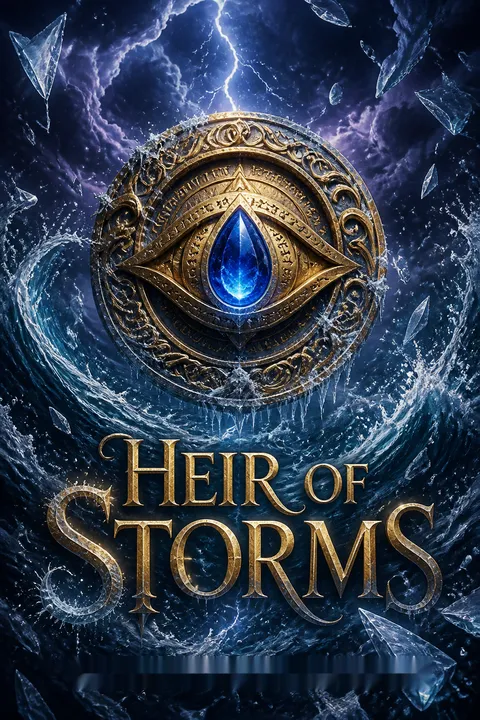


Plot Summary
Prologue
Blaze1 recounts her cursed beginning. Born into House Harglade, a bloodline of pure fire-wielders descended from the Fire Goddess, she was expected to blaze like her twin, Flint.3 Instead, her first breath summoned an endless storm that flooded the empire and drowned thousands.
Days later her own mother carried her into the rain to end it, only for the newborn Blaze1 to close her fist and quiet the deluge herself. Branded with names like murderer, changeling, freak, and Storm Weaver, she is the last of the Rain Singers, an Aquatori born wrongly into a House of flame. She is, as her people say, the beginning that brought the end.
The prologue establishes guilt without agency as Blaze's defining wound: she is condemned for a catastrophe committed before she could choose anything. By framing her birth as both miracle and massacre, the book installs its central paradox, that creation and destruction share a source. The recitation of her many names introduces the motif of imposed identity, language as a weapon that bites to the bone. Crucially, the mother who births her also tries to kill her, seeding the grief and maternal longing that will later prove the literal key to Blaze's power. We meet a narrator who has internalized the world's verdict and learned to perform contrition while privately mourning something stranger: her lost self.
The Caged Girl's Debut
For seventeen years Blaze1 has lived behind Harglade Hall's gates, both prisoner and protected secret. On her seventeenth Name Day, Grandmother6 sews her into peacock silk and parades her before thousands as the four elemental courts arrive: wind, leaves, flames, and waves.
Certain her power is gone (she can manage only feeble drizzle), Blaze1 endures stares of fear and revulsion. King Balen5 of the wind unnerves her, calling her his little dove from across the room.
The kind, silver-haired Queen Hydra7 of the water lifts her gently after a fall, murmuring that sometimes we lose our footing to find our balance. Then Prince Hal,4 the light-wielding Crown Prince, asks her to dance, holding her like something rare rather than monstrous. For one evening she almost belongs.
The debut stages the tension between visibility and erasure that drives the novel. Blaze has been hidden under the language of protection, a word she later recognizes as a euphemism for concealment. Her terror at being looked at, paired with her secret powerlessness, makes her a study in performative survival: she must smile, in Grandmother's words, grateful and graceful, while convinced she is a fraud. The contrast between Balen's silken menace and Hal's warmth introduces the two poles of male attention that will pull at her. Queen Hydra's riddle plants a thematic seed, that destabilization precedes growth, foreshadowing how Blaze's coming losses will paradoxically restore her.
A Thousand Shattered Glasses
Pressured by the emperor13 and King Balen5 to prove she means no harm, Blaze1 is commanded to call rain before the assembled court. She manages only humiliating mist. Sensing weakness, her venomous fifteen-year-old cousin Ember9 leans close and weaponizes the cruelest subject available: Blaze's1 dead mother, calling her a burden and a disappointment.
Something cold and unfamiliar lances through Blaze.1 Every glass of wine in every hand quivers, freezes solid, and explodes at once, slicing Ember's9 palms open and spattering blood across Hal's4 cheek.
The court recoils in horror; Grandmother6 drags her from the ballroom. Behind her, only King Balen5 smiles, lifting his ruined glass in a private toast. Blaze1 has discovered, terrifyingly, that she can make ice, and that rage is the trigger.
This is the inciting eruption: power surfaces not through training but through wound. The scene literalizes how suppressed grief, once provoked, becomes uncontrollable force, an early demonstration of the Melding principle before it is named. Ember functions as the antagonist who knows exactly where to cut, and her attack reveals that Blaze's emotional repression is also a dam. King Balen's approving toast amid the carnage is quietly sinister, marking him as someone who covets rather than fears such power. The blood on Hal's face foreshadows the cost of intimacy, and Blaze's mingled horror and exhilaration captures the moral ambivalence of finally feeling powerful after a lifetime of helplessness.
The Eclipse Names Two Heirs
The morning after, watching the dawn from the roof with her brothers, Blaze1 sees the sun swallowed by the moon. An eclipse: the Gods' summons for a new Crowned Council and a deadly Choosing Rite. The elements rage, then still. Flint's3 brandmark ignites, marking him an Heir as everyone expected. Then Blaze's1 own waterdrop brand lights up too.
She, the most hated girl in the realm, is an Heir to Queen Hydra's7 Aquatori throne. Grandmother6 confirms there is no refusing the Gods. The news detonates Blaze's1 one private hope, that on coming of age she would sail away to the mythic Otherlands and reinvent herself. Heirs are bound to their court for life. Win or lose the crown, she will never be free.
The eclipse converts Blaze's private struggle into public destiny, the formal point of no return. The Choosing Rite, a system that preserves youthful rulers by ritual replacement, exposes a society organized around managed violence. For Blaze the cruelest irony is theological: the same Gods who made her a monster now brand her a symbol of renewal. Her despair centers on the death of escape, revealing how survival under captivity required the fiction of an exit. The roof, where she watches the world she cannot enter, recurs as her liminal space. Here the bildungsroman truly begins, with selfhood and freedom set on a collision course with duty.
Names at the Rift Bridge
Knights escort Blaze1 and Flint3 across the empire toward Cor Caval, the golden Imperial capital ringed by the chasm called the Rift. At a toll bridge the hunched Riftkeeper, Eldritch,19 refuses gold and demands their names, deflecting a knight's killing blow with a mere staff until Blaze1 offers hers freely.
At the Golden Palace each Heir is given a chaperone from the secretive Court of Eyes: irrepressible Spinner10 for Blaze,1 sullen Sheen18 for Flint.3 Blaze1 is also assigned Elva,11 a beautiful amber-eyed serf taken from the Otherlands. At the First Feast she meets her rivals, the haughty Marina14 and sneering Fjord, kind Kai,15 and Flint's3 friends Cole16 and Elaith.17 Hal4 escorts her in, his pointed attention setting the whole court whispering.
The passage widens the world while seeding future payoffs. Eldritch's insistence on names rather than gold elevates the book's preoccupation with naming as power and identity, a lesson that literally saves Blaze later. The Court of Eyes, defined by concealment and surveillance, embodies a political culture where watching is control, and Spinner's cheerful presence carries a low hum of divided loyalty. Elva's introduction quietly indicts the empire's foundation on conquest and serfdom. The ensemble of Heirs sketches the social arena where Blaze must learn alliance and enmity. Hal's escort weaponizes visibility on her behalf, hinting that attention, the thing she fears, can also be armor.
The Secret in the Margins
Training at the windowless Golden Keep humiliates her: before the patient Aquatori trainer River,8 Blaze1 conjures only pathetic drizzle while Marina14 scalds her with boiling waves.
River8 steers her toward a library volume on Rain Singers, its margins annotated with a guarded secret: Rain Singer gifts are Melded, anchored to a single emotion and accessible only when the wielder fully feels it. Blaze1 realizes her rain answers to grief. Alone, she finally lets herself weep for her mother for the first time in six years, and true rain pours from the ceiling.
Soon she discovers her ice is bound to cold fury, replaying Ember's9 cruelty until she freezes the entire training pool. After a lifetime believing herself empty, she learns her power was never gone, only locked away.
This is the psychological hinge of the novel, where suppression is reframed as the source of stagnation. Melding makes therapy literal: Blaze cannot wield power until she stops fleeing her sorrow, dramatizing Grandmother's claim that to feel is to be alive. The breakthrough is a controlled act of mourning, conceal, contain, control, suggesting that healing is not catharsis alone but the disciplined integration of pain. River's quiet faith, that the answer was always inside her, positions mentorship as permission rather than instruction. The chapter also reframes her earlier outbursts retroactively as untrained grief and rage, turning her shame into competence and beginning her transformation from object of pity to agent of her own strength.
The Beast Made of Hatred
The first trial drops Blaze1 alone into a golden arena of miniature mountains and a deep lake. A shape-shifting beast hunts her, wearing the faces of everyone she loves, Ember,9 Grandmother,6 Flint,3 finally her own mother, each spewing tailored cruelty engineered to break her.
When the thing sheds its disguise into a clawed, red-eyed monster voicing every name she has ever been called, she understands: the beast is hatred itself.
She throws herself off a ledge into the lake, then drags herself ashore and unleashes rain and ice together, encasing the creature and shattering it. Victory costs her brutally: a broken wrist, bruised ribs, a sprained ankle, and a concussion. She has learned to fight her tormentors by turning their own venom into a weapon.
The trial externalizes Blaze's interior war, making self-loathing a literal predator. The genius of the test is psychological warfare through impersonation, attacking through love rather than fear, which is why the mother-beast wounds deepest. Blaze's revelation, that the enemy is hatred, reframes her entire life: she has been losing to internalized contempt. Her strategy, redirecting inflicted pain into offensive force, completes the Melding arc by uniting grief-rain and fury-ice. Crucially, she chooses to win after nearly surrendering, the deliberate refusal of victimhood. Her grievous injuries insist that empowerment is not painless; survival leaves marks. The beast also models the book's villainy, threats that wear familiar, beloved faces.
The Boy Who Broke the World
Drugged on painkillers in the infirmary, Blaze1 is carried off by a stranger she takes for a serf, a devastatingly handsome boy with green eyes who smuggles her to a hidden window to secretly watch the remaining trials. She witnesses Flint,3 Elaith,17 and Ember9 battle their own hatred-beasts.
Then a fourth Terrathian Heir, weeks overdue, finally strides into the arena: Fox Calloway Castellion,2 the emperor's illegitimate son. He is the Earth Cleaver, the boy who split the realm and carved the Rift years ago, the most feared Etheri alive and Hal's4 despised half-brother. Blaze1 realizes with a jolt that the tender stranger who cradled her and the monster who once broke an empire are the same person.
Fox's reveal weaponizes the reader's assumptions exactly as Blaze's do. The juxtaposition of his gentleness and his reputation introduces the novel's most sustained theme, the chasm between names and truth, mirroring Blaze's own mislabeling as the Storm Weaver who cannot storm. That the realm's two living catastrophes, the flooder and the cleaver, are now both Heirs suggests the Gods, or the plot, delight in pairing destruction with renewal. Hal's evident loathing sets up a triangulated tension less about romance than about identity: which brother sees Blaze truly. Fox's perceptiveness, watching her watch others, establishes his defining trait, that where others look, he sees.
A Betrothal and a Bedtime Tale
As Blaze1 and Hal4 grow closer, he confides a devastating secret in a cramped broom cupboard: as future emperor he must marry Princess Mirade of Thaven for a political alliance, with no say in it. Then he kisses her, before pulling back in guilt.
Meanwhile a strange pale old man20 haunts the Golden Library, telling Blaze1 a tale of three powerful Magi sisters who each wore a golden Eye: Sifa held the past, Seera the future, and Syla, mightiest of all, held power itself. Captured in the old war, Syla was enslaved by an emperor and bound to serve him through a hostage sister. Blaze1 dismisses the rambling as senility, but the story and its talismans burrow into her dreams.
Two plotlines braid here: the romantic and the mythic, both about constrained agency. Hal's confession reframes his courtship as a doomed thing shaped by duty, echoing his father's loveless marriage and Blaze's own caged life; their kiss is a transgression neither can sustain. The old man's tale, dismissed as nonsense, is classic mythic exposition smuggled in as unreliable testimony, and its detail about a hostage sister, a love that justifies betrayal, quietly previews the book's later moral logic. The Eyes introduce the larger stakes lurking beneath the contest. The convergence suggests that Blaze's coming-of-age is entangled with buried imperial history she is only beginning to suspect.
The Drowning Riddle
Summoned to an intimate banquet, the remaining Heirs raise a toast and collapse: the wine was drugged, and Blaze1 wakes locked alone as the banquet hall fills with water. As the flood climbs toward the ceiling, she carves a wave to swing herself onto the great chandelier, then realizes the rising water is whispering a riddle.
Recalling River's8 insistence that she learn to listen to water, and Eldritch19 the Riftkeeper's lesson that a name is a gift, a curse, and a riddle, she dives beneath the surface and answers it: the thing given but never taken, borrowed and forsaken, living on lips and in heads, is a name. The water instantly drains away. River8 carries her out. Blaze1 has survived the second trial on cleverness alone.
Where the first trial tested courage, the second tests mind, and Blaze's bookishness, long a coping mechanism for captivity, becomes her salvation. The riddle's answer, a name, is no coincidence: it crowns the novel's running meditation on naming as the truest currency, paying off both Eldritch's toll and Blaze's lifelong burden of inflicted names. The flooding hall ironically threatens the Rain Singer with her own element, dramatizing that power untamed is as dangerous as power absent. Her improvisation, riding her happiness-anchored wave to safety, shows mastery now serving survival. The trial rewards the attentive reader and reframes Blaze's isolation, all those solitary library hours, as preparation rather than deprivation.
The Mask That Falls
At the masquerade where everyone dresses in identical gold and wears masks, Blaze1 ventures into the enchanted hedge maze. Overhearing courtiers swear the desert will freeze before she is crowned, she flees and stumbles into a drunken Cole,16 who rings her in fire and douses her gown in liquor, vowing to burn the realm's freak to ash.
A masked rescuer beats him bloody and leads her to the maze's shifting heart, where Blaze,1 dizzy with adrenaline and gratitude, kisses him. When his mask slips she sees green eyes: she has kissed Fox,2 the Earth Cleaver, not Hal.4 Horrified at herself, she flees, while the boy she should fear most only smiles, sending a single vine to guide her safely out.
The masquerade, where all wear the same gold, literalizes the theme of disguise and the instability of identity, making it the perfect stage for mistaken intimacy. Cole's assault, justified to himself as righteous vengeance, echoes the childhood poisoner from Blaze's past, underscoring how hatred dresses itself as justice. The accidental kiss fractures the tidy romance with Hal and forces Blaze to confront her own conflicting desire for someone monstrous, a desire she immediately punishes herself for. Fox's gentle vine, protecting even as she rejects him, deepens the contradiction at his core. The scene turns the love triangle from a contest of suitors into a crisis of self-knowledge.
The Eye That Chose Her
Preparing for the final trial, Blaze1 takes private lessons with Queen Hydra,7 who teaches her water portals, gateways that can transport or hide objects but can drown the careless in limbo between waterways. Meanwhile her recurring dream of a glowing golden eye grows unbearably vivid.
One night she sleepwalks down to the Keep, dives through the training pool, and falls through a hidden portal into a sealed golden chamber where a small golden talisman waits. When she touches it, agonizing, electric power floods her, and she wakes drenched, clutching it in her fist. It is Syla's Eye of the Soul, the key to power itself from the old man's20 tale, made undeniably real, and it appears to have called her there on purpose.
The dream-quest collapses the boundary between the mythic and the personal: the legend Blaze dismissed now physically chooses her. The recurring vision functions as destiny rendered as compulsion, raising the book's persistent question of agency versus predestination, is she acting, or being steered? Hydra's portals, taught as a discipline, double as the mechanism by which the Eye was concealed, a tidy structural plant. The talisman's overwhelming surge dramatizes power as both euphoric and violent, an apt metaphor for the storm-girl's relationship to her own gift. That an enslaved Magi sister's relic seeks out the empire's most hated daughter quietly binds Blaze to a history of stolen power she does not yet understand.
Crystal Cell, Shared Secret
Convinced the old man's20 story is true, Blaze1 sneaks into the palace dungeons, where she finds starving prisoners and, in a cell of pure crystal, a coppery-haired Mage boy who still wields power, addressing her in an Otherlands tongue. She also finds the guards drugged and Fox2 waiting in the crystal cell.
He disarms her, pins her against the wall, licks the blood from a small nick on her throat, and reveals his own secret: he too wears a golden Eye, Sifa's Eye of the Past, which lets him glimpse history. He confesses he always knew the Soul Eye would choose her. Rather than seize it, he lets her keep it, warning softly that he breaks anyone who breaks his trust.
The dungeon descent literalizes Blaze's appetite for forbidden truth and exposes the rotten foundation beneath the golden palace: suffering bodies, an imperial economy of cruelty. The surviving Mage in crystal chains is a living anomaly that hints magic was not lost but taken. Fox's confession reframes their antagonism as alliance, two outcasts bearing relics, and his charged, predatory intimacy fuses danger with attraction in a way Blaze cannot resolve. By relinquishing the Eye, he reveals a code, fairness and choice, that contradicts his reputation as a slaver. The scene escalates the central mystery from personal coming-of-age to a hunt for world-altering artifacts, with trust as the fragile, hazardous currency between them.
The Serf With Glowing Eyes
Returning to find her chambers drowned in unnatural darkness, Blaze1 discovers Elva11 unconscious and Hal4 cradling her, his real secret laid bare: the prince4 loves the serf,11 and the daily roses Blaze1 assumed were courtship were always meant for Elva.11 Fox2 arrives and reveals himself a Healer, not the slaver his name claims, and saves Elva's11 life.
He explains the impossible: Elva's11 eyes now glow because her ancestors' stolen Magi power has been restored to her, and it was Blaze1 who unwittingly returned it by touching her. Syla's Eye was the secret weapon that stripped the Otherlands of magic to win the old war. Blaze1 has been wearing the very instrument of an empire's cruelty against her own skin.
The reveal detonates the romance plot and the historical one at once. Hal's deception recasts Blaze's central relationship as a useful fiction, wounding her pride while freeing her from a doomed longing, an emotional maturation disguised as betrayal. Fox as Healer is the keystone of the names-lie-truth theme: the world's designated destroyer is privately a mender. Most resonant is the postcolonial revelation, that the empire's victory rested on literally confiscating a conquered people's magic and sealing it in a weapon. Blaze becomes both unwitting oppressor's tool and accidental agent of restitution, and the moral weight of the Eye shifts from personal treasure to stolen inheritance demanding return.
Blaze Reclaims Her Storm
The third trial is single combat before a vast crowd. Fox2 brutally tortures the Terrathian girl Amaryllis into surrender. Then Ember9 and Flint3 duel with fire; when Flint3 singes her, Ember9 snaps, overpowers him, and hurls a fireball into his open eye, blinding him and seizing the Ignitia crown everyone assumed was his.
Facing Marina,14 Blaze1 is beaten bloody, her nose broken, pinned and taunted about the storm she caused. At her lowest, remembering Grandmother's6 charge to remember who she is, she uses the Eye to take back her own stolen storm power. She weaves a true tempest over the arena, freezes Marina14 inside a towering wave, and wins the Aquatori crown while the realm watches in terror.
The climactic trial pays off every thread: Melding, the Eye's power to restore, and Blaze's long arc from drizzle to deluge. Her victory is not borrowed strength but reclaimed birthright, the storm that defined and damned her finally chosen rather than feared. Flint's maiming is the book's harshest reversal, puncturing the golden twin's invulnerability and Ember's ascent crowning cruelty over charm, a sober note against fairy-tale justice. That Blaze triumphs by reaching for power itself raises the moral question the sequel inherits: reclamation can shade into the very hunger that makes a tyrant. The crowd's terror, not adoration, reminds us that winning the throne does not win acceptance.
The Binding Becomes a Bloodbath
The old man20 finally reveals himself as Caius Castellion,20 the supposedly feeble former emperor, who holds the third talisman, Seera's Eye of the Future, and foresaw this very meeting. At the Binding Ceremony, where the dying Council's power threads bind into the new emperor, Fox's2 Eye of the Past shows him the truth: King Balen5 murdered Fox's2 little sister Freya and engineered the Cleaving, having reasoned that to break the world one must first break Fox's2 heart.
Fox2 lunges to stab Balen,5 who flits aside, so the blade kills Emperor Alvar13 instead, and the bound queens die with him. Balen5 seizes Fox's2 Eye, demands Blaze's,1 and she hurls it through Hydra's7 dying portal. Balen5 vanishes, vowing this is only the beginning.
The ceremony perverts its own symbolism: a ritual of binding and renewal becomes synchronized mass death, because interdependence, the Council's lifeline to the emperor, is turned into a single fatal weakness. Balen's long game pays off precisely because everyone underestimated quiet menace, and his motive recasts the entire backstory, the Cleaving Fox was blamed for was Balen's design, manipulation weaponizing a child's grief. The convergence of all three Eyes and three holders escalates the personal contest into a war over invincibility. Blaze's split-second sacrifice of the Soul Eye is her first sovereign act, choosing denial of power over its hoarding. Caius's emergence opens a third front, ensuring no clean victor.
The Cage Door Opens
In the smoldering aftermath the realm reels: three queens and the emperor dead, the elements thrown into chaos with wildfires and monstrous tides. Hal,4 now emperor, uses his first decree to exile his half-brother Fox2 rather than permit his execution. Flint3 survives, blinded in one eye, his crown lost to Ember,9 his easy cheer cracked at last.
King Balen5 is loose with the Eye of the Past, Caius20 has vanished with the Eye of the Future, and the Soul Eye lies somewhere unknown, flung by Blaze's1 panicked instinct through a portal. Soon to be crowned a queen she never wanted to be, Blaze1 resolves to slip away and hunt the lost talisman before Balen5 finds it. Flint3 insists on coming with her.
The resolution refuses closure, converting a coming-of-age into the opening gambit of a longer war. Every triumph is shadowed by cost: Blaze wins a crown but inherits a ruined Council and a brother permanently scarred. Hal's exile of Fox, mercy dressed as punishment, keeps the contradictory antagonist-ally in play while severing him from the heroine. The scattering of the three Eyes seeds the central quest of what follows, and Blaze's choice to pursue the Soul Eye reframes her arc: the girl who longed only to flee now chooses to act for the realm that hated her. The final image, the cage open at last but onto danger rather than freedom, captures the bittersweet maturity she has earned.
Analysis
Heir of Storms reframes the romantasy competition trope as a meditation on shame and the politics of being feared. Blaze1 is hated for a catastrophe she caused as a newborn, a sharp allegory for how societies brand people monstrous for things beyond their control or memory. Her core wound is not lost power but enforced numbness: taught that her grief could literally drown the world, she stops feeling, and the book argues that emotional suppression is its own slow death. Melding makes this literal. Power returns only when she lets herself mourn, rage, and rejoice, so mastery becomes synonymous with self-acceptance rather than mere control. The novel is preoccupied with the gap between names and truth. Nearly everyone wears a label that lies: the Storm Weaver who cannot storm,1 the Earth Cleaver who heals,2 the slaver who frees, the doddering old emperor who schemes,20 the disregarded empress, the queenly mistress.21 The Court of Eyes, the brandmarks, the masquerade in identical gold, and Eldritch's19 toll of names all dramatize watching and disguise, asking who controls a person's story. A pointed postcolonial current runs beneath the glitter: the enslaved Otherlanders, whose magic was literally stolen and sealed into a weapon to win an imperial war, indict an empire built on conquest and serfdom, and Blaze's1 accidental restoration of Elva's11 power gestures toward reparative possibility. Romantically, the book resists easy resolution, swapping a sunlit, unavailable prince4 for a dangerous, contradictory exile2 while prioritizing Blaze's1 friendships and self-definition over either. Its tragedy is engineered with care: the Binding Ceremony turns interdependence into mass death, and the patient villain5 wins precisely because everyone underestimated quiet menace. The ending withholds closure, transforming a coming-of-age into the opening move of a longer, costlier war.
Review Summary
People Also Read

Characters
Blaze
The last Rain SingerBorn into a fire-blooded house yet blamed for an infant storm that drowned thousands, Blaze has spent seventeen years caged behind Harglade Hall's walls, swallowing names like murderer and freak while privately mourning the power she believes deserted her. Sharp-tongued, voraciously bookish, and starved for the wider world, she dreams of sailing to the mythic Otherlands to reinvent herself. Beneath her guarded numbness runs a deep, dangerous capacity for feeling she has trained herself to deny since her mother's death. Her arc is one of reclamation: discovering that grief, fury, and joy are not weaknesses but the very anchors of her gift, and that the self she was taught to hide and hate is the self worth becoming and defending.
Fox
The notorious Earth CleaverThe emperor's13 illegitimate son, called the Earth Cleaver for splitting the realm and carving the Rift as a boy. Reputed a slaver, hunter, and the most dangerous Etheri alive, he is treated as royalty by some and feared by all. Yet Blaze1 keeps glimpsing contradictions: a boy who gifts kittens, tends the wounded with herbs, and answers cruelty with protection. Mocking, cryptic, and unnervingly perceptive, he sees what others miss and refuses to correct the false assumptions people make about him. He insists he and Blaze1 are more alike than she admits, and he guards old grief and secrets behind a locked, charming door. Magnetic and frightening in equal measure, he embodies the book's argument that a name and the truth are seldom the same.
Flint
Blaze's golden twinBlaze's1 charming, fire-wielding twin, groomed since childhood to win the Ignitia throne. Beloved by everyone, relentlessly cheerful, and quick with a joke, he shields his sister with humor and fierce loyalty, even threatening duels over her honor. His effortless confidence masks genuine grief over their mother, expressed each year through reckless drinking, and a blind spot for the threats closest to home. Warm, vain, and devoted, he is Blaze's1 anchor and the brother she would protect at any cost.
Hal
The light-wielding princePrince Haldyn, the light-wielding Crown Prince and near-mirror of the god-figure who sired his line. Warm, courteous, and trailed by admirers, he treats Blaze1 as precious rather than monstrous from their first dance, becoming her shield at court. Behind his sunlit composure lies a lonely boy raised among handpicked spies, performing a role he never chose, his future, his marriage, and even his heart dictated by duty and his cold father13. He guards his true affections more carefully than anyone realizes.
King Balen
King of the AirThe emperor's13 younger brother and King of the Wind, able to hear whispers from miles away and carry his soft words on obedient streams of air. Pale, silken-voiced, and quietly predatory, he calls Blaze1 his little dove and seems privy to jokes no one else can hear. His courtly charm cloaks a patient, calculating hunger, making him the most unsettling presence at every gathering he attends.
Grandmother
Harglade matriarchLeda Flameslinger, formidable head of House Harglade, once a famed warrior and mother of the Fire Queen. Imperious, exacting, and obsessed with grace and appearances, she raised Blaze1 and her brothers after their father collapsed into grief. Her sternness conceals ferocious love and quiet guilt for having neglected Blaze's1 training in order to keep her hidden, protected, and, in truth, concealed from a world that fears her.
Queen Hydra
The Aquatori QueenThe aging, silver-haired Queen of the Waves, who travels far to meet Blaze1 and later mentors her in advanced water mastery and the perilous art of portals. Serene, wise, and unfailingly gentle, she speaks in soft riddles about losing one's footing to find balance, and offers Blaze1 a rare, unconditional kindness amid a court of fear and disdain.
River
Blaze's water trainerThe snow-haired Aquatori trainer who once journeyed to see the legendary Rain Singers in person. Patient and principled, he silences the other Heirs' prejudice against Blaze1 and quietly guides her toward the secret of Melding, believing the answers were always inside her. He carries enigmatic knowledge of the Rain Singers and a steady, almost paternal faith in his most unusual student.
Ember
Spiteful cousinBlaze's1 fifteen-year-old cousin, a spoiled and ferociously gifted fire-wielder who has tormented her since childhood. Honey-voiced and precise in her cruelty, she resents being overshadowed by the family's infamous outcast and weaponizes the memory of Blaze's1 mother to wound deepest. Ambitious and disciplined, she trains obsessively and hungers for a crown of her own.
Spinner
Blaze's lively chaperoneBlaze's1 chatterbox chaperone from the Court of Eyes, gold-tattooed and irrepressibly enthusiastic, serving as stylist, guide, and confidante. Warm and loyal, and increasingly smitten with Flint3, she becomes something close to a friend. Yet her membership in the watchful Imperial Eyes is a quiet reminder that she observes as much as she serves, her loyalties stretching beyond Blaze1.
Elva
Blaze's Otherlands serfThe beautiful, amber-eyed serf assigned to Blaze1, taken as a child from the night-isle of Obsidia. Silent and fearful at first, she slowly trusts Blaze1 enough to share fragments of her lost homeland. Gentle, self-sacrificing, and brave in quiet ways, she carries the grief of a conquered people and a tenderness she dares not name aloud.
Renly
Blaze's little brotherBlaze's1 sweet six-year-old brother, born the day their mother died and still without a gift. Adoring, mischievous, and gentle, he is Blaze's1 softest tether and the reason she hesitates to leave home. His existence quietly safeguards her capacity for joy and the family love that grounds her.
Emperor Alvar
Emperor of OstacreThe light-wielding emperor who, through binding, embodies all four elemental gifts. Aloof and difficult to read, he grows visibly gaunt and ailing as the Choosing unfolds, his single unguarded tenderness reserved for his mistress21 rather than his wife or sons.
Marina
Rival water HeirA proud, pure-blooded Aquatori Heir and Blaze's1 chief rival for the water crown, skilled at simmering and scalding. Vain and venomous, she allies with Ember9 and despises Blaze1 for reasons that seem to run deeper than mere competition.
Kai
Kind water HeirA level-headed, dark-haired Aquatori Heir gifted with ice, and one of the few competitors who treats Blaze1 with genuine respect, even offering to teach her. His easy decency makes him a rare ally among the rivals.
Cole
Volatile fire HeirA muscular Ignitia Heir and friend of Flint3 whose easygoing banter curdles into drunken cruelty after his elimination, turning him into a dangerous, vengeful threat to Blaze1.
Elaith
Flame-haired friendA small, sharp-tongued, flame-haired Ignitia Heir who becomes one of Blaze's1 first true friends. Her brash bravado conceals a tender, easily bruised heart.
Sheen
Flint's silent chaperoneFlint's3 perpetually sour, violet-eyed chaperone from the Court of Eyes, whose grudging, watchful devotion to Flint3 hints at warmer feelings hidden beneath his gloom.
Eldritch
Keeper of the RiftThe hunched, riddling guardian of the toll bridge over the Rift, who collects travelers' names rather than gold and dispenses cryptic wisdom that later proves lifesaving.
The old man
Library storytellerAn enigmatic figure of pale skin and ink-black eyes who haunts the Golden Library, telling Blaze1 an unsettling tale of three Magi sisters and their golden Eyes. He knows impossibly much about her and her hidden gift, and seems to be playing a game whose rules she cannot see.
Kestrel Calloway
The emperor's mistressThe emperor's13 strikingly beautiful Terrathian mistress, mother of Fox2, treated like a queen at court despite her common birth. Adored by the emperor and the source of his deepest, rare display of feeling.
Plot Devices
Melding
Power locked behind feelingThe Rain Singers' guarded secret: their gifts are Melded, anchored to specific emotions and accessible only when the wielder fully feels them without being consumed. Blaze1, who long believed herself empty, learns her rain answers to grief, her ice to cold fury, and her waves to happiness. The device transforms her psychological wounds into the literal wellspring of her strength and crystallizes the book's central lesson, that to feel is to be alive. It also retroactively rationalizes her early instability, the shattered glasses, and powers her climactic triumph. Melding makes emotion both hazard and weapon, binding magical mastery to the painful labor of confronting buried sorrow rather than suppressing it.
The Choosing Rite and trials
Lethal contest for thronesEach quarter-century an eclipse summons a Choosing Rite, a deadly competition in which young Heirs battle for the four thrones, keeping rulers forever young by replacing them. Three trials structure the plot: the first pits each Heir against a beast made of their own hatred wearing the faces of loved ones; the second is a timed survival puzzle, Blaze's1 flooding hall and whispered riddle; the third is single combat. The Rite drags Blaze1 from her cage into public scrutiny, binds her fate to the Aquatori throne, and supplies escalating tests that externalize her interior battles. It also gathers every major player under one golden roof, setting the stage for the political bloodshed of the finale.
The three golden Eyes
Relics of absolute powerThree enchanted talismans crafted by a Magi Goddess, each a small golden eye: Sifa's Eye of the Past, Seera's Eye of the Future, and Syla's Eye of the Soul, the key to power itself. Introduced as a senile old man's20 bedtime tale, they prove devastatingly real. The Soul Eye, secretly the weapon that stripped the Otherlands of magic to win the old war, can take, return, and wield power, and it draws Blaze1 through dreams until it chooses her. Possessing all three would render a bearer invincible, making them the engine of the wider conflict. They convert a coming-of-age contest into a hunt for world-ending artifacts and indict the empire's bloody origins.
The golden-eye dream
Destiny as compulsionFrom the eclipse onward Blaze1 suffers a recurring dream of walking toward a glowing golden object she can never quite reach, always ending in falling or shattering ground. The dream works as a supernatural breadcrumb, escalating in vividness until it literally guides her sleepwalking body through a hidden portal to the Eye of the Soul. It externalizes the talisman's pull and the sense that fate, or an ancient enchantment, is steering her hand. By dramatizing destiny as something that calls in the dark, the device sustains the book's tension between agency and predestination, a question reinforced by prophecy, the Eye of the Future, and Blaze's1 insistence that she never asked for any of it.
Water portals
Hidden gateway, hidden vaultQueen Hydra7 teaches Blaze1 to draw water portals, gateways that move or conceal objects across waterways but can trap and drown the careless in limbo. Seemingly a training detail, the skill becomes a planted payoff twice over: it explains how the Eye of the Soul lay hidden for Blaze1 to discover, and it gives her, in the chaos of the finale, the means to fling the talisman beyond a usurper's5 reach through a dying queen's7 final portal. The device rewards attentive readers and reinforces a theme that patiently earned mastery of one's gift becomes the difference between losing everything and safeguarding it.
Download PDF
Download EPUB
.epub digital book format is ideal for reading ebooks on phones, tablets, and e-readers.








































