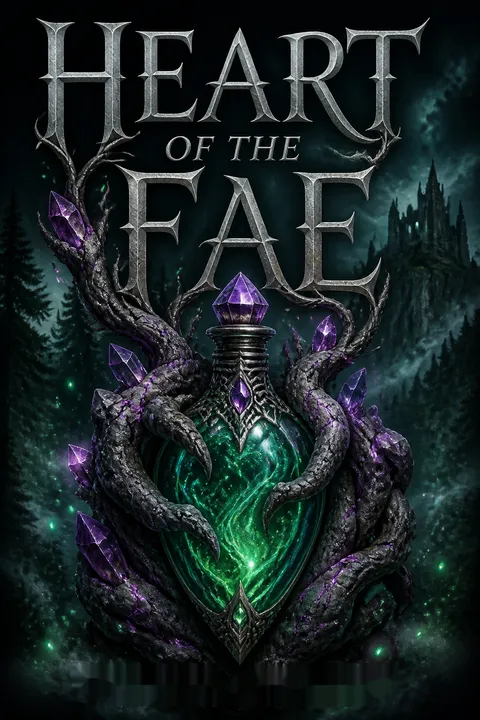

Plot Summary
Cursed Birthright and Banishment
Long ago, in a hidden faerie kingdom, a desperate king bargains for an heir, resulting in twin sons—one a warrior, the other a scholar. But the price of faerie bargains is always steep. When jealousy and betrayal strike, the eldest son is wounded, revealing a body marred by crystals and gems—an unforgivable flaw among the perfect Seelie. Cast out and banished to the phantom isle of Hy-brasil, the prince's name fades into legend, his existence erased by shame and fear. This ancient wound, born of pride and cruelty, sets the stage for a tale of exile, longing, and the search for redemption, echoing through the generations and shaping the fate of all who come after.
Healer's Daughter, Plagued Land
Sorcha, a red-haired healer and midwife, lives on the edge of society, tending to her ailing father and her sisters in a brothel plagued by the deadly blood beetle infection. Her world is one of practical magic, old faerie beliefs, and the daily struggle for survival. Despite her skill and compassion, she is dismissed by the male-dominated healers' guild, her knowledge ignored as the plague spreads. Sorcha's longing to do more, to save her family and her people, is met with scorn and isolation. Yet, her stubborn hope and connection to the old ways keep her searching for answers, even as the world around her grows darker and more desperate.
Bargain with the War Goddess
Driven by love and fear, Sorcha seeks out the ancient shrine of the war goddess Macha, begging for a cure to the blood beetle plague. Macha appears, fierce and unyielding, offering a bargain: Sorcha's father will be spared while she embarks on a quest to find the cure, but the price is hardship, pain, and the promise of suffering. The goddess's children, faerie twins Cormac and Concepta, hold the next clue. Sorcha's journey is no longer her own; she is bound by faerie law, her fate entwined with powers beyond her understanding. The cost of hope is steep, and the path ahead is shrouded in peril.
The Faerie Twins' Deceit
Sorcha is swept into the world of the MacNara twins, faeries glamoured as nobles, whose beauty and cruelty are matched only by their cunning. They reveal the cure is not a potion, but a person: the exiled prince of Hy-brasil. To save her father and her people, Sorcha must travel to the phantom isle, find the disgraced faerie prince, and bring him back—though the twins' motives are as murky as the bargains they strike. Sorcha's resolve is tested by faerie riddles, shifting truths, and the ever-present threat of being used as a pawn in a game she cannot fully see.
Farewell and the Sea Crossing
With her father's blessing and her sisters' tears, Sorcha leaves behind everything she knows. Guided by a dullahan coachman and a Fae-marked ship, she braves the treacherous sea, facing storms, merrows, and the monstrous guardian of faerie waters. The ship's captain, Manus, is both ally and enigma, and the journey is a crucible of fear, seasickness, and awe. Sorcha's faith in the old ways and her own stubbornness carry her through, but the crossing is a trial by water and magic, stripping her of certainty and preparing her for the world that waits on the other side.
The Phantom Isle's Exile
Washed ashore on the haunted, beautiful isle of Hy-brasil, Sorcha is met with suspicion and indifference by its faerie outcasts. The land is lush but lonely, its castle a ruin, its people banished for crimes both petty and profound. Sorcha's kindness and resilience win her unlikely allies among brownies, boggarts, and pixies, but the master of the isle—the exiled prince—remains a shadow, a figure of rage and sorrow. The island is both prison and sanctuary, a place where time moves strangely and the wounds of the past fester, waiting for a healer's touch.
The Beast and the Bargain
Sorcha confronts the master of Hy-brasil, discovering a man both monstrous and noble, his body and soul scarred by betrayal and exile. Their first meeting is a clash of wills—her compassion against his bitterness, her hope against his despair. Bound by bargains and mutual need, they circle each other warily, each hiding wounds that run deeper than flesh. Sorcha's presence begins to stir something long dormant in the prince: the possibility of forgiveness, of connection, and perhaps even of love. But trust is hard-won, and the price of healing may be more than either is willing to pay.
Kindness Among Outcasts
As Sorcha settles into life on Hy-brasil, her healing skills and open heart transform the lives of its faerie exiles. She mends wounds, bakes bread, and brings laughter to a place starved for joy. The outcasts—pixies, brownies, gnomes, and more—become her found family, their quirks and sorrows woven into the fabric of her days. Through small acts of kindness, Sorcha begins to heal not just bodies, but spirits, challenging the island's master to see his people—and himself—with new eyes. In the crucible of exile, hope and community are forged, even as the shadow of the outside world looms.
The Heart of the Monster
The wary alliance between Sorcha and the exiled prince deepens into something more. Through shared meals, confessions, and moments of unexpected tenderness, they begin to see past each other's scars. Sorcha's acceptance and fierce honesty chip away at the prince's self-loathing, while his strength and vulnerability awaken desires she never dared name. Their love is a slow-burning fire, threatened by old wounds and the ever-present threat of faerie bargains gone awry. In each other, they find the possibility of redemption—but the world is not done testing them.
The Seelie King's Shadow
The outside world intrudes as Sorcha is summoned to the Seelie King—Eamonn's twin, Fionn—whose perfection masks a heart of ice. In the gleaming palace, Sorcha witnesses the suffering of the lesser fae, the rot beneath the golden surface, and the king's obsession with control. She is drawn into court intrigue, forced to navigate threats and bargains, and learns the true cost of power. The king's shadow falls long over Hy-brasil, and the threat of war grows ever closer, forcing Sorcha and Eamonn to confront the past they cannot escape.
Revels and Revelations
On the night of Samhain, the veil between worlds thins, and the faerie outcasts gather for a revel that is both celebration and farewell. Sorcha's druidic heritage awakens, and she leads the ritual, binding herself to the island and its people. In the aftermath, she and Eamonn finally surrender to their love, finding solace and passion in each other's arms. But joy is fleeting; the threat of Fionn's army, the weight of prophecy, and the demands of destiny press in. The time for hiding is over—choices must be made, and the cost will be dear.
War, Sacrifice, and Return
Fionn's army descends on Hy-brasil, and the island becomes a battlefield. Eamonn dons his armor, leading his ragtag family in a desperate defense against overwhelming odds. Sorcha, torn between her healer's oath and her love for Eamonn, is forced to kill to survive, shattering her innocence. In the chaos, she is torn from Eamonn's side by Bran, the Unseelie prince, and carried away from the only home she has ever truly known. The war's outcome is left uncertain, but the cost is clear: love lost, innocence broken, and the world forever changed.
Homecoming and Healing
Sorcha returns to her plague-ravaged home, her heart shattered but her resolve unbroken. She finds her family on the brink of death, the brothel boarded up, hope all but gone. Drawing on all she has learned—her healing skills, her druidic power, and the strength forged in exile—Sorcha sets to work, determined to save those she loves. The story ends with her promise to return to Hy-brasil, to the man and the people who have claimed her heart, and to fight for a future where love, hope, and healing are possible, even in a world shaped by faerie bargains and human pain.
Analysis
A feminist faerie tale of healing, exile, and the cost of hopeHeart of the Fae is a lush, emotionally charged reimagining of Beauty and the Beast, set in a world where bargains are binding, exile is both punishment and possibility, and healing is an act of radical defiance. At its core, the novel is a meditation on the power of compassion in a world built on cruelty and hierarchy. Sorcha's journey from outsider to healer-heroine is a testament to the strength found in vulnerability, the necessity of community, and the courage required to face both monsters and men. The story interrogates the nature of power—who wields it, who suffers under it, and how it might be transformed. Through its use of faerie law, duality, and found family, the novel offers a modern myth for readers hungry for stories where love is hard-won, hope is costly, and redemption is possible for even the most broken among us. The lesson is clear: true healing requires facing the darkness, embracing imperfection, and daring to believe that even in exile, we can build a home.
Review Summary
Heart of the Fae by Emma Hamm is a Beauty and the Beast retelling set in medieval Ireland featuring rich Celtic mythology and diverse fae creatures. Sorcha, a midwife seeking a cure for a plague, makes a bargain with the Fae and encounters Eamonn, a banished crystal-covered prince. Reviews praise the gorgeous writing, world-building, strong feminist protagonist, and respectful romance, though some criticize the forced relationship development, unclear setting, heavy-handed feminism, rushed pacing, editing issues, and cliffhanger ending. The Irish mythology integration receives mixed reactions.
People Also Read
Characters
Sorcha
Sorcha is a fiercely intelligent, red-haired midwife and healer, marked by her pointed ears and outsider status in her own community. Raised among women on the margins, she is both practical and deeply compassionate, driven by a need to save her family and her people from the blood beetle plague. Her psychoanalytic core is a blend of longing for belonging and a stubborn refusal to accept the world's cruelty. Sorcha's journey is one of transformation: from dismissed outsider to the heart of a found family, from skeptic to believer, from healer to warrior. Her love for Eamonn is both a source of vulnerability and strength, and her willingness to bargain with faeries, face monsters, and endure suffering marks her as a true heroine—one who heals not just bodies, but broken souls.
Eamonn (The Exiled Prince / Stone)
Eamonn is the banished heir of the Seelie, a warrior prince whose body is marred by crystals—a visible sign of his "imperfection" and the reason for his exile. His psyche is a battleground of shame, rage, and longing for acceptance. He rules Hy-brasil's outcasts with a mixture of bitterness and reluctant care, hiding his pain behind cruelty and isolation. Sorcha's arrival awakens his capacity for hope and love, but also his deepest fears of rejection. Over the course of the story, Eamonn transforms from a self-loathing monster into a man capable of vulnerability, tenderness, and sacrifice. His relationship with Sorcha is the crucible in which he is remade, and his struggle to reclaim his birthright is both personal and political—a fight for the soul of his people and himself.
Fionn (The Seelie King)
Fionn is Eamonn's twin, the "perfect" brother who inherits the throne through betrayal and manipulation. Outwardly flawless, he is inwardly cold, controlling, and obsessed with order. His psychoanalytic core is envy and insecurity, masked by cruelty and a need to dominate. Fionn's relationship with Eamonn is a mirror of self-hatred and projection; he cannot tolerate his brother's difference, and so must destroy or erase it. As king, he perpetuates the suffering of the lesser fae, enforcing a rigid hierarchy that benefits only the powerful. Fionn is both antagonist and cautionary tale—a warning of what happens when fear and pride rule the heart.
Macha
Macha is an ancient Tuatha dé Danann, a goddess of war and sovereignty, whose intervention sets Sorcha's quest in motion. She is fierce, uncompromising, and enigmatic, embodying both the dangers and the possibilities of faerie bargains. Macha's psychoanalytic role is that of the shadow mother—demanding, testing, and ultimately empowering. She sees in Sorcha a kindred spirit, a woman willing to fight for what she loves, and her bargain is both a curse and a blessing. Macha's presence is a reminder that true power comes with a price, and that the path to healing often leads through pain.
Cormac and Concepta (The MacNara Twins)
The MacNara twins are Macha's children, faeries glamoured as nobles, whose beauty and cruelty are matched only by their cunning. They are both guides and obstacles, offering Sorcha the next step in her quest while ensnaring her in their own games. Psychologically, they represent the amoral, capricious side of faerie—delighting in bargains, riddles, and the suffering of mortals. Their relationship with Sorcha is transactional, but not without a strange respect for her tenacity. The twins' motives are never fully clear, and their actions drive home the lesson that in the faerie world, nothing is ever as it seems.
Oona (Pixie / Unseelie Spy)
Oona is a pixie who serves Eamonn on Hy-brasil, her true nature as an Unseelie exile hidden beneath layers of glamour and loyalty. She is nurturing, practical, and fiercely protective of those she loves, especially Sorcha. Oona's psychoanalytic role is that of the surrogate mother and confidante, offering wisdom, comfort, and a reminder of the costs of exile. Her own banishment is a mirror of Eamonn's, and her presence is a testament to the possibility of kindness and community among outcasts. Oona's secret identity adds a layer of intrigue and danger, as the boundaries between Seelie and Unseelie blur.
Bran (Unseelie Prince / Raven)
Bran is the Unseelie prince, a shapeshifter who moves between worlds as both raven and man. He is a trickster, a spy, and a catalyst, guiding Sorcha at key moments and challenging Eamonn's assumptions. Psychologically, Bran embodies the liminal—the space between belonging and exile, loyalty and self-interest. His affection for Sorcha is genuine, but always tinged with ambiguity. Bran's role is to unsettle, to provoke, and to remind the other characters (and the reader) that the world is larger and stranger than they know.
Sorcha's Family (Papa, Briana, Rosaleen, Sisters)
Sorcha's family—her ailing father and her sisters in the brothel—are both her greatest vulnerability and her deepest source of strength. They represent the world she is fighting to save, the ties of blood and love that drive her to risk everything. Psychologically, they are the anchor that keeps Sorcha grounded, even as she is swept into the faerie world. Their suffering is a constant reminder of the stakes, and their survival is the measure of Sorcha's success or failure.
The Lesser Fae (Brownies, Boggart, Cian, etc.)
The outcasts of Hy-brasil—brownies, boggarts, gnomes, and more—are the heart of the island's found family. Each is marked by loss, resilience, and a longing for acceptance. Psychologically, they represent the possibility of healing through community, the power of kindness, and the dignity of those deemed "lesser" by the powerful. Their relationship with Sorcha is transformative for both sides, as they teach her the value of small joys and she reminds them of their worth.
Elva (Seelie Concubine)
Elva is a concubine of the Seelie King, a woman broken by loss and addiction, whose story is a cautionary tale of the costs of power and the dangers of faerie bargains. She is both victim and survivor, her suffering a mirror of the kingdom's rot. Elva's relationship with Sorcha is brief but profound, offering a glimpse of what might have been—and what must be avoided.
Plot Devices
Faerie Bargains and the Law of Exchange
The narrative is structured around the ancient law of faerie bargains: nothing is given freely, and every act of magic or mercy demands payment. This device drives the plot, as Sorcha's quest is shaped by the bargains she strikes—with Macha, the MacNara twins, and ultimately with Eamonn himself. The bargains are both literal and metaphorical, forcing characters to confront the costs of their desires and the limits of their power. Foreshadowing is woven through each deal, as the consequences of choices ripple outward, shaping fate in ways both expected and unforeseen.
Duality and Mirrors
The story is obsessed with duality: twin brothers, Seelie and Unseelie, beauty and monstrosity, exile and belonging. The motif of mirrors—literal and figurative—recurs throughout, challenging characters to see themselves and each other clearly. The narrative structure echoes this, with parallel journeys (Sorcha's and Eamonn's), mirrored betrayals, and the constant tension between what is seen and what is hidden. This device deepens the psychological complexity, as characters are forced to confront the parts of themselves they would rather deny.
Found Family and Chosen Community
Sorcha's journey is as much about building a new family as it is about saving her old one. The plot is driven by the creation of community among outcasts, the forging of bonds through kindness, shared struggle, and mutual respect. This device is both a source of hope and a challenge to the rigid hierarchies of the faerie world. The narrative structure allows for moments of warmth and humor amid the darkness, and the found family becomes the crucible in which true healing is possible.
The Healer's Arc
Sorcha's role as a healer is both literal and symbolic. The plot is structured around her attempts to mend what is broken—bodies, hearts, communities, and even the land itself. Her arc is one of transformation: from powerless outsider to agent of change, from wounded child to wise woman. The healer's journey is marked by suffering, sacrifice, and the willingness to face pain head-on. This device allows for deep psychological exploration, as Sorcha's compassion becomes both her greatest strength and her greatest vulnerability.
The Unreliable World
The faerie world is one of shifting realities, where glamour hides the truth and nothing is as it seems. The narrative structure uses this device to keep both Sorcha and the reader off-balance, constantly questioning what is real and what is illusion. This uncertainty heightens the stakes, as every choice is made in the shadow of doubt. The cost of seeing clearly—of stripping away glamour—is both liberation and loss, as the world's beauty and its horror are revealed in equal measure.
The Otherworld Series
About the Author
Other books by Emma Hamm

Download PDF
Download EPUB
.epub digital book format is ideal for reading ebooks on phones, tablets, and e-readers.








































