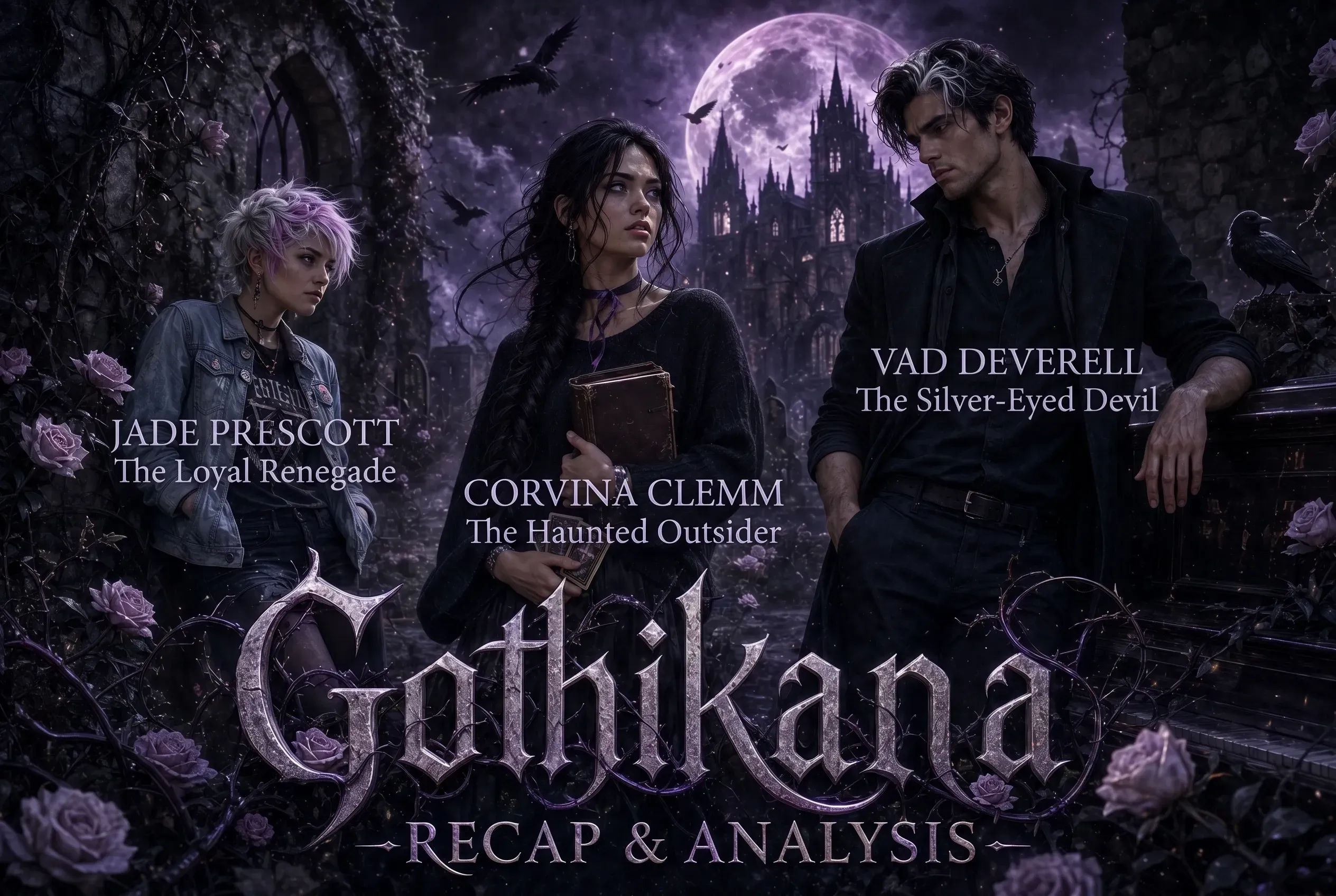


Plot Summary
Prologue
Two beginnings frame the curse. At a grim boys' home, the blind caretaker Zelda12 seizes seven-year-old Vad's2 arm and prophesies that he will go to a castle where none go, that he will find purple eyes, and that it will be a matter of many deaths. His friends, including Ajax5 and Fury, mock him.
Years later and elsewhere, ten-year-old Corvina1 walks beneath a rare Ink Moon with her mother,7 a woman the town brands a witch, feeding crows in a clearing and learning to read tarot. Her mother7 hears voices that warn her to keep Corvina1 hidden. The girl, born under that black moon, sometimes hears voices too, and quietly suspects she may be a freak like her mama.
The dual prologue braids fate and heredity into a single knot. Zelda's prophecy installs a gothic engine of inevitability, while Corvina's childhood establishes the novel's central ambiguity: are voices madness inherited from a schizophrenic mother, or genuine sensitivity to the otherworldly? RuNyx deliberately refuses to resolve this, planting epistemological doubt that will torment the protagonist. The crows, the Ink Moon, and the maternal bond introduce a feminine, intuitive cosmology against which the patriarchal violence of the castle will later be measured. By rooting both lovers in institutional abandonment, the text frames their eventual union as two orphaned, marked children finding the belonging the world denied them.
The Letter and the Castle
Twenty-one and raised in isolation by a mother the town called a witch,7 Corvina Clemm1 accepts a handwritten admission letter to the University of Verenmore, a castle no search can locate, referred by the psychiatric institute that now houses her mother.7
Her taxi driver prays before climbing the fogbound road and warns that people up there go mad or simply disappear. At the gates she meets Jade,3 a bubbly white-haired girl who instantly claims her as roommate and first friend.
As they settle into a drafty tower room, the blonde senior Troy4 taunts from the steps that Jade's3 previous roommate, Alissa, walked off the tower roof. The acceptance feels like the clean slate Corvina1 has hungered for, yet the beautiful castle already hums with something wrong.
The inciting frame inverts the orphan-goes-to-magic-school template into something darker. Verenmore recruits the damaged and discarded, making belonging conditional on prior trauma, a community of wounded outsiders. Corvina's craving for ordinariness and a clean slate is immediately undercut by Troy's casual revelation of suicide, signaling that the past cannot be outrun here. The motif of the unreachable, signal-dead mountain isolates her physically and narratively, severing the safety nets a reader expects. RuNyx establishes Corvina's defining tension: a loner who desperately wants to be seen and loved, walking willingly into a place where being seen too clearly proves lethal.
The Silver-Eyed Devil
A haunting melody pulls Corvina1 from sleep to the tower's attic, where she finds a man playing piano2 in the dark, eyes shut, grief pouring from his fingers. He senses her, snarls at her to leave, and she flees, glimpsing the white streak in his hair. Jade3 names him: Vad Deverell, the silver-eyed devil,2 a doctoral student permitted to teach first-years while finishing a thesis on music and literature.
He is the man Alissa secretly bedded before she died, the only soul who walks the cursed woods alone. The next day his mercury gaze fixes on Corvina1 in class, and the charge between them grows so visible that her friends swear the air pulses. He coldly warns her to keep her distance.
Vad is introduced as Byronic archetype refracted through gothic dread: artist, recluse, suspected predator. The piano scene fuses eroticism with mourning, coding his attraction as something cursed rather than wholesome. The novel weaponizes rumor as characterization; we meet Vad almost entirely through others' fear and desire, mirroring Corvina's own confusion. The student-teacher taboo and the dead-lover whisper layer danger over magnetism, establishing the central romantic question as one of trust under maximum suspicion. His warning to stay away functions, as in all dark romance, as an invitation, the forbidden frame intensifying rather than deterring the pull between two people equally starved for recognition.
Voices by the Black Lake
Following a crow and Mo,6 the comforting sandalwood-scented voice she has heard since childhood, Corvina1 wanders into the woods and finds a still black lake. Vad2 materializes, smoking, warning that the forest could swallow her without a trace.
Their sparring crackles with hunger neither names. As he departs, a new voice reaches her, feminine, begging for help, trailing the reek of decay, nothing like Mo's6 warmth. The episode unnerves her deeply: either Verenmore is genuinely haunted or her inherited madness is finally surfacing.
Around campus she learns more, including a leering psychology professor named Kari14 whom Vad2 silences with one private word, and a brash senior, Roy,8 who warns that any student caught with faculty is instantly expelled.
The lake introduces the supernatural mystery as sensory phenomenon, smell and sound rather than sight, lending it bodily credibility while preserving deniability. Crucially, RuNyx distinguishes Mo (benign, fragrant) from the new voice (rotten, desperate), suggesting a moral taxonomy of the unseen that Corvina cannot yet read. Her interpretive crisis, haunting versus psychosis, becomes the engine of suspense, making her an unreliable narrator who fears her own perceptions. The professor and Roy expand the institutional web, while Vad's quiet authority over a senior colleague hints that he wields power inconsistent with his stated junior status, a clue planted long before its payoff.
The Slayers and the Ball
Jade3 explains the Black Ball, a masquerade held every five years on which someone always disappears, a pattern unbroken for a hundred years. Campus legend names the Slayers: students who once dragged villagers into the woods for sacrificial games until classmates lynched them, then themselves vanished.
Exploring at dawn, Corvina1 finds the ruins where they died, fifteen unmarked graves, and an old piano freshly covered with a tarp, proof Vad2 has been there. In the library a frightened boy whispers that the Slayers are present, then bolts. Soon after, Vad2 corners her in the stacks, slides his hand beneath her skirt, tastes her on his fingertips, and insists this cannot happen again even as his self-control visibly splinters.
The Slayers legend supplies the novel's mythic spine, binding sacrifice, sex, and cyclical violence to the Ink Moon calendar. The fifteen graves and the cared-for piano position Vad ambiguously between investigator and inheritor of horror, deepening reader suspicion in step with Corvina's desire. The library seduction enacts the book's erotic grammar: power, secrecy, the thrill of near-exposure. RuNyx structures attraction as transgression, each escalation breaking a rule (teacher, woods, public space). The whispering boy seeds the antagonist's machinery without naming it, while the recurring tension between Vad's stated restraint and his compulsive pursuit dramatizes addiction, the madness both lovers will later name aloud.
First Kiss at the Ruins
A nightmare drives Corvina1 back to the woods at night, where she finds Vad2 repairing the abandoned ruins piano by lantern. He confesses that his pull toward her is not lust but a barbaric need to possess, a madness. When she presses her fingers to his mouth and dares him to drown her in it, he finally kisses her, claiming he has already descended too far.
Then regret crosses his face and he ends it, sending her away stinging. Gathering her scattered tarot deck, she freezes: three cards lie face up, the Devil, the Lovers, and the Tower, the exact omens her black-eyed mother7 dealt her in the drowning nightmare only hours before, collapsing the wall between her dreams and her waking world.
The first kiss arrives wrapped in renunciation, the dark-romance rhythm of advance and withdrawal that keeps desire perpetually unconsummated and therefore escalating. Vad reframes their bond from lust to compulsion, elevating it to fate and pathology at once. The tarot synchronicity is the chapter's masterstroke: by materializing dreamed cards in waking reality, RuNyx grants Corvina's intuition uncanny authority while keeping rational explanation barely possible. The Devil, Lovers, and Tower function as a compressed plot prophecy, temptation, union, and catastrophic fall, foreshadowing the rooftop climax. His regret wounds her precisely where she is most fragile, in her terror of being unwanted for what she is.
Stranded in the Storm
On her secret birthday, needing to mail a letter to her institutionalized mother,7 Corvina1 rides down the mountain with Vad.2 He admits to reading her file, and she confesses her mother is schizophrenic,7 committed at Corvina's1 own hand when she turned eighteen, her father a suicide who heard voices commanding him to die.
A violent storm strands them on a cliffside turnout, and there, agreeing it stays on the mountain, they have sex for the first time, her first ever. Mid-climax she cries out for Mo,6 baffling and angering Vad.2 Afterward he retreats coldly into Mr. Deverell,2 dropping her at the tower as if nothing happened, leaving her aching and unsure whether she was a lover or merely a curiosity he sampled once.
Confinement breeds intimacy: the storm literalizes the lovers' isolation from a judging world, creating a liminal space where rules dissolve. Corvina's disclosure of her family history reframes the romance as a meeting of two people shaped by inherited darkness, hers genetic, his ancestral. The first sexual encounter is also her first act of radical self-exposure, immediately punished by Vad's emotional retreat, reinforcing her abandonment wound. The intrusion of Mo at the height of passion is psychologically rich, suggesting her dissociative companion guards even her most vulnerable moments, and it provokes Vad's possessiveness, the jealousy that will define his protective ferocity going forward.
Troy Walks Off the Roof
Weeks of charged avoidance shatter when Mo's6 urgent voice sends Corvina1 racing toward the tower. There the cheerful, height-fearing Troy4 stands catatonic on the roof, deaf to the crowd screaming below, then steps calmly off and dies on the cobblestones, blood haloing his head exactly as Alissa fell. His voice reaches her afterward, asking her to tell his brother.
Vad2 spirits her to his attic room and reveals he knows she once admitted herself to the institute for testing, knowledge held in no file. The disclosure nearly triggers a panic collapse; he gentles her, lets her sleep in his bed, and shows her what he found on the roof: a note reading Danse Macabre, the death-themed assignment from his own class.
Troy's death converts ambient dread into urgent thriller mechanics, establishing a serial pattern of staged suicides masked as student tragedy. The repetition of the rooftop tableau confirms method behind the madness. Vad's revelation that he possesses sealed knowledge of Corvina's psychiatric history detonates the romance's trust crisis: is he stalker or guardian? RuNyx makes the bed-sharing scene the emotional pivot, intimacy without sex, care without exploitation, recalibrating his menace toward protectiveness. The Danse Macabre note brilliantly implicates the literature class itself, turning Vad's pedagogy into a possible murder signature and binding the academic, romantic, and criminal plots into one suffocating knot.
The Heir of Verenmore
Troy's brother,4 Ajax Hunter,5 an investigator and Verenmore alumnus, arrives for the body. At a midnight lakeside meeting he recognizes Corvina's1 purple eyes from the prophecy blind Zelda12 once gave Vad2 at their shared childhood home, and reveals that Vad's2 grandfather died suspiciously, leaving Vad2 sole heir, and that the entire mountain and castle secretly belong to the Deverell line.
Confronted, Vad2 admits the buried truth: his grandfather was a surviving Slayer who betrayed and lynched his own circle and was cursed by his witch lover.
Vad2 enrolled incognito to investigate the disappearances he might one day be blamed for. Most staggering of all, he reveals he saw Corvina1 three years earlier outside Dr. Detta's11 office, that he has always seen her.
This is the structural midpoint where mystery and romance fuse into destiny. The reveal that Vad owns Verenmore recasts every prior interaction: his authority, his freedom in the woods, his secrecy all resolve into a single concealed identity. The grandfather's atrocity gives Vad inherited guilt to match Corvina's inherited illness, making them moral twins. Ajax functions as both lawful conscience and prophecy-witness, validating Zelda's vision and thus the supernatural framework. The climactic line, that he saw her years before fate brought her, transforms creepy surveillance into romantic predestination, the book's boldest tonal gamble, reframing obsession as recognition and answering Corvina's lifelong fear of invisibility in one devastating stroke.
Dragging the Black Lake
Corvina's1 nightmares sharpen into specifics: bodies suspended in the lake, weighted at the feet, a drowned version of herself among them begging to be found. Trusting the impulse, Vad2 summons Ajax's5 forensic team and orders the lake dragged, water never searched in a century.
Before that he leads her through a hidden mountain tunnel as a deliberate test of her trust, and despite a whispered fear that he could make her vanish, she takes his hand into the dark. At the bridge she tells the divers to search underneath.
Over three days they surface fourteen skulls and hundreds of fragmented bones, every body weighted down precisely as her dream foretold, the Slayers' long-buried victims finally rising. Afterward, the rotting feminine voice goes silent.
The dredging operation pays off the lake's accumulated dread and grants Corvina's visions forensic confirmation, decisively tilting the novel toward the supernatural while never quite closing the rational door. Her dreamed accuracy reframes her feared madness as prophetic gift, a redemptive inversion of inherited shame. The tunnel sequence stages trust as literal descent into darkness, a courtship ritual where vulnerability replaces seduction; her chosen leap of faith marks the relationship's true consummation, deeper than sex. The silenced voice implies the dead sought acknowledgment, not harm, complicating the haunting into something closer to justice, and quietly distinguishing the genuine spirits from the human evil still hiding.
The Crow Mask and the Ring
As the Black Ball nears and their bond deepens, Vad2 stages a tarot reading in the sunlit gardens, asking Corvina1 before a crowd to draw a card about a woman he loves. Her trembling hands turn the Two of Cups, and she answers that the woman feels exactly the same, a confession smuggled into plain sight. He leaves a bespoke deep-amethyst gown, a silver mask, and a note in a locked office.
At the masquerade he appears in a crow mask and gives her an amethyst ring engraved with a line from Dracula about never letting her go into the unknown alone, then brings her to climax against a pillar amid the increasingly uninhibited masked dancers. For one stolen night, their secret love feels almost like freedom.
RuNyx grants the lovers a brief plateau of joy before the storm, the genre's obligatory false dawn. The tarot reading is exquisite dramatic irony: a declaration broadcast publicly yet legible only to its target, dramatizing how their love survives by hiding in symbol. The crow mask completes Corvina's little-crow nickname, costuming Vad as the death-omen that has shadowed her, eroticizing mortality itself. The Dracula inscription canonizes their bond through the gothic text they studied, literature becoming vow. The masquerade's collective disinhibition externalizes the madness theme, the whole castle briefly surrendering to appetite, foreshadowing the night's coming violence beneath its glittering, anonymous license.
The Burned Body in the Shack
Days before the ball, Mo6 directs Corvina1 to a locked shack deep in the woods, the same one her group once glimpsed a silhouette moving inside. She brings Ajax.5 Behind its unlatched door they find a charred female corpse, burned after death within recent months to obscure her identity.
Ajax,5 bound by duty over friendship, names Vad2 a suspect, listing every link: his intimate knowledge of the woods, his Slayer grandfather, the suspicious deaths trailing him.
Corvina1 refuses the conclusion, insisting Vad2 is dangerous but incapable of this grotesque, frenzied evil, since his kills would be clean and untraceable. The horror confirms her growing dread that something far worse than ghosts walks Verenmore, and the question of the dead woman's name festers as the masquerade looms.
The shack discovery escalates from spectral mystery to visceral, human atrocity, distinguishing the disappearances from the staged suicides and hinting at a living killer hiding among them. Ajax's procedural suspicion of Vad re-weaponizes every clue the reader has tracked, forcing Corvina to articulate her faith as reasoned discernment rather than blind love: she defends him not by denying his darkness but by characterizing its texture. This is the novel's sharpest meditation on its title theme, that true evil wears an innocent face while the obvious devil is merely misunderstood. The unidentified body becomes a ticking clock, its name the hinge on which the entire conspiracy will swing open.
The Roof and the Devil's Breath
After the ball, two vanish: the senior Roy8 and Jade.3 Searchers find the ruins piano ablaze and Roy8 floating in the lake, rescued by Corvina1 and Ajax.5 Then a call identifies the shack corpse as the real Jade Prescott, dead two years.
Knocked unconscious, Corvina1 wakes paralyzed on the roof beside her roommate,3 who reveals herself as a Deverell descendant of the witch Slayer who survived, wielding an Amazonian drug called Devil's Breath to command victims off rooftops.
She murdered the real Jade to steal her place, then killed Alissa and Troy,4 obsessed with claiming Vad2 for their shared bloodline. Vad2 arrives, feigns dark allegiance, then hurls the impostor from the tower. A flood of screaming voices overwhelms Corvina,1 and she collapses, seizing in his arms.
The reveal recontextualizes the entire novel: the warmest, most trusted figure was the predator, validating Corvina's earlier thesis that evil hides behind innocence. The impostor's incestuous bloodline obsession mirrors and corrupts the lovers' fated-mates bond, presenting a dark double who weaponizes belonging into possession. Devil's Breath provides a pharmacological rationale for the staged suicides, partially collapsing the supernatural mystery into chemistry while leaving the Black Ball disappearances and Corvina's visions unexplained. Vad's deception and execution complete his arc from suspected monster to ruthless protector, confirming he kills for her, never her. Corvina's seizing collapse stages the climax of her central terror: the boundary between perception and breakdown finally rupturing.
Choosing Her Over the Castle
Vad2 rushes Corvina1 to the institute, where Dr. Detta11 induces a coma to flush the drug and confirms her brain is healthy, though her genetic risk endures. The doctor11 cannot say whether her voices were the drug, subconscious cues, or something genuinely otherworldly, and counsels Vad2 to watch for any future symptoms.
Faced with a choice between Verenmore, the ancestral treasure he spent his life coveting, and the woman who breathed stars into his melancholy, Vad2 calls the Board, resigns his post, orders the prophetic eye-tree burned, and stays at her bedside through six months of recovery.
He vows to remain her mountain even if she someday forgets him, the way her mother7 now forgets her. For the first time, Corvina1 will not face her feared madness alone.
The resolution privileges chosen love over inherited identity, Vad's sacrifice of Verenmore answering the orphan's lifelong hunger to finally own something by relinquishing it for someone. Dr. Detta's deliberate refusal to diagnose preserves the novel's foundational ambiguity, honoring uncertainty as a livable condition rather than forcing closure. The burned eye-tree symbolically severs the Slayer lineage's instrument of control. Vad's vow reframes love not as cure but as companionship through irreducible risk, a mature counter to romance's usual fantasy of rescue. The mother's dementia looms as Corvina's possible future, making his pledge to stay regardless the book's truest articulation of unconditional devotion.
Epilogue
Six months on, Vad2 takes Corvina1 to see her mother, Celeste,7 who barely surfaces from dementia yet recognizes her daughter's raven hair and accepts Vad's2 promise to keep her safe. They build a quiet life away from the mountain: marriage, a husky named Count, her candle and tarot business, and a novel she writes about her haunted year, titled Gothikana.
Five years later, healed and steady, Corvina1 decides they should return to the cursed castle to raise the family they now want, wanting their children to inherit its beauty alongside its darkness. Vad,2 who reversed his vasectomy as an anniversary gift, relents. The mountain that nearly destroyed them awaits their homecoming once more.
The layered epilogue converts trauma into legacy and inheritance into choice. Celeste's flicker of recognition redeems the maternal bond and models the love-through-forgetting Vad has promised. Corvina writing Gothikana is pointed metafiction: the survivor authors her own haunting, mastering memory by narrating it, mirroring the author's note about real unanswered questions. The decision to return reframes home not as a place of safety but as the site where one became oneself, darkness included. Choosing to breed life into a death-soaked castle asserts regeneration over curse, the roses-on-the-grave imagery made literal. The cyclical ending refuses tidy escape, insisting that healing means re-entering the dark on one's own terms.
Analysis
Gothikana weds the dark-academia gothic to the fated-mates dark romance, using a crumbling mountain castle as a psychological pressure chamber where the question is never simply who is killing students, but whether the heroine1 can trust her own mind. RuNyx's central achievement is sustained epistemological doubt: Corvina,1 daughter of a schizophrenic mother7 and a suicidal father, cannot distinguish haunting from breakdown, and the novel honors that uncertainty to the end, when even her psychiatrist11 declines to diagnose. This refusal of closure is the book's thematic spine, arguing that some questions lack answers and that sanity may mean learning to live alongside the unexplained rather than conquering it. The romance literalizes a theory of love as recognition: Vad2 has, per Zelda's prophecy, sought Corvina's1 purple eyes since childhood, and his repeated insistence that he sees her answers her lifelong terror of invisibility. The text reframes obsessive surveillance as devotion, a morally provocative move typical of the genre, asking readers to accept a possessive, lethal protector2 as the cure for an abandoned woman's loneliness. Its recurring motif, that true evil wears an innocent face while the obvious devil is merely misjudged, drives both the mystery's reversal and its ethics. Inheritance threads through everything: Vad's2 ancestral guilt mirrors Corvina's1 genetic risk, and the antagonist's3 incestuous bloodline obsession functions as a corrupted double of the lovers' fated bond, weaponizing belonging into possession. The resolution privileges chosen love over coveted inheritance, then the epilogue reclaims the cursed home as a site of regeneration, roses rooting in graves. RuNyx, drawing on her own boarding-school past, ultimately offers a meditation on transforming trauma into authored narrative: the survivor1 writes her haunting, mastering memory by telling it, and returns to the dark on her own terms.
Review Summary
Gothikana received mixed reviews, with ratings ranging from 1 to 5 stars. Some readers praised its atmospheric setting, gothic elements, and steamy romance, while others criticized the writing style, underdeveloped characters, and lack of plot resolution. Common complaints included repetitive language, insta-love, and problematic teacher-student dynamics. Many found the book to be overhyped, with some comparing it unfavorably to other dark academia works. Despite the criticisms, some readers enjoyed the book's spooky vibes and romantic tension.
People Also Read
Characters
Corvina Clemm
Haunted purple-eyed studentTwenty-one, raven-haired, violet-eyed, raised in near-total isolation by a mother the town shunned as a witch7. Corvina is an introverted observer who makes candles, reads tarot, feeds crows, and hears voices, chief among them the lifelong, comforting Mo6. Her defining wound is a terror of inherited madness braided with a desperate hunger to be seen, loved, and accepted despite her strangeness. She is intuitive, quietly brave, and drawn to darkness rather than frightened of it, yet perpetually doubting whether her perceptions are real. At Verenmore she chases the belonging and forbidden romance she has only read about in novels, discovering both a self-acceptance she never had and a love that does not flinch from her cracks. Her arc moves from fearful self-suspicion toward trust, in herself and in another.
Vad Deverell
The silver-eyed devilA magnetic, intensely controlled man in his late twenties with premature grey streaking dark hair and mercury eyes, ostensibly a doctoral student teaching literature while finishing a thesis on music and literature. Abandoned to a boys' home, then claimed by a wealthy grandfather, Vad carries inherited darkness and a melancholy he banishes only at the piano. He is morally grey, possessive to the point of obsession, secretive, and unnervingly knowledgeable about Corvina's1 hidden history. He frames his pull toward her not as lust but as a barbaric need to possess, a madness he stops fighting. Beneath the cold, dangerous public mask lives an untamed, fiercely protective man starved of love and belonging, who insists he is not a good man yet may be exactly the devil she needs to fight her demons.
Jade
Bubbly first friendCorvina's1 white-haired, green-eyed, eyebrow-pierced roommate, a chatterbox who adopts her instantly, supplies endless campus gossip, and offers the easy warmth and physical affection Corvina has never known. A self-described foster kid who once fled Verenmore after witnessing her previous roommate's death, Jade carries her own grief and superstition about the castle. Talkative, nosy but kind, she becomes Corvina's1 anchor in an alien world, the sisterly bond that makes the new life feel survivable, even as she warns repeatedly against the dangerous, unknowable Mr. Deverell2.
Troy
Protective blonde seniorA handsome, jovial senior who works part-time ferrying the school's mail to town, making him a fount of local lore and Slayers legend. Initially an asshole who teases Corvina1 as Purple, he becomes a brotherly protector within her friend group, occasionally irritating, hugely loyal. Secretly afraid of heights and woods, he idolizes his investigator brother5 and dreams of following him. His curiosity about the castle's hidden truths sets dangerous events in motion.
Ajax Hunter
Investigator with a pastTroy's4 older brother, a muscular, blue-eyed International Investigation Squad member and Verenmore alumnus who grew up alongside Vad2 in the same boys' home. Gruff, sharp-eyed, and bound by professional duty even when it conflicts with personal feeling, he recognizes Corvina's1 prophesied purple eyes on sight. He carries grief over a girlfriend, Zoe, who vanished at a prior Black Ball. He becomes an uneasy ally, willing to suspect Vad2 while respecting him, and a crucial bridge to the truth.
Mo
Corvina's guiding voiceThe masculine, sandalwood-scented voice Corvina1 has heard since childhood, warm, protective, and reliably right whenever she heeds it. Doctors dismiss him as her subconscious filling in for a dead father; she half-believes them. Distinct from the rotting, malign voices that later plague her, Mo functions as conscience, compass, and comfort, the benign half of her contested mind, repeatedly steering her toward safety and trust.
Celeste Clemm
Institutionalized witch-motherCorvina's1 mother, a paranoid schizophrenic with worsening dementia, once a college student who chose her unborn child over family and stability. Brilliant and loving in her lucid moments, she homeschooled Corvina1, taught her tarot and self-sufficiency, and shielded her fiercely from a world she feared would take her away. She embodies both the depth of maternal love and the genetic future Corvina1 dreads becoming.
Roy Kingston
Brash protective seniorA confident, beautiful blonde senior from a brutal foster past who masks care as bluntness. She mocks Corvina1 as freaky eyes yet repeatedly warns and helps her, an unlikely guardian whose harsh exterior hides genuine decency.
Kaylin Cross
Recruitment specialist handlerThe brisk, red-haired administrator who recruited Corvina1 and serves as her official point of contact. Efficient and rule-enforcing, she repeatedly cautions against student-faculty mingling and seems to wield, or defer to, more authority than her title suggests.
Erica, Ethan, and Jax
The friend groupCorvina's1 circle of fellow students: Erica, a sharp-tongued, observant girl; Ethan, Troy's4 skeptical roommate who dismisses the legends; and Jax, a playful, good-looking boy who pursues Corvina1 without pressure. Together they give her the ordinary college belonging she craved.
Dr. Detta
Corvina's psychiatristThe veteran psychiatrist who tested Corvina1 and treats her mother7, a thoughtful clinician who refuses easy diagnoses and frames her case as extraordinary and ambiguous. He becomes the voice of measured uncertainty, validating both medical risk and unexplained mystery.
Old Zelda
Blind prophesying caretakerThe eerie, white-eyed former caretaker of the boys' home who foresaw deaths and fates, including Vad's2 destiny to find purple eyes amid many deaths. Her prophecy is the supernatural seed from which the entire story germinates.
Mrs. Remi
Town postmistress keeper of loreThe kindly elderly postmistress, sister of the campus librarian Mrs. Suki, whose aunt vanished generations ago. She supplies the town's grim oral history of full-moon disappearances and warns Corvina1 never to linger in the woods on such nights.
Dr. Kari
Leering psychology professorA strict, thickset psychology lecturer who ogles young female students and humiliates the late. He gives Corvina1 the creeps, and Vad2 cows him with a single private word, an early hint of Vad's2 hidden authority.
Plot Devices
The Voices
Ambiguous madness or giftCorvina1 hears voices, the lifelong benign Mo6 and later malign, rotting-scented strangers, that she cannot prove are real or hallucinated. This device powers the novel's central suspense: every supernatural event arrives filtered through a narrator who fears her own mind, given her schizophrenic mother7 and suicidal father. The voices guide her toward crucial discoveries, validating her intuition, while threatening to confirm her inherited illness. RuNyx deliberately keeps the explanation open, even the closing psychiatrist11 refuses to adjudicate, so the reader, like Corvina1, never knows whether Verenmore is haunted or her perception is fracturing. The voices thus fuse the gothic and the psychological, making her unreliability the engine of both dread and revelation.
Zelda's Prophecy
Fate-engine of the plotThe blind caretaker's12 childhood prophecy, that Vad2 will reach a castle where none go, find purple eyes, and face many deaths, functions as the supernatural contract underwriting the whole story. It explains how Vad2 came to seek Corvina1 years before they met, transforming what could read as stalking into predestination. Recurring references (Ajax5 recognizing her eyes, Vad2 confessing he searched for her) pay the prophecy off incrementally. It binds the orphan-home backstory to the romance and the mystery, and its accuracy nudges the narrative toward genuine preternatural forces, countering the purely clinical reading of Corvina's1 gifts. The prophecy gives the love story the weight of inevitability essential to the fated-mates dark-romance tradition.
The Tarot Cards
Foreshadowing through symbolCorvina's1 mother's7 tarot deck, which she reads with uncanny accuracy, externalizes destiny and foreshadows events. The Death card surfaces unbidden on her first night; the Devil, the Lovers, and the Tower appear in both a prophetic nightmare and waking reality, mapping temptation, union, and a fatal fall. Later she stages a public reading where the Two of Cups carries a hidden love confession. The cards let RuNyx telegraph the arc, romance and rooftop catastrophe, in coded imagery, while reinforcing Corvina's1 contested intuitive power. Their self-dealing and dream-matching collapse the boundary between her inner life and external truth, deepening the question of whether she predicts events or merely perceives a fate already written.
Devil's Breath
Mechanism behind the suicidesAn Amazonian drug, powdered from the leaves of an eye-carved tree near the ruins, that strips victims of will and lets the doser command them, even to walk off a roof. Disguised for generations as a witch's dark magic, it rationally explains the impossible staged suicides of Alissa and Troy4 and the puppet-like catatonia witnesses observe. Introduced late but retroactively seeded through the eye-tree, the locked shack, and the catatonic deaths, it collapses much of the supernatural mystery into chemistry, while pointedly leaving the century of Black Ball disappearances and Corvina's1 visions unexplained. It is the antagonist's3 signature weapon and the hinge of the climactic rooftop confrontation.
The Restored Piano
Emotional barometer of VadThe piano recurs as the externalized soul of Vad2: the tower instrument where Corvina1 first sees him, the ruined one he painstakingly repairs in the Slayers' graveyard, and the Vault piano on which he both pleasures her and performs at the Black Ball. His grandfather's Slayers used music to accompany murder, so the instrument carries inherited darkness Vad2 labors to redeem through beauty. It charts the relationship's intimacy, scenes of confession and seduction unfold across its keys, and its eventual deliberate destruction signals targeted malice against Vad2 himself. As motif, the piano fuses the novel's threads of art, grief, lineage, and love into a single resonant object.
FAQ
Synopsis & Basic Details
What is Gothikana about?
- Outcast seeks new beginning: Corvina Clemm, a young woman with striking violet eyes and a secluded upbringing marked by her mother's mental illness, receives a mysterious invitation to Verenmore University, a remote gothic castle institution for students from "special backgrounds."
- Dark academia mysteries unfold: Arriving at Verenmore, Corvina finds herself in an eerie, isolated environment steeped in rumors of past tragedies, disappearances, and a dark history involving a group known as the "Slayers", while navigating the complexities of college life and forming her first friendships.
- Forbidden romance and hidden truths: Corvina is drawn to her enigmatic literature professor, Vad Deverell, known as the "silver-eyed devil," whose own secrets and connection to the castle's past intertwine with her burgeoning powers and the escalating mysteries, leading to a dangerous, forbidden romance.
Why should I read Gothikana?
- Immersive gothic atmosphere: The novel excels at creating a palpable sense of place with its detailed descriptions of the ancient, mysterious Verenmore castle and surrounding woods, making the setting a character in itself.
- Intense forbidden romance: The central relationship between Corvina and Vad is charged with high stakes, psychological depth, and undeniable chemistry, exploring themes of trust, vulnerability, and finding solace in shared darkness.
- Intriguing psychological mystery: Blending elements of dark academia, gothic horror, and psychological thriller, the story keeps readers guessing about the nature of the castle's curse, the characters' true motivations, and the blurred lines between madness and reality.
What is the background of Gothikana?
- Isolated mountain setting: Verenmore University is located on Mount Verenmore, a secluded location accessible by a single road, contributing to the sense of isolation and detachment from the outside world.
- Historical institutional legacy: The university has existed for over 150 years, founded to educate students from challenging backgrounds, but its long history is intertwined with dark legends and unexplained events, particularly concerning the Deverell family who originally owned the land.
- Cultural and psychological context: The narrative touches upon themes of mental illness (schizophrenia, paranoia), societal stigma, and the impact of generational trauma, reflecting real-world issues within a gothic, fantastical framework.
What are the most memorable quotes in Gothikana?
- "Darkness there, and nothing more.": Quoted from Edgar Allan Poe's "The Raven" in the epigraph, this sets the pervasive gothic tone and foreshadows the themes of darkness, mystery, and the unknown that permeate the narrative.
- "I will not let you go into the unknown alone.": Attributed to Bram Stoker in the epigraph, this quote directly foreshadows Vad's role as Corvina's protector and companion as she navigates the mysteries of Verenmore and her own mind.
- "If this is madness... drown me in it.": Spoken by Corvina to Vad in the ruins, this pivotal line marks her surrender to their intense, forbidden connection and the chaotic, unpredictable nature of their relationship and the castle itself, defining their shared journey into the unknown.
What writing style, narrative choices, and literary techniques does RuNyx use?
- First-person perspective (Corvina): The story is primarily told from Corvina's point of view, immersing the reader in her subjective experiences, fears, and growing attraction to Vad, enhancing the unreliable narration and psychological tension.
- Sensory and atmospheric prose: RuNyx employs rich, descriptive language focusing on sensory details—scents (sage, sandalwood, decay), sounds (castle groans, music, whispers), and visuals (colors, shadows, architecture)—to build the gothic atmosphere and reflect Corvina's heightened sensitivity.
- Symbolism and motif repetition: Recurring symbols like crows, the color black/purple, mirrors, the lake, the piano, and specific tarot cards (The Devil, The Lovers, The Tower) are woven throughout the narrative, adding layers of meaning and foreshadowing key plot points and thematic elements.
Hidden Details & Subtle Connections
What are some minor details that add significant meaning?
- Corvina's nose twitching: This seemingly small physical quirk is noted multiple times, particularly when she is close to tears or experiencing intense emotion, subtly highlighting her vulnerability and sensitivity even when she tries to appear composed.
- The gargoyles on the towers: Described as grotesque and masking water gutters, these architectural details are more than just gothic decoration; they symbolize the hidden, often unpleasant truths and functions lurking beneath the beautiful, imposing facade of the castle.
- Vad's left-handedness: A brief observation that Vad writes with his left hand adds a subtle layer to his character, hinting at his unconventional nature and perhaps his connection to things perceived as outside the norm, contrasting with the structured world he inhabits.
What are some subtle foreshadowing and callbacks?
- Old Zelda's prophecy details: Beyond the "purple eyes," Zelda mentions "a castle where none go" and that it's "a matter of many deaths," subtly foreshadowing Verenmore's isolation and the numerous tragedies Corvina will encounter there, linking her arrival to the castle's dark history.
- The Ink Moon: Corvina notes she was born under a rare "Ink Moon" that happens every five years, the same frequency as the Black Ball disappearances, subtly linking her existence and potential destiny to the castle's most dangerous tradition before the full significance of the Ink Moon is revealed.
- The shattered mirror in the bathroom: Corvina's vision of her reflection's eyes turning black and the mirror cracking is initially presented as a potential hallucination, but it subtly foreshadows the reveal of Jade's true nature and her connection to the "Devil's Breath", which can manipulate perception and will.
What are some unexpected character connections?
- Vad's connection to Corvina's mother: The revelation that Vad visited Celeste Clemm at the Institute years before Corvina arrived at Verenmore, prompted by Old Zelda's prophecy and his search for his friend, creates a profound, unexpected link between their pasts that predates their meeting.
- Jade's lineage to the Slayers: The most significant hidden connection is Jade being a direct descendant of the original Slayers, specifically the "witch" figure, explaining her knowledge of the Devil's Breath and her motivation to continue her family's dark legacy at Verenmore.
- Ajax's history with Vad: Ajax and Vad knew each other as children in the same boys' home, a shared traumatic background that explains their complex dynamic and Ajax's initial suspicion of Vad, adding depth to their interactions beyond just investigator and potential suspect.
Who are the most significant supporting characters?
- Jade Prescott: Initially presented as Corvina's quirky, supportive friend, her true identity as the antagonist and descendant of the Slayers makes her pivotal to the plot, driving the central mystery and directly causing the tragedies involving Alissa and Troy.
- Ajax Hunter: Troy's brother and an investigator, Ajax serves as the external force of justice and inquiry, pushing for answers about the castle's mysteries and providing crucial information about Vad's past and Jade's true identity, anchoring the supernatural elements in a search for tangible truth.
- Mrs. Remi (Post Office Lady): Though a minor character, Mrs. Remi provides Corvina with vital historical context about the Slayers legend and the town's fear of the full moon, linking the past to the present and validating some of the rumors Corvina has heard.
Psychological, Emotional, & Relational Analysis
What are some unspoken motivations of the characters?
- Corvina's deep craving for belonging: While she states she wants a "clean slate" and social experience, her intense desire to be seen, accepted, and loved "absolutely adored, no matter what happened, despite her past" is a powerful, often unspoken motivation driving her openness to friendship and her deep connection with Vad.
- Vad's need for control: Beyond his investigation into the castle's mysteries, Vad's actions are often driven by a need for control, stemming from his chaotic and traumatic childhood in the boys' home and his grandfather's manipulative upbringing, manifesting in his possessiveness over Corvina and his desire to "tame" her madness.
- Jade's twisted sense of destiny: Jade's motivation goes beyond simple jealousy over Vad; she genuinely believes she is meant to inherit her grandmother's legacy and rule Verenmore alongside Vad, viewing her actions as fulfilling a dark, familial destiny rather than mere murder.
What psychological complexities do the characters exhibit?
- Corvina's unreliable perception: Corvina grapples with the fear of inheriting her mother's schizophrenia, leading to moments where the reader questions whether her experiences (voices, shadows, visions) are supernatural or psychological manifestations of her trauma and fear, creating significant psychological horror.
- Vad's duality and internal conflict: Vad presents a controlled, authoritative facade as Mr. Deverell, but harbors a wild, untamed "Vad" persona, particularly around Corvina. His complexity lies in reconciling his traumatic past, his family's dark legacy, and his genuine desire to protect Corvina with his own capacity for darkness and control.
- Jade's psychopathy and manipulation: Jade's ability to maintain a charming, friendly persona while cold-bloodedly planning and executing murders using psychological manipulation (Devil's Breath) showcases a chilling level of psychopathy, highlighting the theme that evil can hide behind an innocent face.
What are the major emotional turning points?
- Corvina's first genuine friendship (with Jade): Meeting Jade and experiencing unconditional acceptance for the first time is a significant emotional turning point for Corvina, offering her hope for belonging and making the later betrayal profoundly impactful.
- Vad's declaration of not regretting their kiss: When Vad tells Corvina he didn't regret kissing her but regretted having to stop, it's a crucial emotional turning point for her, validating her feelings and shifting their dynamic from a potentially regretted mistake to a connection he acknowledges and desires.
- Corvina's surrender to Vad's claim: In the woods after Ajax reveals Vad's lineage, Corvina's decision to trust Vad despite his secrets and her fears, culminating in her telling him "I'm yours," marks a major emotional surrender and acceptance of their bond, choosing love over fear.
How do relationship dynamics evolve?
- Corvina and Jade: Friendship to Betrayal: Their relationship quickly moves from tentative roommate connection to deep friendship and mutual support, making Jade's reveal as the antagonist a devastating betrayal that shatters Corvina's newfound trust in others.
- Corvina and Vad: Forbidden Fascination to Deep Love: Starting as a student-teacher dynamic with intense mutual attraction, their relationship evolves through secret encounters, shared vulnerabilities, and revelations of truth, transforming into a deep, possessive love built on mutual understanding and acceptance of their respective "madness."
- Vad and Ajax: Shared Past to Complex Alliance: Their childhood connection in the boys' home creates a foundation of understanding, but their paths diverge (Vad embracing his legacy, Ajax seeking justice). Their dynamic shifts from wary acquaintances to a complex alliance driven by Troy's death and the need to uncover the truth, marked by lingering tension and respect.
Interpretation & Debate
Which parts of the story remain ambiguous or open-ended?
- The true nature of the voices/shadows: While the Devil's Breath explains some manipulation, the origin of Mo's voice and the shadows Corvina sees remains ambiguous. Are they purely psychological manifestations, a result of her genetic predisposition, or is there a genuine supernatural element to Verenmore that interacts with her sensitivity?
- The extent of the "curse": The story presents the Slayers' legacy and Jade's actions as the primary source of recent tragedies, but the lingering sense of dread, the historical disappearances not directly linked to Jade's family, and the unsettling atmosphere leave open the possibility of a deeper, perhaps truly cursed element to the mountain or castle itself.
- The fate of other missing persons: While the lake reveals some victims, the fates of others who disappeared over the century, including Zoe, remain largely unknown, leaving some historical mysteries unresolved beyond the immediate plot.
What are some debatable, controversial scenes or moments in Gothikana?
- The power dynamic in Corvina and Vad's relationship: The student-teacher relationship is inherently controversial due to the power imbalance. Their dynamic is further complicated by Vad's possessiveness, control, and the way he uses information about Corvina's past, leading to debates about consent, manipulation, and whether their love truly transcends these issues or is built upon them.
- The depiction of mental illness: While the novel attempts to destigmatize mental illness through Corvina's journey and Dr. Detta's perspective, the use of schizophrenia and paranoia as potential explanations for supernatural experiences could be debated regarding its sensitivity and accuracy.
- The ending's resolution of trauma: The ending suggests Corvina and Vad find healing and build a healthy life, but the lingering possibility of her developing schizophrenia and Vad's continued capacity for darkness leave room for debate on whether their trauma is truly resolved or merely managed, and if their love is redemptive or simply a shared coping mechanism.
Gothikana Ending Explained: How It Ends & What It Means
- Jade's plot exposed and ended: The climax reveals Jade as the perpetrator of recent tragedies, using Devil's Breath to manipulate victims like Troy and Alissa into suicide, driven by a twisted sense of lineage and obsession with Vad. Her plan to kill Corvina is thwarted by Vad, leading to her own death by falling from the tower, mirroring her victims.
- Corvina confronts her psychological fears: Under the influence of the drug, Corvina experiences a severe episode of auditory and visual hallucinations, forcing her to confront her deepest fear of inheriting her mother's illness. Vad's presence and Dr. Detta's intervention anchor her, leading to her recovery at a psychiatric institute.
- Love transcends legacy and location: Vad chooses to leave Verenmore and his ancestral legacy behind to be with Corvina, prioritizing her well-being over his ambition. Years later, having built a life together and found stability, they decide to return to Verenmore, signifying that they have healed enough to face the past and potentially reclaim the space on their own terms, breaking the cycle of trauma.
About the Author
Other books by RuNyx


Download PDF
Download EPUB
.epub digital book format is ideal for reading ebooks on phones, tablets, and e-readers.








































