

Key Takeaways
Stop trying to fix your husband; reform yourself and watch him respond
The book's engine is one-sided change. Andelin promises a wife can win her husband's complete adoration without his cooperation, awareness, or effort. If romance has cooled, she argues, the wife likely stopped doing the things that once aroused his feelings. The remedy is not couples counseling or negotiation but a private transformation the wife undertakes alone.
She frames this through a hierarchy of needs: a woman's deepest craving is to feel cherished, while a man's is to be admired. Because spouses tend to give what they themselves want rather than what the partner needs, couples talk past each other. The claimed payoff is measured strictly in emotional currency: tenderness, communication, devotion, not new clothes or gifts, which she calls mere fringe benefits.
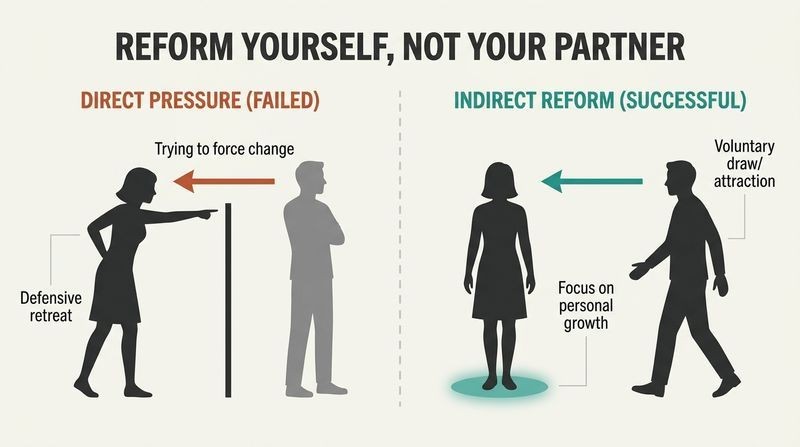
The unilateral premise contains a genuine psychological insight: you can only control your own behavior, and changing one node in a system shifts the whole system. Family systems therapy and Gottman's research both confirm that one partner's softened approach can de-escalate conflict cycles. What is contestable is the causal certainty and the gender asymmetry. Placing the entire repair burden on the wife regardless of a husband's cruelty risks pathologizing legitimate grievance as female failure. Modern therapists would call some testimonials here descriptions of coping with abuse. The durable kernel, that contempt corrodes love and appreciation rebuilds it, survives even when the 1963 packaging does not.
Accepting a man's faults changes him faster than nagging ever could
Acceptance means dropping the renovation project. Andelin opens with advice attributed to Norman Vincent Peale: take a man at face value and do not try to change him. She pictures a husband split down the middle, one half virtues, one half faults, and instructs the wife to turn the dull side out of view and study only the bright side. Pressuring him, she warns, breeds resistance, resentment, and rebellion.
Her cautionary tale is Leo and Sofia Tolstoy: the wife's decades of hysterics and demands to change his ascetic ideals turned adoration into loathing, and he died asking she be kept from his presence. The exceptions Andelin allows are narrow: waking a man blind to career-killing faults, protecting children from abuse, and confronting genuine moral wrongs like infidelity or nonsupport.
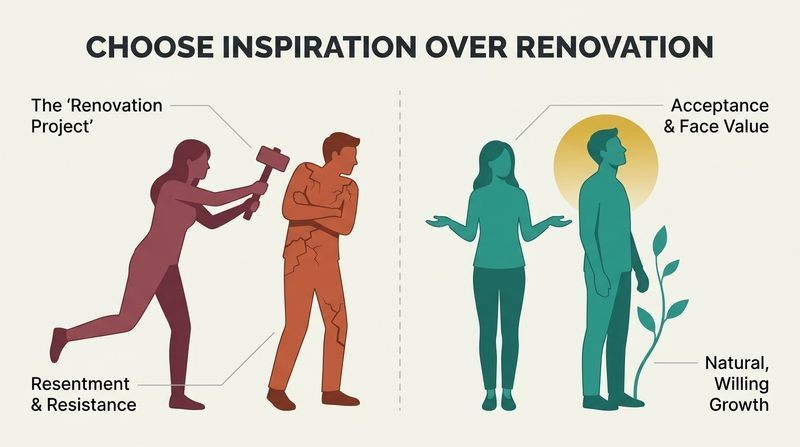
The behavioral logic is sound and echoes self-determination theory: autonomy is a core human need, and perceived control attempts trigger reactance, the impulse to reassert freedom by doing the opposite. Goethe's line, which Andelin quotes, that treating a man as he could be helps him become it, anticipates the Pygmalion effect documented by Rosenthal. Yet acceptance shades dangerously into tolerance of the intolerable. Her own exception list quietly concedes this, carving out abuse and infidelity. The unresolved tension is where healthy acceptance ends and enabling begins, a line the book draws far more permissively than contemporary clinicians would.
Admire his manliness specifically; men hunger for it like bread
Admiration is to a man what love is to a woman. Andelin distinguishes appreciating a man (valuing what he does for you) from admiring him (praising his masculinity: his body, skills, achievements, dreams, and manly character). Generic praise fails. Telling a man he is kind does little; telling him his shoulders are strong or that you respect how he stood his ground stirs him.
She insists admiration must be sincere and specific, built by actually observing and listening to him. Her model is Natasha in War and Peace, who absorbs a man's words with total attention rather than mining them for clever rebuttals. Andelin warns that unmet admiration makes men vulnerable to other women, arguing men stray toward mistresses less for sex than for the esteem their wives withheld.
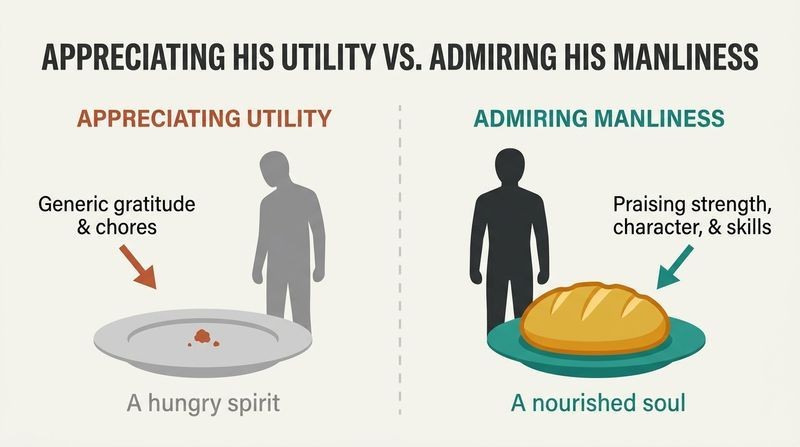
The core claim maps onto research on relational esteem and the Losada or Gottman positivity ratios, where thriving couples pay far more admiration than criticism. Chapman's five love languages later commercialized a similar idea: words of affirmation land differently for different people. Where Andelin overreaches is essentialism, treating admiration-hunger as uniquely male. Studies on relationship maintenance show both sexes wither under contempt and bloom under specific praise. The listening prescription is quietly radical and underrated: attention is a scarce, powerful gift. The claim that admiration inoculates against affairs oversimplifies infidelity's tangled causes, but the emotional neglect it names is a real and common precursor.
Rank your husband above the children, the house, and your career
A man wants to be the kingpin, not background music. Andelin argues that placing children, homemaking, appearance, parents, money, or career ahead of a husband breeds resentment that can poison even his feelings for his own children. She traces the tendency to a girlhood fantasy she illustrates with a nursery poem about a cozy cottage that features children and chores but conspicuously no husband.
Her negative exemplar is Clara, the model mother whose total devotion to her children reduced her husband to a resented appendage and soured his personality. The practical rule: never put children's comforts and whims ahead of a husband's basic needs. She suggests small rituals, like greeting him calmly before letting the kids swarm him, to signal his primacy.
The observation that child-centric marriages can starve the couple bond is well supported. Longitudinal research shows marital satisfaction dips after children arrive, and therapists routinely urge couples to protect the partnership as the family's foundation. Framing it as a zero-sum ranking, though, is the weak move. Attachment science suggests secure children flow from a stable parental alliance, so prioritizing the marriage and nurturing children need not compete. Andelin nearly says this, then insists on hierarchy anyway. A modern reframing, guard the couple relationship as the keel of the family, captures her insight without demanding a mother subordinate her children's needs to a husband's preferences.
Someone must steer the family; Andelin hands the wheel to the husband
She frames the family as a theocracy, not a democracy. Drawing on scripture and an analogy from marriage textbooks (a lock and key, different but equal), Andelin assigns the man three roles: guide, protector, provider. The wife's counterpart roles are wife, mother, homemaker. She argues equality-by-mutual-agreement is unworkable because some decisions cannot wait and deadlocks need a tiebreaker, which she gives to the breadwinner.
The wife's job is to be the perfect follower: honor his position, let go of the reins, trust him, stay adaptable, obey, and present a united front to children, while still asserting herself through feminine advice (leading questions, expressing feelings not verdicts, never appearing to know more than he does). She cites a supposed communal-living study where shared roles bred contention while division of labor bred harmony.
Division of labor genuinely reduces coordination friction, a point from economics dating to Adam Smith, and role clarity does lower conflict. But the leap from someone must decide to the man always decides is assertion, not evidence, and the anthropological claim about hippie communes is anecdotal and unverifiable. Contemporary research complicates the whole edifice: egalitarian marriages report higher satisfaction and stability on average, and shared decision-making correlates with lower divorce risk. The advice technique buried here, influence through questions and feelings rather than commands, is real persuasion science, but its framing as necessary female indirection reflects the era's constraints far more than any timeless law.
Belittling his manhood builds a wall of reserve he hides behind
Masculine pride is the tenderest nerve. Andelin argues a man cannot bear having his manliness ridiculed or ignored, whether his body, skills, achievements, dreams, or provider role. Wounded repeatedly, he constructs what she calls a wall of reserve, retreating into silence to avoid further humiliation. He craves admiration yet fears exposing his hopes to contempt, a bind that only certainty of a warm response can break.
She dramatizes the danger with a wife who, hoping for praise, tells her struggling husband she would be content if he ran a small grocery store, and he snaps that she says exactly the wrong things. To dismantle reserve she prescribes acceptance, admiration, refusing to criticize others (so he trusts you will not criticize him), and holding confidences sacred.
The wall of reserve is a shrewd folk description of emotional withdrawal, and the mechanism Andelin sketches, that people hide vulnerability where they anticipate scorn, aligns with Brene Brown's shame research and with attachment theory's avoidant patterns. The insight that criticizing third parties signals to a partner that they too could be judged is genuinely sharp interpersonal observation. The limitation is the one-directional lens: women also erect protective walls, and men also inflict the wounds. Framing male fragility as a fixed feature to be managed, rather than a pattern both partners can outgrow through mutual safety, locks the dynamic in place rather than healing it.
Femininity, to Andelin, means cultivated dependency, softness, and fearfulness
Charm through contrast. Andelin defines femininity as accentuating every difference from men: in appearance (soft fabrics, no mannish tailoring), manner (light walk, gentle voice, no back-slapping), and above all nature. The feminine nature she prescribes is weak, submissive, dependent, tender, and even fearful, so a man feels stronger by contrast and is moved to protect. Capable, self-sufficient women, she claims, make men feel superfluous and unmanly, killing chivalry.
She illustrates with Amelia from Vanity Fair, whose very softness makes men long to shelter her, and with the counterexample of admired but unromanced professional women who can kill their own snakes. She tempers this with the sweet promise: beneath the frailty, a woman must have hidden strength and courage to meet a real crisis, as widows do.
This is the book's most historically bound and most criticized claim. The relational core, that vulnerability invites closeness and that mutual need bonds people, has real support in interdependence theory. But equating womanhood with performed helplessness collapses under scrutiny: studies of attraction find competence and warmth are widely valued in partners of both sexes, and manufactured dependency correlates with lower autonomy and higher depression risk. The sweet promise exposes an internal contradiction, conceding women possess exactly the strength the rest of the chapter tells them to hide. What reads as timeless in 1963 now reads as a strategy optimized for an economy where women had few alternatives to marriage.
The complete woman fuses Agnes's soul with Dora's sparkle
Two Dickens heroines, one blueprint. Andelin builds her ideal from David Copperfield's two loves. Agnes represents the Angelic side: character, understanding, inner happiness, homemaking, the woman a man reveres. Dora represents the Human side: childlike, playful, enchanting, dependent, the woman a man is fascinated by and longs to protect. David marries Dora and finds fascination without peace, then marries Angelic Agnes and finds peace without spark. Neither alone completes him.
The lesson: a woman must develop both. The Angelic awakens near-worship and calm; the Human awakens tenderness and desire to shelter. Andelin insists these do not conflict and that both are essential to lasting love, adding that literary examples like Deruchette and real figures like Mumtaz of the Taj Mahal embodied the full combination.
Using fiction as evidence is methodologically shaky, since novelists engineer characters to prove whatever thesis a reader brings. Still, the Agnes-Dora split gestures at something research does support: durable attraction blends companionate love (trust, calm, respect) with passionate love (excitement, novelty, desire), and Esther Perel has argued modern couples strain because they demand both security and eroticism from one person. Andelin intuits this decades early. Her error is prescribing the entire blend as a woman's solo assignment rather than a dynamic both partners co-create. The framework also flattens women into a recipe of male-pleasing traits, leaving no room for a wife's own contradictions to be the thing that delights.
Answer mistreatment with saucy childlike anger, never icy resentment
Turn a crisis into a laugh. Andelin's most distinctive tactic is childlike anger: when a man is thoughtless or unfair, respond not with a cutting remark, silent smoldering, or a raging temper, but with the pert, exaggerated indignation of a spoiled little girl. Stamp a foot, use adjectives that flatter his masculinity (you big hairy beast), exaggerate his offense theatrically, maybe pout or threaten never to speak to him again while peeking back to see if he is amused.
The goal is not to reform him but to vent your feelings, preserve your self-dignity, and defuse tension so neither party stockpiles resentment. She distinguishes this from childishness (self-pity, blame, unreasonable demands) and insists it only works once genuine bitterness and hate have been cleared from the character.
Stripped of its infantilizing costume, this is emotional regulation plus humor, and both are validated repairs. Gottman found that successful couples use humor and gentle bids to de-escalate, and that expressing grievance early prevents the resentment that predicts divorce. The instinct to voice hurt rather than swallow it is psychologically healthy. What grates for modern readers is the specific performance: a grown woman staging a toddler's tantrum to make a man feel large. It trades adult standing for tactical charm. One could keep the functional core, name the hurt, keep it light, refuse the silent grudge, without the little-girl choreography that assumes a woman cannot be taken seriously as an equal.
Andelin urges wives out of the workforce and into the home's glory
The home as career, not consolation prize. Andelin coins the Domestic Goddess: a woman who treats homemaking as a world-important calling, masters its arts, manages time and priorities, and radiates warmth so her family reveres her as queen of the household. She argues working outside the home (except in genuine emergencies or to fund a husband's schooling) harms the man (making him feel unneeded), the woman (eroding femininity), the children (neglect), and society.
Her memorable image: the moon, moving from its sphere of night into day, loses its luster. She quotes career women like Taylor Caldwell and Beverly Sills voicing regret, and reframes motherhood as saving souls versus a doctor merely saving lives, insisting the hand that rocks the cradle rules the world.
Written as women were surging into paid work, this is the book's rear-guard stand, and it aged the hardest. Its strongest point is a real critique of consumer culture: chasing luxuries via a second income can cost more in family time than it yields, an argument Juliet Schor later made empirically about the overworked American. Its weakest point is treating homemaking and paid work as mutually exclusive identities, which the majority of families no longer find true or affordable. The dignity Andelin restores to unpaid domestic labor is worth salvaging; feminist economists agree it is undervalued. Her prescription that women exit the workforce to preserve it is a different and far more contested claim.
Analysis
Fascinating Womanhood, first published in 1963 and revised through the early 1990s, is a Christian, framework-driven marriage manual that sold over two million copies by teaching wives to win a husband's total devotion through unilateral self-transformation. Its architecture is a taxonomy of the ideal woman, half Angelic (character, understanding, domesticity, inner happiness) and half Human (feminine appearance, manner, dependent nature, childlikeness), illustrated almost entirely through Victorian fiction and reader testimonials rather than data.
Read charitably, the book anticipates several findings later confirmed by relationship science: that contempt corrodes and admiration rebuilds love (Gottman), that attempts to control a partner trigger reactance (self-determination theory), that vulnerability and mutual need deepen bonds (interdependence theory), and that durable passion blends security with excitement (Perel). Its insistence that you can only change yourself, that specific praise beats generic praise, and that emotional neglect precedes many affairs would not embarrass a modern therapist. Read critically, it is a period document optimized for a world where women had little economic exit from marriage. Its core moves, assigning all repair labor to the wife, defining femininity as performed helplessness, and vesting final authority in the husband, are asserted through scripture, anecdote, and cherry-picked novels rather than evidence, and they collapse against research showing egalitarian marriages are at least as stable and satisfying. The testimonials, some describing what clinicians would now call abuse recast as female failure, are the book's most troubling feature.
The honest verdict is bifurcated. Andelin correctly diagnosed how criticism, entitlement, and emotional withholding kill marriages, and she restored dignity to undervalued domestic labor. But she prescribed a strategy of studied deference and self-diminishment that most contemporary readers will find both ethically and practically untenable. The book is best approached as a fascinating artifact whose behavioral kernels survive its ideology, not as a template.
Review Summary
Fascinating Womanhood by Helen Andelin is a controversial book that has polarized readers. Some praise it as a guide to improving marriages through traditional gender roles, while others criticize it as outdated and manipulative. The book advises women to be submissive, feminine, and focus on pleasing their husbands. Supporters claim it leads to happier marriages, while critics argue it promotes unhealthy dynamics. Many readers found parts insightful but disagreed with others. The book's emphasis on traditional roles and manipulative tactics to influence husbands has sparked heated debate about gender roles in marriage.
People Also Read








FAQ
What's Fascinating Womanhood about?
- Focus on Femininity: The book emphasizes the importance of femininity in a woman's role as a wife and mother, teaching women to embrace their feminine qualities to enhance relationships with men.
- Building Relationships: It provides principles for building a strong, loving marriage by encouraging women to appreciate and admire their husbands, suggesting that a woman's happiness comes from nurturing her family and home.
- Childlike Qualities: Helen B. Andelin advocates for adopting childlike qualities such as trust, joy, and innocence to foster a deeper connection with one's husband, maintaining a playful and loving atmosphere in marriage.
Why should I read Fascinating Womanhood?
- Transformative Insights: The book offers transformative insights into marriage dynamics and femininity, with many women reporting significant relationship improvements after applying its principles.
- Practical Advice: It provides practical advice on cultivating a more feminine demeanor, enhancing a woman's attractiveness to her husband, and includes methods for expressing admiration and appreciation.
- Success Stories: Numerous testimonials from women who have successfully applied the teachings demonstrate the book's effectiveness, inspiring readers to implement the principles in their own lives.
What are the key takeaways of Fascinating Womanhood?
- Embrace Femininity: Emphasizes the importance of embracing femininity in all aspects of life, including appearance and behavior, by dressing in a feminine manner and adopting a gentle demeanor.
- Childlike Attitude: Highlights the value of maintaining a childlike attitude, which includes being trusting, joyful, and playful, to navigate conflicts and enhance relationships.
- Respect and Admiration: Focuses on the need for women to respect and admire their husbands, fostering love and tenderness, and teaching that a woman's attitude can greatly influence her husband's behavior.
What are the best quotes from Fascinating Womanhood and what do they mean?
- "When you cast your bread upon the waters, it comes back buttered." This quote suggests that giving love and support to your husband will return to you as love and appreciation.
- "A man wants a woman of fine character, one he can place on a pedestal and hold in high regard." Highlights the importance of developing character and virtues to inspire admiration and respect from a husband.
- "The hand that rocks the cradle is the hand that rules the world." Underscores the significant impact a mother has on her children and society, reinforcing the importance of a woman's role in the home.
What is the significance of childlikeness in Fascinating Womanhood?
- Childlike Qualities: Refers to qualities such as trust, joy, and innocence that enhance a woman's relationship with her husband, encouraging open and unresentful emotional expression.
- Handling Anger: Teaches that expressing anger in a childlike manner can diffuse tension and foster understanding, using playful exaggeration and gentle expressions of discontent.
- Building Connection: By adopting a childlike attitude, women can create a more playful and loving atmosphere in their marriages, strengthening the bond between partners.
How does Fascinating Womanhood suggest women should ask for things?
- Childlike Requests: Advises women to ask for things in a childlike manner, using trust and respect, and directly expressing desires in a gentle and appreciative way.
- Avoiding Negativity: Encourages avoiding negative or critical tones when making requests, maintaining a positive atmosphere and encouraging favorable responses from husbands.
- Expressing Gratitude: Stresses the importance of expressing gratitude and appreciation for the husband's efforts, reinforcing his desire to fulfill requests and strengthening the relationship.
What are the principles of good health outlined in Fascinating Womanhood?
- Proper Nutrition: Emphasizes the importance of a wholesome diet, suggesting consumption of fresh fruits, vegetables, whole grains, and lean proteins for maintaining health and vitality.
- Regular Exercise: Highlights regular physical activity as crucial for overall health, recommending exercise that raises the heart rate and involves multiple muscle groups.
- Adequate Rest: Stresses the necessity of enough sleep for maintaining energy and a positive outlook, recommending a specific bedtime and avoiding late-night eating for restful sleep.
How does Fascinating Womanhood address the topic of sex in marriage?
- Building the Relationship: Emphasizes that a fulfilling sex life is rooted in a strong marriage relationship, with many couples resolving sexual issues by applying the book's principles.
- Understanding Differences: Acknowledges that women are generally less sex-driven than men, encouraging women to enhance their sexual desire by eliminating resentments and fostering a positive attitude.
- Communication: Stresses the importance of communication in sexual relationships, encouraging women to express needs and desires in a gentle, childlike manner for a fulfilling experience.
What is the role of femininity in a woman's life according to Fascinating Womanhood?
- Central to Identity: Portrays femininity as central to a woman's identity and fulfillment, encouraging women to embrace feminine qualities for enhanced relationships and personal happiness.
- Influence on Relationships: Suggests that a woman's femininity can significantly influence her husband's feelings and behavior, inspiring love, tenderness, and respect in marriages.
- Nurturing Environment: Emphasizes that femininity contributes to creating a nurturing and loving home environment, essential for the well-being of both husband and children.
How can a woman maintain her femininity while working outside the home?
- Balance Responsibilities: Suggests maintaining a balance between job and home responsibilities, prioritizing the role as a wife and mother.
- Feminine Attitude: Encourages retaining a feminine attitude and manner while working, achieved by dressing femininely and interacting gently with others.
- Limit Work Hours: Recommends limiting work hours if possible to ensure enough time and energy for family, preserving femininity and relationship quality.
How does Fascinating Womanhood propose women handle conflicts in marriage?
- Childlike Approach: Encourages handling conflicts with a childlike attitude, using playful and gentle expressions to diffuse tension and foster understanding.
- Respect and Admiration: Stresses the importance of maintaining respect and admiration for the husband, even during conflicts, to foster love and tenderness.
- Positive Communication: Advocates for positive communication, avoiding negative or critical tones, and expressing needs and desires in a gentle manner.
What methods does Fascinating Womanhood suggest for enhancing a woman's attractiveness?
- Feminine Demeanor: Recommends cultivating a more feminine demeanor and manner, enhancing attractiveness to the husband.
- Expressing Admiration: Suggests specific methods for expressing admiration and appreciation, reinforcing the husband's positive feelings and behavior.
- Childlike Qualities: Encourages adopting childlike qualities such as trust, joy, and innocence, which can enhance a woman's appeal and deepen the marital connection.
Download PDF
Download EPUB
.epub digital book format is ideal for reading ebooks on phones, tablets, and e-readers.








































